While writing about ways to hook readers a few weeks ago, I realized that while we’ve mentioned book passes several times on this blog, we’ve never actually written a post dedicated to how to do them. So, here that post is!
Book passes are beautiful in their simplicity. Their purpose is to expose potential readers to a wide variety of books in just a few minutes. All you need are a number of books greater than or equal to your students, their writer’s notebooks, and the power of social capital.

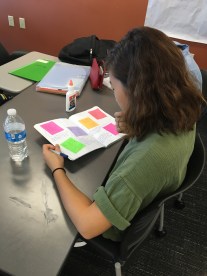
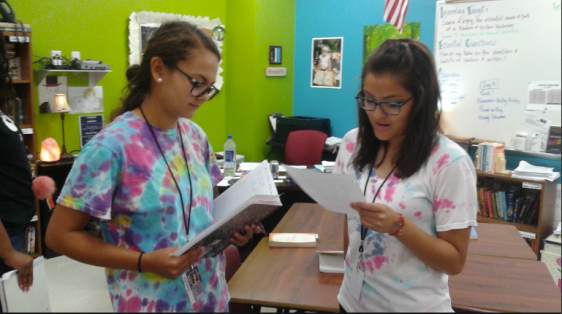
Victoria browses through Peter Johnston’s Choice Words, while Brianna tries to decide between a few choices herself.
When students enter the classroom the day of the book pass, I always have piles of books ready to go on their table groupings. They can’t help but pick them up right away (really, they can’t–sometimes it drives me nuts when they paw through materials we’re not ready to get to, but in this case, I LOVE watching them be drawn to a book), so the book’s contagion begins to spread immediately.
When we begin, I ask students to turn to their TBR pages in their notebooks. “Go ahead and grab a book that’s on the desk in front of you,” I invite, and wham, books are in the hands of readers. “Spend about one minute with this book–look at the front cover, the back cover, the inside flaps, the first page. Decide if you think it might be a good fit for you.” With my preservice teachers of all content areas, I ask them how they might use this book, or excerpts from it, in their future teaching.

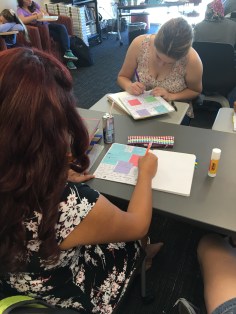
Habbiba gets excited about Will in the World, and nerds out with Alexis.
I set my timer on my phone for 60 seconds as kids flip through pages. Of course, book love is contagious, so some kids share with others what they find–the power of social capital is at work once again here.
When the timer dings, I ask kids to pass their book to the left. “But first,” I remind them, “write down that title on your TBR list if you think it’s something you might want to read.”
Now the students have new books in their hands, made more powerful if they’ve already watched their neighbor write that title down. I love to watch, after multiple passes, when one title gets written down by nearly everyone, and the students who’ve yet to get that book in their hands begin to practically salivate.

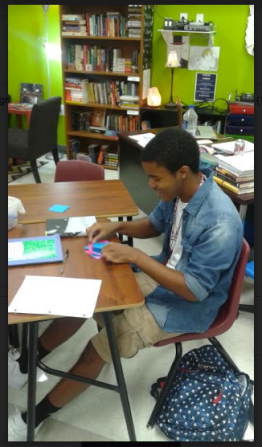
Nick and Ryan thumb through The Double Helix and Moneyball, respectively
The book pass can go on for as many passes as you have time for–enough for every kid to see every title, or just five minutes’ worth, if you prefer. I do this activity multiple times at the beginning of the year, and then again sprinkled throughout the year when I get lots of new books in. It’s a wonderful way to expose students to several titles in a day as an alternative to the traditional booktalk. It’s also a great way to shake up the typical routine in the classroom with a hands-on activity that gets kids excited about books.
I often conduct book passes in this open-ended way–“see if this book is a good fit for you”–but sometimes I do them as a way to expose students to a “new” genre in particular (novels in verse, or graphic novels); a way to introduce the theme of a unit (by finding books all about that theme); or to introduce a reading challenge (read an award winner, or a book of nonfiction). Just passing books around and getting them in the hands of readers does wonders to grow students’ universes of what’s possible when we read.
How might you use a book pass in your classroom? Please share in the comments!

 around them, part of my AP summer work is for students to sign-up for a news story as it breaks or develops over the summer.Students are to read several editorials about the topic and draw their own conclusions as to the impact this story has on a given community (either local, national, or international).As one of their first assignments of the year, they take their research on the topic and present a
  card. We had reviewed the rubric before speeches began, so students could provide positive feedback directly related to their assessment criteria. When all the speakers were finished for the day, we showered our presenters with blessings.Lots of smiles.


 “The feedback we’re going to give today is part of the Bless, Press, Address protocol by the NWP. Blessing the writing means to give specific feedback on what you like about the poem. Pressing the writer means pushing him or her to strengthen their piece in some way. Addressing an issue the writer asks you for help on means giving responsive feedback in order to help the writer achieve his or her goals. Today we’re just going to bless one another, since it’s the first time we’re sharing our writing.”





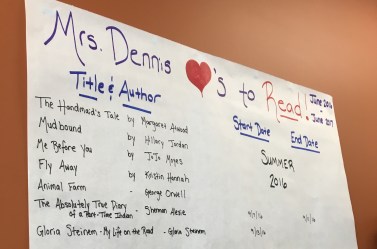
 this morning, my eyes were probably a bit wild too, breath bated, satisfied smile projecting my hope that pens would fly across the pages of our “I want Read” lists. Basically, when I book talk, I feel like the author is standing next to me. “Get them interested, Lisa. Get them thinking. Sell it. Put my book in their hands, and hearts, and minds.”
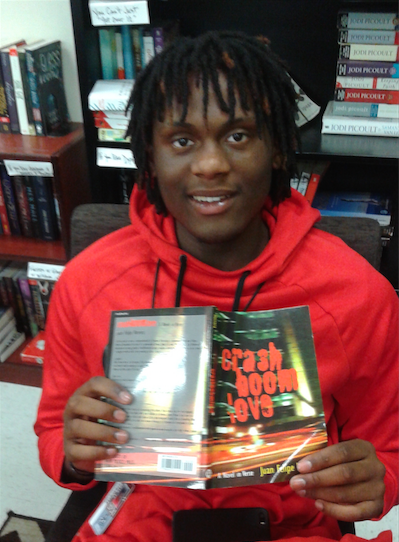
  “Mrs.Dennis,” he said with a coy smile, “you’re super emotional.”
 by Hilary Jordan – This text started my summer reading and while it’s justly won acclaim for it’s themes surrounding racial tension in the south, betrayal, and the secrets that can bury a family, I spoke to my classes about the rich voice Jordan is able to give a wide variety of characters. With a new narrator each chapter, you see this story from all angles and each is more personable and heartbreaking than the next.
 by Margaret Atwood – I finished this book right before summer break and I book talked it then too. It has quickly become one of my favorites as a cautionary tale and an all too real examination of how gradually, but how drastically people can become complacent to the loss of personal freedom. I took students down a “let’s imagine” path by asking them which events in their daily lives they inadvertently take for granted, but would certainly miss if they were denied the privilege. What if it was the right to have your own money that was denied? Or the right to travel? Or learn?
 by Sherman Alexie – This is the first book I read this school year. I took it down in three days and could not stop laughing. I told my students that my connection to this book surprised me, and I think that’s part of the endearing quality of protagonist Junior’s voice. He hooked me with fart jokes. Certainly not my usual forte, but Junior’s search for hope is so real. And as I said to students, we all search for hope in different capacities. Junior searches off the reservation. I search the room during reading time. Just as Shana suggested,
  opportunity/responsibility. With that in mind, showing you are a passionate reader is even more impactful. I feel like my students are getting to know the real me (dork and all). It’s the very best way to start building honest relationships. The kind that build trust, and thereby, community.




 r, I wasn’t confident that they couldn’t have learned more.



 Three Teachers Talk