Category Archives: Classroom Library

Reel Reading for Real Readers: Behind the Beautiful Forevers

20130207-190708This one is still on my TBR list, but just reading this excerpt at NPR has made me think of the many ways I can use Behind the Beautiful Forevers: Life, Death, and Hope in a Mumbai Undercity by Katherine Boo in my English classes this year. Look at the sentence structure, the word, choice, the imagery, the power and beauty of the language. Oh, wow!

Many of my students know next to nothing about life outside of Carrolton, TX–or if they do, it’s the best exits to take for fast food and restroom breaks on their long drives from here to Mexico where they go to visit family. It’s not all their fault. They do not come from families of world travelers. They do not even come from families of readers.

One goal I have this year is to read more world literature myself. If I read it more, I will talk about it more, and I can hopefully get my students reading it more. There are so many wonderful stories, heartwarming and heart-wrenching stories, and I want my students to experience them.

Here’s Katherine Boo explaining her book. I just love her!

“Going There”…and Hopefully Bringing Others Along With Me!

Our Compass Shifts 2-1

I thought for sure my first post would be about my classroom library and books.  My library, which takes up my entire classroom, is my pride and joy.  I’ve worked hard to make it my place of zen (to borrow from Amy).  But it is also my comfort zone; helping students find books they can connect to is one of the few things I know I do well.

In the first two weeks of school, I’ve experienced the familiar joy and success of matching students with books. I’ve connected with students who are devouring books at breakneck speed. I’ve also gladly and eagerly taken on the challenge to find that perfect book for the stubborn “I don’t read” holdouts.  This challenge energizes me like no other!  But I have taken on another challenge, and that is what I want to share about today.

Given I am part of the “Our Compass Shifts” project, you all know that this summer I took a class with Penny Kittle at #UNHLit13. [I will save my fangirl post for another time!] That class totally CML* (Changed My Life). I received affirmation, direction, and practical ideas on how to shift my class to a reading and writing workshop model. But the most important experience from the class was becoming reacquainted with the struggle and vulnerability involved in authentic writing.

Our final project was a non-fiction narrative piece incorporating information or research. I chose to write about my grandfather’s suicide five years ago. I knew it was the story I needed to get out, but as my friends can testify, my writing process was mildly torturous, fraught with resistance, paralysis, and self-doubt. In the end, I “went there” (in the words of Erika, aka “Brooklyn”). I poured much of my own self into the piece, and crying through the read-aloud to my newfound friends and Professional Learning Community took a lot out of me emotionally. It was cathartic, to be sure, and in some ways the beginning of needed processing and healing, but I realized that if I want my students to write the stories they need to get out, I am going to have to commit to “going there” with them all year through writing beside them. I wasn’t sure if I was ready for it!
DaringGreatly_coverRight before school started, I began reading a book called Daring Greatly: How the Courage to be Vulnerable Transforms the Way We Live, Love, Parent and Lead by Brene Brown. [Aside: If you haven’t seen her amazing TED Talk: “The Power of Vulnerability“, you simply must!] Right away, I knew this was a book I needed to read. I started highlighting like crazy, typing out quote after quote.

Brown defines vulnerability as “uncertainty, risk, and emotional exposure” (34). What’s more vulnerable than “going there” in my writing, and then sharing it with others? This summer I learned that I need to model process, not product. That means tons of vulnerability before my students.

My first opportunity came the fifth day of school, as we were writing in response to the poem “Days” by Billy Collins. I chose a particularly happy day from my junior year of high school. As I talked through my own writing process, I showed my students that as I wrote, I remembered more details. My goal was to show my students how you can start out writing one thing, but find kernels of other stories during the process of revision. Through the process of rereading, I noticed a particular detail was much more significant than I had thought initially. In fact it was ominous foreshadowing of the tragic loss of my dearest friend to suicide a year later. But as I explained this, I ended up choking up and crying in not just one, but all five of my classes that day.

Initially I felt embarrassed and really…vulnerable.  I was most definitely emotionally exposed before 150+ young people I had basically just met.  People I had been entrusted with the responsibility of teaching this year.

But later that day I came across a particularly timely gem in Daring Greatly.  Brene Brown’s vulnerability prayer is “Give me the courage to show up and let myself be seen” (42).  I was able to push out the feeling of embarrassment and worry that my students perceived my display of emotion as weakness, and instead recognize it took courage to let myself be seen by them that day.  I didn’t only model for them my writing process, but I took the risk to be the first one to “go there,” and modeled placing trust in the safe space of the community we were beginning to build together.

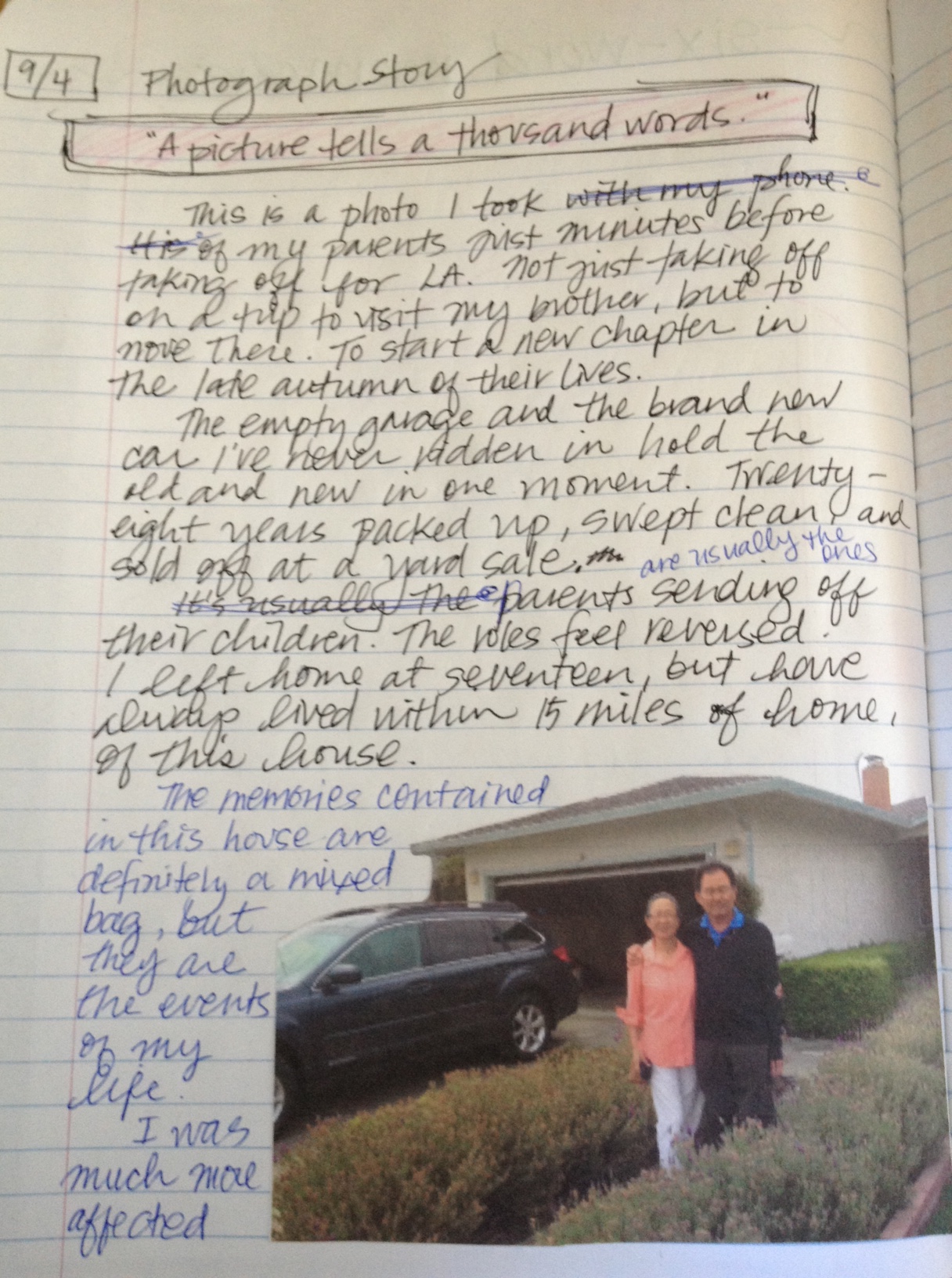
photo-1Taking that first step has made it easier for me to continue writing authentically with my students. This summer, I circled around the topic of my parents moving away, the difficulty of my relationship with my father, and the “grief” of saying goodbye to my childhood home. I wasn’t ready to write about it then, but I began to today. I’ve experienced personally how courage begets courage, increasing connection and building community. Accepting the challenge to write through my vulnerability, rather than resist it, has signaled to my students that it is safe for them to go there as well. And though I haven’t won over everyone yet, there are definitely some who are beginning to take the risks to tell the stories that matter to them.  The stories only they can tell.

*You will get used to some of my go-to initialisms! 

Reel Reading for Real Readers: Pride and Prejudice

20130207-190708.jpgSome of my colleagues might think I am anti-classics, but this is assuredly not so. I just hate how we commit what Kelly Gallagher calls Readicide by reading them to death in English classes. Pride and Prejudice by Jane Austen is my all time favorite:  book and movie. The characters speak to me, and I’d know them on the street; I’ve read of them so many times. I even fantasize about living in turn of the century rural England. Well, maybe not fantasize, but I would like to travel to the English countryside someday.

Official Movie Trailer:  Pride and Prejudice

I want students to read this book. I do not want them to hate it. Therefore, I will talk it up. Quote some characters, show them this movie trailer, and offer a bribe or two if I have to: “I’ll bake you tiny cakes and bring you tea.” Whatever.

“My good opinion once lost is lost forever.” — Darcy, Pride and Prejudice

Do you remember that scene in You Got Mail? Meg Ryan’s character has praised Elizabeth Bennett and in subtle ways thrown down the challenge to Tom Hank’s character to read the book. He tries. For her. It’s the sweetest thing ever.

My daughters and I love all things Jane Austen. When the movie Becoming Jane came out, we were on a girls’ trip in Florida where the drivers love their horns, and we shook hands with a young man named Mr. Stubbs who was missing half a finger. The four of us walked into the movie theater, and we waltzed out humming the score and discussing literature. This mother’s perfect evening, surrounded by loving daughters who talk about books.

I’m all about building relationships with my students. By sharing my love of Pride and Prejudice with them– and why I love it, they will see a glimpse into me. The me outside the English class. The me who loves being a mom. Who goes to the movies. Who takes her girls to Florida on vacation. Who finds irony in people’s names.

If my students know me, I have a better chance of knowing them. Books and literature are so much more than reading material.

So, let’s play a bit here. What’s your favorite CLASSIC text, and why?

Reel Reading for Real Readers: Columbine by Dave Cullen

20130207-190708By far the best book I read this summer was Columbine by Dave Cullen. As part of my class at #UNHLit13, I chose to read this book and study it for craft with three other teachers. Maybe that’s why it’s my favorite.

I’ve been in book clubs before, and I’ve had my students conducting literature circles for a long while now, but I’ve never experienced the power of studying a book like this one.  Maybe it was the subject matter. Maybe it was the amazing group of professionals who were invested in the process as much as I was. Whatever it was, Dave Cullen has crafted a masterful piece that moved me.

I want my students to experience this kind of emotion when they read a book. I also want them to see the art in crafting language. (I’ll use excerpts in mini-lessons throughout the year.)

These are the first clips I will show my students this year, and I guarantee my copy of Columbine will land in a student’s hand, and the waiting list will start out long. I better prep the school library to get their copy ready, too.

OMG! Do You Think You Have Enough Books?

photo-1Last August, as I started in my new role of instructional coach for my district, people often said that I would go through a grieving process as I left behind what I once knew to embrace the unknown. Throughout the year, many have asked if I have missed the classroom, and of course, to some degree the answer is always yes, but there is one specific thing that I miss the most… MY BOOKS!

Walk into my room and more likely you would have asked me, “Jeez, Heather, do you think you have enough books?” Of course, my answer was always, “Uh, NO! How would that ever be possible?” No doubt, the best part about my classroom was my extensive library. If I spent a day and counted, I’d probably total close to 1,500 or more books, all cramped on shelves, waiting to spring into the hands of an unsuspecting reader.

Kids need easy access to books, just like they need easy access to their cell phones. The library can be too intimidating; the book stores are too far away, and often the shelves in their homes are void of books. As the teacher, if I wanted to send the message that books are important, there is no better way than to fill my room with books – good books, colorful books, books that students want to read.

Where I Find Books
* scooped up from a retiring teacher (Why won’t more teachers take early retirement?)
* freebies at conferences (Yes, I lurk in the corners of exhibit halls, executing a flawless freeloader innocence. Note to self: ask Amy to write about her stealing from a vendor experience.)
* purchased at the Scholastic Book Warehouse clearance event (Watch the calendar and pay attention to the Scholastic website)
* given to me by a students – (Please, no more Starbuck’s giftcards and scented candles… I NEED BOOKS!)
* Half Price Books (If near a warehouse, the free give-a-way for teachers is worth it. Otherwise watch for coupons. I just used a $15 off of $50 purchase that meant 21 new books.)

Why I’ll Never Have Enough Books
It’s more effective to walk over to the shelf and hand a student a book than it is to tell her to go to the library or to the bookstore and get it herself. Ever had this happen: a friend tells you about a book, and you think “Oh, I want to read that.” Unless you write it down or make a stop at the bookstore on the way home, you’re not likely to get that title any time soon. Magnify that by 20, and you’ve got what happens with a student. Most often you have to put the book in the child’s hand. Is she guaranteed to read it? No, but I increase the chances exponentially when I grab a book, chat about it, and hand it to a student. And with some students I place one book and another and another, until the student finds the one she wants to read. That’s why my shelves scream with diversity.

In my classroom, I arranged my bookshelves by genre because students may not know what they like to read, but they know what they like. A girl may not know she likes Sarah Dessen novels, but she knows she likes romance. A boy fascinated by the Civil War may search my shelf of war-themed books and discover the writing of James L. Swanson. By placing the books by genre I am able to create a type of comfort zone where my students feel free to explore. Just like no two students are alike, no two readers are alike. The more books on my shelves, the more opportunities I have to get students to read.

How I Kept Track of My Books
I didn’t. I literally have a love relationship with my books. My students know of my affinity, and they quickly understand that the books on my shelves are my personal friends. Friends that will break my heart if I lose the connection. Many a time when a student lost one of my books, he’s replaced it because he knows I care about each of my books. The real deal though– if a book doesn’t make it home to my shelf, I’m okay with it. Maybe it’s altruistic, but I hope she’s happily getting read somewhere by someone. As teachers and librarians we must remember that we cannot be the keeper of the books and the stories they hold (even if they do end up at Half Price Books with your name clearly stamped on them.)

Last May, at the end of the year I carefully selected my most treasured friends, but then I, like someone had once done with me, passed them on to another teacher to share the love of reading with her students. I can only hope her students have found as much pleasure in them as mine once did.

How do you build your classroom library? How do you prevent your books from never returning? (or do you?)

Building a Community of Readers by Sharing Our Own Struggles

booksAt least once a week, if not more, I see some news piece or article about how students these days are spending less time reading. Taking a minute to reflect upon my own reading life, I thought back to how I encouraged a community of reading in my classroom.

Over the course of a school year my students read a lot. Each year when we would count it up, we found that my eighth graders had read between 50-60 books each over the course of the school year.That’s 60 students reading about 60 books. That’s 1200 books. See? A lot! In my classroom, reading is contagious. Walk in the door, and you breathe in the reading bug. If you aren’t reading, you are separating yourself from something important. Reading takes precedence. By making reading a priority, and emphasizing that reading takes us places we’ll never get to, I am able to get even reluctant students to crack a book and creep into the pages. My struggling readers quickly learn that it is not about quantity or speed, but more about the fact that they are reading. Reading opens doors that the world slams shut.

No doubt, the biggest “Why read?” selling point to get my kids reading is my honesty. I openly tell them that when I was in sixth grade I hated to read. I hated to read! In fact, I hated to read so much that I only read one book all year. My students ooh and aah at that: “One book?” they question. Then I go on to tell them that I had a required book report due every six weeks, which meant read one book every six weeks. As you may guess, this discussion quickly turns into a math lesson with students questioning how I could have possibly passed sixth grade reading only one book. Every year I somehow skillfully turn the conversation back to reading. I let them question me: What about now? Do you like to read now? Do you only read because you have to? And my answer: What do you think?

It’s true that kids don’t care what you know until they know how much you care. Establishing rapport at the first of the year requires immediate, daily and purposeful attention, and honesty with students lends well to the building of it. I know it’s my honesty that makes it okay for my students to struggle with reading. We use my experiences, and make connections with their own, to talk about why reading is important and how we can grow as a room of readers. I flood the room with books. I talk about titles that painted pictures in my head. I read while my students are reading. My kids quickly see me as a reader.

Frequently, students want to know what turned me into a reader, like there’s some magic pill that changed my hate to love. They question me when I boast that I read forty-six books over summer vacation or 150 books total for the year. I model being a proud reader, and sometimes this leads to precious moments where my students and I have tender discussions about reading, and I am able to share my reading transformation story. Often students think that because I am their reading teacher I was born with a love of reading, and that it has always been easy for me. Once I dispel this myth, and they find out that I struggled for the better part of my life with reading, students are able to see me as a peer with a similar struggle, and if I work on the rapport right, they begin to envision themselves as readers. Isn’t that the key? If kids can see themselves as readers, maybe even if that seeing requires a high-powered magnifying glass, we can get pages to turn in their hands and characters to come to life. It only takes one book, and that’s a blog for another day.

In the mean time, what made you a reader?

Reel Reading: How about these book trailers?

20130207-190708It’s been a long time coming, but my students have finally produced some pretty good book trailers. I began showing trailers as a way to introduce books and encourage reading at the beginning of the year. Every Friday was silent reading day, and every Friday I chatted with kids about books they’d finished. We wrote on sticky notes and made a “recommendations” wall. We stood up and “testified” to the truth in books and how they touched our souls. No doubt, since I promoted reading more during class time this year, I created more readers.

Evidence? STAAR EOC scores are in. Almost every student who passed their reading test has been vocal in our classroom conversations about books this year. (One kiddo surprised me and scored satisfactorily–his average is a 26, but he passed the reading test. Go figure.)

I know. I know. Test scores are not everything. But… my readers certainly scored better than my non-readers.

On my classroom wall, I have my own six word memoir:  “Reading makes you smarter. Try it.” Those who did have done better than those who have not.

2 reading smarter

Our book trailer project is the culmination of our reading efforts this year. I wish we would have more time to polish them up, make sure we cited image sources, spelled words correctly and all that, but exams are next week, and bell schedules are crazy with awards assemblies, etc. Our time is gone.

Here’s a sampling of the most interesting of my student-made book trailers. Although not perfect, remember, these are 9th graders in an on-level English I class, Title I school. I’m a little proud.

Crackback by John Coy, created by Brandon. He used photos from our own football team.

Brandon Crackback

Unwind by Neal Shusterman, created by Heidi. Look at her hook!

Heidi –Unwind

A Child Called “It” by Dave Pelzer, created by Biridiana. She learned the medium on her own and came up with this!

Child Called It- Biri

The Lifeguard by Deborah Blumenthal, created by Kristen. Okay, so the trailer’s not great, but the video of the girl is Kristen herself. Cool.

The Lifeguard- Kristen

See You at Harry’s by Jo Knowles, created by Brenda. The use of quotes from the book creates the book’s selling points.

See You at Harry’s- Brenda

Reaction by Lesley Choyce, created by Ashley. Other than her characterization using Juno… <smile>

Reaction by Ashley

My Friend Dahmer by Derf Backderf, created by Jonathan. This one got traction when we showed it to the class. Wish it had more umph at the end.

Dahmer- Jonathan

I’d love to hear your ideas of using book trailers to create readers– or anything else you can teach me about books, kids, and reading!

Reel Reading for Real Readers: Summer YA Book Trailers

20130207-190708Pinterest, I love thee!

I didn’t think I would, but when my daughter told me that people were refurbishing and painting “old and ugly furniture like you have in the house, and you can learn how to do it on Pinterest,” I took a peek.

Yeah, ideas galore. (I even took my daughter’s advice, and who knew I could paint such beautiful furniture?)

But, here’s the thing:  There are boards for almost Everything. Even Summer Reading ideas for YA.

Oh, yes, please!

So, #ReelReading will take a break until school starts up next fall, and in the mean time– go check out this awesome board. I’m sharing it with my students next week.

Pinterest

Reel Reading: A Child Called ‘It’

20130207-190708.jpgI’d love to get my students to do some of this cool typography. Since they will be making their book trailers this week, I wanted to show them this option for their creations.

I’ve had great success getting even the most reluctant readers to read A Child Called ‘It’ by Dave Pelzer.

See? Isn’t all that letter and word movement cool?

If students like the topic of abuse (which I don’t quite understand), they might also like Ellen Foster by Kaye Gibbons. I haven’t seen the movie, but this trailer looks like it’s pretty well done.

Maybe next time I’ll look for happy topics.

Sheesh, Amy. This is depressing stuff.

Reel Reading: ROOM. Oh, my sweet Jack!

20130207-190708Few books hit me in the gut and make me weep, but ROOM by Emma Donoghue did just that. Told from the point of view of just just turned 5-year old Jack, this story of abuse, survival, and enduring love packs a punch that leaves you gasping.

Soon after I read ROOM, I heard the real life story of Jaycee Dugard and hurried to the book store to buy the book that shares her story, A Stolen Life.  Oh, my! Terrifying, horrifying, and. . . hopeful.

A Stolen Life

I have students, mostly my reluctant readers, who devour the book A Child Called ‘It‘. These kids often enjoy (or at least have a love/hate relationship) with  these other titles, too.

What is it within us that makes us want to learn of others’ suffering so?