Category Archives: Classroom Library

Reel Reading for Real Readers: The Collector by Victoria Scott

20130207-190708I’m really not sure what to make of this, but I think my female students are going to clamor for this book.

I got an email from my school librarians inviting me to bring my students to a panel discussion with YA authors who would be visiting the CFBISD Literacy Night. Of course, I said yes. I didn’t even care who the authors were. I did ask for a list of names though, and then I searched for their books.

This is the first cover I saw:  Can you hear the girls whispering?

Then I did a search for a book trailer and came upon this great site called the “Teen Fiction Fiend.” Although the book was released last April, it will be brand new to my students–my copy arrived from Amazon last weekend, and the clever reveal here will have my girls who loved Perfect Chemistry falling all over one another as they clamor for the check out clipboard.

See for yourself:  Alice Marvel’s for theTeen Fiction Fiend

From the back cover:  “Dante is the kind of guy I wish I’d met when I was seventeen. And the kind of guy I’d kill if my daughter brought him home.” ~Mary Lindsey, author of Shattered Souls

Oh, brother… to be young again. *scurrying off to read (this book)*

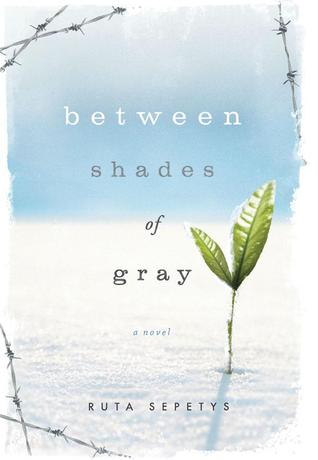
Reel Reading for Real Readers: Between Shades of Gray

20130207-190708.jpgI’ve wanted to read this book for some time now, but it wasn’t until I was searching the shelves at my  favorite Salvation Army that I got my hands on it. (That’s a post for another day:  Building a Killer Classroom Library by Hanging out at Charity Shops) I have a students who is passionately interested in WWII literature. He’s already read two books a

bout it this grading period. I will put Between Shades of Gray in his hands as soon as I am finished with it.

I’m doing a good job this year of talking about a lot of books. Of my 140 students, I’m down to just threefake readers. Many students are reading slowly, but they are reading. I’ve decided I need to do a bit more than just talk about books. I need to step up my use of videos and book trailers to get them interested. The only problem? Every time I use visual images like this, I have more than one student who wants the book. I want to believe that this is a good problem, but it’s pretty sad when not everyone gets a copy of a book when they are excited about it.

Here’s a clip of Ruta Sepetys talking about the story behind the story.  I just know I’m going to need more than one copy.

Gifted and Talented Teacher Leaps off Cliff of Faith and Experimentation

Guest post by Tess Mueggenborg

Make no mistake about it: I’m a classical canon gal.  Always have been, always will be.  And when I say “classical,” I also mean “really old” – few things written after 1650 hold much interest for me.  Favorite work of literature? Milton’s Paradise Lost.  Favorite time period of literature? Early Roman Empire (Ovid & Virgil).  Favorite English Lit class from my undergrad days? Greek Tragedy.

But as much as I love the canon – and I’ve had surprising success with teaching the canon in the past – I’m also a pragmatist.  I know that what I love isn’t always what’s best for my students, and their learning should take priority over my passions (I know … radical idea, right?).  I also acknowledge that the real world in which I live and work is far from my ideal.  Would I like to devote all of my class time to discussing Beowulf and Canterbury Tales?  Of course.  But can I realistically get my students to read and engage with these texts, and develop a passion for them?  Not likely.  Some, of course, will – and I’m happy to guide them on their own paths of classical literature studies.  But I bet (I hope) that those students will wind up as English Majors, and they’ll get their fill of such works in college.  I must work with the students I have, not the students I wish I had.  And the students I have are awesome: bright, curious, hungry for meaningful learning and wisdom.  So this classical pragmatist has started to break her own mold.  Here’s how …

I teach a class known as World Experience; it’s for Gifted and Talented sophomore students, and it combines AP World History with literature.  The history drives the course – it sets the pace, scope, and sequence for the year.  It’s then pretty easy to match up literature with the corresponding time periods.  leap off cliffAncient River Valley civilizations at the start of the year? We read Gilgamesh and Horus the Hawk.  Classical civilizations come next – that mean Antigone and a few selections from Metamorphoses.  Next up is the Medieval period … and this has always been a struggle.  I love Medieval lit, I can read Middle English, and I can wax poetic on the virtues and merits of The Song of Roland and Sir Gawain and the Green Night ad nauseum.  And while the students usually enjoy these stories, they don’t usually get much out of this unit in terms of literature.  They don’t learn much about author’s craft, they can’t do much literary analysis, and they become so frustrated with the archaic language of the text that most of them give up … and it takes me another six weeks to pull them back into literature.  So this year, I’ve scrapped all this, and leapt off a cliff of faith and experimentation.  The results have been pleasantly surprising.

Our district head of English Language Arts was kind enough to buy $600 of books for my classroom library.  I got to choose every one of them: all award-winners (or by award-winning authors), all world literature, all contemporary, all high-level.  No softballs in this classroom library – these are, after all, GT students.  Each student got to pick a book (this was a time-consuming and sometimes contentious process, but it certainly got every student interested in the books and invested in their choice).  Once a week, they’ve been blogging about their novel, based on someone generic questions posed by me.  Some of the questions are just opinion (Do you like this book so far? Why or why not?); some of the questions are analytical (Who is the main protagonist of your novel? What problems do they encounter in the course of the novel? How do you predict they will resolve these problems … or not?); some relate back to the history half of the course (In what ways does your novel relate to the history we’ve studied so far this year?).  Some responses have been good.  Some have been profound, moving, passionate, and elegant.  None have been outright bad, and none have been missing.  That’s right: NONE have been missing.  Every student has been reading and blogging.  Even the student who earned a grade of 9 (yes, a single-digit 9) for the first 9-weeks is reading and blogging about her novel.  I’m calling this experiment a success.

To be fair, I should say: this hasn’t been easy, and it hasn’t been without challenges.  But they’re good challenges, and not insurmountable.  Some students read their novels in a week – and then wanted to borrow another book.  YES!  Many students didn’t devote enough time to reading their novel, and they’ve fallen behind.  But they haven’t given up: they’re still reading.  I haven’t had any complaints of “this book is boring,” though I’ve had many complaints of “this book is so sad/depressing/pessimistic/disheartening.”  Which has led to some great discussions about the point of literature, analysis of tone, and some hefty doses of maturation (I’m pretty sure the girl who read The Kite Runner in a weekend has been inwardly weeping for two weeks now).

We’re wrapping up this unit, and thus this great experiment.  And I think it bears repeating: I’m calling this experiment a success.  Enough of a success that I’ll be spending this weekend revamping the next unit (which starts Monday) to include more student choice and incorporate more of these novels, though in a slightly different fashion.  Stay tuned.

Am I still a classical canon gal? Heck yes. Always have been, always will be.  But my students don’t need to be classical canon fans – they just need to be readers, eager to engage with the world and its complexities.  I think they’re well on their way.

“Professor” Tess Mueggenborg teaches English (and anything else with which her students need help) at RL Turner High School.  Her academic passions lie in comparative language and literature.  The Professor lives in Dallas with her husband, Jeff. Tess’ on Twitter @profmueggenborg

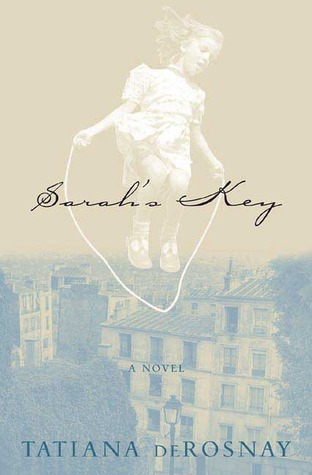
Reel Readers for Real Reading: Sarah’s Key

ReelReading2When my friend Tess got all her world literature novels, one of the hot student favorites proved to be Sarah’s Key by Tatiana de Rosnay. Tess called my room to see if I had another copy. Sadly, I did not– then.

I remembered how much I loved the movie, and while I know that books and movies are often very different, I could see why students were clamoring for this book.

My copy of Sarah’s Key should be here by the time this post runs. I’m sure when I show the movie trailer I’ll have a waiting list of students eager to read it. I already have one young man and another young woman who are passionate about Holocaust literature. My collection of this genre grows year after year because I love it, too. So many tragic yet heartwarming stories that teach and remind us to love.

For the past several years I’ve taken students to the Holocaust Museum in Dallas. We’ve listened to survivors speak to us on several occasions. Sadly, they are all getting so old. In a very few years, these great warriors of a terrible time will be gone. It will only be through great literature that we keep their stories alive.

When a Student Tells You What to Teach: Sweet

I mentioned before that I gave a Pulitzer Prize winning novel to one of my AP English students recently. He gave it back to me three days later.

“Did you read it?” I asked.

“Well, I tried,” he said. “There’s just too much description. I couldn’t get into it.”

“What do you mean?” I asked.

“I don’t know exactly, but it’s the kind of book you should pull passages out of and teach with,” he said.

Okay, then.

I still haven’t read the novel Tinkers by Paul Harding, but I did take a look to see what Levi meant. (He’s a bright young man–taking both AP Lit and Lang his junior year.)

Just read the first page. You’ll see what I did.

Yes, I can teach some skills with this. It’s beautiful, and now I’m reading it– on the lookout for mentor slices that engage and inspire great reading and writing.

Screen Shot 2013-11-03 at 10.02.26 AM

Unsolved Mysteries and The Serenity Zone

ocs

We made it! We’ve come to the end of October, one of the longest (feeling) months of the school year. And I’ll tell you, I need to do some celebrating of the good stuff, because October was a doozy, especially with my sophomores.  We made it through All Quiet on the Western Front, which I personally find to be a beautifully written, truly evocative war novel.  My sophomores, however, had a hard time getting into the book, and many of them never really did.  I struggled with feeling like a hypocrite, because here I was emphasizing choice and pushing my students to (re)discover the pleasure of reading, and I had effectively halted the train we just got moving.  Some of my students had read more in the first month of school than they had in years, and I felt guilty about derailing the progress they had made.

The compromise I came up with was that we would go read the book as fast as possible, slow down for close readings in particularly meaningful passages, and I would book talk war books every day.  Still the students withered during the past two weeks, their GoodReads updates full of longing for their “real books.”  When we finished the book yesterday, some students tried to turn them in to me on the way out of class.  They were horrified when I told them we weren’t done with the novel yet.

Needless to say I haven’t figured out how to strike the balance between the independent reading and whole-class texts.  Our department has determined a certain of novels to be “core texts” that every teacher will teach.  I agree that the novels on the lists are amazing works of literature.  But I know that many of my students have not been sold on reading to begin with, so it’s laughable to think that somehow I’m going to get them to be engaged with books that were written on average of over 125 years ago (thanks to Shakespeare at every grade level).  One student protested, “My mom read these exact same books when she went here.”

As I write this post, I have no answers. I know what is in my heart of hearts.  And, by the way, my students can tell too.  One girl asked suspiciously but tentatively, “Um…Ms. Kim, did you choose this book for us to read?”  I was diplomatic in my response, using the Socratic method to ask a question of her.  But the fact remains that come Monday, I need to have some essay options for my students.  That is a whole ‘nother beast, since trying to engage my sophomores in their writing is even more challenging for me.

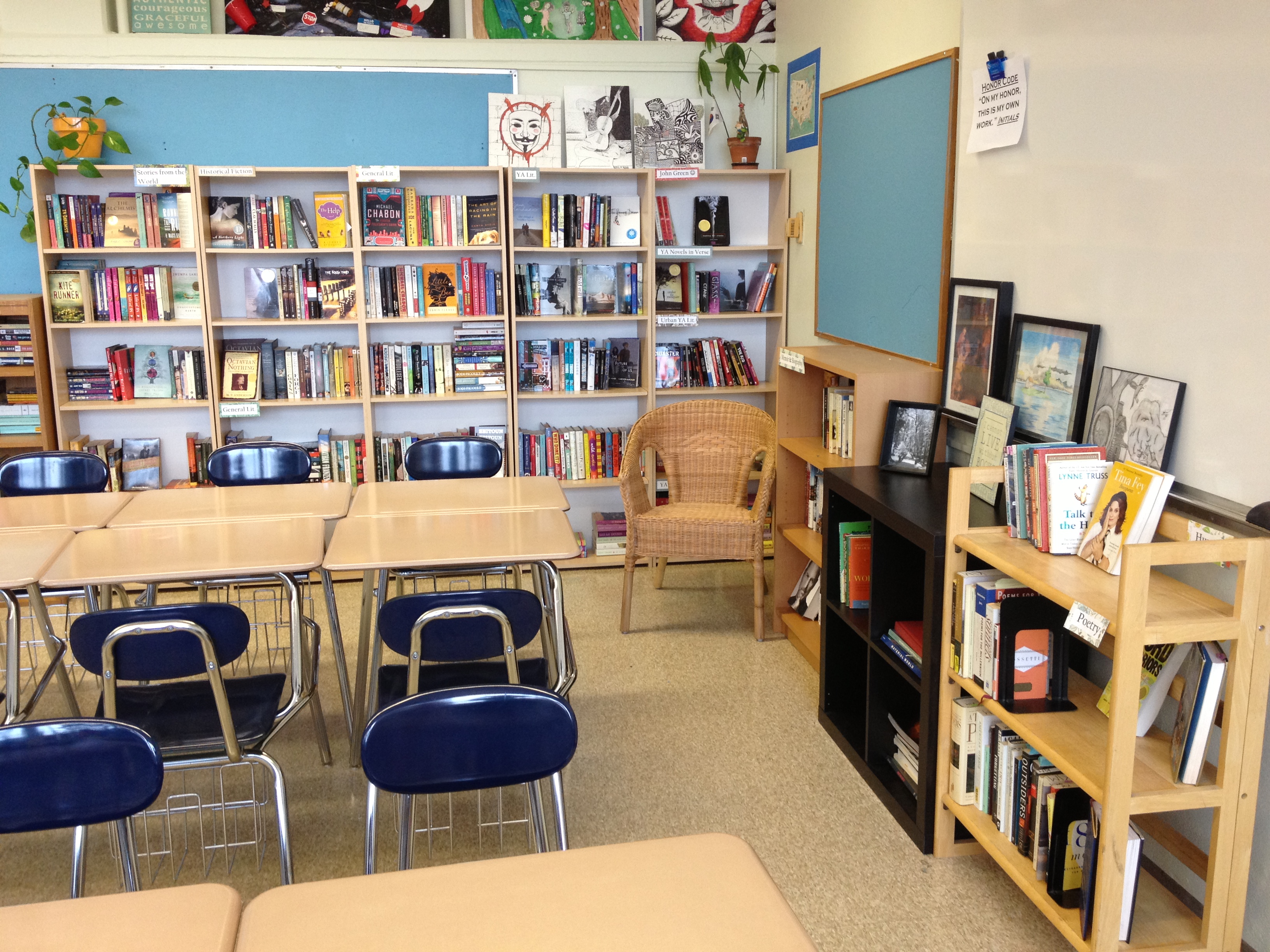
So rather than try to present some amazing answers to this question (since I have none), I am going to show off some pictures of my happy place – aka The Serenity Zone.  How’s that for a completely abrupt subject change?

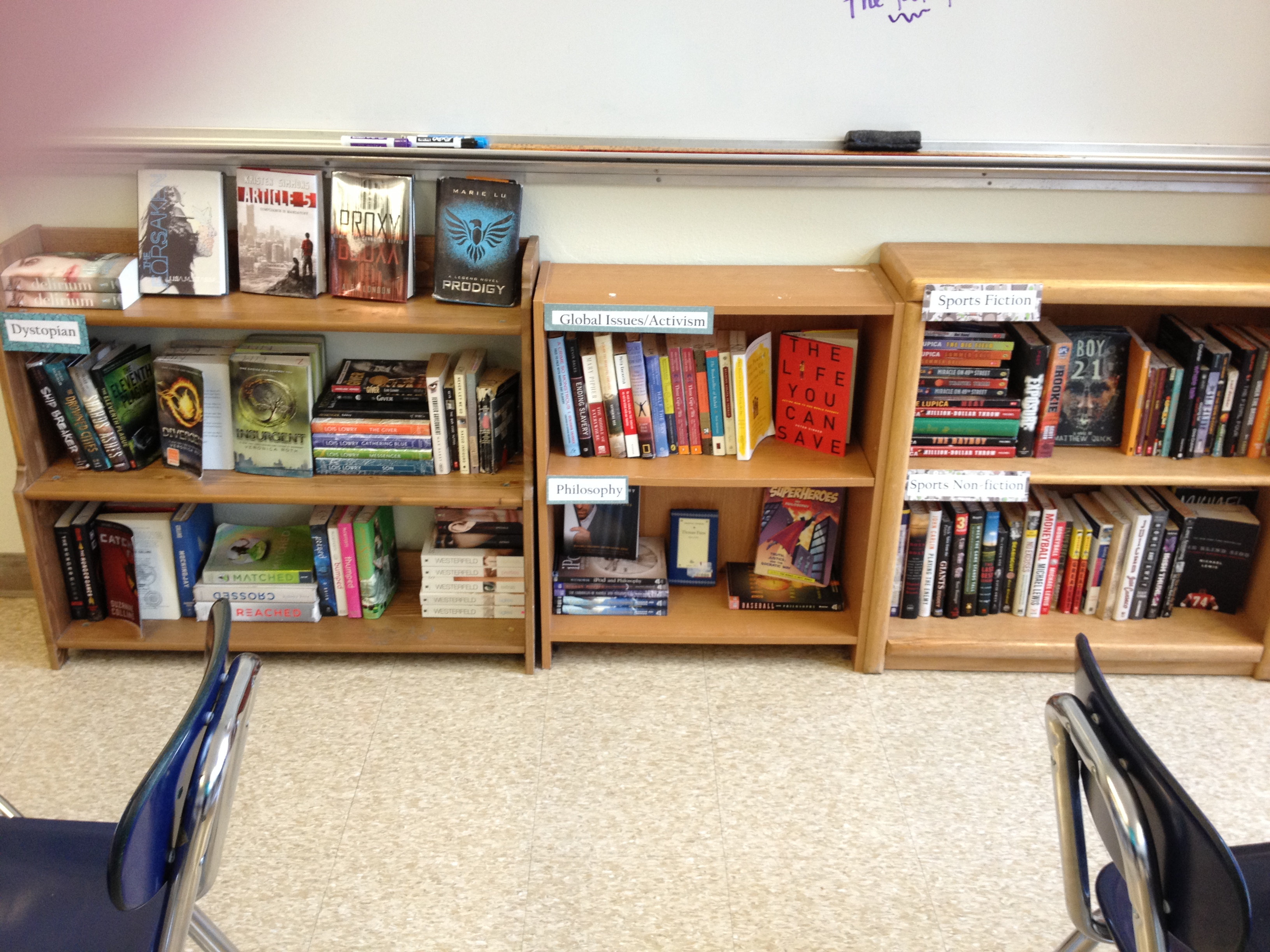
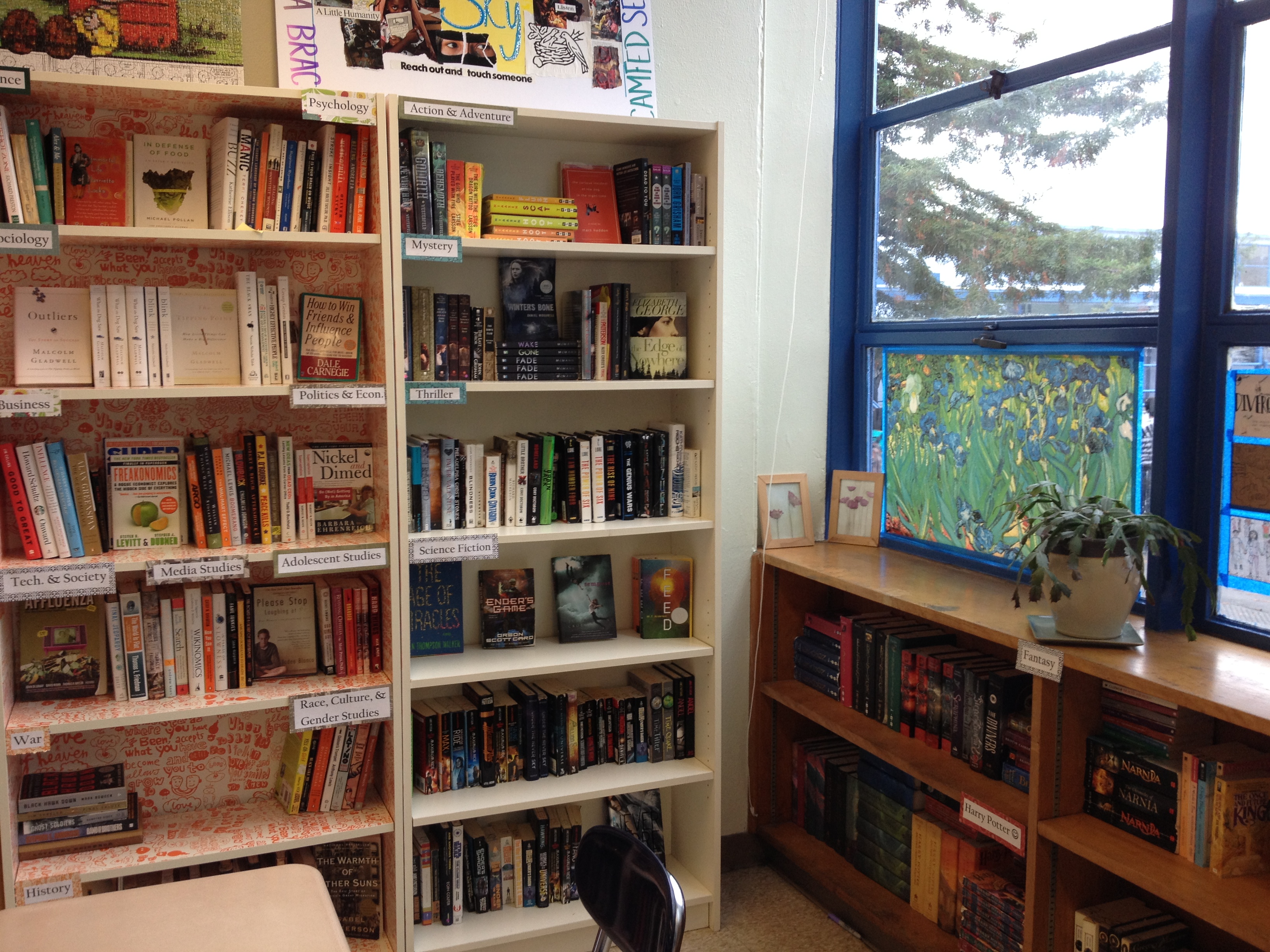
I don’t brag often, but I am definitely proud of my classroom space, and especially my library.  I have worked hard to make it a space that I want to be in, and a place where I can experience serenity (my version of Amy’s “zen”).  That means tons of (organized) books, thriving plants, natural light (no fluorescents!), and good music.  I know a lot of colleagues who lock their rooms for lunch and escape for needed time away from the “crazy kids,” but I actually love the fact that I have a space students want to come and have their lunch, read their books (during lunch?!), catch up on homework, and chat with friends.  It’s the little things, but it tickles me when former students, or students I don’t even know, come and ask if they can look at the books and even borrow one.  Don’t even get me started on how books have forged community and relationships and trust with students – that’s for a whole other post!  To leave you, here are some pictures of my serenity zone.  (I wish you could hear some of my music – one student looked up from her book while rocking in the rocking chair declaring my room her “chill zone.” That’s props you can’t buy!)  Next time I’ll include pictorial proof of students in my room. 🙂

*Thanks for reading this all-over-the-place post!

half of my library

half of my library

'twas unwise to have the dystopians and sports sections in such small shelves...

’twas unwise to have the dystopians and sports sections in such small shelves…

we need a better "book wait list" system. (notice my nerdfighter posters? DFTBA, y'all!)

we need a better “book wait list” system. (notice my nerdfighter posters? DFTBA, y’all!)

the ever-growing list of books i've book talked this year!

the ever-growing list of books i’ve book talked this year!

who would have thought i'd run out of shelf space?!

who would have thought i’d run out of shelf space?!

Reel Reading for Real Readers: Stephen King Fest

ReelReading2I am not much of a horror reader, but I am a Stephen King fan. I remember the first of his books I read was It, but I don’t think I finished it. Too chicken. I also read The Long Walk, which I thought was an okay read until the end, and I thought it was stupid–probably because it made me mad.

My favorite King book is Misery, maybe because it’s more realistic than some of the others. Annie Wilks is a truly frightening character. (Now that I am a Criminal Minds re-run junkie, Annie scares me even more.)

Since I am trying to get many of my student readers to reach beyond YA fiction, I’m thinking a few Stephen King book talks with a few book trailers might be just the thing for Halloween.

The movie for Misery was almost as creepy as the book.

And, of course, the new movie version of Carrie is in theaters now.

Part II. In an AP Class, Shouldn’t It Be about the Reading?

Angels sang to me again today. This doesn’t really happen too often, but when it comes to awesome adventures with students and books, the choir starts belting out in fff.

Based on the feedback to my post on Wednesday, I know many of my peers feel the same way as I do about AP students and reading–or not reading–as the case may be. I appreciate the comments and the emails and the encouragement. (I gave a student the Pulitzer Prize Winner Tinkers today, and another one asked for a copy of The Great Gatsby with no prompting from me whatsoever. I know I am doing something right here.)

I’m pretty much the advocate for independent reading on my campus. I talk about it every chance I get: slip it into a conversation here, there, and everywhere. Sometimes the words work their way into another teacher’s thinking, and Hallelujah! the angels bust out in song.

Read this email I got from my friend, Tess Mueggenborg. She teaches our gifted and talented Globesophomores in a special humanities course, which combines AP World History and Honors English II, and AP Literature. She and I share a lot–some things curriculum related, other things not. When we first worked together six years ago, it was as a team teaching the G/T course: me English/her history. I can tell you this:  Tess loves classic literature–some of which I’d never heard of. Gilgamesh, Horus the Hawk. Sigh.

For the past few years Tess’s heart’s been changing (I say that tongue in cheek because her heart is shiny gold), and she’s allowed for much more student choice in all her English classes. This fall she asked for funds to create a World Literature library of contemporary and complex books for her advanced students. Our ELA coordinator granted the request, and. . .

Read this. You’ll hear the choir.

_____________________________________________________________________________________

Thought you might like to hear (and read) what’s going on with the new novels in World Experience … Last Friday, we had a day of “book speed dating.”  The students had about 60 seconds with each novel, and if the book interested them, they put a sticky note with their name on the back cover.  Then we divvied up the books, which proved to be arduous but entertaining.  Some of these kids were REALLY passionate about which book they ended up with! Today, they had their first assignment (other than “start reading!”) – a blog post.  Here are the questions I posed:

By now, you should be 1/4 to 1/3 through your novel (if not more!).  Based on what you’ve read thus far, answer the following questions on your blog.

1. How many pages are in your novel?  How many have you read?

2. Who is the protagonist (main character) of your novel?  What is the main conflict this person faces?  What are some possible outcomes that you foresee for this person?  (In other words: guess the ending.)

3. In a well-developed paragraph (with text evidence), respond: so far, what do you like about your novel?  What do you not like about your novel?  Why? Explain.

4. Based on what you’ve read thus far, would you recommend this book to someone else?  Why?  Explain.

5. Pick ONE quote that has stood out to you from the novel.  Give the quote, then explain: what made this quote stand out to you?  How does this quote relate to the whole novel?

And here are the links to several of their blogs:

Chris is reading Transatlantic: http://keyboardandseafood.wordpress.com/2013/10/24/transatlantic-novels-assignment-part-1/

Neha is reading The Namesake: http://neha614.wordpress.com/2013/10/24/assignment-for-1024-the-namesake-part-1/

Nico is reading All the Names: http://nicolasrequena28.wordpress.com/2013/10/24/novels-response-1024/

Rafael is reading Enrique’s Journey: http://parrarafael872.wordpress.com/2013/10/24/enriques-journey-part-1/

Angelica is reading Girl in Translationhttp://perezangelica477.wordpress.com/2013/10/24/novels-part-1/

Aaliyah is reading The Secret Life of Bees: http://aaliyahgonzalez.wordpress.com/2013/10/24/novels-part-1/

Overall, I’m really pleased with the results I’m seeing thus far!  Many of the students aren’t as far into their books as I had hoped they would be, but they all seem genuinely interested to keep reading.  I’m definitely getting more traction with these novels than I have with the literature I’ve done in the past for this unit (“Sir Gawain and the Green Knight,” plus Islamic and Chinese poetry).  Next week, I’ll start having them tie the cultural content of their novel to the things they’ve learned about World History thus far.  I’m VERY curious to see how that goes!

_____________________________________________________________________________________

I ran down to Tess’ room the first chance I got. I was too excited to respond in an email. The books Tess filled her shelves with are rich and diverse. Here’s her list: World Literature Library

As I left her room, one comment made me smile:  “I’d still be using the classic lit, if the students would read them.”

And that’s my point: In an AP Class, Shouldn’t It Be about the Reading?

Reel Reading for Real Readers: Lone Survivor

I am always on the lookout for books for my boys– my own and those in my classes.

I heard about Lone Survivor on a blog post that talked about the author Marcus Luttrell’s speaking tour. The author of the blog said Luttrell was warm and funny, and his story would break your heart. I couldn’t help but want to share this story of survival with my boys.

I still haven’t read this book. It’s been in too many male hands. Now there’s a movie coming out, and since the book is always better than the movie, I’ve put on my wish list two additional copies.

Take a peek at the movie trailer. I know, the movie is Rated R. If the book had a rating, it probably would, too. It is about war after all. How could it be realistic if it weren’t?

In an AP English Class, Shouldn’t It Be about the Reading?

This is my fifth year to teach AP English Language and Composition. Every year I can pretty much predict during the first grading period which students will pass the AP exam with a qualifying score. See, my campus practices true open enrollment: any student that wants to challenge herself with PreAP or AP classes may. We have no prerequisites. Any student that demonstrates a strong work ethic, attends tutorials, and tries hard can pass my class, but she may not pass the AP exam in the spring– if she is not already a reader.

Photo by Seasonal Wanderer

It’s a lack of reading skills that gets students every time. The multiple choice portion of the test is a killer with four to five passages and usually 55 questions, which must be answered in 1 hour. I can teach test-taking skills that will help my students do better on this part of the exam, but if a teen is not already a reader when he comes to me, I can rarely help him learn the vocabulary and critical reading skills needed to score at least 50% of the questions correctly (the minimum goal for the mc portion of the test). I’m a pretty good teacher, but the AP exam is difficult, and my magic wand only has so much power.

Many of my students do not come from homes with reading role models. Their parents are hard working immigrants who do not have funds to invest in books. Quite simply, most do not identify themselves as readers. Of course, there’s the few. The students who had an older sibling or a teacher or a librarian (or sometimes a parent) push books into eager hands. These are the students I predict will find success on the AP test come May.

For four years I’ve tried to figure this out:  If it’s the readers who can pass the exam, how can I get more students to be readers? It should be simple.

I tried the classic route. It simple didn’t work. I used to assigned six novels, all the best-loved American literature; and just this summer in a brief Facebook exchange, a former student confirmed what I already knew. She said, “I loved the class, but I didn’t read one book.”

She was not the only one, and my feeble attempts year after year to get students to read, and their feeble attempts year after year to pass my assessments, proved that the classic route was not taking my students on the road they needed to go. They still weren’t readers.

I assert that most high school students do not read the assigned texts, especially classic novels that they can read about online–learning just enough to join a class discussion, write an essay, or pass a test. They might learn the gist of the novel, maybe even get the jokes alluded to in pop culture, but they are not reading.

And that is what I want:  I want to foster readers.

Yesterday I sent out a tweet:

I’m spending grant $. Please, what are the hottest reads in your HS English class library? Thanks for sharing titles. #engchat

Many people responded with several titles i didn’t know, and my shopping list got longer. But I also got this response:

XXXXXXXXXXXX 21 Oct (I deleted the name to protect the not so innocent.)

@AmyRass My Juniors are reading: Huck Finn, Moby Dick, Scarlet Letter, The Road, Gatsby, Things They Carried, Other Wes Moore, Catcher

I responded with this:

@xxxxxx Thanks for sharing. Great books. Are they reading those titles as free choice? If so—impressive.

And the answer was this:

@AmyRass They are chosen from a list we gave them. I also am fortunate to teach some very bright students.

Hmmm. I wish I could poll those students. I’d bet my farm, if I had one, that very few are actually reading those books. To roughly quote Don Graves: “Choice without [a kind selection] is no choice at all.”

I do things differently. I’ve abandoned the whole class novel like I allow my students to abandon books, (although I know there are some cases when reading the same text can lead to useful instruction. Don’t hate.) My students read during the first 10 minutes of every class. I talk about books as often as I can. I add new books to my shelves that I know students will read. (I bought three copies of Allegiant this afternoon because I know Ashley, Kathryn, Sierra, Adrian, and Diego are waiting. There will be a clamor in the morning.)

Is it hard to devote 10 minutes of a 50 minute class period to reading? Yeah, at first–when the traditionalists tried to drag me back to the dark side. Then I had my students blog about their reading lives over the last seven weeks. So many of them wrote about how they’ve read more books in seven weeks than they read the whole of their sophomore year. Three, four, five books. Already.

I am glad they are reading YA literature. I know it doesn’t have higher-level vocabulary. I know that it doesn’t have sophisticated syntax. I also know that my students like it; they are reading after all.

This quarter I will push students into harder texts. Just yesterday, I put a stack of memoir, historical fiction, non-fiction, and classics on every table, and I talked books. I challenged students to add to their What To Read Next list, and I gave descriptions of characters and hints at plots. I’d like students to read a sampling of different genres–try a graphic novel or a NY Times Bestseller–because so many teens don’t know what they like–yet.  If they don’t meet the challenge? It’ll be okay, as long as students keep reading.

Today Yulissa asked for Cut. Luis asked for Unwholly. Esmeralda read A Child Called ‘It’ in 24 hours and went straight to A Man Called Dave when she walked in the door. Anthony started reading The Lord of the Flies, and Stephany asked for an award winner, so I gave her a stack of six to sort through–all had Printz or National Award or Pulitzer emblems. Tomorrow will be similar. We’re nine weeks into the year, and reading’s become routine.

I may not be able to give all my students the skills they need to master the AP Lang exam, but I am giving them the time they need to plant the seeds of those skills. They’ll sprout and take root and begin to grow, and maybe, just maybe, my students will have the stamina they need to succeed in college, and, maybe that stamina will help them succeed in life.

That’s more important than an AP exam anyway.

I’d love to know the reading habits of the AP English students on your campus. Are they (fake) reading? or really reading?