Category Archives: Classroom Library

Reel Reading for Real Readers: The Scorpio Races

ReelReading2Last week during #titletalk on Twitter someone mentioned that she’d been trying to read Shiver but couldn’t get into it. I responded that Shiver is my niece’s all time favorite book — she is obsessed. Someone else chirped in saying that of Maggie Stiefvater’s books, she loved The Ravenwood Boys and Scorpio Races best. I, too, loved those Ravenwood boys, but I’d yet to read the other. I think about five different people joined the chorus, tweeting about Stiefvater’s books. Quite the popular recommendations.

Three days later while scouring the crowded book shelves at the thrift store, I found a brand new copy of Scorpio Races for .75. Book-a-holic deal. Later that week, I had five hours to spend on a plane and read this great little book half the way home. I have a few students in mind who will grab it right out of my hands when I talk about it.

I love that.

Go here to read the author’s reasons for writing this book. She includes a great narrative about writing, and even failing at writing, along with a beautiful painting that hangs in here living room. Fascinating.

Reel Reading for Real Readers: Bruiser by Neal Shusterman

ReelReading2My students have asked for this one, but I didn’t have it on my shelves. Thankfully, Bruiser is a book I got in my box at the ALAN conference. this book jumped to the top of my TBR pile, and I read it the day I got home from Boston.

I love it when a book makes me want to be a better person. Bruiser did that for me. I am not sure this book trailer does the book justice, but I especially like how the students who made it made the opening look like a real movie trailer.

This is a book that’s going to have a waiting list.


AP English: Improving Our Rhetorical Analysis One Quickwrite at a Time

I’ve mentioned that I am working on finding a way to be more efficient in my writing workshop. I want to expose students to beautifully written language that we can study together, and maybe learn a little grammar, but I also want to use these pieces of text for quick writes. I know that the content (or at least my questioning) has to be compelling enough that students will have something that makes their fingers itch to pick up their pens.

When I read I find myself dog-earing pages and book-marking passages that have been crafted with many rhetorical devices and/or literary elements. By helping students recognize how these strategies, used deliberately by the authors, create meaning, my students’ rhetorical analysis timed writings are scoring higher than they have at this point of the semester in years past.

I love it when my ideas work.

This is the passage we will read and respond to this week:

From An Invisible Thread by Laura Schroff and Alex Tresniowski p4

And so, when Maurice spoke to me, I just kept going. Another thing to remember is that this was New York in the 1980s, a time when vagrants and panhandlers were as common a sight in the city as kids on bikes or moms with strollers. The nation was enjoying an economic boom, and on Wall Street new millionaires were minted every day. But the flip side was a widening gap between the rich and the poor, and nowhere was this more evident than on the streets of New York City. Whatever wealth was supposed to trickle down to the middle class did not come close to reaching the city’s poorest, most desperate people, and for many of them the only recourse was living on the streets. After a while you got used to the sight of them–hard, gaunt men and sad, haunted women, wearing rags, camped on corners, sleeping on grates, asking for change. It is tough to imagine anyone could see them and not feel deeply moved by their plight. Yet they were just so prevalent that most people made an almost subconscious decision to simply look the other way–to, basically, ignore them. The problem seemed so vast, so endemic, that stopping to help a single panhandler could feel all but pointless. And so we swept past them every day, great waves of us going on with our lives and accepting that there was nothing we could really do to help.

Write about a time when you encountered a homeless person or a beggar. How did you feel? What did you do?

I am still working on the questions. Sometimes I think it’s best to say, “Just respond.” Other times I think students need more direction.

What do you think?

Christmas Miracles

ocs

December has traditionally been my least favorite month of the school year.  Something about it bogged me down, without fail, every winter–the dark, sunless days…the mountains of papers to grade…the looming specter of exams–to write, administer, and grade.  I hated my job in December.  From old journals, I know that I was consistently unhappy in the twelfth month of the year, and I wanted to quit teaching every time it rolled around.

This December, though, things couldn’t be more different.  I am LOVING my job!!  Last week, I found myself completely caught up on grading–something that literally hasn’t happened yet this school year.  Somehow, I had plenty of time to plan great lessons, confer with students with no back-of-the-brain worries, AND reorganize my classroom library.  I was a productivity machine–and it didn’t stop at school.  At home, I found the energy to assemble Christmas cards, decorate my apartment, and make some holiday crafts.  As I type this, my fingers are still sticky with powdered sugar from the big batch of cookies I baked this morning.  What’s with the freakish perfection, you ask?  One little, made-up, three-week-old, hashtag of a word:  #nerdlution.

nerdlution-button-tiny-01

Teachers across the country made nerdy resolutions that would be kept for 50 days.  They could be anything–write every day, exercise, a more robust reading life.  A Thanksgiving day Twitter chat gave rise to that wonderful idea, which I hope will become an annual tradition.  Still riding my NCTE13 high, I resolved (nerdsolved? nerdluted?) to spread professional ideas about English teaching any way that I could, every day.

IMG_1036I started by leading an epic two-hour workshop for my English department.  We book-passed (a la Penny Kittle) the entire contents of my professional library, shared best practices in a “gift exchange” of ideas, and made our own heart books (a la Linda Rief) of things we wanted to try.  Afterward, Kristine, a 20-year veteran with a reputation for pessimism, approached me.  “I used to have your energy,” she said.  “I don’t know what happened, but I haven’t had it…for years.”  She teared up, then borrowed Blending Genre, Altering Voice by Tom Romano, a balm for her troubled teaching soul.  Other books from my NCTE haul were checked out, too–Georgia Heard’s brand new Finding the Heart of Nonfiction was battled over by two first-year teachers, Penny Kittle’s incredibly dog-eared and highlighted Book Love and Write Beside Them were taken by veterans, and Tom Newkirk’s well-loved Holding On To Good Ideas in a Time of Bad Ones was checked out by our department head, who has held his position since 1972 (I’ll let you do the math on that one).

I was elated, and my colleagues’ willingness to try new ideas didn’t stop there.  The next day, a friend came and talked through some ideas about having her students do mini multigenre projects on Greek gods.  Enthused, I told her I couldn’t wait to see the results.  The following morning, Kristine, the tired veteran who’d borrowed Tom Romano’s book, stopped me in the hall.  “I came to school every day this week with a new attitude.  I feel the spark again,” she told me.  I nearly cried after we went our separate ways.

IMG_1313The following week, it all seemed to be coming together–our entire English department was on board for trying something new, especially the workshop model.  They wanted to see it in action.  In five days, I was observed eight times by fellow teachers, and they saw my students doing amazing things.  With heads down and pens on paper, their extended narratives were growing to eight…twelve…twenty-six pages long.  They were BEAUTIFULLY written, and on an incredible variety of topics–hunting, car crashes, detectives, breakups, death.  One male student wrote a narrative about rape from a woman’s point of view after hearing me booktalk Speak.

IMG_1314As my colleagues listened in, my students conferred with me about their writing like the confident, thoughtful, reflective authors they are:  “I want it to read like a Rick Riordan story,” Kenneth told me.  “Do you think the pace is too slow?” Nora asked.  “I just need to zoom in a little more on this,” Tevin realized.  “I’ve resorted to writing in my vocab section because the rest of my notebook is full,” Adam admitted with a giggle.  I ended every class with a smile and a feeling of pride threatening to burst out of my chest.  My colleagues were stupefied.  “How are you getting them to read so much?  To write so much?  To work on this stuff in study halls and for homework?”  They were flabbergasted, but all I had to do was point them toward that professional bookshelf, full to bursting (but with more and more empty spaces!!) with the brainchildren of so many of my teaching heroes.

So, my #nerdlution, as well as this little workshop experiment that Emily, Erika, Amy, and I have been trying out, is going beautifully.  The two are combining to bring me the most peace I’ve felt during the holiday hustle and bustle in a long time–and that, for me, is a Christmas miracle.

Reel Reading for Real Readers: My Friend Dahmer

ReelReading2My Friend Dahmer by Berf Backderf only sits on my shelve until I book talk it just once. My students are fascinated when I tell them that the book is based on a real boy who grew up to be a real man who murdered people. They only know of serial killers from TV and the movies. I get the “pleasure” of introducing them to a real life psychopath. It creeps me out a bit that this is such a popular book, but students love to read it.

Reel Reading for Real Readers: Meta Maus

ReelReading2The book Maus by Art Spiegelman made me a believer in graphic novels. Maus II was just as influential.

One year I applied for a grant and got the funds to create a whole set of various war-themed graphic novels for literature circles in a gifted/talented humanities class. I no longer teach that class, but my friend Tess does, and she’s the owner of that box of beautifully written and illustrated graphic novels. I remember the first year we used them, our student Claudia said, “I got a question right on the AP World History exam because of something I read in the book about Gaza.” I had no idea at the time that graphic novels could be so powerful and so important. Now a few years later, I have a small collection that a few students eventually work themselves into.

This is a trailer for Maus completed by some students (not my own) using DSI Flipnote Studio. It’s cool, and now I want to download the software. The trailer is well done, too.

He read ZERO books before he came to me. Not Good Enough.

He came to me pretty much hating to read. This tall freshman, eager to talk and laugh, and constantly wanting to do anything else but open a book. He admitted that he read zero books his 8th grade year.

The first book I got him to attempt was Game, a chapter book of about 160 pages that took him four weeks to get through. Every day I had to put a hand on his shoulder and whisper “Get to reading.” Next, he tried Gym Candy, and while he seemed to read it faster, he couldn’t tell me much about the plot or the characters.

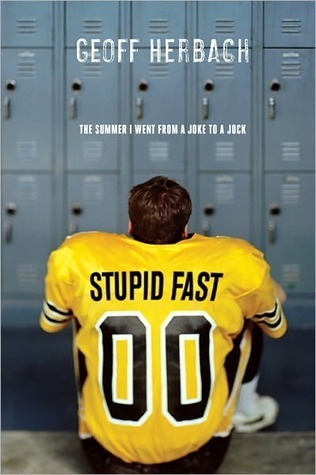
Finally, with a stroke of luck, this young man picked up Stupid Fast by Geoff Herbach. I had book talked it a week or so before, reading the first few pages to the class. At the time, R.J. wasn’t interested. When I saw him with this book, I hurried over and practically begged him to give it a try. “Okay,” he shrugged and moved away from the bookshelf toward his table.

Every day for two weeks, R.J. came to class and told me how much he had read. “I like this book,” he smiled at me more than once. He finished this book in two and a half weeks, and then took himself to the bookshelf to find I’m with Stupid. (At the time, we thought this was the next in the series.)

When I finally made it over to kneel by R. J.’s table and conference with him about his reading, he told me that the beginning was hard to read because the main character’s family was “weird,” but he really liked the parts about football. We talked about character development and how the main character Felton changes throughout the book. “He grows up,” R.J. notices. I asked him what kinds of questions he would ask the author if he had the chance, and then I remembered:  I follow this author on Twitter.

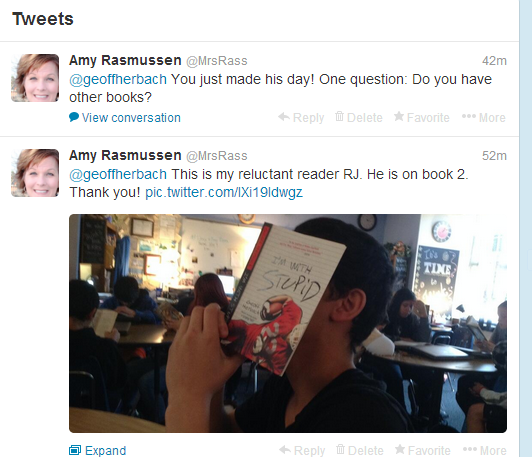
“Hey, R.J., let’s take a picture of you reading this book and tweet it to the author. I bet he’ll respond.”

“No way…. Oh, okay.”

So we did.

RJ tweets to author

RJ tweets to author responses


R.J. left class that day feeling pretty special. He will finish his fourth book this week. His personal reading goal for the whole year was only FIVE.

Now, here’s the really cool thing:  While wondering the exhibition hall at NCTE in Boston, I struck up a conversation with the representatives from Sourcebooks Publishers. They asked if I knew of the books by Geoff Herbach, and, of course, I had to tell them about R.J. Then one of those very sweet insightful women reached under the table and handed me this:

Fat Boy cover

She understands the value of nurturing readers. She’s helped me make a difference in the life of this young man. I wish I could describe the yelp I got when I told R.J. he’d been gifted with an ARC of an ARC — how cool is that?

I’d love to hear your best “Conquering the Reluctant Reader” story. Please share.

Multi-purposing My Quickwrites

Photo Credit: Jennifer

At NCTE last week, Penny Kittle reminded me of the need to consistently share beautiful language with my students. If I ever want them to be able to read it, understand it, and use it in their own writing, I must make conscious choices about voicing that which is lovely. I do a fine job of this right until my students choose their own topics and begin their compositions. Then the room gets stale, and the feeling of “what a chore” begins.

No wonder. I stop sharing short texts and poems. I stop having students respond in their notebooks. I stop allowing them to share their thinking.

While in Boston, I stole a moment with Penny and asked her about my problem, and she simply said, “I keep sharing beautiful language every day.” I must do this, too.

I made a list in my notebook of the things I need to do better when I return to the classroom. Continuing to share poetry and short passages that students can respond to sits at the top of my list, but I want to try to multi-task this activity.

My students are in the process of writing a feature-length article. They chose topics and began drafting before the break. I want them to think about ways to make what they are writing pop into 3D on the page; I want them to see vivid verbs and colorful word choice, and all kinds of devices that they might include in their own writing. My goal is to use poems and passages from now on that will serve several purposes:

1) rhythms of beautiful language,

2) models for sentence structure,

3) examples of figurative language,

4) built-in book talks,

5) questions that aid student thinking about things that matter in their lives.

We will read, and we will respond. We will notice author’s craft as we craft ourselves.

I know, I know, I am slow on this boat. Good planning would make this possible with all my quick writes.  I get that. Thus far, I’ve been a bit disjointed because I struggle with doing it “all:” Independent reading time, quick writes, mini-lessons on craft, grammar, mechanics, student-to-student reading response, reading and writing conferences, book talks. . . I keep most plates spinning, but more and more are crashing lately. My #nerdulation is to do better. (Search that hashtag on Twitter if you don’t have a clue.)

Here’s the passage I will use today. I think it’s appropriate to read a beautiful passage about books since I got a ton of new ones at NCTE. My classroom library welcomes them, but it’s screaming “crowded.” I gotta get a new shelf.

From Broken by C.J. Lyons: 
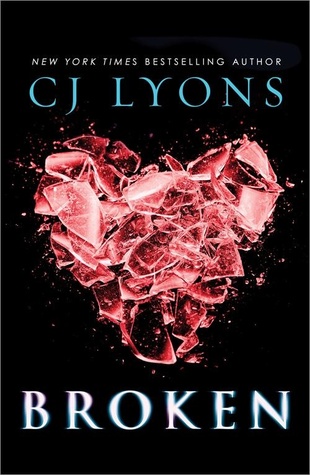
Kids fill the hall from wall to wall. Despite the unfamiliar press of bodies, I don’t panic. Instead, I let them steer me, like running with a herd of wild, untamed horses. At the end of the corridor, the herd separates into two, leaving me alone in front of a high glass wall.

The library.

Footsteps and lockers banging and voices colliding barrage me. Then I open the door, cross over, and step inside. I’m greeted not by silence, but instead by a hushed burble, relaxing, like the sound of a water fountain. I stand, enjoying the sensations, and take a breath.

School smells so much better than the hospital. And the library smells the best of all. To me, a good book is hot cocoa on a stormy winter day, sleet battering the window while you sit inside, nestled in a quilt.

A room filled with books?

I inhale deeply, a junkie taking her first hit. Sweet, musty paper. Ebony ink so crisp it threatens to rise off the pages and singe my nostrils. Glue and leather and cloth all mixed together in a menage a trois of decadence.

Another breath and I’m drunk with possibilities. Words and stories and people and places so far from here that Planet Earth is a mere dust mote dancing in my rearview mirror.

Hugging myself, containing my glee, I pivot, taking in books stacked two stories high, couches and chairs strategically positioned to catch the light from tall windows lining both sides of the corner, like the bridge of a battle cruiser, broad, high, supremely confident, and comforting. In here, I dare to imagine that I might just survive high school after all.

Respond in your notebook:  Describe a place where you find  peace or refuge?

How do you revision your instruction when you know something isn’t working?

Reel Reading for Real Readers: Girl, Stolen

ReelReading2I picked up this title at the thrift store, and the moment I talked about it in class a young woman grabbed it and wouldn’t let go. Later, I found out that this is a popular book in some of my colleague’s classroom libraries. I don’t know why teenagers like books with disturbing themes, but they do. I guess it’s part of the psyche trying to make the plight of others worse than their own. Or something. Right now there is a waiting list for it in my room for this book. Maybe someday I’ll get to read it.

Girl, Stolen by April Henry

Teaching the Lessons of #NCTE13

ocsBeing in Boston with all of these excellent minds has been a balm for my bedraggled teaching soul.  Something about November wears me down every year, as both my students and I yearn for the holiday breaks that are dangling just out of our reach.  Every year, I just pray for the second quarter to speed by so it’s out of the way and over with, but this year, that is not the case.  Reinvigorated by NCTE, I’m now filled with wonderful new ideas that I can’t wait to introduce my students to, and I’m wishing for more time before winter break so I can squeeze more of them in!!  I know without a doubt that my winter is now going to be much more pleasant, but it’s no longer me I’m worried about–it’s all the other teachers, those who are still suffering in the winters of their discontent.

According to the census bureau, as of last year there were 3.3 million public school teachers in America.  Three million, and that’s not including private and charter schools.  Yet, I’ve heard that only around 10,000 of us will attend the NCTE Annual Convention.  That’s an abysmally low percentage, and even assuming there are another 10,000 out there who will access the materials on the Connected Community, that’s still not enough.  We need more teachers aware of the best practices shared here, more educators experiencing the energy of this conference, and more students benefiting from the meetings of great minds.

IMG_0891

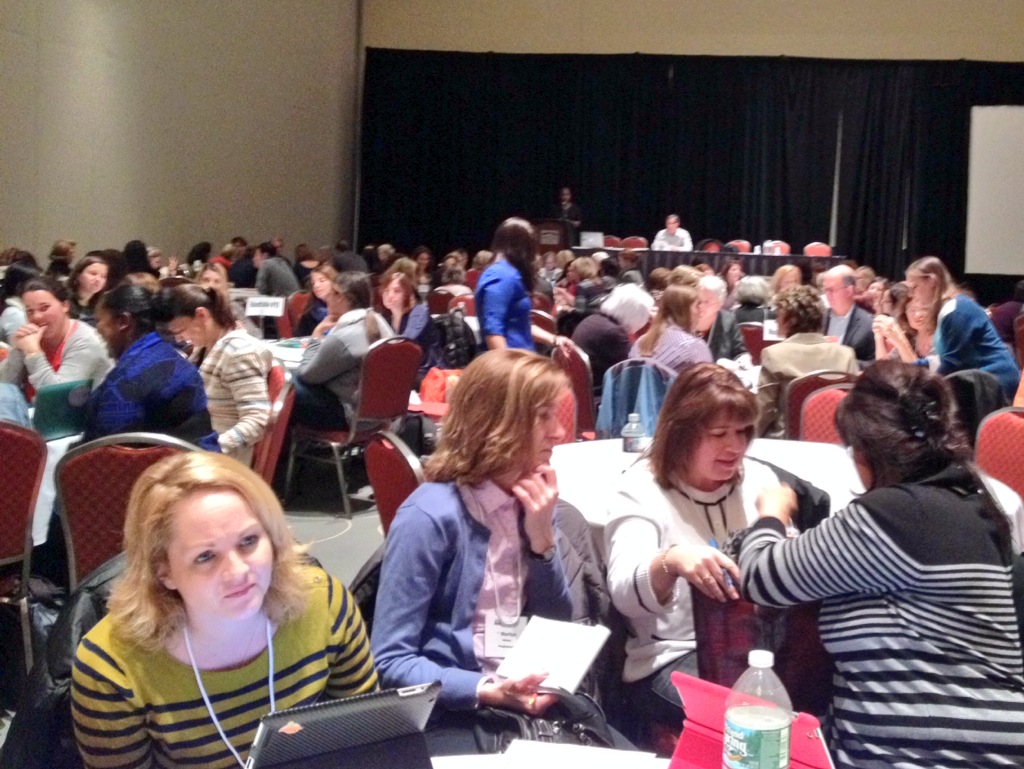
Teachers converse between talks by Carol Jago and Kelly Gallagher

I’m normally a very optimistic person, but I really don’t think enough people know about some of the wonderful teaching mentors in our country.  Yesterday while walking through the Heinemann booth, I watched a woman pick up Penny Kittle’s Book Love, glance at the back, and then replace it on the shelf.  WHAT??!!  I simply had to intervene.  “That’s an amazing book,” I told her, and she turned toward me, interested.  “It completely changed the way I teach, and my students are reading more now than they ever have.”

“Really?” she said. “Well, that’s a ringing endorsement.”  I smiled and urged, “Read it.”  She added the book to her little pile.

IMG_0886

Nancie Atwell sits on the floor to listen to Romano, Rief, and Heard

I felt a small sense of victory–I’d introduced her to a new mentor!  A wonderful set of best practices!  A beautiful book about the love of reading!!  But over the next few hours, the sense of discomfort returned to me.  There are still far too many teachers clinging to antiquated, alienating practices.  There are still too many teacher education programs whose students have never heard of Cris Tovani, Louise Rosenblatt, or Ralph Fletcher.  There are still too many attendees of this conference, even, who don’t understand the elation I felt as I sat on the floor beside Nancie Atwell, Tom Newkirk, and Katie Wood Ray while listening to a talk by Linda Rief, Tom Romano, and Georgia Heard.

Why do so few people know about the insane genius of Penny Kittle? Don Graves? Peter Johnston? Teri Lesesne, Richard Kent, Jim Burke?  These, my teacher heroes, are unknowns to too many.  How can we spread their ideas around?

My hope is that others will do what I’m going to do, and share these findings formally with our departments, districts, and colleagues.  We’ll blog about them, and tweet about them, and most importantly, practice them, so that they spread as rapidly as possible.  So if you’re here at #NCTE13, share these ideas.  Spread the love.  And enjoy the rush that you will ride on for weeks to come.