Category Archives: Books

Giveaway WINNERS!!

Thank you to everyone who entered our giveaway!  We’re so excited to award books to so many amazing teachers.

Without further ado, here are the winners:

  1. Andrea Anderson from Parkway Central High in Chesterfield, Missouri
  2. Hope Bobonick from Trumbull County Career and Tech Center in Warren, Ohio
  3. Melinda Buchanan from Sanger High School in Sanger, Texas
  4. Lindsey Cary from Peru High School in Peru, Indiana
  5. Janelle Christensen from Henry Sibley High School in Mendota Heights, Minnesota
  6. Karen Drake from Lee-Davis High School in Mechanicsville, Virginia
  7. Kopper Ernst from Riverheads High School in Staunton, Virginia
  8. Amanda Gaul from Waukee High School in Clive, Iowa
  9. Jill Gerber from Whitfield School in Creve Coeur, Missouri
  10. Amanda Graham from Latta High School in Dillon County, South Carolina
  11. Benjie Haugen from Monticello Middle School in Monticello, Illinois
  12. Colleen Kiley from Mount Abraham Union MS/HS in Bristol, Vermont
  13. Kimberly Kroll from Lapeer High School in Lapeer, Michigan
  14. Ashlee Kuhry-Larsen from Waukesha South High School in Waukesha, Wisconsin
  15. Kyla Louis from Hood River Middle School in Hood River, Oregon
  16. Anita Miller from Miami Trace Middle School in Washington Court House, Ohio
  17. Kyle Nelson from Lone Peak High School in Highland, Utah
  18. Tasha Rios from Grand Rapids Catholic Central in Grand Rapids, Michigan
  19. Paola Ruocco from Evanston Township High School in Evanston, Illinois
  20. Sarah Whitman from Collingswood Middle School in Collingswood, New Jersey

Be on the lookout for your books to arrive to your school addresses!  If you’d prefer for me to ship your books to your home address, please feel free to email it to me at shanakarnes@gmail.com.

Thanks to everyone who joined the Three Teachers Talk conversation!  Happy Summer!

Mini-Lesson Monday: First and Last Lines

In the spirit of all the books we’re giving away (winners announced tonight!), today’s mini-lesson is one of my favorites to do with independent reading books.  It celebrates the beauty and power of language, no matter the text–poetry, nonfiction, YA, award-winners, graphic novels, and more.  It also celebrates the pure joy of discovery; the launch into a new world attained only by opening to the first page of a new book.

Objectives:  Using the language of the Depth of Knowledge levels, students will identify patterns in opening and closing lines of texts, synthesize their noticings, and draw conclusions about a text’s craft and structure.

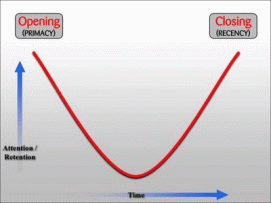
primcacyLesson:  “Have y’all learned about the concepts of primacy and recency in psychology yet?  Who can refresh us?”

A student reminds us that the concept says that the first and last items in a series are easier and more likely to be committed to memory.

“Well, this concept isn’t just for psychology.  It applies to books too.  The first and last lines of books are the most powerful, and the most likely to stick with us.  Let’s talk in our table groups about why the first and last lines are so powerful.”

I wander the room for three minutes as students discuss, in groups of 3-4, these concepts.  They conclude that the first line often sets the tone, introduces a new world, or hooks the reader with some mystique.  The last line, they say, helps keep the reader wondering, or solves a lingering mystery, or even makes you cry.

I write these conclusions on the board, or elicit them from groups if necessary, so that we’re all on the same page.

“Okay, let’s take a look at some of our current reads and see how they can grab our attention.  Open up your independent reading book and read the first line again, and then read the very last line, too.”  (There’s always some anxiety about this, but I reassure them that last lines rarely contain plot giveaways.)

618698KrJJL._SX325_BO1,204,203,200_

(OMG, have you read this? It exploded in popularity the last few weeks of this school year. Read it!)

I ask a few students to give me examples:

  • Miss Peregrine’s Home for Peculiar Children begins with “I had just come to accept that my life would be ordinary when extraordinary things began to happen,” and ends with, “We rowed faster.”  
  • A Prayer for Owen Meany opens with “I am doomed to remember a boy with a wrecked voice—not because of his voice, or because he was the smallest person I ever knew, or even because he was the instrument of my mother’s death, but because he is the reason I believe in God; I am a Christian because of Owen Meaney,” and ends with, “I shall keep asking you.”
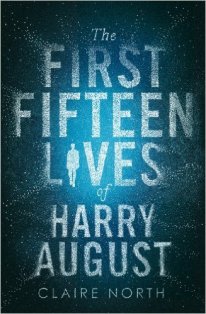
  • The First Fifteen Lives of Harry August begins with “The second cataclysm began in my eleventh life, in 1996,” and concludes, “Instead, for those few days you have left, you are mortal at last.”
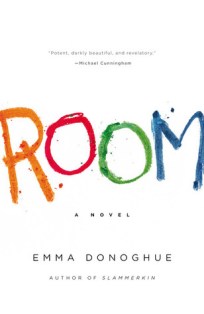
  • Room opens with “Today I’m five,” and ends with “Then we go out the door.”

I ask students to write for a few minutes about all that they can learn from the first and last lines, based on what they already know of the text from reading.  This is key–the lesson is much different than a simple craft study of a text they’re not already invested in, because they’re bringing lots more prior knowledge to their text analysis.

7937843I quickly model with Room, whose plot is simply explained and well known from a recent booktalk.  “I notice the sentence structure first–both lines are short, simple sentences.  Then I get a sense of the narrator’s voice, as he is obviously five years old, and that shapes how I’m going to view the text.  I also know that while they start out trapped in Room, they manage to escape somehow, either literally or figuratively, because of the last line.  I’m intrigued by all of these things, and it sets me up for what sounds like a pretty good read.”  As I talk, I note on the board the kinds of things I’m noticing–craft, tone, characterization, theme, plot, sentence structure.

Students write for five minutes about these topics.  Because they’re midway through these books, they have more knowledge of the text than just the first and last lines.  After a few minutes of writing about what they’ve noticed, I ask, “Now, how does revisiting the first line, and looking ahead to the last line, shape your reading of the text?  What do you find yourself thinking about?  What do you predict might happen?”

Follow-Up:  After students have written their reflections, I ask that they pass notebooks.  They’ll read all of their table mates’ entries, providing 2-3 mini-booktalks–a variation on speed dating.

This lesson could also be a great companion to Jackie’s mini-lesson on writing leads.

This lesson also acts as one of a series of lessons leading up to the students’ writing of a craft analysis of their independent reading books.

Summer Book Giveaway!

Fellow teachers, I have a problem.

img_2969

A book-buying, grant-writing, donation-receiving, classroom-library-growing problem.

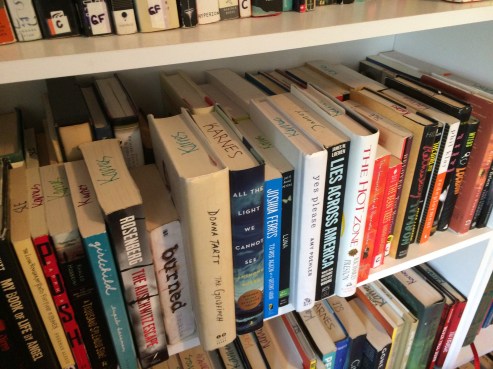
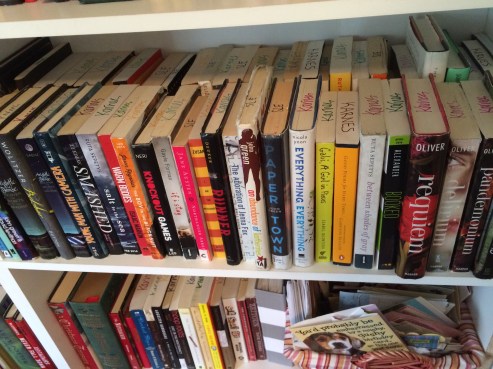
After making it my mission to build a gigantic classroom library, Karnes & Noble has gotten a little…well, out of control.  It has grown to over 3,000 titles, many of which are dog-eared and well-loved, but all of which are wonderful reads.

The problem is, I’ve left the classroom for a while, and…I’ve got wayyyy too many books, and wayyyy too few bookshelves in my tiny townhome.

img_2967

Luckily, I know a few (thousand) deserving teachers whose students would love these titles.

(Yes, I’m talking about you!)

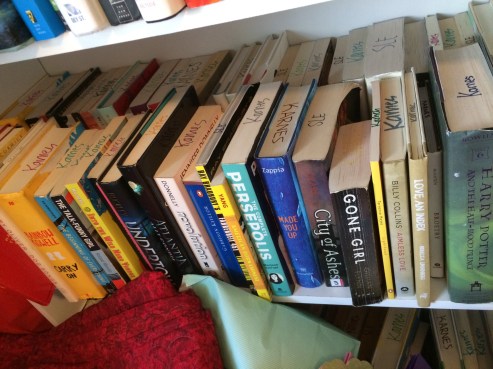
If you don’t mind the Sharpie-d KARNES emblazoned on their spines, then enter to win one of twenty boxes of books I’m giving away!  Nothing would make me happier than knowing that all of these books will wind up in the hands of students who will fall in love with them.  (I’ll also be happy to have my guest room regain the title “guest room,” rather than its current moniker, “Amazon book storage warehouse.”)

There are five ways to enter the giveaway:

  • Complete this 5-minute readership survey to help us tailor our writing to your needs.
  • In the comments section of this page, leave your name, school name, grade level(s) taught, and a list of the 5-10 most popular titles in your existing classroom library.
  • Like our Facebook page, then post to the page a brief description of one of your favorite reading or writing assignments you do with your students.  (Example: I love the multigenre research paper the best!)
  • Using the hashtag #3TTbooks, tweet us an excerpt (pictures welcome) from a text you might use for a craft study or mentor text, as well as your school name and grade level(s) taught.  (Example: a picture of the first page of Peak by Roland Smith, or a picture of the first page of Everything Everything by Nicola Yoon.)
  • Subscribe to TTT, comment on an old post from which you learned something you loved, and then share that post via Facebook or Twitter using the hashtag #3TTbooks.

img_2968

Feel free to enter as many times as you’d like–you may just wind up with two big boxes of books at your classroom door!

And as a consolation prize, even if you don’t win, you’ll be helping to build–and have access to–a toolbox of assignment ideas, book excerpts, classroom library titles, and other useful resources that will be of eminent use to all of us in the fall.

Thank you, thank you, thank you, Three Teachers Talk readers–for getting these books into the hands of kids, and for being with us on our teaching-writing journey every day!

The Right Book May Be an Audiobook

headphones_bookMatching the right student to the right book is at the heart of the reader’s workshop, and lucky for one and all, there are plenty of great books to go around–even for the most reluctant readers.  As a reader’s workshop leader, teachers must be well versed in a variety of genres to do their jobs well:  young adult, nonfiction, and even the classics.  But what about audiobooks?

Admittedly…I’m a book snob.  I was dedicated to paper books for years, until I got married and my early-to-bed husband complained about my reading lamp’s brightness.  Enter my very first e-reader, with which I quickly fell in love.  I reasoned that even though I wasn’t reading a book, per se, I was still reading.  I still wasn’t on board the audio train, though; after all, listening isn’t the same as reading.

Enter my best friend’s move to Virginia Beach, then a 10-hour drive away from our native Cincinnati.  What was I supposed to do for 10 hours whilst driving to visit her?!  “Listen to an audiobook,” she suggested.  “Duh.”  So, I grabbed Thirteen Reasons Why on CD from our library, and (12 hours and a one-state detour thanks to being so caught up in the book that I wound up in Maryland later) I was hooked on audiobooks.

It’s important to note that listening skills are not the same as reading skills, but in the battle to build literacy, one is a scaffold to the other.  While decoding can only happen when a reader is looking at text, the analysis of universal themes, practice of reading strategies, and ability to make connections can happen with any text, written or oral.

“Understanding the message, thinking critically about the content, using imagination, and making connections is at the heart of what it means to be a reader and why kids learn to love books.” –Denise Johnson

Were it not for audiobooks, my own reading life would almost certainly be suffering right now, as I’m so busy and sleep-deprived with an infant, but I love listening to my favorite murder-mystery series in my spare moments.  In countless conferences with my student athletes, I’ve come to realize that their practice and travel schedules keep them incredibly busy on nights and weekends, and audiobooks have helped them remain readers in their busiest seasons, too.

I strongly believe that audiobooks can save, strengthen, and supplement any rich reading life, and as such, I take great pains to recommend this medium to my students, often in the following categories.

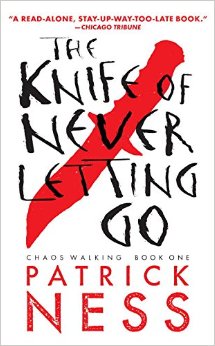
51NcMaqTCsL._SY344_BO1,204,203,200_Series – A great way to immediately get students hooked on audiobooks is to recommend a series they’ve already started.  Sequels to titles like The Maze Runner, The Knife of Never Letting Go, Percy Jackson, Harry Potter, Legend, Divergent, City of Bones, and more are great gateways to the world of audiobooks.

Books read by their own authors – Many writers read their own audiobooks, and it’s fascinating to hear the nuances of Michael Pollan’s or Malcolm Gladwell’s writing as he reads it aloud.  The likes of Maya Angelou, Neil Gaiman, Barbara Kingsolver, and even Barack Obama have deigned to offer themselves to readers in audio form.  It’s endlessly fascinating to me to add a new dimension to “reading like a writer” when I listen like one, too.

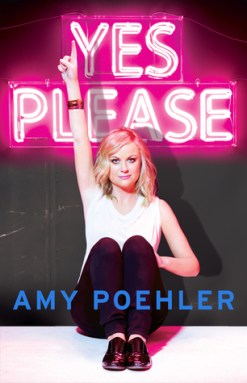
20910157Humor – Similarly, so many amazing essayists, comedians, and satirists read their own audiobooks.  Amy Poehler, Tina Fey, David Sedaris, Mindy Kaling, Neil Patrick Harris, and more are just a few of the folks whose movies or TV shows I’ve watched, and who’ve then joined me in my car or at the gym in audiobook form.

Challenge Books – Books that for one reason or another–length, difficulty, topic, multiple narrators–are challenging are great candidates for audiobooks.  I don’t think I could’ve made it through Unbroken, Behind the Beautiful Forevers, Thinking Fast and Slow, or other lengthy, difficult tomes had I not listened to them rather than read them.  Their tough topics and intimidating lengths would have been much too off-putting for me, and many students find themselves in similar situations.  Audio is my favorite way to scaffold students up to the level of a slightly too difficult text.

Whatever’s always checked out – No one could ever find Winger, Crank, Paper Towns, Because I Am Furniture, My Book of Life By Angel, Boy21, Red Queen, or The 5th Wave this year–they were just way too in demand.  Instead of waiting for those titles to be returned, many students opted to download the audio version instead.

What are your thoughts on the world of audiobooks?  Which titles are your favorite?

Imagining Our Ideal Bookshelves

My students are selfie experts; somehow, through practice, they have discovered the perfect angle, the right light, the exact method to fit ten people into one frame—while still managing to make their head look normal-sized.  In those fleeting snapshots, they capture the essence of who they are (or at times who they want to be), if only for a second.

I believe that the books we read can serve as small photographs of our hopes, dreams, desires, and curiosities.  They provide a  snapshot of who we were, who we are, or who we want to become.

FullSizeRender-2

Julia’s highly organized ideal shelf

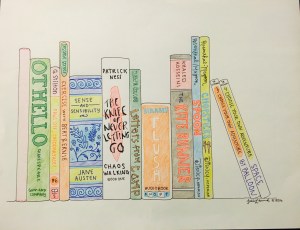
As a final project, my AP Literature and Composition students completed an “ideal bookshelf,” inspired by the book My Ideal Bookshelf and a quick write I completed in Penny Kittle’s summer class two years ago.  The assignment was relatively simple—create your own ideal bookshelf of the books that “represent you—the books that have changed your life, that have made you who you are today, your favorite favorites” (La Force xi).  Since this is an AP Literature class, I added a twist—I wanted students to stock their shelves with books that not only transformed them as a person, but also developed them as a reader.

As each student presented on their shelf, they transformed from self-assured seniors to wide-eyed children who relayed the story of the first book they had ever fallen in love with.  Many of them spoke of how they either found or developed their passion for art,

FullSizeRender-3

Max’s science-based book shelf

coaching, theatre, computers, and physics through books they had found over 18 years.  The books they listed did more than just challenge them as readers; these books had the power to inspire, entertain, and heal.  As Claudia wrote about The Sisterhood of the Traveling Pants, “I have no real idea what is so special about it, but I’m not going to question its magical powers when it does so much good for me.”


What I loved most is how these shelves found life through details; Julia’s shelf held her drawing notebook, Cam’s his favorite cookbook, and Payton’s was adorned with her grandmother’s locket, which she uses as a bookmark.  Some shelves were neat and orderly, perfectly stacked, while others, like Sammie’s were a bit more scattered.  As Sammie put it, “I don’t know what I want to do as a profession; I am still figuring it out.  That partially explains the disarray that is my bookshelf.  I couldn’t decide which would be more practical, stacking or leaning.  The result is a bookshelf with a little bit of both.”

FullSizeRender-1

Sammie’s slightly scattered ideal shelf

As my seniors complete the next three weeks and begin the process of preparing for college, I want them to walk away with the writing and analytical skills we’ve honed all year, but more than anything, I want them to remember why they fell in love with reading in the first place.  I want them to question why books are powerful and understand that the universality of a novel’s message can change readers.  I want them to read for knowledge and depth and challenges, but I also want them to accept that not everything needs to be analyzed, dissected or picked apart.  In fact, sometimes we read for escapism, for love, for adventure.  For many, this might be the last English class they take.  Hopefully, it is only the start of a lifetime of reflective reading and ideal bookshelves.


#FridayReads & Becoming (Twitter) Literary Critics

I am beat. My students are beat. I know you know exactly how that feels.

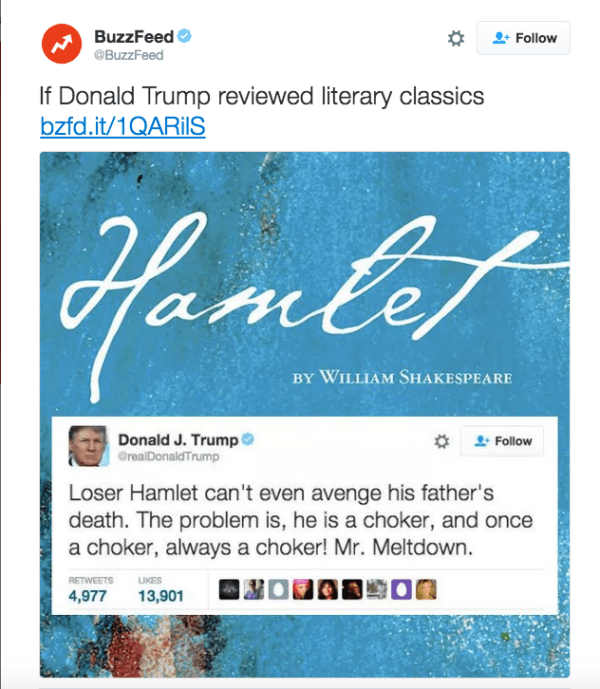
In an effort to lighten the mood but keep the idea of books and reading alive, my students and I had a little fun with Donald Trump. Now, it doesn’t matter what you think of the man or his politics, his tweets make pretty good mentor texts.

Screen Shot 2016-05-26 at 7.38.47 PM

I’m not the only one to think so — actually, I got the idea from someone Buzzfeed. Some clever writer put together a list of tweets, written as if Mr. Trump critiqued literature. Brilliant.

Screen Shot 2016-05-26 at 7.40.19 PM

So to have a little end-of-year fun, I asked my students to consider Trump’s sentence structure, and then write their own reviews based on the most recent books they’d read. Really, my only requirements:  a clear tone, but they didn’t have to be mean, and correct spelling and punctuation.

Here’s a few for your reading pleasure. Of course, the review makes the most sense if you are familiar with the books students refer to — I get that not everyone is as versed in YA like they might be the canon.

(Side Note:  To those who say students will never move beyond YA or ‘easy’ reading when it’s all about choice. Um, wrong again.)

What kind of end-of-year fun with books and reading — or anything else– have you had with your students? Please share in the comments.

14 Days to Take It Up a Notch

I keep thinking that if I could consider myself an expert at conferring I might actually feel confident in writing a book about it. Then every once in awhile I hear a voice that tells me that the only way to become an expert at conferring is to write about it. Then another voice says, “Can anyone ever be an expert?”

I think about conferring a lot. I know that when I confer regularly with my readers they read more, and they read better. The same holds true for my writers. The more we talk about the moves they make and the meaning they want to convey, the more they take ownership of their work and confidently work at it.

But the consistency in conferring trips me up a lot.

This week I read in a student’s notebook: “I didn’t take the AP exam because my teacher didn’t make me feel like I was good enough. I know that is a terrible excuse to go off an emotion like that. But it also connects with the reason why I don’t do my homework. I get no educational support from anyone. I feel like I’m a nobody that just exists in school. That’s why I turn to music cause it makes me feel special and important.”

That burned. He knew I’d asked to read it. He wrote that for me.

I flip through the notebook and read poem after poem that reflects this student’s sadness, despair, and thoughts of hurting himself. Of course, I take it to the counselor.

I turn to my conferring notes and see that I’ve conferred with this student as much as my others, but he has never let on he was quite so unhappy. We’ve talked of academics, of books, of English things like reading and his writing. I’ve known he’d been depressed in the past. I thought he was doing better.

Now, I wonder. What if more of my students feel this way? What could I have done differently this year that would have let them know I care more about them as people than as English students?

I could have approached conferring differently, more purposefully, more personally. The irony? I wrote about the need to confer with fidelity here, and my first point is about our students’ need for personal attention.

I have 14 days left with my students this year. Surely not enough time.

I’m still going to try.

______________________________________________________________

And now for the rest of the story.


That evening I went to the bookstore thinking I would buy this boy a book. I was on the hunt for the YA novel Someday This Pain will Be Useful to You by Peter Cameron, a book I haven’t read yet — but oh, that title.

No copies available.

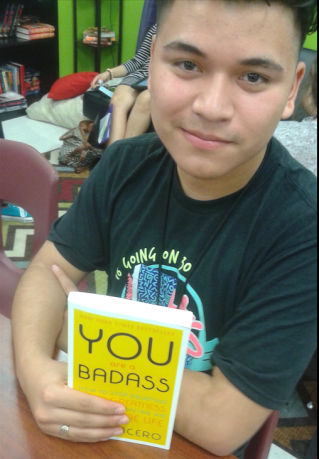
Then, I saw You are a Badass:  How to Stop Doubting Your Greatness and Start Living an Awesome Life.

Screen Shot 2016-05-13 at 1.19.08 PM

Diego:  “…when you feel like you have everything but you are never satisfied” that speaks to me.


Perfect.

The next morning, I scribbled a note inside the cover and called Diego into the hall to give it to him. I told him that I’d read his message and handed back his notebook. We talked a bit, and he assured me that he’d written those poems awhile ago, but he still felt lost at school. I assured him that he was not alone, he needed to believe that every adult in this school cares about him — that’s why we teach here, and the worst thing we could do is take it easy on him because life never will. I gave him the book and watched as he hurried back inside the room and quickly read my note.

I’ll take that smile.

Day 13.


Note:  When I snapped that photo of Diego, one of the girls nearby laughed and said: “Mrs. Rasmussen, taking it up a notch.”

“I’ll be writing about you next,” I said.

Student name and writing used with permission.


Try it Tuesday: Teacher Readers Share the Love

Love what you read and read what you love.

Is this not the life force behind workshop? Behind teaching English? Behind becoming a reader?

Personally, I’m pretty sure my love for reading started in utero. My parents (both educators themselves) read to me and read to me often. The first real memory of a book I have is Disney’s The Penguin that Hated the Cold. Pablo the penguin wanted out of the Arctic. I connected with his desire to swing in a hammock and travel the high seas in a bathtub.

 Next came The Boxcar Children. I used to run out into the backyard of my comfortable suburban home and pretend to be an orphan living in a boxcar. Logical, right?

Soon after, I was devouring the Little House on the Prairie books, the early  Baby-sitters Club books (only those before #100…sorry Ann M. Martin, a girl has her limits), and The Nancy Drew Mystery Stories.  I read under the covers with a flashlight, swinging from the tire swing in my backyard, and sometimes under the dinner table. I only drew the line at reading in the car. Still can’t do it. It makes me vomitous.

The common thread to this early reading, was my love of stories. I chose what I wanted to read and I read voraciously because I was in charge of where I could travel, the conflicts I could watch unfold, and the people I could meet through books. I know my dad wanted me to read more Robert Louis Stevenson, but that was a journey of his childhood. The journeys of my childhood were with Roald Dahl, Beverly Cleary, R.L Stine, and C.S. Lewis.

So where is the balance that we, as English teachers, can bring to our classrooms when it comes to teaching the books we love (or the books we think students “should” read), and our understanding that choice fosters a connection to what we read? A connection that can far outweigh the legitimate literary merit of works we would choose for our students? Where do cultural literacy and passion for literature meet?

Well…I don’t really know. Yet.

What I do know, is that I need to provide opportunities for my students to choose texts that appeal to them. But my job can’t end there. I then need to help them move to more complex and challenging works. Classics included.

How to do that…I don’t really know. Yet. But I am learning.

Here is what I do know – If I am going to build a community of readers, I need to be a reader. If I am going to build a community of writers, I need to be a writer. Lead by example and beautiful things are sure to follow.

Easy, right? Of course we, as teachers, are often readers. The beauty of language, the study of what it means to be human, and the opportunity to live countless lives through reading is what led me to the high school English classroom. But somewhere along the way, I started reading more student papers than novels. More formative assessments than poetry. More parenting books than bestsellers (though I will contend that Oh, Crap! Potty Training is a necessary text for parents with kids of a certain age – Shana, this is the book –  trust me ). But with the advent of workshop, I have read more in the past few months, since Amy and Shana came to Franklin High School for professional development work, than I had in longer than I’d care to admit. And as such, I am able to broaden my repertoire of texts and my students now see me reading. A lot.

In fact, the students at Franklin High School are seeing their teachers read more and more. Not that we weren’t reading before, but as fellow colleague and reader Catherine Hepworth wrote in her guest post, we are now, as teachers working within the workshop model, making our reading far more visible. As a result, I wanted to share some recent reads from my colleagues. Teachers who are fired up about reading, because we love it and want to share the love.


The English Teachers at Franklin High School highly recommend these recent reads:

DemianDemian by Hermann Hesse – recommended by Karin Adelmann

Demian is a coming of age novel. Sinclair, the protagonist, is trying to find his way to what is true and real as he encounters different mentors and situations. The book frequently challenges more conventional ways of thinking.


The Handmaid’s Tale 
by Margaret Atwood– recommended by Lisa Dennis handmaid

As a pretty progressive woman, I can’t believe I haven’t read this book until now. I work; I share a household with my husband; I cook but also know how to shingle a roof, I vote; I raise my daughter to trust herself and know her own mind. And yet, I’ve never read this cautionary tale full of sardonic humor and striking dystopian visions that suggests all that Artwood feared about 1980’s “Morning in America.” The Handmaid’s Tale carefully unfolds the story of Offred, a woman living in the fictional future world of The Republic of Gilead. In a world of declining birth rates, fertile women are assigned to existing families, solely to bare children. Through Offred’s memories of her life before, an American life most of us would recognize, the reader discovers the sharp contrast between the freedom we currently enjoy and the very real limits placed on life when that freedom is lost. Like so many great dystopian novels before and after it, The Handmaid’s Tale is a testament to upholding the values of personal freedom in the face of what life might be like if we forget how precious those freedoms really are. I can’t put it down.

me before youMe Before You by Jojo Moyes– recommended by Erin Doucette

I was hooked on this book from the first page. The book is set in England, so I really enjoyed the voice of the narrator as well as some of the words she chose to incorporate. Me Before You chronicles the sometimes confusing, frequently tumultuous, and always touching relationship between a funny, eccentric, secret-hiding Louisa and formerly adventurous, formerly ruthless, and currently angry, quadriplegic Will. Quirky, unqualified Louisa becomes his care-giver for the 6 months he has left before his pre-planned assisted suicide.

I loved this book. It make me laugh. It made me cry. It made me angry, but best of all, it really made me think about the impossibility of some of the choices we face and the importance of standing by the people we love.

Eleanor by Jason Gurley – recommended by Richard Gould

This is a story of a young girl, Eleanor, whose twin sister dies in a horrible accident. After that, the entire family crumbles. At the age of 14, Eleanor has an experience that she cannot explain, but it seems that someone is trying to contact her in an unimaginable way. As these experiences happen more and more often, Eleanor begins to see a way to repair all the damage to her and her family’s lives. I recommend this book for several reasons. Fist, it features two strong female protagonists. The writing is authentic and the Eleanorcharacters are complex and not without fault. The story delves into “other dimensions” and would appeal to any fan of existential writing. The book is organized through a series of flash backs, flash forwards and time travel, which can be a bit confusing if a reader is trying to quickly read the story; however, this is a book to be enjoyed slowly with frequent pauses to think, not only about the story itself, but about the reader’s own perception of reality. There is a bit of romance, but not too much as the story stays focused on the protagonists’ objectives. The conclusion is satisfying but is not obvious or formulaic. When all is said and done, this book stays with the reader for a long time after it is put down.

Not My Father’s Son by Alan Cumming – recommended by Catherine Hepworth

not my father's sonAlan Cumming, Scottish actor extraordinaire, presents us with two parallel stories about the men in his life and their influence on him. While he is preparing for and filming a genealogy show, he is learning about his maternal grandfather’s escapades in WWII, while at the same time dealing with his own abusive father. It is a very honest and open memoir about one particular moment in his life that is at the same time about his entire life. He is my favorite celebrity and a wonderfully talented writer. I especially enjoyed his memoir because it’s rare that a celebrity gives you this type of glimpse into their heart breaking childhood. When I finished reading, I wanted to rush to NYC and give him a hug.

One More Thing: Stories and Other Stories by B.J. Novak – recommended by Amy Menzel one-more-thing

I like reading short story and essay collections because it mixes things up. It’s like what Mark Twain said about the weather in New England — to paraphrase, “If you don’t like it now, just wait a few minutes.” I can do that. And I’m pretty good at having the memory of Dory when reading story or essay collections. If I read something I don’t like, I forgive, I forget and I swim–I mean, read on. What I really like about Novak’s collection is his thinking. You might know of Novak from The Office fame. He wrote, directed, and starred in the hit sitcom. In this book, he uses his creativity to ponder some what if questions. “What if John Grisham’s publisher mistakenly published one his books with the place holder title of ‘The Something’?” “What if there was one man behind the creation of the calendar?” “What if there was a ‘Best Thing in the World’ Award?” I like how Novak thinks, and I really like that I get to follow his creative thinking in this collection.

WingerWinger by Andrew Smith – recommended by Leah Tindall

I absolutely loved this book because Smith uses real language, humor and other great writing techniques that will truly appeal to all teens, boys especially. I thought I would take about a month to read in between grading and planning. However, once I started on a Tuesday, I finished it the following Friday evening. I could not stop reading it! I laughed almost every page, and then I cried in the end! I began reading it aloud in a few classes and this inspired several of my students- 3 girls and 4 boys, to be exact- to read it! One of the boys I don’t even have as a student- I was talking to him about it in resource. He didn’t read any books last year and finished this book and loved it! P.S. I love Andrew Smith.

Ready Player One by Ernest Cline – recommended by Sarah Sterbin and Brandon readyWasemiller

Sarah says: I love reading books that are being made into a movie so I can compare them. Ready Player One is hitting the BIG SCREEN in 2017 (I’m really on top of my game). It was an awesome read about living in a world where you can “plug in” to the virtual world. I have recommended this to a lot of my students who are into video games (and those who, like me, like to be harsh critics on the movies based on books), but it is a great story for ALL to read!

Brandon says: This is a book that I could not put down, and when I did I was trying to figure out the next time I could dive back in. Ready Player One was all that I could talk about for the week that I was reading it, and I suggested it to colleagues, family members, and students. This book has everything. A mystery, an dystopian future, life inside of a video game, undying friendship, 80’s references, solid characters, and a real look at how much video games affect our life–and more importantly how they could RUN our lives in the years to come. There is no a single person that I would not suggest this book to. It is unlike anything you have read before, and I highly suggest it to everyone.

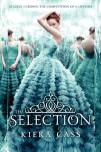
selectionThe Selection by Kiera Cass – also recommended by Sarah Sterbin

This books is a mash up of The Bachelor and Hunger Games. Dystopian feel while seeing the inner workings of a Bachelor type show (with some “ROYALTY”!) I have recommended this to a lot of my students who talk Bachelor/ette with me (guilty pleasure alert), and those who love reading Dystopian stories.

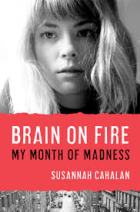
Brain on Fire by Susannah Cahalan – recommended by Brandon Wasemiller brain on fire

I grabbed up this book because I can be a window shopper when it comes to books, and I really liked the cover art on this novel. However, after I read the first page I was hooked, and spent much of my weekend reading through the entire thing. This is a book that takes you into pure madness and back again, and it is great for that reason. Going on a journey with someone as they go insane is a hard journey to take, but Susannah, a writer for the New York Post, brings her story to life. You will find yourself reading just ONE more chapter just to see if things get better.

challenger deepChallenger Deep by Neal Shusterman – also recommended by Brandon Wasemiller

I bought this book on Amazon because I saw that it had a five star rating, and really awesome art on the book jacket–I am so happy I did. The amazing quality that this book has is that it really makes you care about Caden, the main character, and the problems he is going through. Caden is in the real world, but also finds himself on a boat on its way to the deepest part of the ocean, Challenger Deep. You, the reader, are unable to help Caden who is starting to confuse dreams with reality. This book brought me back to the days when my grandma would read James and the Giant Peach to me and do all the different voices as she read, and like James and the Giant Peach, Challenger Deep is a journey of a young man who lives in one world, but escapes to another to work things out, but as a reader you worry that Caden will never come back. What if he is never “himself” ever again?

Columbine by Dave Cullen– Brandon’s passion for books cannot be contained. columbine
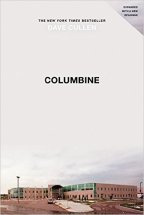
This was a book that I could not put down. Each chapter builds on the last, and you feel connected to the school, its students, and the tragedy that took place more than a decade ago. I never realized how much I did not know about Columbine. This book expertly tells the story of two very misguided young men, but more importantly, the teachers, administrators, students, and families that were all affected on that day and beyond. I would suggest this book to anyone looking for a great non fiction book, and a really solid look into what great investigative journalism looks like.


Thank you to the enthusiastic teacher readers at Franklin High School for sharing their recommendations. Each new text our students see us reading expands their field of choices and also lets them know that we truly, and gladly, practice what we preach. Because we love it.

What are you reading? What recommendations can you share? Can’t wait to grow our “to read” lists together with your suggestions in the comments below! 


Top 10 Books That Will Drastically Change Your Mood

img_1534I don’t know about the weather where you live, but it has been raining cats and dogs for a week here in West Virginia.  Baby Ruth and I are dying to go out for a walk, a coffee, a Target run–anything!!–but the rain is keeping us indoors and we’re feeling rather glum.

Luckily, I have a solution–reading.  It can transport us to other worlds, brighten our days, and alter our moods for the better.  Her little bookshelf is full of great titles by Shel Silverstein, Eric Carle, and other children’s greats, and mine is full of great titles like the ones my awesome student Giulia recommends below.

Giulia made a Top 10 List of books to drastically change your mood when reflecting on her semester’s reading last winter.  She realized that no matter what she was embroiled in–school, work, friends–these ten books could rip her away from reality and change her mood.  So if you’re looking for something to sweep you away, check out Giulia’s list below…and make sure you have these titles in your classroom library!

Giulia’s Top 10 Books That Will Drastically Change Your Mood

71VBpx0qsmLThe Glass Castle by Jeannette Walls

This is one of the few non-fiction books I’ve read. I was more interested in this non-fiction book because the events that took place in The Glass Castle were completely insane so it seemed more like a fiction book. I think this is why I was more intrigued. This girl went through the majority of her life with the most ridiculous parents. They traveled America and went on all these adventurers that most people would consider insane. One part of the book that really stuck out to me was when this girl was little, she was boiling hot dogs on the stove, BY HERSELF, and something happened where the boiling water spilled down the front of her body and she had third degree burn and scars for the rest of her life.

The Book Thief by Markus Zusak

This is one of the rare books where I’ve seen the movie first then read the book, and come to find out that the book was way way way better than the movie. Both the movie and the book made me cry like a baby, but the book was more interesting, obviously. The book is based around a little girl who is growing up in Germany during the Holocaust. She begins to find that she is fascinated with books and does anything she can to get as many books as she can. Her family also faces the fears of hiding a Jew in their basement. Everything that happens in this book seems so fragile to me because I basically get to see this little girl grow up and face the world.

The Sky is Everywhere by Jandy Nelson

This book was recommended to me by a friend and usually I like to discover good books on my own, but I decided to read it. It was a nice love story mixed with humor. I love when authors do that. This girl is in high school and her older sister just died so she’s living with her crazy grandma and uncle. She and her sister’s dead boyfriend begin to fall for each other, but they both know it’s a big no no. They finally start to come back to reality and realize that they aren’t actually falling for each other, they are just trying to find comfort in one another. Throughout the entire book, this girl is STRUGGLING to find her way out of a hole she fell in when her older sister died. It’s touching and humorous and I loved every single bit of it.

sun_375wI’ll Give You the Sun by Jandy Nelson

This book and the previous book both have the same author, Jandy Nelson. I’m assuming Jandy either grew up with a rather odd family or she has a rather odd imagination because both the families in each of these books are not your typically family. This is one of the first books I’ve read where one of the main characters is gay. It was definitely interesting, but not weird at all. The two main characters are a set of twins, both struggling with the divorce of their parents. One child is a boy and the other is a girl. Basically, they are both trying to get into this really nice art school, but the boy is trying harder than the girl. Throughout their childhood they are super close, like best friends, but as they grow older, there are a couple specific events that happen that tear them apart. This book, while wildly outrageous, was fun to read. It may seem confusing and slow at the beginning, to the point where you might contemplate finishing it, but it was totally worth finishing.

Everyday by David Levithan

I just recently read this book so it is fairly fresh in my mind. I was crazy about this book in the beginning, like I thought this was my favorite book of all time, and then it ended. It was maybe one of the worst endings I’ve ever read, but besides the ending, this book was ridiculously amazing. There were some things that were never answered, but then I keep thinking of how awesome the beginning of the book was and all I can do is fantasize about it. There is a boy and he is currently sixteen, and he wakes up in a different body every day. But there’s a catch. He only wakes up in sixteen-year-olds’ bodies, and it only happens in Maryland. It’s a little more complicated than that, but that’s the gist of it. On top of all that, he begins to fall for this girl that he only meets one day. He then continues to spend the rest of his “life” trying to find the girl he fell in love with all while trying not to harm any of the bodies that he inhibits. Crazy book, but ridiculously intriguing.

5152478Wintergirls by Laurie Halse Anderson

This book actually disgusted me in so many ways, but it was sooo good. These two girls have been best friends for a while, then one of them dies. Before the one girl dies, they make a pact to be skinner than the other… gross. The girl that’s still alive is literally insane. She starts hearing/seeing her dead friend. This girl continues to be as skinny as humanely possible. At one point I think her weight was a little less than 90 pounds, which is extremely poor for your health. She’s just having a hard time dealing with her friend’s death, so she is trying to feel better about herself by working out and eating basically nothing to reach her desired weight. The ending seemed a little rushed, but the rest of the book made up for it. I’ve never, in my life, read a book that seemed so realistic like this before. I didn’t know people like these girls actually existed or that it was so extreme.

Ugly Love by Colleen Hoover

I began to start reading books by Colleen Hoover because I wanted to take a break from some of the harsher books I’d been reading, so any of Colleen’s books are a nice book to read if you want to chill. The majority of them are all romance books, but not the cheesy kind. The main character is a girl who just moved into an apartment with her brother because she has a new job and is attending college at the same time, so she needed some help. Come to find out, her brother’s friend is insanely good-looking, so she is attracted to him immediately. There is something that this boy is hiding from her, but every time she tries to pry it from him, he immediately closes up. Warning: there is an EXTREMELY heart-breaking part in this book where I cried for a good ten minutes before continuing on with the rest of the book. The best part is that the movie is coming out in 2016 and I didn’t even know there was supposed to be a movie! So I’ve already made plans to go see it and determine if it will be as good as the book.

Dark Places by Gillian Flynn

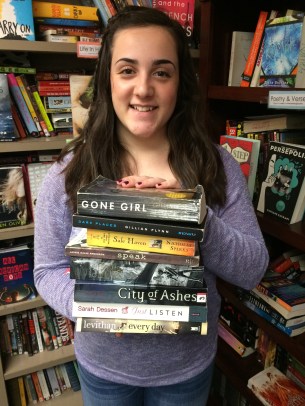
I read this book shortly after I read Gone Girl, and this book was an intense, short read. I have always been intrigued with the most profuse, disgusting, murderous books I can find, and this book definitely hit that level. This family is based on a girl whose family was murdered when she was a little girl. Everyone in her family is dead except for her, her brother, and her deranged father. She lives by herself because her father fell off the face of the earth and her brother is in prison for supposedly murdering the rest of her family. Ever since she was young, this girl was told to believe that her brother was responsible for the murder of her family, but as she grows older, she begins to wonder whether or not her brother was actually capable of something so insidious. She starts to dig deeper into the history of the murder and discovers the real murderer, along with her family’s mysterious past. This book was simultaneously disgusting and captivating and I love how Gillian Flynn writes.

Gone_Girl_(Flynn_novel)Gone Girl by Gillian Flynn

Everything I’ve ever read up until the point of reading Gone Girl didn’t matter to me (until I continued reading other books). This book was that good. I mean I’ve never read any type of thriller like this before in my life and I will never forget this book. It wasn’t the shortest book, but I finished it in two days, and that’s quick for me. The book is centered around this man whose wife goes missing and of course, he is the main suspect. He begins to find clues to lead him to his wife’s whereabouts, which become more gruesome as the “scavenger hunt” goes on. I REFUSE to watch the movie because I know nothing can beat the book. It was excruciatingly hard for me to set this book down. While some of the book was rather sexually descriptive and intense, I still loved it. The ending made me mad, but a good kind of mad.

Sharp Objects by Gillian Flynn

I read this book after I read Dark Places and while I liked this book a little less, it was still amazing. I don’t know how Gillian Flynn comes up with all the insane, nasty events that occur in her books, but it’s all brilliant. This girl is a journalist and lives by herself, but she just heard about a good story to write about back in her hometown, where her deranged mother, father, and younger sister. So she travels back to her hometown and is temporarily living with her family. As she does some research about the murders in town, she starts to link them back to her family. This girl is also not the most stable, so she has a terrible habit of making her body a canvas, and by this I mean she is constantly carving words into her body with any sharp object she can find. While the girl may seem somewhat crazy, it is nothing compared to her mother. One part of the book sticks out to me where the girl was spying on her mother who was taking care of a friend’s baby. When her mom thought no one was looking, the mom bit the baby’s cheek hard enough to draw blood. Obviously, the mother is crazy as well, but everything ties in at the end. The ending is the best part.


What titles do you and your students love that drastically alter your mood?  Please share in the comments!

3 Mentor Text Mini-Lessons

I am the worst at successfully locating mentor texts when I need them (even though Amy gave me great advice on how to do so here), but I do far better at tripping over mentor texts in life and designing subsequent lessons around them.  Recently I found three mentor texts that inspired me to create mini-lessons in which my students could write beside their authors.  Their written products could be cultivated as stand-alone pieces, but because May means multigenre in my classroom, I’d envision these mini-lessons as possible genres for a longer MGP.

img_2531Mentor Text #1:  Microfiction on a Chipotle Bag
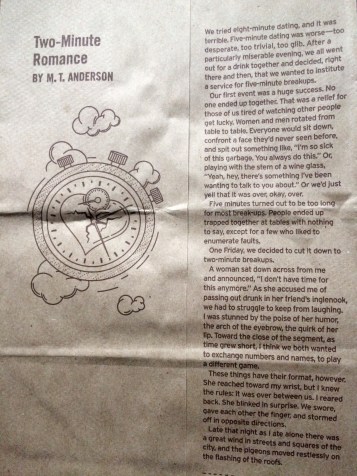
I love Chipotle for a variety of reasons (did you get your free burrito yesterday for Teacher Appreciation Week?), but one surprise I love encountering is whomever is published on my bag.  On my latest visit, I spied one of my favorite new authors on my heavenly-scented bag of burritos–MT Anderson.  This phenomenal author of Feed and Symphony for the City of the Dead is already a favorite in my classroom, so I know his work will go over well.

His story is a piece of microfiction, or a short short story, or flash fiction.  Whatever you call the genre, it’s a highly useful one for the multigenre research paper, which seeks to tell the story of its topic using a variety of genres.  This year, my students are focusing on their relationships to literature in their MGPs, and re-reading one of their favorite books from the year with an eye for telling the story of how they interacted with, learned from, and grew because of the text.

This piece of microfiction is, as a result, a great mentor text.  MT Anderson’s story leaps into the action without directly establishing setting, employs minimal but highly effective dialogue, and uses extremely precise diction.  These skills could easily be practiced during a quickwrite, which could then be revised into an MGP piece.

Screen Shot 2016-05-04 at 7.39.17 AMMentor Text #2:  Annotations in Books

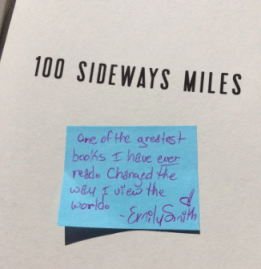
Billy Collins’ great poem “Marginalia” has always been one of my favorites, and I thought it’d be a wonderful genre for this year’s MGP.  On a re-read, there’s plenty to say in the margins, plenty to preview on the inside cover, and plenty to exclaim about after the afterword.  For the project, I asked students to purchase their own copies of their favorite books they’d read this year so they could marginalia the heck out of them.

The creation of marginalia could be done, in part, in two separate class periods–one day for the preview note at the beginning, and one day for the review note at the end, with the remaining marginalia being written while the student was re-reading at home or during independent reading time.  Many of my students relish the idea of writing in books and enjoy encountering previous readers’ marginalia, so I know they’re excited to create a new text by adding to their favorite book.

img_2536While I’ve been wanting to have students try this genre for a while, I was inspired by two mentor texts I stumbled upon–a note left in Andrew Smith’s 100 Sideways Miles, and the notes my students wrote in a copy of Shel Silverstein’s The Giving Tree, which they presented to me as a gift for Baby Ruth.  (Yes, it made me sob, and it wasn’t just the postpartum hormones!)
Mentor Text #3:  Biography Picture Books

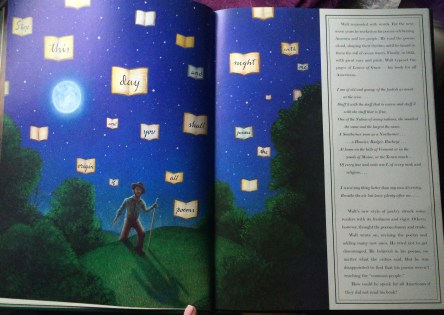
With the arrival of little Ruthie, I’ve found my taste in literature skewing to a decidedly younger set of titles.  One of my favorites is a beautiful, lyrical biography of Walt img_2535Whitman. As my students work to reflect on and engage with their favorite books, I want them thinking about the books’ authors as well–and writing about them, too.  This book is a wonderful mentor text for showing how an author came to be a writer.

Walt Whitman, written by Barbara Kerley and illustrated by Brian Selznick, is a gorgeous text that tells the story of Walt Whitman’s upbringing and eventual discovery of his love for writing.  Kerley intersperses lines of his poetry into the story, and they’re paired with beautiful illustrations by Selznick.  My students could easily create short biographies focused on how their authors became interested in writing, then pair them with an illustration for a children’s book genre to add to their MGP.


What writing lessons have you designed after stumbling upon random mentor texts?  Please share!