Category Archives: Professional Learning Community

Choice as the Keystone in Secondary English Classes

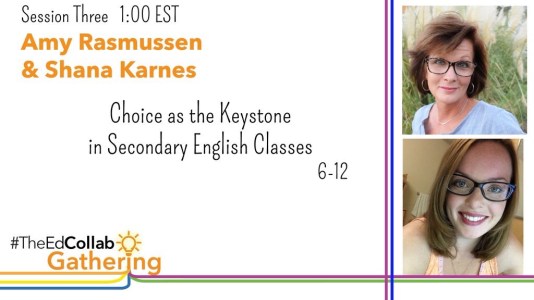
Shana and I were privileged to present a session during #TheEdCollabGathering on Saturday. If you joined us live, thank you! If you’d like to see our session, here it is. If you have questions we did not answer, leave them in the comments. We’ll do our best to answer.

Choice as the Keystone in Secondary English Classes

A big thank you to @iChrisLehman and the EdCollab Community.

Choice as the Keystone in Secondary English Classes

In a readers and writers workshop, everything comes back to choice.

Have you seen the movie You’ve Got Mail?  If so, you’ll recall the scene where Tom Hanks is giving Meg Ryan business advice.  “The Godfather is the answer to any question. ‘What should I pack for summer vacation?’ ‘Leave the gun, take the cannoli.’ ‘What day is it?’ ‘Maunday, Tuesday, Thursday, Wednesday.'”

It’s the same with choice.  “How will I know they’re reading if I haven’t read the book?”  They’ll be engaged, authentically, because they’ve chosen their books.  “How will I get them to want to revise their writing?”  They’ll want to strengthen the writing about topics and in genres they’ve chosen.  “How can I assess them if they’re all reading different books?”  You offer choice in ways for students to show their mastery–reflections, conferences, blogs, and more.

Choice is the keystone.img_1957

We have written about choice here and here and here.  It crops up again and again in our writing, thinking, and talking.

And we’re excited to talk more about choice with you all this Saturday, April 2, during The Educator Collaborative’s annual Gathering.  This amazing, free, inspiring day is the perfect way to spend a spring Saturday, as it will leave you energized, rejuvenated, and brimming with ideas.  It’s the modern PLC at its best, and the perfect way to help you finish the school year strong.

Tune in at 1:00 EST as we discuss choice as the keystone in English instruction.  We’ll share:

  • Research to support choice in literacy education
  • Strategies for teaching independent vs. small group vs. whole-class novels
  • Why conferring is at the heart of workshop
  • Writer’s workshop non-negotiables and the use of skills learned from independent reading

Please let us know in the comments, via Twitter (@amyrass or @litreader), or on our Facebook page what questions you have about choice as the keystone in secondary English classes.  We’ll be happy to answer them Saturday, and we can’t wait to see you there!

#3TTWorkshop: Asking Good Questions When Making the Move into Workshop

IMG_1279

Book talks about NF like Columbine by Dave Cullen and talking about the writer’s research process capture many readers

Shana and I recently conducted a two-day professional development workshop in Franklin, WI — such inspiring teachers in Franklin!

Franklin administrators asked that we help their teachers move into a workshop pedagogy, which is, of course, a favorite topic at Three Teachers Talk. We shared the background of workshop, which stems from the work of Don Murray and Don Graves, and from the work of our mentor Penny Kittle, whose ears had to be ringing and ringing since we said her name a million times throughout those two days.

Franklin teachers caught the vision and the value of letting loose the reins and opening their hearts to choice reading and writing. They just needed to experience it themselves from the seats of their students.

The discussion covers five of the pressing questions teachers asked during our pd.

They:  Where are some great places where I can get resources for books and materials for my classroom library?

Us:  The good news for Franklin teachers is the buy-in from their insightful administrators who have reserved funds to begin building classroom libraries. Not all teachers who catch the vision for choice independent reading, and the need for engaging, well-curated classroom libraries, are so fortunate. We weren’t. But finding resources and is certainly possible. Shana wrote this great post awhile back about grants she’s been awarded and the many businesses that give funds to buy books. Amy’s had great success with Donor’s Choose, one of the options Shana mentions. Three grant projects funded there so far! Lewisville Education Foundation has also been a great resource for Amy’s students and the books they love. Be sure you check out the grants offered through your own EF.

Other resources besides books are important, too. We spent time watching and responding to spoken word poetry with our new friends, modeling quickwrites, and studying the craft moves of these poets. Some of our favorite spoken word poets are Shane Koyczan, Sarah Kay, Phil Kaye, Marshall Jones, and Amy’s new favorite Harry Baker. Search online, and you’ll find YouTube videos and posts with the texts.

Engaging non-fiction articles are an essential in workshop instruction. Mentor texts, craft studies, and pairings with literature all make for authentic engagement with thought-provoking non-fiction. Find interesting articles at NewsELA, Izzit.org, Essay5W, and The Learning Network at the NY TImes. And, of course, the excellent mentors curated by our friends at Moving Writers.

They:  How can I design units that foster inquiry-based outcomes for my students?

Us:  We lead teachers in a gallery walk activity where they explored ideas of what authenticity, modeling, dialogue, inquiry, and other workshop essentials look like from both a teacher and the students’ points of view. It was interesting for us to see the many iterations of inquiry these teachers listed and how closely they overlapped with authenticity. Yes, they should.

However, getting students curious about learning does not always happen instinctively — especially when they come to us hardened by years of sit ‘n git classroom instruction. We must provoke inquiry, pique imaginations, inspire curiosity.  Of course, the move to choice opens doors to many of these needs. Providing, introducing, and talking about highly engaging literature helps. But so does allowing students to decide how they want to read it and what they want to do with it to show they are learning from reading it.

Teachers have to let go of control. We have to trust that students want to learn. We have to stop doing all the hard thinking for them. What if we let them find the mentor texts that best suit their needs as writers? What if we give them chances to determine themes they want to study, and then let them take those themes into other genres and ideas?

Let’s invite students into authentic and on-going research, so we move far far away from the one-unit-one-major-research-paper. Shana’s multi-genre project and my students’ engaging in our multi-modal feature article unit are good examples of how we apply this thinking in our own classrooms.

They:  I write every day for my job, but I have never written a “persuasive essay” for my job. How do I design authentic instruction that mirrors what my students might have to write in the future?

Us:  Read like a writer. Look for mentors everywhere. And know your kids. 

We know, if the answer was really that easy, everyone would do it. Although we do believe every teacher could. One way we’ve found to incorporate authentic instruction is to conduct regular craft studies of a variety of texts. We read a lot, and we look for texts in which we can discuss with our students topics like structure, literary and rhetorical devices, tone, etc. We call this reading like writers.

Shana and I agree, we first learned the value of reading like writers from Katie Wood Ray in her book Wondrous Words. Here’s a great Pinterest board to get you started. Shana and I will post the craft studies we find and use with our students more often. You’ll find several we previously posted when you search the “craft study” category.

They:  How do we hold students truly accountable?

Us:  In a word, conferring. We must talk to our students often and with purpose. 

sticky conferences

Modeling Silent Reading Conferences

Amy remembers when she first started moving students into self-selected texts how her conferences revolved around the books students read. Eventually, she realized that if she wanted to truly move readers, she needed to talk more to the student — as a reader — than about the book she was reading. This is an important shift in mindset and practice.

If we only encourage students to talk about the plot, summarizing this or that, maybe describing the characters, we miss out on valuable opportunities to help the reader stretch and grow in the skills she needs to mature as an independent reader. Identity matters.

Teachers foster a love of reading not by focusing on the books but by focusing on the reader of those books and helping those students identify themselves as readers. If you need ideas on conferring, Amy and Jackie discussed conferring in this #3TTWorkshop post, Amy wrote about conferring in a crowded classroom here, and Shana wrote about a what to read conference here.

Another important thing to remember about accountability:  We can ask students to write about their independent reading. Shana and I both ask students to evaluate their reading lives — several times a year. We consider these summative assessments, and students provide thoughtful commentary on how they struggle, grow, and succeed as readers. Amy quotes many of her students’ evaluations here. They are honest and insightful.

img_0331

Speed dating with books increases student talk about books, which increases students reading good books

When we ask students to write about their reading, it must be a task they see as worthwhile — and one we see as a support to our ultimate goal:  developing life-long readers. Too often, we read about teachers who punitively assign tasks to “catch their students not reading.” If this is you, please stop.

They:  How do I create engagement not compliance due to grades?

Us:  Choice. Choice leads to engagement. Engagement leads to autonomy. Autonomy leads to independence. Independence is engagement.

Trust the process, and see for yourself.


The Best Lesson Series: What Makes a Work of Literature?

NTCE Affiliate Breakfast with Shanna Peeples, 2015 National Teacher of the Year

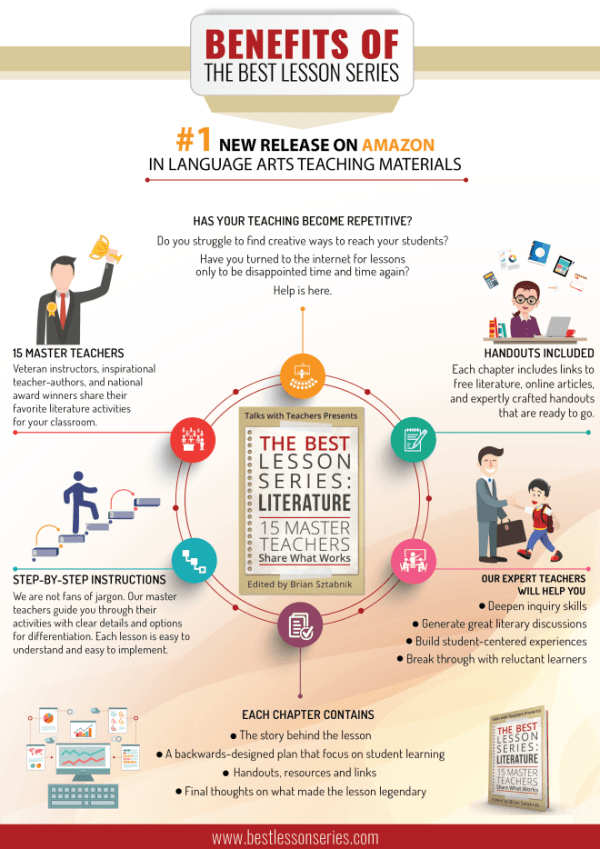
A few weeks ago I read this post by Shanna Peebles, the 2015 National Teacher of the Year, “Building Bridges with Visual Literacy.” She writes about her lesson in the book The Best Lesson Series, a book in which I also contributed a favorite lesson. Shana includes the background of her lesson, an experience and a realization she had when she began working with refugee students many years ago.

Reading Shana’s blog, I reflected on my own refugee students. Mine come from Myanmar, most having walked through Thailand at night holding the hands of younger siblings while moving toward their fathers who left their villages months before to secure passage for their families. These children grew up fast and they hope for much. They study hard because they know the value of education.

They represent the reason that I teach literacy: It is through literacy that we gain power.

The way to grow as literate individuals is to read. I’ve heard my mentors say it again and again: “The only way to develop readers is to get them reading” and “The only way to learn to read is to, well, read.”

Of course, the same holds true for writing.

The lesson I contributed to The Best Lesson Series pertains to both. Here’s the background of my lesson:

I am not one of those readers who jumps to the last few pages to read how a book ends before I have ever started it. I do not understand those people. At all. I like to savor a good book, take it slow — sip the beauty as I breathe in the language, sigh with pleasure as I see how the words work to shape meaning. Or, I like to devour a book in one sitting, curled up on the couch, holding my breath and gasping for more. So, it’s a little surprising that I pulled the last paragraph of a book to use as a craft study.

I promise it gives nothing away. I also promise:  You may just shudder at the loveliness of the language like I do. Or not. Seems some critics panned The Goldfinch by Donna Tartt while others raved about its uniqueness and style (See the Vanity Fair article “It’s Tartt, But Is It Art?. Of course, critics cannot seem to agree on what makes a text literature either. (See the Harper’s Magazine article “What Is Literature? In Defense of the Canon”.)

The author of the article about Tartt’s work poses the same question I ask my students to ponder each year:  What makes a work of literature, and who gets to decide?

Since mine is a workshop classroom where our primary focus is writing, students choose the books they read. That is not to say we do not read high-quality complex literature or read literature as a whole class. We read many passages together and learn skills that students then apply to their independent reading and the novels they discuss in book clubs four times a year.

My goal with books is to develop readers, and too many of my students did not read when I made all the decisions about their reading. However, many of my students do not know how to choose books they might enjoy or books with enough complexity to challenge their thinking. The drive to fulfill my goal to develop readers becomes multifaceted. Allowing choice means I must constantly be on the lookout for richly written passages that we can study, and I must read volumes of high-quality literature, YA and adult alike, so that I may match my adolescent readers with good books.

I love the last paragraph of The Goldfinch because I can use it for several learning opportunities. This short passage can teach us much about what makes a work of literature. I agree with researcher and reading theorist Louise Rosenblatt:  “Students need to be helped to have personally satisfying and personally meaningful transactions with literature. Then they will develop the habit of turning to literature for the pleasures and insights it offers.”

And that’s the whole point, isn’t it?  We help our students love literature so they learn from it as we do.

____________________________________________________________________________________

It’s an honor to be a part of this work. I am surrounded by inspiring educators with intriguing and thought-provoking ideas, and I hope you will consider adding this title to your professional library so you will be surrounded, too.

Teachers sharing with teachers what works. That’s the best pd I know.

benefits of best lesson series


Writing My Wrongs: How I’m Learning From My Mistakes

FullSizeRender

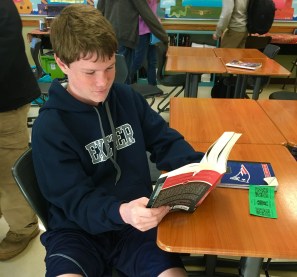
A student caught sneaking his independent reading book into his lit circle novel…this is a first.

Every year I arrive at the second quarter with a new approach, idea, or plan.  This will be the solution! I think.  This will sustain momentum.  This will help us make it through the slump.  This will be the difference between dreading quarter two and praying for quarter three, but year after year, I am wrong.  For the past three years I’ve convinced myself it is the book—Lord of the Flies is too boring; they can’t appreciate Bradbury’s language in Fahrenheit 451.

The problem isn’t with my students though—it’s with me.  I am doing it wrong, and while I am ashamed to admit the honest truth, I realize now the error of my ways.

I “gave up” traditional teaching three years ago, when I transitioned to a workshop model of education.  I carved out time for reading, instated notebooks, poured over workshop guides, and asked countless questions of my mentors and colleagues.  The bare bones were in place, and I was convinced that I had the structure necessary to shift from a teacher-centered classroom to a student-centered classroom built on choice.  In many cases I did; every start of the school year began smoothly with excited readers and passionate writers.  We told stories, read poetry, shared quick writes, and analyzed craft, but I dreaded quarter two, the quarter when together, we would read our first of three required whole class novels.

Quarter two was when I lost their voices, their attention, and their passion.  With whole class novels, our focus shifted from “who are you and what are you thinking?” to “who is your author and what is he thinking?” 

Under the weight of scaffolding, curriculum standards, core competencies, and competency based rubrics, my mini-lessons focused on literary terminology instead of literary exploration.  To me, reading mini-lessons meant teaching the same terms I’d grown up with: symbolism, Freytag’s pyramid, direct and indirect characterization, round and flat characters, etc.  This meant my lessons shifted from writing-centered lessons that started with the question, “What do you notice about the author’s craft?” to terminology-centered lessons, that started with, “Apply your understanding of (fill in the blank) to the book.”  The latter produced significantly less empowering results.

So, I asked and probed my students.  I peppered them with questions during study halls and extra help; I snuck in questions with the straggling Writer’s Club members after meetings, gave out surveys, and chatted at lunch with colleagues.  And while I was convinced that it was because I was “forcing” them to read unrelatable classics, I couldn’t shake the fact that I was missing something bigger.

By the time I sat down with my living mentor Linda Rief at a coffee shop in Exeter, I realized I was doing it wrong in quarter two.  The pieces gradually added up—I knew the three reading options I had given them for literature circles weren’t choices at all.  I was hoping they would read the books in their entirety, but I knew that this year would lend itself to additional groans, frustration, and abandonment.  At the end of the day, I was a workshop teacher defaulting to a traditional methodology or worse, was I a traditional teacher pretending to run a workshop?

The two greatest pieces of advice came first via my special educator mother, who asked, “Why not just teach them good writing?  Isn’t that what classics are?” And second through Linda Rief, who pointblank asked me why I needed to teach plot triangles anyways.

Were there successes in my literature circle unit? Most definitely.  Sure, the vast majority didn’t fall in love with Golding, and it breaks my heart that they couldn’t revel in the beauty of Bradbury’s language, but in final surveys, nearly every student appreciated the time they had to discuss the novels in small groups.  They enjoyed talking about the stories with peers, and while not all of them loved the books, many pointed out that this was the first time they engaged in authentic conversations about literature without a teacher moderating the discussions.  They learned; they just didn’t learn the way I had hoped.

Part of me feels like I lost four weeks that we could have spent more effectively growing together as readers and writers while looking at the beauty of craft in book clubs centered on young adult lit of their choosing.  The other part of me feels like I failed my students in providing this idealized version of what I hoped our class would be and then slamming them back to reality with the same sort of stock analysis I question.

I am impatient when it comes to growth, particularly when it comes to my teaching.  While I understand my students’ needs as developing readers and writers, I am quick to judge my own struggles.  Even as an intern, one of my personal goals was “to be at the level of a second year teacher.”  I repeated this mantra knowing full well that the only way to be at the level of a second year teacher was to be a second year teacher.

All I can promise my students is that I will continue to reflect, move forward, and become the teacher they deserve.  But alas, growth takes time, trial, and error.  It requires me to unravel years of traditional education, analyze what works, what doesn’t, what I should carry with me, and what I can discard.  It will take time for me to unwind my own brain just as I ask my students to unwind theirs.  I am still learning to be a writer, a reader, a student, a teacher, and that takes time, time that sometimes feels all too precious when I only have one year with my kids.  Fortunately, teaching is like writing.  Every day, I begin the process of drafting a new story, and every year, I get the chance to revise my work.

Our Year-In-Review

As we round out the 2014-2015 academic school year, I would like share our Year-In-Review from us here at TTT and dedicate it to all of our loyal and contributing teacher friends who share in our experiences throughout the year.  Playing with the Reading Writing Workshop model is always exhilarating and fresh and exciting and freeing and thought-provoking.  It’s always propelling us, as educators, to break through barriers and teach with our most authentic teaching souls.

So, to capture the essence of how we have all explored the model this school year; here are highlights that allow us to celebrate the risks, the questions, the stumbles, the ‘ah-ha’s, the setbacks, and of course…the successes.  As we are all still progressing through this last month of our current school year, we hope that resurfacing some of our favorite moments will ignite the fire that keeps us all educating with fierce passion, deep inquiry, and continual evolution.

The calm zen of the RWW in Texas.

The calm zen of the RWW in TX.

First up: The lovely Amy Rasmussen who never ceases to amaze all of us with her wit, wisdom, and wildly insightful thinking.  Here is a woman who has taken the RWW by storm and has not looked back; the only time she does is to pick up, dust off, and gently guide those who are trying to find their way through the process.  She is an excellent mentor and extraordinary educator who ensures that her Advanced Placement students are gifted the wonders of the RWW. Here is a collection of how Amy has guided us through the intricacies of customizing the RWW for our own learners:

A Feedback Protocol for Revision Workshop

5 Reasons Why Reading Conferences Matter — Especially in High School English

5 Ways to Enjoy the Last Month of School


A reminder of student movement and achievement.

A reminder of student movement and achievement in NH.

Next: Jackie Catcher’s name could not be more appropriate.  We know the catcher’s responsibility on the field is to guide the team to strategic success; Jackie does the same infield – in her classroom. She moves her students with her unyielding dedication through continual infused literacy by craftily customizing projects and lessons that engage students. She is a powerhouse who, through all the struggles and obstacles of a second year educator, never ceases to find innovative ways to educate and inspire.  Most importantly, she is always a learner first and shares her inquiry with others to not only think collectively, but to create success-driven solutions.  Here is some of her story:

Building My Library Around My Students

Unraveling the Mystery of Poetry

The Question That Changes My Students’ Writing


A bright and energetic learning environment in WV.

A bright and energetic learning environment in WV.

Thirdly: The always-invigorating Shana Karnes. Shana is a shining light to her students, yet her light shines brightly for the world of evolving educators as well.  She is open to sharing her passion, her innovative thinking, and the way she creatively customizes the RWW for her students in the throws of West Virginia.  Shana never loses sight of how vital piles and piles of literature are for the growth of her young readers and emerging writers.  She knows how to roll up her sleeves and do the work right beside her scholars.  It is through the sheer joy of all things literacy, that Shana explores the world of the RWW:

We Learn Facts from Fiction

Teach Readers, Not Books: A Case for Choice Reading in ALL Classes

The Value of Talk


The shelves where our identities are qualified, our ideas solidified, and our passion realized.

The shelves where our identities are qualified, our ideas solidified, and our passions realized in NY.

Rounding it out: Erika Bogdany.  Through the RWW I have challenged my students, and they in turn, have challenged me.  They push me continually with their own inquiries and want to be more fluid writers.  They challenge my writing by offering suggestions and insight that I have bestowed upon them; the gift of creating a safe community for all learners to read, write, risk, and share.  It is through the RWW that students find pride in their work, volume in their voice, crafted secrets in their writing, and beauty in themselves.  It is with passion and grace that students flutter and flop; yet learn how to fly:

All it Takes is a Tutu and Some Focus

Beyond These Four Walls

Today We Draw


We hope that our moment of reflection and celebration continues to provide you ideas and inspiration throughout the remaining time you have with your unique readers and writers this year.  We’d love to continue hearing your voices, feedback, and generous insight while we round out this school year…and look forward to the year ahead!

Reflection, Rejuvenation, Rebirth

May and June always bring sunnier skies, feistier students, and more hopeful days.  Like Amy, I enjoy the last weeks of school, and often spend many of them feeling proud of my students, making big plans for the next year, and reading a ton in order to ramp up my booktalks.  This time of year is my time for reflection, rejuvenation, and rebirth.

ReflectionFullSizeRender

This spring, I’m excited that I have the opportunity to participate in a National Writing Project course, which is uniting me with other English teachers from my area.  Talking with them has helped to energize me even more so than usual at this time of the year, and some of their words have really helped me reflect.

First, my notebook musings during our first class led me to a powerful play on words–listening is at the heart of our teaching.  I’ve written before about the value of talk, but I’m thinking long and hard now about the power of listening…truly hearing our students’ hopes and strengths and worries and wonders.  I’ve paid special attention to emphasizing listening in my lessons these past few weeks, because I know I won’t get to hear these wonderful students’ words after the year ends.

Later in the NWP class, while assessing some of our students’ written products, we were asked to identify the skill we had been aiming to teach, and then evaluate how well our students internalized that lesson.  Claire, an elementary teacher, said that it was impossible to look for just one thing–“Writing is so…big,” she said.  I couldn’t agree with her more.  As I read my own students’ work, I saw themes of my own pedagogical beliefs running through their writing.  They were using beautiful language, inspired by our daily poem or craft-study quickwrites, in all of their writing–nonfiction too.  They were writing strong pieces thanks to the risks they felt safe taking in their choice of topic, genre, and style.  They were producing prolifically, writing long, short, funny, serious, sad, exciting, fiction, nonfiction, poetry, prose–everything.  Their portfolios are thick with creation.  Writing is big, indeed.

IMG_8049Rejuvenation

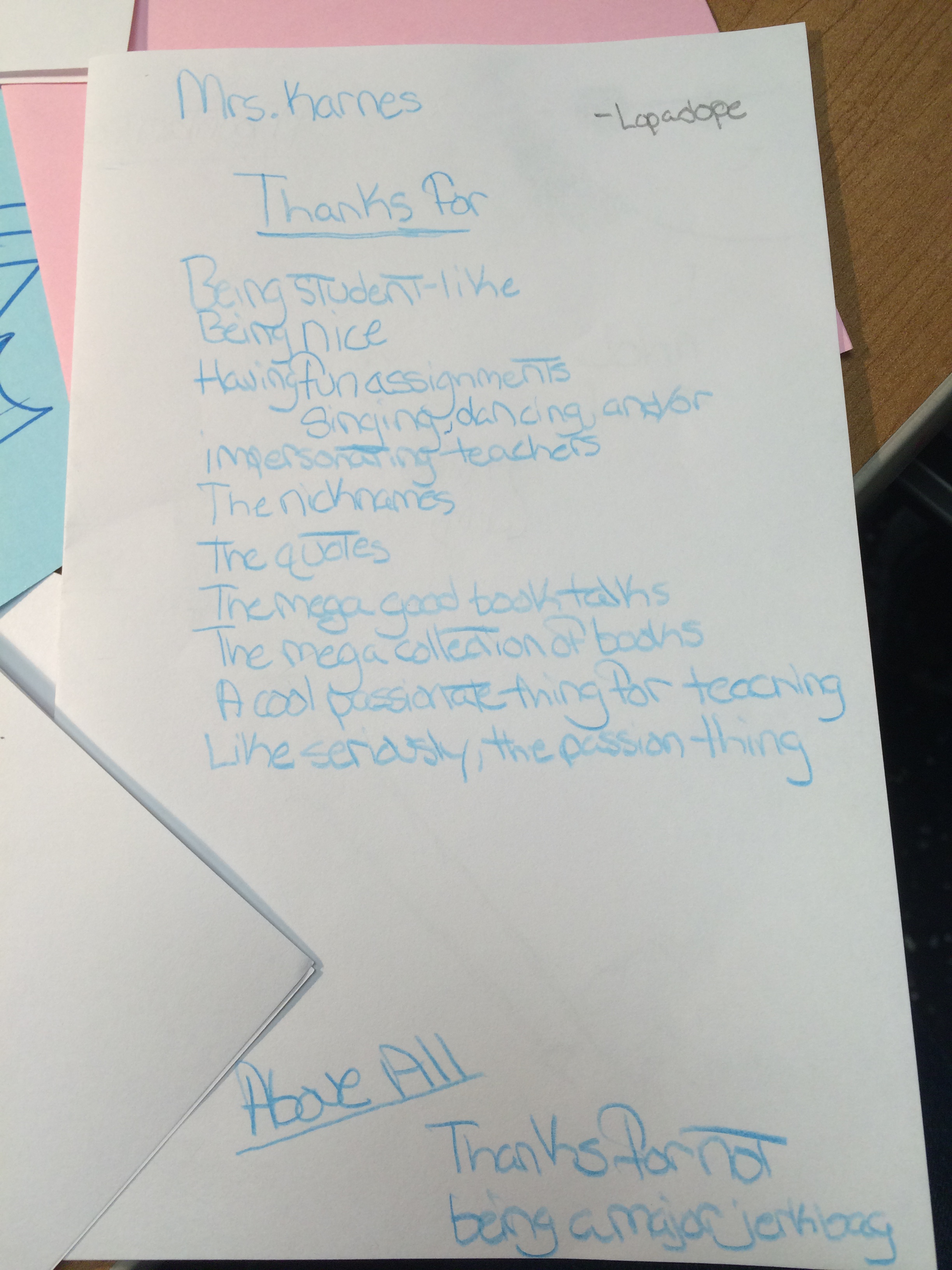
It’s Teacher Appreciation Week, and with that came some delightful thank-you notes from my students.  One student made a list of things he was thankful I did, and he repeated how thankful he was for my “cool passionate thing for teaching…like seriously, the passion thing.”  I recently read an article in the Chronicle of Higher Education that claimed the four properties of powerful teachers were personality, presence, preparation, and passion.  I like to think of passion as fangirling, which I do on a daily basis about books, student writing, authors, and all things bookish.  I’m never sure how much of that passion reaches students, but since this one specifically noted the “mega good booktalks,” I think it gets through to at least some kids.  This thank-you note really rejuvenated me, and now that I know my booktalks are working, I’ll keep at them with new gusto until June 12.

IMG_8027Rebirth

Continuing to revise and change my curriculum doesn’t stop because the year is nearly over.  I’m still wildly out of control on Amazon, buying titles as I get ideas for new units, themes, or genres (like the huge list of novels in verse I jotted down during our #poetrychat Monday night).  A new focus on science fiction, poetry, and nonfiction has been what I’ve noticed in my cart of late.  I am changing as a reader and a teacher, valuing those genres more than I once did, making a strong effort to transfer that new passion to my students.

My teaching philosophy is constantly shifting, evolving, being reborn.  Its biggest shift this year, I think, can be best summed up with a quote from another NWPer from my class last week.  While talking about meeting and learning from great teachers at NCTE, he said he felt like they were “the Wizards of Oz, but they were inviting me to peek behind the curtain.”  I love this analogy, because while great teaching may seem like unattainable magic, I now feel like I understand how to be effective.  I’ve studied living, breathing mentor texts like Penny Kittle, Tom Romano, Amy Rasmussen, Jackie Catcher, and Erika Bogdany, and am looking forward to learning from Tom Newkirk at UNH this summer.  In the past two years, I’ve been reborn as a teacher, whose confidence has grown as I’ve continued to strengthen my practice by dissecting and imitating the successes of others, just like my students do when we analyze mentor texts in class.

Springtime is a time for reflection, rejuvenation, and rebirth.  Nature is no different from my teaching as I think about this year and next, and about the beauty of its constant blossoming and change.  I know our last six weeks will fly by, so I’ll enjoy every moment of them before the luxurious summer begins!

What are you reflecting on this spring?  What has rejuvenated you as the year comes to a close?  What elements of your teaching will be reborn this year or next?  Share in the comments!

Launching an Official Monthly #poetrychat

Screen Shot 2015-04-23 at 2.49.34 PM

Evidently, there is not an official #poetrychat, but isn’t it a sweet idea?

Poetry serves as an important and beautiful lens into the literary world, and it deserves more than a hurrah during National Poetry Month.

I find that the more I talk about poetry the more I use poems in my classroom. Not like that’s a big surprise. The more I talk about books the more my students read.

So, I’ve been giving this a ton of thought. Do I want one more grape on my plate? And the answer has to be yes.

Today @JasonCarney5 artistic director of Young DFW Writers gave a pitch to my English department. Would we like to be a school that takes advantage of the Louder Than a Bomb program?

Um, yeah.

Meeting Jason and hearing about how his introduction to poetry changed the trajectory of his life was another testament to the power of poetry and what reading and writing it can do for a young person.

Aren’t we as literacy educators always looking for ways to engage and empower our young people and give them opportunities to grow as readers and writers?

So, yes, even if I get YDFW at my school next year (which I’m pretty sure is a done deal), I still feel the need to join other educators who are passionate about the “art” in language arts for a monthly poetry chat.

The teacher-writers at Three Teachers Talk are starting a monthly poetry chat. We hope to connect educators and poets, and work to infuse poetry into the year-long curriculum of ELA classrooms.

“A Poem about Topics for a Poetry Chat”

Spoken-word poems,

prose poems

found poems

spine poems


Ways to share student-written poems


Poetry to teach allusion,

imagery

syntax

grammar

self-respect


Books in verse

Verses for book talks


We will meet the first Monday of each month at 8:00ET, directly following #engchat at 7. Remember to use the hashtag #poetrychat — and to have links ready to your favorite poems and lesson ideas.

Mark your calendar for Monday, May 4 at 7:00 pm Central Time.

Leave your ideas for topics in the comments. Thanks!

Guest Post: Changing the Reading Culture in Our School One Book at a Time

Both Penny Kittle and Kelly Gallagher have transformed my thinking as a high school literacy coach.  As a former elementary school teacher, I had always used reading/writing workshop, literature circles, and choice in my classroom.  When I transitioned to being a reading specialist/literacy coach in a high school, I really struggled with the whole class novel approach.  It didn’t work for me with the little ones and I saw more and more of my students struggle with it at the high school level.  Attending workshops offered by Gallagher and Kittle, along with reading everything they have written has given me the reassurance and the research that this approach CAN work in a high school.  Here is what has happened at my high school in just six months:


More and more teachers are trying it…

It all starts with one teacher and the support of a department chair.  Last spring after sharing what I learned at Penny Kittle’s Book Love workshop, one teacher decided to drop everything he has been doing in English and take on the “Book Love” approach.  He had so much success getting students to actually read books and improve their writing that two other teachers decided to jump in second term and teach English through choice and mentor texts.  The results were astounding. Word spread at lunch and in our PLCs – students were engaged and excited to come to English class.  Then at the beginning of term three, we had four more teachers jump in.  I am not sure if it was the “positive peer pressure” or hearing about students’ engagement, but little by little teachers have been asking about how to structure their classes in a way to make this work.


Teachers are reading more and talking about books…

At times during lunch teachers used to vent about the struggles they had motivating students to complete the reading from the previous evening, or how students bombed the reading check, but now the conversations are about books. We are talking about what we are reading, what our students are reading, what mentor texts we are using, and what changes we see in our classrooms.

Thanks to one teacher’s organization and determination, staff members are swapping rooms once a week and book-talking to students that they don’t teach.  The other day the principal’s secretary came in to our freshman class and book talked The DaVinci Code.  After she left, I saw that several students had added that book to their to-read list.

None of this would even be possible if our teachers weren’t willing to read new books.  Teachers are setting their own reading goals, keeping to-read lists, creating book trailers, etc.  For the past two years we have had “I am Reading” posters outside of our classroom doors, but this is the first year teachers are updating their posters more often and students are noticing the books.


Our library is busier than ever before…

We have a beautiful library that has a lot of books that just didn’t get checked out.  This year that has changed.  Last year from August until the end of February, only 4821 books were checked out and 63 books were placed on hold.  This year in the same time period 7333 books have been checked out and 137 books were placed on hold.  That is over 2500 more books being checked out and 74 more books being asked to be held.  Why the change?  Student choice!

Students now come to the library with a purpose.  They have a to-read list (some that are pages long) and if all the books they want are checked out, they can give us a good idea of what they want to read next.  As one of our English teachers told me, “They are thoughtful about what they are looking for if they go to the library.”  He doesn’t worry anymore about students going up to the library trying to “leave class” or “waste time.” Another teacher shared how his students “know their favorite authors and/or recognize titles that have been book-talked.”  They are talking to each other about books and recommending new titles to each other.  They are even checking out 2-3 books at a time.

Our library staff is also trying hard to find ways to get books in our students hands.  Our librarian has shared ARCs with classes and spends time in the classrooms promoting tons of books – the new ones and some of the oldies but goodies that haven’t been checked out in a while. The staff has started creating competitions each month to encourage students to read (Abe Lincoln Award voting, March Madness book bracket challenge, etc) new books.  The library is no longer just a place for students to come and get homework done.


Students are reading….

They really are reading and not just the “YA” books that naysayers worry about.  Prior to taking this approach, students came into classes either as students who read all the time (1-2), students who only read assigned books, students who fake read assigned books, and students who didn’t even try fake reading the assigned books.  As one teacher pointed out to me, “As soon as choice became an option, reading, for the vast majority of the students, became fun again!”  They began forming a reading habit that had been lost so long ago.

The issue is no longer trying to get students to read anything. They are reading more consistently than ever before.   Instead of dealing with them reading zero pages in a week, teachers are finding ways to increase student stamina from 50 to 150 pages in a week. That in itself is a huge success.  Students come to class early and start reading their books.  They can even be found reading as they walk down the halls. One boy almost knocked over an upperclassman in his attempt to finish the chapter of his book.  Once a week I co-teach in a freshman English class.  Of those twenty-one students, I think only two students have finished three books.  The rest have read an average of six books in nine weeks (snow days and all). Instead of worrying how to encourage our students to read common texts and pass the reading checks, the challenge is having enough books that interest all of our readers.

Our students ARE challenging themselves – reading more, picking nonfiction, moving up the reading ladder, and trying new genres based on what others have recommended to them. I had one boy in my homeroom start with Hatchet by Gary Paulsen in January and stretched and read Escape From Camp 14 by Blaine Harden for book two.  It was definitely challenging for him, but he didn’t give up on it and was so proud when he finished it.  Other teachers are finding the same thing – students are willingly picking up books from Fitzgerald or Vonnegut, or Hemingway and are able to have real conversations about these books from their perspectives. Students are talking about books with each other AND coming up to teachers and discussing books with them. Because of the location of my office (the library), I tend to do book talks quite often when kids come upstairs and are looking for something new to read.  One of my favorite memories from this winter was a girl who had seen my Goodreads list and made her to-read list off of some of my favorites.  After she finished To All the Boys I’ve Loved Before by Jenny Han, she asked her teacher if she could come find me and talk with me about it.  She had loved it so much and wanted to thank me for introducing her to that book.These students aren’t afraid of looking smart or nerdy – they are proud.


The culture is changing…

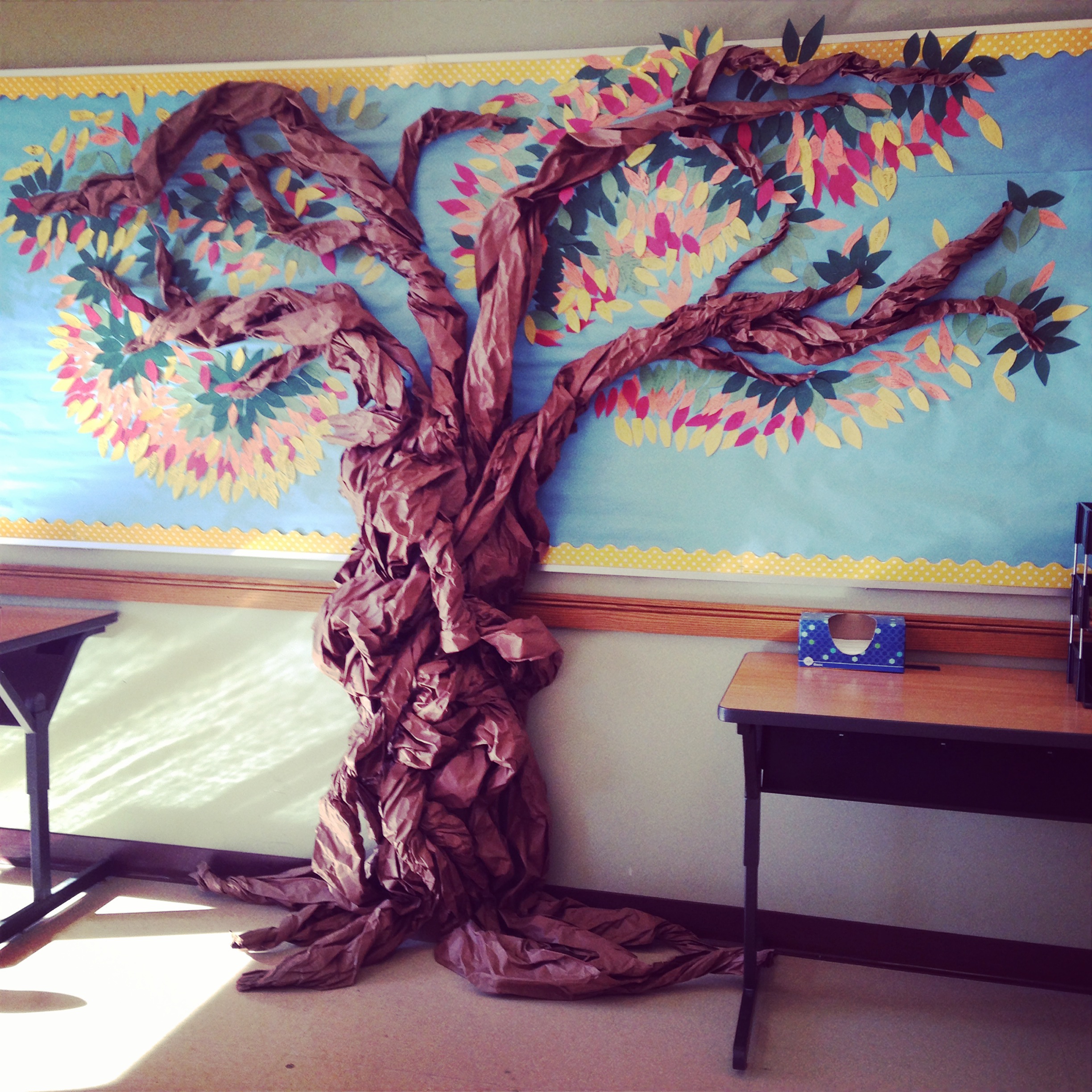
Students are now immersed in books wherever they turn.  Between our March Madness Book Bracket challenge, I am Reading posters, Classroom Reading Trees, the Health class independent reading project, random teacher book-talks, etc. students are reading more than ever before.

Melissa Sethna @msethna23 is a high school literacy coach in Mundelein, IL. She has always had a passion for books, technology, and working with adults. In her free time, she loves to read.  She’s a strong believer in book choice and sharing her joy of literature with her family and students. She says, “I wouldn’t be the teacher I am today without my reading heroes: Penny Kittle, Kelly Gallagher, Kylene Beers, Bob Probst, and Donalyn Miller — who inspire me to take risks, and I try to encourage others to do the same.”

The Modern PLC

Sometimes things stay with you. In December I got this message:

I have been working with three teachers this fall who have transformed their classrooms (all ranging from freshman level to AP Lit and AP Lang) from the traditional class to a readers/writers workshop approach.  Your blog posts always show up in my email box at the exact right time when they are in need of inspiration to keep going and figure out what to do in their classes.  They realized very quickly how fast they were able to get through “old curriculum” when they dropped the class novel approach and were then scrambling to find new and exciting mentor texts, books to share, and additional writing ideas. Their students have read thousands of pages and enormous amounts of books which never happened in their classes before.  Students were writing them thank you letters for inspiring them to become true readers and writers.  Penny Kittle’s books got them started on this path, but your real life teacher posts have helped them validate what they are doing.  So… thank you and keep those posts coming.  They are making a difference in our classrooms.

I could write a book about the value in that feedback (Probably will). Feedback should make writers want to write more. That is exactly what Melissa Sethna’s kind words did for me and my friends here at TTT.

Her simple thanks also made us want to follow her work, support her even more, watch how she helps other teachers. We’ve become colleagues with a united purpose. We’ve become friends.

And that is the beauty of the modern PLC.

A literacy specialist in Mundelein, IL sends a thank you to a teacher/blogger in Lewisville, TX, which makes the teacher/blogger want to become a better teacher so she becomes a better writer so she writes more inspiring and instructional blog posts for other teachers and so on.

Teachers supporting one another as we do our best to do right by the children that we teach. As ELA teachers the best way we know how to do that is through balanced literacy practices in readers and writers workshop.

That’s the foundation for the Three Teachers Talk blog, which started as three friends committing to stay in touch by sharing our work through our writing. We are four teachers now — writing, sharing, and growing. And participating in a Professional Learning Community that’s been redefined, refocused, and restructured by connected educators around the globe who are just like us.

Thank you, readers, for being part of the best PLC on the planet.


Note: Melissa Sethna posts as a guest blogger here tomorrow. Her work inspires us.

©Amy Rasmussen, 2011 – 2015