Category Archives: Professional Development

Defining Readers-Writers Workshop

“I need a visual of a ‘workshop.’ That word confuses me still.”

This is not the first time I’ve been part way through facilitating professional development and a participant has made a similar request. There’s a lot for me to learn here.

Before we can begin really sharing the excitement and benefits of a readers-writers workshop model of instruction, we must get on the same page as to what we mean by Workshop. I’ll try to do that here.

Let’s start with the dictionary definition of workshop and zero in on #2.
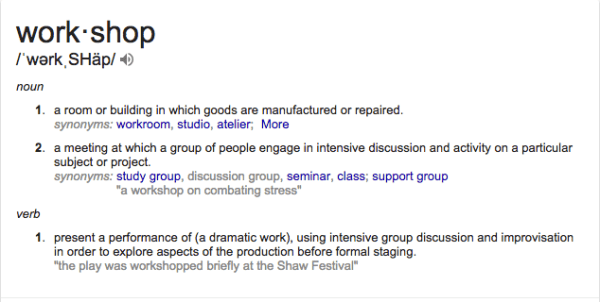
workshop definition

Based on this definition, let’s consider this essential question:

How do we create open spaces where the children we teach can grow as readers and writers?

To me “open spaces” equates to “workshop.” Open spaces means teachers let go of control, remove themselves from center stage as the holders of the knowledge, and invite students into a space of curiosity and discovery. It’s a space where students thrive in a community of trust and sharing, where they talk about their identities and experiences as readers and writers, where they play with language and take risks as they explore what it means to develop their comprehension and analysis skills — and their craft as writers.

Opening spaces requires planning. It is not willy-nilly choice in books or topics, or stations without specific guidelines and instructions, or seats moved from rows into small groups without modeling the thinking that makes it possible to “engage in intensive discussion and activity” around our content. Teachers must model what this looks like. And we must trust that our students will engage and learn in this model.

They will — if we let them.

Readers-writers workshop is a method of instruction that often requires a paradigm shift, a shift from the teacher making all the choices and telling students what to learn within a text, to students making choices, and through practice and application of skills-based lessons, learning as they read and write.

I’ll return to some definitions found online to help clarify:

“The Reading Workshop is a teaching method in which the goal is to teach students strategies for reading and comprehension. The workshop model allows teachers to differentiate and meet the needs of all their students.”

For our readers, we open the space for students to choose the books they read. By doing so, we meet students where they are in terms of their interests and abilities. The teacher becomes a coach, teaching skills specific to the needs of each learner. This requires time. We must reserve time for students to read when they are with us in class, and we must confer with students about what they are reading — and how they are reading it. This is reading instruction in a workshop model. We teach the reader, not the book. Readers must predict, visualize, infer, comprehend, analyze, and evaluate. These are all skills we model and teach in readers’ workshop.

What about writer’s workshop?

“As in a professional writer’s workshop, each student in the class is a working author. The teacher is a writing professional and peer coach, guiding authors as they explore their craft. … Teachers write with their students and share their own work as well.”

To teach our writers, we must be writers ourselves. We must model the moves writers make as they use language to craft meaning. We must validate our writers and help them recognize what professional writers do to think of ideas, organize those ideas, and convey those ideas in a way comprehensible to readers. In a workshop classroom, we use mentor texts:  sentences, paragraphs, passages, essays, poems, stories to teach writing skills that students apply to their own writing. We teach the writer, not the writing.

workshopquestion

So, what do I mean when I say “workshop”? I mean students doing the work of readers and writers, “engaged in intensive discussion and activity on a particular subject” — specifically related to growing as readers and writers. This work happens because teachers open the spaces in their classrooms which allow for it.

Questions about your move to a workshop model of instruction? Please ask in the comments.

Amy Rasmussen lives in north Texas and teaches AP English Language and English 4 (new prep in ’17. She loves talking books, daughters’ weddings (two this year), and grandbabies (five). She also loves facilitating PD for other teachers making the move into a workshop pedagogy. Amy adheres to the words of Emerson: “We aim above the mark to hit the mark,” and Jesus: “Love one another.” Imagine a world if we all aim higher. Follow Amy on Twitter @amyrass. And she really hopes you will follow this blog!


A Call for Real Opportunities to Learn — Not More Test Prep

Natl Literacy Trust Survey 2016

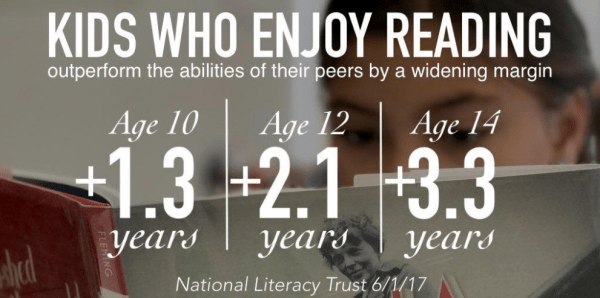
Of course, this data caught my eye.

My friend Gary Anderson posted it on Facebook with this link to the National Literacy Trust Findings from their Annual Literacy Survey 2016: Celebrating Reading for Enjoyment.

I had just spent the day working with teachers in Clear Creek ISD as they launched their two week STAAR Academy, a series of summer school-like classes designed to immerse students in authentic reading and writing — not the typical mode of tutorials often offered in the hope of helping students pass their state mandated English exams.

Billy Eastman, Clear Creek ISD High School ELA and World Languages Coordinator, is a visionary who believes in his teachers and in the students they serve. He knows that when students choose books they want to read, experience learning in an environment that validates their personal lives and learning journeys, and are given space and instruction that allows them to write about the topics that matter to them, students grow. They grow in confidence, and they grow in ability.

Thirty-five teachers met with me in a two hour institute this morning. We read and talked and wrote and talked. We built a community of teacher-readers and writers. We engaged in learning — all with a central goal:  How can we create a space for all students to advance as readers and writers?

Then, teachers planned. In teams they designed lessons intent on engaging students as real readers and writers — not just students reading and writing for a test.

After lunch, teachers facilitated similar community building activities with the roughly 250 students attending the academy.

With generous funding by his district, Mr. Eastman was able to provide books, lots of new high-interest YA literature, in which students could choose a book they want to read. This is the first step in “celebrating reading for enjoyment” and all the benefits that come with it.

As I visited the 12 classrooms this afternoon, I witnessed students writing and talking about their reading lives.

“I like stories okay,” one boy said, “but I don’t like to read.”

“I’m not really into reading,” said another.

“Reading isn’t my thing,” another boy said.

I asked one young man if he liked to read, and he told me: “Yes, I read a lot.” He had just selected Scythe, the new book by Neil Shusterman, and I could tell he was eager to get started reading it. He’d already read Unwind and quickly told me how much he enjoyed that series. The other three students in this boy’s small group were less enthusiastic about reading anything, but they were willing to try. One chose Still Life with Tornado by A.S. King, another Boy 21 by Matthew Quick, and the other Out of Darkness by Ashley Hope Perez.

As I observed every classroom this afternoon, I noticed a few things:

  • The ratio of boys to girls in most every classroom was at least 4 to 1.
  • Boys want to read books that look “tough.” The cover has to captivate them.
  • Girls will choose books with male protagonists more often than boys will choose books with female protagonists.
  • Few students choose historical fiction — they seem drawn to realistic fiction and dystopian.
  • Many students chose books teachers might deem too difficult for them. (One of the most popular book choices offered today was All the Light We Cannot See, which won the Pulitzer Prize in 2015.)

For the next nine weekdays, students will read their chosen books and spend time engaged in their community of learners. They will practice the moves of real readers and writers as teachers practice the routines of readers-writers workshop and read and write beside their students. Besides the obvious benefit for students, teachers will engage in the kind of professional development that truly matters, the kind that gives hands-on experience with students as they practice the art and craft of teaching.

I am excited for the outcome. I am excited that teachers are excited. I am honored to be a part of Mr. Eastman’s vision for his district.

So what does this have to do with the National Literacy Trusts’ Annual Survey? A lot.

As I read through the report this evening, I found nothing startling or surprising. Of course, there are advantages to reading for enjoyment.

But then I shifted my thinking and began questioning the why and the what. Why does the data say what it does? Why are their gaps in enjoyment between boys and girls? Why are their gaps between age groups? What is happening in schools that might be causing these gaps? What is happening in students’ lives that might be causing these gaps? What can change if we approach reading and writing instruction differently? What should change?

I challenge you to read the report and ask yourself similar questions. Then, I challenge you to take the next step:  follow Billy Eastman’s lead. Whatever your sphere of influence, how can you allow a space for reading for enjoyment? And if you haven’t done so yet: How can you change the model of instruction in your classroom, in your school, or in your district so all students have the chance to become real readers and writers who enjoy what they read and write?

Don’t all students deserve similar opportunities to learn — not more test prep?

Amy Rasmussen lives in north Texas and teaches AP English Language and English 4 (new prep in the fall). She loves talking books, daughters’ weddings (two this year), and grandbabies. She also loves facilitating PD for other teachers making the move into a workshop pedagogy because it keeps her focused on her own improvement. Amy adheres to the words of Emerson: “We aim above the mark to hit the mark,” and Jesus: “Love one another.” Imagine a world if we all aim higher. Follow Amy on Twitter @amyrass. And she’d love it if you follow this blog!