Category Archives: Conferring

A scaffold is a scaffold…

As a curriculum coordinator this time of the year gets blurry. I have begun to mold what our summer curriculum work will look like, so naturally I forget that it’s still the current school year and start thinking and feeling like we’ve already moved into next year. A question that I’m going to pose to our grade level curriculum writers is this: what are we going to do differently next year than we did this year? How are we going to continue moving down our path of becoming a workshop district? It’s hard. What do teachers need? Support? Resources? A scaffold? A scaffold!

When we teach our students complex or multi-step skills we break them down, right? Make it more digestible. Isn’t it the same when it comes to teachers implementing workshop in a classroom? Scaffolding workshop implementation expectations make implementation manageable and sustainable.

Maybe this is the time you flag this post and come back to it in May or June when your school year actually ends. Or, ask yourself what went well this year, and what you can do next year to make it even better for your students.

Best advice I received and try to share is this: be okay with organic or grass-roots growth. Just let it happen. Not everything needs to happen at once, or even in one semester, or in one year. I know that’s difficult to hear, especially for English teachers, but take a deep breath and repeat after me…it’s okay to go slow.

So, how do you add one more layer of workshop into your English classroom?

1.What “workshoppy” things do you already do? 

As a district team, we began with a list of “workshop” things. Teachers circled what they were already doing in their classroom and then chose ONE thing to commit to trying in the upcoming semester.

Our list included: Independent Reading, Independent Writing, Conferring, Mini-Lesson, Grammar Instruction, Vocabulary, Structure, Classroom Library, Balanced Literacy Model, Small Group Instruction, Notebooks, Share Time, Collaboration, Mentor Texts, Classroom Culture/Community, Goal Setting, Assessment

What I saw and heard is that our English teachers are already doing a lot. So when it comes to being a workshop teacher give yourself slack, give yourself grace, and give yourself credit. YOU are already doing great things for your students.

2. Where do you start?

I think you have to start by asking yourself what you believe and why you believe that. Shana wrote about some must reads for teachers considering workshop and for me personally this was a great place to start. I bought and read the books she shared. Amy shared a post: Citing the Research That Drives Your Practice. I read it and nodded, a lot. Then I dove in to what I thought my district could do.

⇒ Two key things: the first is independent reading

Our district was able to bring Amy Rasmussen and Lisa Dennis in for two days last summer (repeating this summer) where they shared and defined workshop with about 50 teachers. It was magical to say the least. My big takeaway was how important independent reading is within a workshop classroom. Because of that, we began asking teachers to incorporate 50 minutes of in class reading per week (break it up however you want/however it fits your classroom routine/structure).

I recently went to a PD led by Penny Kittle and Kelly Gallagher where they shared their new book 180 Days which reinforced the work we’ve been doing. No surprise, I immediately bought the book and cannot WAIT to finish it and talk to all the people about it. In the book they share a chart regarding independent reading which shows that if students add basically no outside reading to their routine, but add 10 minutes per day in class (or 50 minutes per school week) they are able to increase their word exposure by 556%! Is there an easier way to increase word exposure than this? <– that’s rhetorical, of course. 😉

⇒ The second key is conferring. 

Same training with Penny and Kelly; I’m immersed in taking notes when Kelly begins to talk about why they sit down beside kids to talk with them about their reading and writing. At this point, I was so engaged that I stopped taking notes mid-sentence and just soaked it all in. So, please no judgement on this sure to be mis-quote. Kelly said something to the effect of conferencing doing more and telling you more than anything else can: it’s 1:1 teaching, it’s a response to intervention, it building relationships, and above all it tells you what kids know and what they don’t know. Wow! No program or worksheet or multiple choice test can give you all of those things.

3.Where do you go next?

If you’re not a part of a campus or district where workshop is an expectation or recommendation, start with your campus and/or district vision. What does your campus/district want the student learning experience to look like, and how does workshop instruction fit into that description? Keep digging into the Three Teachers Talk blog posts. There are so many different perspectives from all over the United States (and outside, too!).

And now, I leave this last nugget from the 180 Days PD with Penny and Kelly…

responsive teaching

If we are responsive to student’s needs they will be engaged in the work that we’re asking them to do. Maybe that means you start by incorporating choice in independent reading, or bring in relevant articles when studying nonfiction versus pulling out the same ‘ole file folder with the same ‘ole speech you do every year, or maybe it meanssitting beside students to talk about what they think.

With the end of the year rapidly approaching now is the time to really reflect on how this year went and what can be done better or different next year. What “workshoppy” thing do you want to try?


Why Workshop? Because Kids Deserve It!

When I first watched the Rita Pierson TED Talk titled Every Kid Needs a Champion, I found myself shouting, “Yes! This lady gets it!”  Our job is to help kids feel connected at school- to ensure that kids feel safe and taken care of while also giving them the best educational experience possible.  This TED Talk catapulted me into thinking- How Screen Shot 2018-03-07 at 10.40.19 AMcan we do things even better? How can we reach more kids?  How can we ensure that every student feels connected to their school and their teacher? Don’t misunderstand me- I work with the best teachers around, who love kids and are passionate about the work they are doing in their classrooms.  However, we can always do more and get better, right?

I am a high school administrator, that is lucky enough to work with the English department.  We serve almost 3,000 students on a daily basis. It’s my job to ensure that every kid has a champion, someone they trust and feel has their best interest at heart.  It’s also my job to ensure that we are providing the best educational experience possible for our students because our students deserve that. James Comer said, “No significant learning can occur without a significant relationship.”  That’s where the workshop model comes in. The workshop model provides us with the opportunity to give students choice in what they read and an authentic environment to write about things that hold value to them. It provides an avenue for our teachers to get to know students on a deeper, more personal level because students are ingrained in work that matters to them.  Teachers are able to work one-on-one with students through reading and writing conferences. Teachers are able to have in depth conversations over current events through philosophical chairs and classroom debates. Students talk about what they’re reading on a daily basis. Students improve their writing because they have great mentor texts and a teacher who is writing with them and modeling writing for them.  In short, we know our kids better because we have implemented the workshop model.  We are also able to teach all the skills we need to through choice reading and providing authentic writing opportunities for our students.

I love Amy Rasmussen’s blog post, So You Don’t Think Workshop Works?  5 Reasons You are Wrong, because she makes key points about why the workshop model can and does work in classrooms everywhere.  I found that as we made the shift away from a more traditional classroom structure to the workshop model, we encountered some people that questioned its effectiveness and its validity.  Some questioned how it would impact our state testing scores (they’ve gone up and we are closing the gaps for our students), some questioned whether students would actually be reading and learning the required TEKS in our classes (they definitely do and on an even deeper level than before), some questioned whether or not you could teach a PreAP or AP class through the workshop model (I see it happen on a daily basis).  It’s important to know your why and your purpose. When you know and believe that the workshop model is what is best for students, because of the positive impact it has for them both academically and relationally, it’s easy to defend.

As the workshop model has become more pervasive, and people notice the positive results happening within our department and in our district, we have received lots of requests for campus visits (which we love!), and I get asked quite often about how and why we made the shift to the workshop model in our department.  I thought I’d share my top tips for implementing and sustaining the workshop model in hopes that it helps you carry on the great work.

  1. Teammates.  You need a team of people who “get it” and believe that building student relationships is the key to success in education.  You need a team that understands workshop and why it’s essential in the English classroom, or at least a team that is willing to learn.  Hiring and retaining the best teachers around will help make your workshop thrive.  If you have an administrator, or teachers, that don’t understand the value, send them the Three Teachers Talk blog!  Point them towards professional authors such as Kyleen Beers, Penny Kittle, Jeff Anderson, Donalyn Miller, Kelly Gallagher, etc.  Have them attend conferences so that they are able to immerse themselves in the work.  Take them on learning walks so they can see it in action, or utilize technology to view workshop from afar.  It has been my experience that you have to see it in action to truly understand the work.  You need to talk to students to understand the impact it is having on their educational experience.
  2. Professional Learning Communities.  Whether you have a team of 6, 3 or 1, PLCs play an essential role in getting the workshop up and running and then also sustaining the workshop model.  Teachers need to collaborate with others. We need to talk about the work we are doing, how our students are doing, what engages them, and even what frustrates them.  We have to learn from each other.  At my school, we team within our school, our district, and even with teachers in other districts.  Additionally, I love blogs and Twitter and consider them a vital part of my learning community. I strongly encourage you to connect with as many people as you can while you are navigating the wonderful world of workshop.
  3. Conferring. Andrea Coachman, a Three Teachers Talk guest blogger and also the English Content Coordinator in my district, wrote a post about Accountability Through Conversation which details our district’s journey of implementing the workshop through one of the most Screen Shot 2018-03-08 at 5.47.07 PMimportant aspects- talking with our students.  This area was a big learning curve for us.  The tendency is to think that having a teacher table or holding daily student conferences is an elementary concept, but in reality it’s what’s best for students at all levels.  The teachers I work with would say that conferencing with students has been a game changer.  They know their students strengths and weaknesses in reading and writing better than before, and they are able to target specific skills that each student needs.
  4. Money. Every school allots a certain amount of budget money to each department.  It really doesn’t matter if it’s a lot or a little, but you need to commit to spending your budget money on professional development for teachers and also books!  Teachers must have the training they need to run the workshop. It’s always a good idea to send them to professional development where they can learn from the experts. My teachers always come back and share with the department, so we all benefit from their learning.   If money is an issue, apply for grants and scholarships to help teachers attend professional development. There are also a plethora of professional books written to help teachers with workshop- check out 10 Pedagogical Must-Reads for Workshop Teachers.  Another important component of the workshop is having classroom libraries; they are a key component because our students must have a selection of books to choose from.  We have been lucky that our Media Resource Specialist has purchased many of our classroom libraries.  However, our teachers are also great about adding to their own libraries as well.
  5. GRIT.  Angela Duckworth wrote Grit which examines why some people fail and others succeed.  She defines grit as a combination of passion and perseverance for a singularly important goal.  It takes a lot of work to get the workshop up and running because the teacher is creating mini lessons based on their students needs, helping students find choice books, modeling writing with mentor texts, and conferencing with students.  We are in year 3 of implementation and are still learning and adjusting each day.  It’s a marathon, not a sprint.  

Workshop works and it’s worth it.  At 7:30 AM this morning, I was on hall duty, and a group of students came walking by, and said, “I love starting my day with English class.  It’s so fun- we read, we write, and we talk about it all. My teacher is the best! It’s the best way to start the day.”


How to Confer Like a Ninja

NinjaConferring.

We all know it is the true Special Sauce in the workshop classroom.  Without conferring, it’s just Silent Sustained Reading, which ironically does little-to-nothing to actually SUSTAIN READERS.

However, we also all know #teacherlife.  When we get into the thick of things, it’s easy to lose our groove when it comes to consistently and effectively conferring with students about their reading lives. (Writing lives matter, too, but that’s another post.)

So, enter my new tutorial, How to Confer Like a Ninja.  I know many of you are imagining me in something resembling an all-black suit and stealthily skulking around whispering, “What are you reading? Why’d you abandon that book?”  I hate to disappoint you, but my students know I’m anything but graceful.  I regularly trip over Chad’s backpack with his tennis racket sticking out the top.  That thing is a weapon of mass destruction.

Instead of the stealthiness of a ninja in terms of moving about the room, I’m going to teach you how to ask questions that students would NEVER even know are conferring questions!!

For all other ninja-moves, please see Coach Moore, or maybe Lisa, or Shana’s daughter Ruthie.  They seem–stealthy.

Anyway.

Here are my four favorite questions for conferring like a ninja:

  1. How’s it Going?  I could write an entire book on this question alone.  Lucky for me–and you–Carl Andersen already did.  This is a completely low-stakes question that leaves room for the student understanding that you respect them as a reader–even if they are a struggling one–rather than feeling like they’re in the middle of a spotlight and interrogation room situation.  Ninjas are nice.  Ninjas are welcoming.  Ninjas just want students to become readers.  (Okay, so my analogy is breaking down a bit, but stay with me.)
  2. What’d you think?  This one I usually pull out in the hallway when a student runs to me in between classes to tell me they finished a book.  I usually get one of three responses: 1) “I’ll have to tell you later, I don’t have enough time!” 2) “Eh, it was okay.” 3) “Ugh!  Mrs. Paxson, I’m so mad!!” All three of these are great because it gives you an entrance–like a ninja–into a larger conversation.  Yes, even the “eh” response is perfect ground for finding them their next great read.
  3. Would you recommend this to a friend?  The answer to this question tells a lot about the journey of a reader.  If they would recommend it to a friend, that means they really do like it and they would risk being ridiculed by said friend if they thought it was boring, weird, etc.  Students don’t often risk that for just anything.  Also, if you can get a student to recommend a great book to one of your holdouts, they are scientifically about 83% more likely to actually read that book.  Yep.  That’s right.  I said SCIENTIFICALLY.
  4. Would you read it again?  Okay, be careful with this one.  I can feel you getting a little eager over there, and you can’t just pull it out of nowhere.  This is the perfect question to test the true level of a book in a reader’s mind.  But, THAT’S the ticket.  This question is for readers.  I would not pull this question out at the beginning of the year, or with one of my reading holdouts.  If I asked one of those students this question, they would stare at me, appalled that I would suggest such a thing.  However, real readers re-read.  It’s a true test of love for a book.  So use this one sparingly, but it will allow you to examine if a reader liked a book, or truly developed an undying love and will miss the characters long after the fact.  Our biggest nemesis in workshop teaching is time, and everything else that is competing for it in our students’ lives.  If they volunteer the information that they would be willing to spend MORE time reading something they’ve ALREADY READ, that means we’ve got ’em.  Take that, cat videos on YouTube.

All of these questions are part of my favorite aspect of a workshop classroom–the in-between.  Its difficult to quantify the leaps and bounds made within any given reading and writing workshop, but don’t let that distract you from the magic of the inconspicuous–or some people call it “normal”–conversation.  Getting to know our students, their reading tendencies, and their journey is part of what shows them that we are different.  We care about teaching them how to learn instead of just what to learn, and we are willing to support them on that journey as often as we can.  Even in the hallways, in transition time, and everywhere in between.

Happy teaching!


Jessica Paxson teaches English IV, AP Lang, and Creative Writing in Arlington, TX.  She runs on coffee and exaggeration, a deadly combination at 7 in the morning. Her students frequently describe her as “an annoyingly cheerful person who thinks all her students can change the world.”  Yep, pretty much. 

Coffee spoons and Google forms – Measuring a Year

Five hundred twenty five thousand six hundred minutes.

Five hundred twenty five thousand moments so dear.

five hundred twenty five thousand six hundred minutes.

How do you measure,

Measure a year?”

Ah.. the opening lines of “Season of Love.” Go on, take a minute, and listen to it here. (Hi, young, pre-Frozen Idina Menzel! You’re amazing!) These lines -especially the “spoons of coffee”- have become so cliche, so tired, so parodied. Yet, even knowing all of that, those opening chords still tug at my heart. And I still find a little (ok, a lottle) truth and joy in the question the song poses: how do we measure a year?

For a teacher, of course, the question of why we measure anything is obvious: we need to know where we are so we know how far we need to go, where we need to go. So, the why is easy – we want our students to leave our classrooms as better readers, writers and thinkers, comfortable “playing” with ideas and using their own voices. However, the question of how we measure a year is a powerful one and, maybe, a more difficult one. How do we measure our successes? How do we measure our students’ growth as learners? How do we know that we’re making progress? How do we know what steps to take next?

Feedback is a big, recurring topic on 3TT. Here are some of ways feedback has been tackled on this site before: from Amy Estersohn, from Amy Rasmussen, from Lisa Dennis.

For me, the answer came in combining some National Writing Project best practices ideas with my love of Google Forms/Sheets. The result? Each week students are asked to use Google Forms to answer three questions based on a modified version of the writing project model of bless, press, address (BPA).

Now, BPA was  originally meant to guide students in asking for and giving advice when reading their peers’ writing. So, directions for BPA would like this in class:

Do you want your piece BLESSED, ADDRESSED, or PRESSED?

        o Bless: If you want your piece blessed, you’re not ready to hear criticism yet (however constructive it might be). You want only to hear about what’s working so far.

         o Address: If you have chosen the address option, what one problem or concern do you want your readers/audience to address? Be as specific as possible.

         o Press: You’re ready to hear constructive criticism and give the readers/audience the freedom to respond in any fashion. This, of course, can include “Bless” and “Address.”

However, I thought the questions would work well as a weekly thermometer of where my classes are, So I modified them to look like this:

  1. What are your positives from this week? (Bless)
  2. What concerns do you have about the ideas/skills we covered this week? (Address)
  3. Is there anything else I need to know? (Press)

Here’s what this looks like in my class. Every Friday I ask students to fill out the form (see what it looks like here). Google Forms automatically collates the data into a spreadsheet, and then a code I created allows me to email all 116 students about their responses individually from the spreadsheet. Easy, peasy, right?

The way this simple give and take has changed my classroom has been astonishing.

For example, here’s a response from a shy student:

Positive Concern Anything Else? My Response
I greatly enjoyed discussing a modest proposal in class and learning and discussing satires. I don’t think there is anything specific I need help with. I really enjoy satires, considering I am very sarcastic in all aspects of my life. Awesome. Keep up the good work. I appreciate you volunteering multiple times in class; I know that’s been a struggle this year.

This feedback allowed me to compliment a student who wouldn’t contribute to class discussions at the beginning of the year for contributing multiple times this week. Our entire conversation about her participation nerves and my suggestions happened via email. And, honestly, that reinforcement might never have happened in our day to day interactions in class. We would have wasted time frustrated with each other: I would have been frustrated that she wasn’t participating, she would have been frustrated because she wanted to participate but didn’t know how, and neither of us would have grown or moved forward.

The form also helps me adapt lesson plans to students’ needs more thoroughly. For example, here’s some feedback from last week’s in class timed practice:

      I need more practice connecting my sources in a timed synthesis writing because my essay felt very choppy when moving between sources.

      Not necessarily with this. I just need to work on doing everything quickly. I’m always running out of time.

      I don’t think I need help with that, I just need to pay attention to the clock more.

      Even though we talked about framing our evidence with our own voice, I struggled including warrant to frame the evidence in the synthesis due to the time limit. I know the warrant and “so what” of a claim are typically the most important parts and I know how to include them but I just never have the time so I tend to just skim a topic and move on so I can address all my points. What other part of my paper would be the best to shorten to leave time for warrant?

This feedback tells me that I need to spend a little time next week emphasizing the value of brainstorming before a timed write.

And what do the students think of the process? Here are a few thoughts:

      It’s nice to have an easy way to regularly discuss the issues as well as the positives with a teacher. Not often to teachers inquire about the good things the class is doing for you and your successes. I also enjoy hearing back from a teacher and feeling like my opinions and concerns are heard 🙂

      Also, I think especially in an environment like Central, students (myself included) are nervous to say they don’t understand things in class because they don’t want to look stupid, but weekly feedback makes it easier to get help.

       Some weeks, it doesn’t seem all that helpful, but others it helps me keep track of all that we have done in that week and keep track of what I need to focus on. It isn’t hard.

        It’s an interesting system. I’m running for governor for this upcoming YIG conference, and we’ve discussed about implementing a system that is quite similar statewide to streamline teacher-student feedback in attempt to improve K-12 education so each individual teacher can cater to his/her classes’ specific needs. I think it works pretty good and there’s not really much of a negative from the student standpoint.

So, how do I measure a year? In emails, and google forms, and excel spreadsheets. My version isn’t quite as catchy as the RENT version, to be honest. But this weekly format works for me; it’s how I measure my year. I value the conversations it starts, the way it allows my classroom to extend beyond the school hours, the relationships it deepens, and how it informs my practice. What works for you?


Sarah Morris teaches AP Language & Composition and Film as Literature in Murfreesboro, Tn. Born with a reading list of books she’ll never finish, she tries to read new texts but often finds herself revisiting old favorites: Name of the Wind, The Stand, Harry Potter and the Methods of Rationality. She tweets at @marahsorris_cms.

Status of Class– How to Formatively Assess where your Students Are

You could hear the cliched pin drop in the room, even though we’re only a few weeks into independent reading. It’s one of my favorite moments in the classroom–heads tilted towards their choice books, eyes moving side to side across those beautiful words and sentences. It’s a moment that ultimately lasts until mid-October, where the shine begins to dull a little and students are either completing books faster than I can get them into their hands, or dropping books faster than I can keep up with (“What do you mean you want to drop Everything, Everything? You just started it yesterday!”).

In a perfect world–not always my 10th grade classroom at my regional vocation urban high school–students would be moving excitedly from one book to another, we would have brilliant classroom discussions about the various books we are reading, and there wouldn’t have to be accountability because everyone is completely engaged and on their way to becoming the bookworms they’re meant to be.

In reality, I’m putting out small fires here and there as the first term ends, trying to keep my head above water. Between helping a handful of students find a book because they either finished their first pick or were dropping their first pick and craving the need to circulate to eliminate any temptation of students, I needed something to hold students accountable (for my boss) but in addition, a way to formatively see where each student was in our inaugural journey into IR.

As I’m sure we all can agree, reading logs don’t work.  Shana summed up what I’ve been thinking for some time now.  All I can think of are my poor (now junior) students who had to endure a reading log entry every time they read with a sentence summary of what they read and a sentence reflection along with their starting page and ending page for those 10 minutes.

Every. Single. Time.

No wonder only my most studious students did it (fearing a bad grade, not because they wanted to or saw value in it). Not only that, but I dreaded grading them (or opening each one in Google Classroom and seeing them not filled out). A sea of zeros flooded my grade book.

Enter what I’ve been using: Status of the Class.

IMG_3974

Status of the Class is truly inspired by both my reading of Nancie Atwell’s amazing book In The Middle (which all teachers should read at some point in their career) and Donalyn Miller’s presentation at Write Now 2016 in North Conway, NH. Both ladies have taught me the beauty of organization in the workshop classroom and the value of short check-ins among the longer conferences I make with my students as they work on their independent reading.

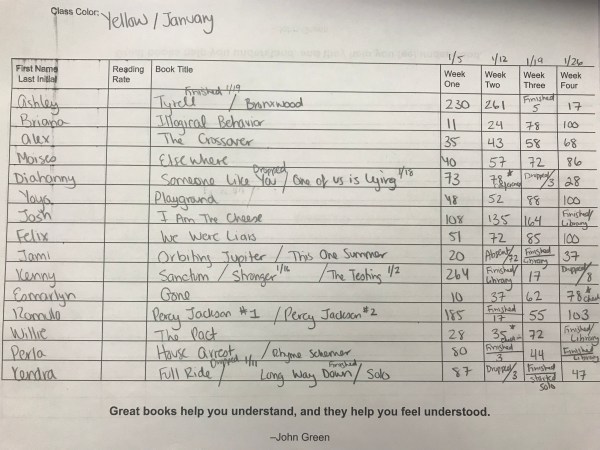
It’s my way to formatively assess where my students are and the progress they are making in their independent reading book. As students are reading the first 10 minutes of class, I circulate the room and peer over shoulders so I can write down what page they are on (and for some students, the title of their new book). While not a traditional conference, this works well on the days (and sometimes it feels like the many days) where I need to do a quick check-in so I can help the handful of students who are either dropping books or finished their book and don’t know where to go next.

I also like using status of the class to keep a running tab of how things are progressing to use when I email parents or during progress meeting for my special education students. It’s also a great resource to use when I conference with Juana, who has dropped three books this month alone–the data doesn’t lie. It also helps me to see that although Paul has finished three graphic novels in a row over the last 6 weeks, it might be time to challenge him outside the genre and try something new.

An added benefit to the status of the class is the competitive nature it brings out in my students. One of my EL students, Marco, asks me for his progress every time I do a Status of the Class. The look of pride on his face when does the math and sees that his reading rate is improving, little by little, is priceless. For Stephanie, she finds the check-in reassuring. On more than one occasion, after a Status of the Class, Stephanie whispers to me, “Miss, I read more pages this week than I did last week.” Stephanie is rereading Room, because last year when I had her as a 9th grader, she fake read it and only made it halfway. This year, she can’t put it down.

I still haven’t figured out a way to make it more student-led in my short 43 minute classes. When we are in the middle of an Independent Reading unit this spring, after our Massachusetts Comprehensive Assessment System test is over and the constant test prep pressure is off, I’m thinking of making the Status of the Class a digital resource, asking students to input via Google Form and holding students more accountable to tracking their titles and progress. By doing so, more students like Paul, Marco, and Stephanie can actively engage in their progress and see how far they truly come this year.

How do you track and hold students accountable in their reading progress? What advice or tips could you offer to teachers with shorter class periods?


Accountability Through Conversation

In Shana’s post “Conversation is our Most Powerful Teaching Tool” she mentions an article by researcher John Goodland. He states that only 1% of instructional time is given to conversation…insert wide eyed emoji…what?!

That statistic has really stuck with me. I’m not sure if it was more than a subconscious thought until the power of conversation became very clear to me.

In a nutshell, I am a content coordinator who works to support (6th-12th grade ELAR) teachers as they hone their craft. Since I began working in this position, I’ve been trying to figure out what exactly teachers need to be and feel successful.

As a district team, we have agreed to implement independent choice reading into our daily routine, as a step toward implementing a workshop model. Teachers are on board and have done some AMAZING things with choice reading in their classrooms, but, regardless of what grade level I am with, or what campus I am on I keep hearing the same question, “how do we know that they’re reading?” We talked about logs, reading responses, summaries, notes, and we’ve shared resources and ideas, but there was still something missing…

Then I had it! A light bulb moment in its truest sense. In classrooms where students TALK about what they are reading, they are accountable. In Amy’s post about shifting control she talks about “find[ing] a space for conversations…” and that if her giving “up control makes space for that, I’ll take it every chance I get.”

lightbulb

For me, that answers the how do we know question. During some learning walks I saw three examples of conversation from three different rooms…

First example: In a 12th grade academic/on level classroom the students began their class period reading for 10 minutes in a book of their choice. Once the timer went off, the students were asked to talk to a partner (or two) about their book. The teacher specifically asked the students to “sell it”. Sell their book to their partner(s). The teacher roamed around the room while the students were talking and then let two volunteer share their “pitch” to the whole group. It was very clear that the teacher knew what their students were reading, IF they were reading, and how the felt about their books.

Second example: In a 7th grade PreAP class students began their class period by reading for 5 minutes, then when the timer went off they got a 1 minute break. Students were asked to talk to their elbow partner during their break about their book’s protagonist. The teacher provided a sentence stem to probe the conversation. Then after the minute was up, they read for 5 more minutes. The teacher roamed and jotted notes as a “status of the class” during that 11 minutes. The students have been talking about the structure and elements of fiction and how protagonists can shape a story. At the end of the minute, the teacher had a pretty good idea about what her students knew and didn’t know about protagonists, including how to pronounce, or mispronounce, the word. 😛

Third example: In an 11th grade AP class the students began their class period by reading for 15 minutes. While they were reading the teacher met with every student in the class. Her questions were simple; she asked, “what’s the title of your book?” and “what page are you on?” The teacher was able to meet with 26 students in 15 minutes. She was able to see who is meeting their reading goal, who is abandoning books, and who isn’t reading.

When students know they’re going to be held accountable to explain their book, connect it to what they’re learning through mini-lessons, or just track their progress to their teacher, they respond. It becomes the culture…

This isn’t anything new, and it’s been talked about before in multiple posts on Three Teachers Talk, but what was a game changer for me was seeing it in action. I was able to create a concrete model that I could then replicate. I learned three different strategies or approaches to talking with students/letting them talk to each other by watching someone else in action. Talk about self-embedded professional learning! I mean, can it get any better than that?!

When I visit campuses my first question to teachers is going to be: how are you getting students to talk? Then we shall see where our conversations lead us. 🙂

I’d love to hear from you! How do you get and promote your students to talk? Are you able to visit other teachers classrooms on your team/campus? If so, do you feel like it’s beneficial?

Conferring with Students Proves Difficult to Implement, Even for the Most Determined

My professional goal this year centered on conferring with students about their reading and writing on a more regular basis and keeping track of those conversations in order to track progress, pose questions, and offer valuable feedback. Based on a tip offered by Kelly Gallagher at the NTCTELA conference (2017), I created a notebook with a 2-page spread for each student in order to record notes from these conversations.

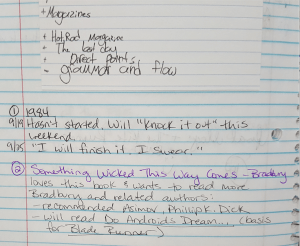
RWNotebookOn the left-hand side, I pasted in a notebook card that students filled out on the first day of class with information about their favorite genre(s) of books, their favorite book, their least favorite book, one writing strength, and an aspect of their writing which they wanted to improve. Below this card, I kept a record of reading conferences with the student. Here, I not only kept a list of what books students read, but I also jotted down notes during our conversations about the text.
The best method I have found for finding out how much my students actually read, understand, or like specific texts is to talk to them about their reading and ask thought-provoking follow-up questions. By recording notes about these conversations, I am better able to tailor instruction for all students – based on common observations or questions – and recommend books for future reading that I think they’ll enjoy and that will match the level of rigor they require.

On the right-hand side of the notebook, I recorded essay scores as well as some feedback about what students need to work on in their writing such as: use of passive voice, crafting a strong thesis statement, and providing evidence to support assertions. This allows me to track student progress toward improvement of writing skills. For instance, I love it when I can record additional comments such as “she successfully wrote in the literary present tense this time” or “his poetry shows insight and creativity.”

Conference and feedback notes also allow me to see when a student fails to make progress. How many times do teachers write the same feedback on successive essays, and where is the student’s incentive to change that practice unless they are one of the rare few who are intrinsically motivated? When we speak one-on-one with students and note the recurrence of these habits, they are more likely to address them.

So – I had a plan. I implemented that plan. But things did not exactly go according to plan.

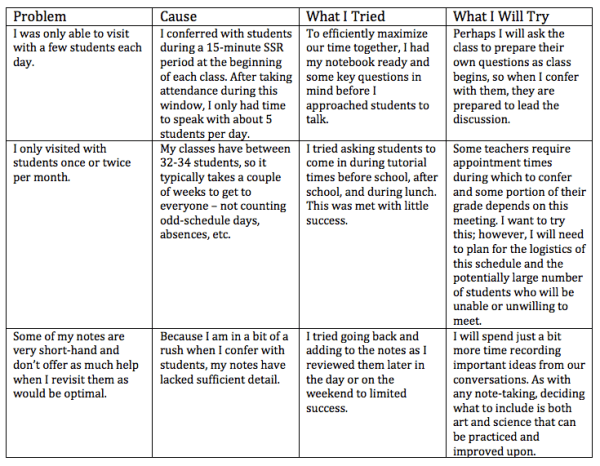
I encountered several difficulties that prevented me – and more importantly, my students – from reaping all the benefits that our discussions and resulting data collection could offer. Below, I have listed some of the problems I encountered, their causes, and the potential solutions I plan to try this semester:

ConferringChart

Though these difficulties left me feeling extremely frustrated at times, I do still deeply believe in conferring with students. Our students need, desire, and deserve the individual attention and feedback that reading and writing conversations provide.

Please comment with suggestions about how you have successfully conferred with students and tracked important ideas from that discourse. Let’s help each other find new ways to build relationships with as students as they build confidence in their writing and a real love of reading that extends beyond our classrooms.


Amber Counts teaches AP English Literature & Composition and Academic Decathlon at Lewisville High School. She believes in the power of choice and promotes thinking at every opportunity. She is married to her high school sweetheart and knows love is what makes the world go around. Someday she will write her story. Follow Amber @mrscounts.

A Reading Conference with Tom Romano

I am fortunate to be on friendly-emailing terms with the great Tom Romano, from whom I’ve learned much about good writing instruction, multigenre, and student voice.

So when I received an email from him the other day, asking for book recommendations, I laughed aloud. My most excellent writing mentor, asking me what to read next?

img_6004

I admit, I balked a little at first. This was like having Tiger Woods ask you what golf club to try next. But then, I fell back on my tried-and-true reading conference strategies, which I’ve used countless times over the years with reluctant and prolific readers alike.

As with any student, I had much of what I needed in order to give a good recommendation between the request itself and my background knowledge of Romano. When students need help finding something to read, we’ll often meet at the bookshelf. As they stare blankly at the wall of books, one of the first questions I ask is:

“What are you in the mood to read?”

Often, students can give me a feeling–something fun, lighthearted, serious, or challenging–or a genre–romance, nonfiction, adventure. It’s even better when they can give me specific titles that relate to their preferences. I usually glean these titles by asking:

“What’s the last book you read that you loved?”

In his request, Romano gave me all the information I needed–he wanted something literary, something like The Nightingale (which I’d read after Lisa recommended it to me), Atonement, or All the Light We Cannot See. He’d also answered another question I usually ask readers:

“What’s your reading plan?”

Knowing where a student will be reading this book–at work in short spurts, at home in long stretches, or on a crowded bus on the way to an athletic event–impacts my recommendation as well. Here, Romano told me he’d be reading for long, uninterrupted stretches of time in airports, so I knew I could suggest something all-consuming.

So, I stuck with my usual formula:

I recommended three titles.

img_6005.jpg

Exit West is a title I’ve heard a great deal about and would love to read, but haven’t gotten to yet; The Secret History is an amazing hidden gem by Pulitzer Prize-winning author Donna Tartt that I read about 15 years ago; and A Man Called Ove is a new viral title that made me sob hard over Girl Scout cookies and coffee as I finished reading it. My three recommendations usually consist of something old, something new, and something I haven’t read yet.

I wrapped up my pitch as I always do, with a clincher:

A promise of what the book will do for the reader.

A week went by, and last night at 11 pm, I received another email from Romano:

img_6006.jpg

“Loved Ove.”

A successful end to a successful reading conference, if you ask me…but of course, like any other conversation about books, I couldn’t let it end there. I just had to throw in one more recommendation, which I always do for my students when they return a book:

“If you liked that book, you should try ______________.”

This quick exchange of emails, like so many off-the-cuff conversations we have with students, was packed full of powerful data about a reader’s interests and abilities; a teacher’s knowledge of texts and titles, and most importantly, the transaction between the two parties–a shared endeavor to find a just-right book at just the right time.

All our words are imbued with purpose and power when we are discussing literacy. Reading conferences don’t need to be formal, sit-down conversations all the time. They have just as much weight when they’re held standing at the bookshelf, passing in the hallway, or from afar via email. This reading conference with Tom Romano reminds me: never take any of our talk about books for granted.


Do you have a what-to-read conference “formula?” What other titles might you recommend to Tom and me? Please share in the comments!

Shana Karnes is eagerly awaiting the end of flu season so she can go back to work without worrying about her two tiny daughters getting sick…again. When her family is actually healthy, she teaches preservice educators at West Virginia University, goes for long runs while listening to even longer audiobooks, and tweets about reading, writing, and school at @litreader.

Moving My Desk to Move Readers and Writers

Happy New Year!!!

What an interesting time of year this is.  The Christmas break offers so much opportunity in the way of reflection, thinking, and development.

I think back on the Fall semester and wonder where it went so quickly.  It’s as if one day I stood with my Student Council kids staring up wonder of the eclipse, and the next day I sent them off for the holiday break.  I must have told them how much I loved them thousands of times.  So much happened this fall and I have so much to think about.

Somehow the stack of books I’m currently reading grew massive this fall.  I’m determined to finish so many that are half read.  The Last CastleA History of WolvesReady Player OneLincoln in the BardoThe Glass Castle are staring at me like unloved puppies.

Reading is important to my teaching life but my thinking is about my classroom as a learning space.  Specifically, I reflect on how I’ve arranged it in the past and how I think that arrangement is antiquated and isn’t optimal for how I want to teach.

An article written by Paul Viccica and Lois Goodell and published in the October 2017 issue of University Business clearly states, “Classrooms that activate experiential and project-based learning approaches reflect the modern workplace by providing social and quiet work spaces, by offering breakout seating, and by creating technical stations where students can collaborate, focus independently and work technically, as they would in an office setting.” This sounds to me like its promoting authenticity in the classroom; something of a mantra for me this year.

I wonder if there is evidence that shows any positive effects of the teacher cordoning off a section of the classroom to create a fortress of solitude into which no student shall venture.

I hate what my teacher desk has become.  I hate that it, like so many others, is a great wall covered in papers, writing utensils, binders, books, note pads, a computer screen, and all the flotsam and jetsam that builds up in a teacher’s daily existence.  I hate that I sometimes find myself sitting behind my desk when the kids are furiously writing or deep in a text.  I despise the disconnect that happens when I steal a minute to answer an email or take the attendance.

Why is the siren song of that momentary mental break so alluring?  How many times has a student looked up to find me sitting at my desk and swallowed their question because I looked too busy to be bothered? I’m confident the answers to the questions are “not often.”  I hardly step behind my desk during classes and that just solidifies my need to make a big change to start this new year.

I’ve written before about the constant conferring that needs to happen in our independent reading and we all know those habits are crucial in teaching writing as well.  There shouldn’t be an opportunity for me to disconnect from the students.  Reading, writing, discussing; those are all activities that I should be completely engaged in, even if my role is just as the listener.  So, I ask myself, when are they doing something that I can disconnect from?  The answer should be: NEVER!

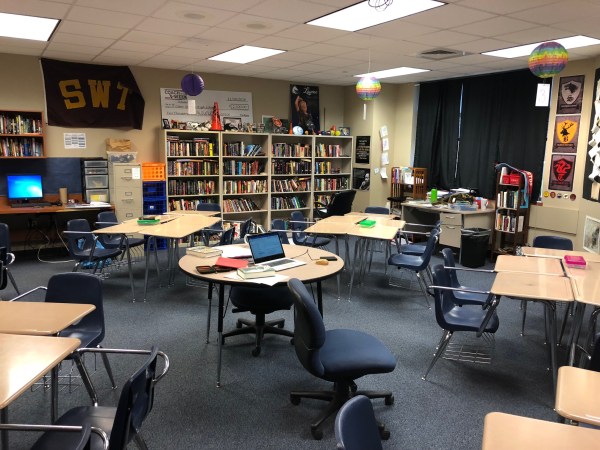
I made the decision to shove my teacher desk against the wall; abandon it.  Like an anchor, its holding me back and I want it out of my way.  I don’t need it anymore, nor do I want it.  It’s a symbol of a bygone era.  It’s one of those things I cling to for my comfort at the expense of students.


IMG_3661 (1)

This is my big move to start 2018. I hope it makes my instruction more effective.  I need a change and so do the kids.

I think it’s important for teachers to encourage other teachers to innovate and throw away the practices or procedures that no longer reflect their teaching styles. Is anyone else making a big change in their teaching life?

New Year, New Classroom!!!


Charles Moore has succumbed to the creativity of his Student Council students and their aesthetic is now his. He can’t stop thinking about how to maximize his classroom space with design and decoration.  He recently lost to his 7-year-old daughter at Clue and catches up on reading in the parking lots of dimly lit soccer fields around League City, TX waiting for his son to finish practice. His almost daily musing can be found on his twitter page @ctcoach

Conversation is Our Most Powerful Teaching Tool

After two months of being cooped up in the house with two kids under the age of two, we finally went back to school yesterday.

Hallelujah!!

To open my class yesterday, I asked my students to get up and get talking with one another–about nothing in particular. Each student had written her name on a note card, and after thoroughly mixing and redistributing them, each student had to go find her card’s owner and get to know him or her. Once we got talking, the room was never silent, and after we were all seated again, I asked students what topics they used as conversational entrees.

“Well, I’ve been in a lot of classes with people in here before, but never knew their names, so it was helpful to just start with an introduction,” one student volunteered.

quote-negotiation-and-discussion-are-the-greatest-weapons-we-have-for-promoting-peace-and-nelson-mandela-81-33-16I was flabbergasted–how could these students not even know each other’s names?! What sorts of classes were being taught that didn’t allow for dialogue and collaboration at this most basic level!?
But then I realized that this was the norm, and often is for our high school students, too. This statistic was even highlighted in the first page of the article we were reading for class: “Less than 1 percent of instructional time is devoted to discussion that requires reasoning or an opinion from students, according to researcher John Goodland.”

I think we can all agree that reasoning and opinion should be at the forefront of student dialogue, and a central goal of any curriculum. But if we’re spending less than one percent of our time on these things, we’re nowhere near where we need to be.

After my students listed ways they began conversations with one another–clothing choices, majors, the weather, how was your break–I asked them how they planned to get to know their students.

“I’m going to give them an interest inventory,” one student said. “I’ll do a learning styles survey,” another claimed. Facepalm, I said.


No one said, “by starting a conversation just like we did today,” which is what I was hoping they’d jump to. Conferring is our most powerful instructional and assessment tool, and it’s the art of a conversation made critical. Not only is it important for teachers to get to know our students through simple talk–not with the barrier of a survey or paper between ourselves and students–but it’s important for students to practice the skill of conversation, first with us, then with one another.

Because perhaps less than 1 percent of instructional time is devoted to discussion not only because of how traditional classrooms are structured, but because of how little space in our culture there is for conversation these days. I’ve written about the value of talk before, but I’m coming to believe that there is more value in conversation. The exchange of ideas is much more valuable than the simple act of articulating one’s own, and needs to be our end goal.

The moves we make as teachers and thinkers will help our students reach this aim–first to help them read critically enough to develop their own nuanced opinions, then to help them write and talk to draft out their thinking, and finally to help them share and grow these ideas through conversation. Not to defend their own ideas, which remain only theirs, but to help their thinking evolve through discussion.

golden-globes6.jpg

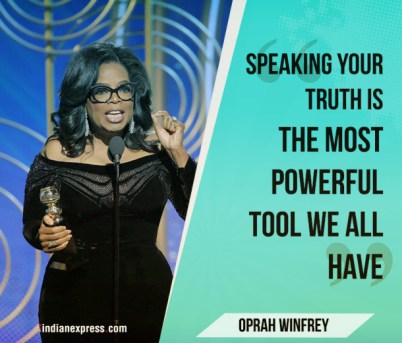
Oprah Winfrey, in a speech that I hope will be close-read by millions of high school students as a mentor text this week, reminds us that “What I know for sure is that speaking your truth is the most powerful tool we all have,” and that our truths have power when someone “chooses to listen.”

Speaking and listening are much more than just standards for us to cover–they are the tools our students need to change themselves and the world for the better.

Shana Karnes is a mom of two daughters, a teacher of preservice educators, and a writer of hopes and dreams–in her notebook and here on Three Teachers Talk. She is delighted that winter break and maternity leave have ended and that she’s back in the classroom with her tribe. Find her on Twitter at @litreader.