Category Archives: Common Core

Mini-Lesson Monday: Narrative Analysis with StoryCorps

We all have a story to tell.

In fact as writers, we have countless stories to tell. We tell of our experiences, fears, hopes, dreams, and even those trivial events that sometimes add up to more “life” than we could have imagined.

We tell the stories of others too. Real and imagined people that speak to us in words we’ve heard and sometimes, in the words we long to hear.

I wax poetic with my students like this often, but especially early in the school year. I want them to feel my passion for the power of stories and encourage them to develop their own passion for expression. As Morris (protagonist from one of my daughter’s favorite children’s books The Fantastic Flying Books of Mr. Morris Lessmore) beautifully states, “Everyone’s story matters.” 

With this in mind, my American Literature collaborative team (Shout out to Brandon, Catherine, and Erin!) worked this year to develop a unit of narrative writing that asks students to look at the stories they tell and how those stories can be interconnected. Everyone’s story matters, and in this case, they get to have even more meaning as students craft individual tales that relate to their chosen thematic focus.

Students, having already selected, listened to, and analyzed an episode of This American Life for elements of author craft in a narrative (hook, chronological/detail choices, and word choice), partnered up or formed a group of three, and selected a theme out of a hat (dangers of conformity, vanity as downfall, the power of choice, etc.) they would explore, both individually and in their groups.

The overarching assignment is to craft an individual narrative that fits the theme and ultimately orally record the stories in a podcast that highlights the interconnectedness of the individual work. Students are graded individually on their narratives, but the podcasts are a group effort and will be played for the class.

storycorps


Objectives — Students will listen to several examples of 2-3 minute stories from NPR’s StoryCorp in order to practice narrative technique identification and analysis one more time before drafting their own stories. Students will discuss and share their insights on narrative impact of what they heard in an effort to purposefully craft their own narratives.

Lesson  — According to their website the initiative of StoryCorp is to “preserve and share humanity’s stories in order to build connections between people and create a more just and compassionate world.” 

In class, we had spoken already about the power and purpose of stories and students had come up with some wonderful ways stories enrich and fulfill us. Stories:

  • explain, or attempt to explain, where we come from and/or why we are here.
  • allow us to express what we believe or hope.
  • reveal who we are or who we want to be.

I shared with students that we were going to listen to some short pieces that told unrelated stories on the surface, but each would link back to some of the reasons we tell stories at all. Students were asked to record what they heard in the hook, insights on which details were included and why, and word choice (all elements they will be scored on when writing their own narratives).

I started by playing a sample story and then walking them through my own analysis. “Traffic Stop” is a piece that details police brutality in 2009 against a black man who was raised by white parents. The piece pretty brutally (I did have to mute three or four seconds of the piece where a police allegedly uses a racial slur that is inappropriate for the classroom) relates the story of a young man who is pulled over by police, searched but cleared, and then is assaulted by police when he questions why the officers are searching his car.

After I played the piece, I projected some of my own analysis. The hook involved the young man’s mother saying that she never would have thought skin color would make a difference for her son, but she painfully learned she was wrong. Word choice vividly captured the pain, fear, and confusion of the young man who was beaten by police. The chronology includes context for the horror of the event, a play by play of the few moments of the traffic stop, and details about the young man’s mother seeing his injuries in the hospital. My analysis was that the elements chosen were specifically selected and organized to convey the disbelief that something like this could happen to an innocent person and the role that race played in the event.

We then listened to two more stories. Students wrote down their take-aways in their writer’s notebooks and discussed after each piece. We shared out ideas and pulled insights back to those class generated elements of why we tell stories.

Finally, I had students listen to one last piece, detail their analysis on a half sheet of paper and turn it in to me for some formative feedback.

Follow-Up — We are about to start mini-lessons on hook, chronology, word choice, and parallelism (thank you Common Core) in drafting these narratives. I plan to reach back to the insights shared during this class in order to help students make purposeful choices in crafting and revising their narratives.

Everyone’s story matters. 

What tools do you use to get students thinking intentionally about their writing craft? Please share your ideas in the comment section below! 

Try It Tuesday: Red Thread Notebooks

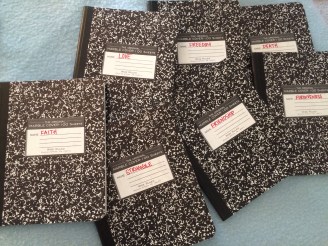
img_3173-1So much of a workshop philosophy centers on the assumption that reading and writing are forever intertwined.  Vocabulary, grammar, poetry–they’re all pieces of the puzzle that make up literacy and a passion for words, too.  It was with this in mind that I created Red Thread Notebooks.
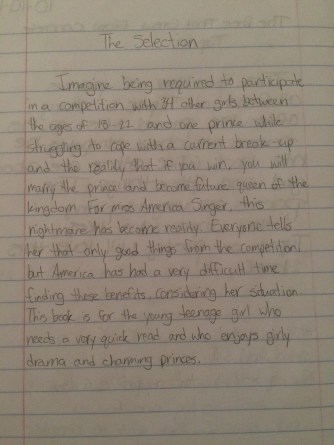
The idea came from two places–one was Penny Kittle’s “big idea books” (found on page 8-9 of those handouts), which are reading response notebooks  centered around themes in literature.  The other was Tom Romano‘s “red thread” assignment, in which teachers had to write about which parts of our teaching philosophy would run through all of our teaching, like a red thread.

img_3177

This student booktalks The Selection in the “STRUGGLE” notebook.

So, when composition notebooks are just a nickel in the summer, I buy 60 of them each year.  My students and I begin the year by brainstorming themes and topics that are important to us–love, cell phones, faith, music, family, video games, death, high school, forgiveness, four wheelers.  We label our notebooks and use them all year long.

There are a variety of ways I invite students to write in these notebooks:

  • Vocabulary practice: list related words, synonyms, word associations, etc. similar to the notebook title
  • Skill practice: write dialogue, revise sentence structure, practice figurative language, craft descriptive writing, about the notebook’s title
  • Book talks: write about how the book you’re currently reading might add to a conversation about the notebook’s title
  • Grammar instruction: revise a sentence, imitate a paragraph, tinker with style, while writing about the notebook title
  • Free writing: write your thoughts and musings on the notebook title
  • Poetry: find an existing poem, craft your own poem, or create a found poem about the notebook’s title
img_3179

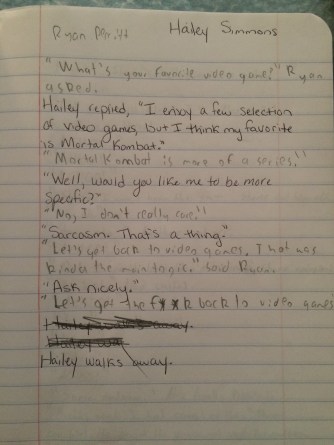
Hailey and Ryan practice dialogue in the “VIDEO GAMES” notebook after I teach a mini-lesson on its conventions.

Because these are shared notebooks, I ask students to refrain from using profanity in them or writing about any of their peers.  I don’t require names, but many students like to sign their writing.  Those are the only rules.

Once the notebooks have begun to fill up, students can refer to them to find book recommendations, writing topic ideas, or vocabulary words to add to their personal dictionaries.  They can also look for examples of skills practice, craft studies, or grammar lessons that we’ve done for additional guidance.  One year students even selected multigenre topics based on our red thread notebooks.

These notebooks are a lovely way to make permanent a yearlong conversation about literacy.  The topics change every year–Michael Jackson had his own notebook my first year of teaching, and this year Lebron James had one–but the opportunities to write, reflect, and make connections remain the same.

Do you think you’ll try Red Thread Notebooks next year?  Do you do something similar?  Please share in the comments!

Mini-lesson Monday: All Good Writing Begins with a Good Question

One of the hardest things I ask my students to do all year is choose their own topics. We start generating ideas on the first day of school. We watch video clips, read quotes and short passages, listen to poems, look at cartoons — and we write responses. We create various versions of writing territories in our writer’s notebooks. We have many ideas stored in our well-used notebooks by this time each year.

But with every writing task, students seems to always start the topic journey right back at square one, even when I remind them that they have a mine of ideas sitting in the pages of their composition books. I’ve decided that just like me they like the process of discovery.

My goal is to get them to move past topic discovery into writing discovery. Too often, students think they have to know what they want to say before they ever start writing. No wonder so many kids have a hard time approaching the blank page. (See NCTE’s 10 Myths of Learning to Write #4)

The last writing assignment my students complete each year is a multi-genre type piece wherein they show they’ve improved in the various writing modes we’ve practiced throughout the year. They have almost total choice in terms of what they write, and they have most of the choice in terms of the forms they write in.

I have just two mandatory suggestions (oxymoron intended):  one piece must be a Rogerian argument, and somewhere in their master piece, students must show they know how to use an academic database to find valid sources, and then they must use the sources in the correct context, and cite the sources correctly.

We look at a few mentor texts that use multiple genres within the same piece. Narrative, informative, persuasive — plus images and info-graphics, or other types of forms that present information, including videos and interviews. My favorite is the award-winning feature article, Snowfall: Avalanche at Tunnel Creek by John Branch.

Once students know their end-goal: the creation of their own multi-genre writing piece that shows off their writing journey for the year, they must choose a topic. Some will want to stick with a topic they’ve written about multiple times this year. Depending on the topic, and the student, I may be oaky with that.

This mini-lesson came about in an attempt to help students figure out a topic that they know enough about to ask questions but not so much about that they could answer all of them.

Objective:  Using the language of the Depth of Knowledge Levels, students will construct a list of things that make them wonder; they will formulate questions about a self-selected topic derived from their wonderings. They will then categorize the questions in sets that make sense. Finally, they will determine which questions may best be answered through a specific genre or form of writing.

Lesson:  I tell students that we are about to play in our notebooks. “Turn to a new page, and write a list of all the things you wonder about,” I say. They usually sit there writing nothing, so I get them started:  “I wonder if teens got paid to go to school if they would want to learn more.”

Most students start to write, but I keep wandering the room, stating things that make me wonder as students list their own wonderings in their notebooks.

“I wonder when the state of Texas will get wise to the lack of wisdom in state testing. I wonder why students choose to do their APUSH homework over AP English. I wonder if the Dallas Cowboys will ever win the Superbowl again.”

Once students have at least a half a page of wonderings, I ask them to talk with one another in their small groups. “Perhaps your peers will remind you of something else you wonder about. Add it to your list.”

“Okay, look at your list and zero in on one topic that you think you can find the answer to with a little bit of research. Now, let’s think all the way around this topic.”

I ask students which of my wonderings I should use as a model for their next step, and they tell me the one about the Cowboys. I write it on the board. “Okay, help me come up with questions that look at this from every perspective possible — like who has a stake in whether the Cowboys win the Superbowl again.”

When was the last time the Cowboys won the Superbowl?

Who led the Cowboys to the Superbowl in the past?

How many times have the Cowboys been in the Superbowl?

Is the Cowboys coach as good as the coaches in the past? Are the players as good as the players in the past?

What is different or the same about the NFL?

What do the Cowboys need to do to win more games?

Who would be a better quarterback than Tony Romo?

Does the current team consist of Superbowl quality players?

Which teams are in the way of the Cowboys going all the way again?

Some questions get silly — pretty sure the Dallas Cowboy Cheerleaders don’t matter all that much to the reality of getting to the Superbowl. Sorry, girls — but students get a hang of the idea. “Ask as many questions as you can think of. After you write a list of your own, ask your peers for help in writing others.”

Next, we need to put our questions in categories. I ask students to talk with one another and determine which of our questions about the Cowboys might go together. We decide we’ve got questions about 1. the history of winning the Superbowl, 2. similarities and differences in the game, the coach, the players, 3. current Cowboys, 4. the opponents.

We talk about what genres and forms might work to convey the best answers to our questions.

“Compare and contrast the differences. That’d be easy,” someone says.

“The history of the Cowboys’ past wins would be information, right?” another student says.

“What could be the topic of a persuasive piece?” I ask.

“The question about the ability of the current players. Easy.”

I tell students that they get the idea, and I charge them with reading through their questions and categorizing them into groups that seem to go together.

I remind them:  “All good writing begins with a good question.” And they’re off.

Follow up:  Students should use their questions and their categories to guide the choices they make as they write their end-of year multi-genre pieces. In conferences, I read through questions, helping students add to and clarify. I remind them that form helps determine meaning, so as they make choices, they need to think about the best way to share meaning with their intended audiences. Students will present their writing projects as their final exams.

Try it Tuesday: Thesis Statement Dissection

Buttering someone up is an idiom that has long made me smile. Perhaps it is my deeply rooted devotion to butter (the dairy state doesn’t play…you can’t live here if you dislike butter) or the visual of someone taking a stick of butter and applying it like deodorant, but either way, I buttered up my students the other day and it worked deliciously.

Basically, I slathered it on like this:

  • Remind students of how awesome they are at writing thesis statements because they have been doing it for years.
  • Have students apply their reviewed knowledge of quality thesis statements to their own papers in order to double check their awesomeness at this skill.
  • Elevate them to the role of “expert” in the area of thesis writing in order to have them make suggestions to their peers about clarity and depth of their awesome thesis statements. 

Underlying all of this was my firm knowledge, butter in hand, that many of their thesis statements were currently far from awesome. However, this certainly wasn’t because my students lacked the skills to clearly convey their ideas, it was most likely because they had procrastinated in writing their drafts, checked out to the warmer temperatures and sunshine, or hadn’t taken the time to really carefully reflect on what they had written in favor of working on something for just about any other class.

So basically, the issues of every paper written by a high school student in May.

In order to encourage some honest reflection and move their work forward, I employed the following strategy:

1. First, I shared with students a thesis statement I wrote to accompany an informative paper I was writing along with them. We talked about the different elements present in my sample and how they matched up with what students knew of writing complex thesis statements. One area we worked through together was my struggle with a negatively connotated word that was pushing my informative thesis statement in the direction of argument. Having students help me change the word, demonstrated what I was going to ask them to do in small groups shortly. (Much praise here and reminders of how awesome they already are at writing thesis statements.)

IMG_0611

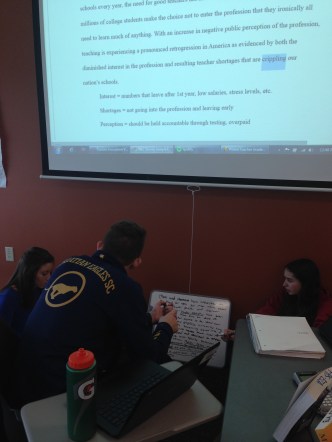
Students work on their thesis statements in small groups, under the projection of the sample paper I wrote along with them

2.  Next, we reviewed the non-negotiable elements of effective thesis statements. I asked students to highlight their inclusion of those elements and/or comment on their papers with what was missing so they could return and revise. We included that an informative thesis statement needed to present non-debatable facts, organization of those facts into a logical roadmap for the paper, and inclusion of a “so what?” element to clarify purpose for their audience on the specific elements of the topic the paper would cover.  At this point, we circled back to my thesis statement and looked one more time with theses specific elements in mind. (Again, more buttering up in the form of high praise to their identification skills and encouragement to now apply that thinking to their own work)

3. I then asked students to spend ten minutes or so, writing their thesis statements on our mini whiteboards, revising as they went. They were to write notes on the side to indicate areas they needed help on or questions they had about the effectiveness of their statements.

4. With markers in hand, students then gathered in small groups, “presented” their thesis statements to their group members by reading aloud and asking questions, and then worked collaboratively to strengthen their sentences. (Before they got to work, I reminded them of how highly qualified they all were to assist others and how as a classroom of writers, each student could provide insight to his/her peers on improving the work)

Honest conversations around the room included such statements as:

“I see what you mean. That part made sense in my head, but it needs to move over here.”

“I like it, but I’m still asking ‘so what?’ Like, what’s your point about stereotypes?”

And my personal favorite, “Dude. That thesis is awesome. Can I steal that idea to have a dependent clause first? My audience needs to think about historical examples of Congressional corruption before they can really understand how bad it’s gotten.”

Dude. Did you just reference syntactical choices to more appropriately orient your audience for your paper? Mic drop.


While students worked in small groups, I was able to conference with several members of the class one-on-one. In addition, I noted a few kids I would need to pull into a small group during the following class period to continue guiding their work on these statements.

With the messiest looking whiteboards I have seen in quite some time, students returned to their seats and kept working on both their thesis statements and the necessary adjustments to their papers to reflect their revisions.

I could have easily reviewed the parts of an effective thesis statement and walked around to take a look at what kids had already written. But by helping students see each other and themselves as resources, most of the class improved their clarity and complexity significantly and my involvement was minimal.

In a community of writers, everyone is a resource. Sometimes it just takes a little grease, er butter, to get the parts moving and the collaboration started.

What are your ideas for helping students see themselves as writing resources in the classroom? Please leave your comments below! And, Happy Teacher’s Day! 


#FridayReads: Required Reading “Our Students Want to Write”

Confession:  I buy a ton of pedagogy books. I rarely read them all the way through. I blame it on my blossoming OCD. I can only take in so many ideas before I run out of space in my head to hold them all long enough to use them.

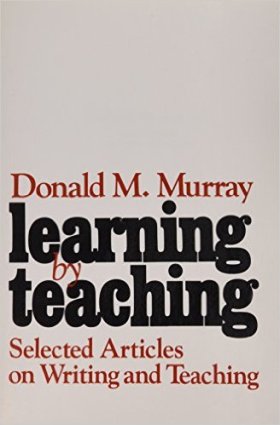
412bcpby4iol-_sx326_bo1204203200_That is not the case with this classic, suggested to me by my friend and mentor Penny Kittle, Learning by Teaching by Donald Murray.

I remember when Penny recommended it. She was in the DFW metroplex teaching a workshop, and I’d asked if we could meet up and talk about my writing. She graciously agreed, and we met at a Starbucks inside a Target. As always, Penny radiated positive energy. She told me about the work she was doing with Kelly Gallagher. I told her about my struggle trying to write a book, a book I am still trying to write.

I still cannot believe I had a writing conference — yet again — with Penny Kittle! (My first was during her class at The University of New Hampshire Literacy Institute the summer of 2013.)

At one point in our conversation, Penny paused and asked if I had read Don Murray’s book Learning by Teaching. I said no. At the time I hadn’t read any of his books, but I’d heard Penny talk about Murray with such affection, quoting him often. I knew this was a book I need to not just purchase, but one I needed to read. I’ve read and re-read and marked page after page.

Don Murray validates the moves I make in my workshop classroom, the moves I make

pageinMurraybook

My thinking while reading the essay “The Process of Writing” by Donald M. Murray


when planning instruction for my AP Language and Composition course. I have learned from those who learned from Murray, and his work reminds me again and again why teaching with student choice in mind works. Every time I feel like I fail, every time I get frustrated with the way an assignment flopped, or I didn’t reach a certain student what I’d hope to teach him, I turn back to this book of essays by Murray. (I did this recently after most of my students bombed an assignment, which was mostly my fault.)

Here’s an excerpt from Murray’s essay titled “Our Students Will Write –If We Let Them” published in North Carolin English Teacher, Fall, 1977. I probably break a copyright law by sharing, but I’ll risk it if it means freeing more writers. (See more about freeing writers in Penny Kittle’s piece “What We Learn When We Free Writers.”)

Our students want to write — but not what we want them to write.

Our students want to write of death and love and hate and fear and loyalty and disloyalty; they want to write the themes of literature in those forms — poetry, narrative, drama — which have survived the centuries. They want to write literature, and we assign them papers of literary analysis, comparison and contrast, argumentation based on subjects on which they are not informed and for which they have no concern.

We should see that their desire to write proves the vitality and importance of literature and literature-making in each generation, that language is central to the human experience, not just as a communications skill but as the best way to recall and understand experience. We tell our students the unexamined life is not worth living, yet we seldom allow those students to examine their lives firsthand through what is termed creative writing.

It is time that we, as a profession, not only support the reading of literature but the making of literature; that we encourage our students to write what they want to write and realize that what they want to write is more intellectually demanding, more linguistically challenging, more rhetorically difficult than the writing we usually require in the English class.

The biggest problem in the teaching of writing is ourselves. We do not encourage, allow, or respond to our students’ desire to write. We do not believe that our students can write anything worth reading, and they prove our prediction. Conditions will not improve until we realize that what we face is a teacher problem, not a student problem.

There are many important reasons to consider taking what is usually tolerated, at best, in the elective creative writing course and placing it at the center of the writing curriculum. Some of them are:

  • Writing about individual human experience motivates both the gifted and those we often consider disadvantaged. In fact, we may find that the disadvantaged aren’t in terms of experiences which can be explored through writing. Students who are not motivated by our lectures on the need for writing skills–they know the need does not exist in the lives they expect to live–still share the human hunger to record and examine experience. Students who are bored with papers of literary analysis or even incapable of writing such a paper at this state in their development may be able to write extraordinary papers based on first-person experience.
  • Students discover…that they have a voice, they have a way of looking at their own life through their own language. They discover and learn to respect their own individuality.
  • Through writing, the student increases his or her awareness of the world, and then works to order that awareness.
  • As students follow language towards meaning they extend and stretch their linguistic skills.
  • The experience-centered, doing nature of the writing curriculum will reach many students who are not comfortable with the analytical passive-receptive nature of the typical academic curriculum.
  • Creative writing gives students a new insight to literature. The study of literature is no longer entirely a spectator sport, but an activity which they can experience and appreciate.
  • The creative writing class may be the place where some students learn to read. Test results in many community colleges and other colleges of the second chance show that many students who test as not being able to read are also the best writers. They are able to read their own words and to perform the complex, evaluative techniques essential to revision. They learn to read by writing.
  • Students and teachers of creative writing rediscover the fun of writing. Art is, at the center, play, and perhaps that is the reason it is so little tolerated in the school. If it is fun can it be learning? Yes.
  • Finally, we should teach creative writing because it is more intellectually demanding than the study of literature or language as they are usually taught in the English class. This runs directly counter to the stereotype believe by most English teachers. IT is easier to complete a workbook on grammar, easier to tell the teacher what the teacher wants to know about a story than it is to use language to make meaning out of experience. The writing course is a thinking course, and it should be central to the curriculum in any school.

There is more. I believe Murray’s writing, like Penny’s books Write Beside Them and Book Love, should be required reading for every English teacher. I wish they would have been required reading in my education classes. For the first few years of my career, I struggled like many teachers I know with student engagement and learning while I taught literature instead of readers and writers. (Someday I’ll write about the Dickens I subjected my 9th graders to. It’s a sad sad tale of student, and teacher, woe.)

And someday I’ll finish this book I’m trying to write. I think Don Murray would want me to.

What books do you think should be required reading for all English teachers? I’d love to read your suggestion in the comments.


Mini-Lesson Monday: Storyboarding to Organize Writing

For me, narrative is central to all reading and writing.  I can find story anywhere–poetry, nonfiction, even a science report–so it’s no surprise that I teach about storyboarding a lot, both in the context of reading and writing instruction.  My students storyboard what’s happening in their independent reading novels, map out what they’ll present about through storyboards, and organize their writing using them too.

Objective:  Using the language of the Depth of Knowledge Levels, students will organize the plot structure of their own narratives; create a map of their story structure, and differentiate between pacing speeds in scenes mapped out.  Or, from the Common Core, students will use a variety of techniques to sequence events so that they build on one another to create a coherent whole and build toward a particular tone and outcome.

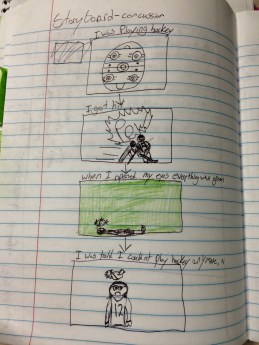
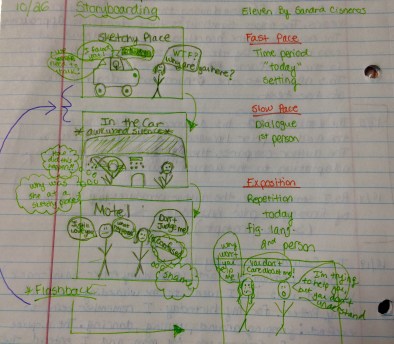
img_1530-1

Mitchell’s narrative storyboard is reminiscent of lessons from Tom Newkirk’s Boys & Literacy class

Lesson:  Prior to this lesson, students will already have selected a narrative topic and talked it out, at least generally, with their peers.  They will be ready to create a start-to-finish storyboard for the structure of their narrative.  We will also have studied “Eleven” by Sandra Cisneros to review pacing, and how to slow down and speed up scenes.

I’ll begin by modeling on the whiteboard for students.  “So, in my narrative, I want to tell the story of this pregnancy.  I want it to be kind of funny, so I’m going to focus most of my scenes on the funny parts–my husband’s and parents’ reactions when I told them, and my own reaction to figuring it out.

“So where should I begin my narrative, do you think?” I ask.

“Probably with suspecting you were pregnant,” a student chimes in.

“Yep.”  I draw a box on the board, and draw stick-figure me at my desk at school, question marks over my head, pondering whether I could be pregnant.

“Then where do I go?”

“Finding out you are for sure,” another kid says.

img_1531-1

Carleen’s narrative storyboard shows her addition of a flashback after partner conferencing.

“Yep.”  I draw another box next to my first one, using a directional arrow to connect them.  We go on in this vein until my storyboard is nearly complete, adding a flashback to previous disappointing pregnancy test results, and swapping the location of a scene.  Then I turn the students loose to draw their own storyboards in their notebooks.

Follow-Up:  After students have drawn their completed storyboards, I’ll ask them to find a partner to tell their story.  Often, this is where hiccups and gaps in the narrative structure are revealed–this second-draft talk.  Students will make revisions to their storyboards, and during workshop time we’ll begin writing actual scenes out in prose format.

In our next mini-lesson, we’ll choose which scenes to slow down and which to speed up, and work on various techniques to control pace.

How do you use storyboarding in your classroom?  Do you have any resources for storyboarding digitally?  Please share in the comments.

Using Picture Books as Secondary Mentor Texts

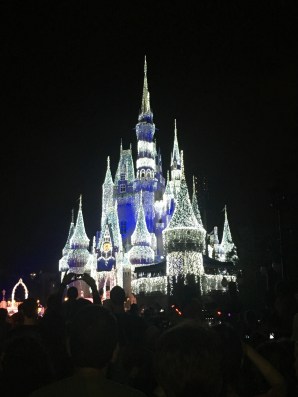
This year my family ditched the traditional Christmas festivities for a week in Orlando,

IMG_1606

Disney started his work as a cartoonist in high school.  How can we carve these same creative spaces for our own students?

Florida.  Swapping fur boots for flip flops, we ran around Walt Disney World, weaving in and out of storybook rides and watching teeny princesses wobble around Cinderella’s castle.  Only now that I am grown do I have a true appreciation for the sheer magnitude of Walt Disney’s brilliance.  He built a physical world of stories.

Disney doodled his way through high school; he honed his craft through drawing and photography classes.  Unfortunately, few curricula allow for the same creative exploration for students.  Oftentimes, the countless possibilities for storytelling and narration tend to center on only real-life experiences, personal narratives, when in reality, writing fiction opens up an entirely different world for self-exploration.

This year I swapped out our traditional multi-scene personal narrative for a story unit in which I taught many of the same narrative craft marks using a combination of fiction and non-fiction mentor texts.

The greatest challenge I faced was in finding short, succinct, and well-crafted stories that weren’t twenty pages long.  While I love short stories, I knew many of my freshmen would not only lose stamina if asked to write such lengthy pieces , but they would also struggle with translating the story structure of these mentors into their own pieces.  I began my hunt for a strong mentor text in, of all places, the children’s section of the library.

Objectives:  In alignment with the Common Core, students will write narratives to develop real or imagined experiences or events using effective technique, well-chosen detail, and well-structured event sequences. Using the language of the Depth of Knowledge levels, students will recognize a wide variety of craft marks in fictional writing.  They will identify patterns and compare effectiveness through discussion. They will formulate their own stories, revising them, and finally applying their understanding to future writing assignments.

Lesson:  I find writing fictional stories intimidating.  My plots seem to sag in some areas, or my dialogue doesn’t feel authentic, but many of my students love leaving their reality to explore their own creative worlds.  The vast majority read fiction, so its only natural that their reading interests feed into their writing curiosity.  The problem is that their greatest mentor texts are, on average, 250 pages long.

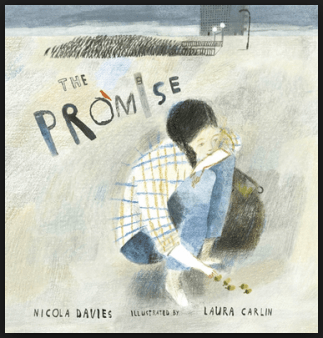
Screen-Shot-2014-11-07-at-1.51.36-PM-1514mm8The Promise written by Nicola Davies and illustrated by Laura Carlin is a beautifully crafted story of a girl growing up in a hardened city. After stealing a purse from a pedestrian, the main character makes a promise out of desperation, only to realize that the purse she has stolen has no value and is instead full of acorns, which she must now plant across the city.  The story reads more like a poem and has a cyclical ending that allows students to see the succinct structure of a short story.

Prior to sharing the story I type up the entire story book (which comes out to two pages) so that the students may access the text without the pictures.  I present it to them as a short story, and we read it aloud like any other mentor text, but I do not tell them it is a picture book!

I ask students to look at the structure of the story—what do they notice about how the author formatted the story as a whole.  Since we just finished studying plot in our literature circles, many of the students dig in to find the rising action and climax while others simply read and re-read to comb through the intricacies of the structure.  Almost all of the students notice The Promise’s cyclical ending that reinforces the story’s themes of redemption and the beauty of nature.

I have them return a second time to the story to look at the writer’s craft.  Students make a list of author’s moves within their writer’s notebook.  If they see something that intrigues them but they aren’t sure of the name, I have them describe what they notice and we develop a name for the skill together as a class.  Finally, we compile our observations onto a large sticky note that remains on display throughout the unit.  Students must then choose two of the craft marks to experiment with in their own writing.

Finally, once we have finished working with the piece, I reveal to students that The Promise is a picture book and I read it aloud.  Oftentimes students are shocked to hear that such a complex story is written for children, but their initial reading makes them value the intricacy of the writer’s work even more.

Follow-Up:  Not only did my students fall in love with the writing process, but they also asked thoughtful questions and engaged in deeper conversations about their writing.  One of my favorite conversations between two jocks involved the complexity of a fight between an alien, human, and zombie.

As a final follow-up, I had students complete a self-revision sheet.  They peer reviewed each other’s work and finally wrote a metacognitive reflection in which they discussed the craft moves they made and how they structured their story.

The freedom to write fiction or nonfiction opened doors for many of the students who tend to struggle with developing ideas while reinforcing many of the craft marks we studied (leads, plot, sensory details, concrete details, internal and external dialogue) in our snapshot narrative unit. As Griffin said, “It’s the best thing I’ve ever written because I’ve gone back and looked at my work in the past.  Fiction is easier because you can make up whatever you want.”


Mini-Lesson Monday: Setting Up New Notebooks

img_0966

Our first semester notebook sections

My students and I have filled up one notebook thus far this school year, and as the second quarter comes to a close, we’re going to buy new ones and decorate, personalize, and organize them together.

At the beginning of the year, I asked my students to create quite a few sections in our notebooks.  This helped us stay organized at first, but as the year went on and sections filled up, the variety of sections caused more stress than they relieved.

img_0959

Brand new notebook! I love this one by “Punctuate” from Barnes & Noble.

Over break, our friend Erika shared an excellent article about the health benefits of journaling.  Amy said this about the article: “I wish composition notebooks were cheap right now. I’d get new ones for my students, read this piece, and start over when we get back to school. We’ve got notebooks, but we are not as into them as I would like. Could be a jump start.”

I feel the same way Amy does.  Our notebooks have turned more into workspaces and less into journals.  I want to change that as we begin the second semester.

Objectives — Using the language of the Depth of Knowledge Levels:  Formulate ideas about topics during quickwrite time; Construct language that reflects beliefs and ideas. Or, from the Common Core: Write routinely over extended time frames (time for research, reflection, and revision) and shorter time frames (a single sitting or a day or two) for a range of tasks and purposes.

Lesson — I’ll begin by telling students this story:  “I read Tom Romano’s Write What Matters again over break, looking for ideas for meaningful notebook activities.  From his chapter titled “Notebook: Playground, Workshop, Repository,” Tom gives this advice about journals:

“Buy one. Write in it every day. You’ll strengthen your writing muscles and keep them supple. You’ll learn to accept words your mind offers. You’ll consolidate writing skills you’re developing. You’ll sharpen your perceptions, live more alertly. You’ll expand your vocabulary, too.

img_0961

My first page of all my notebooks–a photo and a tracing of my hand, inspired by Penny Kittle and Sarah Kay’s poem “Hands.”

“This quote resonates with me.  It reminds me why I write, and why we should all write often.  Why do you find value in writing?”

We’ll have a conversation about the meaningfulness of writing, then set up our notebooks together.

“Last semester felt hectic when all of our sections filled up.  This semester I want to keep it simple.”  I’ll put the following guidelines on the board:

  • What-to-read list goes on very last page
  • Vocab words go on the page before that (see our posts here and here to know how we “do” vocab)
  • Quotes go on the page before that (craft studies usually go here)
  • Small section for heart books at the very end

“And that’s it.  I want to just write in chronological order every day, keeping just a few pages in the back for our usual routines.”

We’ll spend the remainder of class setting up our sections and collage-ing our notebooks to personalize them, as Jackie describes here.  I’ll do this alongside my students, adding ultrasound pictures and magazine cutouts to represent the upcoming year of change that’s in store for me.

Over the coming weeks, we’ll focus on using mini-lessons from Write What Matters–ones that involve drawing, writing therapeutically, and telling the narratives of our writing places and experiences.  I’ll hope to jump start, in Amy’s words, my students’ passion for writing with new notebooks and new notebook routines.

What routines will you change as the first semester ends?  What elements of your teaching will you revise?  Please share in the comments.

Mini-Lesson Monday: Mining Memories to Begin a Writing Unit

Narrative is, to me, the most powerful genre of writing one can do.  Whether the narrative rests in a fictional or true story, or acts as an anecdote within an argumentative text, or helps to illustrate a concept in an informative one, story is central to great writing.  Students know and live this, and are natural storytellers once they get going…but sometimes knowing what story to tell is easier said than done.

I find that stories students have rehearsed well through talk or reflection are the best stories to get them to write.  As a result, we mine our memories to harness our most powerful topics for writing all narratives.

Objectives — Using the language of the Depth of Knowledge Levels:  Identify memories that are rich with complexity to write from. Or, from the Common Core:  Write narratives to develop real or imagined experiences or events using effective technique, well-chosen details, and well-structured event sequences.

Lesson — My students in West Virginia are well familiar with the concept of a mine.  For them, a mine is “an abundant source of something,” while to mine means “delve into (an abundant source) to extract something of value, especially information or skill.”  Using this metaphor for brainstorming topics is comforting for them, since they know we’re digging for existing ideas and knowledge–not crafting something new.

img_0728

My scars maps

One of my favorite activities for mining memories came from Tom Romano, which he simply calls “Scars.”

I begin by drawing a stick figure on the board and then turning to my students.  I point to my knee, then draw a small dot on my stick-figure knee.  “When I was about eight,” I begin, “I really thought I could jump down a whole flight of stairs and land on my feet.”  I get them laughing as I tell them the story of how I got that particular scar.  Then I draw a little dot on my left stick-figure eye, and tell them the story of how I got chicken pox so badly that it went into my eyeballs.  They cringe in horror, so then I draw a little dot on my left wrist and tell them about how my new kitten just really won’t stop using my arm as a scratching post.

We laugh together.

“All scars have a great story behind them.  Draw a stick figure in your notebook and label your own scars.”

They do this, unable to keep silent as they show their neighbor their stick figures and begin to tell their stories in brief.

After a few minutes, I draw their attention back to the board and draw a large heart.

“All scars have stories, but not all scars are visible.  Sometimes we carry scars on our hearts, where no others can see.”  The classroom always gets eerily quiet at this point.  I write the name “MeMe” in my heart on the board, and tell about my awesome Tennesseean grandmother and her fabulous Southern drawl and feisty persona, and how she passed away on my very first day of teaching.

“It was basically impossible to get through my very first day of this career that I so love,” I share.

Then, I write the word “miscarriage” in my heart, and tell about that worldview-shifting event in my life.

“Go ahead and draw your own hearts and label your own heart scars.  We all have them.  Don’t be scared.  This is just for your notebook, for now.  It will stay private.”

img_0729

My scars story

The classroom falls silent and I open my notebook under the document camera while they scrawl, not telling any stories to neighbors this time.

“Beneath your stick figure and your heart, let’s take eight minutes to write about any one of these scars.  Tell the story of how it came to be.  It could be a funny story, or a sad one, or a scary one.  But tell the truth and tell it well.”

We write together, revisiting a routine that has become commonplace in our classroom–I model not just the act of writing, but the act of vulnerability, and my students dive headfirst into the tough stuff as a result.  This is just one practice that builds a strong community of readers and writers.

Follow-Up — After we write, we revise briefly, then elect whether or not to share at our tables only.

The next class, we mine another set of memories by creating a map of our childhood homes, then telling the story of one of the places on the map–a Penny Kittle gem.

Another day, we go through our playlists, choose a song that is the soundtrack of our life, then tell the story that made it so.

We continue with five seed prompts in a row, five class periods in a row.  Then we select one of those stories to refine and workshop into a narrative.  I teach a mini-lesson each day about a narrative skill, so that by the time we’ve really committed to a topic, students are well-versed in pacing, dialogue, descriptive detail, and the like.  We confer and workshop and revise.

I’ll employ this routine when we return from break, focusing on reflection and rejuvenation and resolutions in the new year, working to craft multimodal “This I Believe” essays as we read Siddhartha together.

How do you get your students to come up with meaningful topics for writing?

5 Non-Negotiables When Designing Writing Instruction

IMG_0528

First draft of a unit plan in my notebook

I plan my units of instruction in three-week chunks, alternating between a reading-focused unit and a writing-focused unit.  In every unit, and in every class period, I keep some routines the same, much like Amy describes here.  While I do most of the big thinking about a unit up front, I do leave some holes in the plans to make space for mini-lessons that are responsive to what I discover students need during our conferences.  And every year, I design brand new units.

While each unit is unique, I was reminded while at the NCTE Annual Convention of five non-negotiables to keep in mind when designing writing instruction.

Writing should be low-stakes.  Students need to write a lot, and a lot of that writing should be ungraded, unread, or worth very few points.  I have felt liberated in terms of grading writing since I read Kelly Gallagher’s research-based statement that students should be reading and writing four times as much as a teacher could ever grade.

I think, since I embraced that philosophy, that my students also feel liberated.  Their notebooks are a “safe place for regular, ungraded practice,” as Penny Kittle described in her Ignite session.  While we write in our notebooks every day, and outside of class in one-pagers, I only collect notebooks every two weeks, and only carefully read and respond to one or two pieces my students have marked.  Indeed, 80% of the writing we do stays in our notebooks and never makes it to ‘published’ form.  This takes the pressure off writers to produce something perfect or error-free, because “our classrooms need to be a safe place to fail,” in the words of Taylor Mali.

IMG_0265

The first two weeks of Kelly Gallagher’s unit plan–week three is filled with revision and getting to best draft #3 at the ‘deep end’

Teaching writing is complex, layered, and nuanced.  In her session on revision, Georgia Heard shared the five things all students need in order to make authentic revision happen:  “opportunities for students to write, mini-lessons on craft and revision, choice in topics, mentor texts, one-on-one conferences with both teachers and students.”  Kelly Gallagher’s unit plan he walked us through adhered to those rules remarkably well.  “Assigning writing and teaching writing are two different things.  Grading writing and assessing writing are two different things,” he reminded us.  It is impossible for students to produce great writing if it is merely assigned.  Thus, when I plan a unit of writing instruction, I leave ample time for craft mini-lessons, modeling my own writing, and talk amongst students and myself.

When teachers are writers ourselves, and experience the process of topic choice, revision, and studying craft moves beside our students, we can become the most effective teachers of writing.  We have to walk the talk.  “Great, effective teachers must be informed AND inspired,” Kwame Alexander asserted.  To be a truly informed teacher of writing, a teacher must be a writer herself. I learned more about writing a strong narrative while participating in NaNoWriMo alongside my students than I ever did just trying to teach fiction before I wrote fiction.  I loved the experience six years ago during my first attempt, and I’ve continued to complete all assignments beside my students ever since.  When we write with our students, inspiration will spread through “the contagion of passion,” in Penny Kittle’s words.

Writing should be personal.  While I love to write about reading, and find it valuable for students to do so often, most of the writing in my classroom is personalized, choice-driven, and often remains private.  When we do a nonfiction writing unit, like the rhetorical analysis we’re in the midst of right now, our written products are focused on the students’ relationships to the texts they’re analyzing–in this case, the misleading rhetoric often found in American politics.  Mostly we write narratives, even in the midst of nonfiction, telling the stories of our connections to the topics we discuss in informative or argumentative genres.

“You can write yourself out of dark places. How much of the writing we do in school nurtures that?” Gary Anderson wondered in his session on reflection.  We have to honor the fact that students are not inherently motivated to write for their futures–for college, job applications, or resumes–but rather they are motivated to write for the here and now, and for themselves.  This is why choice is, and will remain, at the center of my writing instruction.

How do you design writing instruction?  Share your process in the comments!