Category Archives: AP English

10 Things Worth Sharing Right Now

I love the little ripple of a thrill that runs through to my fingertips when I find something that I want to share with my students. That borderline codependent excitement that comes with wanting to share a book, an article, a statistic…immediately.

“They NEED to see this,” I think, fumbling around on my phone to figure out how and where to save it.

“They NEED to read this,” I say to my husband, as I make him pause his own life to listen to yet another passage of my latest read.

“They NEED to know about this,” I mutter, linking wildly to our syllabus (just another in a long line of moments where I’m grateful that life happens and we share it in class).

So today, I’m taking a page from one of my newest obsessions, the newsletter put together weekly by the brilliant, inspiring, and wildly creative, Austin Kleon. Each week, delivered to your inbox, arrives a list of “10 things [he thinks are] worth sharing.” Simple. Intriguing. Very, very useful in the classroom.

I’m honestly not sure how I stumbled on this one, but in the month since subscribing, I’ve used three of his images to inspire quick writes, and book talked (loosely) the newsletter itself, suggesting to students that they should subscribe in order to broaden their horizons to current happenings, inspiring visuals, and commentary on books, shows, and cultural phenomenon. In other words, link up to something that delivers items to keep you reading texts other than social media updates (“Made a sandwich guys…bet you’re all jelly. Get it? Jealous, but jelly instead.? God, I am such a genius”).

  1. Austin Kleon’s Weekly Newsletter
    Kleon reflects on a central image each week, along with linking to intriguing articles, a poem of the week, ear candy audio, eye candy visuals, and other noteworthy insights from across the vast expanse of the internet. If someone comes up to you and says, “Hey, did you see…?” chances are Kleon will have it linked on his list for the week.
  2. The Power of Exemplars
    A few weeks back, I was bemoaning to my fellow Three Teachers Ladies, how disappointed I was in a recent project my sophomores had completed. My vision for a poster that brilliantly illustrated their insights on their latest reading, was met with large sheets of paper with haphazard cutouts of text, crudely taped across the page, accompanied by printed book covers in black and white, and the occasional hurried pencil addition to the project (last minute insight for forgotten components). Needless to say, I was frustrated AND without any way to hold students accountable for the quality of the visual they submitted (not the central point, for sure, but a consideration certainly). Take pride in your product, and all that, had fallen short. In my irritation, I searched in vain for something in the Common Core that might suggest students consider carefully how they convey their ideas.

    Then, I took a deep breath. I realized I had what I needed, I just hadn’t used it. See below the power of exemplars. My AP students were completing their community visuals (which I wrote about last year in a reflection on the use of essential questions), and I had no rubric for this work either. However, the power of suggestion, in showing them some of the brilliant work from the year before, was more than enough. They knew the expectation, saw what I thought was praiseworthy when it comes to presenting their insights, and we enjoyed some brilliant symbolism in the presentation of these visuals. Amen.
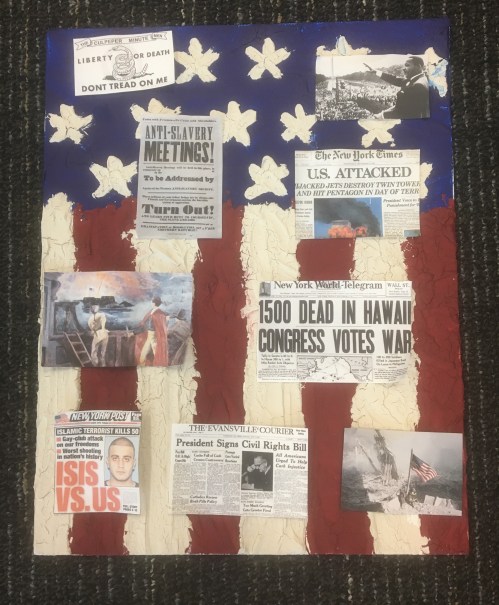
    img_1163

  3. Musical Genius
    One of my groups took a creative leap for their community unit visual and put together a musical. Franklin’s production of Joseph and the Amazing Technicolor Dreamcoat opened this past weekend. Several members of the cast in my first period class asked if they could complete the project in a slightly different way. Their project would still include analysis, present their ideas to the class, and involve audience feedback after the presentation, but…there would be singing.
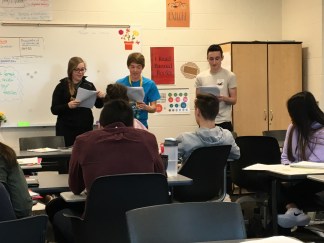
    img_1092

    Francesca, Joe, and Parker

    Since I always joke with my kids about presenting their ideas through interpretative dance, this musical idea intrigued me. Their mini musical included several skits that detailed life within the community of a musical cast/crew. Watching students sing their way through a summative, I was reminded that my vision for a project is rarely as broad and brilliant as what students can come up with on their own. My exemplar pool had just expanded in verse.
    img_1095

  4. Bag o’ Books
    Remember to beg for books. Want to build that classroom library? Get down on your knees and remind your students of how good it feels to give back…to you.Maija recommend the book Dangerous Minds a few weeks back. When a fellow student was at the bookshelf looking for it the other day, I asked Maija if she’d be willing to bring it so, AJ could borrow it. I even turned on a sweet smile and said, “If you don’t need it anymore, I’d be happy to take it off your hands.”

    The book was outside my door the next day, in a bag with a sweet note and several other books. Score.

  5. Amy Poehler on Writing
    I’m training for a half marathon. Without audiobooks, I might not make it. Seriously. I need to get lost in a story to pound out the miles. So, when I started 10 miles on Sunday and realized my Overdrive audiobook had expired, I had to quick download something new. Ugh.Enter, Amy Poehler’s Yes, PleaseI smiled for nine miles (it takes awhile to download when you’re actively running down the street). Poehler’s voice is sincere, relatable, and funny as all get out. Easy to book talk.

    Here’s the golden ticket: The Preface. I heard it and knew I needed to play it for my students. Poehler writes with undeniable voice about writing. She says of her text and the writing process that she “had no business agreeing to write this book” and wrote it “ugly and in pieces,” because “everyone lies about writing…they lie about how easy it is or how hard it was.” She says, and students really related to the idea, that “writing is hard and boring and occasionally great, but usually not.” In reflection afterward, students also noted her use of stream of consciousness, aside, and self deprecating banter to tell her story, not just inform her audience about what the book would be about. Classes agreed that they could really get behind her idea that, “Great people do things before they are ready.” Amen, Ms. Poehler. Let’s all put pen to paper.

  6. langchat#17
    I recently started following the brilliant Elizabeth Matheny on Twitter. Her AP insights and resources have helped fuel my work recently and her AP Language slow chat last week was a great opportunity to have my kids practicing analysis with students across the country. I’m thinking of several things to extend this activity:
    – Have students organize a slow chat for peers
    – Get students to live tweet peer feedback during speeches or discussion
    – See #7 below
  7. Tweeting Authors
    I tweeted Angie Thomas to tell her that her book The Hate You Give is stunning and I’d be getting into the hands of as many students as possible.She liked my tweet.Fangirl moment.img_1024
    Have your students reach out to authors. They often reach back.
  8. Creativity Visual
    I love what this suggests to students about the power they possess.
    img_1157
  9. Get it to the Big (or small) Screen
    My students often buy into the idea that great books are made into (sometimes great) movies. The Underground Railroad is being made into a series with the director from Moonlight. Having just finished this intriguing read myself, I book talked the text this week and shared the movie plans.
  10. Quick Write – Psychopath
    This came across my Facebook feed the other day, and I tossed it on my PowerPoint. As is the way in educator, my students surprised in noticing it, and we ended up doing a quick, quick write about changing social norms. AP Language test prep comes in many , many forms.

    img_1122
    What would make your list of 10 things we need to see and share this week? Add your ideas in the comments below! 

Lisa Dennis teaches English and leads a department of English educating gods and goddesses at Franklin High School near Milwaukee. She loves lists, especially lists with links to beautiful thoughts and ideas. Follow Lisa on Twitter @LDennibaum 
disclosure


Goodbye Days: a Craft Study and a Gorgeous Grand Slam

I love language. I love sharing my love of language with students.

When I read a book, I often dog-ear the pages, thinking of how I might use a passage to help my writers. Sometimes a book just does me in — so many beautiful words I cannot keep up. It’s a bonus if the story does me in.

Like Goodbye Days by Jeff Zentner. 30649795

If you haven’t read this book, oh, you’ll want to. Zenter’s first book, The Serpent King, kissed my soul. Goodbye Days took a hammer to it.

In a good way.

I started marking passages at page 36. I think because I forgot to think about it. Just read the first line of this YA novel:  “Depending on who — sorry, whom — you ask, I may have killed my three best friends.”

Mini-lesson opportunity one (whom), two (parenthetical with the dash), three (participial phrase), and four (voice)– all in one sentence.

The first time I really thought about using language from YA novels to teach my writers was in a class at UNH Literacy Institute taught by Penny Kittle. She showed us mentors of sentences and passages, pulled from the books she introduced to her students. She talked about how these craft studies also could serve as quickwrite prompts and book talks. A triple play.

Since then, Shana (who sat with me in Penny’s class) and I upped the ante:  some of our favorite mentors are hard-hitting home runs. But the following passage from Goodbye Days –It’s a gorgeous Grand Slam.


Excerpt from Goodbye Days by Jeff Zentner (p36)

     I feel like I’m watching something heavy and fragile slide slowly off a high shelf. My mind swirls with mysteries. The eternities. Life. Death. I can’t stop it. It’s like staring in the mirror for too long or saying your name too many times and becoming disconnected from any sense of yourself. I begin to wonder if I’m even still alive; if I exist. Maybe I was in the car too.

     The room dims.

     I’m tingling.

     I’ve fallen through ice into frigid black water.

     I can’t breathe.

     My heart screams.

     This is not right. I’m not fine.

     My vision narrows, as if I’m standing deep in a cave, looking out. Spots form in front of my eyes. The walls are crushing me.

     I’m gasping. I need air. My heart.

     Gray, desolate dread descends on me — a cloud of ash blocking the sun. A complete absence of light or warmth. A tangible, mold-scented obscurity. A revelation:  I will never again experience happiness.

     Air. I need air. I need air. I need air. I need.

     I try to stand. The room pitches and tosses, heaving. I’m walking on a sheet of Jell-O. I try again to stand. I lose my balance and fall backward, over my chair, thudding on the hardwood floor.

     It’s one of those nightmares where you can’t run or scream. And it’s happening to me this moment in the dying light of this day of dying. AND I AM DYING TOO.


What writing mini-lessons could you teach with this passage?

Will You Share Your AP Scores? Here We Go Again

I am not mean very often, but last week I was mean. Okay, not mean exactly, but certainly snarky.

I friend asked me about my AP scores. Innocent question. Struck a nerve.

I’ve written about AP English and AP test scores in the past, and I imagine as long as I teach AP English Language and Composition, I will continue to do so. I really do not mean to be snarky, but the more I talk with kids about their reading lives, the more I keep hoping more and more teachers Aim Higher — not just in AP classes, but in all English classes.

In the signature line of my school email, I include this quote by Emerson:  “We aim above the mark to hit the mark.”

I like that it helps me focus on what matters in my practice:  Teaching beyond a test. Always teaching beyond a test.

So what does this look like in my practice? Mostly, it looks like helping readers find their way back to a love of reading. After all, the best readers are usually the best writers, and the best readers and writers are usually the best test takers.

When Jessica asked me about my test scores last week, I know she was just working on building a case for choice books on her campus, a case for a workshop pedagogy. And while my scores did improve 50% the first year I moved to readers-writers workshop, no testing data captures the learning that happens in my classroom. No data shows an accurate picture of my students’ growth as readers and writers.

See for yourself:

For our midterm last week, my students wrote self-evaluations of their reading lives. Their words are much more valuable than mine when it comes to adding weight to the debate for time to read and choice of books in all English classes.

Leslie is a talker. She speaks with a beautiful Spanish accent and loves to use the new

LeslieandGiselle

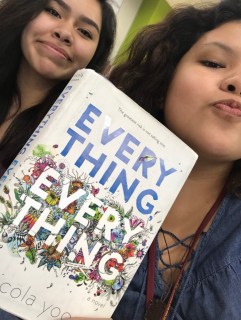
Giselle and Leslie, Nicola Yoon fans, dying for the movie!

vocabulary words she’s studying. I often have to hush her table because these girls like to talk about what they are reading during reading time. The fuss over Everything Everything by Nicola Yoon is on-going. They LOVE that book! Leslie writes:

“My reading goal for next nine weeks is seven books, I want to reach my reading goal and I will make it happen by reading more and do it because I enjoy it not just because I have to do it. I can gladly say that I love reading now, back then I used to be allergic to books and never touch them to read the beautiful stories that they have inside their covers.  After I become the perfect reader I intend to become the perfect writer.”

Giselle’s list of books she’s read so far this year reads like a spine poem. When she writes about whole class novels, she means our book club titles. I use book clubs to push many students into reading more complex books.

Lissbeth has been in the U.S. for three years. She titled her post “No Excuses for Not Reading.” My favorite line: “One of the things that I have learn thanks to my English teachers, is that reading is not just something you do for entertainment, it can also become a lifestyle.” Of course!

image2

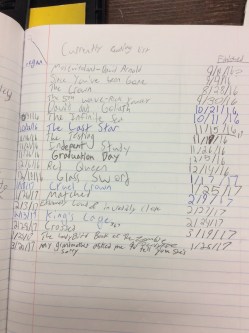
Audrey’s Currently Reading list

Already a reader when she entered my class, Audrey explains her reading experience since last August:

I have learned some about myself as a reader. I’ve learned that I like to stay in my reading comfort zone, but with a little nudge I’m able to read other genres and enjoy it. I’ve learned that I’m always growing as a reader. My reading rate can always improve. My vocabulary can always improve. As a reader I know that with due time, and with a lot of reading and determination, I can read ANYTHING!” [Note: If you read Audrey’s full post, when she mentions me giving the class a list, she’s referring to our book club choices. I do not have a list of all the books in my classroom library.]


Some students are in my block class, so I’ve only had them since mid January.

Cheyenne, who has read 14 books since the beginning of the semester, feels pretty strongly

blogger2bpt2b5

Cheyenne’s book stack

about the whole class novel. She writes: “I definitely have a deep dislike for class novels. This has more to do with the fact that I hate being forced to read certain books by certain deadlines, for me, it defeats the thrill, if you will, of reading the book in the first place.”

This year was the first time since middle school that I have been excited to read in class, and that was because we weren’t assigned a class book to read and we got to choose a book we wanted to read,” Rachel writes.

If you don’t believe some students lose a love of reading because of school, ask them. Ask them questions about what happened. Every kid I know was once an excited reader. Few are when they get to me in 11th grade.

Reghan confirms this in her post. She writes:

From elementary school through middle school, I read every kind of book, big or small. From nonfiction books about the unsinkable, sunken ship: the Titanic, to fantasy books about alternate universes and dystopian societies, I was a reader.

“Until my freshman year of high school.

“Ninth grade wasn’t easy for me. A lot went on that year with my family and personal life, causing me to be unfocused on school, my grades, and reading…and my transcript made that very obvious. I don’t think I read even one book in that entire year, summer included. This carried into my sophomore year, as well as part of my Junior year too. Zero books read, many to go.

“Being in AP English this semester and having to work hard to stay afloat has helped me tremendously and it wouldn’t be possible without my teachers . . . I’ve read four books this nine weeks including: Paper Towns by John Green, Will Grayson, Will Grayson by John Green and David Levithan, Extremely Loud and Incredibly Close by Jonathan Safran Foerand Sharp Objects by Gillian Flynn and I’m on my fifth: Columbine by Dave Cullen. That’s more than I’ve read in the last three years, combined. I’ve been introduced to books that I’ve never heard of and books that I never would’ve picked on my own. In fact, thanks to our assigned book clubs, I now have a new favorite book which is the aforementioned, Extremely Loud and Incredibly Close.

” I credit Mrs. Rasmussen with my progress because of her belief that we as students are more likely to read if we’re choosing books that we want, not that our chosen for us. In my experience, any book that has been chosen for me by a teacher, has been uninteresting and/or hard to finish. Being able to choose has only helped me and there’s proof in the numbers. Not only has this freedom improved my desire to read, but it has showed me who I am and what I like as a reader.”

And then there’s Ciara, who wrote “The Oprah Winfrey (with a little twist) Show.” Here’s a reader I am still working on, but oh, her writing voice. And her taste in TV shows! (We’ve bonded lately over quite a few.)


So in a post with AP test scores in the title, I give you a post about what students have to say about their reading lives.

That’s gonna be my answer every single time.

I happen to be assigned to teach AP English Language and Comp, but what I teach is how to love reading to students who miss it. Most of them miss it.

What are you doing about it?


Amy Rasmussen lives in north Texas and teaches AP English Language and English 3 to the Fighting Farmers at Lewisville High School. She also facilitates professional development for other teachers making the move into a workshop pedagogy. She adheres to the words of Emerson: “We aim above the mark to hit the mark,” and Jesus Christ: “Love one another.” Imagine a world if we all love more than we think we can. Follow Amy on Twitter @amyrass.

Window, Mirrors, and Gigantic Doors: Inviting Sound into Uneasy Silences

For weeks I’ve worked on a list of books to use for book clubs in our junior English classes. I believe that students must have options that challenge, yet engage, and allow them to see themselves and/or others within the pages. It’s that whole windows and mirrors and doors analogy. Jillian Heise describes it well in this post. I’ll just quote a part that struck me:

Dr. Rudine Sims Bishop originated the idea that many now reference. She talks about windows as “offering views of worlds that may be real or imagined, familiar or strange.” And about mirrors, “…we can see our own lives and experiences as part of the larger human experience.” But she also talks about sliding glass doors which “readers have only to walk through in imagination to become part of whatever world has been created or recreated by the author.” The thing is, it’s the third part of it, the sliding glass door that seems to often be left out, but is perhaps the most important part – it’s the part that, in my interpretation, allows us to step into those other worlds and become part of them for the time we are in that book – and isn’t that the power of reading? Being able to develop empathy, understanding, new perspectives by living in someone else’s shoes for a short time. Especially for books as powerful as the ones being written about these real issues that are affecting kids in their lives today, this mirror, window, sliding door access becomes even more important for them to see they have a place in our society, no matter what perspective they may bring.”

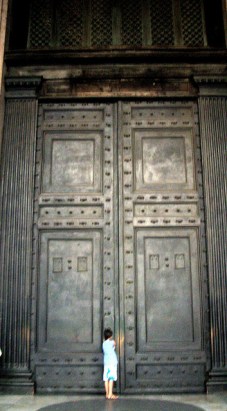
I’d like to offer an addition, not just sliding glass doors that  “allow us to step into those 8124672460_6b6f1ef826_zother worlds and become part of them for the time we are in that book,” although that interpretation is certainly vital to developing readers who love books and to gaining empathy.

What about other doors — like the kinds we have to push or pull to get through — the doors that make us work: cathedral doors, fortress doors, iron doors, or doors with scary knockers? These doors require effort. These doors may make us uncomfortable. And sometimes they require courage.

Some books can change us if we view them this way. They can change our students. And I’m not just talking about lexile levels, or complexity of ideas. I am talking about content. The content that exposes our flaws and weaknesses, the content that pushes our thinking, moves us out of our comfort zones, and makes us face, as Dr. Kim Parker puts it, “the lived experience of so many folks of color in this country.”

I am a white woman who teaches students of color. I grew up in a middle class family with conservative ideals. I go to church regularly, and I practice my religion. I had parents who were married for 55 years and taught me the value of hard work, education, and persistence. I am different from most of the students in my classroom. I enjoy a privilege in this country most of them have never experienced.

So what does this have to do with doors?

I choose the big ones.

Awhile ago I conducted a PD session with a group of teachers, mostly white women who like me teach mostly students of color. I showed some of the spoken word videos I use with my students:  “Spelling Father” by Marshall Davis-Jones and “Knock Knock” by Daniel Beatty. I shared articles about undocumented immigrants and Syrian refugees. I read an except from Homegoing by Yaa Gyasi where a character’s wife is kidnapped and he desperately tries to find her, showing her picture around the streets, and finally being accosted by a policeman after he accidentally brushes into a white woman. The policeman rips up the man’s only picture of his 8-months-pregnant wife. The year:  pre-Civil War.

We viewed and read texts. We wrote quickwrites and analytical responses. We discussed author’s craft and studied the moves the writers make to create meaning. Everyone read. Everyone wrote. Everyone engaged in the learning.

Later, the conversation turned to engagement, and I asked the questions:  “What are you doing to make the learning matter to your students? How are you discussing the issues that echo in their lives?”

I gave them time to talk, and I wandered the room, listening in to table discussions. I heard some valuable exchanges, but I also heard: “Oh, I don’t even go there. I’d lose control.”

Hmm.

How will we ever change as a society if we don’t ever go there? How will our students, no matter their color, ever learn to talk about tender and sizzling issues, ever learn to deal or challenge or change them, if their teachers never go there?

We cannot make excuses. We have to invite the hard topics into our classrooms. We have to provide books that are windows, mirrors, sliding doors, and gigantic wooden ones. Not only for the sake of the students we teach but for our profession.

How will we ever have more teachers of color if our students of color do not have better experiences in their English classes?

At NCTE last November, I met Dr. Kim Parker in person for the first time. She read her credo and she sealed a place in my heart with her sincere desire to do right by the students in her care. I share her credo here because it so closely echoes my own. I don’t think she’ll mind:

Ze’Voun tells me that he never knew that reading books could matter so much, could be so enjoyable. He is a young man who is Black, brilliant, and bored. He is a writer and a reader for whom schools seem to be increasingly less designed. When he disappears from my class without any explanation, I learn, a few weeks later, that he has been assigned to an out of school placement program, joining other boys who are–likely–as Black, brilliant, and bored as he.

I believe in rage, and I believe in action. I believe in a world where staying woke matters.  

My most essential work is making classrooms spaces where kids like Ze’Voun can read and write in ways that matter to them–from diss tracks; to letters to the local police department reminding them that Black Lives Matter, too, and that wearing their hoodies is not a crime; to Tweets to favorite authors thanking them for books that are just for him; to books that affirm, reflect, and extend his existence as a brilliant Black boy. Opening up spaces inside classrooms where they can speak a variety of Englishes as they explore the origins of Ebonics, where they can engage and delight with canonical and multicultural texts and write about their understandings, and where they are creators of texts that validate and stretch their identities is some of “the work my soul must have.”

Though Ze’Voun never returned, I continue to hold space in my classroom for other young people who have similar needs and desires, who are hungry for the diverse texts that reach them. I continue to hold on to a belief, and a dream, that the work I do must be as diverse as the students I teach. As escapist, as validating, as powerful as the texts they read. As whole, as free, as happy as we all wish, hope, and need to be.

This what I’ve dubbed Right Now Literacy. We have to give every student the commitment, resources, and opportunities they need to learn the reading and writing skills they need right now, to live and thrive in the world we are in right now.

Dear reader, I ask you the same questions I asked those teachers at that PD:  What are you doing to make the learning matter to your students? How are you discussing the issues that echo in their lives? 

Please answer in the comments. Let’s share our best practices and best resources for pushing ourselves and our students through the doors that can change us at the core. (And next week I’ll try to remember to share my new book club lists.)

FTC guideline

Amy Rasmussen lives in north Texas and teaches AP English Language and English 3 to the Fighting Farmers at Lewisville High School. She adheres to the words of Emerson: “We aim above the mark to hit the mark,” and Jesus Christ: “Love one another.” Imagine a world if we all love more than we think we can. Follow Amy on Twitter @amyrass.

Stop the Slaughter: Lifeless Literary Analysis

Teaching is a reflective practice. If you’re doing it right, that is.

We question, we research, we dig deep to update, invigorate, and refresh our work on a daily basis. And while this can be utterly exhausting (I think we need to investigate the ingenious cultural practice of siestas), it’s also exciting. As we push ourselves to grow and change as teachers, we impart that commitment to be better to our students.

I remember when I was student teaching several (cough, cough) years ago. The English and Social Studies departments shared an enormous office, and I was lucky enough to be afforded some space in that room to work. The fresh-faced 21 year old with boundless energy and enthusiasm for making a difference and connecting with “kids” (I was teaching 18 year olds. I’m pretty sure I was in elementary school with one of my students).

Then, I met *Mr. Pumblechook. (Names have been changed to protect the identities of very nice, well meaning people whose educational practices make me shutter.)

Pumblechook was a social studies teacher with perhaps six or seven years under his belt. He had a bright smile, hearty laugh, great expectations for his students (I had to. Thanks Dickens) and a file cabinet.

But this, ladies and gentlemen of the jury ( got serious quick, didn’t I?)this was no ordinary file cabinet. For in this file cabinet was a collection of folders. And in those folders were lesson plans.

One folder for each day of the year containing (because I pretended to be impressed with his organization and asked to see): a lesson plan, several worksheets to make copies of (even leftover handouts from the year before), and overhead slides of prewritten notes.

Was I student teaching in 1962? No.
Was I student teaching under a dictatorial regime? No.

This was 2002, people. Suburban Milwaukee.

And every time I tell this story to fellow educators, they nod, and I hear similar stories of educators from days gone by. Worksheet after worksheet, recorded lessons from first hour played to subsequent hours, teachers knitting in the back of the room, and countless acts of readicide across the land. Is seems Mr. Pumblechook had good historical precedent for imparting knowledge to children by opening up their brains and pouring in the same ideas year after year without regard to their role in that programming or real world applications of classroom material.

Enter: My classroom last week.

My AP students are armpit deep (my quip to convey complexity over the waist, but less perilous than the nose) in literary analysis. I wrote last week about our journey with diction analysis, as we got down and dirty with how an author conveys meaning with words.

Along my merry way I skipped, confident in this unit that I’ve taught several times, the tweaks I’d made in planning it for this year (updated mentors, current event references, jokes that students last year hadn’t heard yet – he he), and last year’s solid AP test scores. Not quite a folder for each day, but not too terribly far off either.

Then, I read Rebekah O’Dell’s post from Moving Writer’s, “Three Reasons Literary Analysis Must be Authentic.”

Gulp. Authentic.

I (shamefully) hadn’t really thought of that. I was preparing my students for the AP Language test. Wasn’t that authentic enough?

Of course, the skills of analysis are invaluable. Critical thinking across the curriculum is bolstered by the development of analysis skills which help students recognize patterns, decode information, compare and contrast concepts, classify elements under examination, and utilize inferences to support ideas. As one of the elements utilized by the College Board to determine students’ readiness for college level curriculum in English, rhetorical analysis is obviously important. The traditional essay format is required to pass this test and the analytical skills necessary to do so are a benefit to students far beyond the classroom.

But here’s the rub…

Even AP readers are looking for students to write outside the box. Yes, the skills of analysis must be present. But top scoring papers are those that challenge convention, take risks, and (I’m hanging my head in shame here) speak to a more authentic and far-reaching audience.

O’Dell’s post, like literary providence, reminded me that I needed to climb out of my car with tinted windows (I’m in here doing my thing. Nothing to see here) and pick up a mirror to reflect why I was doing what I was doing.

Her 3 key reflections on teaching literary analysis hit me right between the pencils. She reminds us that:

  1. Our job isn’t to produce English teachers.
  2. Writers need models in order to write.
  3. The traditional academic, literary analysis essay hurts student writing.

So,  am I hurting my students with what I’ve been doing? Absolutely not.
Could it be better? Absolutely, Mr. Pumblechook, because they might be better at formulaic writing with what I’ve been working on, but we’ve taken some steps back in their growth as authentic writers.

To address each of O’Dell’s points, which I felt compelled to do immediately (I had the mirror up and didn’t like what I was seeing), I changed some plans for this week and next.

  1. Our job isn’t to produce English teachers: I have to tell myself this more and more. O’Dell reminds us that 2% of college students major in English, and of those 2%, only 1% will enter professional academics.

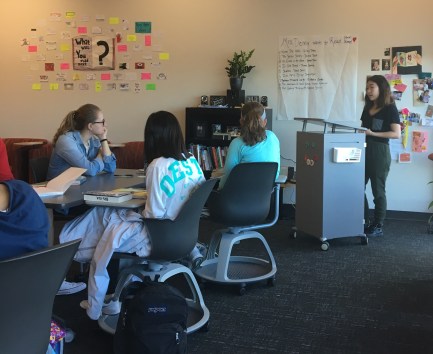
    It did occur to me though, that our students will need to engage with the world around them and likely need to synthesize ideas in order to share them. As such, I had my kids choose editorials on current events and topics of interest to present 1-2 minute speeches on. They needed to make claims about how the author achieved his/her purpose through DIDLS.The fluency of their writing for these speeches has blown me away. We’d been “writing analysis” last week, but none had the same voice, passion, or deep analysis that these had. Speaking the analysis had the power to remove the formula. Students concentrated on engaging their audience in a way that a practice AP prompt could not replicate.

    When my students sat down to write a full AP analysis practice today, I reminded them of how they had to work to capture the audience of their peers through their speeches, and that the nameless/faceless AP writers still wanted that same engagement. They want students to be successful on the test. This exercise seemed to solidify that and afford my kids the opportunity to reignite that natural voice we have been working with all year.

    img_0180

    Katie presents her editorial analysis speech this morning

    speech-form

    A quick Google form that I fill out as students are speaking provides immediate feedback via email 

    speech-feedback

    A sample of the detailed feedback on both content (helps with literary analysis prep) and public speaking (a real life skill for all)

    img_0179

    Students give peer feedback on the rhetorical analysis they heard, as well as the speech overall. 

  2. Writers need models in order to write: I’ve been using student samples from AP to accompany the prompts we’ve been analyzing for years. That’s honestly helpful. I have students score them and discuss with peers what constitutes a high, middle, and unacceptable essay according to AP so they can apply or avoid the same ideas.

    However, those high scoring essays were always met by my students with comments that suggested that top scoring essays held some undefinable magical quality.

    What is it? Style.

    Those essays, as I said earlier, not only develop complex ideas, but they do so in a way that keeps the reader engaged.To work with this, I’m going to share with my students some of the literary analysis that O’Dell’s post links to as well. The Atlantic‘s “By Heart” where authors share their insights on their own favorite passages in literature, is a website that makes literary analysis real, full of voice, and peppered with references to texts/authors my students know.
    My post a few weeks back on Arts and Letters Daily is another place we’re going to explore. How do writers write about texts without using a five paragraph essay? How can we, as Penny Kittle says, stand on their shoulders as writers and work to write as they do?

    al-daily

  3. The traditional academic, literary analysis essay hurts student writing: We want our students to be able to master the structure and form, but yet we want them them to break free of it too.I’ve often told my kids over the years that you have to know the rules in order to effectively break them.

    Maybe it’s true. Maybe, I just don’t have them break them soon enough and get to that authentic voice for an authentic audience.Because there, in the place where they have something to say with confidence, passion, precision, and critical thoughts developed by honed skills, will they bridge the gap between possessing the skills we want them to master and making their writing shine with the creative use of those same skills.

And now…it’s Wednesday morning and the lovely Tricia Ebarvia just ran a post about authentic audience through blogging. I’m headed there next.

I should just carry a mirror. I need it. Always.

How do you help move students move beyond the traditional literary analysis? We’d love to hear your ideas in the comments below! 


Lisa Dennis teaches English and leads a department of English superheros at Franklin High School near Milwaukee. A joke her students haven’t heard yet, but soon will, is:  Why did the librarian miss the conference? She was overbooked. Her students are sure to chuckle, if not pumblechook (used as a verb with creative credit to Dickens), at that one. 


AP English and Choice Reading

Last week Lisa inspired me with a post she called Books Can’t Be Bullied. Her last line:

“Let’s produce millions of resilient readers, hungry for truth, who will open books and listen, because a book is always ready to talk, and frankly, we could all stand to listen a lot more than we do.”

Then, a friend and colleague of mine wrote a post on her blog about the importance of choice in her AP Literature class, a topic near and dear to my own AP English heart. (I’ve written about choice in AP and how I feel about AP test scores quite a lot.)

And I knew I would share Amber’s testament to readers-writers workshop in AP English. She builds resilient readers, hungry for the truth, who open books and listen.

In this world of fake news and clickbait sharing, we might all want to evaluate how we can provide more opportunities for our students, at every level, to take more ownership of their learning and grow as resilient readers who are hungry for the truth.

Let’s stop saying choice does not work in AP English. It does. And it’s the students’ voices that prove it the most.

Here’s an excerpt from Amber’s post. I especially love the student comments:

. . .

I am currently in my fifth year of teaching AP Lit., and I feel confident that the feedback I have received supports the idea that choice and Advanced Placement courses are not mutually exclusive; in fact, choice might just be essential to our students’ future as readers. Not only have my AP scores supported this (I taught the class of 2013 using full-class novels which were chosen based on how many times they were referenced on the AP exam as well as the desire to cover all of the major literary eras, and my AP scores have increased, and have remained above national averages, since I began to offer students some choice in which texts they read), but my students have also provided positive feedback about how the ability to choose what they read has provided them with more incentive to thoroughly read and explore their texts.

I should probably note that the reason I felt compelled to write this post is because recently, I heard several well-meaning, experienced teachers express genuine concern that the classics “are not being taught anymore” and that “we should make students read them because if we don’t, they won’t ever choose to read them on their own.” Yes, that’s right – I clearly heard the words “make them read…” – because yeah, that works.

Here are a few snippets from students:

  • “Being able to pick our own book to read made the class even better, because we got to choose something to read that would fit our own styles instead of being forced to read something we may not like.” –Tiffany
  • “The book I enjoyed the most…are all the ones I chose to read. I had been wanting to read 1984 for a while and I got the chance. It was so interesting to me because my favorite books to read are dystopias. I liked The Picture of Dorian Gray because it’s different form what I’m used to reading. I like the fact that it was controversial. The Nightingale just had me feeling all kinds of emotions. It was hard to put it down because it was full of suspense. Although I loved 1984, Animal Farm was not for me. I was excited to read it, but it let me down. I don’t think it was the book itself, just the fact that it was assigned with a lot of work. Also, that we had assigned chapters every week, so I couldn’t read it and enjoy it at my own pace.” -Isela
  • “By you giving us freedom, we’ve been able to produce more creative ideas and products. You have definitely helped me prepare just a little bit more for college. Thank you!” –Kara
  • “I suppose I should designate Beowulf as my least favorite book that I had been assigned to read in the duration of my high school years.  I did not despise it entirely; it simply was not very appealing.  In addition, I never completed it.  With only a handful of chapters left, it is one of the few books I have not at least forced myself to finish.  Thus, it will always be a sore spot on my conscious. For my final remarks (at least my final mandated remarks, but I am not making any promises), I would like to state that I prioritized this class over my others even though from the grading perspective this made the least amount of sense.  I honestly felt the need to learn and not just merely make last minute memorizations.”  –Allison
  • “The book I liked best that I read for the class was Les Miserables because I liked it the best and because it was so long I cracked and got the audio book, and I enjoyed having the book read to me as I followed along even though it was a 12 1/2 hour audiobook. My all time least favorite book from my high school Englishes was Bless Me Ultima. It was plainly a boring book and the more I tried to read it the less I was interested in it. I didn’t even end up reading it, honestly. I just sat in class and listened to everyone else’s discussions and from that I got the general gist of the story and such.” –Clancy

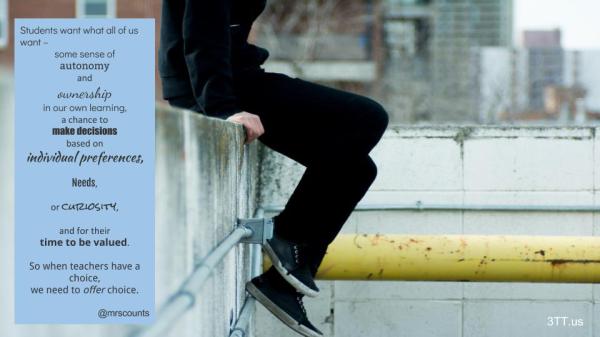
countsquote

Read Amber’s full post Choosing Readers Over Texts with the whole of her students comments. You’ll get it.

What are you thinking? Please let me know in the comments.

Amy Rasmussen lives in north Texas and teaches AP English Language and English 3 to the Fighting Farmers at Lewisville High School. She adheres to the words of Emerson: “We aim above the mark to hit the mark,” and Jesus Christ: “Love one another.” Imagine a world if we all love more than we think we can. Follow Amy on Twitter @amyrass.


Writing Heals. Writing Assignments Do Not

Last week I learned a valuable truth:  Even when we think they are not listening, sometimes students get it.

Let me back up.

The week before last I attended a department meeting where our district ELA coordinator shared the National Writing Project’s Case for Good Instruction, information I learned at my National Writing Project Summer Institute in ’09. It details the differences between When Writing is Assigned and When Writing is Taught. The discussion around me was interesting and peppered with excuses. I left wondering how teachers would answer these questions if they were on a quiz. How would you?

In your ELA class, do students:

  • have opportunities to create topics that matter to them?
  • understand audience and purpose for papers because they are specifically identified in assignments?
  • see you spending time teaching writing skills and strategies?
  • get writing models, assignments, and strategies to guide each of the different writing tasks?
  • reflect on significant growth — or lack of it — in specific writing skills?
  • hear words of encouragement cheering them on to revise, edit, and improve — and to correct drafts and then resubmit?
  • think about what they write through brainstorming, free writing, role-playing, discussion, or other prewriting activities?
  • celebrate what they, and you, write and make efforts to display and publish it?

I think the biggest excuse we give for leaning on assignments rather than acting on instruction is TIME.

“I can’t let students choose topics because they don’t know what to choose.”

“I can’t teach this novel if it takes so long to write a paper.”

“I can’t do my research paper if I give them time to resubmit. It already takes so long to grade the finished product.”

Maybe you are right. Maybe we have to give up things that we think are best practices for things that are better practices.

Student choice in writing topics is better practice.

Writing instruction with effective models, strategies, time to talk, and time to write are better practices.

Helping students revise, edit, and improve their writing during the writing process with a keen sense of audience and purpose are better practices.

conferringwithjulyssaOur students need time. They need our time. They need our attention and our careful consideration about the things that matter to them. We may have to let some things go in order to give our students what they need.

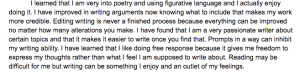
We learn valuable truths when we do. Last week my students performed (or presented) their poetic arguments. We spent weeks choosing topics, watching video performances, analyzing lyrics for structure and craft, thinking, drafting, talking, revising, studying models, reading each other’s writing, giving feedback, practicing mini-lessons on concrete details and using abstract language to create jaw-dropping imagery.

We were a community of writers, united in a task uniquely our own.

And that is the difference between When Writing is Assigned and When Writing is Taught.

During all that time, I didn’t think Stephanie was listening. She sat at her table, barely talking, sometimes writing, always sad. Then right before Christmas break I sat down and we talked. She showed me her draft, and it scared me. I knew she’d been depressed — her grandmother died at the beginning of the year, and the light left Stephanie’s eyes. I listened to her share her sorrow, her anxiety, the weight of her world , and I gave her my cell phone number with the promise she would call if her boots got too heavy. Thankfully, they didn’t.

Every one of my students who presented their poems sparkled with pride as they faced their classmates, even the ones whose knees knocked in fear. They wrote from their hearts about issues that matter to them personally. They wrote the most important arguments about mistaken perceptionholding grudges, self-hate and self-love, parental control and uncontrolled parents, lying and how we’re programmed to labelBlack Lives Matter and dying white privilege. They wrote about better education and the stress of getting educated, absent fathers, loving fathers, and parentless children and alcoholics who should have put down that drink at 21.

They wrote about sticking together.

And they wrote about self-destruction and depression and monsters. So many of them wore grooves in the floor with the spikes that hold them in place until the sadness drags them down under. They broke my heart.

writing-heals-quote

Writing to heal is better practice.

Please enjoy Stephanie’s poem. She calls it “Smile.”


Many students chose video presentations over live performances. I published several this morning on the 3TT Facebook page. Take a look.

Please share your thoughts on teaching writing. Leave a comment.


Amy Rasmussen lives in north Texas and teaches AP English Language and English 3 to the Fighting Farmers at Lewisville High School. She adheres to the words of Emerson: “We aim above the mark to hit the mark,” and Jesus Christ: “Love one another.” Imagine a world if we all love higher and harder than we think we can. Follow Amy on Twitter @amyrass.


10 Things We Did That Invited Initiative — and Growth

It is 6:00 am. I stayed up all night playing with this blog and our Facebook page and Pinterest and Instagram and exploring this app and that extension and whatever else called on me to click on it. I didn’t even realize I’d blown the night up until my Fitbit buzzed telling me to get up and workout. Thank God it is a holiday!

I cannot help but think (besides about how tired I will be all day) about engagement. I remember a while ago I read Danial Pink’s book Drive and then watched the RSA Animate video on motivation. We really will spend time, lots of time, doing the things we want to do be it reading, writing, learning a new skill, climbing a mountain, or sinking into the social-media–abyss. We just have to want to.

So how do we get our students to WANT TO do the things we know will make a difference in their lives, namely, read more, write more, communicate better, think more critically?

We keep trying.

i just finished a semester with my students. I wish I could say that every child read more than he ever has in his life, wrote better than she ever has since she held a pencil, learned to speak with ‘proper’ English and clear eye contact, and thought like a rocket scientist trying to get a man to the moon.

Some did. Some did, and honestly, the first few days of school, I didn’t think they would. But I kept trying.

Here’s a list of the top 10 things I kept doing, even when I was tired, even when I thought they weren’t listening, even when we all wanted to hide behind dark curtains and ring a bell for a cup of tea. (That will be me later today.)

We read at the beginning of class every day (almost — we had about six days throughout the semester when something somehow got in the way of that, i.e., fire drills, assemblies, wonky bell schedules, my car dying on the way to school).

We talked about books A LOT. Book talks, reading challenges, reading goals, tweeting book selfies, and more.

We wrote about our books enough to practice writing about our books. Theme statements, mirroring sentences, analyzing characters and conflict and plot — just enough to keep our minds learning and practicing the art of noticing an author’s craft.

We wrote about topics we care about. With the exception of the first essay students wrote, which was all the junior English teachers committed to as a pre-assessment, students chose their own topics or wrote their own prompts. Donald Murray in Learning by Teaching says the hardest part of writing is deciding on what to write about, yet we so often take that hard thinking from our writers. The worst essays my students wrote was the only one in which I gave a prompt, and before you think it’s just because that was their first essay, nope, I asked them. They just didn’t care — and that is the worst way to start off the year in a writing class.

feedback-on-prompts

feedback-on-owning-topics

feedback-on-self-selected-topics

We read mentor texts and learned comprehension skills and studied author’s craft. I chose highly engaging texts about current events in our society:  police shootings and being shot, taking a knee during the national anthem, race relations, our prison system, immigration issues — all topics that make us ask as many questions as the writers answer. Inquiry lived in our discussions.

feedback-on-writing-as-a-writer

We talked one-on-one about our reading and our writing. I conferred more than I have in the past, taking notes so I wouldn’t forget as students told me about their reading lives and their writing woes. We spoke to one another as readers and writers. We grew to like each other as individuals with a variety of interests, backgrounds, ideas, and dreams.

We shared a bit of ourselves — mostly in our writing — than we ever thought we would. Abusive mothers, alcoholic fathers, hurtful and harrowing pasts and how we grow up out of them. We talked about respect within families and how we can hurt the people we love the best when we ignore their love because it’s masked in fear and strict parenting.

a slice of Daniel’s semester exam essay

We celebrated our writing by sharing what we wrote, by performing spoken word poems, reading our narratives, or reading our quickwrites. We left feedback on sticky notes and flooded our writers.

We grew in confidence and that showed in our work. I held students accountable with high expectations — and lots of mercy. Most rose to the challenge, even those in their first AP class and those far behind who needed to catch up. Most exceeded their own expectations.

feedback-on-high-expectations

feedback-on-writing-as-a-writer

feedback-on-writing-confidently

We joined communities of readers and writers on social media, building a positive digital footprint that shows we are scholars, students who care about their literacy and want to go to college. We wrote 140 character book reviews and explored Goodreads and shared covers of the books we were reading. #IMWAYR #readersunite #FridayREADS #FarmersREAD

martina

rozlin

I will miss the juniors in my block class who are done with English for the year. They were a joy, although a challenge, pretty much every day. And my AP kiddos, they are ready for the kind of learning we will do to face down that exam come May.

We will keep doing what we do: Whatever it Takes to Grow as Readers and Writers (even if it means a lack of sleep.)

What do you do to motivate your learners? Please share your ideas in the comments.


Amy Rasmussen lives in north Texas and teaches AP English Language and English 3 to the Fighting Farmers at Lewisville High School. She adheres to the words of Emerson: “We aim above the mark to hit the mark,” and Jesus Christ: “Love one another.” Imagine a world if we all love more than we think we can. Follow Amy on Twitter @amyrass.

disclosure

On In Defense of Read Alouds. Please, do.

At the end of a post I wrote last August called “My Classes are Only 45 Minutes — How Do I Do Workshop?” a reader named Andy left this comment:  I am at kind of a roadblock mentally and could use a push…I teach 8th grade reading in a building that still has both “reading” and “language” classes. While I am slowly transitioning to more of a workshop approach, I am still getting stuck on a few things. For our second semester, we have always read a whole class novel, but I would love to get away from that. Have any of you done read-alouds in your classes? I am beginning to think that maybe a better option would be to have students vote on a novel with a certain theme and do a read aloud and work on certain aspects of reading. My one concern that I can hear being brought up by administration is making sure I have enough assessments and grades…

First of all, I love that Andy asks this question and recognizes his need for “a push” as he wants to do more to engage his students than just another whole class novel. Not that whole class novels are necessarily bad, but those of us who have seen what choice can do in our students’ reading lives know:   if we only choose whole class novels, we lose valuable time developing readers. Giving students a choice as to a book to read aloud might just be a good idea.

I heard Steven Layne, author of In Defense of Read Alouds speak at the Illinois Reading Council Conference this past fall. He quoted the research and the position statements from scholars of various grade levels on the benefits of read alouds:

  • Positive attitudes are fostered towards books.
  • Imagination is exercised.
  • Background knowledge is built.
  • Reading skills are improved and reinforced.
  • A model of prosody and fluency is provided.
  • Reading independence is promoted.
  • Interests in genres are broadened.
  • Cultural sensitivity is increased.
  • Listening skills are improved.
  • Exposure to a variety of text types is provided.
  • Reading maturity develops.
  • Reading happens.

Based on these statements, Andy, what do you have to lose?

stephenlaynequote

I offer a few suggestions though:  HOW you read aloud to children is as important as WHAT you read aloud. Layne suggests five key elements the teacher-reader must employ as he conveys an awareness of phrasing and word color:  diction, volume, pace, tone, and pitch.

To read aloud effectively, as to engage all listeners, the reader must be a performer.

Of course, what you read aloud matters, too. Offering students several choices and letting them vote is one way to foster trust in your classroom community. Students want to know we value their opinions. I’ve found with my AP English students, when I provide several choices for their Book Clubs, many students will choose to read the books not selected for their independent reading.

I would also suggest that you offer a choice of books that are not too long. I learned a few years ago when I read aloud with my 10th graders that even when they choose the book, attention spans are short. A full-length novel read aloud can cause the same negatives that a whole class novel study can. For this reason, I think it’s important to consider your main objective first and then plan backwards.

If I were doing a read aloud with those same 10th graders this spring, I would plan differently than I did before.

  1. I’d select several books with the same theme I want to build a unit around, and I’d plan to introduce the books by reading aloud from each of them.
  2. I’d think about the goals I can accomplish as we focus on the theme, and I’d think of several summative-type assessments in which students can choose to show they’ve accomplished these goals. Or I’d think about how I might invite students to create their own major assessments.
  3. I’d think about the skills my students need to master, and I’d pair mini-lessons with the ones I know will emerge through the reading. (These can serve as formative assessments.)
  4. I’d think about how I will get my students to apply these skills to their independent reading books, which could all be centered on the same theme (if I planned that well enough). (These can also serve as formative assessments.)

One of my goals with my AP students this spring is to do more read alouds. I’ve learned this fall that many of my students do not understand the different forms and structures stories can take. We are going to use children’s books to help with our understanding. The book Writers ARE Readers by Lester Laminack and Reba M. Wadsworth offers several suggestions on titles that will work with students of all grade levels.

So while I will not be reading aloud a whole novel, I will be performing read alouds and thinking through 1-4 above as I plan this unit.

Best wishes to you, Andy, as you read aloud with your students. I believe this poem by Steven Layne is an important reminder to all of us who work with children:

Read to them
Before the time is gone and stillness fills the room again.
Read to them.

What if it were meant to be that you were the one, the only one,
who could unlock the doors and share the magic with them?
What if others had been daunted by scheduling demands,
district objectives, or one hundred other obstacles?

Read to them
Be confident Charlotte has been able to teach them about friendship,
and Horton about self-worth:
Be sure the Skin Horse has been able to deliver his message.

Read to them
Let them meet Tigger, Homer Price, Aslan, and Corduroy;
Take them to Oz, Prydain, and Camazotz;
Show them a Truffula Tree.

Read to them
Laugh with them at Soup and Rob,
and cry with them when the Queen of Terabithia is forever lost;

Allow the Meeker Family to turn loyalty, injustice, and war
into something much more than a vocabulary lesson.

What if you were the one, the only one, with the chance to do it?
What if this is the critical year for even one child?

Read to them
Before the time, before the chance, is gone.

– Steven L. Layne, from The Reading Teacher Vol 48, No. 2 October 1994

Do any of you have other suggestions for Andy about how he might structure and/or craft assessments for his read aloud? Please leave your ideas in the comments.

Amy Rasmussen lives in north Texas and teaches AP English Language and English 3 to the Fighting Farmers at Lewisville High School. She adheres to the words of Emerson: “We aim above the mark to hit the mark,” and Jesus Christ: “Love one another.” Imagine a world if we all love more than we think we can. Follow Amy on Twitter @amyrass.


disclosure

What’s the most important thing you think you’ll ever write?

I am good at setting reading goals. Good at helping students set them, too.

But I never really thought about the importance of setting writing goals until I decided I wanted to write a book and struggled to get words on the page each day. (I still struggle.)

Even with this blog, my writing goals seem fuzzy. Sure, we have a 3TT posting schedule, and more often than not, I make my mostly self-imposed deadlines. But I haven’t really considered these deadlines writing goals.

Today I am wondering why not.

And I’m thinking that this is probably similar to how my students view the writing tasks I ask them to complete. They look at the calendar I provide. They consider the writing workshop dates, the revision workshop dates, the writing group dates. Maybe they pay attention to the learning goals I write on the board and review each day — all valuable parts of our writing class routines, but I doubt they actually set any goals. (Okay, maybe they set the goal to actually complete the assignment. Maybe.)

But I want them to set writing goals. I want to set writing goals for myself this year.

billygoal

a gem of a goal by my friend Billy

So today as we go back to school and get back into our routines, we will talk about writing goals, not just writing assignments. We will talk about the reasons we write and how practicing our craft can help us accomplish those reasons.

I think we’ll start with this poem:  The Writer by Richard Wilbur. And then read “The Daily Routines of 12 Famous Writers” and maybe “9 Weird Habits That Famous Writers Formed to Write Better.”

Then, maybe I’ll ask this question:

What’s the most important thing you think you’ll ever write? Why?

I don’t know where the conversation will go, but I am okay with that. I’ll let my students know how I feel about setting some personal writing goals. I’ll let them know how I think this may change, or challenge, my ability as a writer.

I’ll write my goals as they write theirs, and we’ll share.

If you need personal writing inspiration — or just want to find some excellent short mentors to use as you write with you students — read this: “Ten Texts That Will Get Teachers Writing.” And, of course, we share lots of writing inspiration on this blog.

I’d love to know your writing goals for the year. Please share them in the comments. (P.S. I hope one of them is to write a guest post here in 2017.)

Amy Rasmussen lives in north Texas and teaches AP English Language and English 3 to the Fighting Farmers at Lewisville High School. She adheres to the words of Emerson: “We aim above the mark to hit the mark,” and Jesus Christ: “Love one another.” Imagine a world if we all love more than we think we can. Follow Amy on Twitter @amyrass.