Category Archives: AP Language

Writing Myself Out of a Wreck

Note: This post was supposed to run this morning. Must not have clicked the right button last night. So, here’s my thinking of late. Better late than not at all. (I think that’s the mantra of many of my students.)

I have a confession:  I am pretty much a wreck.

I could blame it on my son who joined the Army and left for basic training the afternoon of Mother’s Day, or I could blame it on another son who called to say he’s marrying a girl he’s known a month and I’ve never met, or I could blame it on this Empty Nester thing that’s barely three days new and haunting me with shutting doors and creaking floors.

I could blame it on the AP Language exam my students take today.

It’s the same every year — well, not that son part, thank God — but definitely the wreck part.

Every year I wonder if I taught enough, had them write enough, gave enough feedback. I wonder if I helped them grow as critical thinkers and accomplished writers. I wonder if they will read the prompts correctly. I wonder if they’ll answer the questions. (I’d be happy with a thesis statement.) I wonder if they’ll remember we learned to read footnotes. I wonder if they’ll cite their sources. I wonder if they’ll write enough to show they are bright and honest and eager and loving young adults.

Oh, wait.

That’s right.

No matter how my students do on this high-stakes test, the important things — the things that matter to me, and should matter to the world — are the things that cannot be measured in 55 multiple choice questions and three essays.

I just needed to write myself into that reminder.

_________________________________________________________________

Today I read  Enjoy the Best Year Ever with a Mantra by Ruth Ayres and loved her Why I Write mantra. I took up the pen to write my own. It’s still a work in process, but I’m kinda likeing it, and I’m no longer a wreck.

Why I Write

I write to make myself feel better.

I write to discover what I want to say.

I write to hear my voice within the chaos.

I write to play with colorful words (and pens).

I write to show my students I am a writer — and because it’s hard.

I write to share my thinking, my hoping, my planning, my longings.

I write to be remembered and to be worth remembering.

I write to know I belong.

I write to advocate for literacy and learning and the lives of my kids.

I write to become a better reader (and I read to become a better writer).

I write to tell stories.

I write to walk the walk and talk the talk of my English teacher self.

I write because it is better than the spa.


Have a go at it. What is your mantra?


Try it Tuesday: Thinking Outside the Bubble

Testing season is upon us. Heaven help us all.

ACT, SAT, AP – insert your high stakes, hive-inducing, pencil-sharpening acronym here.

As students sit down to demonstrate, in bubble form, their proficiency as scholars (and sometimes in their own estimation, as human beings), we as educational professionals hold our collective breath.

Have we balanced real world application of skills and test prep as we should?
Will students be able to develop their ideas in the limited time provided? 
Do they know the specific language necessary to decode the test? 
Will they demonstrate growth reflective of the hard work of both teacher and student? 
What will these scores mean for my daily practice? My salary? My job security? 

It can sometimes feel desperately difficult to maintain the freedom, choice, and empowerment that workshop affords in the face of district expectations for test performance. Afterall, students aren’t given choice when it comes to test prompts or format, or taking the test at all. However, at the end of the day, the skill focus of both readers and writers workshop speaks pointedly to preparing students for whatever they might encounter on such tests, as learner investment in choice materials in often much higher. So if we work to illustrate key skills in mini lessons and have students work with those concepts utilizing texts they are enthusiastic about, research would suggest a solid return on investment, both scholars and the tests used to measure their “proficiency.”

For example, Greene and Melton’s book  Test Talk: Integrating Test Preparation into Reading Workshop stresses that successful test takers must be smart readers.

Many test taking strategies are simply good reading strategies, so as we work to build student skills in close reading, we are also building their test-taking skills. In this way, test review isn’t an isolated unit, but rather a daily practice that teachers can refer students back to as test time approaches. And because better reading means better writing, the need to develop students as careful readers is paramount.

So while the beauty of workshop is choice, our world of standardized tests demands the development of specific reading and writing skills; however, those two worlds can have more in common than we might initially think.

To illustrate, I took my AP Language students through a prompt review that challenged them with timed writing, analysis of student samples, self-assessment of their work, peer-assessment of their work, and then collaboration to arrive at a final score.

Obviously, part of the written test is one’s ability to write an argument, but in the case of this synthesis prompt, if students aren’t careful readers of the materials provided, they struggle to effectively incorporate the evidence. This specific test prep went way beyond the test in terms of skill development and it went down like this:

  1. Students wrote an AP Language Synthesis essay in class. This required 15 minutes to look at sources and 40 minutes to write an argument essay utilizing those sources to support their claims. AP Synthesis essays ask students to write an argument and incorporate at least three of the provided sources. Students must quickly read through the source material to locate information they want to use in support of their claims and then plan, organize, and write their essay.
  2. The following class period, we looked at student samples and the AP scoring guide from the College Board website. This gave students an idea of what the prompt looked like in action and the actual scores those students received. I divided the class into groups, had each group look at one sample essay and its score. They then had to justify how AP scorers came up with that score. We shared as a class that lower essays lacked organization and analysis, middle scoring essays were adequate in all areas but could be improved with more specifics and developed analysis of included source material, and the top scoring essays blend style and content in a mature fashion.
  3. Students then pulled out a clean sheet of paper and self-assessed using the provided rubric by giving themselves a score and justifying it.
  4. Here’s where I tried something new. Students folded over the top of their assessments and handed their synthesis essays and the reflection (without their score visible) to the person next to them. Peers read through the essay, scored it, and wrote several suggestions for improvement. We went around our tables of four until each student had his or her essay back.
  5. We then unfurled their feedback and engaged in collaborative discussion. I asked students to talk about what they saw in each other’s essays and to arrive at a final score. I recorded this in the gradebook as their formative score for the exercise. Anyone that was dissatisfied with what the table decided, could come and share their concern with me, which I am pleased to report, did not happen.
  6. Students stapled their feedback form to the essay with a final score on top, along with their thoughts on the exercise.

In the end, students said it was hugely helpful to compare their work to that of others and in doing so, realize what they could do to improve their own responses on the actual test.

Eva said she found the activity, “Really, really helpful. It’s good to get perspective and to be able to reflect from that feedback. 10/10 :)”

Sam suggested that it was helpful because he finds it “hard to critique” his own work. Having published student samples from AP and peer samples from his group, he was able to compare and contrast against concrete scored examples and try his hand at assigning a score on his own, with his tablemates to help justify that score at the end.

And Daaman said she, “enjoyed this activity as we were able to see others’ interpretations of the prompt and also see ways we can improve.”

I’m glad they feel more prepared for the test, but beyond that I am most impressed that in just two class periods they demonstrated skills in both reading and writing, analysis, synthesis, reflection, and collaboration. By analyzing student samples as mentors and applying that knowledge to their own work, students walked away with several examples of what to do, what not to do, and where to take their writing for the next argument we write. No bubbles or number two pencils required.

How do you bring workshop and standardized testing together? Please leave your ideas and comments below! 

Mini-lesson Monday: Personal Reading Challenges

If you’ve ever taught juniors, you probably know my struggle. The third quarter of every year, students hit some kind of mountain of a speed bump. I think they are tired, overwhelmed, a little undone.

Junior year is hard for many of my readers. It’s the first time most have taken an AP class, and some are taking two or three. Competing with APUSH is something I’ve become accustomed to —students choose to do their history homework over English every year. Textbook reading for history looks like homework while the reading I need students to do, reading books that fill their heads with knowledge and stories and vocabulary and empathy does not.

When we hit the wall this spring, I asked a group of my students to help me design a plan to get our reading lives re-energized. They kept it simple:

  1. We should create personal reading challenges.
  2. You should talk to us more about what we are reading.
  3. We should talk to each other more about what we are reading.

This lesson shows how we created our challenges. The more talk part? That was a reminder to up my game with conference and to remember to schedule time for more talk around books.

Objective:  Using the language of the Depth of Knowledge Levels, students will assess their reading lives so far this year, predict how many books they can read this spring, and design a personal challenge that will help them continue to grow as readers.

Lesson:  I projected this question on the board at the beginning of class and asked students to write for five minutes in response:  Think about your reading growth and improvement this year. Can you honestly say you are better now than you when you walked in the classroom in the fall?


I then asked students to talk to one another about their responses. And then we talked as a group about how we can up our reading game. I explained that a few of their peers had suggested that everyone craft their own reading challenge, and I showed them mine.

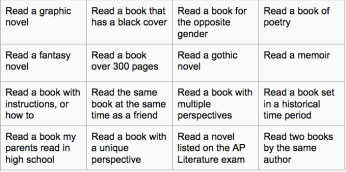
Screen Shot 2016-04-17 at 11.25.13 PM

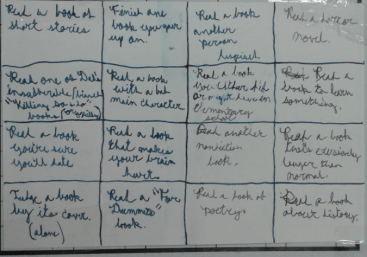
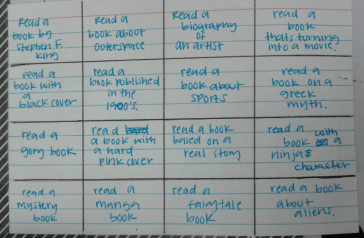
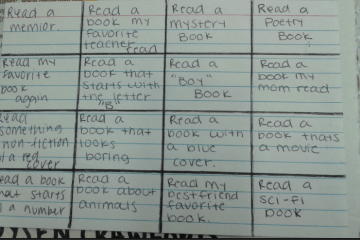
Then, I gave everyone a notecard, and they went to work. Here’s a sampling of some of my students’ personal reading challenges for the end of the year. I think they’ve decided we are playing bingo. (An interesting idea for the beginning of next year, too.)

Read a book that makes your brain hurt. That’s my favorite!

Screen Shot 2016-04-17 at 11.33.17 PM

Screen Shot 2016-04-17 at 11.34.29 PM

Follow up:  I’ve met with more students the past week than I had in the three weeks prior to creating these challenge cards. I appreciate my students reminding me — and wanting me to talk to them more about their reading. The cards serve as excellent talking points for our conferences.

We can never talk to our students one-on-one enough! I know that is true, and I know we get caught up in a million other things that consumes our conferring time. I am recommitted. I want my students to leave me with a sure knowledge that they’ve advances as critical and thoughtful readers who know how to choose books they enjoy and books that challenge their thinking and their abilities. Since students came up with the idea for this little challenge, they have shown much more interest in it than other challenges I’ve created in the past. A good reminder for me. Now, I see kids standing at the books shelves, and when I ask what they are looking for or if I can help them find a book, more often than not, they tell me they need to find a book on their challenge card.


Poetic Rhetoric — Spoken Word Poems in AP Lang

For a long while now, I’ve wanted to write spoken word poems with my students.

I use Sarah Kay’s “Hands” at the beginning of the year to start students thinking about their lives and the important moments that shape them. We draw hands in our notebooks and fill them with words that represent our memories. Like many of you, I first did this myself with Penny Kittle, and now I draw a hand in every notebook as one of the first pieces I write in it.

I use Shane Koyczan’s “To This Day” and ask students to write a response to it. Sometimes they tell me things that break my heart. Like the fall on the first day of school when two different girls in two different classes wrote about the abuse they experienced from their fathers at home.

These and other poems students find interesting and inspiring, and while they’ve always worked as never-fail quick writes, I wanted to challenge students to use all the skills we’ve focused on this year to write their own poetry. My student teacher, Zach, and I finally figured out how.

And students wrote some powerful poems with some perfectly poetic language.

We called the assignment:  Poetic Rhetoric. what-matters-most-in-life-are-quotes-and-stuff-that-tell-you-what-life-is-really-about_motto

The initial task read like this:  Craft a spoken word poem that addresses a personal conflict and/or a social issue, include rhetorical techniques and literary and rhetorical devices to convince your audience of the need for positive change. Perform your poem for the class live, or create an automated slide show with visuals, or a video recording as a way to digital.

Every day for a week we shared a different spoken word poem. Sometimes we wrote responses as a way to mine for our own ideas for topics. Sometimes we studied the lyrics, closely reading and analyzing structure, tone, and literary devices. We encouraged students to use the work of these poets as their mentors:  “Remember, we learn to write when we study good writing.”

We listened to “Paper People” by Harry Baker, and we talked about theme and sentences that hold the most weight, ones that might be his position statement.

We listened to “Education” by Aadil Malik, and we talked about evidence and examples that support the main idea.

We listened to “Touchscreen” by Marshall Davis Jones, and we talked about repetition, puns, and other literary devices that make language clever and meaningful.

We analyzed the structure of “To This Day,” and we talked about how Koyczan moves from self, to another, to another, to everyone as a way to finally get to his moving plea “to get a better mirror.”

Zach taught mini-lessons, reminding students how to use personification, puns, allusions, and fresh figurative language. We gave students time to write in class, and time to talk with one another, and time to talk with us about their process and their product.

We provided resources on how to write performance poetry like this and this and this.

And students wrote beautiful and meaningful arguments.

Most students performed their poems live in class. (I did allow for a teleprompter since I am the worst at memorizing myself.) We have a slam poetry night coming up on our campus in April. I hope many of my student will perform their poetry again there.

Here are the lyrics to some of the ones I personally enjoyed. I wish I had video of the performances. You’ll have to trust me — they were awesome.

Nefertiti Franklin:  WelcomeToStereotypesAA

Jennifer Melendez:  Find Your Charge, which includes an evaluation of her writing process

Kennedy Jenkins: Use Your Mind

Fabian Gutierrez: ADPoem

And here is an example of one of the poems published digitally. I love her language.

Jessica Ortiz:  People Love to Talk

Reminders to self for when I do this writing unit another year:

A. Take more time with topic selection. As with any writing, if students choose topics that are too broad, or they do not know enough about, the writing is harder to revise.

B. Meet with students more often. Conferring is essential to helping students find what they want to say. Too many students procrastinate and then think they can produce quality writing at the last minute. I must remember to confer at the beginning, the middle, and the end of the writing process. Schedule time for this.

C. Allow time for students to provide one another more targeted feedback. Although they met in small groups and talked about their writing, they did not use their time as effectively as they could have. If I will be more purposeful in modeling what a helpful feedback group looks like, students will be able to help one another more.

I love teaching students to write. I’m not sure there’s a better gift than reading their published work and seeing that they understand the power of their voices. Sometimes they blow my socks off with the force of their wisdom. I love it when they get it.

Have you used spoken word poetry in your writing class? How? What are your favorite poems?

#FridayReads: Required Reading “Our Students Want to Write”

Confession:  I buy a ton of pedagogy books. I rarely read them all the way through. I blame it on my blossoming OCD. I can only take in so many ideas before I run out of space in my head to hold them all long enough to use them.

412bcpby4iol-_sx326_bo1204203200_That is not the case with this classic, suggested to me by my friend and mentor Penny Kittle, Learning by Teaching by Donald Murray.

I remember when Penny recommended it. She was in the DFW metroplex teaching a workshop, and I’d asked if we could meet up and talk about my writing. She graciously agreed, and we met at a Starbucks inside a Target. As always, Penny radiated positive energy. She told me about the work she was doing with Kelly Gallagher. I told her about my struggle trying to write a book, a book I am still trying to write.

I still cannot believe I had a writing conference — yet again — with Penny Kittle! (My first was during her class at The University of New Hampshire Literacy Institute the summer of 2013.)

At one point in our conversation, Penny paused and asked if I had read Don Murray’s book Learning by Teaching. I said no. At the time I hadn’t read any of his books, but I’d heard Penny talk about Murray with such affection, quoting him often. I knew this was a book I need to not just purchase, but one I needed to read. I’ve read and re-read and marked page after page.

Don Murray validates the moves I make in my workshop classroom, the moves I make

pageinMurraybook

My thinking while reading the essay “The Process of Writing” by Donald M. Murray


when planning instruction for my AP Language and Composition course. I have learned from those who learned from Murray, and his work reminds me again and again why teaching with student choice in mind works. Every time I feel like I fail, every time I get frustrated with the way an assignment flopped, or I didn’t reach a certain student what I’d hope to teach him, I turn back to this book of essays by Murray. (I did this recently after most of my students bombed an assignment, which was mostly my fault.)

Here’s an excerpt from Murray’s essay titled “Our Students Will Write –If We Let Them” published in North Carolin English Teacher, Fall, 1977. I probably break a copyright law by sharing, but I’ll risk it if it means freeing more writers. (See more about freeing writers in Penny Kittle’s piece “What We Learn When We Free Writers.”)

Our students want to write — but not what we want them to write.

Our students want to write of death and love and hate and fear and loyalty and disloyalty; they want to write the themes of literature in those forms — poetry, narrative, drama — which have survived the centuries. They want to write literature, and we assign them papers of literary analysis, comparison and contrast, argumentation based on subjects on which they are not informed and for which they have no concern.

We should see that their desire to write proves the vitality and importance of literature and literature-making in each generation, that language is central to the human experience, not just as a communications skill but as the best way to recall and understand experience. We tell our students the unexamined life is not worth living, yet we seldom allow those students to examine their lives firsthand through what is termed creative writing.

It is time that we, as a profession, not only support the reading of literature but the making of literature; that we encourage our students to write what they want to write and realize that what they want to write is more intellectually demanding, more linguistically challenging, more rhetorically difficult than the writing we usually require in the English class.

The biggest problem in the teaching of writing is ourselves. We do not encourage, allow, or respond to our students’ desire to write. We do not believe that our students can write anything worth reading, and they prove our prediction. Conditions will not improve until we realize that what we face is a teacher problem, not a student problem.

There are many important reasons to consider taking what is usually tolerated, at best, in the elective creative writing course and placing it at the center of the writing curriculum. Some of them are:

  • Writing about individual human experience motivates both the gifted and those we often consider disadvantaged. In fact, we may find that the disadvantaged aren’t in terms of experiences which can be explored through writing. Students who are not motivated by our lectures on the need for writing skills–they know the need does not exist in the lives they expect to live–still share the human hunger to record and examine experience. Students who are bored with papers of literary analysis or even incapable of writing such a paper at this state in their development may be able to write extraordinary papers based on first-person experience.
  • Students discover…that they have a voice, they have a way of looking at their own life through their own language. They discover and learn to respect their own individuality.
  • Through writing, the student increases his or her awareness of the world, and then works to order that awareness.
  • As students follow language towards meaning they extend and stretch their linguistic skills.
  • The experience-centered, doing nature of the writing curriculum will reach many students who are not comfortable with the analytical passive-receptive nature of the typical academic curriculum.
  • Creative writing gives students a new insight to literature. The study of literature is no longer entirely a spectator sport, but an activity which they can experience and appreciate.
  • The creative writing class may be the place where some students learn to read. Test results in many community colleges and other colleges of the second chance show that many students who test as not being able to read are also the best writers. They are able to read their own words and to perform the complex, evaluative techniques essential to revision. They learn to read by writing.
  • Students and teachers of creative writing rediscover the fun of writing. Art is, at the center, play, and perhaps that is the reason it is so little tolerated in the school. If it is fun can it be learning? Yes.
  • Finally, we should teach creative writing because it is more intellectually demanding than the study of literature or language as they are usually taught in the English class. This runs directly counter to the stereotype believe by most English teachers. IT is easier to complete a workbook on grammar, easier to tell the teacher what the teacher wants to know about a story than it is to use language to make meaning out of experience. The writing course is a thinking course, and it should be central to the curriculum in any school.

There is more. I believe Murray’s writing, like Penny’s books Write Beside Them and Book Love, should be required reading for every English teacher. I wish they would have been required reading in my education classes. For the first few years of my career, I struggled like many teachers I know with student engagement and learning while I taught literature instead of readers and writers. (Someday I’ll write about the Dickens I subjected my 9th graders to. It’s a sad sad tale of student, and teacher, woe.)

And someday I’ll finish this book I’m trying to write. I think Don Murray would want me to.

What books do you think should be required reading for all English teachers? I’d love to read your suggestion in the comments.


5 Things I Need to Remember When Teaching my Writers

I know we’ve been posting mini-lessons on Mondays on this blog for awhile now, but today marks the first day of my spring break, and since my students and I just finished a fairly complex writing task, this is a good time for reflection.

don-graves-quoteMy AP Language students wrote arguments as spoken-word poems, and then performed them in class. (Or if they produced their poems digitally, which was an option for publishing, they projected them.)

Our process included reading and studying several poems. We watched YouTube videos of spoken word poems by Shane Koyczan, Harry Baker, Marshal Davis Jones and more. We analyzed structure, craft, and theme. We pulled out lines we felt held the weight of the poem and wrote responses to them, hoping to find inspiration for our own writing. We reviewed the elements of argument. We discussed the claims the poets make and how they use evidence (or do not) to support these claims. We spent workshop time thinking, writing, and revising our poems. And my student teacher Zach and I spent hours talking to writers about their writing.

I’ll share some of the amazing poems my students produced in another post. For now, here are some things my students reminded me I need to do better so they can do better in our next round of writing:

  • Topics matter. If I want my students to produce well-written texts, they must select well-chosen topics. Too often my writers choose topics they might have a passion for, but they know little about. This leads to vague superficial writing.

I need to take more time on the front end of the writing process to make sure all of my writers choose a topic that they not only care about, but that is specific enough to the task at hand. One resource that will help as we choose topics for other writing tasks is this tutorial from University of Arizona Libraries. I need to remember to slow down on the front end and help students select narrow topics.

  • Clear feedback matters. For this writing project, I only left feedback once on student drafts. It was not enough. Or it might have been — if students had read it. (Please tell me I am not the only teacher with this issue:  Students ignoring feedback.)

The best feedback is not when I leave comments on Google docs like I did for this project, but when I talk to them face-to-face and answer their questions. Students need to see my response to the work they have done. They need to see if I like it. They often misread, or don’t read, my tone in written feedback. I must remember to give them a balance of both — and a lot of it all along the way.

  • Sometimes more explicit instruction matters. In more than one conference, when I asked students why I didn’t see application of the mini-lesson in their writing, they said: “Oh, I thought that was just a suggestion.” Well, yes. But what’s the point of a mini-lesson — designed to help students write better — if they refuse to at least try it?

I know that we must teach the writer and not the writing, but sometimes without a little push to make specific changes, my writers just do not improve. I need to remember that with some students I must be more explicit in my instruction.

  • Accountability throughout the process matters. I was out of the classroom several days when students had writing workshop time to work on their poems. (Someday I’ll tell you about the standards revision work I’ve done with the TEKS Review Committee in Austin this year.) Although my student teacher was there, and my substitute — a former teacher and a sub my students know well — too many of my students clearly wasted the time given them in class to write. They are teenagers after all:  give them an inch and they take a mile. And they are major procrastinators. I think they are finally understanding that good writing takes time, but many are still not taking the time to produce good writing.

I need to do a better job at holding them accountable for working during workshop time. More exit slips. More sharing a favorite line or passage they’ve written that day. More purposeful formative assessment and personal evaluation of their writing processes.

  • Conferring (more) matters. The two days students shared their poems were exciting. So many were fantastic. So many clearly showed their understanding of how to write an effective argument — and how to be clever and creative with poetic elements as they did so. But quite a few did not.

As Zach and I discussed each performance and each poem, matching the writing to our rubric and assigning a grade, we became clearly aware of which students we conferred with the most and which students we did not. One of us would say: “She did exactly what we discussed in our conference,” or “That was something he and I talked about in his conference.”

The students we conferred with the most not only fulfilled the requirements for the assignment the best, they produced the most creative and convincing argumentative and poetic writing. And they knew it. Their confidence as they performed their poems was evident, and they rocked the house with their beautiful and inspiring poetry.

Taking the time to confer with every student — whether they want to talk about their writing or not — must be a regular part of the writing workshop. Too often conferring becomes optional when I get too busy or spread myself too thin. I must remember to schedule conference time into the lesson plans and hold myself responsible for making them happen — not once but several times for each student.

How do you know when your writing workshop is working?  Please share your ideas in the comments.

Doing More with Essential Questions: Where and How Do I Belong?

As I read through Cyndi Faircloth’s post a few weeks back on Applying Essential Questions in Workshop, it got me thinking about the role of essential questions in my own classroom. As Cyndi said, I needed to do more. Using the essential question to choose mentor texts, guide quick writes, and frame discussion, we had done. I also encourage students to see the essential question as something answered by each and every text we encounter.

But this was about doing more. This was about students answering the question for
themselves; students lending their unique voices as “texts.” I was going to need to look at this from another angle.

My AP Language and Composition students recently finished a unit on community. Theyimageworked in and around the essential question, “What is the relationship of the individual to the community?” Through the study of a variety of essays, including everything from Henry David Thoreau’s “Where I Lived and What I Lived For,” to Scott Brown’s “Facebook Friendonomics,”  to student selected current event articles, I watched my scholars analyze text to connect author’s purpose with rhetorical strategies. However, beyond that, I was blessed to be able to witness a conceptual development in these classes too. 

Students seemed genuinely surprised when they considered just how many communities they are a part of: geographical, family, faith, school, sports, friend, experiential. But when they started to consider their roles within those communities and words like responsibility, conformity, and balance began to dominate class discussion, I knew they were really on to something.

Students spoke of the dangers of conformity alongside the necessity for it. They explored the freedom found in chosen communities and the often unwelcome responsibilities to those communities we fall into by default. I saw them wrestle with the concept that communities rise and fall based on the actions and inactions of their members, and then saw evidence in more than one journal entry of the very real concern students have for their own part in that equation.

image_2As these kids get ready to head off to a world beyond the insulated suburban existence most of them have known all their lives, they know many of their foundational communities will be changing. For some, this change can’t come soon enough. For others, I think it will be a rude awakening. And still others, a chance to move toward the authentic selves that they so desperately need to discover.

To bring this unit to a close, I wanted to harness all the unique inquiry that we had experienced. To do so, I borrowed from my American Literature class. Throughout this year, my sophomores have started each unit by doing a bit of research on literary movements in American Literature (somewhat of a snoozefest to many). I wanted them to have some contextual understanding of the mentor pieces we would study, and so they gathered information on historical events responsible for the movement, major themes of works at the time, elements of style popular during the period, connections to music and art, and famous authors working within that movement.

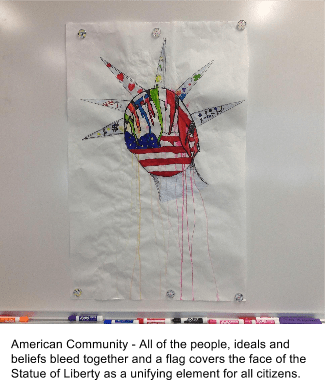
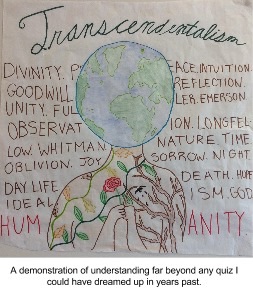
Students gathered and compared their research findings in small groups and then were charged with symbolically representing their research on poster sized paper. For the imaginative qualities of Romanticism, we saw Sponge Bob. The Transcendentalist faces of Emerson and Thoreau became flowers in a pot, watered by Walt Whitman. Mark Twain held up a mirror to a map of the American South. In image_1short, students captured the movements and we hung up the evidence to remind us of the context of what we were exploring.

And so, for my AP Language students, I chose to end their unit on community by bringing
them together in small groups as well, to choose a specific community and illustrate an answer to the unit essential question. I figured if they answered the question without a specific community in mind, we’d get a lot of generic posters with people holding hands around the world – thank you, Google.

Instead, they had to choose specific communities to show their understanding of the complexity of the essential question and then supply textual evidence from the mentor texts we explored in order to support those symbolic meanings.

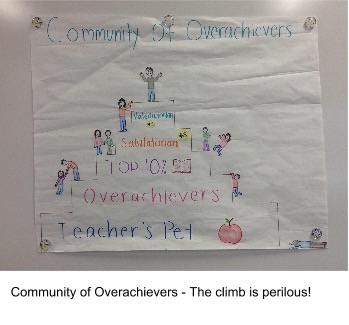
imageStudents shared some phenomenal work and I was impressed not only with the depth of their thinking, but the synthesis of texts this activity produced. And, because my own artistic development was apparently arrested in the second grade, it was such fun to see some of my visually gifted kids shine through the use of a new medium.

Zoey and Alyssa, who created the Statue of Liberty visual said the exercise allowed them to express their “artistic qualities – which is many times put on the back burner in AP courses.”

Creative expression of understanding put on the back burner? Shame on us.

And I know for a fact that AP classes aren’t the only place to suffer a similar fate. If we are going to do more with essential questions, we need to not only have students to be directly involved in answering them, but also give our kids more voice in the demonstration of their learning.

Ultimately, it was an assessment that combined creativity, common core standards, direct connection to the unit essential question, analysis, entertainment, synthesis, and genuine student enthusiasm. Not bad for mid-February in the frozen North.

How do you use essential questions to effectively deepen critical thinking? Please share your comments.

TTT welcomes Lisa Dennis, inspiring teacher and innovative leader at Franklin H.S. in Franklin, WI, as a visiting contributor on this blog.

Mini-lesson Monday: Taking on the Thesis Statement

Right now, my students and I are writing spoken-word poems. I’ve wanted to play with language this way for a long time now, but finally mustered the courage — and figured out a way to make this kind of poetry fit into my AP Language goals and the needs of my students as they prepare for the AP Lang exam.

While watching and listening to many spoken-word poems, I realized that most of them are an argument, filled with not only beautifully crafted language — devices galore — but they also show craft in the use of the appeals. With the help of my student teacher, Mr. Zachery Welch, we designed a unit that centers around the rhetoric in spoken-word poems. And we are all writing our own. (This is a challenge for me, but I absolutely believe the the importance of a teacher writing beside her students. Thanks, Penny Kittle, for teaching me that!)

The performance task for this unit reads:  Craft a spoken word poem that addresses a personal conflict and/or a social issue, include rhetorical techniques and literary and rhetorical devices to convince your audience of the need for positive change. Perform your poem for the class live, or create an automated slide show with visuals, or a video recording as a way to digitally perform your poem.

This lesson stems from our work  — and the need for students to include stronger thesis statements in all of their argumentative essays.

Objective:   Using the language of the depth of knowledge levels, students will identify powerful lines in a spoken-word poem that serve as position statements. They will discuss and then categorize these statements in order of importance as it pertains to the poet’s overall theme. Students will then formulate three powerful thesis statements of their own and revise their drafts to include these powerful thesis-like lines.

Lesson:  Watch and listen to “Paper People” by Harry Baker. Ask students to pay particular attention to the lines of the poem that hold the weight of the poet’s position. They must listen carefully because Baker’s poem is primarily crafted with the alliterative “p”. Give students a copy of the lyrics, and on the second listening, having them mark specific lines they think represent Baker’s position. Then, ask students to discuss the lines they marked with their small groups. As a class, determine the line that best serves as Baker’s thesis.

Next, instruct students to write three thesis statements for their own poems. They should discuss their thesis statements within their groups and help one another develop powerful statements that hold the weight of the meaning in their poems. Then, instruct students to revise their poems, including all three of their new strong lines.

Follow up:  Students continue to revise and strengthen the arguments within their spoken-word poems. They should also remember to write three powerful thesis statements in their argumentative essays and challenge themselves to use all three in their writing.

Mini-lesson Monday: Moving Past Identify

When my students and I talk about reading, we talk about writing.  If they pay attention to not just what the writer means in the words on the page, but how the writer crafts that meaning with words on the page, they move much quicker into the rhetorical analysis they must do on the AP Language exam in the spring.

But it is not easy. So many of my readers read below grade level. They struggle with fluency, so their reading is slow and laborious, and as a result, they miss out on much of the flow of the language that leads to constructing meaning as they read. If they cannot comprehend, how can they analyze craft?

They are pretty good at identifying devices and figurative language and the like though. They are pretty good at identifying structure. They’ve learned writers have different ways of approaching a topic, but they are not so good at discussing why. Why did the writer craft the text that way? What does that move do to further the writer’s message? What effect does it create? What is the tone?

So, this lesson came about as a way to help my students practice some critical thinking about how writers make choices with language — and as a bonus, introduce my readers to four new book titles.

Objective:  Using the language of the Depth of Knowledge levels, students will recognize a variety of structural and craft moves in fiction and non-fiction texts.  They will identify patterns and compare effectiveness through discussion. They will analyze the tone. They will summarize their discussion in their writers’ notebooks, and apply their understanding to future reading and writing assignments.

Lesson: Introduce three new titles as choices for independent reading by providing copies of the first few paragraphs of The Other Wes Moore, Nothing to Envy– Ordinary Lives in North Korea, and The Dog Stars. In small groups, giving each group one (or more of the passages depending on the time you want to take for the lesson) instruct students to read the passage and determine the structure and the craft moves the writer makes to begin the books. Ask:  Why do you think the writer chose to begin the book this way? What does that beginning do to capture the reader’s attention? Why might it be an effective way to do so? What is the tone of the passage? How do you know?

Help students recognize the effect of beginning a text with a passage of dialogue versus startling information versus first person narrative. What are the similarities? What are the differences? What structure do you find the most engaging? Why?

The Other Wes Moore by Wes Moore

Nothing to Envy, Ordinary Lives in North Korea by Barbara Demick

The Dog Stars by Peter Heller

Follow-up:  Students will apply their understanding to their independent reading books, and as homework will write a one-page response that analyzes the first few paragraphs of their books.

#3TTWorkshop — Making Workshop Work in AP English Part 2

This is a continuation of yesterday’s post — a conversation between Amy, AP Language teacher, and Jackie, new AP Literature teacher

Do you think it’s important that students read classic literature in an AP class?

Amy:  In an AP Literature class, yes. In classes leading up to AP Literature, yes, in sound bites and shorter texts. However, balance is key. Do we give students some say in what they read for our classes — not just what they may choose to read on their own? Are our students reading and growing as readers? Do we approach the text with the goal to help them do so, or do we approach the text and teach the book instead of the reader?

In a conversation the other day, one teacher said she likes to use classic literature because the conversations around the complexity help even her struggling students learn. Of course, that is probably true, but learn what? Those conversations will not help those students become better readers. The only way to become a better read is to read. If students are not reading the books we choose, we have to be okay with that. We have to admit that perhaps our goals for that specific unit, and that novel, are different than choosing the book because we know all students will read it. We have to decide we are okay will students not reading. I wrote a pretty long post about this whole debate here.

Jackie:  In AP Literature, yes, my students must read classic literature.  Because the AP Literature test Jackieclassroomboysis centered on the canon of “higher literary merit” books, I do teach set texts like Invisible Man by Ralph Ellison and Othello, but I stress from the beginning that in this course we are continuing to develop our reading lives as both academics and hobbyists.  Fortunately, many of my students arrive at my door with a passion for reading, but as I saw at the beginning of the year, far too many of them haven’t read a book for enjoyment since their freshman year.  Their lives become too busy and the first thing that seems to go is reading.

In turn, while I teach multiple whole class texts to fulfill the needs of the test, I also make space for independent reading.  The vast majority of my AP Literature students are seniors, and I know that this is their last English class before they move onto college.  In turn, my greatest goal beyond providing them with the necessary skills for deep critical thinking, is to reinvigorate their passion for literature and love of books.  

Where does teaching writing fit into your AP curriculum?

Amy:  I tell my students:  Ours is primarily a writing class. Before we even get settled in, students know they will write a lot — in all kinds of different modes and to a vast audience they build themselves. When I first changed my approach to teaching, I began with writer’s workshop. I’d heard Penny Kittle present, giving ideas from Write Beside Them, and that book became my curriculum guide. Today, I urge teachers who are thinking of shaking up their teaching, to take the first wobbly step into writer’s workshop. Depending on your book shelves and your library, it might be easier. Of course, it depends on your own confidence, too. If a teacher isn’t comfortable teaching writing, it’s probably because she hasn’t practiced being a writer herself. That has to be step number one. Write. Write beside your students so they see you struggle. Read articles and books on writing by writers. I’ve been reading the works of Donald Murray, a suggestion given to me personally by Penny Kittle. Murray’s books have enriched so many aspects of my writing life — and my teaching life. Try Learning by Teaching, and you will know exactly what I mean.

Jackie: It’s funny that you say your class is primarily a writing class; for me, AP Literature is primarily a reading class.  At the beginning of the year, I challenged my students to read 25 books…and I don’t just mean books of higher literary merit.  I wanted students to fall in love with reading again, which can be quite tricky when it comes to a class centered on analyzing books.  Even today during a mid-year progress presentation, a student talked about how he initially felt guilty picking up a YA book, but how this book helped him fall in love with reading again.  As you said, I too practice my craft alongside my students, only this year, it’s all about reading beside my students, which I do every year, but it’s fun to analyze many of the pieces for the first time with my students.  I don’t hold back when it comes to admitting my own questions about a text.  Learning beside my students makes the social process of the workshop model that much more authentic.  

Amy: Besides teaching my students to write arguments, since that is what the AP exam is all about, I also teach my students to write everything. We start with narrative, move into information, determine the difference between persuasive and argument, and practice research and synthesis as we go. My students write on their blog, usually about topics they read about in the news, although I’m going to try to mix this up in the spring and open their topics up to ones they find in their independent reading.
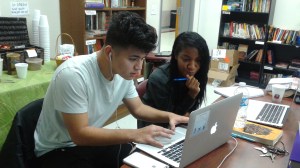
Diego and Tia deep into discussion around revisions.

Diego and Tia deep into discussion around revisions.

Blog writing is practice writing. I read as many posts as I can get to, and I try to leave feedback that helps the writer grown. The whole process starts out rough. Students think they they can pour out their thoughts on the page and then publish without doing much revision. We talk about this. We talk about audience, purpose, form. We even explore what Bloggers do to appeal to their audiences, and we try to build a readership (although I need to do a better job and take more time on this.) The whole point is to expand the classroom — to give my readers a reason to write that is other than Mrs. Rasmussen said so. Does every student buy in? No, but I get many more students to buy in to becoming writers, and many of them ask me if they can write on their blogs more than I require.

Of course, we also move through process papers, using mentor texts, studying the moves of writer’s, mirroring and modeling his or her craft, practicing revision and revision and revision before finally publishing. This year we’re writing about four of these essays a 9 weeks, which isn’t as much as I would like, but it’s a good amount for my writer’s this year.

Jackie: I am building from the bottom up this year.  With the help of a phenomenal mentor, Sheridan Steelman, I am learning how to marry the workshop classroom with the traditional AP Literature curriculum.  AP Lit is all about recognizing the beauty of language and the craft moves an author makes as they frame an idea or concept.  I’m that weird teacher that is so moved and excited by my students recognition of beauty in a piece that I jump out of my chair and cheer.  It’s okay though, I’m surrounded by word nerds!

During the first half of the year has involved analyzing writers’ craft to gain a better sense of the author’s goals and purpose.  We do write plenty of analysis essays, some being short timed pieces while others are lengthy explorations of deeper themes.  We also co-write papers in small groups, which forces students to rely on one another as they tackle the writing process.  Next semester I look forward to exploring more creative writing outlets as students mirror some of the craft within their independent novels.

Above all, my favorite writing my students do is the writing in their critical reading notebooks.  I love thumbing through the raw reactions to students’ YA literature and personal reading novels as well as the the pages of scribbled notes on characters and connections from their novels of higher literary merit.  
Join the conversation. What ideas do you have for a balance of choice and required in an AP English class? How do you manage the writing?