Author Archives: Shana Karnes

Writing With Mentors: A Nonnegotiable of Writers Workshop

41dIMvzIynL._SX395_BO1,204,203,200_

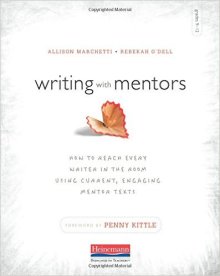
WRITING WITH MENTORS by Allison Marchetti & Rebekah O’Dell

Reading Allison Marchetti and Rebekah O’Dell‘s Writing With Mentors is reminding me of the summer, three years ago, that I committed to making the move to readers and writers workshop.  Like my new friends in Franklin, Wisconsin, I already had many of the structures of workshop in place–I just didn’t know how to fit them all together.

As I read and wrote and thought beside the likes of Penny Kittle, Amy, Jackie, Erika, and my other UNH friends, I learned quickly which parts of my instruction to keep and tweak, and which parts to flat-out jettison.  While I felt like my reading workshop practices were solid, I knew I needed to completely rethink the way I designed writing instruction.

I wish I’d had Writing With Mentors that summer.

That summer, I learned that I shouldn’t be designing lessons around a staid form like a persuasive essay or a literary analysis.  I needed to begin thinking about having my students write authentic, interesting pieces on topics of their choice–but I didn’t know how.
img_0791

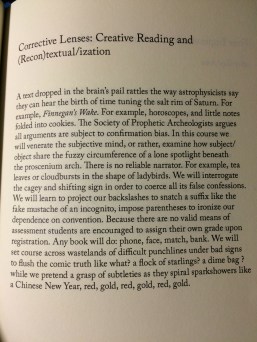
I immediately saw Gregory Pardlo’s DIGEST, full of prose poems, as a mentor text.

I learned how to read like a writer, how to look at the craft and structure of my favorite authors’ works.  I began to see mentor texts everywhere, and in fact too many places–I was exhausted by trying to keep track of everything I wanted to share with my students, and even resolved to read less as a teacher.  I wanted to offer a variety of rich mentor texts to my students without losing my mind–but I didn’t know how.

I learned that my writing process was as unique as my handwriting, and that process has value just as much as a written product does.  I wanted to restructure my unit planning, my gradebook, and my classroom routines to reflect that–but again, I didn’t know how.

Over three years, through trial and error, I’ve figured out how to reckon with a lot of those issues, but I would have known instantly had I read Writing With Mentors then.  This book succinctly showed me great writing units and products, how to plan for them, and how to select and organize current, engaging mentor texts.

img_0480

Books are at the center of my writing instruction–literally.

It reminded me that when we read–even to study the craft moves of a mentor author–we must read as readers first, for the “pleasures of story time” and to “hear the rhythms of good writing” (65).

It affirmed my habit of designing new units each year, complete with brand new mentor texts, to meet the needs of my current students and the sociopolitical climate in which we live and read and write.

It helped me cement mentor texts, alongside the writer’s notebook, conferring, and authenticity, as nonnegotiables of a successful writers workshop–because, in Allison and Rebekah’s words, “mentor texts enable complete creativity and individuality to emerge in student writing and writing instruction” (3).

And it reminded me that when students leave our classrooms, “mentor texts will always be present” (167).  When we teach students to write with mentors, they remain capable of reading like writers as they engage with print and media and other real-world texts.   Since getting my students to become lifelong readers and writers is my ultimate goal, this book is now an important mentor to me.

Writing With Mentors is the book to pick up when you put the textbook down, toss out your binders of writing rubrics, or throw up your hands when you read your 94th crappy plagiarized paper in a row.  If you’re seeking to rejuvenate, organize, and revamp your writing instruction, don’t undergo three years of trial and error like I did…let Allison and Rebekah help you write, more happily, successfully, and authentically, with mentors.

Have you read Writing With Mentors?  Share your feedback in the comments!


Mini-Lesson Monday: Reader’s Response to Frame a Unit

Penny Kittle recently shared this article about the diminishing attention span of humans, thanks to the plethora of instant-gratification stimuli that burdens our plugged-in students.  I was reminded of my vow to help my kids simplify their lives, slow down their minds, and just…be.

img_1212

The unit plan Mike and I designed

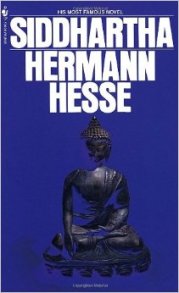
All of this led my student teacher, Mike, and I to design a unit plan around mindfulness, reflection, and deep thinking.  We wanted to use all of Siddhartha, parts of Hamlet, articles like the one above, various poems, the music of Cat Stevens, activities like contour drawing, and exercises like meditation to help our students slow down and explore their minds.


So, today we’re launching this unit of self-reflection and self-exploration, and one of the first mini-lessons we’ll teach is a reader’s response to “The Eight Second Attention Span” article.

Objectives:  Using the language of the depth of knowledge levels, students will identify patterns in Egan’s writing that align with our unit theme, cite evidence in the text of those patterns, and synthesize Egan’s argument with our prior readings.  Or, from the Common Core:  students will read closely to determine what the text says explicitly and make logical inferences from it; cite specific textual evidence when writing or speaking to support conclusions drawn from the text.

41drZBnWSzL._SY344_BO1,204,203,200_Lesson:  We’ll pass out copies of the article for students to read and annotate, and they’ll also have their writer’s notebooks out.

“First,” I’ll say, “let’s read this article and just identify Egan’s argument.  What is he saying?  Underline or highlight key lines or facts that help make his point.”  We’ll read and annotate together, me using the document camera to model.

“Once you’ve figured out what Egan is saying here, go ahead and jot it down in your notebook in your own words.  What’s the gist of what he’s talking about?”

After the jot, students will talk in their table groups about the article and what they’ve noticed.  We’ll share out as a class and make sure our thinking is in sync.

img_1157

Nonlinguistic storytelling through doodles–one of my proposed solutions from my response. We’ll do this exercise later in the unit.

“Okay, so Egan ends by offering two solutions to this problem.  What are they?”  Gardening and deep reading, students will offer.


“Let’s write a response for a while in our notebooks and brainstorm what our own solutions to this problem would be.”

We’ll all write, me modeling once again on the document camera.  Then students will share in small groups what their proposed solutions are.

Follow-Up:  I’ll ask students to practice one of their two proposed solutions are over the course of the week, then request a one-pager reflecting on the experiment.  We’ll apply our reading of the article, our practice of deep thinking, and our reflection on all of it to our unit of study as we move forward in our exploration of our themes.


Best High-Interest Books for Teens

This year, Amy and I were determined to make our exams authentic.  One of the options for the reading portion of the exam was for our students to create top 10 lists, and many of them did.  Their lists are funny, honest, and so valuable for helping spread the word amongst readers about good books.  Below is Aleigha’s list of recommendations for high-interest books that will hook teens and get them to fall in love with reading–feel free to share them with your students!

img_1175Aleigha’s Top 10 List:  Best High-Interest for Teens
  1. Fangirl by Rainbow Rowell

Though this book was funny and lighthearted it still had the ability to change my life.  It really helped me realize that you should appreciate your siblings while they are close to you.  Seeing how quickly Cath and Wren distanced themselves in college put my relationship with my siblings into perspective.

  1. Eleanor & Park by Rainbow Rowell

This book is so much different from your usual love story. By that I mean it’s extremely realistic. It changed my life because I could picture myself as Eleanor. It was one of those books that are so realistic it’s kind of scary not many love stories can make you envision yourself as the character.

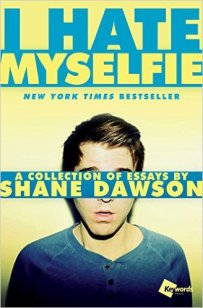
  1. I Hate Myselfie by Shane Dawson

hatemyselfieI have never laughed so hard while reading a book. This guy literally takes everything that should have been traumatic to him and turns it into humor. This book changed my life because it taught me that it is important to laugh at your own pain. You shouldn’t take everything so seriously.
  1. Looking for Alaska by John Green

This book for me is one that really set an example. It breaks away from the normal click of kids you have in high school and puts a group of complete opposites in a single friend group. That was one of my favorite things about this book. It just kind of made me feel like it’s okay for me to talk to the jock or the pothead.

  1. All the Bright Places by Jennifer Niven

This book is very eye opening. It is about two teenagers who bond over a mental illness and fall in love it. It makes you very aware of the signs of depression and makes you analyze not only yourself but others. This book has the ability to change lives because it teaches you about the sensitive topic of depression.workinprogress

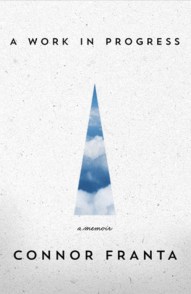
  1. A Work in Progress by Connor Franta

The author of this book is a Youtuber who tells you all about his life in high school and his YouTube journey. The book itself contains a lot of life lessons. He tells a story and then wraps it up with a lesson at the end. I enjoyed this book a lot because it shows how a normal really small town kid can become really successful with hard work.

  1. We Were Liars by e. lockhart

If we’re being honest, the only reason this book changed my life is because it just made me really depressed. I was just extremely upset once I reached the end of it. I didn’t want to believe what had happened was true and I cried for the main character. And then I cried because what other reaction can you have to a book that ended so terribly. So I guess this book changed my life because it made me realize that I cry more for fictional characters than I do for people I actually know.  

  1. The Fault in our Stars by John Green

Again another book that screwed me up emotionally. This one really does make you cherish your life and your friends. If after reading this you are not greatful for what and who you are blessed with that will be a surprise. Everytime I read this book I don’t just form my own imaginary relationship with Augustus Waters. I also find myself being very thankful that I have experienced little loss in my life.  This book is another one that puts it all into perspective.

  1. Every day by David Levithan

Every day is a book about a person who wakes up in a different body every day. He never has the chance to experience what it is like to have a family or best friend. This book is perksofbeinglife changing for me because it makes you appreciate the blessing of continuity. I think having a constant in your life is something that we all take for granted.

10. The Perks of Being a Wallflower by Stephen Chbosky

The Perks of Being a Wallflower is one of those books that make you really cherish your friends. Until you find out what happens to Charlie as a child, you assume the book is about a young boy coming out of his shell. As u read through the book, you experience the ups and downs of friendship and watch Charlie become a whole new person. This book has made me really appreciate my friends.

Integrating Reading & Writing Instruction: Craft Studies & Mentor Texts

This is a continuation of our post from yesterday.

#3TTWorkshopWhat are you reading now, and/or what are your latest finds that could be strong mentor texts?  
Jackie:  For fun, I am currently reading Ready Player One by Ernest Cline, and for AP Literature, I am currently reading Othello.  I read Ready Player One as a departure from my typical YA reads.  I was never a gamer or 80s enthusiast, so I wanted to “challenge” myself by choosing a new genre.  Ernest Cline brilliantly writes action pieces.  Somehow he manages to translate the video game structure into a novel AND make it interesting for non-gamers like me; I am planning to use an excerpt to discuss movement of time either when we work on our multi-genre project this year or our fictional writing next year.  

Most recently, my CP freshmen read the picture book The Promise by Nicola Davies as a mentor for our narrative fiction unit.  In my academic freshman classes, we recently completed process papers based on The Compound by S.A. Bodeen.  Mentors for these included “What you will need in class today” by Matthew Foley and “Instructions for a bad day” by Shane Koyczan.  Students used each as a mentor text by which to craft their own poems and then eventually built them into unique survival guides ranging from “How to survive a zombie apocalypse” to “How to survive a friend’s breakup.”  As Shana said yesterday, I like pairing professional work with my own to show them the messy process of writing, so prior to class I get a head start on my own piece and then I continue developing it while projecting my writer’s notebook on the board at the beginning of workshop time.    

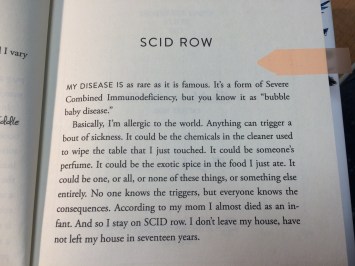
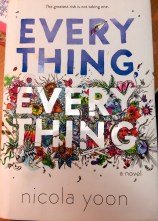
img_1056-1Shana:  I just finished the beautiful Everything, Everything by Nicola Yoon.  I love it as a mentor text because it’s a bit multigenre, and it’s an engaging YA love story, AND it’s gorgeously written.  With tons of parallel structure and a short-chapter format, it’s a quick read but one that lends itself to lots of frequent re-reading.  I’ll use this text for craft studies at the sentence and paragraph level to teach things like repetition, parallel structure, and varied sentence structure.

Another book I just read was Caitlin Doughty’s memoir Smoke Gets In Your Eyes, and Other Lessons from the Crematory, which I usually booktalk with Mary Roach’s Stiff.  This tale of Caitlin’s experiences working in a crematory will be useful for my students to analyze at the chapter level, during which she employs narrative to blend her adult experiences in the crematory with the formative experiences of her youth in order to make a claim about the nature of human life and death.  It’s a powerful example of the use of narrative within nonfiction.

I also recently read Memoirs of a Teenage Amnesiac by Gabrielle Zevin, which tells the story of a high school senior who falls and loses all memory of everything after sixth grade.  As a result, most of her life story is revealed through dialogue with other characters, so this will be a fantastic mentor text at the whole-text level–how can we craft a short story that uses dialogue to reveal movement through time, a character’s background, or a character’s personality traits–all without that dialogue being spoken by that character?


How will you integrate your current reads into your practice?

Shana:  I like to share this article about noticing beautiful writing with my students.  We use it as the basis for two sections in our notebook–“Quotes & Craft Study” and “Wondrous Words.”  I like to break down with my students why a particular line or paragraph or chapter in a piece of writing is so powerful–at the word level, the structural level, the punctuation level.  When we read like writers, we can notice all of those details and begin to imitate them in our own writing.  

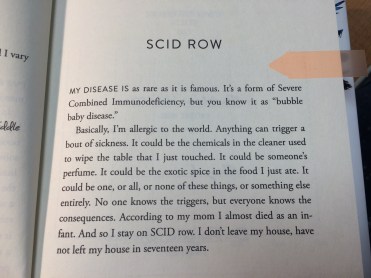
img_1057My students asked for more craft study and grammar instruction in their midterm exams.  With our new notebook setups, I’m hoping to create a routine for the wordplay we’ll need to constantly return to in order to strengthen our use of punctuation, specific diction, sentence structures, and other craft moves.  I want to employ more “triple-plays,” as Penny Kittle calls them–books that act as a booktalk, a quickwrite, and a craft study mini-lesson.  For example, I’ll take the chunk of Everything, Everything pictured at right and make copies of it for my students to glue into their notebooks.  Beneath it, we’ll imitate the parallel structure of the sentences, and the exercise will serve to teach parallelism, talk up the book itself, and be a quickwrite we’ll call “it could be.”

Jackie:  Inspired by a course we took this summer with Tom Newkirk, my colleague and I are putting together a superhero unit for our academic Freshman English classes.  The unit will involve both a persuasive essay and a comic strip students make about a hero in their life.  In turn, I’ve been skimming comics and graphic novels to find inspiration for students.  

In this unit, students will practice storyboarding their own comics while studying the use of craft like onomatopoeia, movement of time, and internal and external dialogue.  My hope is that these building blocks will provide a foundation for us to further discuss the use of colors to portray goodness and evil within a comic (or novel) as well as the use of framing or perspective in the pieces as well.

Please join the conversation–how do you approach the study of craft with your student writers?

Finding Mentor Texts & Craft Studies

#3TTWorkshop MemeWhat prompted you to begin the process of noticing examples of mentor texts or craft study?
Jackie:  When I first started teaching, finding mentor texts proved to be difficult.  While I knew what made writing strong or well-crafted, I didn’t always know what I was looking for.  Instead, I would eat up a plot line, soaking in word choice (I have always loved words), but rarely did I stop to think about how an author sculpted a line or page or chapter.  Finally, after struggling with structuring a piece of fiction writing, I referred back to To Kill A Mockingbird by Harper Lee.  Intrigued by her ability to create a scenes that showed the progression of time, I read and re-read the novel, observing her intentional moves as a writer.  Gradually, I began understanding the value of mentor texts to my own writing.  

The skill is not easy, and I have learned more about myself as a reader in the time I have taught than I ever did during my schooling.  While reading like a writer does slow down the reading process, it also makes me appreciate the artistry of writing.  It makes me aware of my own moves as a writer and how writing, like any other form of art, is about discipline, awareness, and interpretation.

Shana:  I didn’t know about the concept of mentor texts, or craft studies, or imitating great writers, or even reading like a writer…until I took Penny Kittle’s UNHLit class in 2013.  Everything that summer blew my mind, and I was hungry to begin looking for strong examples of real writing for my students to study, imitate, and craft.  I learned about lots of authors, nonfiction writers, poets, journalists, and more while I was at UNH, and in the year following I learned to think back to my own favorites and ask my students for their recommendations when I needed more mentor texts.

Once I began thinking about writing instruction in terms of products I wanted my students to create, I learned to start searching for examples of those strong products.  Sometimes I seek out a specific genre of mentor text if I want to teach a unit about narrative fiction.  Other times, I find an amazing mentor text and design a unit around getting kids to create that specific genre.


Describe your process as you search for examples of mentor texts and craft studies.

Shana:  I read much more slowly now.  Almost all of my reading is of texts that could be used for craft study in my classroom, or books that might go well on the shelves of my classroom library.  I think about writing and reading in such new ways now that I almost unconsciously note a good page for a booktalk, a beautiful line for craft study, or an interesting segment of writing for a mentor text.  

To build an arsenal of texts for use in my classroom, I began to scour the award lists for the National Book Award, the Pulitzer Prize, the Man Booker Prize, and lists of recommendations by groups like ALA, Kirkus, and more.  I also value the recommendations of literacy greats in our field like Donalyn Miller, Carol Jago, and Penny Kittle.  I want strong, complex writing to hand my students, so that they can absorb the craft of good writing through constant, diverse exposure.

img_1057

The page I’ll booktalk from Everything, Everything by Nicola Yoon

Now, most of the mentor texts I discover are incidental–I stumble upon a lovely sentence in a book I’m reading, or I see someone tweet a link to a good article, or I’m struck by a student’s craft as I’m reading their writing.  I try to give a published example, a student example, and my own example as an “in-progress” mentor text, in keeping with the recommendations of Katie Wood Ray in Wondrous Words.

Jackie:  Now that I have begun practicing reading as a writer, I am more aware of the mentor texts that surround me every day.  It took about a year of intentionally slowing down my reading, contemplating the craft, and thinking about where to file the piece within my units for me to develop this practice.  

From Pinterest finds to articles to book excerpts to poems, I am constantly searching for pieces that will inspire and engage my students.  Most of my finds feed into mini-lessons that tackle current skills with which my students struggle.  For example, Many of my students grapple with the use of second person point of view and use it as a default instead of intentionally employing it to reach out to and connect with their audience.  After the November Paris attacks, I found a piece that brilliantly uses second person point of view to help students develop empathy with Syrian refugees.  This piece serves to not only guide them but also make them think about the intentional moves needed to connect with one’s readers.

I also look for mentor texts in classic literature and young adult reads.  These short excerpts teach my students phenomenal craft while dually serving as a mini-book talk.  The writing sells itself.  I always have students request The Glass Castle by Jeanette Walls after I use the first chapter as a mentor text for multi-scene narratives as well as a craft study for opening lines.  The same goes for when I use The Goldfinch by Donna Tartt when I use a short explosion scene to discuss snapshot narratives.

Tomorrow we’ll discuss how we employ found mentor texts in our classrooms.  Join the conversation in the comments–how and why do you seek out mentor texts?


Mini-Lesson Monday: Setting Up New Notebooks

img_0966

Our first semester notebook sections

My students and I have filled up one notebook thus far this school year, and as the second quarter comes to a close, we’re going to buy new ones and decorate, personalize, and organize them together.

At the beginning of the year, I asked my students to create quite a few sections in our notebooks.  This helped us stay organized at first, but as the year went on and sections filled up, the variety of sections caused more stress than they relieved.

img_0959

Brand new notebook! I love this one by “Punctuate” from Barnes & Noble.

Over break, our friend Erika shared an excellent article about the health benefits of journaling.  Amy said this about the article: “I wish composition notebooks were cheap right now. I’d get new ones for my students, read this piece, and start over when we get back to school. We’ve got notebooks, but we are not as into them as I would like. Could be a jump start.”

I feel the same way Amy does.  Our notebooks have turned more into workspaces and less into journals.  I want to change that as we begin the second semester.

Objectives — Using the language of the Depth of Knowledge Levels:  Formulate ideas about topics during quickwrite time; Construct language that reflects beliefs and ideas. Or, from the Common Core: Write routinely over extended time frames (time for research, reflection, and revision) and shorter time frames (a single sitting or a day or two) for a range of tasks and purposes.

Lesson — I’ll begin by telling students this story:  “I read Tom Romano’s Write What Matters again over break, looking for ideas for meaningful notebook activities.  From his chapter titled “Notebook: Playground, Workshop, Repository,” Tom gives this advice about journals:

“Buy one. Write in it every day. You’ll strengthen your writing muscles and keep them supple. You’ll learn to accept words your mind offers. You’ll consolidate writing skills you’re developing. You’ll sharpen your perceptions, live more alertly. You’ll expand your vocabulary, too.

img_0961

My first page of all my notebooks–a photo and a tracing of my hand, inspired by Penny Kittle and Sarah Kay’s poem “Hands.”

“This quote resonates with me.  It reminds me why I write, and why we should all write often.  Why do you find value in writing?”

We’ll have a conversation about the meaningfulness of writing, then set up our notebooks together.

“Last semester felt hectic when all of our sections filled up.  This semester I want to keep it simple.”  I’ll put the following guidelines on the board:

  • What-to-read list goes on very last page
  • Vocab words go on the page before that (see our posts here and here to know how we “do” vocab)
  • Quotes go on the page before that (craft studies usually go here)
  • Small section for heart books at the very end

“And that’s it.  I want to just write in chronological order every day, keeping just a few pages in the back for our usual routines.”

We’ll spend the remainder of class setting up our sections and collage-ing our notebooks to personalize them, as Jackie describes here.  I’ll do this alongside my students, adding ultrasound pictures and magazine cutouts to represent the upcoming year of change that’s in store for me.

Over the coming weeks, we’ll focus on using mini-lessons from Write What Matters–ones that involve drawing, writing therapeutically, and telling the narratives of our writing places and experiences.  I’ll hope to jump start, in Amy’s words, my students’ passion for writing with new notebooks and new notebook routines.

What routines will you change as the first semester ends?  What elements of your teaching will you revise?  Please share in the comments.

10 Pedagogical Must-Reads for Workshop Teachers

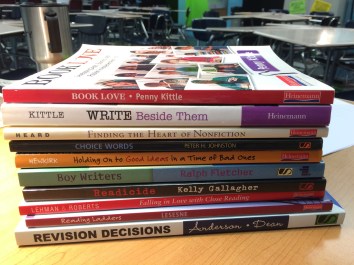
IMG_0650I met with my new student teacher a few weeks ago, and he asked me to borrow any books that might help him get going on the readers-writers workshop–the “theory” version of Jackie’s starter kit.  He’s been in my classroom before, so he knows the general routine and character of our work, but he wanted to know the ins and outs of how I thought and planned and conceptualized the whole thing.

I sat at my desk and looked at all of the titles I had on hand, remembering how influential reading them for the first time had been.  As a result, it was hard not to just dump my entire professional bookshelf onto a cart for him, but I managed to pick out a few titles that have guided me most adeptly in one aspect or another of my current classroom practice.

  1. Book Love by Penny Kittle – This was the book that helped to solidify my vision of an ideal classroom.  Before I read it, I had already been doing many of the best practices Penny mentions–writer’s notebooks, choice reading, personalized writing.  But I didn’t know how to bring it all together until Book Love.  As such, this is my #1 recommendation for any teacher looking to jump-start their individualized workshop curriculum.
  2. Write Beside Them by Penny Kittle – This book introduced me to the concepts of mentor texts, reading like a writer, and best draft/publication of writing.  I learned about quickwrites, constant revision, writing conferences, and a great deal more of what are now standard routines in my classroom.  This is the book for anyone curious about the big picture of writing instruction.
  3. Finding the Heart of Nonfiction by Georgia Heard – I was raised in the tradition of literature as containing mostly fiction and poetry, but Penny’s books helped me see the great value of nonfiction.  I wanted to know how to integrate it well into my thematic units, and this book helped me do that.  Georgia’s book is full of wisdom about finding the soul of good nonfiction writing and matching it to your students’ needs.
  4. Choice Words by Peter Johnston – This book taught me how to talk to students.  It is my #1 recommendation for anyone looking to address those pesky Speaking and Listening standards in the Common Core–this book teaches you about the delicate, volatile power of a few choice words between you and your students.  I re-read it every year, and it might be the most important book in this stack.
  5. Holding On to Good Ideas in a Time of Bad Ones by Tom Newkirk – This book is subtitled “Six Literacy Principles Worth Fighting For,” and Tom Newkirk certainly made me want to engage some of my former teachers in fisticuffs when I finished it.  This text is full of common-sense brilliance that will transform the way you think about why we teach reading and what kinds of texts we teach.
  6. Boy Writers by Ralph Fletcher – Why do my students keep writing about violent gun battles?  Why do they always ask if they can swear in their writing?  What’s up with the complete unwillingness of my boys to be vulnerable?  If you’ve asked yourself these questions…this book is for you.  Ralph writes about everything you ever wondered about boy writers and how to move them forward in their writing.
  7. Readicide by Kelly Gallagher – Schools have been killing reading for many years, Kelly argues, and then presents ways you can stop the slaughter.  He fires away at pop quizzes, assigned chapters, multiple-choice tests, and all the practices that steer our students toward SparkNotes.  Then he reveals ways to get students authentically engaging in literature in a way that doesn’t kill their love of reading.
  8. Falling in Love with Close Reading by Chris Lehman and Kate Roberts – After finishing Readicide and wanting to abandon the eight or so whole-class novels I once felt chained to, I wasn’t sure how to teach close reading skills.  This book answered that question for me, and more.  Chris and Kate reveal how to use poems, articles, short stories, and selections from novels to get kids interacting with the beauty and power of language in all kinds of texts.
  9. Reading Ladders by Teri Lesesne – When all of your students have finally found a book they will actually read–then what?  Teri Lesesne taught me how to help students climb a reading ladder of text complexity with this book.  It’s a tough battle to get all kids reading, but it’s even tougher to get them to all challenge themselves once they are.  Reading ladders are the solution to the increasing complexity question–now they’re a consistent part of my instruction.
  10. Revision Decisions by Jeff Anderson and Deborah Dean – After reading the first nine books on this list, I still wasn’t sure where grammar instruction fit in.  I knew to have students read like writers and learn from language and sentence structures that way, but I wasn’t sure how to structure my mini-lessons, until I read this book.  Jeff and Deborah helped me find strong craft study lessons and bring them into the classroom in a way that appealed to students and also benefited them immediately in their writing.

This is by no means an exhaustive list–That Workshop Book by Stephanie Harvey, Read Write Teach by Linda Rief, The Book Whisperer by Donalyn Miller, and many other integral titles were simply not on my shelf when I gave this stack to Mike.  But these top ten are ones I wouldn’t be the same teacher without.

What other titles are essential to your practice?  Please share in the comments!

Update:  Here are must-read folks that readers have suggested via Twitter and Facebook, as well as in the comments:

  1. Lucy Calkins
  2. Nancie Atwell
  3. Linda Rief
  4. Katie Wood Ray
  5. Donalyn Miller
  6. Don Graves
  7. Donald Murray
  8. Peter Elbow
  9. Ariel Sacks
  10. James Moffett
  11. Louise Rosenblatt

The Best Gift You Can Give Your Students

A few weeks ago, when I sat down to confer with Asia, she told me that she bought me a Christmas gift. She was really excited about it. “I’ve never bought a teacher a gift before!”

She’s a senior in high school.

img_0731

My scarf from Asia

I asked her why she’d never bought a teacher a gift before. She thought for a moment. “No teacher ever gave me respect automatically, like I deserved it.”

It breaks my heart that in twelve years of public education, this girl never felt that a teacher respected and cared about her.

“How did you know I respected you?” I asked her. A few other kids sitting with us answered this question too.

“You talk to us every day, like we’re adults, about our learning, and you really care what we say.”

We confer.

“You do all our assignments with us so we know they’re not busywork.” This from Shailyn.

I write beside them.

“You always expect us to know more than we do, and you don’t take BS excuses about why our work isn’t done,” Jocelyn said.

I have high expectations.

“You know exactly what your students are capable of,” Jocelyn further explained.

I know them, well, through frequent talk about their choice reading and writing.

“You just seem to really like me, and see me,” Asia finished.

A few days later, she eagerly presented her gift to me, and waited eagerly for me to open it.  It’s a lovely seasonal scarf much like the ones I always wear–a very thoughtful gift that, when I thought about her reason behind giving it and combined that with my pregnancy hormones, made me completely bawl.  I love it, because Asia gave me much more than just this scarf–she gave me proof that my teaching is important, if only just to her.


Readers and writers workshop is about more than just nurturing literacy skills–it’s about nurturing people, their thinking and creativity and confidence.  Conferring isn’t always about teaching into a standard–it’s often about just talking with another person about what’s in your mind, helping to flesh it out through talk before writing.  Writing beside your students isn’t just valuable because it’s modeling–it’s essential to creating a true community of learners committed to growing as readers and writers and thinkers.

This holiday season, give your students the best gift possible–respect, love, value, and the equal footing that comes with shared learning and the collaborative creation of knowledge.

Mini-Lesson Monday: Mining Memories to Begin a Writing Unit

Narrative is, to me, the most powerful genre of writing one can do.  Whether the narrative rests in a fictional or true story, or acts as an anecdote within an argumentative text, or helps to illustrate a concept in an informative one, story is central to great writing.  Students know and live this, and are natural storytellers once they get going…but sometimes knowing what story to tell is easier said than done.

I find that stories students have rehearsed well through talk or reflection are the best stories to get them to write.  As a result, we mine our memories to harness our most powerful topics for writing all narratives.

Objectives — Using the language of the Depth of Knowledge Levels:  Identify memories that are rich with complexity to write from. Or, from the Common Core:  Write narratives to develop real or imagined experiences or events using effective technique, well-chosen details, and well-structured event sequences.

Lesson — My students in West Virginia are well familiar with the concept of a mine.  For them, a mine is “an abundant source of something,” while to mine means “delve into (an abundant source) to extract something of value, especially information or skill.”  Using this metaphor for brainstorming topics is comforting for them, since they know we’re digging for existing ideas and knowledge–not crafting something new.

img_0728

My scars maps

One of my favorite activities for mining memories came from Tom Romano, which he simply calls “Scars.”

I begin by drawing a stick figure on the board and then turning to my students.  I point to my knee, then draw a small dot on my stick-figure knee.  “When I was about eight,” I begin, “I really thought I could jump down a whole flight of stairs and land on my feet.”  I get them laughing as I tell them the story of how I got that particular scar.  Then I draw a little dot on my left stick-figure eye, and tell them the story of how I got chicken pox so badly that it went into my eyeballs.  They cringe in horror, so then I draw a little dot on my left wrist and tell them about how my new kitten just really won’t stop using my arm as a scratching post.

We laugh together.

“All scars have a great story behind them.  Draw a stick figure in your notebook and label your own scars.”

They do this, unable to keep silent as they show their neighbor their stick figures and begin to tell their stories in brief.

After a few minutes, I draw their attention back to the board and draw a large heart.

“All scars have stories, but not all scars are visible.  Sometimes we carry scars on our hearts, where no others can see.”  The classroom always gets eerily quiet at this point.  I write the name “MeMe” in my heart on the board, and tell about my awesome Tennesseean grandmother and her fabulous Southern drawl and feisty persona, and how she passed away on my very first day of teaching.

“It was basically impossible to get through my very first day of this career that I so love,” I share.

Then, I write the word “miscarriage” in my heart, and tell about that worldview-shifting event in my life.

“Go ahead and draw your own hearts and label your own heart scars.  We all have them.  Don’t be scared.  This is just for your notebook, for now.  It will stay private.”

img_0729

My scars story

The classroom falls silent and I open my notebook under the document camera while they scrawl, not telling any stories to neighbors this time.

“Beneath your stick figure and your heart, let’s take eight minutes to write about any one of these scars.  Tell the story of how it came to be.  It could be a funny story, or a sad one, or a scary one.  But tell the truth and tell it well.”

We write together, revisiting a routine that has become commonplace in our classroom–I model not just the act of writing, but the act of vulnerability, and my students dive headfirst into the tough stuff as a result.  This is just one practice that builds a strong community of readers and writers.

Follow-Up — After we write, we revise briefly, then elect whether or not to share at our tables only.

The next class, we mine another set of memories by creating a map of our childhood homes, then telling the story of one of the places on the map–a Penny Kittle gem.

Another day, we go through our playlists, choose a song that is the soundtrack of our life, then tell the story that made it so.

We continue with five seed prompts in a row, five class periods in a row.  Then we select one of those stories to refine and workshop into a narrative.  I teach a mini-lesson each day about a narrative skill, so that by the time we’ve really committed to a topic, students are well-versed in pacing, dialogue, descriptive detail, and the like.  We confer and workshop and revise.

I’ll employ this routine when we return from break, focusing on reflection and rejuvenation and resolutions in the new year, working to craft multimodal “This I Believe” essays as we read Siddhartha together.

How do you get your students to come up with meaningful topics for writing?

5 Non-Negotiables When Designing Writing Instruction

IMG_0528

First draft of a unit plan in my notebook

I plan my units of instruction in three-week chunks, alternating between a reading-focused unit and a writing-focused unit.  In every unit, and in every class period, I keep some routines the same, much like Amy describes here.  While I do most of the big thinking about a unit up front, I do leave some holes in the plans to make space for mini-lessons that are responsive to what I discover students need during our conferences.  And every year, I design brand new units.

While each unit is unique, I was reminded while at the NCTE Annual Convention of five non-negotiables to keep in mind when designing writing instruction.

Writing should be low-stakes.  Students need to write a lot, and a lot of that writing should be ungraded, unread, or worth very few points.  I have felt liberated in terms of grading writing since I read Kelly Gallagher’s research-based statement that students should be reading and writing four times as much as a teacher could ever grade.

I think, since I embraced that philosophy, that my students also feel liberated.  Their notebooks are a “safe place for regular, ungraded practice,” as Penny Kittle described in her Ignite session.  While we write in our notebooks every day, and outside of class in one-pagers, I only collect notebooks every two weeks, and only carefully read and respond to one or two pieces my students have marked.  Indeed, 80% of the writing we do stays in our notebooks and never makes it to ‘published’ form.  This takes the pressure off writers to produce something perfect or error-free, because “our classrooms need to be a safe place to fail,” in the words of Taylor Mali.

IMG_0265

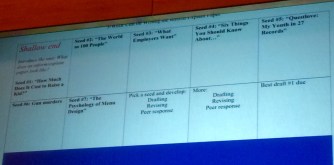
The first two weeks of Kelly Gallagher’s unit plan–week three is filled with revision and getting to best draft #3 at the ‘deep end’

Teaching writing is complex, layered, and nuanced.  In her session on revision, Georgia Heard shared the five things all students need in order to make authentic revision happen:  “opportunities for students to write, mini-lessons on craft and revision, choice in topics, mentor texts, one-on-one conferences with both teachers and students.”  Kelly Gallagher’s unit plan he walked us through adhered to those rules remarkably well.  “Assigning writing and teaching writing are two different things.  Grading writing and assessing writing are two different things,” he reminded us.  It is impossible for students to produce great writing if it is merely assigned.  Thus, when I plan a unit of writing instruction, I leave ample time for craft mini-lessons, modeling my own writing, and talk amongst students and myself.

When teachers are writers ourselves, and experience the process of topic choice, revision, and studying craft moves beside our students, we can become the most effective teachers of writing.  We have to walk the talk.  “Great, effective teachers must be informed AND inspired,” Kwame Alexander asserted.  To be a truly informed teacher of writing, a teacher must be a writer herself. I learned more about writing a strong narrative while participating in NaNoWriMo alongside my students than I ever did just trying to teach fiction before I wrote fiction.  I loved the experience six years ago during my first attempt, and I’ve continued to complete all assignments beside my students ever since.  When we write with our students, inspiration will spread through “the contagion of passion,” in Penny Kittle’s words.

Writing should be personal.  While I love to write about reading, and find it valuable for students to do so often, most of the writing in my classroom is personalized, choice-driven, and often remains private.  When we do a nonfiction writing unit, like the rhetorical analysis we’re in the midst of right now, our written products are focused on the students’ relationships to the texts they’re analyzing–in this case, the misleading rhetoric often found in American politics.  Mostly we write narratives, even in the midst of nonfiction, telling the stories of our connections to the topics we discuss in informative or argumentative genres.

“You can write yourself out of dark places. How much of the writing we do in school nurtures that?” Gary Anderson wondered in his session on reflection.  We have to honor the fact that students are not inherently motivated to write for their futures–for college, job applications, or resumes–but rather they are motivated to write for the here and now, and for themselves.  This is why choice is, and will remain, at the center of my writing instruction.

How do you design writing instruction?  Share your process in the comments!