Author Archives: Shana Karnes

Mini-Lesson Monday: Identifying & Imitating Voice

Comedy is all about voice, and we’re gearing up to notice and imitate as much voice-filled comedy as possible in the next few weeks.  When thinking about how to help students identify and craft their own written voices, I thought of a lesson Amy and I shared in Franklin a few weeks ago.

721003Objectives: Using the language of the Depth of Knowledge Levels:  students will make observations about a writer’s craft, identifying patterns in sentence structure, punctuation, and word choice to help define voice.  Or, in the Common Core, students will interpret words and phrases phrases as they are used in a text and analyze how [they] shape meaning or tone.

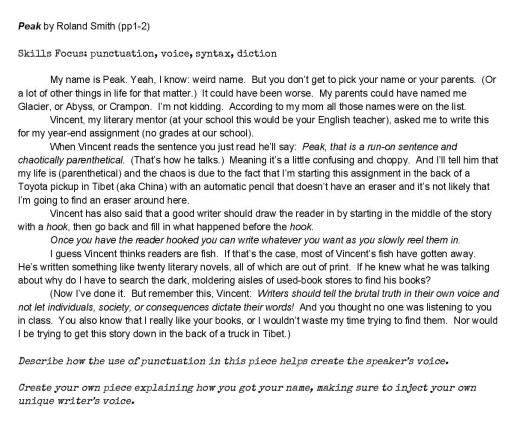
Lesson:  I’ll distribute copies of this excerpt from Peak by Roland Smith, which will serve today as both a booktalk and a mentor text.  I’ll introduce the piece as a book I loved, then segue into how it serves as an examplar of voice.

“Peak–that’s the main character’s name–is writing the whole book in the form of journals to his English teacher, so his voice is very conversational.  I found him pretty hilarious and sarcastic.

“Today we’re going to look at this excerpt from page one and try to see how Peak creates his writing voice.  Let’s all read this and annotate for craft–just notice HOW he’s saying what he’s saying.”

PeakVoiceLesson-page-001

After a few minutes of student annotation, which I am doing alongside them on the document camera, I’ll ask students to share their noticings in their table groups.  “Share with your tables what you notice about Peak’s sentence structure, punctuation, and word choice,” I’ll say, writing those bold terms on the board.

Once students have shared in small groups, I’ll ask each table to share out what they noticed.  As a group, we’ll arrive at some conjectures about Peak’s use of:

  • parenthetical asides to the reader
  • occasional fragments amidst his varied sentence structure
  • relaxed jargon
  • rhetorical questions.

Once we have those key terms in our notebooks, along with great examples from the text, I’ll ask students to practice using these skills.

“In this case, using these writing moves create a writer’s voice unique to Peak.  We’re going to imitate this piece now by writing a quickwrite about how we each got our own names.  Write your piece imitating Peak’s style, and use those four writing moves as you do.”

Follow-Up:  We’ll all take about eight minutes to craft our name stories, imitating Peak’s voice, in our writer’s notebooks.  We’ll share them in our small groups, then use that quickwrite as a seed prompt for a possible comedy best draft as we move through the unit.

How do you help your students craft their writers’ voices?

YA Fiction That’s Funny and Full of Voice

After millions of snow days, my student teacher, Mike, and I are finally wrapping up our Siddhartha self-reflection unit and jumping into a new writing unit I’m really excited about–comedy!  We’ll study satire, sketch comedy, stand-up, commentary, and monologues for mentor texts, then work with our students to craft strong comedy writings that exemplify the skills of pacing, payoff, “punch-up,” and one other skill that I think is the most important:

Voice.

Writing voice, for me, is where humor, sarcasm, and personality come alive in a piece of writing.  “Voice,” Tom Romano writes, “is the writer’s presence on the page.”  Voice is the most elusive quality of writing to teach, I think, because it’s not really quantifiable and cannot be duplicated or imitated.  Each writer must craft his own authentic voice.

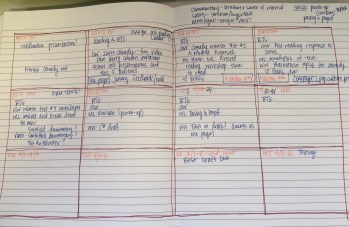
img_1738

Brainstorming the bare bones of a comedy unit

While discussing the very bare bones of our comedy unit, we brainstormed mentor texts, seed prompts, and writing skills.  After we hammered those out, Mike wondered about which books to booktalk for the unit.  “Nonfiction comedy is easy,” he said.  “Bossypants, Yes Please, Confederacy of Dunces.  But I’m not sure what to booktalk for fiction.”

“But YA fiction is so hilarious!” I exclaimed.  I started rattling off narrators who cracked me up.  Their writing voices were the perfect mentor texts for our students, who’d be focusing on crafting a humorous writing voice over the course of the unit.

“Looks like I know what I’ll be brushing up on for my weekend reading,” Mike remarked.  So here, in part, is a list of what I recommended to him–YA fiction that’s funny and full of voice.

The Absolutely True Diary of a Part-Time Indian by Sherman Alexie — This novel, paired with illustrations by the narrator, is loosely based on Alexie’s own upbringing somewhere between two identities–his poor Indian self who lives on the rez, and his striving-to-succeed “white” self who attends a better school up the road.  It’s infused with Alexie’s signature wry humor even against a pretty dark plot backdrop.

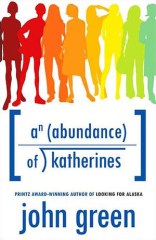
49750An Abundance of Katherines by John Green — This is, to me, the funniest of Green’s novels, although all of his narrators are pretty hilarious.  Colin Singleton has dated 19 girls named Katherine, and has been dumped by all of them.  If that’s not funny enough as it is, Colin is trying to write a mathematical formula for relationships and likes to find anagrams in random places.

The Disreputable History of Frankie Landau-Banks by e. lockhart — For me, Frankie is the female version of James Dean in Rebel Without a Cause.  Determined to subvert the male-dominated traditions at her private school, Frankie gets into all kinds of mischief, and I loved her headstrong voice.

American Born Chinese by Gene Luen Yang — This excellent graphic novel pairs multiple storylines, all of which are made hilarious primarily through dialogue and stylistic choices in Yang’s illustrations.  From antagonists so dumb they’re funny to Yang’s monkey alter ego, this is a humorous look at growing up different in America.

Anna and the French Kiss by Stephanie Perkins — I identified so much with the quirky narrator of this novel.  Forced to change schools right before her senior year, Anna is self-deprecating, sarcastic, and delightfully bewildered when she moves to the International School of Paris.  There’s also a great cast of hilarious supporting characters here.

Dumplin’ by Julie Murphy — I just loved Willowdean, the narrator of this terrific, important novel.  Most of her snide comments are made through internal monologues, but her interactions with her mom through dialogue are also quite funny, too.  Like Part-Time Indian, there are some heavier themes, but all in all I smiled throughout most of this book.

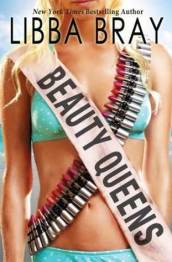
9464733Beauty Queens by Libba Bray — An all-girls’ Lord of the Flies, this book was fantastic for a variety of reasons.  The colorful cast of alternating narrators means there’s someone every reader can identify with, the interactions between those characters are often ridiculous and hysterical, and interwoven with it all is a series of broadcasts from a corrupt third party who are so evil it’s funny.

Noggin by John Corey Whaley — I finally read this book after it was stolen from my library countless times, and it’s hilarious from page one.  The story of a boy whose head is transplanted onto another teen’s body after he dies of cancer, Travis’ tale is at turns heartbreaking and hilarious as he tries to navigate the world five years after he last left it.  A fantastic series of supporting characters elevated the humor in this book for me, too.

Me and Earl and the Dying Girl by Jesse Andrews — For me, this was a more realistic version of The Fault in Our Stars.  I found Greg’s writing voice engaging and entertaining right away, and it made me read this book in one sitting.  His frequent addresses to the reader combined with his hilarious interactions with his friend Earl made Greg a favorite narrator of mine, and makes me eager for Jesse Andrews to write some more books!

Winger by Andrew Smith — All of Andrew Smith’s writings are hilarious at times, but for me Winger was the funniest.  Ryan Dean West is a scrappy fifteen-year-old making his way through freshman year at a private school, and his escapades with his rugby teammates, his crush, and his teachers made for a lot of laughs–up until I completely broke down in sobs for the last 30 pages or so of the book.  Still, Ryan Dean’s voice was so great that I couldn’t wait to devour this book’s sequel, Stand-Off.

What are some of the best-voiced YA books you’ve read that have cracked you up?  Please share in the comments!

Book Talks & How To Do Them–#3TTWorkshop


img_0331-1

Amy booktalks during our visit to Franklin High School

Conversation Starter:  What’s a book talk and why do you do them?

Shana:  Booktalks are a structured way to fangirl about my favorite things in the world: books.  I do two booktalks per class, right after independent reading wraps up.  They’re a great way to transition from the relaxed reading mood of the classroom and move into the fast-paced work of critical reading and writing, but they’re also the number one change I’ve made to my teaching that has influenced how much I can get my kids reading.  Three years ago, I only did booktalks whenever the mood struck or whenever I got new books into my library, but now I do two a day, every day, no matter what–and it’s made an incredible difference.

Amy: You are an inspiration in consistency, Shana. I’ve done better at doing book talks this year than I have in the past. I try to do two a day as well — one non-fiction book and one fiction. I always seem to fall off the wagon at some point though. The demon, impending testing, pulls me to the dark side every year. I’m putting up a good fight this time around, and I have a plan to reinvigorate, not just my book talks, but the reading that’s happening in my room. Curiosity and intrigue: my goal for better book talks.

Is there a set protocol for a book talk — like length, reading a passage, etc?

Shana:  Just talking books is the biggest nonnegotiable for me.  While most days I do follow a protocol–one fiction, one nonfiction; 2-3 minutes per book; always share a passage, a brief plot teaser, and my own reading experience; try to mention a student who’s read the book–some days I just have to gush over a book that’s been recently returned, or a book I am reminded of during conference time, or some new items I’ve purchased.  Either way, I talk books every day, no matter what, which helps students become accustomed to exposure to new titles, adding books to their what-to-read lists, and hearing about trends in authors, genres, or topics.

Amy:  Remember at Penny Kittle’s Book Love class at UNH two years ago how she had everyone model a book talk? She set no guidelines other than modeling a few for us. After just a few turns, it became clear:  The best book talks are short, energetic, and introduce the book in some insightful or clever way. I try to do that.

When I read the books in my library, I look for passages for craft studies or beautiful sentences we can use as mentors. Sometimes I share those in book talks without doing the study — we just enjoy the language or listen to the voice of the narrator. I’ve started asking questions and trying to get my students to think about the topics the writers might address in the books. Just another way to get my readers to make a connection with writing.

The hardest books to book talk are the ones I haven’t read yet, but even those are doable when we show genuine excitement about the book. Why would I have a book in my library if I am not excited about students reading it? That’s a pretty easy sell in and of itself. It’s fun to get students to ask questions about the cover and to read the comments.

41drZBnWSzL._SY344_BO1,204,203,200_How do you decide which books to talk about within each unit?

Shana:  This is pretty easy for me since most of my units of instruction are themed.  For reading units themed around a topic, I find lots of books about that topic, or that contribute an alternate perspective to whatever central text we might be reading.  (Example:  While reading Siddhartha and thinking about coming of age and going on journeys, Outliers, Marcelo in the Real World, The Other Wes Moore, Paper Towns, and Their Eyes Were Watching God fit right into our unit.)  While in the  midst of a writing unit, I think about books that might serve as mentor texts in terms of topic or structure, or that are written by authors who serve as good mentors in general.  Other times, I have no rhyme or reason to my booktalks, because I simply MUST talk about a new book (like Dumplin’, which I just read and LOVED and had to booktalk randomly.)

Amy:  I structure my units more around genre than theme, so my book talks are more random than yours. Hey, maybe that’s the problem with my consistency!

My students and I talk a lot about aesthetic and efferent reading. I want them to understand the importance of making connections with the books they choose to read, and lately, I’ve seen that there is a real disconnect. Just because students choose books does not mean they are making personal connections to them. This is in part why so many of my students this year are having a hard time sticking with the books they choose. Because I know many are abandoning books so quickly, I’ve been working on getting students to talk a lot more about topics and how writers approach these topics. My hope is that my non-readers will find interest in learning about things, even if they are not interested in reading for the pleasure of it.

I’ve done several book talks this year around a topic; for example, depression, which is one of my 11th graders’ favorite topics to write about this year. Forgive Me, Leonard Peacock, Every Last Word, My Heart and Other Black Holes all flew out of my hands, and I had to get more copies.

Do you ever have students conduct book talks?

Shana:  Very occasionally, I do, when it’s really authentic.  When a student finishes a book and just raves about it during a conference, I ask them to share that enthusiasm with the class.  Last quarter, I asked all students to read a challenge book and then complete their choice of follow-up activities with the book–one choice was a booktalk, and the students who shared about the titles they loved did spark some interest in their peers.  However, those booktalks didn’t go over as well as the ones that arose from sheer exhilaration, so I think my future goal will be to limit student booktalks to spontaneous ones only.

Amy:  Like you, I rarely have students conduct book talks — at least the way I do. I’ve tried, but you are right, without the spontaneous excitement about the book, the other students just do not respond the same as they do when I conduct the book talks.

However, I do have students talk about books with one another. Most of the time it’s pretty informal:  Talk to your table mates about what you are reading. Sometimes it’s a little more formal:  Speed dating with a book, which is one of our favorite ways to share books.

What are some other ways you talk about books with your students?

Shana:  Basically, I bombard them with talk about books all the time.  When I see current or former students in the halls, I ask them what they’re reading.  When they come to visit me, I urge them to leave the room with a new book.  I make lots of segues in conversations from all topics to all books (mostly because this is just what I do in real life…ask anyone who knows me).  I also share with students all the time what I’m reading, and why they might like a given book.

Amy:  We are so much alike! I love to have former students borrow books, and I talk about books with every person who will listen — and some who don’t. I also try to get students to engage with me on Twitter, using the hashtag #FridayReads to share what they are reading each week. A few students set up accounts and we follow each other on Goodreads. I love those kids! I’ve also started a favorite quotes wall, and I’ve asked students to pull significant lines that lead to theme and/or beautiful sentences that show author’s craft. Getting students to pay attention as they read, noticing how writers use language to create meaning, leads to significant improvements in their own writing. Without fail, it’s my best readers who are also my best writers. If only more students would get that.

Do you have topic ideas you would like us to discuss? Please leave your requests here.

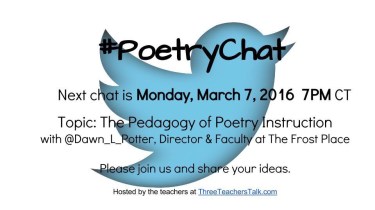
The Pedagogy of Poetry Instruction: Join us for #PoetryChat

img_0341-1I have had the joy of watching Amy get revved up about a variety of teaching topics, but I’ve never seen her with a brighter glow than when she talks about her experience at The Frost Place.  Their Conference on Poetry and Teaching is an amazing opportunity for teachers, readers, and writers of poetry to experience the “reading-conversation-writing-revision cycle” that is so central to conference director Dawn L. Potter‘s poetic philosophy.
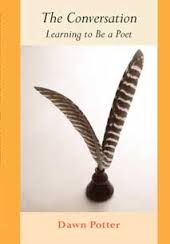
I’ve been reading much of Dawn’s aforementioned poetic philosophy, and seeing it in practice, in her book The Conversation–which is blowing my mind.  A thick, wordy tome with small print offset by the white space so signature to poetry, the book is full of wisdom that is the conversationrevolutionizing how I view the teaching of poetry.

As such, we are thrilled to have Dawn as our guest during March 7’s #PoetryChat, where she (and other chat participants) will converse about how to teach poetry.  Dawn’s expertise as a teacher and poet are incredible, and we can’t wait to hear her thoughts on our questions, and see her responses to chat participants’ questions as well.

Below are our questions for the chat–please share any that you have in the comments, and join us Monday, March 7 at 7 CT/8 ET for this month’s #PoetryChat on the pedagogy of poetry instruction.

  1. What poets and poems inspire(d) your love of poetry?
  2. What’s your best advice for helping students read and understand poetry?
  3. What’s your best advice for helping students WRITE poetry?
  4. How can teachers move away from poetry units and toward embedding poetry in ALL instruction?
  5. What is the best way to help make poetry relatable (and not intimidating) to its readers?
  6. As a poet, how do you approach reading poetry?
  7. What are your thoughts on revision?

Share your questions in the comments, and join us for the chat

Talking About What Matters by Catherine Hepworth

guest post iconWe’ve all been there. The conference room is crowded. It’s too hot. Every third person is clicking away on their laptop, answering emails or checking their phone, answering their kid’s plea to bring their forgotten gym socks to school. The presenters drone on, flipping through slide after slide on a fairly average power point. At the front of our minds, a constant throbbing pulse: how will I ever use this in my classroom?
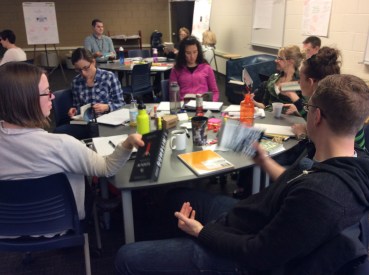
There is no interaction between presenter and audience. There is no spark. All of us wonder: is it too soon to take another bathroom break?

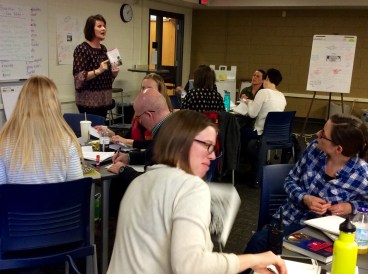
Fortunately, this is the exact opposite of what we experienced when Amy and Shana came to teach us how to implement the workshop model at Franklin High School on two dreary days in February. The time working with them inside our little classroom was anything but dreary.

And teach is the key word here. The most important realizations I came to at the end of the second day were:  I can do this…and, I was treated as both a student and a teacher.

It invigorated me.

img_0327

I’m in the plaid, exploring a possible independent reading book during “speed dating with a book”

We were exposed to a variety of activities for getting students to think, write, and talk about what they read and wrote. To really know how something will work in the classroom, you have to try it out for yourself. A big idea in the workshop model is that you must read books and write stories and essays alongside your students. As part of our two-day workshop instruction, we were reading and writing as if we were the student, so we could feel how each activity might go from the student perspective. Then we were allowed ample time to discuss and reflect on these activities as professionals.

Amy and Shana’s presentation modeled everything a teacher is supposed to do with a class of students.

Objectives were evident right from the start.

  • They gave clear directions.
  • They listened intently and attentively when we spoke.
  • They circled among us so they gave ample time to each group during small group discussion.
  • Their enthusiasm was palpable.
  • They made me feel like I mattered. They made me want to go out into the world and be somebody.

At the end of the day, isn’t this what we all wish for our students?

The best reading workshop strategy Amy and Shana taught us was one that engaged students in reflecting on their independent reading as well as talking with a friend about what they read. It all took less than 10 minutes.

First, students grab a post-it and write one insight they had about a character and provide a quote from the book that helped them achieve this insight. Then, students find someone else in the room (preferably someone they have not talked with recently), and share their post-it with that new student. The listener paraphrases what the student says and then they switch roles. The teacher collects the sticky notes from everyone, comments on the sticky notes, and hands them back (either within the hour or the next day).

As a “student,” this activity was really fun for those of us who like to talk about what we read. Because we are seeking a peer instead of being forced to talk to someone, it makes talking about what we read fun too. Lastly, each student must practice active listening skills. I especially like that Amy and Shana explicitly stated that the listener must paraphrase what they hear. I’ve already tried this activity with my students, and when we were done, several of them exclaimed, “Wow – it’s so nice to talk to others about what we’re reading; we need to do this again!”

For anyone who wants to change things up in their classroom and get kids more engaged, switching to workshop is it. The best way is to start small – dedicate 10 min of your class time to reading. Don’t think of it as “we have to read,” instead, think of it as “we get to read.” (This was an old trick used at Girl Scout camp. We didn’t tell campers “You have to collect firewood; rather we’d say, “You get to collect firewood.” It seems sneaky, but it’s not; it’s just a lot more appealing).

So teachers, think of it this way: you get to talk to your kids about the books and writing that matter to them, and those conversations will matter to both of you. Keep reading this blog for ideas and inspiration — it definitely helped me and my colleagues at Franklin. If you have the opportunity to invite Amy and Shana into your classroom/district, make it happen. We’re glad we did.

Catherine Hepworth has been teaching for 10 years; she currently teaches English and coaches Forensics at Franklin High School in Wisconsin. In the summer, when not reading books or frantically sewing historical clothing, she participates in living history events around the Midwest. Check out her living history & sewing blog at https://catherinetheteacher.wordpress.com/.

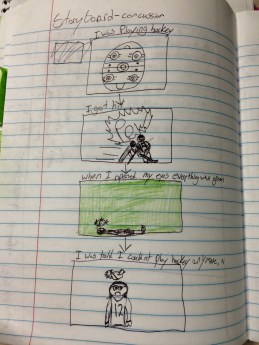
Mini-Lesson Monday: Storyboarding to Organize Writing

For me, narrative is central to all reading and writing.  I can find story anywhere–poetry, nonfiction, even a science report–so it’s no surprise that I teach about storyboarding a lot, both in the context of reading and writing instruction.  My students storyboard what’s happening in their independent reading novels, map out what they’ll present about through storyboards, and organize their writing using them too.

Objective:  Using the language of the Depth of Knowledge Levels, students will organize the plot structure of their own narratives; create a map of their story structure, and differentiate between pacing speeds in scenes mapped out.  Or, from the Common Core, students will use a variety of techniques to sequence events so that they build on one another to create a coherent whole and build toward a particular tone and outcome.

img_1530-1

Mitchell’s narrative storyboard is reminiscent of lessons from Tom Newkirk’s Boys & Literacy class

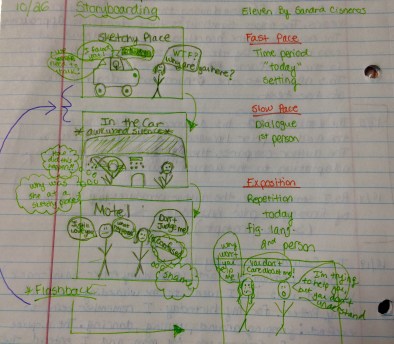
Lesson:  Prior to this lesson, students will already have selected a narrative topic and talked it out, at least generally, with their peers.  They will be ready to create a start-to-finish storyboard for the structure of their narrative.  We will also have studied “Eleven” by Sandra Cisneros to review pacing, and how to slow down and speed up scenes.

I’ll begin by modeling on the whiteboard for students.  “So, in my narrative, I want to tell the story of this pregnancy.  I want it to be kind of funny, so I’m going to focus most of my scenes on the funny parts–my husband’s and parents’ reactions when I told them, and my own reaction to figuring it out.

“So where should I begin my narrative, do you think?” I ask.

“Probably with suspecting you were pregnant,” a student chimes in.

“Yep.”  I draw a box on the board, and draw stick-figure me at my desk at school, question marks over my head, pondering whether I could be pregnant.

“Then where do I go?”

“Finding out you are for sure,” another kid says.

img_1531-1

Carleen’s narrative storyboard shows her addition of a flashback after partner conferencing.

“Yep.”  I draw another box next to my first one, using a directional arrow to connect them.  We go on in this vein until my storyboard is nearly complete, adding a flashback to previous disappointing pregnancy test results, and swapping the location of a scene.  Then I turn the students loose to draw their own storyboards in their notebooks.

Follow-Up:  After students have drawn their completed storyboards, I’ll ask them to find a partner to tell their story.  Often, this is where hiccups and gaps in the narrative structure are revealed–this second-draft talk.  Students will make revisions to their storyboards, and during workshop time we’ll begin writing actual scenes out in prose format.

In our next mini-lesson, we’ll choose which scenes to slow down and which to speed up, and work on various techniques to control pace.

How do you use storyboarding in your classroom?  Do you have any resources for storyboarding digitally?  Please share in the comments.

Best Books About Life and How to Live It

Amy and I have been talking a lot lately about how to help our students connect meaningfully to the books they’re reading independently.  This focus on personal connections stems from our recent reading of  Louise Rosenblatt’s work, our effort to make our instruction authentic, and our noticing of the ease with which our students disconnect from the world.

One activity we gave our students the option to complete was the creation of their own Top 10 Lists, like this one.  Emily’s list is titled “Life and How to Live It,” and it is full of her own personal connections.  It’s reflective of Emily’s desire to become a published other, full of her love for literacy and learning about the world through reading.  I hope her passion spreads to your students when you share this list with them.

img_1502Emily’s Top 10 List: Life and How to Live It
Here, I present to you my top ten favorite books all loosely based around my personal favorite theme to read about: life and the different outlooks different people have on life. Some see the good in life, some see the bad, and others get to see both. Each one of us will face hardships throughout our lifetime while later on finding that one thing that makes us feel as if we have a purpose to exist. When we first open our eyes at the beginning of each day, we are faced with the option to treat this day like a curse, hiding away from this beautiful life we are given to live, or to focus our attention on the positives we have. The choice is yours.

The Giver by Lois Lowry

The Giver is hands down my favorite book of all time. I first read it in middle school and have been in love with it since then. The idea is basically that Jonas, the main character, lives in a utopian society with no bad whatsoever. At age 12 everyone in this society receives their career, and Jonas has a difficult time dealing with the career he has been given. I love this book for a few reasons: one is the way that the book itself is written, and the other is the story behind it. I love the idea that Jonas is the only one who gets to see the bad in the utopian society, because to me it sends the message that what may seem perfect, deep down has repressed secrets we all can’t see.

Of Mice and Men by John Steinbeck

Of Mice and Men: a classic. In this tale Steinbeck tells the story of George and Lennie, two friends who take on the hardship of the Great Depression. Lennie, however, takes on more considering he is practically a father figure to George. Times get hard, but they don’t give up on each other. In the end, Lennie realizes that sometimes no matter how much you love something, if it’s not what is best for you then you can and will be able to survive without it, no matter how hard it is. I think overall this is the reason why I love this book so much.

Tuesdays with Morrie by Mitch Albom

This book brings me to tears–a lot of tears. Based on the true story of a young man who is happy in his life, living a life full of money and materialistic things. On the other side of the story, his old college professor Morrie is diagnosed with a deadly disease and must reunite with Mitch to teach him the things in life that are truly important. I love the idea behind this story, that in life we get lost in materialistic things and lose sight of the things that are most important in this short life we are given.

717Tx5+P+7LIt’s Kind of a Funny Story by Ned Vizzini

The relationship between myself and this book is remarkable. I can honestly say that I personally connect to it more than most other readers. This book is about a young man who deals with severe depression and one night decides to admit himself into the hospital after contemplating suicide. He then spends a week in a psychiatric hospital, learning things about himself and everyone else. Vizzini actually spent time in a psychiatric hospital before writing this book which makes it that much better considering he can grasp the inside look on what it’s really like. I, myself, have spent time behind the doors of a psychiatric hospital, and strangely enough my story started off almost the same way Craig’s did.

Perks of Being a Wallflower by Stephen Chbosky

Yet another amazing book that has the ability to bring tears to my eyes. The Perks of Being a Wallflower follows the story of Charlie, a freshman in high school who is struggling with depression and anxiety issues. Through letters, he talks about the good days and the bad, along with what is going through his mind. Charlie befriends Patrick and Sam who being to show him that it is okay to be different from everyone else.

Looking For Alaska by John Green

Looking for Alaska by John Green is a beautifully written story of a young boy who develops the nickname Pudge at a private high school where he meets and falls in love with the beautiful Alaska Young. So much happens while they are there together and he learns a life lesson. She teaches him to not be afraid of life, to go out and grab it because it can be a lot shorter than we expect.

Paper Towns by John Green

Paper Towns tells the heart-warming story of Quentin Jacobson who has secretly been in love with the girl next door, Margo. Margo taught Quentin a lesson which is the main reason I love this book so much – she taught him to go through life without being afraid of adventure. This is one of my top favorite books because I relate to Margo and her adventurous personality. I love Morgantown but I have always wanted to move somewhere where I can start completely over – the idea of recreating myself in a new place is thrilling.

410BrI9l37L._SY344_BO1,204,203,200_Skinny by Ibi Kaslik

Many teenage girls face a deadly mental illness – anorexia. Skinny tells the story of Giselle and how her battle with anorexia has flipped her life around. It also tells the story of her younger sister, Holly, and how her sister’s disease is effecting her life as well. The writing in this book was not my favorite, but it was still a great read. I love the idea that someone would want to put the issue of anorexia into words. My favorite part of the book, and the main reason it made my list of favorites, is the fact that it not only goes into the mind of the person facing the anorexia but someone close to her as well.

Afterparty by Ann Redisch Stampler

When I first started reading this book I didn’t think I would make it through but I’m glad I decided to finish it. Afterparty follows the story of a quiet girl who moves to a new town and decides it’s time for a change. She meets new people and gets to experience new and exciting things. This is something I have always wanted to do, which is why it made this list. Getting into a new place where you get to start completely over is more than exhilarating.

Everyday by David Levithan

Have you ever wondered what it would be like to be someone else for a day? To get inside of their minds and read their deepest secrets? A, the main character in Everyday, gets to wake up in a new body each and every day. To me, the idea of this is both terrifying and fascinating. When I was reading this I was thinking about the psychological aspects of this because I want to become a psychologist one day so I will be in people’s mind, understanding then, just as A does.

What other titles teach readers about life and how to live it?  Please add your recommendations in the comments!

What Teachers Need

img_1463-2

Love this meme Mike teased the students with!

I’m thinking of Taylor Mali’s “What Teachers Make” this morning, but I’m thinking about what teachers need.  I know I need something right now, because this job has me in the winter of some serious discontent, as Shakespeare says.

After this year, I am leaving the high school classroom.  I am starting to get very nervous about it.  Perhaps part of my anxiety comes from the fact that I’m seven months pregnant, but I think the majority has to do with the fact that a big part of my identity is teacher…and when I’m no longer one, who am I?

Next year holds lots of promise for me–motherhood, PhD work, teaching some Education courses, presentations, and more time for writing.  But I know that I’ll miss working with the teens in my classroom.

Right now I’m struggling with finding things to sustain me, because I have an excellent student teacher.  He’s teaching all six of my classes, doing all of the grading, and generally thriving on his own.

I get to plan with him, but then I sit in the back of the room and observe.  There’s always something that needs to be taken care of, whether it’s editing pages in the yearbook, running copies, or filling out paperwork.  But I am still so bored.

img_1470-1

Running into two of my students at the gas station was the highlight of my day yesterday.

I miss conferring with kids–our daily meetings at the bookshelf to talk about what to read next, or poring over their notebooks together, or sharing an exciting mentor text.  I miss the active work of discovering texts that I want to share with my students and urge them to reproduce.  I miss doing booktalks every day.  I miss conducting the symphony of rustling notebook pages, shuffled piles of books, or scribbling around poems.

A former student teacher observed that my typical day only consists of about 50% teaching.  The other 50% is made up of grading, making copies, lesson planning, running errands, going to meetings, and all of the not-so-fun tasks of our jobs.  They’re all essential to being prepared for the big show–the lesson–but I’m learning that I really hate those parts of my job when they don’t lead up to the ultimate experience of teaching.  It seems that they are mindless and pointless, and it makes me wonder about how teachers who have mandatory curricula, or who choose to teach straight out of a textbook, sustain themselves in this profession for decades.  I worry about their health!

I am craving the autonomy I’m accustomed to in my teaching.  Choice, independence, and purpose are just as important for teachers as they are for our students.  They sustain us in our quests to create lifelong readers and writers.  Without them, we’re just going through the motions of any job that doesn’t require creativity and energy and dynamism.

authenticityWe teachers need everything our students need:  timely, specific feedback (a great deal of it positive); the resources to do our work well; someone to listen to us and thus validate us; choice in what we teach and how we teach it; an identity as a teacher who is part of an authentic community of educational professionals.

It’s not every educational community that offers those conditions.  We often must go beyond our own school walls to fulfill those needs.  I’m thinking of Meenoo Rami and her excellent work to connect and sustain educators through Teacher2Teacher, and her important championing of the needs of teachers in Thrive and through #engchat.

I am depending upon Meenoo’s wisdom to get me through this winter–a winter both literal and figurative–and upon the wisdom and inspiration I find in my friends on Three Teachers Talk, Twitter, and more.  If you find yourself struggling, too, remember what teachers need–and do whatever you can to get it!

How do you sustain yourself in the winter of your teaching?  PLEASE share in the comments–I, for one, am dying to know!

Applying Essential Questions in Workshop by Cyndi Faircloth

guest post iconAfter almost twenty years of teaching, I’m starting to think I might be getting the hang of it. I’ve used essential questions over the past few years, but they weren’t producing the deep discussion and analysis that I’d hoped for. It wasn’t enough to use the EQ to help us approach whatever we were reading together. I needed to do more with it.
This past year, after reading “Text Dependent Questions” by Fisher and Frey, and What’s the Big Idea by Jim Burke, something clicked. Now, the EQ has driven pretty much everything in my planning –my selection of informative texts, some of the prompts for their Writer’s Notebook, even some of the vocabulary that I select. (Though I am also having a lot of success with student choice in vocabulary, thanks to a November post on 3TT!) Now, my students are leaving class and discussing the essential question and issues from our text in other classes. A colleague mentioned (complained?) last month that he had trouble starting his class, after students leaving my class were continuing our class discussion into his room.

They are struggling with real-world questions and topics and thinking about how they really want to approach them.

Here is what that looks like in my current English class:

Kite_runnerWe are reading The Kite Runner together. Our EQ has been “When is forgiveness important?” Their final assignment will be writing about their own answer to that question.

Along the way, we are reading news articles about Afghanistan, which include the idea of someone being wronged. Students respond to guiding questions (and generate their own questions) about the articles, and they struggle with those questions in their Writer’s notebooks. We’ve read about forgiveness from people betrayed by their families, by the government, and by strangers. [To find these, I used my subscriptions to the NY Times and Washington Post and searched “forgiveness” and “family”. Sadly, a wealth of resources came up…]

One really rich pair of stories I found for them to consider centers around the shootings in South Carolina in 2015. One article highlights the teenaged children of one of the victims having expressed forgiveness toward the shooter. The other is an opinion piece that says the children forgave too quickly because “the almost reflexive demand of forgiveness, especially for those dealing with death by racism, is about protecting whiteness, and America as a whole.” The author points out that there has been no rush to forgive after any of the ISIL beheadings or 9/11. Students really dug into that idea and explored it.

In their Writer’s Notebooks, students have been responding to the idea of betrayal and forgiveness in a number of ways. They chose a quote from a list and responded to it. They reread parts of the book and considered how ‘betrayal’ or ‘forgiveness’ played a role (Thank you Fisher and Frey). They used words from their vocabulary list and wrote a poem about betrayal.

While they haven’t written their final products yet, I expect the students will have differing answers to the essential question. I believe that their writing will express the wrestling match they’ve had with the ideas. Thank goodness Burke’s book helped me see how I can use more aspects of my class to help students explore a “big idea”, and give them examples and smaller pieces of writing that they can draw from in writing an answer to the essential question. I believe my students are developing the skills to wrestle with the big questions that life has thrown (and will continue to throw) at them. They will look for more than one point-of-view, consider the source, and question the message so that they can form their own opinion based on more than something they read on Facebook.

Cyndi Faircloth teaches English, Social Studies, Art, and Journalism at Paradise Creek Regional High School in Moscow, Idaho. The school is small – with only two full-time teachers – so it’s easier to say that she teaches everything that isn’t math and science. As an interdisciplinary teacher, she works to incorporate writing in all of her classes and is learning to incorporate the writing workshop into her classes. Cyndi is a National Board Certified Teacher in English Language Arts – Adolescence and Young Adulthood.

Mini-Lesson Monday: Freezing Time

dumplinIt’s -4 degrees in West Virginia today, which might explain why I’m thinking about the narrative skill of freezing time.  I’m also thinking about it because I’m reading the fantastic Dumplin’ by Julie Murphy, the story of an unconventional small-town beauty pageant contestant.  As I read, I was aware of how quickly the writing hooked me–I began to look for reasons why, inspired by Writing With Mentors.  My noticing of Murphy’s freezing of time to show me the thoughts and feelings of her narrator, Willowdean, reveals two skills I’d love for my students to utilize: the skill of reading like a writer and imitating the craft they notice in their own writing.

Objective:  Using the language of the Depth of Knowledge levels:  students will identify and categorize Murphy’s craft moves, then revise their own narrative drafts to apply the concepts they learned.  Or, in the language of the Common Core:  Analyze the impact of the author’s choices regarding how to develop and relate elements of a story or drama (e.g., where a story is set, how the action is ordered, how the characters are introduced and developed); Use narrative techniques, such as dialogue, pacing, description, reflection, and multiple plot lines, to develop experiences, events, and/or characters.

Lesson:  I’ll introduce Dumplin’ during book talks by describing the plot and passing out the following excerpt:

The car behind me at the drive-thru backfires, and I rush inside.  My eyes take a second to adjust to the dim light.  “Sorry I’m late, Bo,” I say.  Bo.  The syllable bounces around in my chest and I like it.  I like the finality of a name so short.  It’s the type of name that says, Yes, I’m sure.

A heat burns inside of me as it rises all the way up through my cheeks.  I run my fingers along the line of my jaw as my feet sink into the concrete like quicksand.

The Truth:  I’ve had this hideous crush on Bo since the first time we met.  His unstyled brown hair swirls into a perfect mess at the top of his head.  And he looks ridiculous in his red and white uniform.  Like a bear in a tutu.  Polyester sleeves strain over his arms, and I think maybe his biceps and his hips have a lot in common.  Except the ability to bench-press.  A thin silver chain peeks out from the collar of his undershirt and his lips are red with artificial dye, thanks to his endless supply of red suckers.

He stretches an arm out toward me, like he might hug me.

I drag in a deep breath.

And then exhale as he stretches past me to flip the lock on the delivery door.  “Ron’s out sick, so it’s just me, you, Marcus, and Lydia.  I guess she got stuck working a double today, so ya know, heads up.”

“Thanks.”

I give students a specific purpose for reading, since we’re looking at this text as a mentor.  “While I love a lot about this book–the author’s diction, how her word choices change the narrator’s voice and reveal her personality and sense of humor, and the fantastic chemistry between Bo and Will, today I just want to pay attention to how Julie Murphy paces this scene.  As you read, you’ll notice how she just freezes time so you feel like you’re holding your breath.  Annotate how exactly she does this, and we’ll talk about it in five minutes.”

I read alongside my students, modeling notes on craft with the document camera.  After five minutes I ask them to share at their tables, very specifically, what they noticed.  Then, I solicit from each table group one craft move they saw, and where it was in the text.

“Well, dialogue kind of brings you back into the present, like at the end when Bo says something and kind of snaps Will out of her daydream,” one student offers.  I write on the board, dialogue–keeps you present.

“Awesome.  What else?”

“The long description of Bo’s appearance stops the action,” another says.

“Yep.”  I write on the board, description–freezes action.

We continue until each table has shared a craft move they’ve noticed.

“Okay, so today during workshop, I want you to think about how you might play with freezing time in your narratives.  Use what we talked about to help you revise the pacing in your scenes, and if you think Dumplin’ sounds good, add it to your what-to-read list.”

Follow-Up:  During that day’s workshop, I’ll confer with students and see where they might be strengthening existing moments of freezing time, or adding some brand new ones, in their narratives.

Later, as we finish the narrative unit, we’ll return to the anchor chart we’ve been adding to and create a rubric that reflects the skills we’ve focused on, one of which will be pacing.  I’ll also hope to see lots of students reading Dumplin’ over the coming weeks–doubling a booktalk with a craft study lesson is usually a highly effective way to get kids hooked on a book.