Author Archives: Lisa Dennis

Blackout Poetry with a Twist

Early in the school year, I’m always on the lookout for new ways to gather diagnostic data on my students, without uttering the words diagnostic, data, quiz, baseline, or any other term that reduces my students to plot points on a spreadsheet or numbers in the gradebook.

We know the power of conferring in learning about our students in countless ways, but what to do when, say as an AP teacher, we need to know students’ understanding of analysis terms or their ability to apply those terms in order to really dig into authentic analysis through study of mentor texts?

The idea of a vocabulary quiz makes me shutter. Conferring long enough with each student to get a good understanding of his/her knowledge of syntax, imagery, figurative language, etc. would take weeks. Submitting annotations on our first go-around seems cruel to both students and to me.

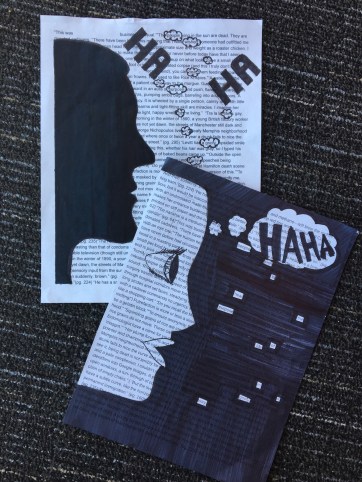
So this year, my colleague Sarah and I decided to try something different. We wanted an understanding of how students would go about identifying the purpose of a piece and img_6137provide appropriate text evidence of the basic terminology of analysis: syntax, imagery, diction, figurative language, and detail. We wanted students to use their left and their right brains. We wanted to students to work together to solve a problem.
Enter, the blackout poem.

Traditionally, black out poetry makes meaning out of the words provided by a single page of text. Whether it be from a book, article, essay, etc., a poem is created from the words that live on the page by blacking out all other words and leaving just the ones that create meaning for your given purpose. Additional images are sometimes included.

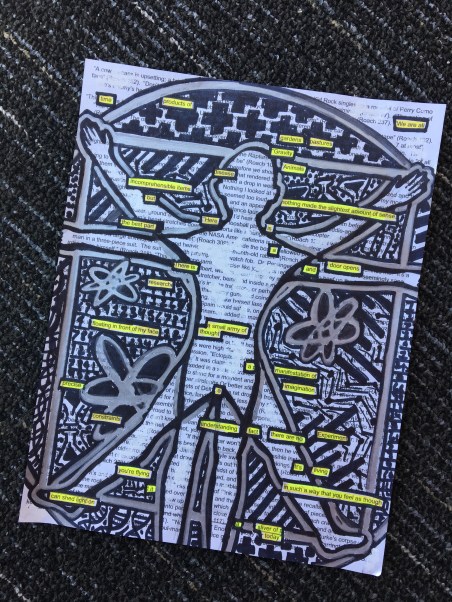
We decided to turn this upside down a bit. Students would create their page of text from the text evidence they pulled from their reading (In this case, their choice of Mary Roach books from our summer homework assignment) and a poem to illustrate their claim of purpose from that reading.

And this, is some of what we got:

Below, are the steps we took in guiding students through this unique assignment. It could work for jut about any reading, and I would love to try it when students have read a variety of perspectives on a given topic.
img_6132

  1. Students read their choice of Mary Roach books over the summer and kept track of instances where they felt she purposefully utilized DIDLS (Detail, Imagery, etc.).
  2. We then partnered up or formed groups of three to discuss what we found and what we thought it meant. We were working toward specific purpose claims for each text.
  3. Students shared examples of the various instances of craft from Roach’s texts and as they did so, they typed those quotes onto a shared Google document. Their final task with that original quote document was to decide on a claim of purpose for the text(s) they read.
  4. Once finished, students printed that document of quotes so I could take a look. I’ll use it as a jumping off point for review that’s needed with specific elements of analysis.
  5. The kids then eliminated all of the formatting for their quote document, so they were left with a page full of quotes from their texts. Essentially, they created the page of text for their blackout poem, instead of using an existing one from the book.
  6. We then talked about how to communicate their claims of purpose poetically. Simply finding the words from their purpose was not going to be poetic, it was going to sound like a thesis. We brainstormed ways to convey the purpose through related ideas and involve more imagery, figurative language, etc. in our own work.
  7. Finally, we put the poems under the document camera and each group explained their claim for Roach’s purpose in the text, how it influenced their poem, and read their work to us. We snapped at the end of each reading.

I love that this work got students talking about a text, using text evidence, attacking an assignment with both sides of their brains, and enthusiastically supporting one another’s work by sharing with the class. Their creations went well beyond finding and explaining examples, to creation. Poetry from nonfiction for the win.


Lisa Dennis teaches English and leads a department of incredible English educators at Franklin High School near Milwaukee. Her favorite insight from Mary Roach (courtesy of the book Gulp) is that our mouths fill up with saliva before we vomit in order to protect our teeth. We have so much acid in our stomachs that our teeth would be irreparably damaged when we puke, if our saliva didn’t protect them. Science. Incredible. Follow Lisa on Twitter @LDennibaum 


Saying Something, Not Just Anything: Student Talk – A Guest Post by Margaret Lopez

Written in the spring of 2017, Margaret Lopez reflects on the value of purposeful communication and strategies to get kids to create questions that get at the heart of a topic and generate meaningful discussions. 

All year, my juniors and I have been workshopping writing and reading different texts for a range of purposes, pairing fiction and nonfiction for some whole class studies (Death of a Salesman and Outliers–a hit!  1984 and current events surrounding fake news and government–loved it!).  I realized a skill I hadn’t closely instructed, we had just “done,” was intentional classroom discussions.  As my juniors prepare to be seniors, Screen Shot 2017-05-01 at 8.44.22 PMcollege students, and individuals in the workplace, they need to speak purposefully and ask intentional questions.  I want them to be able to say something, not just anything  From this reflection, and students’ interest in recent protest movements and community issues in Chicago, a social justice unit based mainly on speaking and listening with low stakes writing was born.

I selected three books for students to chose from, and those choices became their lit circle groups.  Students could chose from Half the Sky which discusses female discrimination across the world, Ghettoside which examines policing in a predominately African American community outside of LA told by a reporter who spent years reporting on crimes in the area, or Hillbilly Elegy, a memoir about growing up in Appalachia.

Throughout the unit, we have followed the same routine:  

Mondays are for lit circles, Tuesdays are for extension activities with nonfiction, and on Wednesdays, we discuss all three texts together in a Socratic Seminar.  My goal was a lot of low stakes writing and fruitful discussion.

I think there is a reason that discussion is a central component of the English classroom, as it builds community, facilitates deeper or new thinking on a topic resulting from other perspectives, and is a college and job skill we have the duty to foster and refine in our students.  However, students need to speak, listen, and ask purposefully.  My students know how to talk–at my small school, where classes can be between 6 and 16 students, class stalls if they don’t have anything to say.  The awkward silence lingers.  Then someone says any random thought they have just to break the silence.  But there is difference between saying anything and saying something.  To elevate students to say something about the injustices across the texts, not just anything so that awkward silence doesn’t linger too long, I began with questioning skills.

Magnifying Glass - Questions

It is challenging students to take the idea they’re wondering about and want their peers to contemplate and thinking about it backwards, writing a question that doesn’t give away their opinion, lead peers right to the answer, or simply confuse others.  

We began by running through the list of essential questions from this school year and reviewing their quick writes on the topics from throughout the year.  I asked students what they noticed about the questions, many came to the conclusion that the questions are BIG, meaning they have more than one answer, but those answers aren’t definitive or “right.”  From there, we looked at a list of plot-based questions I made about the first chunk of their reading to compare the lists of questions.  They easily noticed these questions were the opposite of essential questions, meaning they had a limited scope of what response could be correct or on the right track.

Great, they can notice the difference.  Now to teach them to apply this to their own questions. Thank the teaching gods and goddesses for Jim Burke’s What’s the Big Idea?.  I used his entry points into teaching questioning around three types of questions:  Factual, Inductive, and Analytical, having students label their own questions as one of the three types.  Then, we worked on revising after I modeled some examples.   I challenged students to move beyond the factual so we could get to the big ideas and scale up Bloom’s Taxonomy.

Jacely revised her questions to get to the heart of her concern, which was why law enforcement doesn’t seem to care about women that are in trouble:

  • Factual:  On the very first page of chapter 2, what does Nick ask the Officer about regarding trafficked girls?  
  • Inductive:  Kristoff asks an Officer about what exactly they look for and then mentions if they look out for trafficked girls and the officer mentions there isn’t much to do about them. Why do you think these officers seem to not care about this huge issue?   
  • Analytical:  What implications does this have on the community?  Women’s futures?  Are there issues with law enforcement in the communities in your books?

Mishawn revised to include more perspective and connection:

  • Factual: Why is the crime rate so high in Watts?
  • Inductive:  What allure do gangs have for the young people in the community?  How does this create a cycle of violence and crime?
  • Analytical:  What factors, both historically and recently, have lead Watts to become a breeding ground for criminal activity?  In your opinion, which factor is/has been the most detrimental?

I also provided students with question stems as a guide and encouraged students to use these until they felt comfortable framing their questions.  By the end of the unit, student questions were synthesizing the three texts and major ideas.  I noticed students would lead with a question geared more towards their text, then extended the question to the other two text, thus inviting in more conversation and fluidly moving between inductive and analytical questioning.  The discussions moved from inner to outer, from focused on one book to all three books.

Jordan:  How does Leovy expect the reader to believe in the good homicide detectives while at the same time giving examples of racist and uncaring detectives?  What contradictions exist in your book’s community?  Do these lead to an imbalance of power or other injustices?

Ben: Isolation is discussed by Vance as one reason leading to a disconnected, stalled hillbilly society.  How are the people in your text isolated, whether by location, proximity, cultural norms, or otherwise?  Does this perpetuate the problem or is it a solution that hasn’t been capitalized on?

To springboard Wednesday’s seminars, we often pre-thought through the big ideas for that chunk of reading as a way to anchor thinking and create a common entry point into the seminar, and also, so students had something to say.

  • Google Doc Quick Collaboration:  I posted some initial questions on the google doc to get students thinking, then watched the entire class collaborate on 1 document–so cool!  I limited this pre-thinking to about 3 minutes so students didn’t type all of their discussion points.  I also left this projected during the seminar, serving as an anchor chart and inspiration for more questions.  So easy. Minimal prep.  Great results!
  • Discussion Tables:  I made three table tents at three different tables in my classroom, each with a common idea and thread that occurred during that chunk of reading.  I gave students two minutes to discuss how each topic related to their book.  After two minutes, they moved to a new table and could shuffle up their group.  Again, minimal prep and 6 quality minutes of pre-thinking.
  • Essay Highlights:  Students wrote for 20 minutes about the central injustice in their novel, justifying why that, out of all the intersected issues, is the most pressing for the community in the book.  I then typed the major argument from each student’s essay and used it as an entry point into a Wednesday seminar.  Students were able to see the something their peers had to say, understand how perspective and perception shade one’s reading, and make connections across the three texts.
  • Pass Around:  I asked students to write a line from their book that really just hit them in the gut and explain why.  Then, students passed them around the room, spending a few seconds reading what their peer had been most impacted by and why.  I actually couldn’t stop students from talking. Across the table, students were making “OMG” eyes at each other, whether it was a connection with their lit circle peer or shock over what a peer had written about from another text, the conversation was immediately started.

As I have listened to each small group discuss the same texts, it was amazing to hear how the conversation differs from class to class.  I wanted students to experience that, to give them a chance to expand each others’ thinking.  I assigned two digital seminars using our school’s digital platform, and while this is nothing crazy innovative, students posted and responded, I noted many benefits from this type of “discussion”:

  • Students experienced new perspectives and interpretations of the text from their peers in other classes, and I found more students sharing personal anecdotes–students were sharing their personal experiences with discrimination and inequalities.
  • Shy students or those that need more process time were the space to contemplate, revise their thinking, or deepen their response by not having to think on the spot as they would during an oral discussion.  I have many exchange students from around the world (China, Spain, Thailand, and Italy), who have the extra task of interpreting, decoding, and thinking in two languages  By writing, students had more time to think and contribute at their pace.
  • Students were more thoughtful in their responses and more likely to use text evidence to support their argument or open their classmates’ eyes because they aren’t so “on the spot.”  Students used evidence from the book, as well as other articles we had read, thus adding rich context to the discussion.
  • Students had another opportunity to practice practical writing for college.  Many college courses require blog post or digital contributions, and the reality is that most of my students will take an online course at some point in their academic or professional lives, too.  
  • Students received real time feedback on their questions.  If no one responded, maybe the question was unclear, too narrow, or too broad.  Student-led formative assessment–a new trend?
  • Students had a time and space to learn about digital etiquette and practice, something very important as Snapchat and Twitter become accepted means of communication.  As students move into their post-secondary endeavors, they may be communicating with bosses or professors via email and must communicate clearly, without a misinterpreted tone.  We discussed how to politely disagree and how to ask a follow up question instead of answering with bias, as well as the time and place for proper mechanics.
  • I made time to write beside them, contributing to the discussions, too.

Although these strategies were successful in moving my students beyond saying anything at all to fill the void, the best part was how moved my students were by the injustices that exist in our world.  They spoke with such compassion and concern for those suffering they no longer seemed to be kids, but young adults.


Maggie Lopez has six years of teaching experience at large public high schools in Louisville, Houston, and now Chicago.  A graduate of Miami University, she had the pleasure of learning from the workshop masters and is on a continual quest to challenge, inspire, and learn from her hilariously compassionate juniors and seniors. 


Screen Shot 2017-05-01 at 8.44.22 PM

Care to join the conversation? We’d love to add your voice! Please email guest post ideas to Lisadennibaum@gmail.com.

#TwitterTeacher

I’m late to the party. This I know. But my enthusiasm for this soirée is genuine, and it fueled some of my first day success.

In an effort to build community as quickly as possible this school year, and to get to know our students a bit over the summer, my colleague Sarah Sterbin and I decided to add some technological play to our AP Language summer homework. Using the hashtag #fhslanglife, students were asked to share their reading life twitter4throughout the summer.

They could snap photos of their trips to the bookstore, their feet in the sand and a book in their hands, and their smiling faces reading the summer away.

They could quip about quotes from required and choice reading, make suggestions to peers on what to read next, comment on the insights of others, follow my reading adventures, and the list goes on.

As often happens with open ended assignments, we got a wide variety of participation. Tweets ebbed and flowed throughout the summer, but each time a student posted, I made it a priority to comment, retweet, like, and/or tag an author to promote connections across the world of reading. When Ishmael Beah, Allen Eskens, and Matthew Desmond interact with your students over the summer, I call that a solid win for starting to build readers and a community with enthusiasm around reading.

twitter5

On the very first day of school, and in the few days that followed, as we quickly collected summer work, set down to work with a quick writes, set up writers’ notebooks, organized editorial speeches for our first speaking opportunity, and took in the surroundings of our room, I asked students to use our hashtag to share their excitement about the work ahead. I love what they chose to share.

twitter3twitter1twitter 2twitter6

Tweeting is a quick and easy way to build community. I sometimes display current tweets our daily PowerPoint/Syllabus to keep the movement afoot, and I love to hear students’ reactions as they come in the room to see their humor, insights, and recommendations on the big screen.

Twitter

How do you use social media to promote reading and writing lives? Please leave your brilliant ideas in the comments below!


Lisa Dennis teaches English and leads a department of incredible English educators at Franklin High School near Milwaukee. Her latest tweet suggests that she thinks about reading 24/7. Follow Lisa on Twitter @LDennibaum 

Unscripted Magic – A Guest Post by Lori Vincent

As much as it pains me to admit it, my “best” moments in the classroom often start with an unprofessional incident. Perhaps it is because my students get a glimpse of real me rather than the semi-scripted English teacher version they expect. Or maybe it’s just magic. Screen Shot 2017-05-01 at 8.44.22 PM

During a class change one morning, I checked my Twitter feed (the kids had to teach me how to use it last year). Instead of clicking on hearts and retweet, I squealed like a three year-old girl. I’m forty-four. I have twenty-one years of classroom experience. They call me Mean Mrs. Vincent.

  1. Do. Not. Squeal.

Except for when author Ava Delaria acknowledges my tweet with a reply. Total fangirl moment. It must have been black magic that made me do it.

The squeal got some attention, and it gave me the chance to begin class early. Nobody complained (actual magic). I did an impromptu book talk on Delaria’s Love Letters to the Dead, a YA novel about Laurel who struggles to find herself in the midst of her sister’s death and her freshman year of high school. Laurel’s English teachers ask her to read “One Art” by Elizabeth Bishop. Predictably, the teacher gives a writing assignment that Laurel seems to ignore (also quite predictable).

Within minutes of the book talk, I had two overwhelming requests (and an extensive waiting list to check out my sole copy). 1: Find money and purchase another copy. 2: Bring a copy of the poem and “do” it with them the following day. The kids ASKED ME to bring in poetry.Like I said… MAGIC.

Eventually, the kids began asking if they could write their own love letters to the dead. They REQUESTED a writing assignment (more magic). The results were amazing. I knew I couldn’t leave it there, so I did some quick research and located http://www.read.gov/letters/,  a contest sponsored by the Library of Congress. The Letters about Literature is an annual contest and winners from three age groups are selected from every state.

I invited the students to compete, and more than half of them revised their letters to the dead to use for the contest. Others wrote a new letter. MAGIC. One of my seniors earned recognition for her letter to Ned Vizzini.

While I can’t plan for the magic (unprofessional moments) I know that it is more likely to appear when I offer my students engaging books and invite them to write for authentic reasons.

In the moment of my squeal, I wasn’t Mrs. Vincent. Instead, I was an excited fan having a moment. Breaking the teacher persona does not always have to be catastrophic.

When the moment allows me to share my passion, not because I think it will be useful for graduation or college or the unit test, but because it is truly exciting for me, I have to take it.

This fall I have 6 new classes, so how do I recreate the spell? How do I make sure they feel the magic too? I’m certainly not planning unprofessional moments, but I think that what I can do is provide a space for the students to BE readers and writers, not just students of readers and writers.

What about you? What are some of your magical moments from years past? How do you invite students to become readers and writers?


Lori Vincent is a wife, mother, and teacher just south of metro-Atlanta. When she isn’t in the classroom (or at a local coffee shop) teaching AP Language, Writers Workshop or newspaper journalism, she is somewhere talking to everyone who will listen about reading and writing. You can follow her adventures on Twitter @MrsVincentOHS  


Screen Shot 2017-05-01 at 8.44.22 PM

Care to join the conversation? We’d love to add your voice! Please email guest post ideas to Lisadennibaum@gmail.com.

Build It Brick by Brick

In a sea of back-to-school positivity (well-founded) and hoopla (well-intentioned), I often feel overwhelmed and ill-prepared.

Blame a jam-packed teacher preparation week, a summer of mindfulness that limited a deep dive into my lesson plan book, procrastination, denial, or crippling avoidance in the face of too many awesome options. I’m stressed out. Already. And tired.

Honestly, most of it is that last option. I do pretty constantly think about teaching. Ways to improve my content base, opportunities to more deeply understand my students, and countless resources to pour through in order to refine lessons all populate my summer.foolish How then does it all seem to come crashing down so quickly? Where does that raw enthusiasm for “the new” become wide-eyed, survival-mode, toss-me-a-life-jacket exhaustion?

It reminds me of those early days of parenthood. When you are “supposed” to feel overwhelming joy and revel in the breathless beauty that is a new and precious life, but few (if any) people prepare you for just how emotionally and psychologically challenging the change can be. When compounded with minimal sleep, mounds of self-applied pressure to be brilliant, and the feeling that every decision is make or break, you’re never very far from the edge.

So, just as parents want little more in those early days than to do right by their kids, teachers want to start the year by forging relationships, making connections, and presenting students with opportunities to learn that they can’t refuse. We want to learn their names, find them the best books, spark their enthusiasm with the perfect discussion question, change a life with the first kind smile. I’m a bit tired just typing it. However, stop someone on the street and say, “This new school year has me exhausted already,” and I would imagine they would be tempted to remind you of June, July, and August. But, the struggle is real.

I’m here this morning with a quick reminder. A reminder that I too need to hear as I furiously capture moments of a student bio gallery walk to share on Twitter, check in scads of summer homework, collaborate on new curriculum with multiple colleagues, adjust to a new schedule, less sleep, and more stress:

Rome wasn’t build in a day, but they were laying bricks every hour. 

Our work at the start of the year is certainly important. It’s foundational. That said, it doesn’t matter if it’s year one or year thirty-seven, remember to breath, remember to rest, and remember that our students are overwhelmed at the start of the year too. They need a bit of ease, understanding, and comforting as much as we might.

Epictetus once said, “If you want to improve, be content to be thought foolish and stupid.” I might add that one should be content to be exhausted as well, but loving students is exhausting. Most things that we truly value demand much more from us and are thereby far more valuable in the end.

Hang in there, friends. We’re in this together, and the mission is worth every ounce of weary we might be feeling.


Lisa Dennis teaches English and leads a department of incredible English educators at Franklin High School near Milwaukee. She currently misses long afternoon naps, but squeezes in catnaps here and there, on her couch, under a book, and with her eyes open during stoplight stops. Follow Lisa on Twitter @LDennibaum 

Diving In: My 1st Week of Readers/Writers Workshop – A Guest Post by Gail Stevens

September 4, 2017

School started for me last Monday, and with it my journey into Reading Writing Workshop.  Lucky for me I have three colleagues who were ready to try something new, too.  Why try Workshop? So many of our students were not reading. They were Screen Shot 2017-05-01 at 8.44.22 PMdisengaged, and so were we. We were feeling  discouraged and something had to give.

At the end of the school year, we invited anyone in our English department who was interested  to join us to discuss the possibility of implementing Reading Writing Workshop. Attendees discussed why we wanted to try this method, and teachers had time to ask questions and voice their concerns. We left that meeting feeling excited and energized by what could be,  and committed to reading and studying about Workshop over our break.

Over the summer, we read Penny Kittle’s Book Love, participated in the Book Love Summer Book Club, and read everything we could get our hands on about the ins and outs of running a workshop in the high school classroom.

Fast forward to last week. With summer over we met back at school to figure out how this workshop thing was going to actually look in our classrooms. We quickly realized that we needed to make peace with being uncomfortable and tolerating the ambiguity that comes with the territory of trying something radically new. We are pioneers, and we have each other and a host of mentors online via Twitter and some amazing professional blogs like this one to guide us in our first steps.

The Three Teachers Talk blog has been a godsend to us. Every day there are thoughtful articles, engaging lessons, and practical tips on doing workshop from real teachers who are teaching real students. The authenticity of this work shines through every post as well as the encouragement we get from teachers who are doing what we aspire to do.

So how’s it going so far?

AMAZING!

We just finished our first full week with students and the four of us are feeling so energized and excited about our first starts at establishing workshop classrooms. Some background on the range of classes we are teaching this year:  I am teaching four year-long sections of English II Honors (on an A/B day schedule). All of my students are also takingAP Seminar, the first AP class in theAP Capstone program. Capstone is new to our school this year, so again, more new territory for us as teachers. I work closely with my students’ AP Seminar teachers and my plan is to support the work my students do in that class in whatever way I can. I also co-teach one section of ESL Sheltered English I. My workshop colleagues are teaching English III & English IV inclusion and honors sections. Here are some of the reading/writing activities we used to begin establishing community in our classrooms:

Day 1 was  “Book Speed Dating” in the Media Center. Students had a chance to “speed date” at different tables (each table was set up with different fiction genres). All students left with a book that day.  We wanted students reading from Day 1.

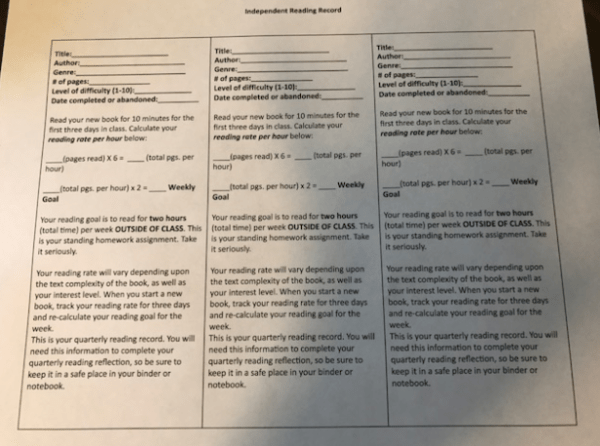
Day 2 Students began their independent reading at the start of class.  Students read for 10 minutes and recorded the number of pages.  Next, they filled out their Independent Reading Record sheets to calculate their weekly reading goals (using Penny Kittle’s formula). We will use these records when we confer with students to help them design their reading ladders and to guide choices for next books.

workshop one

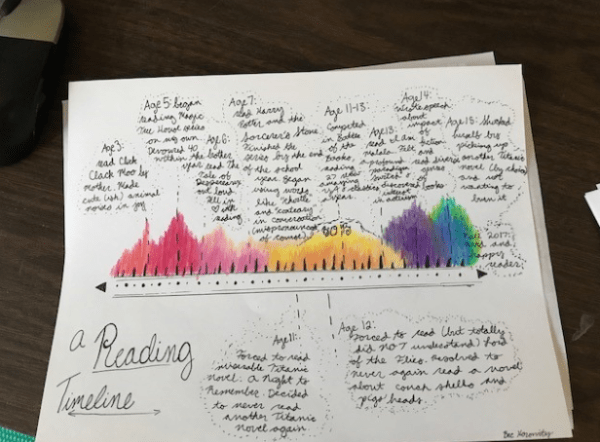
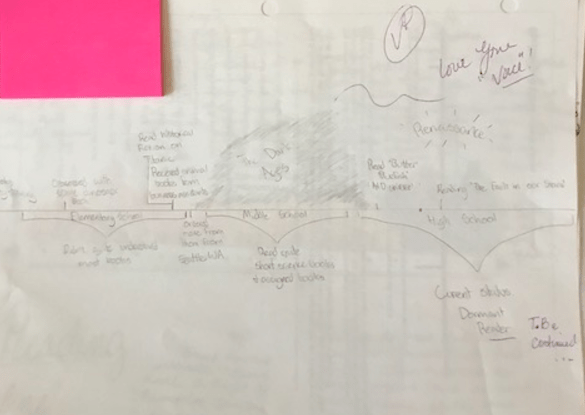
Students also completed aReading History Timeline. This is something I’ve used before but haven’t done in a while. I like seeing a visual timeline of my students’ literacy development. Students were supposed to choose 8-10 events that helped shape their reading lives. Positive events were to be placed above the line; negative events below the line (some students forgot this part, so I had to have them clarify for me). Students placed their completed timelines on their desks and we did a gallery walk. Afterwards, we discussed common themes, beloved books, shared experiences with literacy. One common theme was students’ loss of interest in reading as their lives have become busier. Almost all mentioned a lack of time to read as being a major contributor to this problem. This only reinforces my belief that if we intend to help students grow as readers, we must give them time to read in class.

workshop two

workshop three

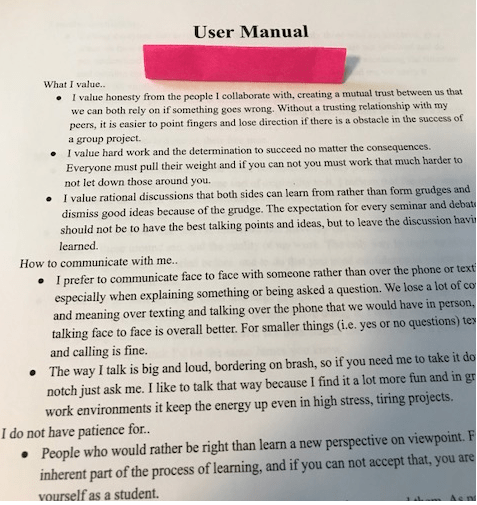
Day 3 we created aPersonal User Manual. I  loved the idea of students writing guides to what matters to them. I shared the mentor text, and then wrote my own User Manual to share with students. I explained to them that I would be doing all of the writing assignments (and setting my own reading goals) with them. They loved this idea!

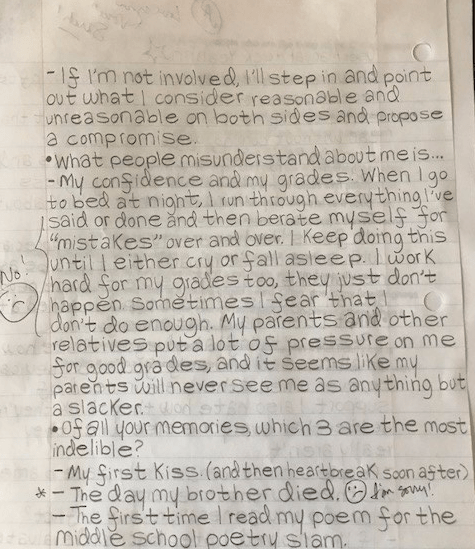
I am only halfway through reading my students’ Personal User Manuals, but so far I am thrilled with the results. Notice the voice that is evident in their work. This is such a great beginning to the year to be able to identify a student’s voice and encourage it right from the start.

What insights I have gotten into my students after only the first week of class!

Here are some student samples:

workshop four
workshop five
workshop six

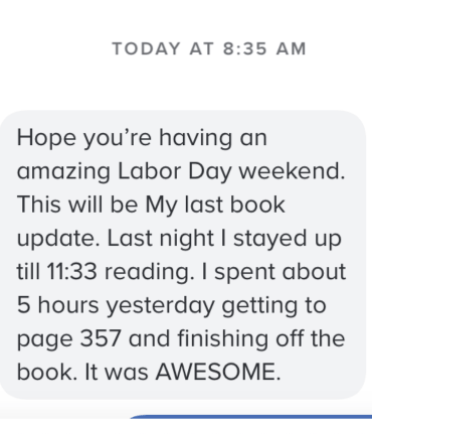
All of these activities helped us to get to know each other as well as build community and excitement for books and writing from day one. A great example: even my most skeptical student, a young man I taught last year in English I, found a book he was willing to read. This is the message I received from him this morning that made my day:

workshop seven

What’s next? Students will be experimenting with writingAuthor’s Bios. I plan to have them include their picture with their bio, and I will print these out and post around the room.

Student response to these first steps into establishing a Reading Writing Workshop have been overwhelmingly positive so far.

Thank you Amy Rasmussen andThree Teachers Talk,Penny Kittle, and all of the amazing Workshop teachers out there who generously share their work and enthusiasm for this practice. My colleagues and I are encouraged by the changes we see in our students and ourselves, as we are more engaged and energized than we’ve been in a long time. We hope to inspire others around us who are curious about workshop but are not ready to take that next step.

I look forward to sharing more adventures in Workshop with you.

Gail Stevens


Gail Stevens teaches 10th grade Honors English & 9/10 ESL Sheltered English at Cary High School, in Cary, North Carolina. This is her 18th year teaching, third in high school, after teaching middle school for 15 years. You can email her at gstevens@wcpss.net or follow her on Twitter @jerseygirl_1021.


Screen Shot 2017-05-01 at 8.44.22 PM

Care to join the conversation? We’d love to add your voice! Please email guest post ideas to Lisadennibaum@gmail.com.

Reading and Writing When You’re Not Supposed To – A Guest Post by Amy Estersohn

Teachers, I’m stuck in a dilemma: How do you respond when members of your reading and writing community read and write when they’re not supposed to?

Those who sneak a book and read through a mini-lesson.Screen Shot 2017-05-01 at 8.44.22 PM

Those who slip a pencil in their hands to continue writing during whole class share.

My initial reaction is to monitor for compliance.  If I tell you to stop reading, you should stop reading.  If I can’t get you to stop reading, then you might do all sorts of other disruptive things, like, I don’t know.

My second reaction is that it’s impolite to broader community.  Attempting to sneak a book during a mini-lesson is not polite to me or to those around you.  Writing while somebody else is reading to you?  Your body language says “I am more important than you right now.”

But there’s a another lesson to consider here: reading and writing happens on its own schedule, and sometimes we get so far into what Nancy Atwell calls the Reading Zone that we don’t want to leave.  We won’t allow ourselves to leave.

I know firsthand what the reading and writing zone feels like, especially as an introvert who needs time and solitude (not necessarily silence, just solitude) to read, write, and think.  

And as educators and observers, we can appreciate that students who read and write even when they are not expected to are in the midst of lifelong lessons about reading and writing.  We’ve won over these teens for the big victory, the way I see it: their writing and reading is of importance to them beyond a grade, beyond what we think, and beyond what their peers think.  No teacher would ever complain that students were making up math problems to solve that weren’t assigned for homework.  No teacher would complain that students were fantasizing about science experiments they’d like to perform some day.

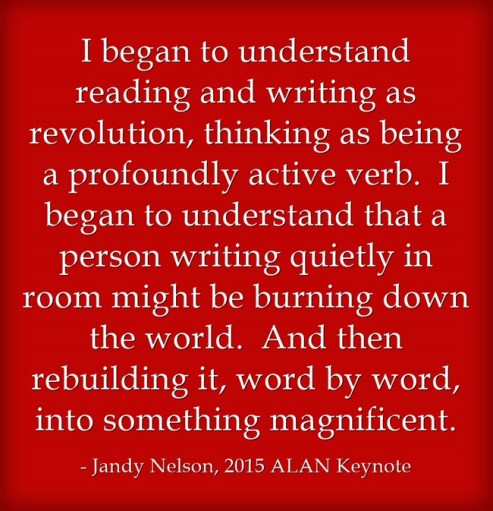
These students are engaged in a revolution of one:

I-began-to-understand

Rather than attempt to interrupt thinking in progress Because I Said So or Because It’s Polite, here are some of the questions I’m considering before I ask students to stop, look, and listen:

  1. Is the stealthy reading and writing intended to disrupt or undermine other student learning?
  2. Is the stealthy reading and writing coming from a student who never or rarely engages in enthusiastic reading and writing?
  3. When will I have an opportunity to measure student progress and understanding of a teaching point?

I adjust some classroom routines to accommodate this stealth, too:

  1. Daily sharing is optional; students can share with a writing partner or friend in small groups and move around the room to share or they may sit at their desks and continue working for more stealth time.
  2. I don’t reprimand students for writing during independent reading blocks, but I also don’t expressly encourage it.
  3. I respect that not all students will be enthusiastic about sharing their work with me, especially if their writing and reading feels private and part of a deeply personal journey.

But … but… there’s always that careful balance between the needs of the community and the needs of the individual, so I’m interested in hearing from you about how you manage this stealth in your classroom.


Amy Estersohn is an English teacher in New York.  She can be found blogging at Teaching Transition, No Flying No Tights, and other education and book review blogs.  Amy was a 2016 recipient of the NCTE/ALAN Gallo Grant and a panelist for the CYBILS awards.


Screen Shot 2017-05-01 at 8.44.22 PM

Care to join the conversation? We’d love to add your voice! Please email guest post ideas to Lisadennibaum@gmail.com.

Why English? – A Guest Post by Mitchell Nobis

Why English- (1)

I’ve had a weird year. Many of us have. For me, it has been kind of like a tornado blew my house off to Ontario but left the foundation behind. What do you do in a situation like that? You might first bask in memories and drive to the river to wave hello to your old house sitting in a field somewhere south of Sarnia. (Hello from Michigan!) But after a minute, you can’t keep shouting at your house telling it how much you miss it. No, eventually you go back and examine the foundation that’s still there.

We go to work and deal with one-size-fits-all state mandates. We check the education news and see grant after grant going to STEM courses. We go out with friends Screen Shot 2017-05-01 at 8.44.22 PMand hear a hundred citations to or shouts about “fake news.” But what’s the foundation that holds strong through all of this? 

As my main man Hamlet would say, “Words, words, words.” (Granted, he was in a different context when he said that, but then again, maybe not that different.) In the craziness of 2017, I keep thinking about thinking. I keep returning to the humanities. I keep coming back to English. Why English? Why humanities? Why liberal arts?

We might as well ask, why words? So let’s.

Why words? Why do we take and teach English classes in the first place? In the news media and conventional wisdom of the day, business leads the way. For so many of our students, making a million dollars is their goal and only sign of success. Ours is a society that does measure success with bank account commas, so that’s entirely understandable. But if you read interviews with wealthy thought leaders (say, the Bill Gates of the world) or look at a survey of CEOs, you see that they want to hire creative thinkers and collaborators. They want liberal arts majors. They want folks who are good with words. Why? Words are how we show thinking. We need thinkers.

Our work as English teachers is cut out for us and is more important–and harder–than perhaps ever before. Words build a mind. Words build a soul. Words build a sense of self in community. They build the community. Regardless of our students’ career goals, if they are to be successful and thoughtful human beings, they need the opportunities to think, to listen, to communicate, to write, and to speak that English classes can provide in ways that no other discipline can.

Sure, students read in science class but mostly with a goal of learning the difference between xylem and phloem. Yes, students write in history class but mostly with a goal of explaining the cause of—all too often—a war. English class allows the unique opportunity to read, write, and speak with a goal of greater understanding. Our goal boils down to a greater ability to think.

But that’s hard to do. Many people want a checklist approach to teaching English, but that’s not how literacy works in a real world democracy. We have to read information in live time, and we have to decode big ideas on the fly. This doesn’t happen when students can use only textbooks. We need to be okay with having hard conversations and using real-world texts, but how do we foster safe spaces for these discussions? By doing it. We can model for students by actually engaging in deep discussions in our lives and in our classrooms.

English teachers have rare opportunities to get to the deep, real work of an education. (No pressure, eh Teach?) The English department is often the home of the faculty’s most outspoken and deepest thinkers. This is no mistake because the very material we teach increases critical thinking and empathy. English teaches us to read deeply, to pause and think critically, and to empathize. If we embrace this role as teachers, we can help students change the face of America and the future. We need understanding. We need kindness. We need a viable, sustainable society. That is why English classes matter. That is why we study words. We need humanities because we need each other.


Mitchell Nobis (@MitchNobis) is the president of the Michigan Council of Teachers of English, a co-director of Red Cedar Writing Project, and a curriculum support teacher in Metro Detroit with over 20 years experience in the high-school English classroom. He recently co-authored Real Writing: Modernizing the Old School Essay, from Rowman & Littlefield, and for June 2017, he’s posting a poem per day at the Tupelo Press 30/30 Project website.


Screen Shot 2017-05-01 at 8.44.22 PM

Care to join the conversation? We’d love to add your voice! Please email guest post ideas to Lisadennibaum@gmail.com.

Get Your Story on the Page

Get Your Story on The Page (1)

Once upon a time, in a land of equality and compassion…

Attention! Do not open! Live snakes inside…

To the Love of My Life, It is with regret that I must inform you…

The power of the written word to change our perspectives, alter our actions, stir our hearts, and change our lives are just some of the reasons we all work to teach authentic writing with such passion, urgency, and unwavering commitment.

We reach out to our students with mentors, craft study, low-stakes writing, and the call to put their hearts on the page, because we firmly believe that writing can empower, enlighten, and embolden their lives as it has ours.

I am so proud to hold up as evidence, the guest posts on this blog from the past two days. If you’ve not had “beginning of the year, crazy teacher-presession days, I’m trying to learn 172 names, you’ll find me in a corner weeping” time to read those two posts, I cannot recommend that you take the time more highly.

Charles Moore and Megan Thompson, both teachers from flood-ravaged Houston, tell their stories of the start of a school year that will alter their lives and the lives of their students forever. The posts are honest, raw, vulnerable, and everything we ask out students to put on the page from day one. They are informative, persuasive, and narrative at its best, because they come from a place of true connection between content and humanity.

Often, especially at the beginning of the year, I will hear students say, “I just don’t know what to write.” And I hear that. In the face of powerful mentor texts about tragedy, inequality, injustice, and the raw realities of life, it can sometimes feel like my words on the page are very, very small in comparison.

However, this is where our students need the most support. They need to know that their words put on paper are uniquely theirs and that they are important. They fulfill the timeless desire of humanity to express, convince, and connect.

As we get to know our students this year, I think it’s equally important to get to know them well enough to intelligently hand them books to move their reading lives forward AND to get to know them well enough to coax out of them the true stories they have to tell.

We’ll work all year to fine tune the telling of those stories (mini lessons, craft study, feedback galore), but my goal very early in this school year is going to be to help my students get to know themselves right along with me as I get to know them and to help them see that the desire to communicate has always been within them. Regardless of their live experiences, the wonderings of their minds and the musings of their hearts are great voices we need to help students tune back into.

When I got home this past Tuesday, after a twelve hour day of pre-session and open house, my daughter Ellie (age four) was just getting tucked into bed. As I sat down next to her bed and soaked up her barrage of hugs, she smiled broadly and told me she had left something under my pillow that I needed to go get right away.

When I returned to Ellie’s room with the slip of paper below, my four-year old read me a story of about two minutes in length that explained all the markings on the page. It detailed her day img_5459while I was away, her desires to have me stay home so she could hug me whenever she wanted, several additional expressions of love, and a suggestion that we get ice cream this weekend with gummy bears on top. Signed with her name, it was one of the first pieces of evidence I have of her desire to tell her story on the page.
We learn first how to write our names. And when we learn this skill it’s to take ownership of our ideas. To take pride in the sharing of what we’ve created. We can’t let our students lose this. As their skills grow, and they learn all the additional letters to organize into words that tell what they feel, what they need, and what they want others to know, we must validate that exploratory writing in order to encourage it to continue.

It starts so early, this need to share ourselves with ideas and feelings that can’t always be said, and it is up to us as the teachers of these darling children coming of age, to remind them of the power that a page of their ideas with their name at the top can hold, if only they take the time to make those ideas deeply felt and deeply honest.

This school year, as we teach the particulars of the craft of writing, let us remember to encourage our students to share what they need to. Let us encourage them to share what they might not even know/remember is in their hearts and minds, and that it’s important.

We owe it to ourselves and to our students to make our writing instruction about more than answering the prompt, getting it over with, and/or filling a page requirement. Remember the deep desire humans have in expressing ourselves, putting our unique voices in print, and (should we chose) sharing that tiny piece of ourselves with others.

Students may hesitate, but their stories matter. Let’s get them on paper.


Lisa Dennis teaches English and leads a department of incredible English educators at Franklin High School near Milwaukee.  Follow her developing story on Twitter @LDennibaum 


Time Well Spent: Getting to Know Our Students as Readers and Writers First

Untitled presentation

Perhaps this school year is your very first as an educator. Maybe it’s your thirtieth. It could be that you’ve moved schools, or changed rooms, or will be teaching in a new subject area. Regardless of the circumstances, it isn’t unusual to have back to school dreams (flippin’ nightmares, if you ask me – driving to the wrong school again isn’t just embarrassing, it’s downright inexcusable fifteen years in), enthusiasm and optimism tinged with anxiety, and a bit of sheer panic that while you thought there wasn’t enough time to get ready at the start of August, now you are really, painfully sure.

However, the first day of school will come, as surely as the fireflies start to fade from warm summer evenings and the emails begin rolling in from panic-stricken students, who left somewhat less time than they probably should have to complete summer assignments.

And when that first day comes, all new outfits and nervous bellies, I’d like to ask that we all keep in mind something that I have come to see as very important in my classroom. I would ask that we all consider carefully how we spend out time.

A few weeks back, I came across a tweet from Danny Steele. He said,

I don't care

How true. How do I spend my time? How will I spend my time during pre-session? Drowning in data and prematurely exhausted by situations I cannot control, or physically and mentally preparing to welcome students to my class and the deep learning we will do?  During class, am I promoting books, writing in front of my students, talking with instead of at my students? Do I make time for my students beyond the class period? Beyond the class day, will I make time for my own reading and writing in order to live the life I sell to my students as essential?

For my students, we’ll need to discuss the very same concepts. For many, a case for becoming readers and writers will need to be airtight if it will successfully compete with loads of homework from other classes, endless hours of extracurricular practice/performance, and the responsibilities to after-school jobs, family, and friends. Thankfully, the most important job of an adolescent (discovering who he/she is and wants to be) is beautifully bolstered by time spend exploring experiences in a writers notebook and devouring the writing of great thinkers, explorers, and dreamers. My brief sermon to students very early in the year will repeatedly support good reading and writing habits by reminding them of the power of the choices they make in relation to these areas of their lives.

So, as workshop is dependent on the tenant of choice, teachers and students becoming writers and readers is reliant on choice as well, not just the choice of what to write/read, but how, when, for how long, and to what end.

This means, on day one, when I see each of my classes for only twenty minutes, I will be promoting the choice to become (continue as/make time for being/change a mindset around living a life as) readers and writers. I won’t be handing out my syllabus. I won’t be putting insane pressure on myself to know them all/love them all/build a community in one day. I will be giving students time to get acquainted with the idea that a life as a reader and a writer will be real in this class and my ultimate goal will be to make it real for them outside this class as well. In an effort to start this discussion, I’ll ask my students to write about the following:

What choices do you make as a writer and a reader?

In what ways do those choices lead you to becoming a stronger writer and reader?

When Sam suggests that his choice is not read, well, at least I’ll know. When Kara claims she wants to read but doesn’t have time, at least I’ll know. When Joe says he only reads science fiction no matter what, at least I’ll know. Because once I know, I’ll know better who and what I’m working with.

In the days that follow, my priorities will be to:

Continue to establish a workshop community that values reading and writing by talking about books, helping students select their first choice books of the year, writing with my students every day, talking about books every day, and using more pointed questions for reflection/conversation around getting to know my students as readers and writers specifically. For this purpose, I plan to use George Couros’s “5 Questions to Ask Your Students to Start the School Year” from his work at The Principal of Change: 

  • What are the qualities you look for in a teacher?
  • What are you passionate about?
  • What is one BIG question you have for this year?
  • What are your strengths and how can we utilize them?
  • What does success at the end of the year look like for you?

Strongly promote curiosity as a mainstay of our work together. More to come on this in a future post. Amy and I started talking about student curiosity when I was working with her in Texas earlier this month. Since then, I’ve been thinking about it as a mandatory component to my planning that has been on the back burner for awhile. Of course the work we all do each day is to pique student curiosity, but I want this back at the forefront of my teaching. How often have you had a student answer the question above about what he/she is passionate about with a response of “I don’t know” or “I don’t think I’m really passionate about anything”? Readers and writers embody curious spirits, therefore, we need students to locate that curiosity that our traditional education system has beaten out of them by second grade.

Reflect on, discuss, dive into, write about, and work to digest the current events, perspectives, conflicts, and life-altering chaos of this summer in order to promote civil discourse and debate about how to move forward. Easy, right? Yeah. I’m sure we’ll have this all solved by the end of quarter one. Sigh. This work is going to be some of the toughest of my career; however, it’s necessary work. For my students from all walks of life, experience, and personal bias, we need to work more than ever to build understanding, empathy, and support for one another in order to send these scholars off to a life beyond high school with both hearts and minds wide open to the truth, the history and current actions that mold that truth, and how to make this nation and our world better.

And that, friends, is no small undertaking for the first few weeks of school.

At the heart of everything we do though, the grounding feature to the start of my year will be to focus on how we spend our time. What will we spend our time talking about? What will we spend our time worrying about. What won’t we spend our time worrying about? What will we promote and what will we let go of in an effort to be better students, better educators, and better people?

We will spend our time talking, I know that, because the best source of data in my room is the collective and individual voices of my students. So while I am nervous for all we have to do and be, and I’m sad to let go of the summer I am currently living (I type this on the couch in my pajamas, with my beautiful daughter curled up next to me), it’s time to spend my time a bit differently. It’s time to spend it in one of the most influential places in life. The classroom.

What will you be tackling the first few days of schools? What are your major goals for those foundational days of the school year? Please share in the comments below! 


Lisa Dennis teaches English and leads a department of incredible English educators at Franklin High School near Milwaukee. Her first days of school will also involve an increase in caffeine, Kleenex for spontaneous weeping at the sound of the alarm at 5:00 a.m., and an insistence that her lovely husband consider saving her life by dinner. Follow Lisa on Twitter @LDennibaum