Now, just to be clear, when I say year I mean about a decade’s worth of exhaustion, emotion, and uncertainty rolled into 180ish days of tough.
And as this crazy school year comes to a close, I reflect on everything we’ve accomplished as educators, not least of which has been literally surviving and I’m happy to report I hear the distant rumble of a slow clap. The steady drumbeat of solidarity, growing ever louder as more and more educators join the chorus of almost disbelieving hands clapping…for each other and for ourselves. We. Did. It.
Let’s be real a moment. Not our usual humble selves, but really, real.
You deserve a standing ovation. You deserve pots banging in the streets. You deserve sweet cards, and smiles, and thank you’s, and sincere gratitude from communities overwhelmed by your sacrifice for their children.
I know our realities are as varied as our geographic location and preferred book genre, but our difficulties are often the same. Many have to work more than one job to make ends meet. Some continue to work through vacations to make up for lack of preparation time just to be ready to start all over again next year. We see our own kids less than the children of other people. We watch weekends fly by from behind our computer screens and buried under piles of papers. Stack on top of this the fact that the impossibilities of modern education are often met with either toxic positivity or a “this is what you signed up for” attitude, and we can all be left feeling like we apparently deserve to run on empty.
This isn’t true.
You deserve a break.
Please go back and read that one more time. You deserve to unplug from all things school. You deserve to feed the parts of you that get neglected in the service of others. You deserve so much, but a break you can actually take. Lengthy, short, in snippets here and there, with a good book, a favorite beverage, those you love, or completely on your own, step back. Disable the notifications on your phone (I’ve actually contemplated chucking mine out of a moving vehicle lately) and nap. Often. Stare into the summer sky and know you likely did more this year than you ever would have thought to be possible in this profession…and you made it. Your students are so blessed that you did. Now is the time to ensure you can return to them next year, a more complete and mentally rested person.
So this summer, as we step away from our classrooms or computers, please know that we here at Three Teachers Talk see you.
We see the commitment.
We see the work.
We see the struggles.
And we want you to know you are not alone. Take as many steps back this summer as you responsibility can. Whether it be moments to read fluff or planning work put off until fall, slide your attention back to yourself. We do what we do for our students, but we will in fact be better for them if we work to heal what this year has done to and taken from all of us.
Take a break, dear friends. You deserve it.
And if you hear strange banging noises this summer, it’s me, banging like a loon on a pot to herald all your hard work, because you deserve that too.
How are you taking time for yourself this summer? What message of solidarity do you have for fellow weary educators? Comment below!
Lisa Dennis spends her school days teaching AP Language, English 9, and Virtual Film as Literature while also leading the fearless English Department at Franklin High School, just outside Milwaukee, Wisconsin where she lives with her husband Nick, daughter Ellie, and beagle Scout. She now tries to live life based on the last pieces of advice her dad gave her – Be kind. Read good books. Feed the birds. Follow Lisa on Twitter @LDennibaum
When I found out late last summer that I’d be returning to the classroom in person, full time for the 2020/2021 school year, I was equal parts elated and terrified. Having basically not left my house in months, I couldn’t fathom how we’d manage to move back into the classroom with any sense of normalcy or how I’d keep myself, my family, my colleagues, and my students safe simultaneously. Pandemic teaching sounded to me like a mashup of dystopian proportions.
At the same time, teaching from home all last spring brought with it challenges I didn’t relish either (My husband and seven year old daughter were home working alongside me and there were times we were each/all ready to pack a bag and go…who knows where. Mostly elsewhere). I once again considered returning to my roots as a barista or possibly trying to sleep through the coming school year. Healthy, yes?
As news trickled in about navigating our return, it was clear we were building an airplane thirty-two thousand feet off the ground. A noble effort to be sure, but harrowing, dangerous, frightening, and quite possibly deadly. As educators have been time and again, we were being shoved to the front lines. Not as well-equipped or even trained first responders, but instead, as the humble servants who apparently swore oaths to serve and protect no matter the circumstances or cost. I was to be handed a mask and optional face shield, told to keep distance from the thirty students in my room, and do the job I had signed up to do. It did not sit well.
I raged – How could they ________ ? (Fill in the above blank with four million questions about how it would all possibly work)
I feared for my safety – If I get sick what will happen to ________? (Fill in the above blank with anyone I love and had been working so hard to protect in the previous months by staying home, masking, not hugging my own mother, etc.)
I cried – But what if _______? (Fill in the above blank with an equal number of less rational and more emotionally charged wonders)
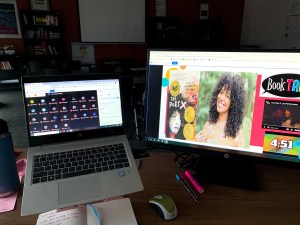
And while I’m not here to tell you it’s all gone perfectly, or that all of my initial concerns were or even could be addressed before we jumped in, or that the same will be true for you if you’ve yet to return – we have in fact done it. For eight months, I’ve taught in person and virtually at the same time (during the same class hour, in fact). 30 kids in my classroom. Masks all the day through. Suspicious eyes cast on every cough, sneeze, and inadvertently exposed nose.
We’ve shut down just once for two weeks last fall, but otherwise through a revolving door of exclusions for both students and teachers, staff turnover, extended class periods to allow time for cleaning each hour, and nervous moments spent supervising hundreds of unmasked students during lunch…we’ve supported one another through the uncertainty.
In some ways, things are no different than they ever were. My students read at the start of each period, write about what matters to them, and challenge themselves to discuss the weighty issues of our times both intelligently and diplomatically. The room looks much as it always has, but beneath the masks we wear each day, are fears and questions and uncertainties and trauma I could not have imagined last spring when I walked to my room in a haze on March 13th after a brief staff meeting suggesting our spring break would be extended by a week, gathered a few items to teach from home, and looked around at my empty classroom with a growing sense of dread.
Over a year later and as a mirror to live outside of my classroom, it all seems surreal. The longest school year of my life and the quickest. The most stressful, to be sure, but also the most challenging in ways that have caused me to grow in resilience, patience, and compassion.
A few days ago, Melissa asked if we were okay. My answer is yes, and no, and sort of, and I don’t even know. The layers of exhaustion wrought by worry, extra duties, student exclusions, positive Covid cases in my room, and teaching as I never have before (basically tethered to my desk so students at home can hear me while students in the room likely wonder whether my ankles are twisted or I’ve just grown lazy) are just too much. And yet, having kids in my classroom (and even teaching Virtual Film as Literature to 34 black Google Meet boxes), is the light in this dark time. Their curiosities and triumphs push me forward.
So, if you are staring down a return in fall, I cannot be the one to hug you (for obvious reasons) and say everything will be alright. But I can assure you through my example, that you are not alone in your fears, but likewise not alone in the overwhelming sense of joy you’ll feel by seeing your students in person and stretching in a thousand ways to inch back toward a new normal.
What I have learned in this past year (not related to making your own cleaning products, conserving toilet paper, or managing familial relations in close quarters for weeks on end) will forever change my teaching, but also solidify that nothing can shake the core principles that existed well before this pandemic …
Students and teachers are resilient, but still human:
If there was ever a circumstance to put patience and understanding at the forefront of our work, this pandemic is certainly a contender. It adds an ever present layer of uncertainty that is equal parts traumatic and debilitating. We’ve all experienced loss and change and fear and stress in ways we’ve collectively never experienced before. As ever, students need structure and support as they school in new and sometimes scary ways. Listen more/talk less. Write more/grade less. Read more/test less. Be there for your students, but also for yourself.
Reading and writing offer timeless benefits we know well, but choice is more important that ever:
I recall last spring, the push to have students write about their experiences in quarantine. And then the push back with the consideration that many students couldn’t/didn’t want to try and process this fresh trauma. It’s been my guide this year in offering students far more opportunities to process through SEL grounded prompts, but there’s always choice. Some students have written all year about the pandemic and what it’s meant to them, done to/for them, taken from them. Some students want to write about anything but. In the weeks and months ahead, our students will be on different timelines with their experiences and per the usual, it will be our job to be equal parts support system and challenger to process the world in which we live. Fall back always on choice – it provides for our students what our limiting circumstances often cannot.
Toxic positivity is not the answer, but active engagement in seeking positivity can be:
We cannot know how deep the cuts from our recent experiences truly are. We don’t know for ourselves or our students. Personally, the opportunity for deep and meaningful change that seems to have passed us by in hitting the pause button on traditional schooling is a deep cut. The standardized test slog is still in place (don’t get me started on the calls to measure “learning loss” with tests, tests, and more tests…though there are some reasonable voices out there), our hours/schedules/calendars are largely unchanged despite unprecedented additions of responsibilities and stress, and most importantly, to my mind, the opportunity to restructure in a meaningful way to address unconscionable achievement gaps often resulting from inequitable systems and misinformed priorities across education. This year has reminded me that I must continue to use my voice to advocate change in our work, but the moment to moment with kids demands that I give them as much positivity as I can muster. And when my store of smiles is low, I give myself the grace to take a step back, take a deep breath, and take time for myself, because in this circumstance we need to take a little to have anything left to give.
Above all, do what you need to do to balance the unending demands so that you and your family come first every single time. We are only as good for our students as we can be to ourselves, and we can be better each day when we prioritize our health, our loved ones, and our own sanity.
Lisa Dennis spends her school days teaching AP Language, English 9, and Virtual Film as Literature while also leading the fearless English Department at Franklin High School, just outside Milwaukee, Wisconsin where she lives with her husband Nick, daughter Ellie, and beagle Scout. She now tries to live life based on the last pieces of advice her dad gave her – Be kind. Read good books. Feed the birds. Follow Lisa on Twitter @LDennibaum
Speak, by Laurie Halse Anderson, has been on my radar for years, but it burst into my classroom last year after Pernille Ripp’s Global Read Aloud inspired me to do a read aloud of Anderson’s text in my class. With some heavy groundwork laid for trigger warnings and difficult subject matter, the text spurred conversation, self reflection, and some seriously intense quick writes.
So, during my latest jaunt to Half Price Books, I was beyond tickled to see the graphic novel version of the text with illustrations by Emily Carroll. Though it’s been out for well over a year, I missed its release, and I’m so sorry I didn’t snag it sooner.
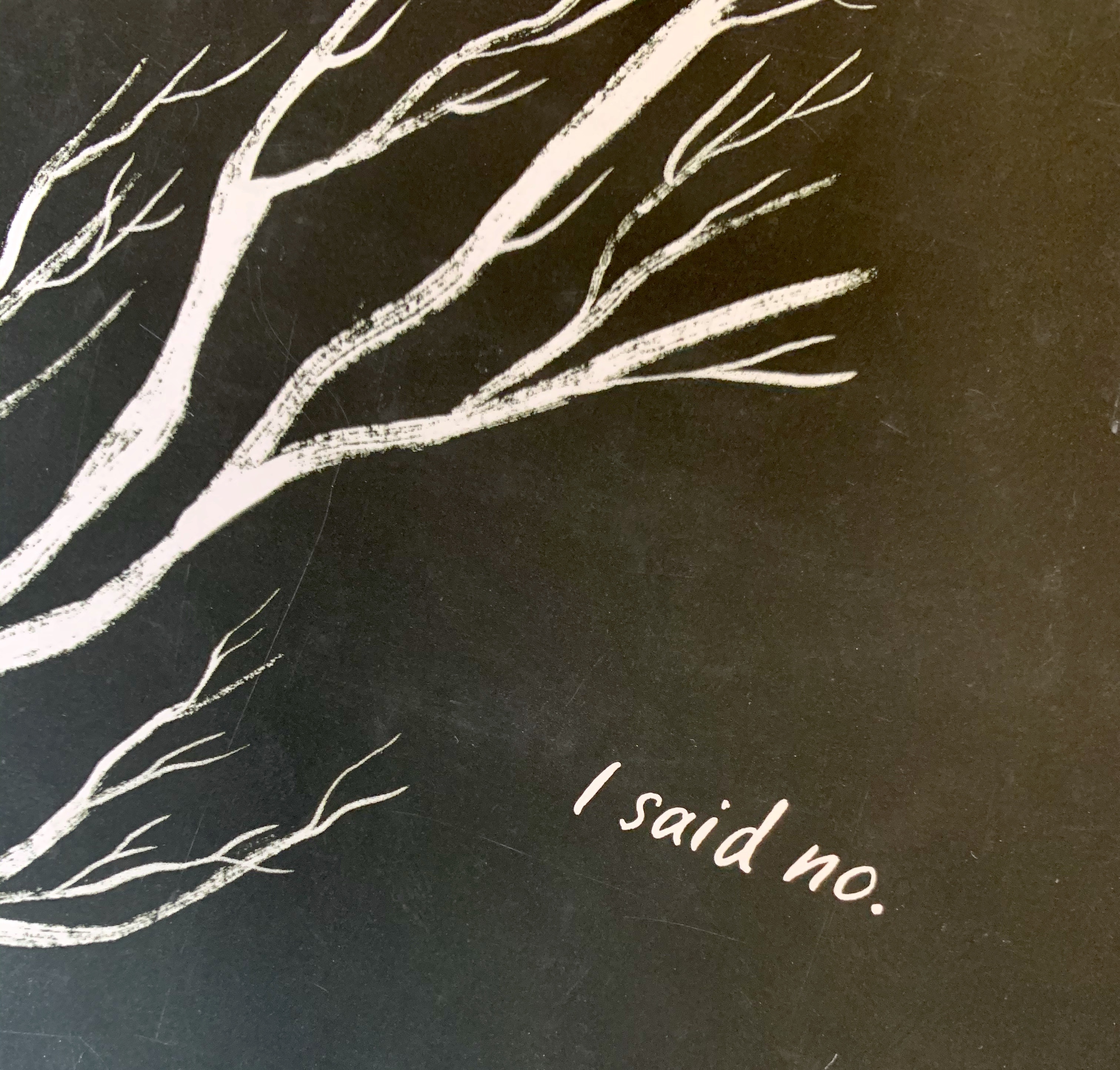
After some perusal, I find it to be an absolutely gorgeous visual text. It’s full of gripping images that convey not only the raw emotion of the pain and uncertainty Anderson’s main character Melinda experiences, but the formatting of the text itself is also a work of art.
Ways I Have Used Speak and Its Graphic Novel Version:
Character Analysis: Especially early in the book, the protagonist Melinda is a wealth of character development through thoughts, actions, dialogue, and mysterious backstory. Students (especially my freshmen) can relate to her struggles on the first day of high school and as the book progresses they see the reasons for her struggle as raw and real.
Prose as Poetry: The formatting of the graphic novel highlights specific words and phrases, literally drawing the depth of the text into a mentor for rhetorical analysis in a way that helps struggling students see the emphasis and emotions without quite so much inference. For some of my language learners, this is key to both understanding and engagement.
Narrative Mentor Text: As students transition from studying narrative to writing their own, this text serves as a mentor with clear and engaging voice, rich story lines, realistic dialogue, and relatable characters.
Have you used Speak as a mentor is your classroom? Have you read and enjoyed it yourself? Feel free to leave a comment below and share your enthusiasm for this awesome text!
Lisa Dennis spends her school days teaching AP Language and English 9, while also leading the fearless English department at Franklin High School, just outside Milwaukee, Wisconsin where she lives with her husband Nick, daughter Ellie, and beagle Scout. She now tries to live life based on the last pieces of advice her dad gave her – Be kind. Read good books. Feed the birds. Follow Lisa on Twitter @LDennibaum
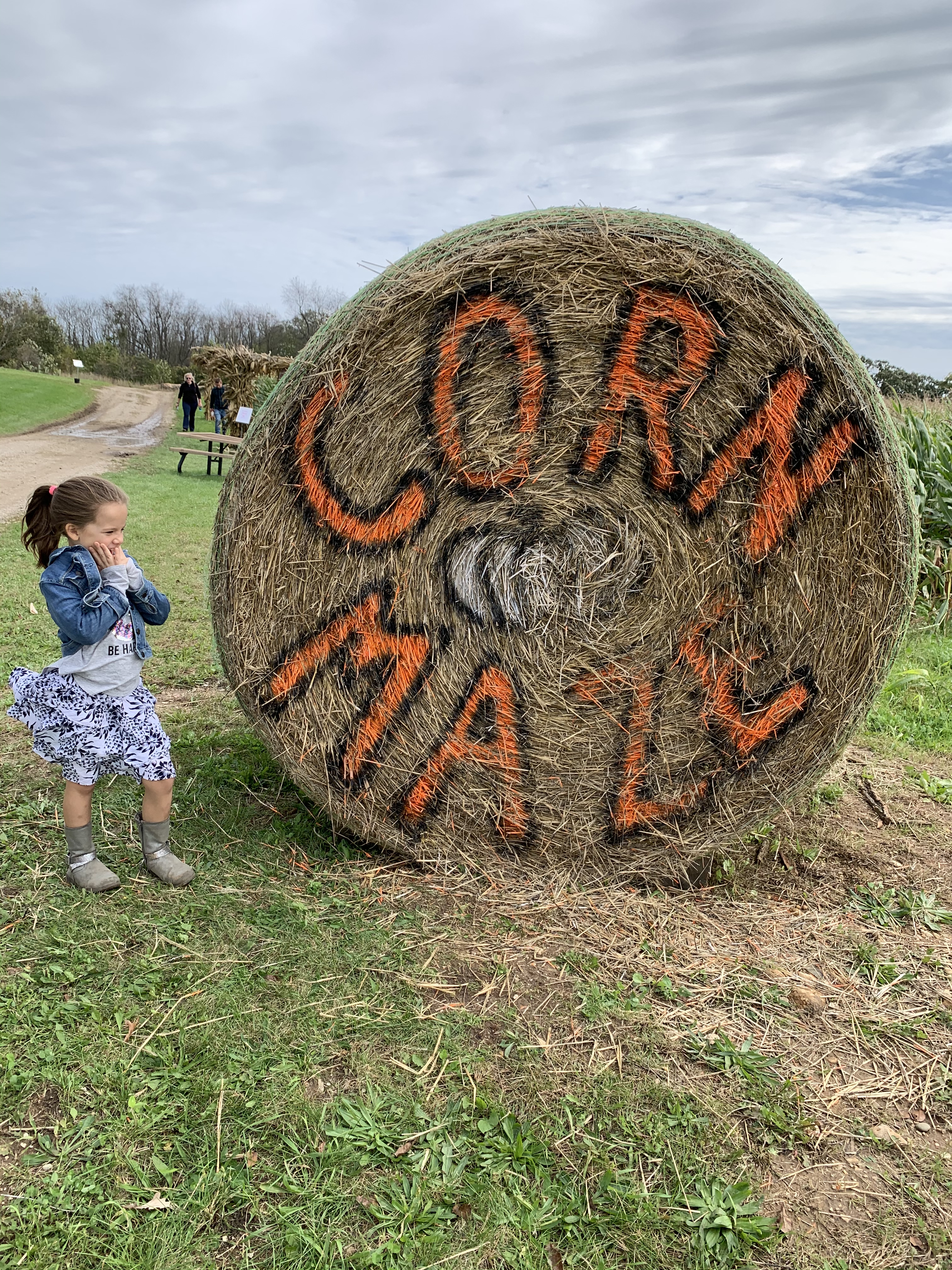
This past weekend, I found myself unexpectedly lost. An innocent trip to the pumpkin farm to enjoy a beautiful fall day in Wisconsin quickly deteriorated to a literal Children of the Corn situation as my six-year-old and I spent almost 45 minutes lost in a corn maze. It was a maze of maise, as it were, and the two of us were no match for its twists, turns, or other cleverly landscaped stalks of doom.
As our enthusiasm for our new adventure began to wane, my panic level began to rise. It was no surprise that my daughter needed to go to the bathroom. It was no surprise that we hadn’t had lunch yet and were both starving. It was no surprise that the stalks of corn kept thwapping me in the face. I started having visions that we might be stuck in there for quite a while. What if it started to get dark? What if we turned in circles for hours and couldn’t find the entrance or the exit? What if the mini donut stand closed before I could make my way out?
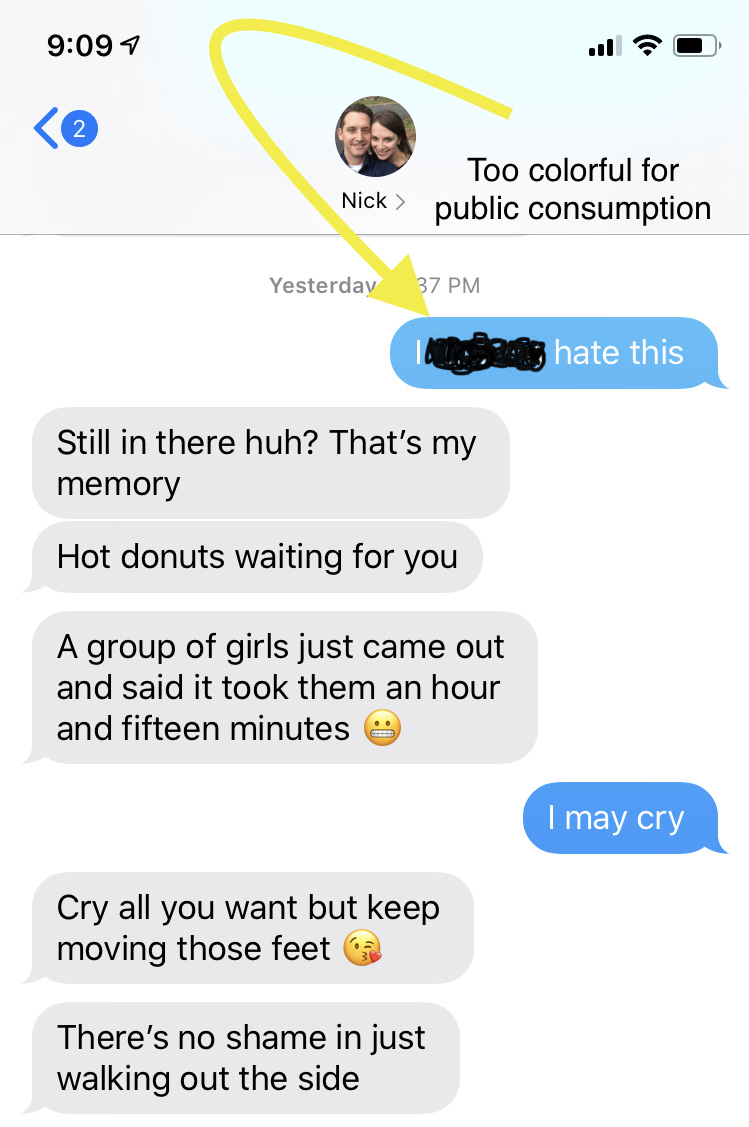
In desperation, I texted my husband. Using some inappropriate words, I conveyed how disappointed I was that I had thought this would be a good idea and that I was getting sincerely scared about how long it would take us to find our way out. Thus far, my daughter and I had been rather innocently complaining about wanting to be done. Thankfully she hadn’t caught on yet to my growing concern about our situation.
A few moments later, we passed a young couple, headed the opposite direction. Trying to defuse tension with humor, as I often do, I smiled brightly and quipped, “Been in here long? Feels like we may have to spend the night in a corn field!”
“Yeah, we’re sort of stuck too,” the woman replied with a sigh. “We’ve been in here almost 90 minutes.”
***Insert Awkward Fake Laughter Here***
As my panic reached a fever pitch, a text came in from my husband.
“There’s no shame in just walking out the side…”
There might not be shame…but there’s a bit of fear for sure.
What if I pull my daughter off the path and into the corn only to lose my bearings completely? What if we walk toward a landmark that just happens to be in the middle of more corn? What if I have to utter the word “corn” one more time and I lose my mind?
Speaking of losing one’s mind. How’s the start of hour school year been for you? (Nice segway, hmmm?) If it’s anything like mine, there is a very thin line between the enthusiasm of this beautiful fresh start, and the disorienting chaos of being lost in the middle of what is indeed familiar, but no less overwhelming. 30 freshman (13 of whom have professed to hate reading. Hate.), will do that to a person. And that’s just one period.
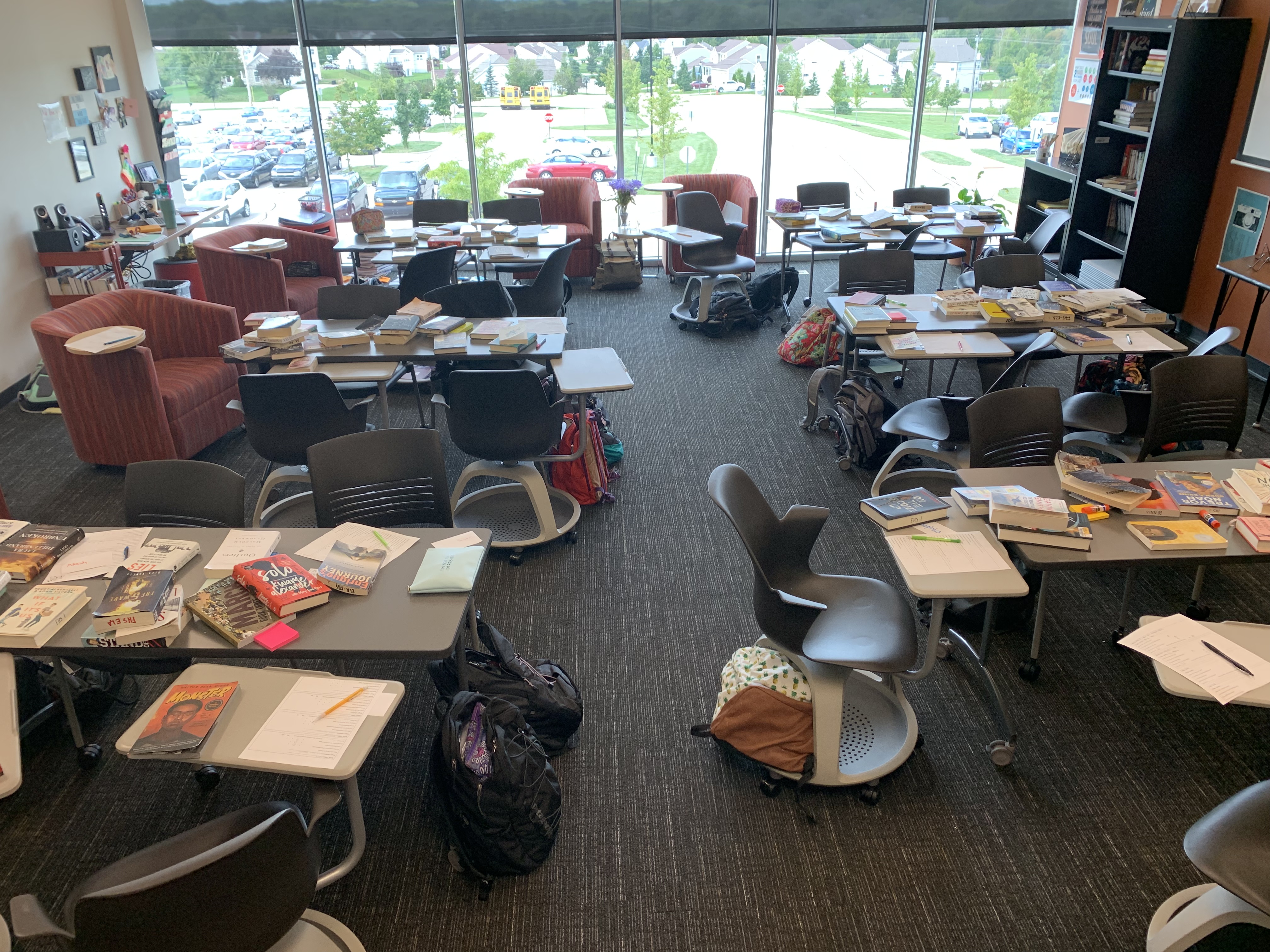
Split lunch makes for quite the scene
But short of diving for the exits (or the pandemonium of a course forward without a path) what’s a passionate educator to do?
Routines – Remember to fall back on the routines of workshop when in doubt. When the crazy of homecoming week has your students climbing the wall, starting the class with 15 minutes of silent reading is not only beneficial, but a soothing balm of calm. I don’t compromise on this time – ever. We read no matter what and we read because no matter what, it’s one of the most important things we do. It gives my students time to change the crazy, amped up rhythm of their day, it gives me time to confer with kids, and it sets the tone for the whole class period of learning. Chaos be gone (eventually, as freshmen are still learning this quiet skill).
Build relationships – When I take some time to reflect on what’s causing me anxiety in the classroom, it is rarely the students. It’s the grading, the planning, the politics, the meetings, the everything that takes my time away from getting to know my students. So, when I’m struggling (this time it just happened to be in a field of corn), I try to remind myself that knowing my kids (academically and personally) makes all the difference. We can get through the tough together when we’ve established a connection as a class that makes us a community. When that community is focused on building readers and writers, all the better.
Self Care – I texted the Three Teachers last night with a bit of a plea/cop-out/desperate cry for help. I wasn’t sure I could post today. Last week saw PD on Monday, a department meeting Tuesday, School Improvement Team time out of the classroom on Wednesday, English Department Review Thursday morning (also out of the classroom) and PLC on Thursday afternoon. Then I got lost in corn. I’m behind and feeling disconnected from my kids. Amy’s simple advice “Self care, self care, self care” reminded me of a very important fact. One, I’m not alone in this treading water scenario and that brings some comfort. Often, in panic, we feel very isolated. In the community of educators, however, there is a lot of support for the over-committed, overtired, over-stimulated teacher. Instead of wallowing in it though, the mindful practice of self care and acknowledgment of our feelings can go far in helping us seek the balance we need.
In these reminders, there is nothing new. And in that, should be the calm in the chaos we all need. When the rows of corn feel stacked against you, choose a path and head in one reassuring direction. You will emerge. You will be in one piece. You will avoid corn mazes from now on, but in terms of the analogy…you’ll have come out the other side with a new appreciation for seeking the type of calm that can positively impact your day, your teaching, and your sanity.
Lisa Dennis spends her school days teaching AP Language and English 9, while also leading the fearless English department at Franklin High School, just outside Milwaukee, Wisconsin where she lives with her husband Nick, daughter Ellie, and beagle Scout. She now tries to live life based on the last pieces of advice her dad gave her – Be kind. Read good books. Feed the birds. Follow Lisa on Twitter @LDennibaum
Back in the day (before teaching, marriaging, and parenting), I loved the Indie Rock flavored reflection of an afternoon spent at the coffee shop. Pen, journal, and intellectually stimulating text at the ready, I’d dream away the hours in self reflective bliss. Fueled by sips of chai and youthfulness, I’d take the time to try and grow through the art of reflecting on the great mysteries of life as viewed by a college student. It was probably 2002.
Fast forward to 2019. I now reflect on life in the car on the way to and from work, in the shower, while my daughter flips across the floor at gymnastics class, and in the 37 seconds it takes me to fall asleep each night (if I haven’t already passed out from exhaustion on the couch).
There are thoughts of how I could have better handled my daughter’s overtired meltdown. There are moments of longing for my Dad, who I lost in March, and reflection helps to sustain me in my grief. Professionally, there are the moments when I ask students to write about their chosen texts, talk over with an elbow partner how they felt their latest speaking opportunity went, and consider how their experiences in school have helped (or hindered) their journey to this moment in their learning. Reflection happens in our lives intentionally and involuntarily all the time, though personally it happens now in much shorter snippets.
Back as a recent college graduate, with that twenty three year old glow, I floundered in the daily chaos and reveled in the fresh newness of the profession. This led to reflection on my teaching for a few moments each and every day in my journal. Nothing extensive, just a few lines about what really impacted me that day and what I wanted to do better.
That’s the beauty of reflection – its forward thinking, endlessly hopeful, blissfully enthusiastic bedfellow is goal setting. We grow forward when we look back. If we take the time.
In the ebb and flow of life as an educator, however, I’ve not kept up this practice over the years…which is a shame. Of course, there are endless reflective practices that we take on and use purposefully as educators every day, without having to write down a word, but in the quest to continually refine my practice, I consider reminders to reflect to be a hugely valuable add to my day to day. This type of professional reflection can help us overcome debilitating challenges, foster relationships, and reduce stress.
With the start of a new school year, the impulse to look forward is far stronger for me than to look back, but my dear colleague Anita Sundstrom, who has a blackbelt in reflective practice and who often knows what I need before I have a chance to figure it out, shared an article with me this week that got me thinking…and thinking and thinking.
Consider taking the time for yourself, at great benefit to your professional satisfaction, positive impact, and accumulated stress level, to read this piece from Wabisabi Learning, “10 Reflective Questions for Teachers to Use Everyday.”
I’ve created a set of notecards with one of the ten questions on each. I’m going try to flip through them once a day, select one at random, and just think, because what I value enough to take the time to do today, can make all the difference for both today and tomorrow.
How do you use reflection to positively impact your professional outlook? Your students? Yourself? Leave a comment below and share your beautiful mind with us!
Lisa Dennis spends her school days teaching AP Language and English 9, while also leading the fearless English department at Franklin High School, just outside Milwaukee, Wisconsin where she lives with her husband Nick, daughter Ellie, and beagle Scout. She now tries to live life based on the last pieces of advice her dad gave her – Be kind. Read good books. Feed the birds. Follow Lisa on Twitter @LDennibaum
My back-to-school rituals include: setting up my writer’s notebook, organizing a snazzy course calendar I’ll inevitably abandon, watching School of Rock, and feeling guilty that I haven’t checked in more with new teachers once the year is underway. Back in the day, I started my career mid-year and was briefly mentored by a well-intentioned educator who solemnly said, “Teaching is a very lonely profession.” Welcome!
Luckily, she was wrong. I worked with some wonderful and wonderfully supportive colleagues those first six years at Cudahy High School (shout out to my Packer peeps!) and throughout my career I have come to realize that teachers are some of my absolute favorite people. Still, teaching can feel lonely at times. And I don’t always think I do enough to ensure my colleagues feel supported in the same ways I have. I want to remedy that and I’m starting now with a brief (I know your time is valuable) letter to new teachers.
Eh hem…
Dear New Teacher,
Welcome! Isn’t this exciting? And slightly terrifying? Yeah, it’s the best.
Now, I know you’re busy, so I’m going to keep this brief. I just want to reach out and provide some insight and initial support. I’ve narrowed down my advice to four main points. Hopefully this helps. Feel free to reference back as necessary throughout the year–and, just maybe, throughout your career.
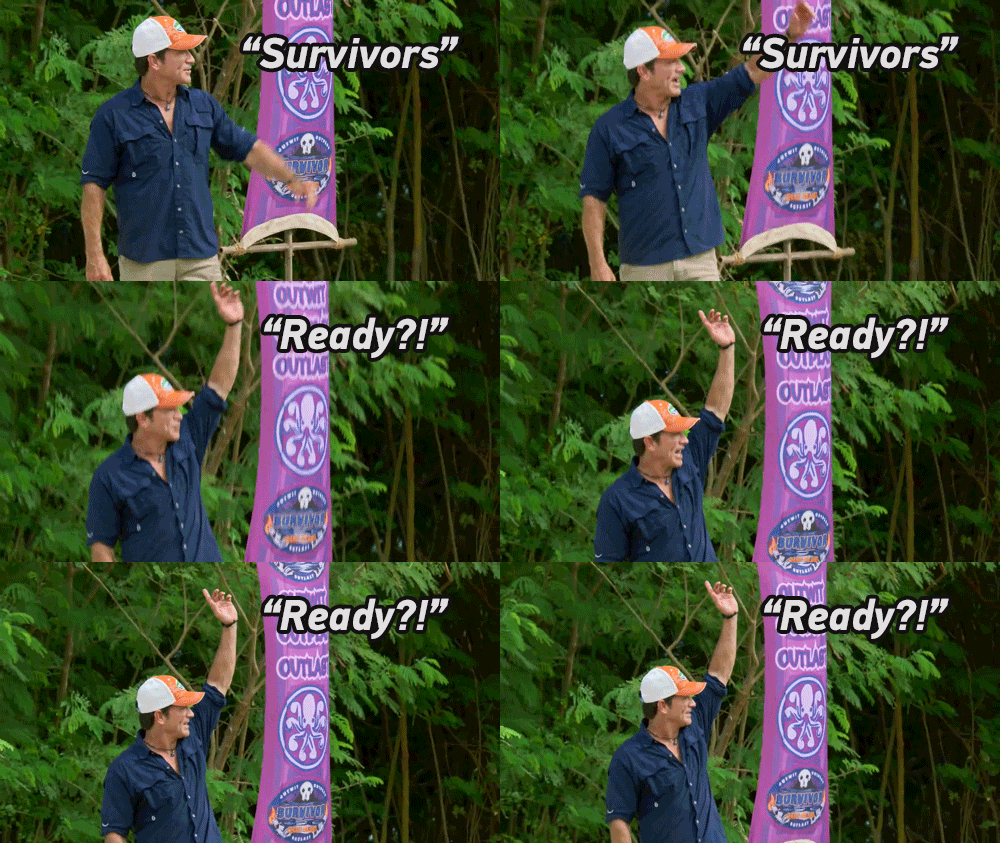
Brace yourself. Kidding! (Not kidding.) Teaching in hard. It will get easier, but it will always be hard. There are just too many variables beyond your control to ever make it even seem easy. But, whether you realize it or not, you already know this. In fact, it’s one of the reasons you chose this profession. You like–no, you love a challenge. So, in the words of Jeff Probst…
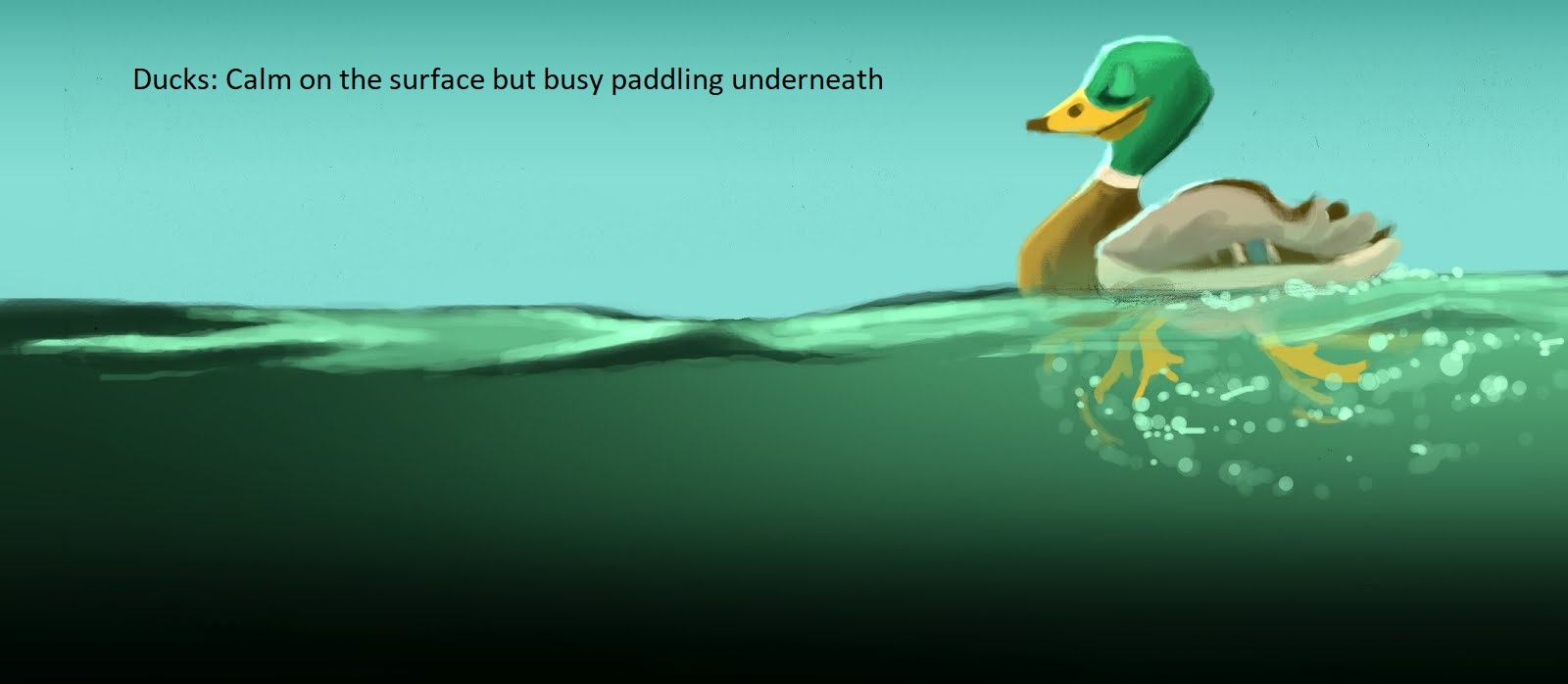
Again, I kid. (Sorta.) Know this: teaching is hard for all teachers. Don’t let the cool demeanor of veteran educators fool you. Some of them have spent years perfecting their duck faces.
No, not this duck face:
This duck face:
Find your people. NOTE: Your people should genuinely enjoy teaching. None of this, “Don’t smile until Christmas stuff.” (Or maybe that’s just me…)
These should be colleagues you feel you can turn to for feedback, advice, and/or to help you fix the copier when it’s broken (again). Do keep in mind that even the best of colleagues may seem frazzled at times, but we’re all in the business of helping people. So, if you have a question or few, ask away! If they’re “your people,” you generally won’t feel like you’re bothering them.
Figure out what’s really important. Remember how I said teaching is hard? Well, the hardest part is that there will always be a bajillion things to do and they will all be important. Or, rather, deemed important. Of the utmost importance, really, because, in the field of education, there is no prioritizing. Everything is important and it all deserves your immediate and undivided attention. Good luck!
Just kidding. In all seriousness, determining what’s really important and prioritizing accordingly is the single most important teacher skill you can and should develop. It’s a survival skill, really. Trusted colleagues (i.e. “your people;” see #2) may be able to help you in this regard. Otherwise, and/or in addition, allow #4 to be your guide.
Remember that the individuals seated in front of you every period of every day are the most important. If what you’re doing doesn’t directly and positively affect their lives and their learning, it’s not all that important. Full stop.
Maybe I should have led with that last one. As another year starts, I’m definitely going to lead with it.
Have a great year, Teach! You’re going to do great things.
Sincerely,
An admiring and supportive colleague
Amy Menzel is excited to join her students and colleagues at Waukesha West (WI) for her 3,007 day of high school in just a couple of days. Until then, it’s more reading and writing on the back patio. Ahhh, summer…
Hello. My name is Lisa Dennis and I used to be a writer.
For an English teacher, that should be a pretty scary admission, but this year didn’t go at all the way I planned, so admissions seem like a good place to start. This was going to be a year of new beginnings with an English 9 reunion tour, and plenty to blog about, but instead it was a year of loss and uncertainty. Both stole my voice.
But I cannot let that loss roll unchecked from this year to the next. Neither I, nor my career could survive it. So, it’s time to reclaim my role as writer. I want to relish the feeling of the keys under my fingers and the possibility that this post will release what’s been building up in me for months now. Perhaps it must be as Louis L’Amour suggests and I should just “start writing, no matter what. The water does not flow until the faucet is turned on.” Here’s to releasing some flood waters.
November of 2018 was supposed to have been a time of great achievement and celebration. I was speaking at NCTE with some of my dearest friends and colleagues at a session chaired by Cornelius Minor. I was headed home from that event to celebrate Thanksgiving with my family. As it turns out, very little went as planned that month.
At NCTE, our incredible session entitled “Accomplice”ing Great Things – An Action Plan for Equity, Inclusivity, and Allied Partnerships in ELA Classrooms” was a well attended (thanks for the boost, Corn!) multi-presenter talk and was generally well received. After weeks of work with my dear friend Alejandra on a presentation celebrating cross-categorical partnerships, the two of us spoke on the joy we feel in working cross categorically to build both community and highly engaging/challenging work for our students.
During our presentation, however, an audience member took umbrage – on Twitter – with our suggestion that fellow educators create their own “Teacher Tribe” with colleagues in order to build a supportive culture amongst staff to positively influence student outcomes. For the offense, though we had no idea at the time that our wording was offensive, we took great pain in having misstepped. For the public Twitter shaming, however, I was horrified. Our group was still presenting when someone showed me the tweet. Instantly, my stomach dropped and my heart began to race. Though we weren’t even finished presenting yet, the hard work of all our entire group now had a shadow over it and I felt that I was to blame. I wanted to melt under the table and disappear. It took everything I had to keep from crying through the rest of our presentation. Jon Ronson, if you need a subject for a sequel, I’m your gal. Talk about an instant lesson in the power of embarrassment to halt learning.
A bit later, after apologizing to everyone involved, including Cornelius Minor (shame, shame, horror, and shame), I took stock. Our work had been heartfelt, sincere, and intended to support the awesome work of educators of all backgrounds in raising student voice. Instead, for me, the entire experience was tainted by my feelings of having failed my fellow presenters in some way I could never have anticipated.
And then…I got mad. Overeat takeout in my hotel room, angry text my husband, downright mad. In my humble opinion, a community of educators working to support one another deserve the same grace we grant our students when they take risks and try new things. A conversation to teach, versus a tweet to publically call out, would have been the most appropriate, and helpful, way to move a fellow educator forward.
I fully understand that the road to hell is indeed paved with good intentions, and as leaders we must do and be better, but when a learner is unaware of new rules and changing guidelines, we teach.
When we see a need for change, we teach.
When we know more or better or deeper than our students, we teach.
We teach because the need is great and the best learning occurs with support. That’s the teacher I strive to be.
So, I worked to turn the corner and do better. However, when I returned home to Wisconsin, things did not improve. In fact, the hit and run of NCTE was nothing in comparison with the imminent head on collision to come. I wanted to write about the experience, but couldn’t find the words. Before I knew it, that turned in to not wanting to write about anything. At all. I felt afraid to speak, for fear of saying the wrong thing. Afraid to offend. Afraid to suggest I knew much about anything at all.
Then, just after the holiday, my father, who had been in remission from stage four cancer for well over a year, announced that his cancer had returned. A surgery was scheduled for mid-December and all the fear, uncertainty, and helplessness that accompanies the aging of our parents, washed over me once again. Anyone who has supported a loved one through cancer knows…the tide can be swift and merciless.
The next four months are sort of a blur. Dad’s heart stopped unexpectedly during surgery and added both time and difficulty to his recovery. Though the procedure had been successful in removing the cancer from that one area, it was determined just a few weeks later that the cancer had spread even further. Dad’s treatments intensified and his quality of life simultaneously plummeted. My vibrant, funny, energetic, all around amazing Dad was slipping away. Quickly.
It was during these bleak midwinter months that I desperately wanted to write. The feelings, longings, and bottomless black holes opening inside of me made me ache to release my uncertainties and insecurities, but I couldn’t. I would sit and nothing would come. I would open my notebook and cry instead. I would wish the pressure in my chest onto the page, and I just couldn’t make the pen move. I felt so hollow and so desperately full of pain at the same time.
And then, in late March, Dad’s body could take no more. In a sterile, ugly, impersonal ICU room, my father, who only weeks before had been so hopeful, and full of life, passed away of an infection he contracted just days before. After five years battling cancer, he was suddenly gone, and what had been my seemingly endless fears, and questions, and longings, tiny explosions ripping through my body at all hours of the day, went completely numb. My little nuclear family, just the three of us, was down to two and the man who had taught me to love reading, think critically, and write myself into existence no longer existed himself. I could barely breathe.
In the coming days, I knew I would need to return to writing, and it would be the most important piece I had ever crafted – my father’s eulogy. The doubts and the writer’s block had to melt away. I had no choice. I must find my voice to sing the praises of the man who gave me life, taught me to love, and showed me how rich a life of learning could be. Weeks later, I would read C.S. Lewis’sA Grief Observed, and see how it was possible for me to suddenly pour myself onto to page after months of nothing. Lewis writes, “We cannot understand. The best is perhaps what we understand least.” Such is true of both what is lost and what is found. I obviously wish that the finding could sometimes happen without the losing, but this was not my truth this time around. I had to be completely empty. Only then could I pick up a pen and squeeze something from nothing.
It’s an appointment with my therapist that brought about this post. As she is helping me to process my grief, I’m starting to see the possibilities in myself, and my writing, again. It was her suggestion to write. Now I ponder the implications on my students for next year. How different I will be in fostering their writing lives and advocating for the saving graces that accompany a release of emotions onto the page.
Here’s hoping that turning on the faucet of my writing leads to a mighty monsoon. I miss this…and I cannot be the writing teacher my students deserve next year unless I get back to it.
Lisa Dennis spends her school days teaching AP Language and English 9, while also leading the fearless English department at Franklin High School, just outside Milwaukee, Wisconsin where she lives with her husband Nick, daughter Ellie, and beagle Scout. She now tries to live life based on the last pieces of advice her dad gave her – Be kind. Read good books. Feed the birds. Follow Lisa on Twitter @LDennibaum.
I can’t put my book down. I’m (finally) reading Extremely Loud and Incredibly Close and I am loving it. I book talked it a week ago and I’m 75 or so pages from finishing. I’m not sure why I didn’t read it before! I’ve book talked it before, so I assume I was so engrossed in another title that this one had to wait. Anyway, I’m already anticipating a serious book hangover upon finishing.
As I crawled into bed and turned on my reading light last night, I had two lightbulb moments. In addition to the obvious one, there was the realization that I am not rereading a book for the eleventy-seventh time this year. In fact, I haven’t reread an entire book for the past two years. Not that there’s anything wrong with that. But there may be something misguided about an English teacher focusing all her efforts on teaching the same few books year after year.
I spent nearly the first decade of my high school teaching career doing just that. I could still deliver a solid lesson on To Kill a Mockingbird, Fahrenheit 451, The Great Gatsby, or The Kite Runner at a moment’s notice. Give me an hour or so to prep and I could review layers upon layers of annotations in my personal copies of each and make a solid lesson a good one. But I’ve been there and done that. Sure, I found new insight with each reread, but I don’t think enough to warrant the time it took. I’m not convinced my lessons got that much better from year to year, despite my thoughtful (and time-consuming) planning and preparation. And, really, that shouldn’t surprise me.
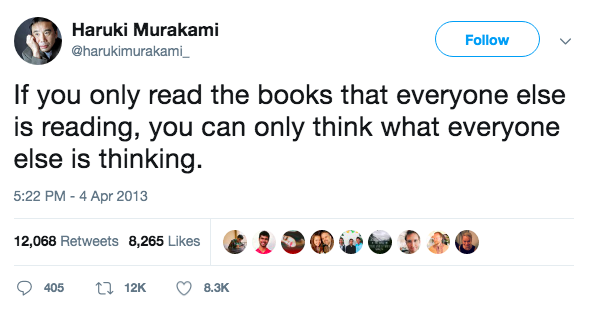
Writer Haruki Murakami once tweeted, “If you only read the books that everyone else is reading, you can only think what everyone else is thinking.” And, there I was, only reading the books that I had read, and only thinking what I had thought. I mean, I added related readings to ever-expanding text sets and used new pedagogical practices, but I was basically the academic equivalent of a Taco Bell drive-thru. It was all the same stuff just packaged differently.
That’s no way to live. It’s no way to grow.
I see my job as an English teacher much differently now than I did as an eager newbie. I’m still eager, alright, but I also have this sense of urgency. Part of it is that I teach seniors now. And second semester Senior English is basically the pressure cooker of secondary education.* I have 90 days to help students identify as readers. Let me tell you, it’s not going to happen with a traditional approach. At best, a traditional approach might convince them that reading is “not that bad” as they grind their way through a couple assigned books (or the SparkNotes of a couple assigned books) that they may or may not find all that engaging. I’m striving for more than that.
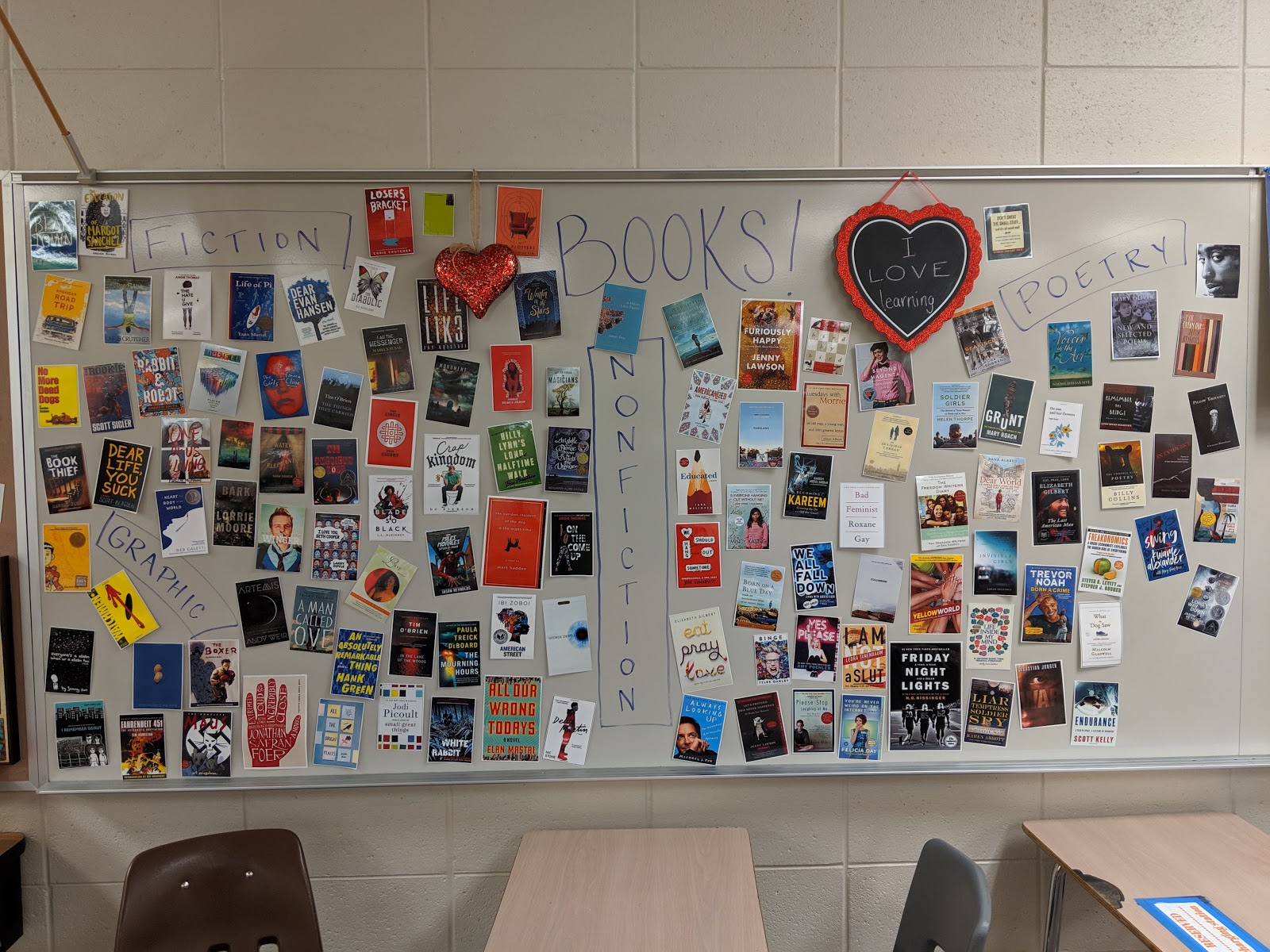
I don’t have a lot of time with these young scholars and there’s no time to waste. It’s time they find books that intrigue them, inspire them, and challenge them. It’s time they find books they actually want and will read. And it’s really important that we shift to students finding their own texts. “Real world” readers don’t read because some lady named Mrs. Menzel tells them they should. They read because they find books that speak to them. Of course, I’m here to help. I book talk a new title every single day. I make it my job to play nerdy cupid and match the right title with the right reader. It all takes a lot of time. But not more time. I’ve simply reallocated my time. I don’t spend hours rereading the same books and turning last year’s burritos into this year’s enchiladas. Instead, I read. For real. I read a lot. I read books I want to read and books recommended by librarians and students. I read novels and nonfiction and graphic memoirs and collections of poetry. I read magazine and newspaper articles and blog posts and lyrics and scripts and transcripts. And I share what I read. And I ask students to share what they read. And we talk about it and we write about it.
my book board, featuring all the title’s I’ve book talked this year so far
And I’m finally living a reading life I want my students to follow.
(And look at them follow!)
*I’m pretty certain this analogy checks out. It sounds good. Truth be told, I’m much more Taco Bell than I am pressure cooker kinda person in the nonliterary, culinary sense.
Amy Menzel finished Extremely Loud and Incredibly Close nearly seven books ago. She just got around to revising and submitting this guest post because teaching. She knows you understand. You might also understand why she’s contemplating spending $20 on this “SAVE THE WORD TACOS” t-shirt. She hopes you have a great end of year and a fantastic, restful summer filled with great reads.
I’m feeling a bit chaotic lately. The holidays are fast approaching on the personal front, but seemingly retreating on the professional front (we have how many days left until break?!). My reunion tour with freshmen requires more planning and more patience than I fear I have capacity for. My only child status is rearing its ugly head as my Dad prepares to have surgery today for that emperor of all maladies, and my mind is flying to all sorts of outcomes I can’t imagine dealing with right now. Additionally, I’ve decided that with no time and little energy, I’m going to commit myself to the madness that is Orange Theory Fitness and complete workouts that leave my aging limbs in such agony I’m walking down the stairs sideways. I needed the elderly assistance bar in the restroom the other day, friends. It’s been quite a season.
Needless to say, I need some solace (and a full body heating pad). No surprise, I’ve found it recently in books. Here are a few texts that have me feeling beautifully nostalgic, contemplative, and remembering the joy of learning as I try and hold it together on the outside, but not so secretly disappear into books.
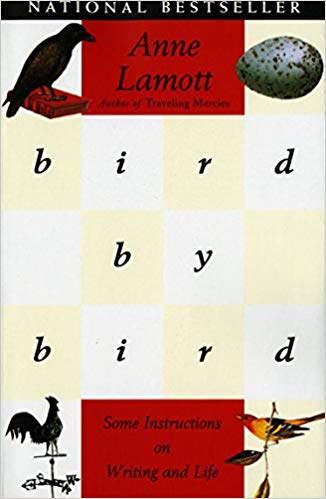
Anne Lamott’s Bird by Bird, Some Instructions on Writing and Life, an accessible text on turning your writing ambitions into a practice that will bring both joy and fulfillment, has me laughing out loud, recommitting to my own writing life (her recommendation to remember the power of short writing assignments make it all seem so…doable!), and finding pearl after pearl to share with my students about moving their own writing forward, specifically memoir.
For example, I can picture several of my students benefiting from Lamott’s advice to remember that perfectionism, both in writing and in life, “is based on the obsessive belief that if you run carefully enough, hitting each stepping-stone just right, you won’t have to die. The truth is that you will die anyway and that a lot of people who aren’t even looking at their feet are going to do a whole lot better than you, and have a lot more fun while they’re doing it.” Sometimes we all have such struggles letting go, we can’t even get started. We must be willing to release not only the formulas, structures, and sentence starters of writing, but also give ourselves permission to write in a way that brings us joy and releases pain without judgement from inner critics that can crush our work before it begins.
I also can’t let go of what Lamott suggests in being brave enough to write about those experiences that carry weight in our lives. Those memories that crush us beneath the wheels of remembering and try to halt all progress we can make toward a path of personal growth. Far too many of our students have such experiences, and writing about them can help some to process and release.
With a nod to the fears and reluctance that students in her own classes have when it comes to writing about what really matters to them, Lamont suggests that we:
Remember that you own what happened to you. If your childhood was less than ideal, you may have been raised thinking that if you told the truth about what really went on in your family, a long bony white finger would emerge from a cloud and point to you, while a chilling voice thundered, “We *told* you not to tell.” But that was then. Just put down on paper everything you can remember now about your parents and siblings and relatives and neighbors, and we will deal with libel later on. (Lamott)
Lamott is witty, clever, and real. I plan to pull some sections from this book as mentors for both style and content. This text is a “warm, generous and hilarious guide through the writer’s world and its treacherous swamps,” said the Los Angeles Times. I could not agree more.
My love of Anne Shirley was actually born through Canadian actress, Megan Follows. The 1985 mini series on the trials and triumphs of fiery tempered Anne was a favorite of my grandmother, and we watched her two tape VHS version together until it literary broke.
Fast forward to today (I couldn’t help myself) when at NCTE in Houston a few weeks back, I found a copy of Sarah McCoy’s recent publication Marilla of Green Gables. I love a good backstory, so to see McCoy’s ideas around how the sometimes prickly Marilla Cuthbert came to be, made me smile. The text takes it’s liberties, and expands on some character traits that reach a bit from who these classic characters were in my mind, but overall it was a nostalgically tender read that took me back to a story I’ve loved since I was a girl. Having found a few Anne fans in my own classes, this is a great text to recommend.
Ruth Sepetys Salt to the Sea had me researching the World War II civilian tragedy of the Wilhelm Gustloff and sharing with my students the power of stories we don’t often hear, because history is too often told only by the voices of the winners.
The Tattooist of Auschwitz by Heather Morris has become an audiobook I can’t hit pause on.
Sold on a Monday by Kristina McMorris is where I’m heading next.
Which books are you escaping into these days? Please share in the comments below!
Lisa Dennis spends her school days teaching AP Language and English 9, while also leading the fearless English department at Franklin High School, just outside Milwaukee, Wisconsin where she lives with her husband Nick, daughter Ellie, and beagle Scout. She is a firm believer that a youthful spirit, a kind heart, a big smile, and a good book can ease most of life’s more troublesome quarrels. Follow Lisa on Twitter @LDennibaum.
In the world of Readers Workshop, I am still working to strike a balance between the promotion of reading for the sake of enjoyment, and my capacity to hold students accountable for that reading on any consistent and meaningful basis.
In the past, I tried (and liked) Google Forms to have students reflect on and make reading goals, the use of their writer’s notebooks to track current and past reading throughout the year, and of course conferences with students to see who and where they are as readers.
However, my capacity to consistently track the reading lives of 142 students (which is far fewer even than many of my colleagues) often feels daunting, if not completely crippling. I rarely feel like I’m giving enough attention to, or celebration of, the ever-evolving reading lives of my students, at least early in the year. As the year progresses, regardless of the method, we get to know our students well enough that their reading lives come into focus, but the before Thanksgiving days are far too murky for my taste.
My goal this year was to figure out a way early in the year that I could take manageable snapshots of my students’ goal progress in order to both celebrate the success that would fuel reading momentum and to get a handle on who among my students would need the most encouragement.
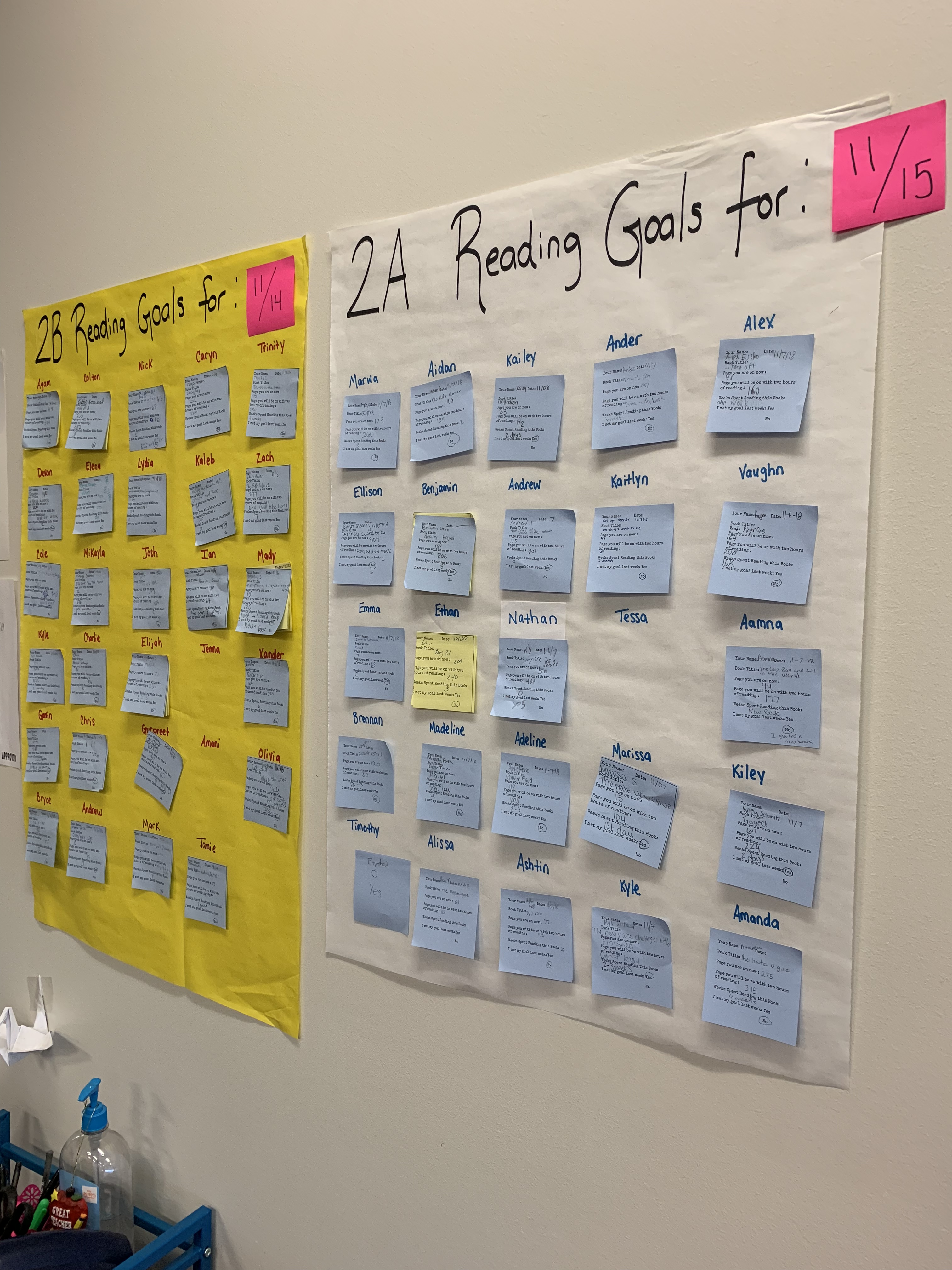
For this purpose, I’ve worked to make our goals more visible, easy to check in on, hard to ignore, and readily accessible for quick conferences.
I started the year with my Reading Goal posters prominently displayed for my 9th grade classes. Each week, students would set a goal after calculating their reading rate, let me know the progress they would be working to make in their books, and how long they had spent reading. Not surprisingly, for the first few weeks of 9th grade, my projected sample of a Post-It didn’t necessarily (consistently) get us a clear picture of what we were looking for. Numbers weren’t labeled, titles weren’t always included, etc.
I decided to take out the guesswork and use a Post-It template I found and photocopy quick reflections each week that would make it easy for both students and teacher to see:
What book are you reading?
What page are you on now?
What page will you be on based on your current calculation of reading rate?
How long have you been with this text?
Did you meet your goal for last week?
As I hand back slips to each child each week, I can do a quick check-in to see how on target, or not, my students are. This quickly prioritizes conferences for later in the week.
How do you keep track of students’ reading goals? Please leave a comment below!
Lisa Dennis spends her school days teaching AP Language and English 9, while also leading the fearless English department at Franklin High School, just outside Milwaukee, Wisconsin where she lives with her husband Nick, daughter Ellie, and beagle Scout. She is a firm believer that a youthful spirit, a kind heart, a big smile, and a good book can ease most of life’s more troublesome quarrels. Follow Lisa on Twitter @LDennibaum.














 remember the power of short writing assignments make it all seem so…doable!), and finding pearl after pearl to share with my students about moving their own writing forward, specifically memoir.
 The 1985 mini series on the trials and triumphs of fiery tempered Anne was a favorite of my grandmother, and we watched her two tape VHS version together until it literary broke.




 Three Teachers Talk