Author Archives: Charles Moore

Guest Post by Amanda Penney: The Workshop Classroom and YOU!!!

Note: This post signifies quite a milestone for the ELA 1 team I had the privilege of joining this year.  As of this morning, and thanks to the graciousness of this blog’s creators, the entire team has now published on this site.  To see a post by our department chair Megan, click here. Austin posted this summer, here. Sarah, our team lead posted a few weeks back, and my one year anniversary as a regular contributor is in January. This agency affords us power.  It gives us a voice in our fight for literacy.  To the creators of this blog, Thank You.

The workshop classroom is undoubtedly overwhelming to embrace at first. It is difficult to find information on how to properly implement this pedagogy, and there are many misconceptions of what workshop actually looks, for instance, on sites like TeachersPayTeachers. It’s a lot of work to be a workshop classroom. You actually have to read and write yourself if you want your students to benefit from this structure. You need to learn how to identify a solid mentor text from a variety of works and know what you can do with them successfully.

But the work pays off. It gives you, the teacher, so much more than you could ever have imagined. To keep your students engaged in their choice reading, you have to keep up with the never-ending influx of newly published works. You are forced to venture into genres of writing that you would not normally reach. For instance, I read Matt de la Pena’s We Were Here, and I can assure you, it is not historical fiction (my typical go-to). My students were writing about their foster care experiences and retelling their mishaps that placed them in alternate schools. Matt de la Pena provided an avenue for me to better understand these students, who in turn, helped broaden my reading interests.

For me, this shift has been monumental. As a workshop teacher, I actually get to read what I want to read and have picked up books I wouldn’t normally and enjoyed them! I get excited when I stumble upon a passage that might as well jump off the page and into my computer, so I can begin identifying my mini lesson and therein construct my fantastic lesson cycle. It is fun and exciting, and I have such a unique opportunity in my profession to be creative each and every day.

Writing has been the most exciting shift for me personally. I had lost a lot of confidence in my abilities as a writer when I entered college. I will never forget attending Texas A&M’s orientation for new students and the very blunt speech we were given. Simply put, the speaker stated that the five-paragraph-essay would lead to nothing more than a failing grade, so we better learn something new now or “See you later!” I was terrified, of course, because I had been taught nothing other than the five-paragraph-essay. The only piece I had ever written that did not follow that god-awful structure was my college admissions essay. Little had I known, I had “workshopped” my most proud piece of high school writing to which my first line stated “I am crazy.” However, one piece did not shake the terror I felt upon beginning my first day of classes the following week.

As a transfer student my sophomore year, I took an Advanced Composition course and a Shakespeare course. I held a solid A in my Advanced Composition class with helpful pointers and typically positive feedback from my professor. Yet, I could barely hold a low C in my Shakespeare class where I was regularly criticized for my writing style. I spent most of my time in the writing center, and at one point, the graduate assistant was so baffled by my C- paper over Shylock’s speech “I am a Jew” that he asked for the opinion of his “boss” who returned with a shrug and said, “I’m sorry, I don’t know why you got a C…. it looks like he just dislikes how you write and is grading you accordingly. Good luck.”

I spent the rest of my English degree pursuit frustrated and confused. I concluded that writing was a painful process, which would typically yield disappointment from my readers. I would never truly be able to improve because I, unfortunately, did not and would not inherit the mutant skill of mind-reading from Professor Xavier or Gene Grey.

Then, I began to teach. My first year, our campus did not have workshop at all, and teaching was painful day in and day out. My students really did not benefit from The Odyssey or the tragedy of Romeo and Juliet, and to be honest, neither did I. My second year began with the introduction of workshop, which was difficult to understand, considering I not only had never taught this way with my meager one-year experience under my belt, but I also had not learned this way. So, I struggled through what I learned and still could not get my students to engage. They always referred to their “I give up” phrase of “I don’t know what to write about,” and it left me frustrated and exhausted each day.

I had heard about writing along with my students, but I was afraid to do this. I did not identify as a writer and had long since decided I wasn’t very good at it. My students could never know this of course… But I was getting nowhere, and it was time for a shift.

So, one day, half-way through my second year of teaching, I tried something new. I chose to write with my students. I had been flipping through the pages of Kelly Gallagher’s Write Like This and stumbled upon his “1 to 18 Topics” lesson cycle. I embraced my fears of writing with my students and took the dive head-first the next day.

I started safe with soccer and intended to choose a new topic to expand each class period. To my astonishment, every single student had their pens to their papers and were scribbling madly as if they had been starved of this freedom for too long. Conferring revealed a vulnerability I had not anticipated, and I became inspired to show my own vulnerability as the day continued. I realized I had a lot to say, and I wanted to “say” it through my writing. I had starved myself of this freedom for far too long, and I was eager to continue writing.

My third-year of teaching is when workshop really kicked off in my classroom. I was searching for an engaging mentor text that utilized simple sentences as my students struggled (and still do) with sentence boundaries.  An excerpt from Dune stood out to me and I was eager to write beside it with my students in class. The excerpt is as follows:

penny1

Each student wrote for 10 minutes and were asked to begin their piece with “I must not __.” We then pulled a Penny Kittle and revised it to ensure it was only constructed of simple sentences. My students wrote some incredible pieces, and I am convinced their success is a result of my own enthusiasm for the lesson itself. Their writing inspired my writing and in turn began to reconstruct my identity as both a writer and teacher. I was embracing myself as a writer, and my students, in turn, began to embrace themselves as writers.

Workshop has transformed my perspective of writing and provided a unique platform for me to embrace myself as a writer. It has exposed a variety of genres to read but also has provided a variety of genres I can choose to write.

Prior to workshop, I used to hate poetry. Yes. I used the word “hate” … as an English major and teacher…. It was this daunting task and an awful entity that lurked in the dreary school hallways. My teachers never taught me to write beside a poem and always found the most difficult poetry to “interpret” in class. In Ohio, my freshman English teacher appeared to enjoy watching us squirm in confusion and insisted we leave his classroom never ever knowing what the author’s message actually was. I despised poetry’s very existence because of this and determined its purpose was a cruel joke on the reader.

Workshop completely shifted this perspective of poetry for me. I would never had guessed in a million years that I would currently be reading not one, not two, but THREE poetry books at once. The thought of writing my own poetry was a complete joke as well. Yet, here I am, writing beside poetry in my classroom and encouraging my students to do the same. It has a completely different purpose now than it ever did before. Its purpose is no longer to torment my being but to excite my creativity and provide an avenue for expression I never would have known existed if it wasn’t for workshop. The first poem I wrote beside was a Rudy Francisco piece and it looks like this:

Mentor Text:

When people ask how I’m doing

I want to say,

my depression is an angry deity, a jealous god

a thirsty shadow that wrings my joy like a dishrag

and makes juice out of my smile.

I want to say,

getting out of bed has become a magic trick.

I am probably the worst magician I know.

I want to say,

this sadness is the only clean shirt I have left

and my washing machine has been broken for months,

but I’d rather not ruin someone’s day with my tragic honesty

so instead I treat my face like a pumpkin.

I pretend that it’s Halloween.

I carve it into something acceptable.

I laugh and I say,

“I’m doing alright.”

-Rudy Francisco, Helium


My Version:

When people ask how I’m doing

I want to say,

leave me alone, please, now and forever while

my anxiety leaps and jumps throughout my body

and makes me cringe.

I want to say,

standing here is an allusion of sanity,

a trick I feel I will never truly perfect.

I want to say,

this fear is my only possession I have ever had

and I want someone to destroy it so it cannot return,

but I’d rather not burden someone’s day with the demon that encircles me

so instead I treat my face like a canvas.

I paint with bright colors.

I create something mundane.

I smile and I say,

“I’m doing alright.”

-Ms. Penney


I felt so freed of my previous misconceptions with this one piece, and as a result, my class and I enjoy our daily “Poet Moments” inspired by my colleague Charles Moore. I revel in this peace and tranquility and am grateful for workshop with each and every poem I have the privilege to write with my students. This joy has completely altered my initial definition of poetry, and I will forever be indebted to workshop and this genre of writing.

Workshop has given me the opportunity to grow as a reader and writer. It has given me a purpose and a drive to find new and exciting ways to engage not only my students but myself. I no longer feel as if writing is a painful process and the nagging frustration of how my invisible readers expect me to write has long since passed. I have a voice and a means of expressing that voice, as do you, every single day.

Amanda Penney is a bit of a perfectionist and is grateful for the patience that her colleague, Charles Moore, has for her and her ever-changing blog post. She plays soccer whenever she can and loves exploring nature with her only child (her dog who she considers her child) Shanti. She is a complete nerd when it comes to anything comic book oriented and is currently exploring the possibilities of her favorite series, The Uncanny X-Men from the late 1960’s, becoming an exciting and invigorating mentor text. She hopes this will be the topic of her next guest post, that is of course, if Charles is willing to embrace another bought of Penney and her procrastinating-perfectionism.

Lesson Cycle: How to Teach Collaboration

When I wrote several weeks ago about how we went about building a reader/writer workshop, one of the traits we focuses on was “Collaboration.” Our Lesson focus for that day was, “I want you to know that members of this workshop community…”

We started our 55 minute class with reading, briefly visited a poet moment, and then dove into three practical rotations with texts where we explored ways collaboration can help us be better readers and writers. We used three short excerpts that we had already explored in building other parts of our workshop.

First Rotation: Talking is rehearsal for writing.

Text: You Don’t Know Me excerpt from Sherman Alexie

1st Move: Read the following excerpt and think about what the author does that you don’t do.

2nd Move: Starting with desk 1, take one lap around your group, sharing what you noticed.

3rd Move: Find a place in your notebook near this piece and write about what you shared with your group.

4th Move: Think about how hearing from others before you write serves as rehearsal for your writing. 1 or 2 students share out to the class.

img_4627.jpg

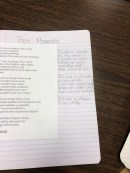
A poet moment from one of the texts

Second Rotation: Writing is a rehearsal for talking.

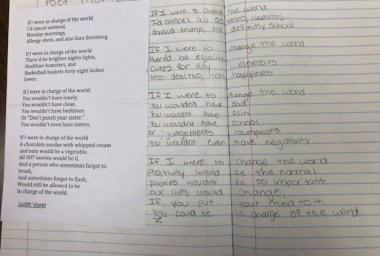
Text: If I Were in Charge of the World

1st Move: Read the following poem and think about something in it that surprised you.

2nd Move: Find a place in your notebook near this piece and write about what you noticed in this poem that surprised you.

3rd Move: Starting with desk #2, take one lap around your group sharing the ideas about which you wrote.

4th Move: Think about how writing about something serves as a rehearsal for you to share. 1 or 2 students share out to the class.

IMG_4625

A different poet moment

3rd Rotation

Text: Ready Player One excerpt

1st Move: Read the following excerpt and think about how the last line of the third paragraph makes you feel.

2nd Move: Starting with desk #3, take one lap around your group sharing how the words in the third paragraph affected your feelings in relation to the piece.  Share in the opposite direction this time.

3rd Move: As a group, construct a sentence using Earnest Cline’s sentence as a model, that mimics the complexity of the feelings.IMG_4626

4th Move: Think about how working together can take us further than we can go by working alone.


Quick Write:

Write about how you can use collaboration to support your growth as a reader and writer.  Write so fast that your inner critic can’t slow you down.

This lesson cycle was all about teaching the students about collaborating, a crucial skill in a workshop.  Eight weeks later, they can zip around their groups, sharing their thoughts, asking questions, blessing each other’s writing, and they do so effectively and efficiently. This may not be the best way to accomplish our goal, but it worked for us.

Please comment below if you’ve had success teaching collaboration or if you just want to chat.

Charles Moore loves working with his students in their reader’s/writer’s workshop.  His divides his time between school, home, and his son’s robotics practices which are three days a week for a total of 11 hours.  He is currently doing a terrible job keeping his grass cut and his pool pristine.  He promises to work harder.  If you’d like to see his somewhat nicely written book reviews check out his book review blog and if you want to see his numerous and random tweets, check out his twitter.

Choice Reading Shouldn’t be a Choice Not to Read

I love that silence that permeates our reading time. A certain peace settles over the room as thirty souls lose themselves in the pages of their books, the only sounds: rustling pages, tapping feet, or contented sighs.  I also love that groan they emit when, after ten minutes, an eternity of silence, I implore them to mark their page and pause their reading for now.  That’s exactly what I say to them, “Alright kiddos, lets pause our reading and get out our reader’s/writer’s notebook.”

While we’ve practiced that transition dozens of times, they still plead begrudgingly, “Can we just have more reading time!!!”  “You can,” I tell them, “on your time.”  Some of them, the truly committed, make time for their self-selected independent reading, but most, for now, do not.  This reality, jarringly disturbing to committed readers like you or me, is something that keeps me up at night.  It prompts old teacher/football coach friends to text me on Sunday morning, asking for some kernel of knowledge that might help them move readers.  For this problem, though, there is only one short and fast answer: Hard Work.

I wrote about the difficult task of moving seniors into reading lives last year: here and here. The results, transformative for some, middling at best, and woeful for many, read like a Picasso.

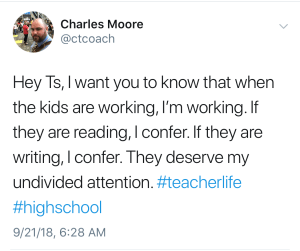
I promise you this: We can’t afford not to give them everything we’ve got.  That thought spurred this tweet from me earlier in the week:

Tweet1


We know reading and writing dovetail to form literacy.  If we instruct using whole class novels, we run the risk of alienating many who can’t engage with something in which they have no interest and as a result, we get nothing. If we encourage choice reading and we allow the kids to choose not to read, we get nothing.

We must engage in their self-selected reading lives and I believe that I can’t do that if I’m reading while they read.  While they read, I’m moving around the room, tracking pages read, asking the reluctant about their reluctance, asking the readers when, where, and why they are reading on their own, simultaneously serving both ends of the reading spectrum.  You won’t ever find me sitting behind a desk, because my desk is shoved up against the wall, relegated to table status, as a place where papers pile.

It’s hard work, like everything about our roles as literacy advocates.  It takes planning,  reflection, and intention to match every kid to the perfect reading conference question.

That’s part of it too.  One question does not fit all.  If a student isn’t reading, they can’t reach into their reading experience to share with me their opinion on the effectiveness of setting, for instance, in their selection.

Also, I have to give them the sobering news that this lack of reading life may hinder their writing life as well, and while I don’t take grades for self-selected reading, I do take grades for writing and their engagement from one directly affects their success in the other.  I need to tell them that, before their grades do.

Charles Moore loves conferring with readers, even struggling ones.  He loves concerts with his wife and when his son texts during the concert, he texts back, “We are having fun without you.”  He’s loving the new adventure with Pre-AP students and his freshman are growing on him; they are adorable.  Check out his book review blog at www.mooreliteracy1.wordpress.com and his far too frequent twitter rants at @ctcoach.

Atmosphere: 4 Big Ways to Nurture Readers And Writers

How do we get our students to become readers and writers; literate, engaged, empathetic contributors to our world?

flexible seating 3It’s simple. Ask yourself, “How do I prefer to read, write, create and learn?” I can guarantee that each and every one of us would have a different idea of what that looks like and would choose something different. We don’t all learn the same, so why do we expect our students to. The relationships we build and the space that we provide to our students each year is crucial to allowing them to become readers, writers and creators, and we have to cater to the different needs that allow them to become what we hope they can be. How do we create open spaces where students can, and want, to learn and grow?
The answer = Relationships!!!

Team building

This happens for at least the first FOUR days of school in my classroom. Yes, four. I don’t even say the word syllabus until day three. I want to start the year getting to know my students and how they function; who they are, what they love and what they hate. I spend these days doing team building activities and switching the teams up each day intentionally. It teaches them to work well with different personalities and it allows me to see who they can work best with. It’s also a nice perk to know who should avoid whom in those more difficult classes. This all plays into how I approach them to start those one on one conversations. These team building moments can carry on throughout the year, not just be left for the first week. I often break up high pressure times of year with a team building activity to help keep the momentum going and refresh their minds and our classroom atmosphere.

A big part of our relationship and team building happens when have a conversation about our classroom social contract. Every year, it never fails, each class initiates the signing of that contract with no prompting from me. It’s a beautiful thing to know that they WANT to act and sign the contract that THEY helped create. The more involvement and choice students have in what they do in our classrooms, the more investment they have in what they are working to create. Giving them the opportunity to have a say in what our classroom expectations are allows them to have that investment.

Team building is so important to me and my classroom environment because if we don’t feel like a team, if the students don’t feel welcome and safe, they will never hear one word of anything I need to teach them the rest of the year. A positive relationship is the best foundation for the rest of the year to be built upon.

Conferring

Flexible seating 2Yes, we confer to learn what books they like and guide them in their writing, but we also need to use it to build our relationship. Conferring during the first week (sometimes two) of school is simply “get to know you” conferring. I ask about reading and writing but I also want to know about the person behind the face and name that I will spend all year with. I write with them and they learn about me, then I confer with them about what they’ve written about their own lives.

Allowing our students to get to know us is just as important as us getting to know them. We need to let them see us in the struggle of writing; that’s why modeling what we ask them to do is so important. We need to let them know if we might be having a bad day and let them know it’s their turn to show the teacher some grace, like we show them each day. It’s a swaying tightrope that requires an immense amount of balance through a necessary obstacle if we want our students to become great readers and writers.

When students see their teacher taking the time to notice specifics about their personal life, not just the way they read or write, it creates a trust and willingness to be vulnerable and authentic in their writing. A simple, “I am so happy you shared!” or, “I am sorry to see that you felt this way and hope you never do again” can really allow them to feel like a wanted soul in your classroom, especially when you have 32+ students in one class period and they feel like just a number.

Affirmation and Validation

flexible seating 1These kids need to hear the words from us, spoken aloud, that tell them, “I care about you.” We can assume they know but hearing it out loud is necessary to their belief in that feeling. Sometimes a simple, “Hey! I care about you guys! Have a great rest of the day!” is something that will make a kids day turn around. Some of these precious souls that come through my door each day don’t see an adult figure, or one that is a positive role model, outside of this school. I need to be that for them. If I’m not, then who?

Validation is what they need to feel like they matter, that they are worthy, in order to move into a creative space and explore themselves as readers and writers. Yes, there are probably a million things we could critique about their writing, BUT we need to remember to build them up or they will never have the motivation to create at all. Validating and affirming that they are on the right track through conferring, notes, and blessings is a good way to do this. Starting with the positive and ending with encouragement. Giving them a positive end note can help them become motivated to dive back into a piece and create that authentic masterpiece. If we don’t work to make our students feel welcome, they will never hear what we want to teach them.

SPACE

Alternative seating  –  Five years ago I began my adventure of flexible seating. I have not had one moment of regret ever since. I am so glad I chose to push back against the fear of change, the “norm” in classrooms, and power through to what I have created now.

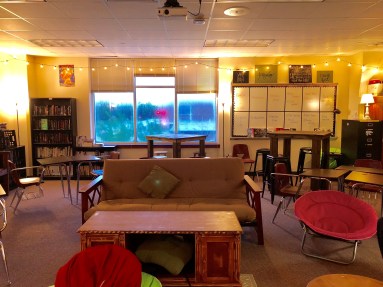
As you enter my room, you will see a space that ditches that harsh fluorescent lighting and replaces it with soft, warm lighting from lamps and stranded garden lights. You will notice that there are very few desks and many bean bags to sink into. There are two couches that will call to you and beg to be used. There are two bistro tables at standing height for those of us who need to stand in moments of writing to get our energy out. There are saucer chairs to hug you through those difficult pieces of reading and writing. My coffee tables are the perfect height for the “floor sitters,” like me, and accompanying floor pillows. There is also a beautiful, whimsical bench that my husband crafted (he also made the bistro tables with his talents – I might keep him around for a while). The atmosphere is welcoming and inviting, nurturing creativity.

When I first decided to bring in these seating alternatives, it was because I asked myself how I prefer to learn and WHY that space looks the way it does for me. The why is so, so important and gave me direction for which to take my classroom. Why do we need to create a comfortable space for students to create and learn in? The answer was simple. As an adult, I prefer to learn or read or write or create in a space filled with pillows or bean bags. One day I might want to sit on the couch, or, for days when I am really concentrating and creating (like while writing this blog) I prefer to sit on the floor with a coffee table as a desk, where I can spread out. So, as an adult, if I prefer this, I knew for sure my students would appreciate the option of getting to sit in the way they prefer, too. Feeling comfortable in a space provides us with the opportunity to open up all of our senses and focus on the creating of a piece or escaping into a novel. Giving them the opportunity to choose their space in my room is crucial to their development as readers and writers.

Flexible seating does not mean traditional desks are trashed and burned. Students use all the flexible seating, including the traditional desks. Some even move up to a traditional desk in moments of deep thinking or creating. Most of this seating you see in our classroom was free, donated or built. I only purchased the three saucer chairs and large futon from an online garage sale app. This is 5 years of accumulating different seating, so if you are inspired to start using flexible seating, know that it will take some time and always look for those deals! Even spending what you can spare on a simple cushion for the floor will be worth it.

I often get asked many questions when I talk about flexible seating. I think the biggest one is, “How do you get them to behave so well?!” Our flexible seating expectations are a topic we discuss while creating our classroom contract. It is important to voice your expectations at the beginning, just like any other classroom expectation. One of my expectations is that if students are debating on who gets to sit in a certain spot, they will decide calmly and compromise on who gets to sit in the seat that day, then switch the next day. Another important expectation that I make very clear is that it is their responsibility to maintain their focus while in the flexible seating. If they talk to their friends, sleep or just don’t complete the task at hand, they need to practice responsibility and make the decision to place themselves in a successful space. Some kids may need a reminder of this responsibility, but I rarely have to intervene when it comes to this. I think you will be pleasantly surprised at how much responsibility our students will take on when we give them the opportunity to have more responsibility through choice.

My students are free to choose how and where they sit, to learn and create in the way that fits them best. That choice gives them so much ownership of their own learning! And, isn’t that what we need to provide; more responsibility and ownership when it comes to their learning? Giving them a choice is how we provide them with that opportunity; in what they read, what they write and HOW they learn. When we establish the relationships with our students that allow them to feel comfortable in the vulnerability that is attached to what they share and write, when we give them the opportunity to take their learning into their own hands by giving them choice, they become literate, engaged, empathetic contributors to our world. They become readers and writers. Our students have stories to tell, and we need to guide them and give them the skills to tell them through the relationships and space we create for them.

Sarah Roy is currently singing songs from The Greatest Showman nonstop and wondering what took her so long to finally take her nose out of a book and watch those 105 minutes of greatness. She is enjoying spending time in her students work and seeing the potential that they have to create greatness in her class this year. Sarah is also seeking out her next read but enjoying reading all the informational books about salamanders with her eldest son, Crosby.

How We Built our First 3 Weeks of Workshop

Picture1

Look at Sarah’s room!

A classroom built around flexible seating is amazing for kids building their literacy.  Comfy chairs, tall stools, and bean bags take a student out of a “classroom” mindset and into a creative work space that encourages ideas to flow across boundaries that might have been impermeable with rows and rows of sterile desks.

It works just as well for teachers building a workshop from thin air. You can imagine how comfortable that tan couch felt on the last Friday morning before the start of school.

Sitting in that room for this much anticipated planning session felt as comfortable as if I’d been there for a decade.  Five teachers with a singular focus gathered their resources and experience to put together a plan that was student focused and built on the foundation of workshop.   I got to know this group well at the Literacy Institute but I’m still trying to learn the full extent of their individual and collective power.

It is important, on our team, to be intentional and explicit with our lesson design.  The kids should know exactly what we are doing and why we are doing it.  They should recognize the moves their teachers make and take comfort that those moves were selected specifically for them. There is no reason to keep the “why” and the “how” a secret.

On this team, we typically build lessons with an eye towards a learning focus that starts with something like: I want you to know that readers/writers ….. do something. (Thanks Amy, Billy, and the Lit Institute.)

For the first three weeks, though, we talked about using: I want you to know that members of a Reader/Writer Workshop….do…one of the six pillars.  You get it.

Our curriculum documents, designed by teachers, contain a section devoted to the six routines of workshop instruction and the following are the routines around which we built lessons:

The Reader’s/Writer’s Notebook

Lesson Focus: I want you to know that members of this Reader’s/Writer’s workshop use a notebook to explore thier literacy.

Our “notebooks” look very different teacher-to-teacher.  Some of our classes will use traditional composition notebooks and some will use Microsoft OneNote in our explorations.  Either way, the point of having a safe and personal place to plan, draft, revise, reflect, etc. remains consistent across our classes.  Its not enough for us to ask the kids to have a notebook, they need to know the importance of having it.  Some of the kids struggled with following my set-up instructions because they were intentionally vague.

Student: “Mr. Moore, what categories do you want us to use to track our reading this year?”

Me: “That’s up to you.  Its your notebook.”

Self-Selected Independent Reading:

Lesson Focus: I want you to know that members of this Reader’s/Writer’s workshop take ownership of their reading and writing experiences.

I remember back to last year, and how much the kids struggled genuinely connecting to a book. Maybe it was the hurricane sitting out in the Gulf or that they really only had one year of workshop leading up to their senior year.  What ever it was, we worked hard to take ownership of our reading, so much so that I wrote about it here and here. (Looking back at those words is like seeing the words of a different writer, but I digress…)

Mentor Texts:

Lesson Focus: I want you to know that members of this Reader’s/Writer’s workshop use mentor texts to guide their learning.

We use mentor texts to teach kids how to read and write like a writer. The students need to know that we looking at the writing of others with specific intentions in mind. Its important to delineate the separate lenses of craft and content and constantly reinforce the importance and interconnection of both.

We planned for ways to write beside them.  When I write in front of my students it invites them to connect to a writer from their community.  This connection is between a student and a person that shakes their hand every day and smiles when they make eye contact. That’s an incredibly deep connection and one that I’ll leverage every chance I get.

Mini-Lessons:

Lesson Focus: I want you to know that members of this Reader’s/Writer’s workshop look at specific skills that we want to learn and then apply those skills to their reading and writing.

The skills we choose to highlight are intentional and our students need to understand that they aren’t chosen at random.  Not only that, but we aren’t going to spend more than a few minutes in our mini-lessons before we move back into reading and writing, with an emphasis on those specific skills.

Collaboration:

Lesson Focus: I want you to know that members of this Reader’s/Writer’s workshop listen to others share and provide feedback that supports their growth.

I can’t teach all 30 of them all the time and maintain any level of effectiveness.  We have to build a supportive community that  allows me to widen the feedback cycle from one, typically confident student, to 30 who are confident to share with their confidants. They need to know that the days of me asking a question and calling on one person for the answer are far behind us.  We practice the routine over and over. Ask a question, discuss in group.  Ask a question, practice their thinking through written response. Rinse/Repeat.

Oh, and they have to be trained not to shoot up their hands or shout out an answer when they are asked to notice something.  Instead, they will learn to sit in the silence and let their thinking wash over them in waves. Or maybe the metaphor is to peel back the layers of their thinking like an onion. Whichever you prefer.

Conferring:

Lesson Focus: I want you to know that members of this Reader’s/Writer’s workshop take advantage of opportunities to talk one-on-one with the expert in the room.

The importance of regular one-on-one conferences can not be understated. I’m not just “checking-in” on them while they read and write.  I’m digging into their thinking for places I can provide support.  We will explain to our students how important it is for them to be honest and open when we confer.  They can’t hold back due to nervousness or fear. Like Jerry Maquire said, “Help me, help you!!!” with that typically creepy look on his face.


Based on our planning sessions, impromptu secret meetings, and the genuine happiness in which we approach each other, I know this year will be my best ever and it is because of the work this team will do together to move our freshman class forward in their literacy.

Now, in all seriousness, lets cross our fingers and hope nature and fate don’t hit us with the same intensity as last year.  We all need time to heal a little more.  Let’s do it together.

Charles Moore had a quiet Friday night and went to all four of his son’s soccer games this weekend.  He passed El Deafo by Cece Miller back and forth with his daughter this weekend.  He put more than two thousand words to the page this weekend between his grad classes and this blog post; a new record.  He can’t wait to get back into the classroom Monday morning and learn alongside the students.  And he wishes you the same happiness he’s enjoying right now. Visit him on twitter or instagram.


3 Ways This Year Will be the Best Ever!!!

Can you feel it coming?  Do you smell new books and old desks?  Are you imagining the sounds of students shouldering their way through the halls and into your classroom like bees through long un-mown grass? (I’m a huge Oscar Wilde fanboy!)

Are you ready to hear a deep breath or quiet giggle interrupt a totally silent self-selected reading segment? Are you ready to mop up tears in buckets and heal emotional wounds with book bandages?

If not, you better get ready.  You may be starting school today, or maybe next week.  It doesn’t matter; time to get your mind right.

I’m ready to launch from the best summer of my life into the best teaching year of my life.  Happiness breeds happiness.

So here are three thoughts I have that will help me be the best teacher I’ve ever been.

  1. Book Talk like my teaching life depends on it…because it does.

If the number one tool in my belt is my classroom library, my number two is my ability to “sell” books.  We all know that we need to be able to sell books both informally and formally.

Informally, we confer with readers and talk about books with individual kids (and adults!) who are in the market for their next reading relationship.  This is the easy back and forth that comes with being a reader and contributing to a literacy rich classroom culture.

The formal moments, in my mind, are those points in time you carve out to stand in front of your class, or some group, and give them the hard sell on a book you’ve decided was worthy of their attention.

To me, these two different bookish scenarios require different thought processes and the latter is example is the one to which I plead my case.

Obviously we have to consider “how” we present the key information that we think will engender interest in deserving books.

But also, we have a massive burden to present books that offer a cultural variety of information that will allow our readers the “windows, mirrors, and doors” that Rudine Sims Bishop wrote about all the way back in 1990.

I took a step forward on the Sunday of the ILA conference and chose to attend a session featuring LGBTQ writers and their books.

Over and over, the panelists describe the point in their lives when they first encountered a character in whom they saw themselves.  Ashley Herring Blake, a primary grade teacher and middle grade writer from Tennessee talked about how she was 32 when it happened to her.  We have to be more pro-active when it comes to offering students windows, mirrors and doors.  Book talks are an opportunity in which we can’t afford to play it safe.

2. Love the kids like their learning lives depend on it…because it does.

I said it before: I will be 100% this year in telling my classes I love them before sending them out the door each period.  I’ve already been practicing with the Student Council kids that I hung out with at Fish Camp.  It was our first time to work together and as the day ended, I told them too. You never get a second chance to make a first impression.

But I’m not just going to say it to their backs as they sprint out of the room.  I’m going to say it to their faces as they enter and I’m going to write it on their papers.  Reading and writing culture revolves around love: of texts, but more importantly the readers and writers.

3. Empower the students to read and write in a massive volume like our world depends on it…because it does.

We know how important volume is in a student’s growth.  We have to let them read and write more than we can ever think about grading.

Also, we have to give them room to read and write in ways that let them explore their place in the world. Anything less than this, and I’ve failed. I will not fail.

Charles Moore will, for the first time in many years, teach Freshman English this year. His bleeding heart required him to volunteer to sponsor Student Council at this new school. You can follow his antics on twitter at @ctcoach


ILA 2018 Conference Run-down!!! (and an epiphany!)

Am I the only person who feels super awkward meeting new people?

So I’m standing in the “New to ILA!!!” section of the Austin Convention Center early Saturday morning.  Several well spoken women and men address the throng of newbies and supply us with important information about the conference.  Remarks concluded and we are encouraged to visit with those around us, meet new people, and hang out.

I’m there by myself waiting for Gretchen Meyer, my fellow literacy advocate, to arrive. She shared this conference experience with me and I couldn’t ask for a better guide.

IMG_4479

Can you imagine a more awkwardly handsome face?

So I’m scanning the crowd looking for familiar faces, assuming there won’t be one.  I’m an award winning people-watcher and for those of you who aren’t, teachers can be incredibly fun to observe.  Anyways, Marcie, an incredibly nice women with a bright smile introduced herself to me and we talked about the conference and how excited we were to listen to the speakers at the General Meeting that was to begin shortly.

Both of us, my new ILA friend and I, massively underestimated the level of brilliance that was about to wash over me.  I listened to Adan Gonzalez talk about his success in the face of poverty and bigotry and how he works to fight those demons today.  Nadia Lopez blew the crowd away with the statement, “I opened a school to close a prison.”  So…um…wow.  If that wasn’t enough, we got to experience the passion of Cornelius Minor and his charge to consider, “How can we not stand for our children…when the traumas of the world weigh them down in our classrooms?”

I had to pinch myself.  Was the rest of the conference going to be this amazing? (It was.) Was this euphoria and uplifting feeling of being re-energized going to fade as I left this hall and moved on to the other presentations? (It didn’t.) Was I ever going to see my new friend, Marcie, again? (I did, on the big screen, at the end of the general meeting.)

Marcie

Meet Marcie Post, the Executive Director of the ILA.

Even now, back in League City, I can’t stop reflecting on the lessons I soaked in at ILA.  Maybe the biggest realization I came to, and there were many, wasn’t about books or kids or literacy.  This realization encompassed all those ideas, but was really about me.

I realized that above all else, I’m a “culture” guy.

I’ve identified myself by so many labels over the years: Football guy, Coach that can teach, Book Lover, Literacy Advocate, Student First Teacher… all those things. But, when its all said and done, after 16 years in the classroom, culture means everything to me. The culture in my classroom is, obviously, important. Just as important, perhaps, and, for the most part out of my control, is the culture of the people around me.  I want to be around teachers that are happy people.  I want to feel like we are all in this together and that the kids will be the big winners in this world.

I think this seed might have been planted by this blog post by Lauren Ambeau, an intermediate school principal in my school district that posts on her own blog. Or it might reach all the way back to my first two principals, Marlene Skiba and Deanna Daws; two women that made me feel confident and valued in my teaching role.

I think, also, the people I learned from at my most recent, and longest, stay had a lot to do with it.  I have the honor of presenting with the brilliant Jenna Zucha next week and this woman took time out of her summer, twice actually, to visit with me about our upcoming opportunity to present about writing to the leaders and stake-holders of our district.  She guest posted on this blog back in May.  What’s funny about our second meeting, is that one of my best friends happened to be at the very same Starbucks. He’s a genius, and famous.  You might have heard of him… Ashton Kutcher thinks he’s cool.

bro

This summer’s Literacy Institute, our own sort of ILA, comes to mind as well.  Billy Eastman and Amy Rasmussen build a culture of respect, trust, and love that I try to recreate in my classroom.  The huge win came from spending three weeks with the beautiful souls whose teaching team I’m so looking forward to joining.   We laughed enough to get stares from the other groups and cried buckets on the last day as we bared our souls through our writing.  Sarah Roy guest posted about that process just two weeks ago and then Austin Darrow guest posted for Amy the next day!!!  Amanda Penny is one of the most fun loving people I’ve ever met. Looks like the culture I’m joining at my new place is strong, and, having gotten the opportunity to interact with the instructional leaders there, I know this is by design.

Kylene Beers, Sunday afternoon, said, “Our democracy requires that we hold onto our own literacy and not turn it over to a few pundits on this network or that one.”  This statement reminded me that I posted about this very same idea back in February.  Thus I’m reminded further that this blog, this digital workshop, is a culturally supportive space for teachers like me.

There is so much more to write about.  I plan to sprinkle those tidbits through my posts this year.

Understand this: I’ll fight for culture.  I’ll seek out good people and happy teachers for the rest of my teaching career.  The kids deserve it.

Charles Moore has his pool looking as clear as crystal.  He’s done a horrible job being a reader this summer. His kids spend most nights sleeping in a blanket fort in the boy’s room (thick as thieves, those two.)  He’s looking forward to sharing the experience of discovering a new school with the incoming 9th graders at Clear Creek High School.

Guest Post: The Authentic Writing Process

Writing is one of the biggest struggles among the students who visit my classroom each year, much like many classrooms across America. The traditional, sterile way students are taught to write stifles the authenticity of what writing is naturally. The writing process is often the most confusing because the students are told they can only write one way through a certain formulaic expectation. Instead of teaching a formula and using a one-size-fits-all graphic organizer, we need to teach students how to write authentically; teach them the process of writing, not the product. By teaching a student how to master the process of writing we teach them how to overcome the struggle that so many of our students experience.

This summer I excitedly attended the Summer Institute with some of my fellow Clear Creek ISD English teachers and was able to really absorb and practice the writing process through Reader Writer Workshop.

The writing process began when the class was tasked with mimicking a mentor text. Students need to see the moves that writers are making in their own pieces and use what they have seen and learned to inspire their own writing craft. Using mentor texts is a great way to help students improve their writing through reading. We read a few texts, responded with writing about those texts and then briefly discussed in our groups what we had written, then moved on to our writing task. We were given about 8 minutes and told to respond in writing to a piece we felt a connection with, to not worry about the way we began, but just to write. I chose to write alongside The Poem Mami Will Never Read from The Poet X by Elizabeth Acevedo. Something about the way she wrote the poem for someone who, for one reason or another, would never read it, really spoke to me. For the last two years I have been dealing with grief over the death of one of my best friends, so I decided to write a poem to him that he would never read.

I began by mimicking the line from the poem, “You will never read this poem that…” and took it from there. I poured my heart onto this page in my notebook revealing all the pent-up emotions I have been pushing to the back of my mind and ignoring in my heart for two years. Quite possibly, it could just be that it took this long for my heart and mind to process the shock and grief that came with his death. I wrote about a page and a half before the class moved on and I was able to come up for air and let the poem be. Having permission through the process to just write without a formula is what gave my piece the ability to become something great.

The next class day we were given time to draft more on our piece. I began by reading back through what I had written and began adding to it. At the end of the writing period we were encouraged to share with a peer at our table what we had written so far. Fear surged through me, I could feel my heart begin to beat so quickly I was sure everyone at my table cold hear it or see my shirt move up and down with each beat. I reminded myself that as a teacher, I will ask my students to do this. How can I ask my students to share their vulnerable hearts with me, if I do not do the same. At the beginning of Summer Institute, I vowed to dive in 100% with the Workshop process and way of teaching, so I shared my piece with a partner at my table. I immediately felt fear but also a feeling I didn’t expect; liberation. Handing him my notebook, with my heart on the page, was like handing the emotions over and validating that they are real; my first step to find healing within myself, and my first big leap in the writing process.

I remember feeling anxiety begin to pour into every crevice in my body as I watched him read every word on the page and begin to make notes about my writing, my feelings, my emotions. I remember being scared as he handed back my notebook with a look I could not discern on his face. As I read through the notes I began to feel empowered, my writing was validated by my partner and friend as a touching and creative. He pushed me to write more specifically and pour more of myself into this piece. Sharing became a significant and empowering tool in my writing process. By seeing what others thought and how readers read my writing, I was able to revise and edit my piece in a way that ensures my readers hear what I am wanting them to hear and learn what I want them to learn.

I intentionally took a day away from my piece after sharing and revising for a bit. I think this is one of the most important things I did in the process. It allowed me to step back and process my feelings and thoughts and let the piece breath for a bit before I dove back in. I felt refreshed and was able to refocus when I came back to the piece. I worked on this piece for another three or four days before sharing again to learn more about what was lacking in my piece for my reader and continuing in the process of writing.

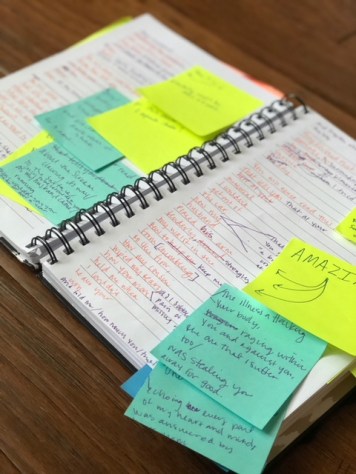
notebook

During my revision of my third draft, I heard the terrifying words, “Let’s all share with our groups our best lines.” I had to remind myself that I committed to fully experience this process; what I ask my students to do each day in my classroom. I shared. I cried. I kept writing. My face flushed with heat and my voice shook as the words were spoken aloud for the first time, in front of other people. It felt as if the world stopped and all eyes were peeking into my soul. I hated it. But loved it at the same time. I loved it because I saw the process working. I didn’t stop writing, in fact, I wrote six more pages. Six. More. Pages. Imagine if we model with our students with as much vulnerability and dedication as we ask them to share. Imagine if we give ourselves over to this process, as scary as it might be for some. Change is never easy but almost always, in my experience, worth it.

On the last day I was to present my piece. When it was my turn in the circle I pulled on my memory of the last three weeks and the process I took to get to get this “final” piece. I channeled the empowerment I felt through sharing and after about 60 seconds of steady tears and intentional calm breathing, I read my whole piece aloud for the first time.

I sobbed as I read, remembering how death stole from me. I shook at the overwhelming feeling of grief’s grasp on my heart. I breathed through the memories of never getting to say goodbye to someone I loved so dearly for more than 16 years. Each exhale taking with it another line from the poem, another piece of my shattered heart. I painted a picture with words of my precious best friend’s soul, smile and life that I never thought I would be able to. At the end, when I was done, the room was silent for a many long seconds and I remember feeling the weight and shackles of grief release in the slightest bit. A start to more healing; therapy through writing.

My experience this summer was messy, beautiful, difficult, liberating, scary, healing and most of all empowering. Reader Writer Workshop allowed me to experience the writing process in a way that renewed my love of writing and freed my creative mind previously bound by the limits of traditional, templated writing curriculum. The whole writing process gave me so much confidence in myself and my writing and I can’t wait to instill this same confidence in my students next year.

A few things I took away from my time as a Workshop student about the writing process:

  1. The writing process needs to be authentic and organic. It is different for each writer.

  2. Being a reader is so important. Reading as a writer is what helps the writer find their voice and authentic process of their own writing.

  3. The writing process is not a one size fits all formula. It is far from that, so throw away your essay outline template and let your students follow your lead on becoming a true writer. The writing process is something that happens naturally, authentically, differently, for each writer.

  4. Authentic writing is not a formula. I have found that I don’t really “brainstorm” or “pre-write” or make webs and charts… I just write. Whatever it is I feel, whatever it is I want to say – or sometimes what I don’t want to say.

  5. My first draft is often messy and there is so much beauty in that mess. It is often unorganized, drowning in imperfect sentences and awful cheesy metaphors, and that is okay. Our students need to know this as well, that as writers, we are never going to get it on the first try. That is why this is called the Writing PROCESS. There are many steps to writing an essay, a story, anything at all, and if we are to do it well we need to be 100% committed to the Workshop Process.

  6. Sharing is necessary. This was the most difficult part for me and my writing piece this summer. Letting others read my scorched and broken heart on a page was not something I was immediately ready to let happen, but without it, I would not have gone through the writing process and created my piece with the depth I did. The piece I wrote is raw and full of anguish. It was, and still is, terrifying to share but more therapeutic than I could have imagined. Hearing what my friends and peers had to say was encouraging and gave me confidence that what I was writing and what I was writing about was important to more than just my healing, but others’ as well. Knowing this is what made the tear stained pages a little easier to share.

  7. Revision is a balance. Knowing when to resurface before diving back into the emotions and write more, write with deeper purpose and meaning is essential to a successful writing process.

  8. Writing is never really done. I read my “final” piece aloud in our read around on the last day of this class and I still find myself wanting, needing to dive back in a make it more than it was.

Although a piece may never feel “finished”, knowing when to leave well enough alone is important.

  1. The writing process gave me power and bravery to keep writing. I feel like more of my heart is ready to pour out into this one piece, but maybe that means there is another piece lying within me. This is the beauty of this process, seeing clearly what the purpose is of each piece and moving on to another when you need to.

  2. Our students need to experience this each and every day in our classrooms.

This next year I will continue my growth as a writer alongside my students in the Reader Writer Workshop classroom by modeling what true writers do. I will be sharing my experience with the writing process and encouraging my students daily to find their voice through this beautiful, necessary process. Yes, it is less conventional, but so are our students. I hope to free them from the traditional approach to writing and watch them create and find empowerment in their creations. It is up to us, their teachers, to model and write alongside them vulnerably and intentionally, showing them what real writers and readers do. They deserve the chance to learn in a way that will empower them for the rest of their life. Imagine the writing we can experience from our students if we let them find their writing process.

Sarah Roy is a mother to three amazing, energetic, creative little boys and wife to a Marine turned Texas State Trooper who is braver and more selfless than anyone she has ever known. She is a Disney addict and is excited to surprise her sweet boys with a trip to Disney World in 10 days. Her passion for reading and writing overflows into her students each year and she loves watching them grow on their journey to be readers and writers.

My Number 1 Tip for Moving Readers and Writers

My go-to question for readers and writers who don’t know where to go next is: What have you been thinking about lately?

thinker

Whatcha thinkin’ about?

That’s it.  That one question works just as well on adults as it does on kids.  It makes people think about who they are and where they are in their thinking.  Whether it’s a theme, issue, or struggle, I can go to my library and present a handful of books to meet almost every reader’s needs. Struggling writers need to examine themselves in that same way.

This very blog, for instance, has so many posts about the importance of making connections with kids.  Look here, here, and here, for just a few examples.  There shouldn’t be any argument about prioritizing the hearts and minds of our students.

Take me, for example: I’m addicted to YouTube.  My subscription list is a mile long and the list of topics is a mile wide.

When I really look at it though, it turns out most of my channels connect thematically..  My feed is full of builders and makers and I look forward to their progress videos like I do the next Game of Thrones episode. It’s not exactly “appointment TV,” but it’s pretty close.

Some of my favorites:

I love this channel produced by April Wilkerson (a Texan!) where she designs and builds everything from Adirondack chairs to her own gigantic workshop!!!  This woman is an inspirational creator that shows me that I could learn how to do anything I put my mind to. Maybe this speaks to my need to build literate people.

TheCorvetteBen channel documents the restoration of cars, mostly C3 corvettes. As an owner of a 1970 Corvette, a family heirloom, I love watching a regular guy work on cars and save them from the trash heap.  It’s cool to me that he works cars like the one I work on.  Maybe this speaks to my need to save as many kids as I can.

Pure Living for Life shows the lives of a couple who sold everything, moved to Idaho, and started the process of building a timber frame house from scratch.  A lot of this channel is about “grit” and “problem solving.”  It reminds me of a major theme from our district’s Literacy Institute: the privilege to struggle.

Those are just three of the several dozen channels I watch, but the themes repeat themselves over and over.

Questions:

What do you watch? What types of media attracts you and appeals to your interests?

Do we need to be aware of the media our students consume? Could deepening our awareness help us make stronger connections to the issues in which our students are interested?

I think so.

Charles Moore is struggling to get his grandfather’s corvette to drive.  He is struggling to get in a summer reading rhythm because he can’t put down his iPad and he can’t convince himself to focus on reading One of Us is Lying.  He wants to go sit in that river in Wimberley, TX already!!!

Career Changers!!!

Looking back at the big forks in the roads of our lives is something we all do.  We lament decisions unmade or decry decisions we didn’t even get a chance to make.  The ones made for us can be the hardest to accept, but others can be the best that ever happened to us.

As a second year teacher, my principal decided I was up next in the push to train our teachers in the theories espoused by Flip Flippen in Capturing Kids’ Hearts. This overnight, professional learning opportunity in Round Top, TX changed the course of my career.  I’m sure I didn’t live this creed to it’s fullest potential in those first years, but the lessons make more and more sense as I grow older both in age and experience.

Flash forward fourteen years and zoom in as we finish up week two of the second cohort of the CCISD Reader’s/Writer’s Institute.  This work is as powerful as anything I’ve ever done, and will be as long lasting.

I get the chance to meet people around our district who travel the same path that I do. Whether it’s the department heads, instructional coaches,  or teachers from other schools, I’m learning something new every day.  The Teacher of the Year from Clear Brook high school is my co-teacher!!!! Where else would I get this opportunity???!!!

I get to work with Amy and feel her passion for giving kids the best possible chance to learn and grow. She brings energy and heart to our meetings every morning and has, again, taught me to look at this work from different angles and given me tools to take into my new classroom.

I get to glimpse the vision that our curriculum director, Billy Eastman, has for the teachers and students in our schools. His vision blends reading and writing with thinking in a way that will challenge our kids to look beyond themselves, but also into themselves, to explore the concept of humanity.

I get to read and write with teachers at the school I’m moving into in August. They are amazing people first, but amazing teachers as well.  I can’t wait to continue our work together next year at Creek.

What else can I do to help myself be ready to take a huge leap next year?  What new tricks can this old dog learn?

Charles Moore is excited to continue his education at almost 40 at The University of Houston.  He still believes that face-to-face meetings are better than email exchanges and he’s spent 1,500 of his 2,000 Book Love Dollars and is looking for suggestions.  Please email him at mooreliteracy1@gmail.com if you want to visit or check out his embarrassing instapoems at @mooreliteracy1 on Instagram.