Author Archives: Jessica Paxson

Classroom Culture Wasn’t Built In a Day

Untitled presentationHappy Back-to-School, everyone!  I’ve been missing around these parts lately because I squeezed every single ounce of summer out.  Then I tried to squeeze some more.  It was fantastic.

Here I am, three days into the new school year, and my body hasn’t yet adjusted to the lack of constant caffeine influx.  It feels kind of like being hit by a train, and having to get up on stage and still perform.  You all know what I mean!

In the past, the beginning of the year has been stress-on-stress-on-stress.  According to most educational circles, you have to utilize THE FIRST DAY to create a classroom culture, show the students who you are, help them get to know each other, communicate your expectations, and don’t-you-dare-waste-a-minute-of-real-instructional-time (a.k.a. get some content in there, too).  Phew.  I’m out of breath.

This year, I approached the beginning with less of a scarcity mindset.  At least, I tried to.  I mean, a great classroom culture–much like Rome–is not just “created,” it’s built, isn’t it?  It is.  Especially if we want a culture, not just a community.

Brick by brick, my friends.  

So here are a few of the bricks I’m starting to hoist, pile, place, and hope that the structural integrity of the workshop classroom begins to take shape sooner rather than later:

First Day: Create something together.  This year I decided not to talk about books on the first day (gasp!).  I know.  I was floored, as well.  The thing is, I love my initial talk about books and choice so much, I didn’t want the initial change in classes, etc., to excuse any students from my soapbox.  So I did a rockstar lesson (credit to my awesome friend, Jen Fuller for the idea) on the first day.  Students were to choose two or three items from my pile o’ crap (excuse my language), combine them to make an original product, then write a commercial to sell that product.

What I wanted to accomplish: 

  • Building community/communication
  • A glimpse into the collaborative nature of the course
  • Writing/persuasion in disguise

Why I think it worked:  This activity was awesome for a few reasons.  First, just as Susan said of her first day plan, it had the novelty factor.  Students were expecting to be bored to death with the aforementioned, traditional pleasantries.  Second, sometimes the hardest part of writing is the fear.  I told Lisa, “I obviously want to get to baring our souls, but that’s HARD.  Especially on the first day.”  This activity gave them someTHING to write about, to talk about, to create.  Third, it helped me assess how the students work in groups, even on the very first day.

What will happen next?

Next, we will talk about choice.  We will pass books.  We will go over possible difficult scenarios that might happen in a classroom (again, not my idea), and discuss how we would handle them with kindness, seeking to listen first and understand.

Originally, it was logistics that kept me from my traditional First Day plan, but I think it worked out better than I could have imagined!  It was a great first brick.

AND NOW WE BUILD.

What bricks have you chosen to place into the first weeks of school?  What are you trying to build?


Jessica Paxson teaches AP Language and Composition, English IV, and Creative Writing in Arlington, TX.  She is currently pursuing her Masters in Educational Psychology and GT education, and dreaming of a home free of construction materials and boxed-up books.  If you are a fan of candid vulnerability, you can catch more of that over at www.jessicajordana.com. Follow her on Twitter or Instagram @jessjordana.

Workshop: Going Sane Feels Like Going Crazy

Three Teachers Talk

My life altered in many ways last summer.

I attended an Abydos (formerly, New Jersey Writing Project) training for writing workshop.

One of my incredible mentors, Valerie, suggested Book Love as I searched and pleaded that there MUST BE a better way than the way I taught my first year.

My work bestie, Michelle, encouraged me to rekindle my creative life with The Artist’s Way, by Julia Cameron.

In August, I jumped headfirst into creating a classroom environment entirely different than the one I felt as though I clumsily stumbled into the year prior.  As I reveled in the joy of matching kids with books, watched as they surpassed what even they thought they could do, held firmly to my principles when questioned by many-a-colleague or administrator, I found myself stuck on Julia’s words one weekend.

“It’s important to remember that, at first flush, going sane feels just like going crazy.”

-Julia Cameron

I have to admit, I’ve felt much more CRAZY than SANE in this adventure in teaching and learning.  Anyone with me?

A few weeks ago, I sat in the only true workshop (though many claimed to be so) session in my AP Summer Institute training.  It was a fantastic event with many incredible educators.  As we know from Amy’s many rants, advanced educators have a hard time wrapping their minds around workshop.  I couldn’t help but chuckle as the presenter, Jacqueline Stallworth, fielded the question of many steam-eared AP teachers:

But do you have a list for them to choose from?  How do you know they’ll choose right?

How do you know they read if you haven’t read the book?

And Amy’s favorite: They won’t ever read these books if we don’t make them!

Well, I was “made to read them,” and I didn’t.  Neither did Shana–at least not in high school.

We know the vast majority of students are not reading. So what if you could get them to read?

As we at Three Teachers Talk always say, it’s about teaching the reader, not the reading.  It’s about teaching the writer, not the writing.  Why does that seem so crazy?

I’m increasingly convinced that workshop–while backed by reputable, extensive research and proven time and again to advance the WHOLE student, not just the test-taker–is still new to many educators.

In true summer fashion, I’ve binge-watched episodes of Quantico.  In season one, Alex says, “You are willing to blow yourself up for people to see your truth instead of helping them find it for themselves.”

I’m hoping that this year, I can step back and realize it won’t work for teachers until they find it of their own accord, try it themselves, ask questions and realize there is not always an answer.

I’m hoping that I can do less of the “blowing up,” and more of the “helping [teachers and students] find their own truth” rather than simply taking on mine.

What makes you feel crazy as a workshop teacher?  Let us know in the comments!  We are here for you, reading/writing warriors!


Jessica Paxson teaches AP Language and Composition, English IV, and Creative Writing in Arlington, TX.  She is currently pursuing her Masters in Educational Psychology and GT education, and dreaming of a home free of construction materials and boxed-up books.  If you are a fan of candid vulnerability, you can catch more of that over at www.jessicajordana.com. Follow her on Twitter or Instagram @jessjordana.
5 New Ideas from a Stack of Books

Books 1I keep telling myself I won’t buy any more books.  Every time I resolve that enough is enough, and I can wait for grant money, it seems like another sale pops up.

Enter Scholastic Warehouse Sale.

I fell victim to the Arlington Warehouse Sale yesterday after school.  By victim, I mean I wheeling through the aisles at breakneck speed with a giant smile on my face.  I left with a stack of about 27 books for $61, and a slew of fresh lesson ideas.

5 New Ideas from a Stack of Books

  1. This I Believe Essays:  I have seen so many teachers use This I Believe from NPR as a jumping-off point for writing and larger projects.  I snagged a book full of these essays for mentor texts.  How great for seniors to think about how their beliefs have changed throughout high school?  I would love to do more of this next year.
  2. For the Love of…: This basketball picture book is going to make for a great mentor text for expanding upon a list.  This would also make a great starter mentor text for writing about favorites for ESL students. Books 2
  3. Same/Different/Crazy: I got this from the top two titles on my stack.  Quickwrite prompt–What has been the same this year in high school?  What has been different?  What has been CRAZY?
  4. Pieces of Me: From the title, Piecing Me Together, we might do a visual representation of the pieces of each student.  Part self-portrait, part personal reflection.
  5. Linger: What do you hope will disappear when you leave this building, and what do you hope will linger?  What is the legacy that you have left on this place?

These are only the ideas I’ve gleaned from the titles of these books.  I can’t wait until I actually crack the covers!

Does a new stack of books reignite your creativity?  What does your stack look like?  We would love to see some pictures in the comments or shared on FB!


Jessica Paxson is an English IV and Creative Writing teacher in Arlington, TX.  She usually takes on major life events all at once rather than bit by bit, such as starting graduate school, buying a house, going to Europe, and preparing for two new classes next year.  If you enjoy watching her make a fool of herself by being unbearably vulnerable, you can catch more of that over at www.jessicajordana.com. Follow her on Twitter or Instagram @jessjordana.

When Context is a Novelty

Senioritis is real, people–I think I have it.  Teacheritis?  I don’t know.  Either way, the type of this condition my students have seems to be an airborne contagion, because I’ve caught it.

However, along with the feeling of I-just-want-to-sit-on-a-beach-and-read-Matthew-Quick-novels, I’m having all the other feelings, too.

We are nearing the end of the school year, which will bring to close my SECOND–count ’em, one, two–year of teacher the lovely half-child, half-almost-adults, half confused and terrified individuals we call seniors.

The other feelings I’m beginning to feel are difficult to wrestle.

I’m excited for a clean slate.

I’m lamenting over all the Should Have Done’s and Wish I Did’s.

I’m paralyzed with fear that someone will steal books from my classroom over the summer, jeopardizing the integrity of the inventory I have yet to take.

I’m overwhelmed at coming up with a better system of organization than my piles of sticky notes.

I’m also mourning the fact that these amazing human beings whose lives I’ve been a part of for 180 days will now go off into the world and I may never see them or hear from them again.

One of these incredible humans is Zoe.

file

Aside from the fact that we look like sisters, Zoe has been a student who’s been on my mind a lot this year.  The first day when we set reading goals, I was taken aback that her goal was heftier than mine.  She wanted to read 50 books this school year.  Even more, she labored over a plan to actual complete that goal, as she wanted it to be realistic!

At the Principal’s Breakfast, I described Zoe as having her head in the clouds with one foot on the ground.  She has this uncanny ability to dream big, but to make sure she understands the logistics of everything.

Zoe is a student who always asks why.  She doesn’t ask it in a way to throw off the teacher, she just truly wants to know how everything connects and why it matters.  This has made me better.

When we had our class discussion on engagement, Zoe explained that this was the first English class in which she felt everything had context.  Surprised at her remark, I asked her to explain further.

She said, “We don’t do random worksheets for grammar or learn random words that don’t have any sort of genesis or connection with what we are actually reading or talking about.”

She tweeted a few things that made my heart sing:

PTT6

Aside from the fact that I’m glad this connection is happening in my classroom, I’m confused as to why context in the classroom is such a novelty.

I’ve been seeing many Twitter friends commenting on the new book from Kylene Beers and Bob Probst, Disrupting Thinking.

file

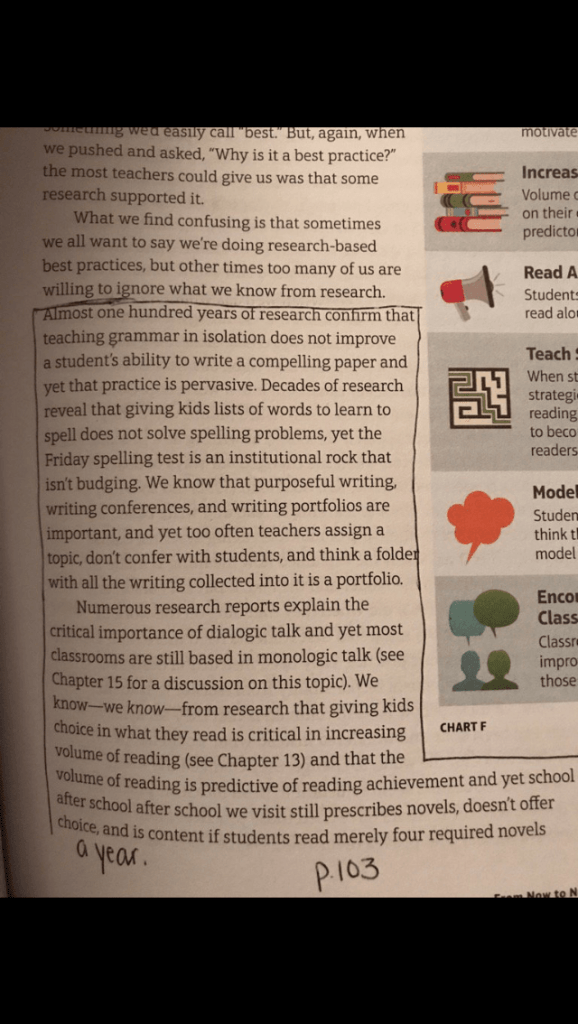
Excerpt from Disrupting Thinking via @msethna23 on Twitter


Like it says, we know the research.  We know things should not be taught in isolation.  We know kids need hooks and pegs on which to hang their knowledge.  So why are our classrooms still reflecting a plot-and-prescribed-theme teaching, vocabulary word memorizing, grammar terms on Fridays environment rather than an environment of connected and contextual literacy?

With a couple of sentences in a classroom discussion, Zoe sparked my mind to not only consider my own teaching practice, but to artfully consider why things are the way they are in education in general.

My new research question: If one knows something, how do they benefit from feigning ignorance?  What would it take to change a whole system in which so many are comfortable with comfort?

As for those that are reading this post, I’m sure I’m preaching to the choir.  Even still, how can we band together to show how much better it is this way?

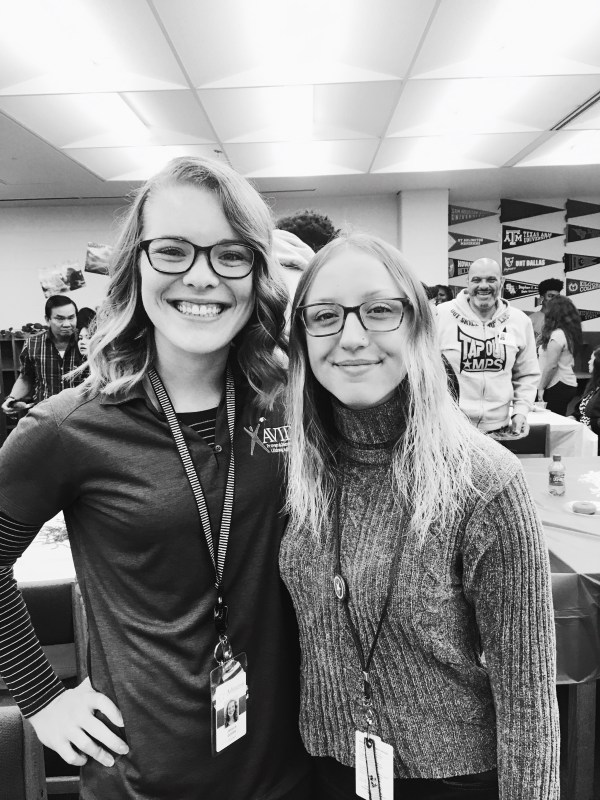
Zoe is the type of student who sticks with you, but I’m running into increasingly more of those these days.  I’ve attempted this year to change my teaching from This is What You Need to Know to What is your story and how can I help it along, make it wider and deeper, and revel in the light of a lifelong learner taking a step into the real world. 

How do you create context and connectivity in your classroom?


Jessica Paxson is an English IV and Creative Writing teacher in Arlington, TX.  She usually takes on major life events all at once rather than bit by bit, such as starting graduate school, buying a house, going to Europe, and preparing for two new classes next year.  If you enjoy watching her make a fool of herself by being unbearably vulnerable, you can catch more of that over at www.jessicajordana.com. Follow her on Twitter or Instagram @jessjordana.

Without Contact, There Can Be No Impact

Stories

“I had gone off to be a teacher, asking myself from time to time if I could teach English in such a way that people would stop killing each other.” -Mary Rose O’Reilley

As soon as I came across this quote in Peter H. Johnston’s book, Choice Words, I immediately related to it, which then caused me to feel alienated.  You see, this book had been assigned as a school-wide PLC read.  Aside from being one of the few that would complain about having to READ A BOOK (English teachers, anyone?), I also knew that the next day we would have to discuss this reading.  I knew I would bring up this quote.  I knew commotion would stir as everyone discussed what a preposterous notion this was.

OF COURSE we can’t stop murder.  OF COURSE we can’t change the whole world.  OF COURSE we can’t save them all.

Does the fact that we can’t change reality mean we shouldn’t still try?  Does the possibility of not reaching one hundred percent success prevent you from setting a goal in the first place?

I read all of that before it seemed real–the “killing” part, at least.  It was before everything changed.

I saw his name flash by on another student’s Facebook status closely followed by words like too soon, I love you, rest easy, etc.  I quickly went over to check his page as I found myself whispering to myself, “No, no, no, no, no.”  When I found his page, my worst fear was confirmed.  My former student had been shot and killed the night before.

As I stared at his picture, my mind ventured back to almost everyday after school last year, my first year teaching, when this student was in my classroom.

The news story that soon followed confirmed that the altercation occurred to settle a debt of $70.  He went to defend his friend, and as the other kids refused to fight, he walked away and was shot in the back.

$70.

Since that moment, just a few months ago, this quote crosses my mind almost daily.  I find myself thinking, What if we talked more about violence in the classroom?  If he had gone to college, would he have been in this same situation?  If he was not afraid to ask questions, maybe he would have asked someone for the money or helped his friend earn it rather than attempting to settle the debt in another way.  If this… if that…if only.

I know it is not healthy to think of all the things I should have done, but the truth is that I do.  I believe teaching can change lives not because we know things, but because we know kids.  Students want to be known, even if they don’t let on that it’s true.

I don’t only think of what I should have done, but I let it propel me into, What more can I do this time, today, this class period, for this student?

In a conversation with my 3TT friends, we were discussing “worksheet teaching.”  In a very long and broad conversation, I told them another story that happened that week, and then I thought:

You have to get really close to have an impact, but getting close makes things really difficult sometimes.  No wonder teachers sit at desks.  There’s less skin in the game that way.

Honestly, that’s how it feels some days–like I’m scraping off tiny pieces of myself to try and fill what these kids need.

So I write to patch the scrapes, air out the wounds, and find the light breaking through the cracks.

Today I’m not writing to lament about teaching, to share war stories or anything of that nature, but just to heal.

Teachers need to write because it pieces us back together.  We need to write, because others need to see our hurts to know they’re not alone.  

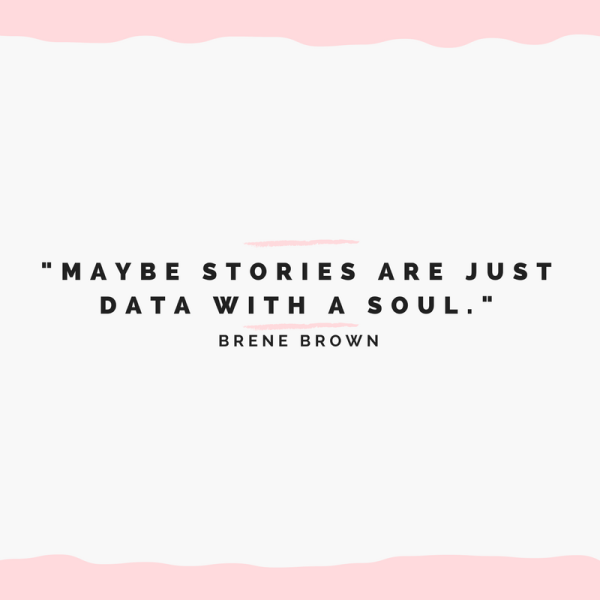
Like Brene Brown says, “Maybe stories are just data with a soul.” Despite the pushes for test scores, data, and measurable growth, we teach souls every single day.  Those stories need to be told.

What do you do to heal from the inevitable trials of teaching souls?  Do you think teachers can “stop the killing,” or should teachers refrain from distracting themselves with such lofty aspirations?  Let’s start a conversation in the comments.

Jessica Paxson is an English IV and Creative Writing teacher in Arlington, TX.  She usually takes on major life events all at once rather than bit by bit, such as starting graduate school, buying a house, going to Europe, and preparing for two new classes next year.  If you enjoy watching her make a fool of herself by being unbearably vulnerable, you can catch more of that over at www.jessicajordana.com. Follow her on Twitter or Instagram @jessjordana.


3 Types of Talk to Boost Confidence and Community

the hate u give

My first day of teaching was going to be great, because I WAS PREPARED.

I wrote a speech, long hand, about 5 pages.  It was going to communicate what students could expect from the class and what they should know about me.  It was going to INSPIRE them.  They would hang on my every word.

Forget all of the appalling things I just mentioned–you haven’t even heard the best part.

After I gave my approximate 35 minute speech, and students were drooling as a result of my awesomeness, we would have A DISCUSSION.

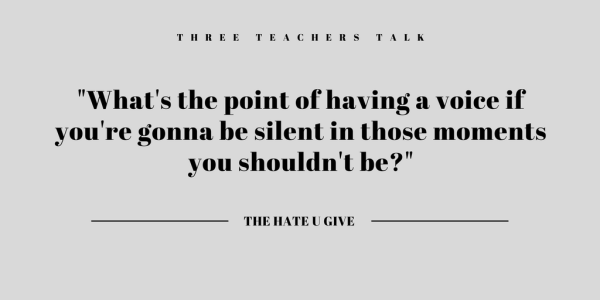
Drop the mic.  Best teacher ever.  My students will have a voice!

Needless to say, having never been in the classroom before, my first day was a shock.  Most students did not want to hear a single word I had to say, much less ABOUT MYSELF.  My voice was gone by the end of the day and I was in tears because I had no idea how to go back and do it for another round of classes the next day.

I had no idea discussions needed planning and structuring.  I thought they just HAPPENED.

Oh–sweet, naive, extremely troubled Baby Mrs. Paxson.

Almost two years later, we never have a discussion without some sort of structure.  The structure can be minor, or it can be massive.  It can simply be planning on my part, planning on the students’ parts, or it can be structure that I pull out of my back pocket to maximize of a discussion that materializes out of thin air.  It can mean a different configuration of desks, or a script to which students can refer if they get stuck.

When we teach literacy, we can’t just command students to “talk.” We have to give them tools and materials and practices so that they are building their houses of reading, writing, speaking, and listening on a solid foundation, rather than a shaky one (insert your chosen Three Little Pigs invocation here).

Here are a few of my favorite ways to structure talk in the classroom, that can really work for ANYTHING from talking about books, to talking about real world issues, to reviewing pieces of writing, to students encouraging each other in passions and endeavors.

AVID Strategy, 30 Second Expert:

I learned this strategy through AVID, and it is so stinking versatile, it kills me.  I’ve adapted it many times to fit what we need, but the underlying concept is in the script.  I used this last during our Life at 40 Unit in which students were exploring desired careers and imagining/researching a possible life path.  In order to get students thinking and talking about career paths, after we did a little bit of preliminary research and decision-making, I posted two sentence stems on the board.

I’m an expert about (desired career) because I found out that __________________________.

I will be an expert at (desired career) because I am (character trait), (character trait), and (character trait).

Now, after they fill out these sentence stems, here is where the magic happens.  Students are required to pair up and repeat this script to a partner.  Their partner must actively listen and repeat what this student said in their own words.

Here are some conversations I got to hear that day:

  • “I will be an expert at physical therapy because I look on the bright side of things and I don’t give up on people.”
  • “I will be an expert at cardiology because I have discovered that I can learn anything, and will work harder than anyone sitting next to me.” (Positive self talk, anyone?)
  • (Repeating back to their partner) “I think you will be a great teacher because every time I talk to you in class, I feel heard and understood.  You stated you were a good listener, and I have experienced that from you.”

This is just a small glimpse into the conversations that can happen with 30 second expert.  Students feel silly at first, and they joke A LOT with these scripts, but even so, if you change your thoughts you can change your world.  Sometimes changing thoughts means changing the way you talk about yourself to others.  This allows students to phrase things they’ve just learned or mastered in a way that helps them realize they have added to their learner toolbox.

Speed-Dating:  

We are major speed daters over here at 3TT.  We speed date books ALL THE TIME.  I’ve also found that the speed dating format is golden for a lot of things such as when students bring in their own news articles for an assignment, giving post-it blessings, reviewing and revising writing, trying different mentor sentences and sharing, or really any situation in which you would like to allow students to have face-to-face time with many different ideas and possibilities.  You could also do 30 second expert in a speed-dating format!Structured Talk


Socratic Seminar:

I am by no means an expert on Socratic Seminar, but many different educators have different ways to get students talking about higher level questioning in a group setting.  B’s Book Love has some of my favorites.  In 822, we’ve tried fishbowl, whole class circle, passing stickies, and inner/outer circle with a live Twitter Chat.  They’re all great.  When my kids hear Socratic Seminar, they know I mean serious business, so this usually elicits slightly more academic talk.

Ultimately, structured talk promotes confidence and community in the classroom because it not only communicates high expectations, but it gives students the building blocks to reach those expectations and with skills they will carry into the real world!

How do you structure talk in your classroom?  Have you learned any tricks along the way?  Share them with us below!

Jessica Paxson is an English IV and Creative Writing teacher in Arlington, TX.  She usually takes on major life events all at once rather than bit by bit, such as starting graduate school, buying a house, going to Europe, and preparing for two new classes next year.  If you enjoy watching her make a fool of herself by being unbearably vulnerable, you can catch more of that over at www.jessicajordana.com. Follow her on Twitter or Instagram @jessjordana.


Ask Your Students: What is Engagement?

Between the World and Me

A few weeks ago I ran into a brick wall with a project in my classroom.  I promised an update, but what I have for you is so much more.

I took Shana’s advice and asked my students, WHAT WILL ENGAGE YOU?!  However, as I thought about asking them that question, I found myself wondering if they would know what I meant.

All teachers aim for engagement, administrators search for engagement and attempt to quantify it, but how many students have been explicitly taught what it is we truly desire from them?

I set out to do just that last week.  I knew we would be working with three different concepts that I think are frequently muddled in the classroom.

Fun.  Compliance.  Engagement.

I also knew we needed a purpose/audience for the discussion, so I explained to the students that they would be assisting me in writing this blog post.

I never knew it would be necessary to define these words, but as I doled out a different word to each table group, I walked around to notice a lot of the same conversations happening at each table.

What would a fun classroom feel like?

It would feel like everyone doing what they want, being productive, and everyone would be happy.

What would a compliant classroom feel like?

A compliant classroom would feel how school is supposed to feel; come in, get your work done, leave. 

What would an engaged classroom feel like?

It would feel like students being able to choose their paths.  It would feel like happiness because the students would know the teacher and classmates cared about them.

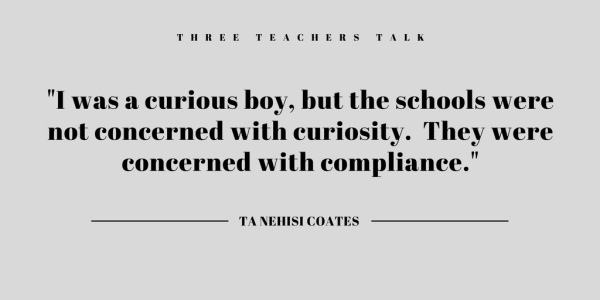
These students have been taught to be compliant their entire educational career.  Sure, it is necessary to be compliant in terms of respect, but if you are ONLY EVER compliant, you’re being robbed of the best part of learning: Recognizing you can push your mind further than you ever imagined.

I want an engaged classroom.  You want an engaged classroom. Oprah wants an engaged classroom.  EVERYBODY WANTS AN ENGAGED CLASSROOM.

So if compliant and engaged classrooms both get work done, what’s the difference?

Engage: (v.) pledge or enter into a contract to do something; establish a meaningful connection with.

Did you catch that?

To engage means to commit and connect.  That doesn’t just change classrooms, it changes lives.

So why is it so hard? Commitment and connection don’t come through passivity or apathy, they require effort and exertion.  They require pushing past the point of comfort (for both students and teachers), and sitting in the pain–not because you want to, but because you committed to it.

As we discussed why a classroom should not be all fun, Andy had an enlightening thought.  He said, “I think the problem is, any time you take part in something, you’re sacrificing something else.  I think a lot of students are afraid to sacrifice their own comfort to make a connection with someone.  There’s always the risk, too, that you won’t connect, and then it’s like you lost twice.”

Sometimes I forget the amount of fear that exists in the classroom on a daily basis.  Commitment asks us to sacrifice the easy path.  Connection asks us to say goodbye to selfishness.  All of this has to take place before engaged learning can happen!

It takes a straight up ninja to pull that out of every student in every class period!

We ended this mini-unit with a Socratic Seminar.  I love me some good structured talk.

PTT5

2nd Period Preparing for Socratic Seminar/Live Tweeting

What is the purpose and direction of our learning?  How can we make our classroom a space of authentic dialogue and engagement? (Question credit goes to my emergency lesson-saver, Shana.)

Zoe said she never liked English until she had choice.  She also said she wanted to do more talking about books in a way that connected with her classmates and what they were reading.

Dee said she enjoys higher level thinking.  What might happen if _____ happened to someone you know?  Would you handle things the way this character did?  What would you change? (Her suggested questions.)

4th period agreed they would like to deal with real world issues, and have choice in how they present their findings (poetry, video, podcast, etc.).

2nd period explained it should be about the learning, not about the grades, but it’s been that way for so long that they don’t know how else to operate.

Grady said, “School gives you a chance to do something great with your life, but you have to DO SOMETHING to be great.”

Shahin said, “Compliance is a downfall because you just follow orders and don’t think for yourself.  It makes it to where you will always need a boss, or you won’t know how to operate.”

PTT1PTT4

PTT2PTT6

Listening most often leads to learning, and I sure learned a LOT last week! Thanks for the ideas, #PaxThinkTank!!

Is your classroom one of compliance, engagement, fun, or a mixture?  How do you communicate with your students what you expect from them each day?

Jessica Paxson is an English IV and Creative Writing teacher in Arlington, TX.  She frequently feels as though someone made a mistake in allowing her to hold the futures of over 100 teenagers in her jittery, over-caffeinated hands for the past two years.  If you enjoy watching her make a fool of herself by being unbearably vulnerable, you can catch more of that over at www.jessicajordana.com. Follow her on Twitter or Instagram @jessjordana.


The Savior Complex

The Savior Complex

The lesson was going great. Discussions were facilitating deep thinking, work was getting done, kids were talking about their reading without my prompting.  Then I saw him: Head down, possible drool pool hiding beneath the pillow he constructed out of his arms.  As I went to gently shake him awake, I thought, Shoot–how did I miss that?  I had been furiously conferencing with other students and must have been turned the other way.  Almost simultaneously, I heard a student–who generally favors the hyperbolic statement–say, It is so freezing in here.  I HATE THIS CLASS.  

And then it started to go.

Matthew Quick’s character, Bartholomew Neal, would call it the angry man in his stomach.

Oskar Schell would claim he was getting heavy boots again, and might pinch himself for his shortcomings.

Julia Cameron dismisses it as the Inner Critic.

The Bible would call them lies spun by the enemy.

Either way, the moment I hear a negative comment, see a student who has slipped through the cracks for five minutes, or stare at all the red in my grade book for hopeful graduating seniors, I can’t seem to quiet that voice–whatever you choose to call IT–no matter how many times I attempt to smother or extinguish the flame.

IT says: You’re the worst teacher on the planet.

What makes you think you can change the world, or even one class period, one student?

They say you’re doing a great job, but what does anyone really know?  Don’t they just see what you present to them?

And worst of all, God didn’t place you here, He probably just forgot for awhile, and this is where you ended up.

Amateur.  Inadequate.  Soft.  Never Enough.

Forget the fact that I know all these thoughts are false.  They plague my mind daily, hourly, sometimes even by the minute.  So what is it that allows me to take the few negatives as failures, even when juxtaposed with many more positives?

In response to one of my messages one day, my friend and trusted mentor, Amy, called it The Savior Complex.  We want to save all the students–ALL OF THEM.  And by save, I mean engage, facilitate growth in life and learning, help them to feel loved and valued, encourage their ambitions and challenge them each and every day.

Seems doable.  (Not that I set lofty goals or anything.)

It’s my goal in these last few weeks to focus on the positive and deal with the negative.  I don’t want one to replace the other.  I don’t want to only see the positive, because that would take away the growth.  I just want to give each one its due in contributing to what I speak to myself each day.

Just like I tell my students:  Don’t say anything to yourself that you wouldn’t dream of saying to someone else.

How do you deal with that Angry Man in your stomach or the Inner Critic?  Let me know in the comments!

P.S. (Can 11 weeks qualify as “a few?”)

Note: This post was originally published on Jessica Jordana.

Jessica Paxson is an English IV and Creative Writing teacher in Arlington, TX.  She frequently feels as though someone made a mistake in allowing her to hold the futures of over 100 teenagers in her jittery, over-caffeinated hands for the past two years.  If you enjoy watching her make a fool of herself by being unbearably vulnerable, you can catch more of that over at www.jessicajordana.com. Follow her on Twitter or Instagram @jessjordana.

Letting Go in the Name of Book Love

letting go

I am a super fan of Pro/Con lists, although the true reflection of these lists never seem to govern my life as much as the making of them does.  Let me explain.

I can always think of a million reasons not to do something, but if I’ve already decided I want to do it, the Pros generally outweigh the Cons because of just that–weight.  Sometimes the reasons TO do something are fewer, but are so weighty that they can’t be ignored.

Workshop was that for me.

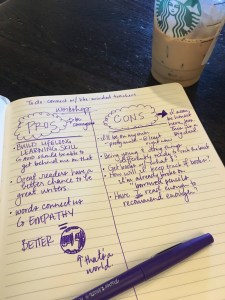
pro con

This is a real picture of my real notebook.  Please don’t judge the fact that I give myself pep talks within my P/C Lists.


Here are a few Cons of workshop from my list at the beginning of this year:

  • I’ll be on my own, pretty much.
  • I’m young, and everyone will think I’m just trying to rock the boat.
  • WHERE WILL I GET THE BOOKS?!!
  • Once I get those books, likely via my own dwindling bank account, how will I keep track of the books?  I already go broke on borrowed pencils–and those cost…well… can anyone break a penny?
  • What if I haven’t read enough to recommend enough?

Sure, all of these were true then, and are still true now.  However, I think the weight of the Pros on this list were hard to ignore:

  • I could truly build something that would become a lifelong skill that carries students through the rest of their lives as learners.
  • Great readers have the potential to be great writers.  You can’t do what you’ve never seen (at least not well).
  • Reading in builds empathy.  Reading far and wide builds empathy far and wide.

To be honest, the biggest fear on that list of Cons was the idea of losing books.  We teachers, just as Lisa pointed out yesterday, are notorious for going broke for the cause.

I started workshop anyway.  As soon as I met 3rd Period this year, Terri-Rose quickly became the actualization of my worst nightmare.  On the first day when we checked out books, she insisted on taking three home to peruse because she couldn’t make a decision.  My first endeavor into workshop, I wasn’t quite sure if that was a thing.  I gritted my teeth and slowly expelled a perfectionistic breath, attempting to inhale a free spirit (something which usually doesn’t hover near me much less inhabit my own body).  She held three of my shiny new bestsellers bought with my own money after the small grant I obtained already ran out.  I told her she could do that as long as she signed them out and brought two of them back to me the next time.  I glanced over my shoulder to my then-meager amount of books after the first checkout.  Who knew 300 books could go so quickly?  I might never see them again.  

But, you know what, I did.  Most of them.  Terri-Rose still hasn’t learned to make a decision.  Whenever she finishes one book, she takes two more.  She’ll get halfway through one, and then give it back to me.

I’ll ask, “You didn’t like this one?”

She’ll say, “I do, but I want someone else to be able to read it while I finish this other one.” We developed a system with her book marks.  She likes to use candy wrappers (always pristine) to mark her place, so she’ll hand me the candy wrapper, and I’ll put a sticky note on it with the book title and page number to hand back to her when she’s ready for that book again.  It’s a nice system.

The other day, she came into class raving about a book.  It’s a normal occurrence.  She’s never quiet about something she loves–a quality I’m hoping to channel more in the future.  She wanted to barrel her way through Everything, Everything because the movie is slated to release in May.

Then came the request.

“Mrs. Paxson, I have this pen pal in Weatherford and we’ve started talking about books.  I told her about Everything, Everything, and the movie coming out and now she really wants to read it.  Would it be okay if I mailed it to her to read and then she mails it back before school is over?  I can even ask her to write a review for it before she sends it back!”

The exhale and inhale was quicker this time, mostly because I was leaping for joy inside at the desire to share the Book Love.  I agreed to the terms of her proposal, and I can’t wait to get the book back with a long distance review.

All of those Cons, like I said before, still stand true.  I’ve lost some books this year–probably five or six.  But the weight of the Pros have grown heavier with success and small triumphs–more than I ever thought they might.

As I think of Terri-Rose, unable to make a decision, reading books halfway through and two at a time, always sharing with friends before she’s even close to done, I’m reminded of my own reading life.  It’s a real one, not one for a grade or to check a box.

Then I think: Holy crap–it works.

What moments have surprised you with sharing #BookLove and watching it grow?

Jessica Paxson is an English IV and Creative Writing teacher in Arlington, TX.  She frequently feels as though someone made a mistake in allowing her to hold the futures of over 100 teenagers in her jittery, over-caffeinated hands for the past two years.  If you enjoy watching her make a fool of herself by being unbearably vulnerable, you can catch more of that over at www.jessicajordana.com. Follow her on Twitter or Instagram @jessjordana.


Monitor and Adjust: Begging for Engagement

Control

I’m not sure where the plans went.  I don’t even have a window.  They must have squeezed out through the rat-chewed hole in the ceiling.

Wherever they went, they no longer resided within my white-knuckled fists generally inclined toward control–control of listening, control of thinking, control of growth and progress.

It was a project I thought would stretch students to think about their futures and what it would take them to get there.  And it did!  It was practical, imaginative, rigorous, artistic.  It was what every high school senior wanted–or maybe it was just what I wanted.  The work was getting done–for the most part.  We were simply missing one thing: Electrifying energy, passion, a desire to find out more.  Many teachers call this “engagement.”

This project was just another task for my students.  So as I began to search for the cracks in my classroom responsible for swallowing up my PERFECT PROJECT, I turned to my lovely colleagues/friends for advice.

Lisa offered a lovely story about fraudy feelings in her own teaching career, and a story about a faltering relationship with a student that left her feeling less than a great teacher.

Shana shared the possibility that I might just ask my students, “WHAT WILL ENGAGE YOU?!  TELL ME!”  Begging and pleading might seem below an “authority figure” such as a teacher, but I disagree.

Amy seconded the fact that I might get the students involved in determining what they would like to do, but her second piece of advice was even more reassuring.  She explained, “If you go deeper into conferring–more frequently, with more probing questions–you might discover it is actually only a couple of  students in each class who are affecting the entire culture.”  She went on to discuss the “Savior Complex,” and how 100% engagement, 100% of the time is a very lofty goal.

All this advice, however, reminded me that engagement is a worthy (albeit, bloody and tearful) fight.

I wish I would have asked for help sooner, but I’m going to take a little bit of each piece of advice.

  1. We are going to finish this project and these presentations after we have a Spring Break palate cleanser.  I am finishing this out knowing, after conferring and returning to my notes, that it is only a few students affecting the culture.
  2. After presentations, we will take some time for feedback (or feedforward?).  I will beg and plead.  I will write in all caps, WHAT WILL ENGAGE YOU?! TELL ME!  However, I think we will also need to discuss, What even is engagement?  How is engagement different than compliance?
  3. Develop a plan by including the students, but holding them fast to high expectations.  Learning should stretch, it should challenge, it should change.  Sometimes that is painful.  I don’t want to get rid of the pain and the stretching, I just want them to be able to get behind the place into which they are stretching and growing.

My goal in this post was not to complain or lament, but instead to share that ALL teachers struggle with engagement.  ALL teachers deal with real humans, with real struggles, and real curious and wondering minds.  We want them to open the windows and the doors, but we have to teach them how, first.  Workshop is not a magic pill, but it is a magical formula that allows a lot of wiggle room to engage students if they’ll let you.

I want to get back to why I became a teacher, and remember to let go as much as humanly possible so that the students can grab onto the learning themselves.

What do you think?  When do you make changes and when do you stick to your plan?

Jessica Paxson is an English IV and Creative Writing teacher in Arlington, TX. She also attempts to grapple with life and all of its complexities and hilarities over at www.jessicajordana.com. Follow her on Twitter or Instagram @jessjordana.