Author Archives: Amy Rasmussen

5 Lists of Books and More Space for Talk

I am a collector. I collect bookmarks I don’t use and tweets with headlines I think I’ll read later. I collect cute little pots I think I’ll eventually make home to plants, and notebooks I’m afraid to mess up with a pen (from my pen collection, of course.)

I also collect lists. Doesn’t everyone?

I collect lists of books thinking this will keep me from buying more books. Sometimes it works. Not often.

We’ve shared several lists of books on this blog:  Coach Moore’s list of books he read this summer, Shana’s Summer Reads to Stay Up Late With, Amy E’s Refresh the Recommended Reading List, and Lisa’s Going Broke List just to name a few.

I like reading lists about books. This helps me stay current on what my students might find interesting or useful. Often, I find titles that help me find the just right book for that one students who confuses “reading is boring” with “I don’t read well,” or “I don’t know what I like to read.”

With one heartbreaking event after another in our country lately, I keep thinking about the importance of reading to help our young people grow into compassionate citizens who more easily understand their world. Did you see the results of yet another study? Reading makes you feel more empathy for others, researchers discover.

Of course, we don’t need another study to tell us this. Many of us see it in our students.

I see it in my students. My students who enjoy reading also enjoy talking about their

Bookclubdiscussion

My students chose from nine different books for their book clubs. Once they chose, we had five different book clubs happening in one class. At the end of our second discussion day, I had students combine groups and talk with one another about the major themes, make connections, and share a bit about their author’s style.

reading. They relate to one another more naturally as they talk about their books, the characters, the connections. They welcome conversations that allow them to express their opinions, likes and dislikes. They learn much more than reading skills through these conversations.

My AP Language students recently finished their first book club books. I left them largely without a structured approach to talking about their reading. My only challenge on their first discussion day was to stay on topic:  keep the conversation about the book for 30 minutes. They did. I wandered the room, listening in as I checked the reading progress of each student.

On the final discussion day (three total), I reviewed question types and used ideas from Margaret Lopez’ guest post Saying Something, Not Just Anything, and asked students to write two of each question types:  factual, inductive, analytical prior to their book club discussions. This led to even richer conversations around their reading.

I remember reading a long while ago about how conversations about poetry could invite opportunities for solving big problems. I don’t know if this is the article I read, but the poet interviewed in this article asserts it, too:

I think we know the world needs changing. Things are going awry left and right. I firmly believe that in our very practical, technological, and scientific age, the values of all the arts, but of poetry in particular, are necessary for moving the world forward. I’m talking about things like compassion, empathy, permeability, interconnection, and the recognition of how important it is to allow uncertainty in our lives.

. . .Poetry is about the clarities that you find when you don’t simplify. They’re about complexity, nuance, subtlety. Poems also create larger fields of possibilities. The imagination is limitless, so even when a person is confronted with an unchangeable outer circumstance, one thing poems give you is there is always a changeability, a malleability, of inner circumstance. That’s the beginning of freedom.

When we invite our students to read, and then open spaces for them to talk about their
bookclubdiscussion2

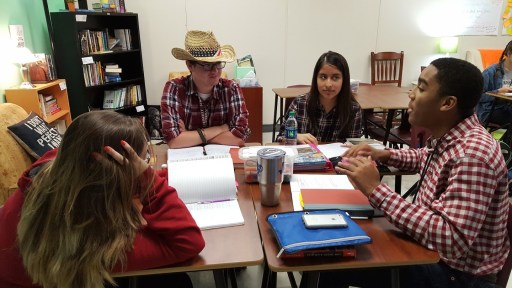
This group had hearty discussions around Hillbilly Elegy by J.D. Vance. It’s Western Days. They don’t always wear hats and plaid and boots, even in Texas.

reading, we provide the same opportunities that discussions around poetry do. Maybe not on the micro scale of ambiguity and nuance, but most certainly on the macro scale of possibilities. Our students are social creatures, and we must give them spaces to talk.

So I collect lists of books I think my students may like to read, with the hope of engaging them in conversations — with me and with one another — around books. (A couple of years ago, Shana and I had students create book lists as part of their midterm.)

Here’s five of the book lists I’ve read lately. Maybe you will find them useful as you curate your classroom libraries and work to find the right books for the right students, so they can have the conversations that help them grow in the empathy and understanding we need in our future leaders, right or left.

6 YA Books that are Great for Adults

50 Books from the Past 50 Years Everyone Should Read at Least Once

The Bluford Series — Audiobooks

20 Books for Older Teen Reluctant Readers

43 Books to Read Before They are Movies

Oh, and if you haven’t read Lisa’s 10 Things Worth Sharing Right Now post in a while, now, that’s an awesome list!!

Amy Rasmussen loves to read, watch movies with her husband, and tickle her five grandchildren. She’s in the market for a lake house and likes to shop thrift stores for books and bargain furniture. Someday she’ll be disciplined enough to write a book about teaching. For now, she teaches senior English and AP Lang and Comp at her favorite high school in North TX. Follow Amy on Twitter @amyrass, and, please, go ahead and follow this blog.

Shifting Control to Invite More Learning

569059I admit to liking control. I won’t go far as to say I’m a control freak, but I am freakishly close. As I age I realize I like more and more things in neat little rows, even my To-Do lists must be lined up perfectly, so I can make tiny check marks with my Precision pen.

I am ridiculous.

The hardest part of teaching for me is letting go. It’s also been the best thing for my teaching.

To be an effective workshop teacher, we step aside so our students can step in. They want to know their opinions, ideas, and choices matter. They’re hungry for it. We’ve written a lot about choice reading on this blog, and I know many of us advocate for self-selected independent reading, protecting sacred reading time like an O line protecting our quarterbacks.

I wonder what other choices we offer our students. How else do we invite them to own their learning?

Recently, I read this post “The Inspiration in Front of Your Eyes” by George Couros. He begins:

Often when working with educators, I try to give relevant examples of ideas that can be implemented into learning but get very specific to either a class or grade level.  My focus is not adding something to the plate of an educator but replacing something they currently do with something new and better than what they may have been doing before.  For example, instead of a teacher spending hours searching a video to explain a concept in math, or even creating it themselves, why not have the students find the concept and say why it is powerful, or having the students create some form of multimedia to explain the concept themselves? The flip is putting the learning into the student’s hands, which can lessen the work for the educator.

Deeper learning for the student, less work for the teacher.  Sounds good to me!

Couros goes on to explain the importance of being observant and connecting ideas we find in the world, and reshaping them to facilitate deeper learning for our students. Of course, this resonated. This is how we find mentor texts like author bios and user manuals. But Mr. Couros got me thinking about shifting the finding to my students.

Then before school a week ago Monday, I saw Kristen Ziemke‘s Padlet, Take a Knee. And I got another spark to shift my instruction.

I’d never used Padlet before, so while my students shuffled in to first period, I quickly made an account and created a board. I put one thing on it:  Kwame Alexander’s poem, Take a Knee, which I knew was the perfect quickwrite for the day after so many NFL players knelt in protest.

After we wrote and shared and talked in small groups and as a class about the issue. One student said, “I just don’t know enough about it to know what I believe.”

The perfect intro!

I suggested we make a text set that could help us understand the why’s and who’s and what’s of this hotbed of a topic, and I issued the challenge:  As a class of individuals with a wide variety of beliefs and backgrounds, we’d search for articles that would address all sides. We’d use Padlet as our storage space. Then we’d use the text set we build together for our learning in class.

With their phones and iPads, students went to work, and in the 10 minutes I gave them in class, they talked. Students talked about where to find information that “wasn’t biased,” “would tell them the truth,” “will help me want to know more.”

I leaned in to these conversations, teaching terms, suggesting sites, encouraging objectivity — and why it is important for our understanding of human needs and desires.

Our Padlet What’s the Argument is not complete. We haven’t had a chance to return to it yet, but we will. Maybe we’ll use it as we learn to ask better questions in preparation for whole class discussions. Maybe we’ll use it as we learn to synthesize information from a variety of sources. Maybe we’ll use it to spark ideas for the arguments we’ll post on our blogs. It doesn’t matter.

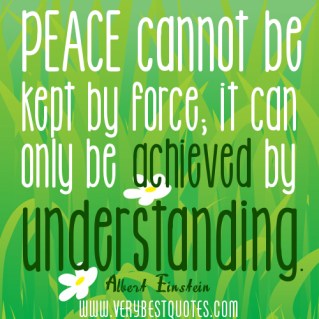
When we return to our Padlet, or even create another one that coincides with whatever peace-cannot-be-kept-by-force-it-can-only-be-achieved-by-understandinghotbed topic fires up the nation (sadly, there are so many), my students will know I value their input. They’ll know that helping them make sense of our world is as important to me as helping them love books and become good writers.

And maybe they’ll remember to look at all sides of the issues, to see into the hearts and minds of those we may disagree with so we can find a space for conversations.

If my giving up control makes space for that, I’ll take it every chance I get.

What ideas to do have to flip the learning into students’ hands, let go of control, and invite deeper learning? Please share in the comments.

Amy Rasmussen is a neat freak in her classroom but not her bedroom closet. She loves sharing books with student readers and reading students’ writing. She is the mother of six, grandmother to five, and wife to one very patient man. She teaches senior English and AP English Language at a huge and lovely senior high school in North Texas. Follow her on Twitter @amyrass

On Substitutes in a RWWorkshop Classroom

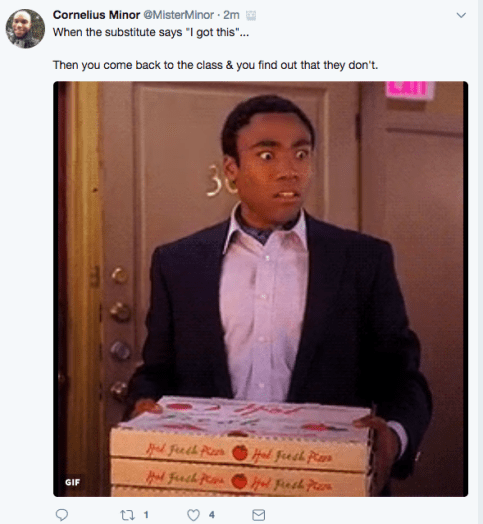
We’ve all been there:

tweet by Mr Minor

If you don’t follow @MisterMinor, you’re missing out. He’s a master teacher, and a master at gifs. No justice in this screenshot.

We carefully craft lesson plans, sometimes with step-by-step instructions, and descriptions of each students’ temperament scrawled in the margins of our rosters; sometimes leaving flow charts to indicate transitions from activity to activity, hoping if are meticulous in our details, and we leave a timer, and sternly warn our students: “Be on your best behavior,” even just a bit of reading and writing will happen when we need a substitute.

When I first started teaching, it rarely did.

I’d never thought to write about a workshop classroom in the hands of a substitute until I got an email from a 2nd year teacher who is newly implementing workshop in her sophomore English classes. Just so happens I got her email the same day I saw Mr. Minor’s tweet.

My new friend wrote:  “How do you approach substitute plans? Do you chalk it up as a loss? Do you leave detailed plans with the idea that once students have developed routines, they should still be able to follow them with another adult in the room?”

If you know me, you know I never chalk anything up to a loss — even in the days when my precise plans didn’t work, I tried to save the day.

Sometimes it depends on the substitute. Just like pretty much everything, some are better than others. Sometimes we are just grateful someone picked up the call. Sometimes our substitutes are used to being left with crowd control, so they think that’s the job.

I speak from several years experience. When I returned to college to finish my degree, I substituted at my children’s high school. I loved the teachers who left me detailed plans, the teachers who held their students accountable for being on task when they were not physically in the classroom. I could always tell the teachers who had established rapport with their students, built relationships of trust, practiced routines, and set expectations for completing work while they were out. I substituted for five years –about half of the teachers I subbed for fit this category of awesome.

Effective workshop teachers are these teachers. Of course, I didn’t know what a workshop pedagogy was back then, and I never subbed in a readers-writers workshop classroom, but the culture in the classroom is the same.

When our students “buy-in” to the community we create around reading and writing everyday, they are more likely to be on task when we leave them in the care of a substitute teacher. Some classes can even facilitate the workshop themselves.

Here’s my tips for leaving instructions for your substitute teachers:

1.Encourage substitutes to stick to your routines. For example, my students read for 15 minutes at the beginning of every class period. I ask my substitute to monitor this sacred reading time by walking the room and when necessary waking up the sleepers, and asking the phone-addicted to put away their devices. (I have to do this everyday myself. Some teens can be so slippery.) And depending on my students’ stamina, sometimes I ask my sub to double the reading time. Many students thank me for it.

  1. Invite substitute teachers to share their reading lives. This is a good fill in for a planned book talk. Ask them to take five minutes and share their favorite books. If they don’t have favorites (sad but sometimes true), ask them to instruct your students to turn and talk about their books, maybe with focused ideas like “Describe the main character,” or “Imagine your book was being made into a new movie, who would be cast as the characters?” I’ve had substitutes borrow books from my classroom library. They’ve left me notes  — and usually bring the books back, eventually.

  2. Invite substitutes to write with your students. Leave a favorite poem or short passage, or if the substitute has access to technology, a video clip that students can read or watch and write a response to. Of course, this ties back to routines. My students and I write almost every day. Sometimes our quickwrites spark ideas for further writing. Sometimes they spark thinking about a topic we’ll explore in a longer reading task. I’ve had some substitutes love writing what my students write. These are the ones I want again.

  3. Trust substitute teachers to facilitate your workshop. Maybe they cannot teach a mini-lesson, but they can give students a reading passage to read and discuss in small groups. They can give students a handout with a short writing task and prompt a discussion around topics students may choose to write about. If we’ve taught our students how workshop works, they will know what to do, even if the substitute is unsure.

  4. Follow up with your students when you get back. This has made the biggest difference in my students staying on task when I am out. If they know I will hold them accountable for the workshop the day before, they are more apt to not take a vacation day when I am gone.

Having a successful substitute experience all comes back to our community. If we’ve built a culture of readers and writers working together to reach individual goals, we can trust our students will keep on learning without us for a day or two.

Go ahead. Take a break if you need it.

How do you ensure learning in your workshop classroom when you leave your students with a substitute? Please share in the comments.

Like every teacher she knows, Amy Rasmussen lives tired. Leaving feedback for student writers, and reading books to share with teen readers, keeps her up way too late. Add in her 5:30 am workout, and no wonder she’s beat. Amy teaches senior English and AP Language at the home of the Fighting Farmers in North Texas. When she’s not yawning, she’s attending her grandson’s baseball games, trying to quit her online shopping addiction, and writing on this blog. Follow Amy on Twitter @amyrass & @3TeachersTalk; and please join the conversation over on Facebook at Three Teachers Talk.


Inviting Controversy, and Often

“If you could, keep any type of content that has to do with race and gender possibly politics out of any classroom discussion, videos, papersor anything of that sort. Its very controversial. . . It’s very debatable , especially when we have different values/ethics on subjects .”

If you can look past all the errors, perhaps you can see why this student’s message cut into my brain a bit. I invite open dialogue, so that a student felt comfortable emailing me with such a request took some of the edge off. Some. Of. It.

But really?!

Once my heart slowed a bit, and I got over the audacity of this child (Can you even imagine telling a teacher what is and is not appropriate to discuss in class?) I realized one important thing:  I am right on target.

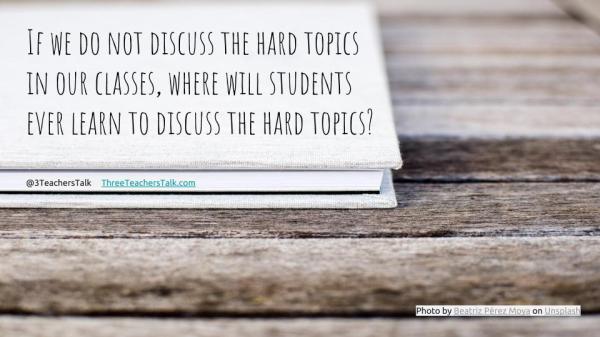
Hard TopicsIf we do not discuss the hard topics in our classes, where will students ever learn to discuss the hard topics? Sure, we can hope they debate social, economic, and political issues in their homes, but we know many families do not have meals together much less conversations. And it’s the conversations, varied and diverse, that can help us view the world in a different light — sometimes a cleaner, clearer, more empathetic and compassionate light. I think we need more of this light.

Here’s part of my response:

I appreciate your concern about controversial topics; however, English is a humanities class, and as such, we should learn about the humanities. That means all the messy topics that make us human. We should invite controversial topics into the classroom. The classroom becomes a microcosm of the world outside of school. If we cannot learn to discuss and debate in polite conversation here, how can we expect to ever discuss and debate politely as adults?

I see it as my job to be sure we think and feel and share as individuals with diverse backgrounds, cultures, and interests. I will continue to use texts, including poems, that give us voice to our lives and thinking.

Side note:  The poems in question were ones I shared as quickwrite prompts to spark thinking for the college application essays students would soon begin writing, “Raised by Women” by Kelly Norman Ellis and “Facts about Myself” by Tucker Bryant. I still don’t see the controversy.

Yesterday I saw a post on a Facebook group I follow where ELA teachers often ask for help. One person posted:  “One of my students challenged me today to include more literature that is relevant to what they are seeing in the world right now. . . What should I include?”

I refrained from responding:  EVERYTHING in my Twitter feed.

We all know the importance of helping students see the relevance in the texts we study, and I don’t know the context of that student’s request, but I wonder if sometimes students believe relevance means:  reflects what I already believe and feel, instead of: often challenges what I already think and feel.

Maybe we need to do a better job of explaining why we must challenge our own beliefs, get out of our echo chambers, and at least acknowledge the opinions of those who differ from our own.

Maybe I failed my student because I didn’t explain enough at the get go.

Today he got his schedule changed. Right after I found this infographic, an argument for the humanities.

We’ll study it in class real soon — after we discuss Jared Kushner’s Harvard Admissions Essay and finish writing our own. (See what I did there?) Then we’ll brainstorm the most debatable topics we can think of — DACA, Black Lives Matter, Confederate monuments, everything A Handmaid’s Tale, gender rights, gay rights, women’s rights, and more rights– and engage in the critical, and oh, so vital discussions that help us understand what it means to be human.

How do you invite these critical conversations into your classroom instruction? Please share in the comments.

Amy Rasmussen is a trouble-maker. Tell her not to do something, and she will do it — especially if it leads to expanding the minds and improving the learning experiences of today’s youth. She teaches Humanities/AP Language and Composition and senior English at a large, diverse, and truly wonderful high school in North TX. Her hobbies are searching for controversial topics that spark debate, reading and sharing banned books, and challenging the status quo. And she loves the readers of this blog. Follow Amy on Twitter @amyrass and @3TeachersTalk; and please join the conversation over on Facebook at Three Teachers Talk.

3 Ideas for Better Book Talks

I should have written this post yesterday. Yesterday was 9/11, and I always try to incorporate some lesson about the events, emotions, and effects of that day into whatever our focus is in class. It’s important we always remember.

My students are juniors and seniors. 9/11 is history to them, and few of my students like to read historical fiction. They choose YA off of my “Teen Angst,” “There Might Be Kissing,” and “You Just Can’t Get Over It” shelves most often. (I suppose most of the books I book talked today fit in that last category though. I’ll be moving a few later.)

Without really meaning to, I shared three books with students on Monday in three different ways. Thus, the idea for this post on engaging students in reading by mixing up our book talks.

  1. Read a poignant, exciting, or particularly intriguing passage from a book.

Over the weekend, I read The Memory of Things by Gae Polisner. I found this a touching story about love and loss and resilience — all topics my students can relate to. What does it mean to be responsible? How do we fight our fears and struggle through the tragedies that terrify us?

In my book talk, I spoke about the characters in the book:  a young man trying to prove his worth to his dad, and a young woman who we learn is in conflict with hers — both struggling with the realities in NYC on the tragic Tuesday of 9/11.

I read the first few paragraphs aloud:

“I move with the crowd, away from downtown Manhattan.

We travel swiftly but don’t run, panicked but steady, a molten lava flow of bodies across the bridge.

A crash of thunder erupts–another explosion?–and the flow startles and quickens. Someone near me starts to cry, a choked, gasping sound, soon muted by a new wail of sirens rising at my back.

I stop and turn, stare frozen. People rush past me:  faces twisted with shock and fear, mouths held open in O’s, others only eyes where their noses and mouths have been covered with knotted sleeves against the toxic, burning reek.

I search fro Kristen or Kelly, or Mr. Bell, but I lost them all as soon as we got to the bridge.

I don’t see anyone I know from school.

I don’t see anyone I know.

I press my sleeve to my nose– Don’t think, Kyle, just move!–but feel stuck gaping at the place where the city has vanished beyond the thick brown wall of smoke.

Two planes have hit, one building is down, and my dad is in their somewhere.”

There’s a lesson in imagery in there I may return to sometime. We are writing narratives right now, so I bookmarked this for later. For now, it’s a good teaser and an effective book talk.

2. Show a movie trailer — but play up on how the book is always better.

My students love videos. They admit to spending their entire lives on YouTube, so any chance I get to show a video clip I take.

If you’ve read Extremely Loud and Incredibly Close, maybe you feel like I do about the movie:  I loved it, but the book just gives us so much more detail, description, characters, and craft to love. Oh, how I love the craft in this book by Jonathan Safron Foer.

For my book talk, I first flipped through the book, showing student how Foer plays with white space, page markings, and photo essays — all which play into how he develops the plot and constructs meaning. I talked about the parallel plot line and how the movie makers diminish, change even, the important second storyline. I explained how this book taught me more about author’s craft than anything I’ve ever read. Then, I showed the movie trailer.

(Book trailers work as effective book talks, too. You’ll find a bunch here and here and here. We even have a few ideas about book trailers in our archives on this blog.)

  1. Use a passage as a quick write prompt or as a craft study. 

Have you read The Red Bandanna: A Life, a Choice, A Legacy by Tom Rinaldi? Just a few pages in, and your heart will swell.

As I read the books I know I will share with my readers, I mark passages that make me think and feel. Important moves for any reader. I model these moves as I share books and writing ideas with my students. This passage from The Red Bandanna tears me to shreds every time.

The Red Bandana

In my senior English classes, I talked about the heroics of Welles Crowther, the main character in the book, and then students wrote in response to the questions:  What do you carry, what truth could it possibly contain? What meaning could it hold?

In my AP Language class, we talked in our groups about the word choice, the interesting syntax, the tone, and then students wrote their answers to those questions, trying to imitate the writer’s rhythm and descriptive language.

In all my classes, we talked about 9/11, our thoughts, our feelings, and why they matter to the lives we live now. We made connections to texts and to one another as we shared our thinking and our writing. That to me is an added bonus of an effective book talk.

I know my students will read more the more I talk about books. I am the salesperson, and they are the often skeptical customer. I’ve learned that mixing up how I talk about books matters.

And getting students interested in reading pretty much anything these days matters most of all.

Do you have ideas on mixing up our book talks? Please leave your ideas in the comments.

Amy Rasmussen loves to read, watch movies with her husband, and tickle her five grandchildren. She’s in the market for a lake house and likes to shop thrift stores for books and bargain furniture. Someday she’ll be disciplined enough to write a book about teaching. For now, she teaches senior English and AP Lang and Comp at her favorite high school in North TX. Follow Amy on Twitter @amyrass, and please, go ahead and follow this blog.
Why We’ll Read More Than an Article of the Week in Senior English

I wish I were kidding. I am still laughing, but this is not funny.

Last week was my first week back to school. We had five days of shifting classes; schedule changes like shuffling cards with every student vying for their winning hand, or at least two out of four classes stacked with friends.

This is my first year to teach senior English (I still have one section of AP Lang), and I felt a mixture of excitement and dread all summer. Twelve years of reading, or not. Twelve years of playing the game of school, or not.

How do I get students to want to read, want to write, want to explore and question and challenge when it’s possible they just want to be done with school? I am pretty sure that’s how I felt senior year. Granted, that was a loooong time ago, but I do not remember any teachers’ names, any books I read for school, anything I learned the year before I graduated.

I wonder if that’s normal. Somehow I don’t think it should be.

But I do not want my seniors to remember me. I want them to remember learning something that adds value to their lives. I want them to remember learning something that adds value to my life as they vote beside me for elected officials, move into my neighborhood, become my doctor, or perhaps teach beside in the classroom next door.

I know the routines of a workshop pedagogy will help me do that, of this I am certain.

We’ll read and think and write and talk. We’ll share our thinking and our writing in small groups and as a class. We’ll talk about books and the themes that resonate and why that might be so. And we’ll write about the things that matter in our lives.

We started all of this in five short days.

I also got a little panicky.

If you are familiar with Kelly Gallagher’s work, you’ve probably heard him talk about why he started Article of the Week. He said he’d given his students, seniors, an article to read, and while circling the room and checking in with small groups, he asked a couple of kids how their reading was going. “Okay,” they said, “except we don’t know who this Al Quaeda guy is.”

Uh huh, seniors. Seniors who had no idea what was happening in their world.

I’m not too sure mine do either.

2017 Face Palm Experience #1:

We’d just looked at images of the destruction from Hurricane Harvey. We’d done some thinking in our notebooks about how these images made us feel and what we could do to help in the efforts to aide our fellow Texans. I walked the room, listening in as students read from their notebooks. Then, I heard this:

“Can a hurricane happen on a lake?” Student A said, “I mean like would a hurricane ever happen on Lake Lewisville?”

I stopped. Wouldn’t you?

Student B answered, “Uh, hurricanes happen on an ocean.”

“So what ocean is by Houston?” said Student A.

“That’s the Gulf of Mexico,” said Student B.

And Student A asks “So what ocean is that, the Pacific?” as she reaches for her cell phone.

I wish I were confident she planned on looking up information about hurricanes and oceans and weather patterns. Somehow I doubt it. I’ve asked her to put her phone away 47 times in five days. (So far phones have not been an issue except with this student.)

Now, I am left wondering:  Will whatever we do in room E111 be enough to prepare my students for the world beyond the halls of our high school? The responsibility is a lead weight on my shoulder.

I sure hope I can carry it.


Amy Rasmussen is the mother of six amazing young adults, grandmother of five smart and sassy little people, and wife to a brilliant marketer, sales exec, life coach, and dog lover. She teaches readers and writers in AP Language and English IV in North TX and facilitates professional development on the workshop model of instruction at every opportunity. She loves God, her family, the U.S.A., and all humans everywhere. Follow Amy on Twitter @amyrass

Guest Post: Find the Light in the Darkness: My English Classroom Post-Harvey

I’m a teacher. My job is to teach children-teenagers-everything English. It is what I was Clear Creek ISD June 2017 (1)called to do 10 years ago. So as I sit here in the aftermath of Hurricane Harvey, I can’t help but think about what I will teach my students when we return to school and our new normal.
What can my English classroom offer a student who has possibly lost everything in a horrific storm? A student who is staying in a shelter wearing donated clothes because all he could carry out of his flooded house was a duffle bag and the clothes on his back? A student who has braved the tragic conditions to save others from their nightmare of rising water and tangible fear? A student who didn’t flood, but is watching his friends and family suffer the stress of life-altering devastation?

Staying indoors for 5 days straight offers ample time for reflection, so the answers to my questions have come. My classroom has not changed–it is quite possibly the one stable place that Harvey couldn’t touch. Not that he didn’t try. My classroom will remain a safe place for my students to write through the pain they feel. It will be a microcosm for the amazing unity we are seeing in our area. It will allow my students to talk to their peers about shared emotions. It will give students the opportunity to write to process, to share, and to unite. It will be a place where tears are shed and spirits are renewed. It will be a place where students can learn about compassion and what it means to be a community through real-world experiences right in our backyard.

I am not sure I could think of a stronger classroom than that.

And I will lead the way as I always do–through modeling with my own Harvey experience. And when I do, it will probably look something like this:

As I sit here writing these words, I am not even sure what emotions I’m feeling anymore. Fear. Shock. Disbelief. Fear. Sadness. Guilt. Fear.

I don’t think I will ever forget this storm. The fear I felt Saturday night as the rain and wind ripped through my neighborhood is indescribable. At one point, I just wrapped my arms around my sleeping three-year-old daughter and hugged her close to my chest- not to comfort her, but to comfort me. I needed stability because I had absolutely no control over what was ensuing outside my window.

Texts poured in throughout the night- friends and family checking in and reporting the surreal nightmare unfolding before our eyes. Water ferociously crawled up my yard, and I watched with panic. My Facebook newsfeed couldn’t refresh fast enough as I saw new friends reporting flooding with every second’s update. I finally fell asleep at about 4:00 in the morning as the howling wind died down to a soft roar, and the water stayed a few feet away from my house.

What I woke to on Saturday morning is what still sits in my gut. The national news channels- national, people- like CNN and The Weather Channel- were in a place so near and dear to my heart. The place where I went to elementary school. The place where I slept over at friends’ houses. The place my husband and siblings went to high school. The place that taught me what it means to be a teacher. The place I spent the first six years of my teaching career. The place where SO many of my friends and beloved former students live. The place that had been hit like a freight train by this natural disaster called Harvey.

There is something very eerie about seeing familiar places and faces on the national news.

I saw images of my friends on rooftops being rescued by more of my friends selflessly putting themselves at risk to save others. I saw even more of my friends and their babies, some only days old, riding in boats to their safety and riding away from the lives they had known before the storm. I commented on all that I could, but with each comment, my words felt less and less valuable. How many times can you say, “I’m so sorry. I’m praying for you.” before it means nothing?

I received more texts from friends and family far and wide.

“I saw Dickinson on the news. Are you okay? What can we do?”

The scenes I watched on TV and social media were shocking. But the weird thing was, I didn’t cry. All day, I held it together. Probably because I didn’t want to worry my daughters. And probably because I was numb to what was going on–I just kept saying that I couldn’t believe what I was seeing.

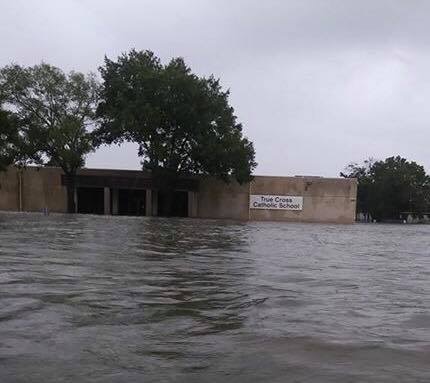
Until one picture came across a text. My childhood friend had been out all day on his boat rescuing people in Dickinson and knew I would want to know how our elementary school, the school my two daughters currently attend, fared in the storm. That’s when I lost it.

TrueCrossCatholicSchool

Once the tears started, it all came rushing forward. I cried for my girls who no longer have a school. I cried for my friends who no longer have a home. I cried for my former students who lost everything. I cried for my sister whose husband drove her suburban up on a trailer at 2am as the waters rose fast beneath his feet threatening to enter their home. I cried for my family who no longer has a church. I cried for my coworkers as I read their terrifying scenarios of rescues from rooftops. I cried at the thought of the stories I haven’t heard yet. I cried because I am stuck at home, flooding all around me, unable to get to those who need me–even if it is just to give a hug to say what my words can’t seem to express.

But behind the tears is an incredibly proud spirit that knows we will bounce back–as a community, as a state, as a nation. We will pick ourselves up and pick up those who can’t find the strength along the way.

It is very easy to let the guilt creep in as I think about why my house was spared in the flood. But I have chosen to focus on the answer instead of the question. I know why I was spared- so I can help.

I will help my students cope through reading and writing. I will listen to their stories and cry right alongside them, all the time reassuring them that we will get through this. I will teach them that through dark times, we must look for the light. I will be that light for them if they can’t seem to find it anywhere else.

I will help my friends clean up and start over. I will volunteer my time to tearing out soaked sheet rock and ripping up soggy carpet. I will offer my home to the ones who are now homeless. I will hug them and catch their tears on my shoulders as they try to pick up the pieces and move on.

I will help my daughters clean up their school and the teachers there (one of whom is my sister) replenish their classrooms. I will help the school rebuild and crawl out of the hole of destitution Harvey has created.

And through all of this, I pray that I will help the world see that there is hope for humanity. If you can’t see it, just come on down to my community and watch because it is in full force all around me.

Now move out of the way, Harvey, we have work to do.


Bio: Megan Thompson is the Department Head of English at Clear Creek High School. She teaches AP Literature and Composition and Pre-AP English I. When she isn’t teaching, she spends most of her time chasing around her daughters, Aubrey (5) and Maycee Jo (3), and spending time with her husband of 7 years. Follow Megan @teacher_mmt

Guest Post: A Houston Teacher’s Heart

What do you do when a hurricane slams you in the face after four days of school?Clear Creek ISD June 2017 (1)

This was the best first 4 days of school I’d ever had. Tuesday saw us independent reading with self-selected books for the first 10 minutes of class. A habit we will cherish through June. We were moving in and out of our notebooks by Wednesday. Groups were discussing and reporting their thoughts back to the whole class. A community was rising in all four of my senior English classes. My inclusion para-professional and I had worked through the mountain of paperwork and conferred about this student and that one. I had plans to video a class for a whole week to use for who knows what. Who could believe that senior English students could move so far so fast. Our potential was limitless.

My district sent out a message Thursday evening that school would be cancelled on Friday. Some coaches met up at school that evening to stow away hurdles, high jump mats, and benches. We lamented our missed football scrimmage and wondered when we would resume school.

The hurricane projections said it would hit hundreds of miles away and would only be a category 3. We knew the “dirty side” of a hurricane was not a fun place to live, but a few days of rain and maybe a little wind was all I mentally prepared for.

Friday, I went to school to grab my laptop and a couple of teacher books so I could finish my lesson plans, review the game plan for next week’s game against Pearland, and whatever else needed attention. Having been through hurricanes and heavy rain before, I thought maybe we would go back to school on Tuesday at the latest.

Our football staff has a group text that is mostly silly memes and rude jokes. Now it reads like a timeline of the storm.

As I look back on the text threads, there is a definite change in tone on Friday evening when the rain started. We went from making fun of each other to being seriously concerned for one another. The rain fell Friday night but none of us had water in our houses or were flooded in. I even got out of the house to drive around on Saturday. I went to the grocery store for eggs and drove around a bit to see what was what. We spent the day planning for our week one football game and watched the news as the storm worked its way closer.

Saturday night was when it started getting scary. A flood, a deluge of water fell on our city. My wife and I didn’t sleep. It was one of the scariest most nerve wracking nights of my life. 15 inches of rain fell in 3 hours and we were constantly up and down watching the water levels in the street rise and making sure our flooded pool wasn’t about to merge with our kitchen. The coaches’ group chat filled with pictures of rising water and reports from all over south and west Houston. I’m sure we are all too macho to admit it, but we felt that fear collectively and it was a relief for us to know that we weren’t alone in this storm.

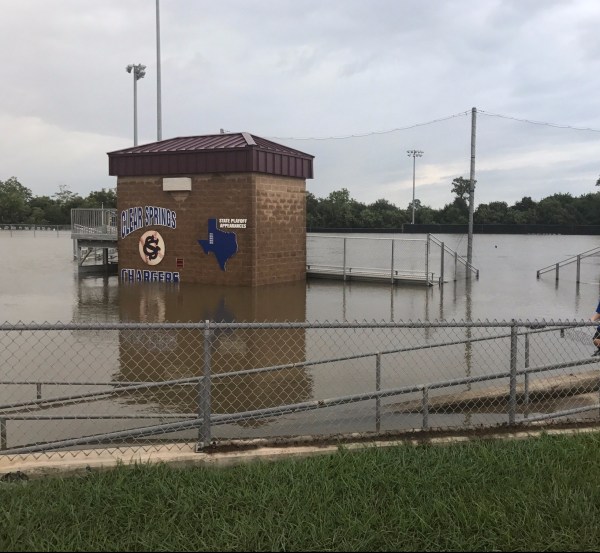
When the sun rose on Sunday, my house was still dry and the electricity was on. Others weren’t so lucky. Neighborhoods within a quarter mile of my house were completely flooded out and many of our students don’t have a home to go back to anymore. I’m sure you saw reports on TV of water rescues happening in League City. Those are our kids. I see those families at parent night and sub varsity football games. We shop at the same grocery store and order pizza from the same place. My twitter feed filled with images from our community of families who were rescued in boats and won’t see their houses for weeks.flood

Despite the destruction we endured this weekend, I can’t help but think toward the future. It will take some time, but the flood waters will abate and the roads will clear. At some point, we will reopen our schools. We will ask the students and teachers to come back and the process of building will resume.

Even those whose houses didn’t flood will bear the scars of this terrifying natural disaster. And those whose houses did flood will be consumed by it.

Where will that process even begin? What will I say to them? What can I reasonably expect them to produce?

I have no idea how to answer most of these questions. All I know is that I’m going to tell them that I love them over and over. My classroom will be a refuge from the aftermath of the storms. We can be safe together. We can write about our pain and share our fears. My Student Council class will work to bring some normalcy back to people’s lives whether through food drives, donations, or lending a hand to those who need it. I’m going to give my linebackers the biggest hugs they’ve ever gotten and I’m going to tell those boys, who think they are men, that I love them.

Harvey’s footprint will always be seen on this school year for these students and teachers.

Maybe we can learn about survival and community and love. I think my classroom is the perfect place for those lessons. I hope I’m up to it.

Charles Moore is the senior English team lead at Clear Springs High School in League City, TX. He enjoys leisure swimming, reading, and coaching linebackers. Follow Charles on Twitter @ctcoach

God Bless Texas

I know I should write about readers and writers in room E111, but I just can’t today. Because Texas.

Thank you to my online friends who’ve asked if my family and I are okay. Yes, yes, we are. I live in North Dallas — far away from the major flooding down by the Gulf. I appreciate your kindness and concern.

I wonder if you’d do me a favor — do you think we can take that concern and turn it into action, if we haven’t already?

Here’s some perspective of the need.

Screen Shot 2017-08-28 at 7.07.04 PM

Guys, Texas is a huge state. We are talking A LOT of water.

Here’s some ways to help:  According to FEMA, we can connect with trusted volunteer organizations. We can also donate online or by phone.

Screen Shot 2017-08-28 at 7.04.43 PM

Isn’t it amazing how quickly we can put concern into action with that Red Cross text?

If you’d like even more inspiration, check out this Hurricane Harvey Relief Fund thread. Every little bit will help.

My students came to class today. We enjoyed a pretty stress free back to school.

Thousands of children did not.

I will share these links with my students today, and we will make a plan to help our neighbors.

I pray we will all continue to do our part to ease suffering, relieve stress, save lives, and make the world a better place for everyone.

God Bless You All, my friends.

And God Bless Texas

Amy

Our Day One Writing: Personal User Manuals

I’ll be honest. I’ve started this post three times. At first bemoaning why I can’t believe summer is over. Then whining that I didn’t get enough done, and finally, justifying why I can’t seem to get in a writing groove. None of it matters. I started back to school yesterday. Kids come next Monday.

I will be ready. And I’ll love it.

I’ve spent hours working on my new room. It’s almost done (I’ll post photos soon), and I classroom culturefigure if I can get my room perfect, everything else will fall into place. Misplaced priorities? Maybe, but that’s how I roll. The aesthetics in my classroom matter to me, and if you’ve visited (and many teachers and admin from around TX did last year), you know what I mean. Book shelves just right. Colors and furnishings that invite. Places to chart skills taught and showcase students’ thinking. All of this matters to the culture I work hard to cultivate in my classroom.

And while I’ve worked, I’ve thought about the students whose names rest on my rosters. Who are they as readers and writers? Who are they as individuals with needs and wants and passions? How can I help them know of their potential and of the possibilities that await them not just this year but beyond?

I’m teaching seniors for the first time this fall. Since my school is on an accelerated block schedule, I will have these students for one semester. Just one. One semester at the end of their high school experience. One semester to create a community, build a culture, bridge gaps, shape literacy identities as individuals about to face the big wide world — hopefully as citizens unafraid to face their fears, and the frightening things in our society.

One semester to read and write and think — together. One semester with a dream for a lifetime.

I’ve read a lot about the importance of building community lately, and I’ve talked a lot about the first day of school in most of the pd I’ve facilitated. I used to think, especially with my AP Lang classes, I had to knock ’em dead with my syllabus the first day, list my expectations, explain my grading policy, discuss my plan for how and what they would learn. Scare them into understanding the complexities of my AP class. I blew a lot of opportunities over the years. That “my” got in the way a lot.

How can it be “our” learning community if I am the one laying out all the learning plans? If I am the only one talking about what the learning must look like?

I wrote this post Talking about the First Day of School in 2015. Funny because I’m in the same canoe this year, wondering about how I will welcome students on Day One. The last thing I want is to ignite the fear, flight, freeze response, which so often happens with that same ole same ole flood of student expectations. Students are already experiencing high levels of stress the first day of school. I do not want to accelerate it

I’ve thought about reading the poem “Possibilities” by Wislawa Szymorzska. I wrote about how my students and I used this poem to begin our understanding of rhetorical analysis last year. I’ll do that again, but it’s probably better as a week two activity.

TeacherAuthorBio

author bio, Linda Sanchez, Wylie ISD

I’ve thought about reading author bios and asking students to write their own. Lisa and I wrote about our successes with students writing author bios last year and even modeled writing author bios with our teacher friends during pd this summer. So many talented teacher writers! Author bios are a new favorite, but they’re probably not for day one.

I’ve thought about jumping right in and setting up our writer’s notebooks. I stocked up

composition notebooks

I bought 170. The cashier at Walmart scanned them one by one.

and have one for each student ready at the bell. Now, I’m wondering if setting the notebook up is as important as just writing down some thinking on the first day of school.

Susan Barber wrote about her First Day of Class activity, and the idea of beginning with reflection resonates with me. I just don’t know about a trek to the football field — our students graduate at the UNT Coliseum miles away, and TX weather means it’s still hot hot hot. I can already hear whining. I love Susan’s idea though and want to think about this more.

I keep coming back to community. And culture.

My instruction works because of the community we build as readers, writers, listeners, and speakers. Or is it a culture we create as readers, writers, listeners, and speakers? Is it possible to have one without the other?

When Lisa was in town, we sat in my car in a parking lot and talked about this very thing. Lisa shared her wisdom: “Community is the classroom. It’s more immediate.” Mentioning her teaching before her move to workshop, she said,  “I built community to help us get through the things students didn’t like — like Huck Finn.”

Interesting. So community is good — sharing likes, dislikes, working toward a common goal, getting along, respecting one another.

We talked about get-to-know you games, icebreakers, we’ve all used on the first day of school. Many of them good ideas for building community. Then Lisa asked: “Do we get-to-know for the get-to-know — or the value of learning who are students are as readers and writers?”

Ah, the beginnings of building a culture.

“Culture is more pervasive,” Lisa said, “A culture of learning in an English class values reading, writing, talking, and thinking that goes on — that has demands beyond the classroom.”

And now I’m wondering:  On the first day of school, how do I build a community that begins creating a culture, a culture that validates, shapes, and inspires my students’ identities as thinkers, readers, writers, citizens, and humans that goes beyond the classroom?

Not an easy feat. But maybe there’s an easy start.

I don’t know why I clicked on this headline, but I think I’ve found my first day of school: “Completing this 30 minutes exercise makes teams less anxious and more productive.”

I think we will write personal user manuals. It’s a task business leaders are using to help

user_guide

I’d like a better name than “user.” Any ideas?

their teams work better. Why not try it in the classroom?

The article states, “The user manual aims to help people learn to adapt to one another by offering an explicit description of one’s personal values and how one works best with others. This shortens the learning curve for new employees, and helps everyone avoid misunderstandings.” Since student talk and collaboration is central to my instruction, I think writing one-page user manuals about ourselves might put us on the fast track to better communication and the culture that fosters better learning.

Abby Falik, founder and CEO of Global Citizen Year, states: “My User Manual is one of the ways I practice leading out loud. It’s a living document that describes my innate wiring and my growing edge, while putting it out to the world that I know I am – and aim to always be — a work-in-progress.” And the article includes the structure Abby used to write her manual and a link to the manual itself. Mentor text, y’all!

Abby’s user manual centers around these six topics:

  1. My style
  2. What I value
  3. What I don’t have patience for
  4. How to best communicate with me
  5. How to help me
  6. What people misunderstand about me

I’m thinking of including prompts that probe other topics more specific to what I need to know about my students literacy histories — kind of like a reading/writing territory — and topics that can jump start connections and trust between students. Maybe things like:

Describe yourself as a reader.

What is your favorite book? Who is your favorite author?

Write a simile about your writing life. 

When it comes to English class, where do you feel you want to grow the most?

List ten things you like to do in your spare time.

Of all your memories, which three are the most indelible?

What five adjectives describe your disposition?

I also like these questions I read regarding building trust in Adolescents on the Edge by Jimmy Santiago Baca and ReLeah Cossett Lent, a book I just started and am already loving for content, stories, and ideas:

Have you experienced fair treatment, either by family or by the system?

How do you express appreciation? Do you often receive appreciation for your acts?

How important is it for promises to be kept, either those made to you or those you make to others?

Do you feel that you are a part of decision making that affects your life?

Are you dependable? Do you feel others are dependable?

How do you generally resolve conflicts?

How important is truthfulness to you?

Too much? Maybe. But students will have choice in what they answer — and how. And like any time we write like this, we will talk first. Talk matters in a writing classroom.

Of course, I will write my own user manual. If I get my act together, I’ll have it ready on Day One as a way to introduce myself to my students. Hopefully, I can write it in a way that lets them know that while I am intense, passionate, and purposeful in helping them grow as readers and writers, I am also pretty vulnerable, and an introvert on a stage cast in the role of extrovert.

I’m thinking we will use our user manuals a lot. I’ll include a copy of each students’ in my conferring notebook for easy access and review when I meet with them. We’ll share with our table mates. We’ll share in our book clubs and in our writing groups. We’ll share when we do group projects or collaborate on writing.

We will use our manuals like leaders in business do because “the ability to share your thoughts and ideas openly, honestly, and without fear of judgment—has been repeatedly proven the key to innovative, happy teams. Whether you’re a manager or young employee, writing and sharing a user manual has a clear business payoff. The better a team knows one other, the easier it will be for them to navigate conflict, empathize with one another, and feel comfortable sharing, critiquing, and building upon one another’s ideas.”

What do you think? How will you (or did you, if you’ve already gone back) start building your classroom culture?


Amy Rasmussen is the mother of six amazing young adults, grandmother of five smart and sassy little people, and wife to a brilliant marketer, sales exec, life coach, and dog lover. She teaches readers and writers in AP Language and English IV in North TX and facilitates professional development on the workshop model of instruction at every opportunity. She loves God, her family, the U.S.A., and all humans everywhere. Follow Amy on Twitter @amyrass