Author Archives: Amy Rasmussen

Keeping It Real As a Teacher of Writers

I have taken up watercolor. It’s been ages since I tried a new hobby, and I find the challenge pretty intense. Prone to put perfectionistic pressure on myself, my need to “get it right” limits my ability to play. This is problematic. And pretty stupid.

I will never get better if I do not take risks — with brushes or pigment or with the water.

For a long while now, I’ve followed my friend Laura’s work with watercolors. Her talent paints.jpgpiqued my desire to give painting a try, so I sent her a message asking advice on beginner supplies. She was gracious and encouraging in her response.

Then, I bought not three brushes but nine, not one medium-grade paint set but five, not one pad of paper but seven — in a variety of sizes. And I saved over 48 watercolor tutorials on Pinterest, plus, watercolor images of flowers, people, trees, waves, birds, landscapes, gardens. . .and pigs; and followed 18 watercolor artists on Instagram.

Because it seemed a lot easier to get ready to learn to paint than it did to try and fail.

Kind of like writing.

If you’ve read this blog awhile, you know I’ve been thinking about writing a book almost since starting 3TT. I’ve outlined three now. But I think and talk and read what others say about writing much more than I write. Like my hesitation about painting, this is problematic.

Of course it is.

And it reminds me of many of my student writers — the fear of getting it wrong or not making the grade, the vulnerability it takes to put ideas out there.

It’s real, and sometimes it’s stifling.

As I’ve worked to conquer my fear of learning to watercolor, practicing lessons on Skillshare (which has a plethora of lessons on multitudes of topics — check it out if you haven’t), trying new brushes and different washes and color combinations, and, finally, just relaxing into my art, I’ve discovered what I hope all young writers discover:

Writers must write for themselves. They write because they feel the tug of it, the need to express thoughts and ideas and meaning. Because they want to. Just as I paint for myself –the joy of it, the adventure in seeing if I can, the peace it brings me.

Recently, 3TT was asked this question on Twitter:  How often do you think MS and HS writers should publish? and I responded–

3tt tweet

I’ve thought about this exchange a lot since, and my thinking has led to more questions than answers:  How can we help our writers set personal goals for their writing? Which comes first:  the personal goal or the desire to write? If there’s no desire, can writers still write well? Does it matter if students write well?

Of course it does.

But just like every watercolorist finds her style, every writer must find his. All too often, school writing means prompts and formulaic structures, word counts and rubrics that restrict meaning-making more than they invite it.

So what can we do to open spaces that invite writers into the vulnerable places needed to grow? The best way I know is to keep it real.

Here’s a short list of what real means to me as I teach writers.

  1. Design Lessons based on what real writers do. For example, they don’t use standardized prompts — they come up with ideas they want to explore, creating their own prompts. Try quickwrites that inspire students to think about their lives and the world around them. Plan time for them to talk to their peers in ways that expands their thinking. Plan time for them to explore topics that interest them or challenge their thinking. Don’t just ask students to write about what they know. Ask them to write about what they notice.
  2. Make your writing life visible. Our writers need to see our thinking as we organize our thoughts into words on a page. They need to see us clarify, discover, and make meaning. They need to see that revision leads to improvement. Revision is not just a one-and-done step in the writing process. It’s not a strategy. Revision is a living breathing move writers make, and they make it often. Model all of the moves you do as a thinker, reader, and writer.
  3. Talk about everything related to writing and writers. “Writing floats on a sea of talk” (James Britton). Our writers need to share their ideas with one another — and with us as writing coaches in conferences. Often, we wait to invite writers to talk about their writing in peer feedback groups or in conferring sessions after they have penned their drafts. Real writers talk throughout their writing processes — from idea to draft into revision and on to redrafting. Talk leads to clarity and discovery, and in my experience, purposeful talk is the best resource teachers have for helping all students grow in confidence as writers.
  4. Immerse writers in beautiful language, clever word play, effective and powerful stories, essays, and poetry. Mentor texts that show students the impact of word choice, figurative language, and everything else from how an author creates believable characters to using dialogue to propel a plot forward are valuable teaching tools. Studying mentor texts helps students internalize what writers do. They come to recognize organizational patterns and structures they may choose to use in their own writing. Before I write pretty much anything of import, I study mentors. Don’t you?
  5. Make writing personal and purposeful. When we write about things we care about for readers we care about, we make deliberate choices as writers. Too often, and I am guilty of this myself, our writers only write for their teacher. Now, maybe your students differ from mine, but I’ve taught many a writer who didn’t care that I was her reader, and it showed. However, when I removed myself as my students’ primary audience and worked to build a community of writers where they wrote for one another, almost every student (sadly, there’s often a few hold outs) began to take greater care and ownership of their writing. They knew they had readers other than me. Of course, we can also help students determine outside-of-class purposes and audiences for their writing, and I encourage it; however, I’ve found that sharing our writing within our own classroom community is just as effective.

By no means do I claim to know it all when it comes to teaching writers. The puzzle working with adolescents is as real as my desire to help them grow as writers — and my newfound desire to learn to watercolor. I do know authenticity matters. When we make choices about literacy instruction, steeped in the authentic practices of what real readers and writers do as they read and write, more students engage in the tasks we ask of them. They take more risks. They more often than not rise to the occasion. And they shine as writers in their own right.

If you’ve made it to the end of this post with me, I appreciate you. And while I am not super confident in my watercolor abilities, and I have a ton to learn about the art of it all, I do have a stack of 20 bookmarks I’ve painted — mostly of birds because they make me smile. If you’d like one, share this post, follow me on Twitter @AmyRass (if you aren’t already), and send me a direct message with your name and address. (First 20 only. I’ve got a book to write.)


Amy Rasmussen has decided she loves teaching writers more than she loves to write, but she’s working on a balance of that as she attempts to discipline herself to “get ‘er done.” She has also decided that watercolor painting is harder than it looks. Amy’s currently on a “gap year” from the high school English class as she works on a book about authentic literacy instruction and facilitates professional development as an independent literacy consultant. She misses kids. A lot.

I’ve Got Three Problems

Of course, making New Year’s resolutions is nothing new. Perhaps keeping them is. At least for me.

If you know me well, you know I am an idealist. I usually wake with Big Ideas that go onto lists and into Whatsapp convos with my blogging partners. But lately, actually, for a long while now, my first thought of every day has been:  What is it you want?

I do not have an answer (at least not one simple enough for just one blog post), but I do have a pretty clear idea of what I do not want. We can all probably make that list — easy.

I read Seth Godin’s blog pretty much daily. He’s a marketing guru, and I find useful info in his short quippy posts. On the last day of 2018, he published  Hilbert’s list.  It begins like this:

In 1900, David Hilbert published a list of 23 problems that he proposed would be the important ones for mathematicians to solve in the upcoming century. That list led to a focused effort that lasted a century, and the vast majority of the problems have been fully or partially solved. Ignoramus et ignorabimus is a foolish statement. We can know, and one day, we will.

Technology (the technology of connection, of devices and of knowledge) can create a surplus. The cost of light, of transport and of food has dropped by orders of magnitude in just a few lifetimes. Most of us waste electricity, water and other essentials in ways that would have been astonishing just a generation ago. Privileged populations go to the doctor for illnesses that wouldn’t even be a topic for discussion among those with less access to the surplus that we’ve created in access to healthcare.

Surely, we can build a better future with technology instead of focusing on autonomous drone delivery of a latte 9 blocks away in San Francisco.

As we enter a new year, one in which technology promises to move faster than ever, it’s worth considering what our 23 problems might be.

Then Godin suggests we make a list of the problems we want solved, personally and/or globally.  He states, “Technology doesn’t have to be high-tech. It can simply be the hard work of finding generous solutions to important problems, big or small.”

And this made me think about teaching, specifically teaching our readers and writers to be better readers and writers. I could probably come up with a list of 23 problems, but I think a concerted effort on just three would change literacy education as we know it. Thus, we change the lives of our students — and potentially, the world.

  1. Equitable systems that validate, celebrate, and allow educators to teach into the personal and unique strengths and needs of each learner.
  2. Authentic literacy experiences, including easy access to a wide array of vibrant engaging books by diverse authors our readers want to read; and using these texts to teach writing — the kind of writing our writers want to write, and readers in the world want to read.
  3. On-going professional learning at every level of literacy education, which builds content-specific skill so administrators and teachers know how to engage and instruct readers and writers through authentic literacy experiences.

As we step into 2019, I commit to adding my voice, to pushing back against the status quo, to advocating for students and teachers. As Godin says, “Our next steps might be far more effective than simple resolutions, which are easily ignored or pushed aside. We can work toward dignity, toward access, toward seeing the world as it is…” Or perhaps more importantly, toward seeing the world as it needs to be.


Amy Rasmussen is excited for the New Year and looks fondly back at 2018. She made some important career moves, changed homes, welcomed two new grandsons, and met her reading goal of completing 66 books. Follow her on Twitter @amyrass

3TT Talks Gifts: Besides BOOKS, what supplies make your workshops work?

“I think the greatest gift that anybody can give anybody else. . .As a matter of fact, the only unique gift that anybody can give is his or her honest self.”  Mr. Rogers

Teachers give of themselves uniquely all the time. We know this. We live this.

We plan, teach, reflect, carry tote bags of papers home to grade at night and on the weekends. Okay, that doesn’t sound too unique. It sounds like every other English teacher we know.

But — you are unique, and we know you give of yourself uniquely to your unique students. Daily. And since this is a time of year we often get a chance to pause, give thanks, recharge, and give and receive gifts, it seems like a good time to share some of our 3TT favorite things — just in case you need some ideas on gifts for colleagues or ways to spend that stack of gift cards coming your way. (Sometimes it happens.) And just so you know, if you buy through our link, we will get a little something.

I asked Three Teachers’ Talk contributors questions about their favorites. (I already posted a gift list for favorite YA books.) Maybe some of these workshop necessities are already your favorite, too. Maybe they’ll serve as good gift suggestions.

What type of notebook do you purchase for yourself? Any particular size, shape, brand?


Zequenz Classic 360 Softbound Journal

Mead Composition Notebooks

Paipur Notebook, softbound, 9.75″ x 7.25″

Moleskin Classic

Exceed Dotted Classic Notebook

Rocketbook Everlast Reusable Notebook

a regular spiral


What type of pen do you choose to write with most often?


What classroom supplies can you not live without?


Do you have any go-to games or activities you use with your readers/writers?

Bring Your Own Book. My juniors love this!


Taylor Mali’s Metaphor Dice

Story Cubes

The Autobiography Box

Quicktionary:  A Game of Lighting-fast Wordplay

Crazy Aaron’s Thinking Putty (I have this in lots of different colors. Great for fidgeters or serious thinking time.)

3TT Talks Gifts: What books will you give this season?

If you know me, you know I live by lists. I make them. I collect them. Sometimes I even stick to them. I raised seven children, you know. I had to keep track of who needed to go here, there, and everywhere and who needed what and what and what just to survive and thrive in our robust and rowdy family. Christmas shopping, often on a bone of a budget, gave me hives.

Gift-giving has never been my strong suit. Perhaps my practicality, and my history of stretching dimes into dollars, gets in the way of thoughtfulness. (Not even kidding, my kids got socks and underwear wrapped in cute paper. To their credit, they never complained–at least not to me.) I know it is possible to be both practical and thoughtful, but I am still working on that balance.

So what does any of that have to do with a blog about teaching readers and writers? Not a lot — except, I asked my fellow writers to help me craft a list for literacy teachers. Maybe you’ll find something to gift yourself, a colleague, a friend, or a perfect stranger. (I like the idea of gift-wrapping a book and giving it to one of the Salvation Army bell-ringing volunteers and saying, “This is for you.”)

Part 1 of this literacy teachers’ list is below. I’ll post about professional books, and favorite writer’s notebooks, pens, and other clever things for literacy lovers over the next few days.

BOOKS. What are the top titles students love in your classroom library right now? (Remember, we work with a range of readers from middle grades to AP Lit. There’s old and new, non-fiction, YA, and just some really good recommendations here, in no particular order, that would make great gifts for any reader or want-to-be reader or you-want-them-to-be a reader in your life. )

The Poet X by Elizabeth Acevedo
Long Way Down Track Series (Ghost, Patina, Sunny, Lu) by Jason Reynolds
Ready Player One by Ernest Cline
The Hate You Give  by Angie Thomas
American Street by Ibi Zoboi
Graphic novels (Ghosts, Smile, Babysitters… by Raina Telgemeier
Love that Dog/Hate that Cat/Moo by Sharon Creech
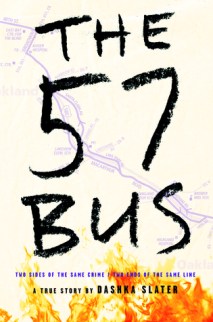
The 57 Bus:  A True Story of Two Teens and a Crime that Changed Their Lives by Dashka Slater
Love, Hate, and Other Filters by Samira Ahmed

331553252034261734647324

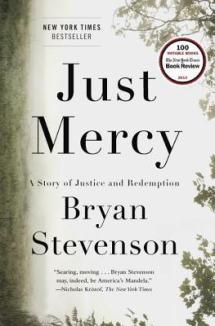
Just Mercy  by Bryan Stevenson & the version adapted for YA
Lies My Teacher Told Me by James W. Loewen
The Handmaid’s Tale by Margaret Atwood & the graphic novel version by Nan A. Talise
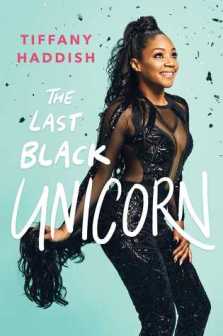
The Last Black Unicorn by Tiffany Haddish
The Nightingale by Kristin Hannah
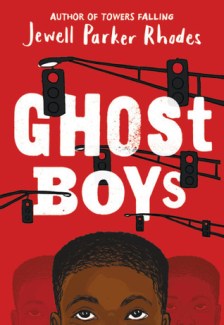
Ghost Boys By Jewell Parker Rhodes
The CrossoverBooked & Rebound by Kwame Alexander
Children of Blood and Bone by Tomi Adeyemi
The Greatest Stories Never Told:  100 Tales from History to Astonish, Bewilder, and Stupefy by Rick Beyer

249749963497431033830437

An Ember in the Ashes by Sabaa Tahir & the whole trilogy
Looking for AlaskaTurtles All the Way Down by John Green
My Bloody Life: The Making of a Latin King by Reymundo Sanchez
Twisted by Laurie Halse Anderson
Dear Martin by Nic Stone
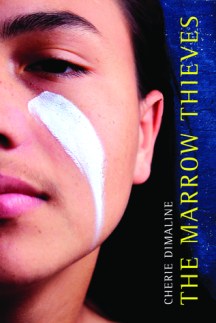
The Marrow Thieves by Cherie Dimaline

NOTE: Get this book free with a donation to Book Love Foundation

We Should Hang Out Sometime:  Embarrassingly, a True Story & Love and First Sight by Josh Sundquist
I am Not Your Perfect Mexican Daughter by Erika L. Sanchez
Because I was a Girl:  Trues Stories for Girls of All Ages by Melissa de la Cruz

346493482901039534608062

Between the World and Me by Ta-Nehisi Coates
The Martian by Andy Weir
1984 by George Orwell
The Lovely Bones by Alice Sebold
The Road by Cormac McCarthy
#NotYourPrincess: Voices of Native American Women by Charleyboy (editor)
All the Broken Pieces by Ann E. Burg
The Astonishing Color of After by Emily X.R. Pan
Far from the Tree by Robin Benway

For more book-gifting ideas, check out the Goodreads Choice Awards for 2018; 15 Life-Changing Middle-grade Books; and here’s the School Library Journal list of best children and YA audiobooks of 2018.

Conferring and My Wish for a Time Machine

I am as guilty as the next guy. When I first started teaching, I didn’t have any idea how to get students to read more, write more, do more in my English class. I didn’t even know I would have to work so hard. Although I was in the middle of raising my own teenagers (and they all turned out great), I had no idea how to inspire other people’s teens to give books a long enough look to want to read them or to take the time needed to write something they would want others to want to read. I was all about my content, my lesson plans, my choices, my control. I did most of the talking. I did very little listening.

I remember the first day of my first year teaching. Students sat in assigned seats, alphabetically by last name. I asked each student, seat by seat, row by row, to tell everyone their name and one thing they hoped to learn in their freshman English class. I have no idea what they said — except for one.

“My name is Susie, and I hate white people.”

I am a white woman.

I might have felt stunned, hurt, appalled. I do remember thinking, “The audacity!” and shouldering an internal huff. I tried not to let these words sink me before I ever got afloat, and for the most part, I think I succeeded. Susie and I learned to work together that year, and she did fine in my class.

But my idea of success is much different than it was back then:  I no longer think fine is ever good enough.

I think about those young people from my first few years of teaching, and if time machines were a real thing, I’d set the dial to 2008. I would do things differently because I am different. I know better. I learned to be better.

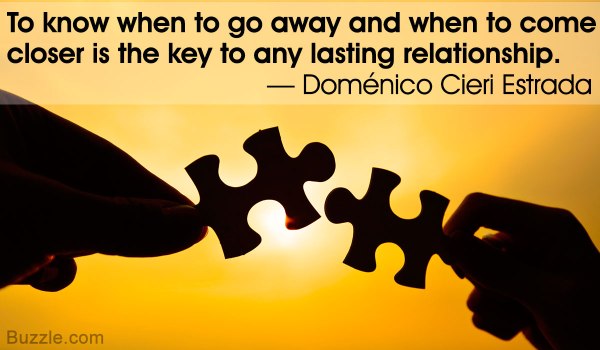
1200-330446-relationship-quotes-and-sayings

Last week I facilitated a day-long training on implementing the routines of readers-writers workshop in secondary classrooms — a shift in pedagogy so students sit at the center and learn through authentic reading and writing practices. These teachers are eager, and their district leadership is providing support to make this happen. Yet they struggle.

In table-group conversations, two topics came up again and again:  Our students lack discipline. We need more tips on conferring.

What’s obvious to me now, that wasn’t back when I first started teaching, is a clear connection between the two. Students need to be heard. Now, I am not saying that implementing a workshop pedagogy will fix all disruptive behaviors, but I do believe these behaviors are often evidence of a lack of conferring. Students need to be seen and heard. (See more on why here.)

We talk a lot about creating a positive culture in schools and cultivating learning communities where relationships thrive. These take intention, effort, and time. In ELAR classes, these take intentionally designing instruction that utilizes every square meter as we practice authentic literacy skills with authentic texts and model the effort it takes to build our identities as readers and writers. To do all of this well, we must meet our students where they are in their learning, or in their apathy, or their attitudes, or whatever we want to call it. Conferring, those one-on-one little talks with kids, is where we do it.

As with anything that deals with humans, it has to start with listening. Listening jumpstarts relationships. Relationships build community. Community shapes culture.

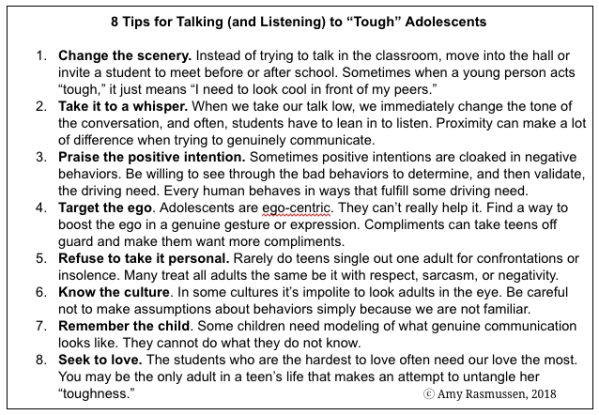
8 Tips for Talking to Adolescents

If I could relive day one of my first year teaching and my interaction with Susie, I’d make sure she knew I heard her. I’d pull up a chair at the beginning of our next class, and I’d listen. That would be the start of Susie doing more than just fine in her freshman English class. I am pretty sure of it.


Amy Rasmussen loves her life in North TX. She’s currently reading We Got This by Cornelius Minor, Embarrassment by Thomas Newkirk, and Braving the Wilderness by Brene Brown. She may be a completely different person come 2019. Find her on Twitter @amyrass

The Teacher, the Story-teller, the Writer: Guest Post by Milree Latimer

Screen Shot 2017-05-01 at 8.44.22 PM

by author-educator Milree Latimer

Teaching might be the greatest of the arts since the medium is the human mind and spirit.

John Steinbeck

To write fiction, one needs a whole series of inspirations about people in an actual environment, and then a whole lot of work on the basis of those inspirations.

Aldous Huxley

Some days when I reflect upon my years as teacher, then as an elementary school principal, a high school vice- principal, and a professor of education–I see a thread. As William Stafford writes in his poem The Way It Is “There’s a thread you follow. It goes among/things that change. But it doesn’t change…/While you hold it you can’t get lost…/You never let go of the thread.”

There has been a thread throughout my teaching days, one that has manifested itself in my life now as a writer and published author. It’s been there all the time. A long gaze back reveals how I have grounded myself, the children and the teachers with whom I’ve worked, in the flow of story. There is a natural quality in the life of teaching that feeds the story-teller.

The narratives and chronicles of the educator’s life fed my yearning to write.

•••••

“Come, tell me your stories.” I said. The children in my kindergarten class and I gathered on the carpet. We told stories to one another: made-up tales of adventure, show-and tell chronicles of the life of a five year old, once-upon-a-time boldness.  It was 1963.

“Whenever I’m asked what advice I have for young writers, I always say that the first thing is to read, and to read a lot. The second thing is to write. And the third thing, which I think is absolutely vital, is to tell stories and listen closely to the stories you’re being told.”

~John Green

••••

“Let’s find a story together, draw it, write it, tell it.” I said.  I set my over-sized journal on the classroom easel. One by one they talked about what their story might be that morning – there’d been a snowstorm, white drifts were accumulating at the windows. Together we thought aloud. “A weather report for school announcements!”  They wrote, they drew, they told their stories. It was 1967. It was first grade.

••••

“You had the ball in your hands, Mark with few seconds on the clock–Tell us what that was like” I said.  It was 1974. Mark was an eighth grader.

“Anyone who is going to be a writer knows enough at 15 to write several novels.”
~May Sarton

••••

“Tell me what you hope for. Tell me what happens in your classroom that astonishes you. Tell me how you came to this, to be a teacher. Begin your educator’s biography this morning, write the last chapter when you retire.” A class of soon-to-be teachers at a Faculty of Education. September 1990.

•••••

The Graduate class was entitled “Reflective Practice.” The assignment: “What do you do; why do you do it the way you do; what do you hope for? A philosophical and personal portrait.”

A student’s response moved me. He wrote from a deep place within himself.  His was a narrative revealing his journey, his was a reflective piece of writing that inspired.

What truly set the path to my personal exploration was a question asked of me in one of my first courses taken at the Master’s level. When asked ‘who are you,’ my immediate response was ‘a wandering soul searching for answers.’ That answer came from somewhere deep inside…. I realize that there are many aspects of my life that I need to connect…I have to reflect on what it is that I actually do and the reasons surrounding that. (Tyrone Perreira, June 2004)

••••41n7v0p5fxl

Four characters in my novel THOSE WE LEFT BEHIND, are a composite of graduate education students with whom I worked from 1996 till 2004.

I held the images of those students as I wrote the story of Casey MacMillan, Professor of Education. The conversations that wove throughout the chapters represented some I may have had with my Master of Education students.

Casey gave air and space to her words. She believed that spoken thoughts and responses needed time to establish their own significance rather than being run over by too-hasty support or worse, ill-considered questions.

 As the author of Casey’s story, I discovered my experiences engendered a quality of truth within the story.

Professor Casey, the main protagonist taught about love, loss and the human condition. Even though she locked away her emotions within her life, her teaching bore a wisdom that connected her with her students.

When I wrote Casey’s story there was a direct line between myself as teacher and myself as author. A conversation between Professor MacMillan and her doctoral student Rob exemplifies this link:

Rob opened his briefcase reached in and pulled out a manuscript–his thesis. Her hope for all her advisees and her grad students was that they discover their own energy of possibility.

“Here’s what I really want you to see.” Rob said. He leaned forward and slid a page across the smooth mahogany table.

When she finished reading the page, she placed it on the table slowly, carefully–Resting her chin on her hand she began: “It’s a radical approach to tell your own story as your thesis. Saying that, it’s not impossible…difficult yes. (P. 99 Those We Left Behind)

••••

“Capturing shards of memory, writing specific scenes, I began to discover…” (Floyd Skoot, 2008).

There is a thread that I hold. Writing is my inner life moving me into the open a passage to the page where I am exploring, imagining, and remembering. I connect to my experiences, I hold the thread, I never let go.

Writing is a coming home. Like Toko-pa Turner (2017), I remember myself home.

Resources:

Skoot, Floyd, (2017). The Wink of the Zenith. The Shaping of a Writer’s Life. University of Nebraska Press.

Turner, Toko-pa, ( 2017). Belonging. Remembering Ourselves Home.

Her Own Room Press. Salt Spring Island, British Columbia.

Milree Latimer is a writer who spent most of her life as an educator and professor. She has an undergraduate degree from McMaster University, a Masters of Education from The Ontario Institute For Studies In Education, and a Doctoral degree in Education from Penn State University. An expat Canadian, she lives among the mountains in the Pacific Northwest of the United States with her husband Jerry and their three cats. She is currently at work on her next novel.

#NCTE18 –Ready, Set, Talk: An Action Plan for More Critical Conversations

“There can be no settlement of a great cause without discussion, and people will not discuss a cause until their attention is drawn to it.”  William Jennings Bryan

We’ve written quite a lot about the importance of talk on this blog. Too often, classrooms remain quiet as teachers impart their wisdom instead of helping students discover their own. Listening and speaking often get short shrift in our classrooms; however, with concerted team effort, we can change this.

At NCTE this Saturday, Lisa Dennis, ELAR teacher, and Alejandra Ovalle-Krolick, World Languages teacher, will share how they had a meeting of the minds and began shaping opportunities for learners to read and discuss culturally relevant texts across disciplines.

Opening windows and inviting critical conversations that explore our shared humanity is one way we become allies and advocates who instigate positive change.

NCTE 2018- shared slides

#NCTE18 We’ve Got Some Action Plans to Talk About

It’s cold. Not to be a whiner, but . . . We moved into a new house during the hot Texas summer. The air conditioner worked. We thought we were good. Then, this month, finally, cool weather. Cooler and cooler. The temperature drops, drops, drops. “Guess what?” he says, “Uh, about the heater. We never turned the gas on.”

I sit here with my hot herbal tea steaming beside me and the electric blanket warming my feet as a portable space heater I found in the garage radiates from across the room. One call and the heater will toast up the house in no time.

I know others aren’t so lucky. So fortunate. So blessed. Shall we say — so privileged?

Perhaps that’s simplifying it. I know.

I’ve spent my career teaching in Title 1 schools. A warm place to write is often not even on my students’ lists of worries. I’ve thought about my privilege, a white woman educator, helping children of color grow as readers and writers. I’ve rewritten and revised countless lessons all with the earnest desire to give my students what I have always taken for granted.

I know that is not enough. Not enough if I want systemic change for all children everywhere. The more I learn the more I learn how little I know.

This tweet was pivotal to my understanding:

privilege intersections

What does this mean for me as an educator? What does this mean for the approach I take to selecting texts, to engaging readers, to fostering writers, to facilitating classroom discussion, to advocating for students in my realm of influence?

At NCTE this year, some of us on this blog team will present on how we are Raising Student Voice: Speaking Out for Equity and Justice.

NCTE 2018- shared slides

I am still working on my 10 minutes. (I know. I know! NCTE starts on Thursday!) But here’s what I am thinking —

For those of us who advocate for choice independent reading, we often quote Rudine Sims Bishop’s thoughts on books being mirrors, windows, and sliding glass doors. (I quote her in this post I wrote last week.) I wonder how often we think about our students’ writing with a similar lens.

Do we empower writers the same way we hope choice empowers them as readers?

We should. We can.

I think I have a little of it figured out. If you will be at NCTE, I hope you will come join the conversation.


Amy Rasmussen loves her work with teachers and teenagers. She binge watches a lot of Netflix originals with her best-friend husband and reads a lot of YA lit. Her recent reading favorites: The Poet X by Elizabeth Acevedo, The Doubt Factory by Paolo Bacilagupi, and Swing by Kwame Alexander. And the teaching book she’s most excited to dig into if it ever comes in the mail:  We Got This by Cornelius Minor. (We are honored to have Mr. Minor chair our session!)


It’s a Good Day to Talk about Talk

Many of us are on edge. You may feel it, too.

I woke today thinking about something I heard in the first professional development session I attended as a new teacher:  We read literature to learn what it means to be human. It provokes a seemingly simple question, and one that’s prompted rich discussion with my students:  What does it mean to be human?

Maybe we don’t talk about our shared humanity enough. Maybe we should do that a little more.

For those of us who embrace choice reading, we often refer to the words of Rudine Sims Bishop:

Books are sometimes windows, offering views of worlds that may be real or imagined, familiar or strange. These windows are also sliding glass doors, and readers have only to walk through in imagination to become part of whatever world has been created or recreated by the author. When lighting conditions are just right, however, a window can also be a mirror. Literature transforms human experience and reflects it back to us, and in that reflection we can see our own lives and experiences as part of the larger human experience. Reading, then, becomes a means of self-affirmation, and readers often seek their mirrors in books.

Let’s think about this line:  “When lighting conditions are just right, however, a window can also be a mirror.” Shared humanity.

Last year at NCTE, Lisa, Jessica, and I had the chance to sit down and chat with Cornelius Minor. We were three white women educators working to listen and learn and do more to advocate for equity and social justice in our classrooms. We knew Cornelius could help. He did.

“We start by focusing on what we have in common. Our humanity,” Mr. Minor told us. Then he highlighted the difference between diversity and inclusivity:  Diversity is everyone sitting at the table. Inclusivity is everyone sharing equal power at the table.

daiga-ellaby-718861-unsplash

Photo by Daiga Ellaby on Unsplash

So what does this mean for me as a teacher, a facilitator of professional development, a writer, a mother, and a grandmother — someone who desperately cares about not just my family, but others’ families, about my country and the interactions we have with one another, about the future and all that entails?

What does it mean for you?

Sure, getting students reading and talking about books is a great starting place. But we also have to open spaces for talk. Cultivating risk-rich safe spaces where readers and writers can share their ideas, struggles, and successes about topics and issues that matter to them is vital to cultivating a civil society. I’ve long thought that our classrooms represent a microcosm of our society. If we can facilitate critical conversations where students respect and truly listen to one another, maybe we have a chance at changing conversations on the street or in courtrooms or press conferences or Congress.

Idealistic? Sure. But that’s the nature of hope.

In her article “Mirrors, Windows, and Sliding Glass Doors,” Bishop concludes with these lines:

Those of us who are children’s literature enthusiasts tend to be somewhat idealistic, believing that some book, some story, some poem can speak to each individual child, and that if we have the time and resources, we can find that book and help to change that child’s life, if only for a brief time, and only for a tiny bit. One the other hand, we are realistic enough to know that literature, no matter how powerful, has its limits. It won’t take the homeless off our streets; it won’t feed the starving of the world; it won’t stop people from attacking each other because of our racial differences; it won’t stamp out the scourge of drugs. It could, however, help us to understand each other better by helping to change our attitudes towards difference. When there are enough books available that can act as both mirrors and windows for all our children, they will see that we can celebrate both our differences and our similarities, because together they are what makes us all human.

We come to understand each other better, yes, through wide reading, curating libraries with diverse, vibrant, engaging titles by authors of diverse heritage and backgrounds. Reading more matters. Couple Bishop’s thoughts with these by Lois Bridges:

Reading engagement is nothing short of miraculous—engaged readers spend 500% more time reading than do their peers who aren’t turned on by books—and all those extra hours inside books they love gives them a leg up in everything that leads to a happy, productive life:  deep conceptual understanding about a wide range of topics, expanded vocabulary, strategic reading ability, critical literacy skills, and engagement with the world that’s more likely to make them dynamic citizens drawn into full civic participation.

Yes, wide voluminous reading matters. A lot.

But so does talk.

I believe it’s through talking about their books, discussing their similarities and differences, their characters, conflicts, and resolutions; talking about their writing, helping each other see angles they might not have seen, validating ideas and challenging others — all in safe spaces of shared respect — that we fast track students’ abilities to engage with each other and with their world. Our world.

So on this election day, I would ask you, dear reader, one favor:  Between now and the next election, can we all do a little more to open spaces in our instruction to facilitate more meaningful discussions? Let’s amplify our shared humanity.


Amy Rasmussen has no middle name, but if she did, it would be “Idealist”. She believes everyone is a child of God and should be loved as such. She’s excited to attend NCTE this month and hopes you will attend her session at 4:15 on Saturday as this blog team presents “Accomplice”-ing Great Things: An Action Plan for Equity, Inclusivity, and Allied Partnerships in ELA Classrooms. 

On Writers’ Testimonies & Why We Need Them

If I want to call myself a writer, I better start writing. Seems simple enough, right? I’ve read tons of quotes from writers who say the best way to begin is just sit down and bleed on the page. But I struggle.

As I was trying to write this post, with my dogs barking incessantly at an invisible squirrel in the backyard, and The Walking Dead booming from the bedroom tv where my husband languished with flu-like blahs, I thought of all the tweets last week for the National Day on Writing (fantastic inspiration and ideas there).

tweet#whyIwrite

I thought of why I write:  to think, to feel, to clarify, to play with language, to vent and heal and commit to change. All the reasons that everyone else writes. I am not unique.

Or am I?

Recently, I’ve been reading and re-reading the writing of Donald Murray. (Learning by Teaching: Selected Articles on Writing and Teaching is my bible as a writing teacher. Huge thanks to my friend Penny K. for the recommendation!) But I’ve also delved into Murray’s Shoptalk: Learning to Write with WritersIt’s a collection on quote on writers about their craft. Murray states in the preface that he began collecting quotes on writing when in junior high, filling twenty-four three-inch-think notebooks with at least eight thousand quotations. His motivation? He just wanted to know how writers wrote. Murray explains the importance of writers’ testimony:

     Many people have the romantic notion, encouraged by those writers who feel comfortable in the magician’s robes, that writing is an instinctive matter of talent, an art, not a craft, and therefore cannot be explained.

     But writing is not an unintelligent act. Writing is a craft before it is an art, and writers can and do discuss their craft in terms we can understand. There are good reasons teachers and students of writing should hear what writers say about their craft.

     . . . I bring writers into my classroom through their written testimony. As writers of today and yesterday–female and male, young and old, poets and novelists and playwrights and nonfiction writers–talk about their feelings and their problems while writing, my students discover that their natural responses to writing are often the same as experienced writers.

     This is vital. Students facing a writing problem will often find they have to solve it by starting over and will fell they have failed. When they read the testimony of experienced writers, however, they discover that they too act like writers and this increases their confidence in designing their own solutions to their own writing problems. School often teaches unnatural, non-writerly attitudes toward writing–know what you want to say before you say it–and students need to see that their own instincts are the instincts of published writers.

     Students also need to see that writers are not looking back at a finished text but are in the act of confronting the blank page–or looking at the world before their is a page; trying to get started; trying to keep a text on tract or following it off track; working to make a text clear to themselves and to a reader. Writer’s counsel isn’t distant, detached from the act of making; it is immediate, speaking to the writer in the middle of making, a master sharing the tricks of craft with an apprentice at a common workbench.

I need these reminders–for myself and those I hope to take on the identity of writer, other teachers and students alike. Murray explains:

Too often we defend writing as a skill, saying writing should be taught so that students can fill our a job application or write a better letter asking someone to buy a cemetery lot. Writing is a skill on that level, but it also a craft and an art; it satisfies an essential need of the human animal.

So how do I share more writers’ testimonies? How do I help satisfy the essential need of the humans in my care daily?

10-768x384

Here’s some ideas:

  • Share some quotes on writing by writers. There’s lots of insights in that link and even some nice images like the one above.
  • Share Poets & Writers and follow on Twitter, too. I love their weekly update.
  • Read and share articles from NY Times Writers on Writing. This one by Amy Tan is a favorite and makes a fantastic mentor text to write beside.
  • Think, write, model, talk, share, and repeat with writers every single day. Let them know they are not alone in their pursuit of putting meaning on the page.

When I brought the barking dogs in, and before the tv went off and the zombies faded out in the bedroom, I heard a line that gave me pause. It went something like this: “This place is a canvas, and we are the paint. We were sent here to create. We did.”

I don’t know about you, but I think that relates to writing. I write to paint my world in the swirl of language, to create images and goals and imaginings, to figure out what I feel and think and know. I write because it feeds my need. I am human, so I write.

Amy Rasmussen writes most often sitting at her newest DIY project, a desk she repurposed from a vanity her paternal grandfather made for her grandmother over 70 years ago. She lights a candle and listens to Michael Bluble radio on Pandora. And when she gets stuck in her head or on the page, she reads. Follow her @amyrass