Author Archives: Amy Rasmussen

It’s Monday What are You Reading? Me? Starting Summer Reads

Mon Reading Button PB to YAEarlier in the year I shared some data on literacy rates with my students. Some of the numbers made them mad; they called them “racist” because white readers by and large have higher literacy rates than Latinos. We had a decent discussion about why that might be the case, but I could tell my students still didn’t really “get it.”

Then, I came across this blog post at Literacy Learning Zone, and I knew I had a useful tool to help my students understand why their reading levels might be lower than some of their peers’ at the high school across town. We watched the YouTube video that explains the gaps created by a lack of reading during the summer. The timing was perfect. All morning administrators were busy calling individual students into the hall to discuss their recent STAAR EOC scores and summer school options. Kids were sad.

I’ve encouraged, begged, pleaded with students all year: “The single most importance thing you can do for your education is READ. Read books, magazines, newspapers. Read anything for extended periods of time.”

If only they would believe me!

So, today after watched the video linked inside that blog, I gave my soon-to-be sophomores their summer reading assignments. It’s pretty simple: Read any book of your choice that has some literary merit (we talked about what this means) and make a note of 5 significant quotes. [I suggested they look for the Notice and Note signposts. Thank you Kylene Beers and Bob Probst.]

I will read this summer, too. I am excited to be back in the classroom full-time. That district instructional coach job just didn’t line up with my passion– a lesson I learned from reading Ken Robinson’s book The Element. I miss the students, and I miss learning with my students. My schedule is heavy with three preps, but the trade-off will be worth it. I’m already excited about the reading I need to do to get back into the groove of an AP Language class.

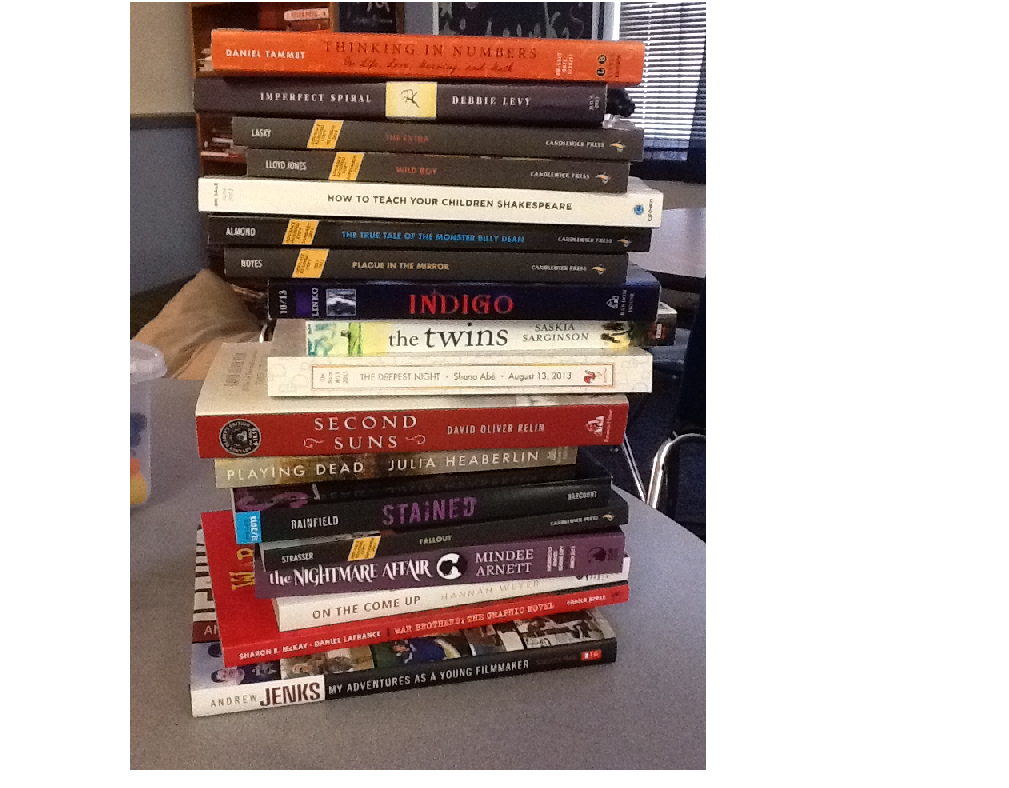
Here’s a shot of what I start reading, and/or re-reading this week.  Lucky me!

My 2013 summer reading


Reel Reading: How about these book trailers?

20130207-190708It’s been a long time coming, but my students have finally produced some pretty good book trailers. I began showing trailers as a way to introduce books and encourage reading at the beginning of the year. Every Friday was silent reading day, and every Friday I chatted with kids about books they’d finished. We wrote on sticky notes and made a “recommendations” wall. We stood up and “testified” to the truth in books and how they touched our souls. No doubt, since I promoted reading more during class time this year, I created more readers.

Evidence? STAAR EOC scores are in. Almost every student who passed their reading test has been vocal in our classroom conversations about books this year. (One kiddo surprised me and scored satisfactorily–his average is a 26, but he passed the reading test. Go figure.)

I know. I know. Test scores are not everything. But… my readers certainly scored better than my non-readers.

On my classroom wall, I have my own six word memoir:  “Reading makes you smarter. Try it.” Those who did have done better than those who have not.

2 reading smarter

Our book trailer project is the culmination of our reading efforts this year. I wish we would have more time to polish them up, make sure we cited image sources, spelled words correctly and all that, but exams are next week, and bell schedules are crazy with awards assemblies, etc. Our time is gone.

Here’s a sampling of the most interesting of my student-made book trailers. Although not perfect, remember, these are 9th graders in an on-level English I class, Title I school. I’m a little proud.

Crackback by John Coy, created by Brandon. He used photos from our own football team.

Brandon Crackback

Unwind by Neal Shusterman, created by Heidi. Look at her hook!

Heidi –Unwind

A Child Called “It” by Dave Pelzer, created by Biridiana. She learned the medium on her own and came up with this!

Child Called It- Biri

The Lifeguard by Deborah Blumenthal, created by Kristen. Okay, so the trailer’s not great, but the video of the girl is Kristen herself. Cool.

The Lifeguard- Kristen

See You at Harry’s by Jo Knowles, created by Brenda. The use of quotes from the book creates the book’s selling points.

See You at Harry’s- Brenda

Reaction by Lesley Choyce, created by Ashley. Other than her characterization using Juno… <smile>

Reaction by Ashley

My Friend Dahmer by Derf Backderf, created by Jonathan. This one got traction when we showed it to the class. Wish it had more umph at the end.

Dahmer- Jonathan

I’d love to hear your ideas of using book trailers to create readers– or anything else you can teach me about books, kids, and reading!

My Rubric Failed Me

I needed this reminder. As my students stood up to share the posters they created for their Romeo and Juliet theme projects, I oohed and aahed along with the rest of my students when some of the most artfully skilled students shared their work. It’s not that I don’t differentiate my classroom instruction, but sometimes I forget to differentiate when it comes to how students can show me mastery of the skills they’ve learned.

Honestly, this year I think I’ve focused too much on writing. (Did I really just say that?)

As kids presented their theme poster, they had to explain how the quote they chose represented the theme of their project and how the images and colors they used to illustrate their poster reflected their quote and theme. Every single kid could do this orally. Not everyone could do it on the paper they were supposed to submit when they presented. Or some just didn’t want to. Sigh.

So, now I’m wondering how to “grade” some of these assignments. My rubric has failed me. It’s focused–like my class has been this year–heavy on the writing. “Think for me on paper.”

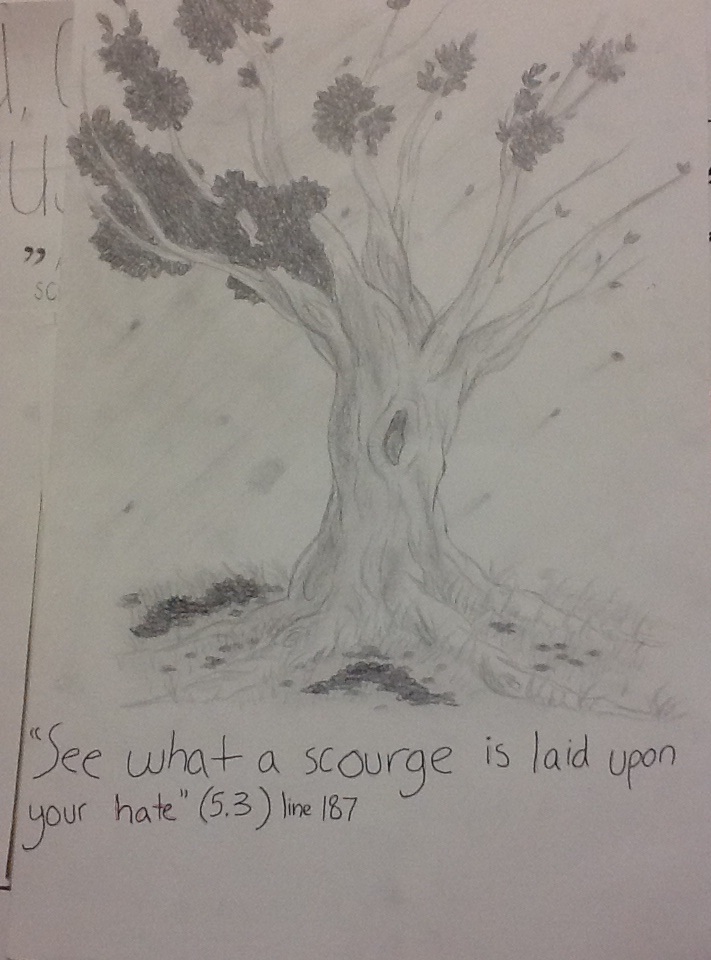
I needed this reminder. If it’s about mastery, there are lots of ways for students to show me what they know. I get the writing part and know that has to fit in somewhere–lots of wheres, but still. . . I just can’t assign a failing grade to a child that represented “See what a scourge is laid upon your hate” with a beautifully drawn tree that’s suffering from blight. There’s thinking here.  Luis tree with blight

And there’s thinking here:

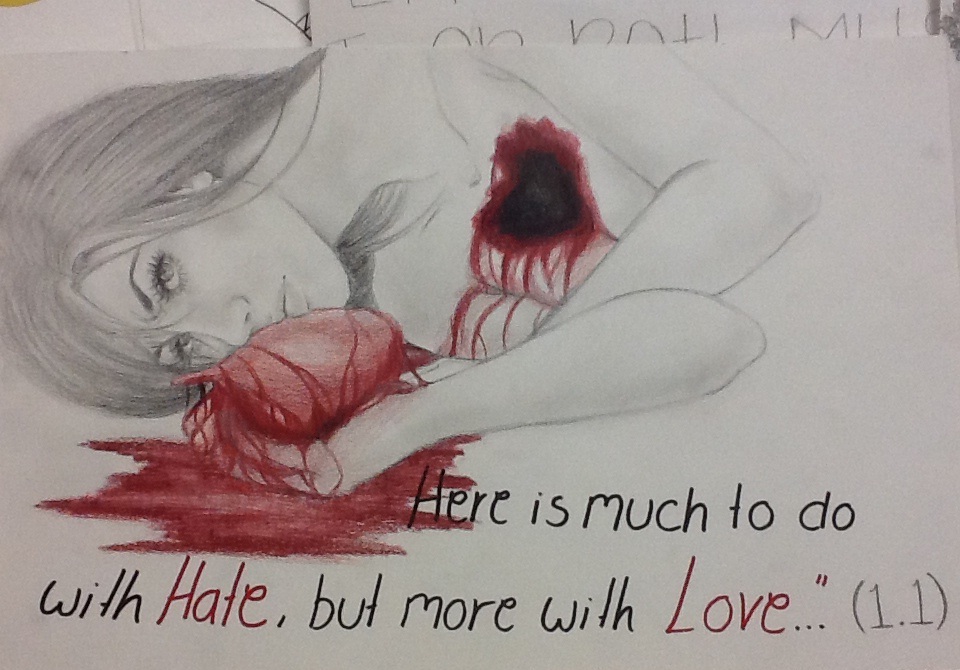
Kelly bleeding heart

And here:

Biridiana's eye

And here:

Collage of projects

Oh, I better revisit that whole rubric debate.

Reel Reading for Real Readers: Summer YA Book Trailers

20130207-190708Pinterest, I love thee!

I didn’t think I would, but when my daughter told me that people were refurbishing and painting “old and ugly furniture like you have in the house, and you can learn how to do it on Pinterest,” I took a peek.

Yeah, ideas galore. (I even took my daughter’s advice, and who knew I could paint such beautiful furniture?)

But, here’s the thing:  There are boards for almost Everything. Even Summer Reading ideas for YA.

Oh, yes, please!

So, #ReelReading will take a break until school starts up next fall, and in the mean time– go check out this awesome board. I’m sharing it with my students next week.

Pinterest

Agh! Grading – Trying to Manage the Scary Beast

assignmentI heard the discussion yet again today. It almost always gets heated. You’ve had them. I know you have.

Topic: Grading.

What is a grade actually for anyway?

While I don’t claim to have all the answers, I have a few that have worked for me.


Here are some thoughts that may help you on your own journey of deciding how your gradebook might look. (I’ll try not to rant, but I might.)

A grade should be representative of a student’s learning over a period of time (usually a six or nine weeks). If that is the case, taking off a bunch of late points because a student is disorganized shows not the student’s academic ability but rather their organizational ability. This thought, however, is somewhat idealistic and not always realistic. I still must find a way to hold students accountable for being responsible, lest they take advantage of me and never turn anything in on time. In my gradebook, I actually had a category called Professional Ethics and Responsibility. This category is where I would put in grades to reflect if a student was turning his work in on time. I also included a grade, or two, reflective of the student’s ability to be responsible–not only with the iPads but also with classroom procedures and norms. The grade counted as 10% of the overall grade. This would not by itself fail a student, but at worst it could drop his grade an entire letter grade. One thing that changed my thinking was the idea of practice (otherwise known as formative assessments). I still don’t understand why other educators haven’t had this Aha.

I know when I am learning a new skill, I want to be able to practice–free from judgement–so that I might build some confidence before I am formally evaluated. The same is true for kids. We should give them opportunities to practice and build confidence. If we create an environment for our students to practice without judgement but with feedback, we might think twice about what we put in the gradebook.

Transparency is important in grading, too. I wanted students and parents to understand the skills that were being taught not just a final score. In order to provide more clarity, in the gradebook I would include in the title of the assignment the skill that was being addressed (characterization, inferencing, critical reading, etc.). Then, in the description of the assignment I would include a bit more information about the specific assignment so that the student might remember exactly what the assignment was. This cuts down on arguments about what was and what was not turned in as well.

Did you know that most online gradebooks have an incredible ATTACHMENT feature? With relative ease, I was able to post rubrics and even the actual assignments directly linked to the assignment in the gradebook. Some parents (and students) love this!

I don’t know about everywhere else, but in my district discussions about grading have been a source of heated conversation for a while. Now, as an instructional coach I hear similar questions all the time:

How can we continue to hold students accountable for their learning all the while creating a grading system that is truly representative of a students mastery of a subject?

Certainly I don’t have it all figured, so I invite you to join in the conversation and post a comment about your thoughts on grading. Love it? Hate it? How do you manage it?

Photo credit: woodleywonderworks / Foter.com / CC BY

It’s Monday: What Are You Reading?

Mon Reading Button PB to YAA couple of weeks ago I crashed the American Library Association annual meeting in Ft. Worth and bought an entrance pass to the exhibit hall so I could get free books. The best $25 I’ve spent in a while. See this new TBR pile?

books from ALA

Now, It’s Monday, and what am I reading? I DON’T KNOW. I don’t know where to start. Do you ever get that I’m so in love, infatuated, so gaga over books that it’s like drowning in your favorite chocolate syrup. That is me today.

So, I will start swimming.

I reach for the book on top, a lifesaver of non-fiction, and my ears start ringing and my heart beats faster. I’m always on the look out for engaging non-fiction, especially knowing that I am returning to the AP English Language classroom next year.

I read the prologue, and I breathe.

I begin chapter one, and I breathe faster.

“In a smallish London suburb where nothing much ever happened, my family gradually became the talk of the town. throughout my teens, wherever I went, I would always hear the same question, “How many brothers and sisters do you have?”

The answer, I understood, was already common knowledge. It had passed into the town’s body of folklore, exchanged between the residents like a good yarn.

Ever patient, I would dutifully rely, “Five sisters, and three brothers.”

Hey, me, too! Well, almost. I have four sisters and three brothers. But still. Not many people can claim they came from a family of so many kids. And while it might not be the most amazing lead to a book, it got me.

So, it’s Monday, and what am I reading?

Thinking in Numbers Is… by Daniel Tammet.  Here’s a review.

Thinking in Numbers

Reel Reading: A Child Called ‘It’

20130207-190708.jpgI’d love to get my students to do some of this cool typography. Since they will be making their book trailers this week, I wanted to show them this option for their creations.

I’ve had great success getting even the most reluctant readers to read A Child Called ‘It’ by Dave Pelzer.

See? Isn’t all that letter and word movement cool?

If students like the topic of abuse (which I don’t quite understand), they might also like Ellen Foster by Kaye Gibbons. I haven’t seen the movie, but this trailer looks like it’s pretty well done.

Maybe next time I’ll look for happy topics.

Sheesh, Amy. This is depressing stuff.

Teaching and Reaching Kids in Poverty

I sat in a meeting last week. It’s May. Week one of two weeks of testing. Kids are tired. Teachers are weary. We read an article called “How Poverty Affects Classroom Engagement.” Not surprisingly, the discussion fell flat. It’s not like we haven’t heard this information before–we teach in a Title I school, 74% low SES. The subtitle of the article read “Students from low-income households are more likely to struggle with engagement.”

 I quote the teacher next to me: “Duh.”

 According to the article, there are 7 reasons for struggling engagement:

1. Health and Nutrition. Doesn’t every human listen better, learn better, FEEL better when they are well-fed and well-rested?

2. Vocabulary. It’s not hard to figure out that kids from affluent or even not, print-rich families will know more words than kids who don’t. No surprise they struggle with reading.

3. Effort. If the student likes the teacher, he’s more likely to work for the teacher. Pretty logical.

4. Hope and the Growth Mindset. Encouragement, positive feedback, hope all lead to better student input and output. Pretty much like for every person everywhere: make me believe I can do it, I probably can.

5. Cognition. Teach cognition. Sometimes you just have to teach a kid how to think. This point above all the others is the one most overlooked. Don’t most teachers assume students know how to do this already?

6. Relationships. What matters most to the child is the relationships that make him feel safe, comfortable, cared for. Positive comments result in much more compliance and movement toward success than continual negative ones.

7. Distress. We all feel it at some point. How can we work effectively when we are stressed to the max? Remove the stress. Have more fun. Kids will respond, and hey, achieve more.

Yeah, tell us something we don’t know about our kids.

 After we read the article, we chunked it and added a few testimonials of how these things impact student achievement. Then we left.

Really? We talk and talk and talk about recognizing the issues that smack us in the face when we try to help our students, but how often do we take action on creating solutions? Yes, the article offers some, but nothing that the best teachers are not already trying. Trying doesn’t always work even for the best. We have to decide to do something more different.

 Ironically, I had a rant session (you know you have them, too) with a colleague earlier in the day, and we discussed these very things– except we made a list of our own hopes.

photo by Mike Bitzenhofer

Here’s four ideas we hope to get put into our practice next year:

1. Whole school read. I’ve heard of this done in communities and schools. I know that Dallas ISD is supporting Read Across America with their DALLAS Reads program and wide reading of The Lorax. I’ve heard of whole grade levels reading something as wonderful as Wonder. Other places engage in One City One Book programs where the whole community is encouraged to read the same book. Imagine the talking points!

So what if during the first quarter of the new year, every student and every teacher read the same book? This could be done in Advisory classes (30 minutes every day set aside for administrivia and silent reading). And it could be complemented with paired readings, analysis, and writing in English classes.

Of course, we are open to suggestions, and purchasing the books might be an issue (my grant app is open in another window), we think something like Sean Covey’s Seven Habits of Highly Effective Teenagers would be a good pick. They don’t have organization skills; they don’t have study skills; they don’t have strong work ethic. How could these seven things NOT help our kids?

The 7 habits

1.    Be Proactive

2.    Begin with the End in Mind

3.    Put First Things First

4.    Think Win-Win

5.    Seek First to Understand, Then to be Understood

6.    Synergize

7.    Sharpen the Saw

2. Expand the walls of our classrooms. Have you ever heard of a Mystery Skype? I’ve only read about it on Twitter, but this is something that needs to happen–one classroom making a connection with another classroom, sometimes on the other side of the globe. Teachers arrange it. Students prepare questions. Skype connects the classrooms. All students participate in a guessing game of “What is your Country,” or “Where are you from”? Or, something like that. Sure beats learning about Spain or Tanzania from a textbook or lecture.

Other ways to expand the classroom include field trips–real and virtual, and even walks to the nearby elementary school. My 9th graders can read with your 1st graders if we take a little time to coordinate that. The DART station is less than a mile away. We can walk a group of kids there and travel to downtown Dallas for a mere $2 per kid. Oh, the Places We’ll Go: art museum, newspaper office, JFK Memorial, Holocaust Museum, Dallas Theater Center, aquarium, and the brand new George W. Bush Library.

“Most of those things cost money,” you whine. Yes, but we have a BUSINESS COLLEGE on our high school campus. Shouldn’t the business college be about creating businesses–that, you know, make money?

I read an article that I have to hunt down. It said that the best way to raise kids out of poverty was to teach them entrepreneurship. Yes, let’s.

 3. Real-life projects. Take fundraising for example. What if students hosted a design contest for t-shirts?  Every student, and most teachers, wear some kind of t-shirt with some kind of design on it at least sometimes. We could have a contest–or several. The winner’s design gets imprinted on tees that are sold, and the money goes into the field trip fund. Or, instead of t-shirts it’s wristbands or backpacks or pencils for heaven’s sake. Kids will buy things if they are cool, and contrary to what some may think: many kids from poverty have cash in their pockets.

YouTube videos. Somehow, someway there has to teach Language Arts by connecting students’ craze for YouTube with the standards they are supposed to learn in class. I’ve started watching more, and there’s some great stuff out there that requires lots of literary allusion, knowledge, and know-how. One example that made me laugh: Paint

4. Guest speakers. The most animated I’ve seen students be about reading is when Simone Eckles, author of the Perfect Chemistry books, spoke at our school. She was warm, funny, and engaging. She talked about her books and her writing process and ideas. She showed book trailers, and had our kids cheering about reading opportunities. The librarians had won some kind of contest, and the prize was this author visit. The books are still a huge hit, especially with our reluctant Hispanic readers. We need more home runs like this. Fortunately, we have one author visit lined up thus far:  Matt de la Pena, author of We Were Here, Mexican White Boy, and others will be on campus in September. His story mirrors that of so many of our students:  poor, hates to read, loves sports. We need to bend the ear of someone and make sure there’s money to buy multiple copies of his books for many classroom libraries.

Maybe I’m an idealist. Maybe it’s the end of the year, and I’m just tired and wondering if all I’ve done with my students this year has done a bit of good. I’m not hopeful that they’ve done well on their standardized tests. The gaps in reading and writing are too wide for a fix in such a few short months.

Maybe I need to believe that next year I can do things better. I can focus less on a test and more on what tests life will hand these kids. I can give them opportunities to explore and question, and just maybe I can give them hope– because while it is #4 on that list at the top, I think it’s number 1. Without hope. . . well, there’s kind of a big fat nothing.

I get it.

Do you have ideas that might help? Please share!
Reel Reading: ROOM. Oh, my sweet Jack!

20130207-190708Few books hit me in the gut and make me weep, but ROOM by Emma Donoghue did just that. Told from the point of view of just just turned 5-year old Jack, this story of abuse, survival, and enduring love packs a punch that leaves you gasping.

Soon after I read ROOM, I heard the real life story of Jaycee Dugard and hurried to the book store to buy the book that shares her story, A Stolen Life.  Oh, my! Terrifying, horrifying, and. . . hopeful.

A Stolen Life

I have students, mostly my reluctant readers, who devour the book A Child Called ‘It‘. These kids often enjoy (or at least have a love/hate relationship) with  these other titles, too.

What is it within us that makes us want to learn of others’ suffering so?

Zombie Test Prep–Continued

I wish I could definitively say that I know my students performed better on STAAR because of the activities we did with this zombie project, but that would be a bit like being overconfident in surviving when 200 of the “Undead” are trying to eat my arm off. The English I Reading and Writing tests are hard–at least for my non-readers.

In response to several requests I received via Twitter. Here’s an outline of the project:

First, I did some backwards planning. What are the primary skills students need to master in order to achieve satisfactory scores on STAAR?

  • Write a literary essay with engaging characters, plot, theme, etc

  • Write an expository essay with a strong thesis, good organization, solid supporting details, etc.

  • Respond to reading–literary, expository, poetry, etc.–in paragraph form with embedded textual evidence

  • Read critically and answer questions about content, text structures, author’s purpose, etc.

No Sweat! Well, actually, a lot of sweat, tears, blood. . . Well, not blood. Not really. But I worry about my students A LOT. They come from homes in poverty with hard-working parents. By and large, they are sweet, good-hearted teens. But– they do not read, and this one thing impacts their learning in pretty much every aspect of my English class.

Thus, Z O M B I E S. I can hopefully get them interesting in the reading, which will hopefully get them interested in the learning.

I set the project up like PBL, but since I have limited training in how to actually carry out a PBL project, and my students have no experience with the requirements of this student-centered approach, which requires strong student leadership, the PBL part of the project was the first victim of our zombie attack. PBL lingered but it didn’t take an active part of the learning process. My students were too needy, and I felt rushed for time.

Introduction:  Entry Document/s

Part I. Silent Discussion. In my last post I shared the Intro to Zombie Project I used first  to spark student thinking about the project.  After students watched the video, they completed a Poster Activity (strategy idea from Bob Probst) where I gave them each a colored marker, and on each table I put a poster-size paper. I told students that they must use their marker to think on the paper. What things did you see in the video that you think you will be required to do in this project? Students wrote their thoughts in a silent discussion for about 15 minutes, and I circled the room, reading their comments and writing comments and questions to promote more thinking on their posters.

Part II. Memorandum. Next, I gave each student a copy of Zombie Apocalypse entry doc. They had to read it, and then I gave them time to talk with their table mates about their thinking. I gave each group a sheet of paper. On the paper, I had them make a T-chart. On the left they wrote what they KNOW about the project, based on their reading of the memo and the video; on the right they wrote what they NEED to KNOW. Finally, we had whole class discussion, and students helped me complete a class KNOW/ NEED to KNOW chart that stayed posted on the wall throughout the project.

[This intro worked better than I could have imaged. We did it on a day I happened to have a group observe my classroom: Student engagement high. Evidence of student thinking high. Collaboration high. Literacy in action high. Higher-level questioning high.]

Reading and Writing 

Part III. Self-Selected Reading, Throughout the year I’ve required students to read books of their choosing. If you’ve read other posts, or seen Reel Reading on Fridays, you know I talk YA books incessantly. In an attempt to get students to read something that might tie into the texts and topics we were talking about in class, I wanted to bring in as many books about zombies as possible.

I turned to my Twitter PLN first, and with their help, I build this Zombie shelf at Goodreads.com. I hit the bookstore and spent way too much money on books for my classroom library. Then asked the awesome librarians at my school to pull all the books they had that dealt with zombies. They gave me about 45 titles that I book talked with my kids. The first book to go? World War Z. I had two copies and had to start a waiting list for checkout. Personally, I read the first two books in the Rot and Ruin  series by Jonathan Maberry. Good, gory books. Too thick and intimidating for my kids though.

I didn’t care if students read a book about zombies. I just really wanted them reading something. If I do this project again though, I think I would like them all to be reading a book that ties in thematically. I have to think about this more.

Part IV. Expository Reading to Become Better Expository Writers. Expository is a big umbrella, but the state of Texas defines it as INFORMATIONAL. Our students must write an explanation of a topic, using a clear and organized structure and evidence to clarify their points and support their explanation. Essays only have to be 26 lines handwritten, or about 300 words typed. It sounds easier than it is–especially for non-readers.

Students also have to be able to answer short answer reading questions. I kind of hate that we call these short answers–they are really essay questions that require essay responses. You know, with embedded text evidence: Quote something, analyze it, make your response a complete paragraph? Again, it sounds easy, but for my students it is the most difficult thing. Ever.

I know that before I can get students to focus on the writing skill. I have to get them interested in the reading passage. I struck zombie gold when I typed “zombie” and “Valentine’s” into Google. Here’s a sampling of the articles and the questions my students answered to practice writing short answer responses.

Zombie Valentine expository articleSAQ with Zombie Valentine article

SAQ Test- What Rhymes with Undead

We also read the introduction to SAQ Zombies vs Unicorns and practiced short answers. (These folks are serious and even have a Facebook page.)

News Articles. Most of my students have no idea what is going on outside of their own communities. I try to bring news of the world to them as often, and in any way, I can. To prepare them for their expository essay on STAAR, I wanted to expose them to as many types of expository writing, and as many topics in the news that I could. So, under the guise of “You are the survivors of this zombie apocalypse  What would people 100 years from now what to know about your civilization?” I had students look up news articles, practice writing summaries, and explain.

Part V. Literary Writing. Another part of the Texas STAAR test for English I is a literary essay. Students are given a prompt, and they must write a little story that shows evidence of their understanding and ability to develop characters, conflict, plot, setting, and theme. Here’s the Literary Story- Zombie Project we used for our project. If you’d like student essay samples, let me know.

Part VI. Poetry. Finally, although students do not have to write poems for their STAAR test, they might have to read and analyze it. We had already read many poems in class, so for this project, I really wanted students to just play with word choice. Most did a zombie-like job on their poems. Plagiarism 5 times. Way below grade level work at least a 100 others. Here’s a sampling of Zombie poems. I especially like a few of the blackout poems:

the helpless

are able

to

be

a little daring

Rubric and Reflection

If I ever do this project again, I will allow for more creative time in class. Most of my students rarely do homework, so if I don’t capture the time I have them, I rarely see work once students leave the room. Most groups did not pay attention to the Zombie Project Rubric. They focused on one area much more than they focused on others. For example, I had one group that did a sensational job on the items in their survival backpack, but they did not take the time to write engaging stories or read and evaluate news articles. Therefore, their overall grade was low. A lot of this was my fault for not allowing equal time in class for each part of the project.

As our final event, the day after our second STAAR test, we watched the first episode of “The Walking Dead.” I wished that the movie “Warm Bodies” was on DVD because that would have been a great lead into our next unit:  Romeo and Juliet. It’s loosely based on Shakespeare’s play, you know? Check out this video for a fun re-mix:

Do you have any ideas for Zombie test prep? I’d love to add your resources to my growing file. Who knew zombies could be so . . . well, alive?