
Author Archives: Amy Rasmussen

Reel Reading for Real Readers: Eleanor and Park

20130207-190708I hope I get to read Eleanor and Park by Rainbow Rowell before this post runs; I am writing it in advance.

Every time I hear this title another person chimes in with commentary on how much they love this book. Thankfully, I finally got a copy at #ALAN13, and it’s steadily rising to the top of my TBR pile. Sometimes I let students read books like this first, but from what I’ve heard, this will be a popular hit with my kids. I was scared I might never get a chance to read it .

Yes, sometimes I am selfish and read books first.

Here’s another way to introduce students to books:  introduce them to blogs about books. I like this one jenna {does} books. She’s got a Top Ten Tuesdays: My Favorite Quotes from Eleanor and Park.

Reel Reading for Real Readers: The Black Count

ReelReading2My personal reading goal for 2014 is to read more award winning books. The first for the year is The Black Count  by Tom Reiss; it’s the winner of the 2013 Pulitzer for biography.

I cannot even tell you why I was drawn to this book, other than while wandering the aisles and staring at the stacks of books at Costco, I saw the gold prize emblem on the cover. My mother had just died, and I’d rushed off to Utah to plan and participate at her funeral. I needed a book to read or I’d go mad.

I remembered reading The Three Musketeers as a young teen and falling head-over-heels for all four of Dumas’ dashing men. I’d later read The Count of Monte Cristo, which I loved, and once I read the cover of The Black Count, I knew I could escape into the story of Dumas’ dashing and daring father.

Honestly, I do not know if I can get any students interested in reading this book. I doubt many have much interest in French history, although several probably know Dumas’ famous stories. I want to try though. The writing is not just informative, but at times it is moving. Reiss helps us feel the love that the novelist Dumas has for his long-forgotten (but never by him) father.

I only found one book trailer, and it was kind of weak. I’d rather introduce this insightful book to my students through the author’s own words.

Author’s essay from Amazon:

I’ve always loved exploring history. It’s like an uncharted hemisphere, and when you look at it closely, it has a tendency to change everything about your own time. I’m also drawn to outsiders, people who have swum against the tide. I often feel like a kind of detective hired to go find people who have been lost to history, and discover why they were lost. Whodunnit?

In this case, I found solid evidence that, of all people, Napoleon did it: he buried the memory of this great man – Gen. Alexandre Dumas, the son of a black slave who led more than 50,000 men at the height of the French Revolution and then stood up to the megalomaniacal Corsican in the deserts of Egypt. (The “famous” Alexandre Dumas is the general’s son – the author of The Three Musketeers.) Letters and eyewitness accounts show that Napoleon came to hate Dumas not only for his stubborn defense of principle but for his swagger and stature – over six feet tall and handsome as a matinee idol – and for the fact that he was a black man idolized by the white French army. (I found that Napoleon’s destruction of Dumas coincided with his destruction of one of the greatest accomplishments of the French Revolution – racial equality – a legacy he also did his best to bury.)

I first came across Gen. Dumas’s life in the memoir of his son Alexandre, the novelist. And what a life! Alex Dumas, as he preferred to be known, was born in Saint Domingue, later Haiti, the son of a black slave and a good-for-nothing French aristocrat who came to the islands to make a quick killing and instead barely survived. In fact, to get back to France in order to claim an inheritance, he actually “pawned” his black son into slavery, but then he bought him out, brought him to Paris, and enrolled him in the royal fencing academy, and then the story begins to get interesting.

What really stuck with me from reading the memoir was the love that shows through from the son, the writer, for his father, the soldier. I could never forget the novelist describing the day his father died. His mother met him on the stairs in their house, lugging his father’s gun over his shoulders, and asked him what he was doing. Little Alexandre replied: “I’m going to heaven to kill God – for killing daddy.” When he grew up, he took a greater sort of revenge, infusing his father’s life and spirit into fictional characters like Edmond Dantes and D’Artagnan, with shades of Porthos, too. But the image of the angry child stuck with me and drove me onward to discover every scrap of evidence I could about his forgotten father.

And recovering the life of the real man behind these stories was the ultimate historical prospecting journey for me: I learned about Maltese knights and Mameluke warriors, the tricks of 18th-century spycraft and glacier warfare, torchlight duels in the trenches and portable guillotines on the front; I got to know about how Commedia del Arte influenced Voodoo and how a Jacobin sultan influenced the Star-Spangled Banner, about chocolate cures for poisoning and the still brisk trade in Napoleonic hair clippings. I discovered the amazing forgotten civil rights movement of the 18th century – and its unraveling …

This review here The Sentinel Alexandre Dumas:  The Black Count lends a powerful voice to the impact of this biography. It also includes some audio clips from the book, which I will share with my students.

That’s another of my reading goals:  more audio books. I think busy students need to know the value of listening as reading, too.


Finding Success in Hell

Guest Post by Jackie Catcher

flames“Ms. Catcher, do you have Inferno?”

Inferno?” I asked.  I looked up at Sean*, a skinny freshman with small gages in his ears and a bleached blonde buzz cut.  His punk skater image matched the rebellious reputation of the book he had recently finished: The Perks of Being a Wallflower.  This was the first time he had come to me with a book request for his independent reading.

“Yeah, you know that book about hell.”  I couldn’t help but chuckle—when Sean came into my classroom he associated books with being in hell, now he wanted a book on hell.

“Um, yeah, let me find it.  Dante’s Inferno?” I repeated again.  I tried to mask my surprise but could hear my voice crack with the title.

“Yeah, that one,” he said straight-faced.  The image of my tired college English professor popped into my head; the threadbare sports jacket he wore as he droned on about Inferno; I remember feeling like he single-handedly had pulled me through all nine circles of hell.

Sean owned the video game adaptation of the book, which had sparked his interest.  I handed him a copy, warning, “This is a hard read.  Even if you get through part of it, that will be impressive!  I read this in college.”  I felt the need to somehow soothe his frustrations even before he started.

“Ok.” He brushed off my warnings.

Every day I watched Sean crack open Inferno and slowly make his way through the convoluted English translation.  And every day I expected Sean to walk into my classroom and abandon the book.  But he didn’t.

“How much does he really understand though?” asked another teacher after I brought up Sean’s accomplishments.  She made a good point.  Not only was Sean in my academic class, the lowest level in my tracked high school, he had also scored partially proficient in reading on the New Hampshire state standardized tests over the past two years.  Even if Sean didn’t understand the book in its entirety, I believe he gained just as much as any freshman English major dissecting the poem.

Sean might not have delved into the intricacies of the epic poem, but he took away a sense of confidence and pride that can only accompany struggle.  Many students lack the reading stamina Sean exhibited, an essential skill for success in post-secondary schooling.  Students can be quick to abandon books, and I have found that it isn’t until students become more developed, advanced readers that they understand the value of pushing beyond the first ten or even one hundred pages of a book to get to the “good stuff.”  Despite Sean’s distaste for reading prior to this year, his hunger for a challenge paired with the independent reading initiative allowed Sean to build his stamina and prove himself as a reader.  As Sean said, “I kept telling myself it’s just a book.  You can keep reading.”  Reading Inferno stemmed from his curiosity and transformed into an undertaking of pride.

Sean’s experience with Inferno didn’t include deep literary analysis and his takeaway would most likely make my stuffy college professor cringe, but I’d argue that Sean learned the lesson Dante intended: perseverance and hard work lead to significant achievements.


*The name has been changed to protect the identity of the student

 Jacqueline Catcher is a first year teacher at Exeter High School in Exeter, New Hampshire. She teaches Academic and College Preparatory Freshman English and an upper level elective writing course using the workshop model.  She can be reached at jcatcher@sau16.org.

Not the Same Old AP Writing Teacher

ocsWriting takes time. I imagine most English teachers know this. However, I am not sure most English teachers allow students enough time to produce their best work.

I speak from experience. You might be able to relate.

Traditionally, I would give students a writing assignment. We’d pre-write a day, sometimes two. We’d draft a day, sometimes two. We’d revise (or I’d hope they’d revise) maybe a day–or none at all, depending on the student. We’d publish our work and turn it in for a grade.

Oh, how incredibly dull . . .and ineffective. No wonder so many students hated writing.

This year we do writing differently. We are writing a lot more like real writers.

We start with reading. We read an engaging and complex mentor text. The author becomes our writing coach for as long as we are working on the assignment. The piece my students are writing now is a feature article modeled after the work of John Branch in Snowfall:Avalanche at Tunnel Creek, which recently won a Pulitzer Prize. We read the first four pages or so together, stopping to talk about the many devices Branch uses to craft the introduction to this piece. We discussed the rhetorical appeals and how Branch uses them to build credibility and create emotion. Students were mesmerized by the narrative. It’s a lovely day in my teaching life when every sentence in a text has something worthy of taking note–I had to stop myself in Snowfall. Too much talk, and we lose the rhythm of the article.

After we read, my students and I looked at the embedded photos with the captions and watch a couple of the videos. We discussed why the author included these in the piece where and how he did. I then told students that they would be creating their own article, and John Branch just became their writing coach.

Students chose topics after a lot of class discussion and responses to my probing questions in their writing notebooks.

  • If you didn’t have to go to school, or work, or any other responsibility, what would you do with your time?
  • If you could have dinner with three famous people, past or present, who would you invite to dine?
  • If you could travel in time, what era would you want to return to?
  • Where to you see yourself in five years?
  • What do you want your life to be like in 10 years?
  • What is something you have always wondered about?

Students chose some interesting topics:  One young woman is writing about building schools in Mexico, another is writing about neurobiology, and another is writing about hiking across Europe. A young man is writing about what life was like during Jesus’ time, another is writing about game design, and another is writing about becoming a pastry chef.

Initially, I had students jot their topics on a sticky note, so I could see if what they had chosen was “doable.” (We all know those students who choose topics that are so broad, and perhaps the students’  skills are so immature, that there is no way they will ever be able to write anything interesting.) I wrote some quick feedback, pretty much either “Run with it,” or “Wait! narrow this down,” and most students were ready to write.

Then I had this idea that I’d been playing with in some consulting I’ve conducted with North Star of TX madewithOver-2Writing Project. It’s a working structure to get students thinking. And if I teach it right, students will learn four different modes of writing in one go:  definition, narrative, examples, and argument.
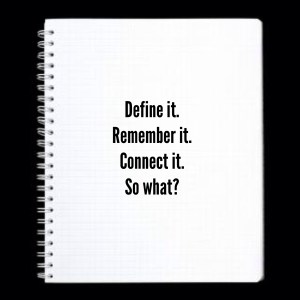
I wrote my own working piece, and my students and I read it together. Then I asked them for suggestions on where I could improve and where I could add research. You can see my working document here: Authenticity.

Students then began crafting their own four paragraphs. This ended up being the final summative assessment for fall semester due to the deaths in my family and my many absences. Turned out to be a pretty good resting place.

When we return to class next week, these are our next steps:

First, we will return to Snowfall and read and discuss the piece in more detail. You know, to get us back in the reading and writing groove after our two weeks break.

Then, we will project a few student work samples on the board and talk through them the same way that students did with mine, offering suggestions on improvement and where research may work to advance the meaning. Every student who wants whole class help will have the chance to ask for it. Others might choose to just get help from their small writing groups. Either is fine, as long as all students share their work and get feedback.

Eventually, we will work on revising our structure, moving around paragraphs, and making our writing follow Branch’s award-winning article. Of course, I will pull sentences to study and conduct other mini-lessons all throughout our writing process. And I will confer with students regularly. We will add photos and videos (hopefully originals), and we will polish and polish and polish before we publish.

For the first time ever, I am in no hurry. I will not allow our time to be regulated by grading periods– well, until the very last one at the end of the year.

We will write.

We will revise.

We will confer and share and grow as writers.

And eventually, we will publish.

And celebrate.

I’d love to know how or what you have changed as a writing teacher. Please share.

Reel Reading for Real Readers: The Scorpio Races

ReelReading2Last week during #titletalk on Twitter someone mentioned that she’d been trying to read Shiver but couldn’t get into it. I responded that Shiver is my niece’s all time favorite book — she is obsessed. Someone else chirped in saying that of Maggie Stiefvater’s books, she loved The Ravenwood Boys and Scorpio Races best. I, too, loved those Ravenwood boys, but I’d yet to read the other. I think about five different people joined the chorus, tweeting about Stiefvater’s books. Quite the popular recommendations.

Three days later while scouring the crowded book shelves at the thrift store, I found a brand new copy of Scorpio Races for .75. Book-a-holic deal. Later that week, I had five hours to spend on a plane and read this great little book half the way home. I have a few students in mind who will grab it right out of my hands when I talk about it.

I love that.

Go here to read the author’s reasons for writing this book. She includes a great narrative about writing, and even failing at writing, along with a beautiful painting that hangs in here living room. Fascinating.

Make Your New Year Revolutionary

It’s the end of New Year’s Day, and I am pondering resolutions. I should have probably already made some, but the end of 2013 took over my heart, and I am a little behind.

My husband’s grandmother passed away two days before my sweet mother. We attended two funerals in one weekend. Since we had to travel and plan services, I took the last seven days of the semester off, which means I missed reviews and final exams and calculating semester grades. I have a lot to do. And I’m having a hard time feeling like doing it.

But I will. And as I’m thinking about my resolutions I know I need to help my students set some, too.

So many need to read more, write more, do more. And I only have one more semester to help them learn.

So I am going to slow down, be more purposeful in my conversations with students, take more time for allowing them to talk, express, emote.

I am going to extend writing time, allow more hours to create and polish and publish–instead of rushing to meet the end of a grading period like I always seem to do.

I am going to keep filling my award-winning-books-only bookshelf and challenge advanced students to take on more advanced texts.

And finally, I am going to use Twitter more in the classroom: share links to student blog posts, reviews on Goodreads, book suggestions, author tags, and more. Try to model the sharing I do with my own PNL. Twitter made a huge difference in my class two years ago, but I haven’t taken the time to get it set up and going well in class this year. I need to change that.( I’m thinking about Instagram, too, but I’m still mulling around how to use it to promote more reading.)

On Monday I got two messages about resolutions from two of my daughters. Jenna said, “church was all about resolutions. They kept just calling them goals, but I always think a resolution should have a stubbornness to stop something or do something. You know, when people say things, resolutely? There’ something with staying power there. So, yeah, I’ve made some resolute goals for the New Year.”

And Kelly said, “I hope you all are making some New Year’s REVOLUTIONS! Not resolutions because that is lame…And revolutions are big. Make it a year to remember with me!

Next Tuesday my students and I will be back in the classroom. We will talk about being more resolute in revolution readour learning, more intentional as we learn together this spring. We’ll set some new goals.

And if I can figure out how to get students to do all this grading (the one thing that bugs me the most about teaching), well, that will be truly revolutionary.

Happy New Year, friends.

What are your New Year’s Revolutions?

Reel Reading for Real Readers: Bruiser by Neal Shusterman

ReelReading2My students have asked for this one, but I didn’t have it on my shelves. Thankfully, Bruiser is a book I got in my box at the ALAN conference. this book jumped to the top of my TBR pile, and I read it the day I got home from Boston.

I love it when a book makes me want to be a better person. Bruiser did that for me. I am not sure this book trailer does the book justice, but I especially like how the students who made it made the opening look like a real movie trailer.

This is a book that’s going to have a waiting list.


AP English: Improving Our Rhetorical Analysis One Quickwrite at a Time

I’ve mentioned that I am working on finding a way to be more efficient in my writing workshop. I want to expose students to beautifully written language that we can study together, and maybe learn a little grammar, but I also want to use these pieces of text for quick writes. I know that the content (or at least my questioning) has to be compelling enough that students will have something that makes their fingers itch to pick up their pens.

When I read I find myself dog-earing pages and book-marking passages that have been crafted with many rhetorical devices and/or literary elements. By helping students recognize how these strategies, used deliberately by the authors, create meaning, my students’ rhetorical analysis timed writings are scoring higher than they have at this point of the semester in years past.

I love it when my ideas work.

This is the passage we will read and respond to this week:

From An Invisible Thread by Laura Schroff and Alex Tresniowski p4

And so, when Maurice spoke to me, I just kept going. Another thing to remember is that this was New York in the 1980s, a time when vagrants and panhandlers were as common a sight in the city as kids on bikes or moms with strollers. The nation was enjoying an economic boom, and on Wall Street new millionaires were minted every day. But the flip side was a widening gap between the rich and the poor, and nowhere was this more evident than on the streets of New York City. Whatever wealth was supposed to trickle down to the middle class did not come close to reaching the city’s poorest, most desperate people, and for many of them the only recourse was living on the streets. After a while you got used to the sight of them–hard, gaunt men and sad, haunted women, wearing rags, camped on corners, sleeping on grates, asking for change. It is tough to imagine anyone could see them and not feel deeply moved by their plight. Yet they were just so prevalent that most people made an almost subconscious decision to simply look the other way–to, basically, ignore them. The problem seemed so vast, so endemic, that stopping to help a single panhandler could feel all but pointless. And so we swept past them every day, great waves of us going on with our lives and accepting that there was nothing we could really do to help.

Write about a time when you encountered a homeless person or a beggar. How did you feel? What did you do?

I am still working on the questions. Sometimes I think it’s best to say, “Just respond.” Other times I think students need more direction.

What do you think?

Reel Reading for Real Readers: My Friend Dahmer

ReelReading2My Friend Dahmer by Berf Backderf only sits on my shelve until I book talk it just once. My students are fascinated when I tell them that the book is based on a real boy who grew up to be a real man who murdered people. They only know of serial killers from TV and the movies. I get the “pleasure” of introducing them to a real life psychopath. It creeps me out a bit that this is such a popular book, but students love to read it.

Rethinking: Real World Learning

life

I can’t say that I’ve ever posted an assignment to readers of my blog before, but I do promise this is not an exercise in futility. It will be worth your time.

After reading this article:

These Are the 30 People Under 30 Changing the World

Ask yourself:

  • What are you doing in your classroom with teenagers that is really pretty trivial in the scheme of life?
  • Is dissecting Silas Mairner for the 83rd time really necessary when kids in your classroom are quite literally curing cancer & making millions in real life?
  • How might you bring real life into your classroom and make learning relevant for kids?

I know when most educators say, “I’m trying to prepare these kids for the real world,” they are referring to the “real world” as the time when students have graduated high school or college and are living on their own, but let’s be real with ourselves. The world that our learners are currently living in is the real world. Why do they have to wait until they are 18 years old, or older, before what they are learning in school becomes relevant?

Personally, I was blown away to think about all the things that young people are currently doing to change the world in which they live, and I immediately began to think about how we could be doing school differently to support the ingenuity and innovation of our learners. Hopefully you will take a minute to think about that too.


Photo credit: Werner Kunz / Foter.com / CC BY-NC-SA