Author Archives: Amy Rasmussen

Mini-lesson Monday: A How-to on One Way I Teach with Short Texts

“Hey, Mrs. Rasmussen, I noticed this passage when I was reading,” Geovany said after class as he flipped a few pages in The Kite Runner and read a few lines. “That just really make me think, and it’s really nicely written.”

“And this is what I want you to understand, that good, real good, was born out of your father's remorse. Sometimes, I thing everything he did, feeding the poor on 
the streets, building the orphanage, giving money to friends in need, it was all 
his way of redeeming himself. And that, I believe, is what true redemption is, 
Amir jan, when guilt leads to good.” ~Khaled Hosseini

That might have been the passage. I don’t remember exactly, but I do remember the moment. It’s one of my favorites of the year.

Geovany did little work in my class until these book clubs. I’m not sure he finished reading even one book all fall. Although bright and capable, he is busy. He works 20 hours a week changing tires at a local auto shop, plus school with at least one AP English class. Mine. I know Geo has big hopes for his future, and I know he wishes he had a dad. He’s written a few times this year about how he wishes he had a father to mentor him, care for him — be a dad to him. So when Geovany showed me that passage in The Kite Runner, and when he explained that he’d made a connection to it, I knew all my talk about reading and noticing how authors craft language was working.

I will keep doing what I know works.

This lesson is an example of how I use what my colleagues and I call a triple play. We got the term from Penny Kittle. A triple play is when we find a passage that allows us to do three things with it:  1. have student write a personal response to the passage, 2. talk about an engaging book students might like to read, 3. study the author’s craft — not necessarily in that order. This lesson uses a passage from Challenger Deep by Neal Shusterman. (Actually, there’s two passages because I love them both!)

Objective:  Using the language of the Depth of Knowledge Levels, students will make observations about a text, write a response, discuss and analyze the author’s craft, and construct meaning of their own modeled after the writer’s.

Lesson: First, to give students a glimpse into the book, I introduce it by reading the cover, 18075234which has three interesting quotes:  1. “A brilliant journey across the dark sea of the mind; frieghtening, sensitive, and powerful. Simply extraordinary.” ~Laurie Halse Anderson, award-winning author of Speak; then two from the book:  2. “The bottom is only the beginning.” and 3. “My feet are on safe, solid ground, but that’s just an illusion.”
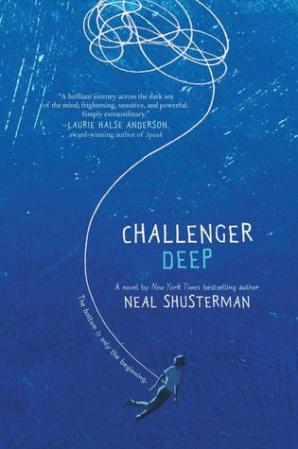
I ask: What do you think this book is about? After we read a passage from this book today, analyze a little bit, and write a little bit, I hope this is a book you will want to read.

Next, I give students a copy of the passage. I read it aloud first and ask students to pay attention to anything they find interesting that the writer does with language. They almost always find the literary or rhetorical devices I hope they will. Sometimes they do not know how to name it, so this is where I teach academic vocabulary. We discuss the effect of the devices on the meaning of the passage or why the writer might have made those choices when constructing meaning. We almost always talk about tone. Depending on where we are in the school year and how much we’ve done with analysis, I may ask students to write an analytical paragraph that answers the craft study question.

Finally, I ask students to read the passage again to themselves and then write a response. Some suggestions for response prompts are at the bottom of the passages. Students have about 10-15 minutes to write. I always ask students to read over what they wrote and then revise before they share. Sometimes students share at their tables. Other times we share out as a whole group.

Follow up:  Throughout the school year, I use a variety of texts I pull from books I read from my classroom library. You’ll find other passage I’ve used if you search the categories for craft studies (or just click there).

A few times a year, I ask students to find significant passages in the books they read. Sometimes they construct their own “craft study” questions. (I especially like to do this when we read in our book clubs.) Sometimes students answer the questions they construct in formal response one-page essays.

The goal is to help students learn how to identify and analyze the moves writers make to craft meaning — and to help them practice writing using these moves as models for their own craft.

And just maybe they will make connections to a text like Geovany did to The Kite Runner.


#FridayReads: Required Reading “Our Students Want to Write”

Confession:  I buy a ton of pedagogy books. I rarely read them all the way through. I blame it on my blossoming OCD. I can only take in so many ideas before I run out of space in my head to hold them all long enough to use them.

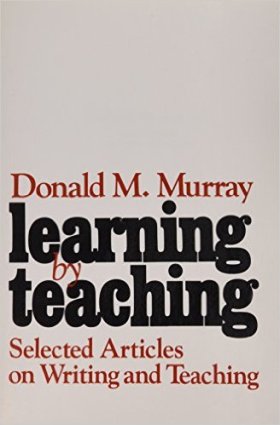
412bcpby4iol-_sx326_bo1204203200_That is not the case with this classic, suggested to me by my friend and mentor Penny Kittle, Learning by Teaching by Donald Murray.

I remember when Penny recommended it. She was in the DFW metroplex teaching a workshop, and I’d asked if we could meet up and talk about my writing. She graciously agreed, and we met at a Starbucks inside a Target. As always, Penny radiated positive energy. She told me about the work she was doing with Kelly Gallagher. I told her about my struggle trying to write a book, a book I am still trying to write.

I still cannot believe I had a writing conference — yet again — with Penny Kittle! (My first was during her class at The University of New Hampshire Literacy Institute the summer of 2013.)

At one point in our conversation, Penny paused and asked if I had read Don Murray’s book Learning by Teaching. I said no. At the time I hadn’t read any of his books, but I’d heard Penny talk about Murray with such affection, quoting him often. I knew this was a book I need to not just purchase, but one I needed to read. I’ve read and re-read and marked page after page.

Don Murray validates the moves I make in my workshop classroom, the moves I make

pageinMurraybook

My thinking while reading the essay “The Process of Writing” by Donald M. Murray


when planning instruction for my AP Language and Composition course. I have learned from those who learned from Murray, and his work reminds me again and again why teaching with student choice in mind works. Every time I feel like I fail, every time I get frustrated with the way an assignment flopped, or I didn’t reach a certain student what I’d hope to teach him, I turn back to this book of essays by Murray. (I did this recently after most of my students bombed an assignment, which was mostly my fault.)

Here’s an excerpt from Murray’s essay titled “Our Students Will Write –If We Let Them” published in North Carolin English Teacher, Fall, 1977. I probably break a copyright law by sharing, but I’ll risk it if it means freeing more writers. (See more about freeing writers in Penny Kittle’s piece “What We Learn When We Free Writers.”)

Our students want to write — but not what we want them to write.

Our students want to write of death and love and hate and fear and loyalty and disloyalty; they want to write the themes of literature in those forms — poetry, narrative, drama — which have survived the centuries. They want to write literature, and we assign them papers of literary analysis, comparison and contrast, argumentation based on subjects on which they are not informed and for which they have no concern.

We should see that their desire to write proves the vitality and importance of literature and literature-making in each generation, that language is central to the human experience, not just as a communications skill but as the best way to recall and understand experience. We tell our students the unexamined life is not worth living, yet we seldom allow those students to examine their lives firsthand through what is termed creative writing.

It is time that we, as a profession, not only support the reading of literature but the making of literature; that we encourage our students to write what they want to write and realize that what they want to write is more intellectually demanding, more linguistically challenging, more rhetorically difficult than the writing we usually require in the English class.

The biggest problem in the teaching of writing is ourselves. We do not encourage, allow, or respond to our students’ desire to write. We do not believe that our students can write anything worth reading, and they prove our prediction. Conditions will not improve until we realize that what we face is a teacher problem, not a student problem.

There are many important reasons to consider taking what is usually tolerated, at best, in the elective creative writing course and placing it at the center of the writing curriculum. Some of them are:

  • Writing about individual human experience motivates both the gifted and those we often consider disadvantaged. In fact, we may find that the disadvantaged aren’t in terms of experiences which can be explored through writing. Students who are not motivated by our lectures on the need for writing skills–they know the need does not exist in the lives they expect to live–still share the human hunger to record and examine experience. Students who are bored with papers of literary analysis or even incapable of writing such a paper at this state in their development may be able to write extraordinary papers based on first-person experience.
  • Students discover…that they have a voice, they have a way of looking at their own life through their own language. They discover and learn to respect their own individuality.
  • Through writing, the student increases his or her awareness of the world, and then works to order that awareness.
  • As students follow language towards meaning they extend and stretch their linguistic skills.
  • The experience-centered, doing nature of the writing curriculum will reach many students who are not comfortable with the analytical passive-receptive nature of the typical academic curriculum.
  • Creative writing gives students a new insight to literature. The study of literature is no longer entirely a spectator sport, but an activity which they can experience and appreciate.
  • The creative writing class may be the place where some students learn to read. Test results in many community colleges and other colleges of the second chance show that many students who test as not being able to read are also the best writers. They are able to read their own words and to perform the complex, evaluative techniques essential to revision. They learn to read by writing.
  • Students and teachers of creative writing rediscover the fun of writing. Art is, at the center, play, and perhaps that is the reason it is so little tolerated in the school. If it is fun can it be learning? Yes.
  • Finally, we should teach creative writing because it is more intellectually demanding than the study of literature or language as they are usually taught in the English class. This runs directly counter to the stereotype believe by most English teachers. IT is easier to complete a workbook on grammar, easier to tell the teacher what the teacher wants to know about a story than it is to use language to make meaning out of experience. The writing course is a thinking course, and it should be central to the curriculum in any school.

There is more. I believe Murray’s writing, like Penny’s books Write Beside Them and Book Love, should be required reading for every English teacher. I wish they would have been required reading in my education classes. For the first few years of my career, I struggled like many teachers I know with student engagement and learning while I taught literature instead of readers and writers. (Someday I’ll write about the Dickens I subjected my 9th graders to. It’s a sad sad tale of student, and teacher, woe.)

And someday I’ll finish this book I’m trying to write. I think Don Murray would want me to.

What books do you think should be required reading for all English teachers? I’d love to read your suggestion in the comments.


5 Things I Need to Remember When Teaching my Writers

I know we’ve been posting mini-lessons on Mondays on this blog for awhile now, but today marks the first day of my spring break, and since my students and I just finished a fairly complex writing task, this is a good time for reflection.

don-graves-quoteMy AP Language students wrote arguments as spoken-word poems, and then performed them in class. (Or if they produced their poems digitally, which was an option for publishing, they projected them.)

Our process included reading and studying several poems. We watched YouTube videos of spoken word poems by Shane Koyczan, Harry Baker, Marshal Davis Jones and more. We analyzed structure, craft, and theme. We pulled out lines we felt held the weight of the poem and wrote responses to them, hoping to find inspiration for our own writing. We reviewed the elements of argument. We discussed the claims the poets make and how they use evidence (or do not) to support these claims. We spent workshop time thinking, writing, and revising our poems. And my student teacher Zach and I spent hours talking to writers about their writing.

I’ll share some of the amazing poems my students produced in another post. For now, here are some things my students reminded me I need to do better so they can do better in our next round of writing:

  • Topics matter. If I want my students to produce well-written texts, they must select well-chosen topics. Too often my writers choose topics they might have a passion for, but they know little about. This leads to vague superficial writing.

I need to take more time on the front end of the writing process to make sure all of my writers choose a topic that they not only care about, but that is specific enough to the task at hand. One resource that will help as we choose topics for other writing tasks is this tutorial from University of Arizona Libraries. I need to remember to slow down on the front end and help students select narrow topics.

  • Clear feedback matters. For this writing project, I only left feedback once on student drafts. It was not enough. Or it might have been — if students had read it. (Please tell me I am not the only teacher with this issue:  Students ignoring feedback.)

The best feedback is not when I leave comments on Google docs like I did for this project, but when I talk to them face-to-face and answer their questions. Students need to see my response to the work they have done. They need to see if I like it. They often misread, or don’t read, my tone in written feedback. I must remember to give them a balance of both — and a lot of it all along the way.

  • Sometimes more explicit instruction matters. In more than one conference, when I asked students why I didn’t see application of the mini-lesson in their writing, they said: “Oh, I thought that was just a suggestion.” Well, yes. But what’s the point of a mini-lesson — designed to help students write better — if they refuse to at least try it?

I know that we must teach the writer and not the writing, but sometimes without a little push to make specific changes, my writers just do not improve. I need to remember that with some students I must be more explicit in my instruction.

  • Accountability throughout the process matters. I was out of the classroom several days when students had writing workshop time to work on their poems. (Someday I’ll tell you about the standards revision work I’ve done with the TEKS Review Committee in Austin this year.) Although my student teacher was there, and my substitute — a former teacher and a sub my students know well — too many of my students clearly wasted the time given them in class to write. They are teenagers after all:  give them an inch and they take a mile. And they are major procrastinators. I think they are finally understanding that good writing takes time, but many are still not taking the time to produce good writing.

I need to do a better job at holding them accountable for working during workshop time. More exit slips. More sharing a favorite line or passage they’ve written that day. More purposeful formative assessment and personal evaluation of their writing processes.

  • Conferring (more) matters. The two days students shared their poems were exciting. So many were fantastic. So many clearly showed their understanding of how to write an effective argument — and how to be clever and creative with poetic elements as they did so. But quite a few did not.

As Zach and I discussed each performance and each poem, matching the writing to our rubric and assigning a grade, we became clearly aware of which students we conferred with the most and which students we did not. One of us would say: “She did exactly what we discussed in our conference,” or “That was something he and I talked about in his conference.”

The students we conferred with the most not only fulfilled the requirements for the assignment the best, they produced the most creative and convincing argumentative and poetic writing. And they knew it. Their confidence as they performed their poems was evident, and they rocked the house with their beautiful and inspiring poetry.

Taking the time to confer with every student — whether they want to talk about their writing or not — must be a regular part of the writing workshop. Too often conferring becomes optional when I get too busy or spread myself too thin. I must remember to schedule conference time into the lesson plans and hold myself responsible for making them happen — not once but several times for each student.

How do you know when your writing workshop is working?  Please share your ideas in the comments.

#FridayReads of a Different Kind of Joy


Sometimes we just need a little joy.

I know it is almost spring break, and the attitude’s toward thinking and learning and producing quality work have been bleak lately. (Evidence = 12 out of 24 students turned in the last assignment, and only seven of the 12 finished all the parts of it.)

My head’s been banging on the desk a little too much lately. I know you’ve been here a time or two yourself.

Teaching is hard.

Then we get gifts like the one I got today:  a blog post written by a student who shows she not only understands the philosophies behind my pedagogy — she likes it. She believes she’s learning.

Please read Jessica’s post.

I’ve read it five times today, and I smile just thinking about lines like this: “I feel strongly that this free-range form of teaching can be beneficial to other students as well, in the way that it both implements a refreshing break of classroom custom, and prepares us for the life of decisions that waits beyond the embellished paper borders of our high school diplomas.”

Choice matters, my friends.

I would love to hear of your most recent successes with students. Please join the conversation by leaving a comment.

Doing More with Essential Questions: Where and How Do I Belong?

As I read through Cyndi Faircloth’s post a few weeks back on Applying Essential Questions in Workshop, it got me thinking about the role of essential questions in my own classroom. As Cyndi said, I needed to do more. Using the essential question to choose mentor texts, guide quick writes, and frame discussion, we had done. I also encourage students to see the essential question as something answered by each and every text we encounter.

But this was about doing more. This was about students answering the question for
themselves; students lending their unique voices as “texts.” I was going to need to look at this from another angle.

My AP Language and Composition students recently finished a unit on community. Theyimageworked in and around the essential question, “What is the relationship of the individual to the community?” Through the study of a variety of essays, including everything from Henry David Thoreau’s “Where I Lived and What I Lived For,” to Scott Brown’s “Facebook Friendonomics,”  to student selected current event articles, I watched my scholars analyze text to connect author’s purpose with rhetorical strategies. However, beyond that, I was blessed to be able to witness a conceptual development in these classes too. 
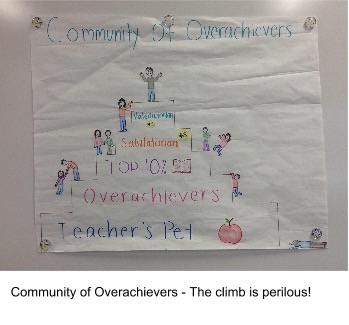
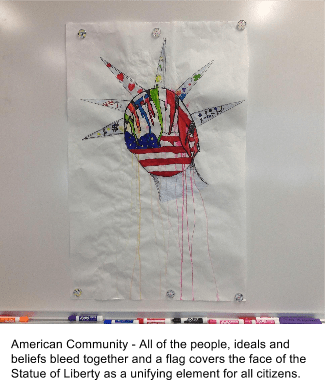
Students seemed genuinely surprised when they considered just how many communities they are a part of: geographical, family, faith, school, sports, friend, experiential. But when they started to consider their roles within those communities and words like responsibility, conformity, and balance began to dominate class discussion, I knew they were really on to something.

Students spoke of the dangers of conformity alongside the necessity for it. They explored the freedom found in chosen communities and the often unwelcome responsibilities to those communities we fall into by default. I saw them wrestle with the concept that communities rise and fall based on the actions and inactions of their members, and then saw evidence in more than one journal entry of the very real concern students have for their own part in that equation.

image_2As these kids get ready to head off to a world beyond the insulated suburban existence most of them have known all their lives, they know many of their foundational communities will be changing. For some, this change can’t come soon enough. For others, I think it will be a rude awakening. And still others, a chance to move toward the authentic selves that they so desperately need to discover.
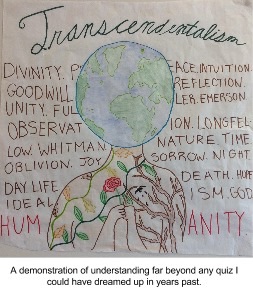
To bring this unit to a close, I wanted to harness all the unique inquiry that we had experienced. To do so, I borrowed from my American Literature class. Throughout this year, my sophomores have started each unit by doing a bit of research on literary movements in American Literature (somewhat of a snoozefest to many). I wanted them to have some contextual understanding of the mentor pieces we would study, and so they gathered information on historical events responsible for the movement, major themes of works at the time, elements of style popular during the period, connections to music and art, and famous authors working within that movement.

Students gathered and compared their research findings in small groups and then were charged with symbolically representing their research on poster sized paper. For the imaginative qualities of Romanticism, we saw Sponge Bob. The Transcendentalist faces of Emerson and Thoreau became flowers in a pot, watered by Walt Whitman. Mark Twain held up a mirror to a map of the American South. In image_1short, students captured the movements and we hung up the evidence to remind us of the context of what we were exploring.

And so, for my AP Language students, I chose to end their unit on community by bringing
them together in small groups as well, to choose a specific community and illustrate an answer to the unit essential question. I figured if they answered the question without a specific community in mind, we’d get a lot of generic posters with people holding hands around the world – thank you, Google.

Instead, they had to choose specific communities to show their understanding of the complexity of the essential question and then supply textual evidence from the mentor texts we explored in order to support those symbolic meanings.

imageStudents shared some phenomenal work and I was impressed not only with the depth of their thinking, but the synthesis of texts this activity produced. And, because my own artistic development was apparently arrested in the second grade, it was such fun to see some of my visually gifted kids shine through the use of a new medium.

Zoey and Alyssa, who created the Statue of Liberty visual said the exercise allowed them to express their “artistic qualities – which is many times put on the back burner in AP courses.”

Creative expression of understanding put on the back burner? Shame on us.

And I know for a fact that AP classes aren’t the only place to suffer a similar fate. If we are going to do more with essential questions, we need to not only have students to be directly involved in answering them, but also give our kids more voice in the demonstration of their learning.

Ultimately, it was an assessment that combined creativity, common core standards, direct connection to the unit essential question, analysis, entertainment, synthesis, and genuine student enthusiasm. Not bad for mid-February in the frozen North.

How do you use essential questions to effectively deepen critical thinking? Please share your comments.

TTT welcomes Lisa Dennis, inspiring teacher and innovative leader at Franklin H.S. in Franklin, WI, as a visiting contributor on this blog.

From John Green to Jane Austen: Student Choice and Motivating Non-Readers

Anyone who knows me knows I talk a lot about moving readers and writers by offering choice in the classroom. Without a doubt, the more I study the research on reading acquisition, the more I confer with my students and try to write about it, the more I immerse myself so I can immerse my students in engaging YA and award-winning literature, the louder my voice gets.

I am a full fledged advocate of readers and writers workshop at the secondary level.

And I’m not backing down.

This semester I have a student teacher who hears it from me every second of every day. Almost.

My ultimate goal is to tattoo Zach’s brilliant young mind with everything I’ve learned about teaching the past ten years. Everything that sent me to and cemented my pedagogy in workshop. And I think choice seals the ink that may change his teaching career forever.

But this pedagogy is not easy. Just like in a traditional classroom, students put up their fists and sometimes fight dirty. Sometimes they want to be told what to read and what to write and how to think. Sometimes too often.

And that is when this job gets hard.

Lately, it has been hard, and Zach has seen my frustrations. But he is smart, and he sees through student b.s with laser-like charm, problem-solving as I vent and complain.

I should be more controlled I tell myself every morning. Careful-what-you-say-Ame. But I can’t help it — my job is my sleeve. If I didn’t care so much about my students, their lives, their futures, I’d call it a day and tell Zach to take charge and have fun.

But I want him to learn. I want him to last in this profession that eats ’em up and spits ’em out. So I’ll share.

I’ll share what I’ve learned and how I’ve learned it. I’ll encourage. I’ll prod. I’ll challenge.

He’s a keeper I can already tell.

How do I know? Well, I asked if he’d write a post for this blog about reading YA literature for the first time. What does Zach do?

Oh, he writes, but he starts his own blog and tells me today: “I’ve got this friend who’s student teaching over in Northwest ISD, and she’s started blogging, so maybe we’ll start this new-teacher blog thing….”

You can still see my smile.

Here’s Zach’s post about his first adventure into YA literature. You’ll read it, and then you’ll want to hire him.

Yeah, I know.

Choice Doesn’t Necessarily Mean Personal Connection: A reflection for a do-over


I have started this post four times, and I cannot think of a pithy way to begin. You know, some clever opening, some hook to get the reader’s attention — some startling statement.

My creativity got swallowed by analysis. Well, kind of.

I figure I must be doing something wrong because my students cannot analyze to save their lives. They can talk around a text and say absolutely nothing quiet well though.

So all afternoon and into the evening I’ve thought about thinking. I’ve thought about my students’ thinking.

And I’ve determined the problem: Many of my students are not doing it.

They sit and wait, looking around the room, waiting for someone else to speak up and do the thinking for them. It’s like a Mexican standoff, and something’s gotta give.

105997-clint-eastwood-mark-wahlberg-s-jkzn

Last week I listened to Dr. Margaret Hill talk about the importance of connections and how standards must include opportunities for students to make both efferent connections and aesthetic ones. The only way to truly learn is to make personal connections, Peg reminded me, citing Louis Rosenblatt’s Transactional Theory.

How can I provide more opportunities for students to connect to the learning?

Yesterday I read an article about mindfulness and how when it’s practiced in schools it is helping children’s well-being. Some experts say the practice of mindfulness is even an essential —  a way to reduce depression, extend focus, truly learn.

How can I help students get and stay in the present?

This morning I watched the TED Talk by Shonda Rhimes “The Year I Said Yes to Everything,” and how playing again has helped her find “the hum,” the thrill and joy in her life and in her life’s work.

How can I introduce more play into my classroom?

Today in class most of my students crashed into a brick wall of higher-thinking they could not go through, over, or around. Many didn’t even try. I came home from school worn out and weary.

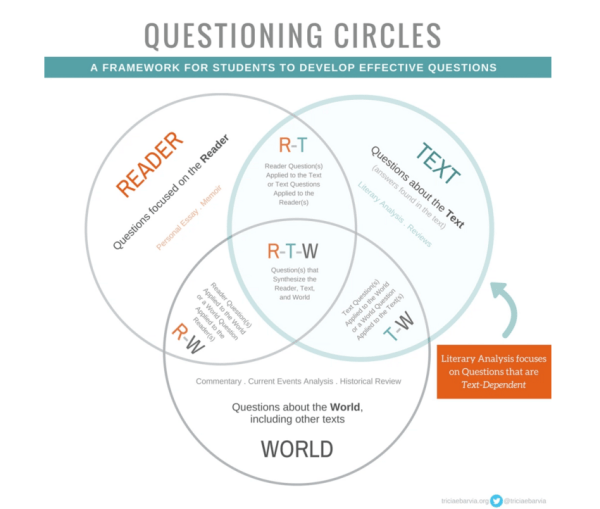
Then I read this post by Tricia Ebarvia, and I stalked her blog until I read the post “Steps toward an Inquiry-based Classroom,” and a missing piece walked right into my puzzle.

Tricia made me think about the on-going need for curiosity and student-generated questions. The ongoing need for purposeful and personal inquiry. She shared the chart below, citing the work of Christenbury and Kelly, NCTE, and Jeff Wilhem. And I got it.

Screen Shot 2016-02-18 at 7.18.15 PM

My students do not care enough about the books they’ve chosen to read. They do not care enough about the topics they’ve chosen to write about. I haven’t been paying enough attention, or I would have realized this sooner:  Choice does not necessarily mean personal connection.

I am glad I have time this year for do-overs.

It’s time to back up a few steps, so we can step into better opportunities for engagement, growth, and learning.

Maybe we’ll mediate.

Maybe we’ll play.

But we will certainly play with developing effective questions.

An Honest Reflection: No Ugly Crying Required

I just finished an ugly cry. You know, the kind where you sob until your eyes close so tightly that you wonder if you might hurt yourself? The delicious, exhausting, purge of a cry that leaves you breathless and wholly satisfied at the same time? In my humble opinion, it’s the type of weep-fest that only great writing can deliver, and I am delighted to report that I just slobbered my way through another story’s end that left me wanting to pick up the book and start right over again. On the recommendation of colleague, I picked up A Monster Calls on Friday afternoon during last period and finished it by Sunday afternoon.
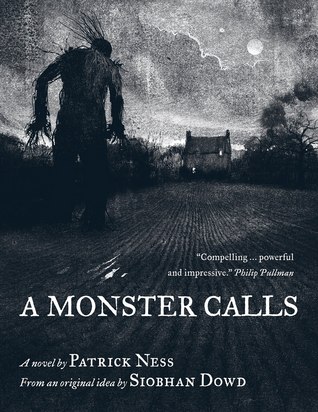
Though I could go on for pages about how amazing this book is, and how excited I am to 8621462book talk this story tomorrow, and how transformative I think this text could be for some of my kids, it’s what led me to this text that I find really important right now. As a result,  approximately eight minutes after finishing that book, seven minutes after shoving a copy of it into my husband’s hands and insisting he “Read this. Read this immediately” (thankfully we’ve been married long enough that he can recognize a literary induced meltdown and not fear for his own safety), five minutes after texting half my department to tell them of my ugly-cry recommendation, and three minutes after blowing my nose one more time and pulling myself together enough to see the screen clearly, here I am. Counting the minutes until school starts, so I can tell students about this text. It’s the best feeling and it’s fueled by what I have deemed A Workshop Whirlwind.
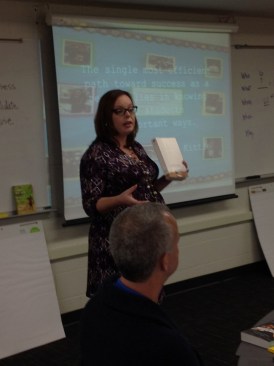
A Workshop Whirlwind. And that’s not just cutesy alliteration either. It’s representative of an urgent and necessary flurry in my teaching career. And I, for one, could not be more excited. You see, it was this past week that Workshop came to knock on the door of the Franklin High School English Department in a real and meaningful way. And this is the story of how we’ve started down a path that I believe will change our practice and lead our students to see themselves as both readers and writers in a way we would not have thought possible.

Our journey with workshop is a unique one. We are going to be moving to this new delivery method as a whole group in one glorious leap. Thankfully, by a bit of divine intervention, we have had the support of the lovely and overwhelmingly talented ladies at Three Teachers Talk. It was TTT that gave us a place to land and see that workshop is not only possible at the high school level, but it can make a world of difference for our kids. And it was a little over a year ago, with the knowledge that my department was being asked to drastically change our day to day practice, that I pored through post after post on this blog searching for guidance. How to plan, how to assess, how to hold kids accountable, and how to organize, but most importantly…how to inspire our students. How to help them see that reading and writing could be so much more than an assignment. That our study of English could be a study of what it means to be. What it means to feel.

Now, change is rarely easy. In fact it sometimes leads to a brand of ugly-crying that is reserved for just these circumstances, where you feel the happy ship you’ve been sailing on has hit something substantial and the band has already started playing “Nearer My God to Thee.” Everyone find a lifeboat! We’re never going to make it out of here alive! I liked this boat a lot better before you put this big hole in the side.” And that, my friends, is what change does to a person. What change can do to an English department. Like the seven stages of grief, change too has its stages, and I’ve both felt these stages and watched my department try to stay afloat as this major shift comes our way. See, we aren’t individual contractors, coming at this move to workshop only out of our own desire to do so. This is a district level move that has led to the following:

Shock They want us to do what? I can’t even. I just…can’t.
Denial This isn’t happening. This isn’t happening. This isn’t happening.
Anger Nope. Just nope. You people are crazy. We should just set  the place on fire, while we’re at it.
Bargaining I can still teach __________ right? I’ll do this workshop thing, but only if I can still    teach ________.
Depression Whatever. It’s fine. More change. Not like we aren’t used to it. What does it matter, anyway? What does any of it matter? I’ll be in my room, reading __________ (please see stage above).
Testing Well, I guess I could give them time to read at the start of class. That makes sense to me. I love books too, so, natural move.
Acceptance I too am a reader and writer. I can do this.

And now, I am happy to report an eighth and amazing stage to this move – genuine enthusiasm.

In the last week, since Amy and Shana came to lead our department in two incredible days of professional development, I have felt a surge of excitement at everything I want to do in my own classroom and I’ve seen my entire department rally around this initiative in a way I would not have thought possible. In the last week, the halls of Franklin High School have echoed with book talks, students are curled up in corners with texts, and  teachers are chatting about trying out new strategies and putting together mini lessons. In the last week, the Wisconsin  “Bleak Mid-Winter February” has been anything but.

The teachers I am privileged to work with have been doing phenomenal work for years, since long before I joined their team. Their skill and passion, which has long fueled their sincere desire to help students learn, makes this an incredible place to work. And so, while my team would collectively injure me if I announced that everyone feels totally relaxed and ready to hold hands and sing Kum Ba Yah, I can confidently say that our journey has begun. We are poised and now also excited, to continue learning with and inspiring our students in new ways.

No ugly crying required.

Lisa Dennis is the English Department Manager at Franklin High School in Franklin, WI. Her energetic leadership and insight leads her department into the wonderful world of workshop instruction. TTT appreciates Lisa’s candor and drive to do right by her colleagues — and all their students. We thank God for teachers like Lisa!

#3TTWorkshop: Asking Good Questions When Making the Move into Workshop

IMG_1279

Book talks about NF like Columbine by Dave Cullen and talking about the writer’s research process capture many readers

Shana and I recently conducted a two-day professional development workshop in Franklin, WI — such inspiring teachers in Franklin!

Franklin administrators asked that we help their teachers move into a workshop pedagogy, which is, of course, a favorite topic at Three Teachers Talk. We shared the background of workshop, which stems from the work of Don Murray and Don Graves, and from the work of our mentor Penny Kittle, whose ears had to be ringing and ringing since we said her name a million times throughout those two days.

Franklin teachers caught the vision and the value of letting loose the reins and opening their hearts to choice reading and writing. They just needed to experience it themselves from the seats of their students.

The discussion covers five of the pressing questions teachers asked during our pd.

They:  Where are some great places where I can get resources for books and materials for my classroom library?

Us:  The good news for Franklin teachers is the buy-in from their insightful administrators who have reserved funds to begin building classroom libraries. Not all teachers who catch the vision for choice independent reading, and the need for engaging, well-curated classroom libraries, are so fortunate. We weren’t. But finding resources and is certainly possible. Shana wrote this great post awhile back about grants she’s been awarded and the many businesses that give funds to buy books. Amy’s had great success with Donor’s Choose, one of the options Shana mentions. Three grant projects funded there so far! Lewisville Education Foundation has also been a great resource for Amy’s students and the books they love. Be sure you check out the grants offered through your own EF.

Other resources besides books are important, too. We spent time watching and responding to spoken word poetry with our new friends, modeling quickwrites, and studying the craft moves of these poets. Some of our favorite spoken word poets are Shane Koyczan, Sarah Kay, Phil Kaye, Marshall Jones, and Amy’s new favorite Harry Baker. Search online, and you’ll find YouTube videos and posts with the texts.

Engaging non-fiction articles are an essential in workshop instruction. Mentor texts, craft studies, and pairings with literature all make for authentic engagement with thought-provoking non-fiction. Find interesting articles at NewsELA, Izzit.org, Essay5W, and The Learning Network at the NY TImes. And, of course, the excellent mentors curated by our friends at Moving Writers.

They:  How can I design units that foster inquiry-based outcomes for my students?

Us:  We lead teachers in a gallery walk activity where they explored ideas of what authenticity, modeling, dialogue, inquiry, and other workshop essentials look like from both a teacher and the students’ points of view. It was interesting for us to see the many iterations of inquiry these teachers listed and how closely they overlapped with authenticity. Yes, they should.

However, getting students curious about learning does not always happen instinctively — especially when they come to us hardened by years of sit ‘n git classroom instruction. We must provoke inquiry, pique imaginations, inspire curiosity.  Of course, the move to choice opens doors to many of these needs. Providing, introducing, and talking about highly engaging literature helps. But so does allowing students to decide how they want to read it and what they want to do with it to show they are learning from reading it.

Teachers have to let go of control. We have to trust that students want to learn. We have to stop doing all the hard thinking for them. What if we let them find the mentor texts that best suit their needs as writers? What if we give them chances to determine themes they want to study, and then let them take those themes into other genres and ideas?

Let’s invite students into authentic and on-going research, so we move far far away from the one-unit-one-major-research-paper. Shana’s multi-genre project and my students’ engaging in our multi-modal feature article unit are good examples of how we apply this thinking in our own classrooms.

They:  I write every day for my job, but I have never written a “persuasive essay” for my job. How do I design authentic instruction that mirrors what my students might have to write in the future?

Us:  Read like a writer. Look for mentors everywhere. And know your kids. 

We know, if the answer was really that easy, everyone would do it. Although we do believe every teacher could. One way we’ve found to incorporate authentic instruction is to conduct regular craft studies of a variety of texts. We read a lot, and we look for texts in which we can discuss with our students topics like structure, literary and rhetorical devices, tone, etc. We call this reading like writers.

Shana and I agree, we first learned the value of reading like writers from Katie Wood Ray in her book Wondrous Words. Here’s a great Pinterest board to get you started. Shana and I will post the craft studies we find and use with our students more often. You’ll find several we previously posted when you search the “craft study” category.

They:  How do we hold students truly accountable?

Us:  In a word, conferring. We must talk to our students often and with purpose. 

sticky conferences

Modeling Silent Reading Conferences

Amy remembers when she first started moving students into self-selected texts how her conferences revolved around the books students read. Eventually, she realized that if she wanted to truly move readers, she needed to talk more to the student — as a reader — than about the book she was reading. This is an important shift in mindset and practice.

If we only encourage students to talk about the plot, summarizing this or that, maybe describing the characters, we miss out on valuable opportunities to help the reader stretch and grow in the skills she needs to mature as an independent reader. Identity matters.

Teachers foster a love of reading not by focusing on the books but by focusing on the reader of those books and helping those students identify themselves as readers. If you need ideas on conferring, Amy and Jackie discussed conferring in this #3TTWorkshop post, Amy wrote about conferring in a crowded classroom here, and Shana wrote about a what to read conference here.

Another important thing to remember about accountability:  We can ask students to write about their independent reading. Shana and I both ask students to evaluate their reading lives — several times a year. We consider these summative assessments, and students provide thoughtful commentary on how they struggle, grow, and succeed as readers. Amy quotes many of her students’ evaluations here. They are honest and insightful.

img_0331

Speed dating with books increases student talk about books, which increases students reading good books

When we ask students to write about their reading, it must be a task they see as worthwhile — and one we see as a support to our ultimate goal:  developing life-long readers. Too often, we read about teachers who punitively assign tasks to “catch their students not reading.” If this is you, please stop.

They:  How do I create engagement not compliance due to grades?

Us:  Choice. Choice leads to engagement. Engagement leads to autonomy. Autonomy leads to independence. Independence is engagement.

Trust the process, and see for yourself.


Mini-lesson Monday: Taking on the Thesis Statement

Right now, my students and I are writing spoken-word poems. I’ve wanted to play with language this way for a long time now, but finally mustered the courage — and figured out a way to make this kind of poetry fit into my AP Language goals and the needs of my students as they prepare for the AP Lang exam.

While watching and listening to many spoken-word poems, I realized that most of them are an argument, filled with not only beautifully crafted language — devices galore — but they also show craft in the use of the appeals. With the help of my student teacher, Mr. Zachery Welch, we designed a unit that centers around the rhetoric in spoken-word poems. And we are all writing our own. (This is a challenge for me, but I absolutely believe the the importance of a teacher writing beside her students. Thanks, Penny Kittle, for teaching me that!)

The performance task for this unit reads:  Craft a spoken word poem that addresses a personal conflict and/or a social issue, include rhetorical techniques and literary and rhetorical devices to convince your audience of the need for positive change. Perform your poem for the class live, or create an automated slide show with visuals, or a video recording as a way to digitally perform your poem.

This lesson stems from our work  — and the need for students to include stronger thesis statements in all of their argumentative essays.

Objective:   Using the language of the depth of knowledge levels, students will identify powerful lines in a spoken-word poem that serve as position statements. They will discuss and then categorize these statements in order of importance as it pertains to the poet’s overall theme. Students will then formulate three powerful thesis statements of their own and revise their drafts to include these powerful thesis-like lines.

Lesson:  Watch and listen to “Paper People” by Harry Baker. Ask students to pay particular attention to the lines of the poem that hold the weight of the poet’s position. They must listen carefully because Baker’s poem is primarily crafted with the alliterative “p”. Give students a copy of the lyrics, and on the second listening, having them mark specific lines they think represent Baker’s position. Then, ask students to discuss the lines they marked with their small groups. As a class, determine the line that best serves as Baker’s thesis.

Next, instruct students to write three thesis statements for their own poems. They should discuss their thesis statements within their groups and help one another develop powerful statements that hold the weight of the meaning in their poems. Then, instruct students to revise their poems, including all three of their new strong lines.

Follow up:  Students continue to revise and strengthen the arguments within their spoken-word poems. They should also remember to write three powerful thesis statements in their argumentative essays and challenge themselves to use all three in their writing.