Author Archives: Amy Rasmussen

Mini-Lesson Monday: Do Teens Read Seriously Anymore?

It’s the end of our nine weeks. Well, kinda. I have one class of English 3 students that are at midterm since they are on accelerated block, and I’ve got two classes of AP English Lang who I share with AVID every other day in a year-long class, so they are at about the 4.5 weeks mark. Talk about crazy trying to keep the pacing straight and everyone moving.

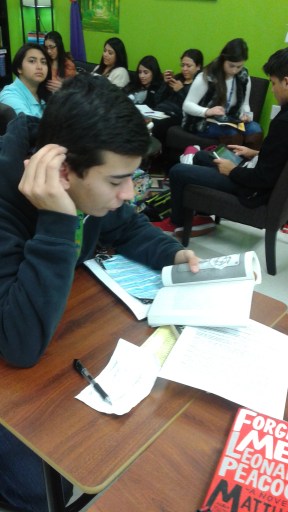
One thing I know:  All my readers need to revisit the goals they set for themselves the first week of school. We’re going to start with independent reading. I’ve seen a little too much of this lately:
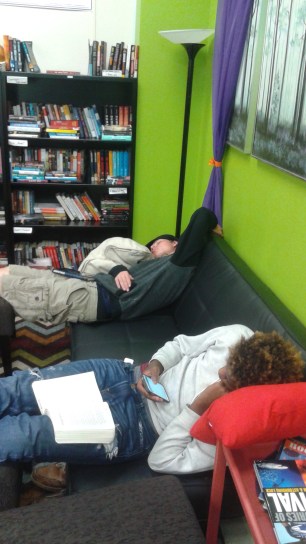
joshandtajhnotreading

Taken after exams when I suggested students use the time to read.

and not enough of this:

juniorboysreading.jpg

Daily routine: 15 minutes of independent reading

I set the standard high and ask my students to read three hours a week. This is difficult for busy teenagers who are not used to reading (and if we are honest, many are not used to completing any type of homework).

We will read this article this week “Do Teens Read Seriously Anymore?” and create our personal reading challenge cards. But before we do, I want to get students thinking about themselves as readers and what reading can, and should, mean to them and what they hope to accomplish in their lives.

Objective:  Interpret a quote on the importance of reading and connect it to my own reading life; construct a plan to help me meet my reading goals.

Lesson:  Students will select up two literacy/reading quotes and glue them into their writer’s notebooks. They will then think about their reading habits over the past several weeks of school and write a response to the quotes that connects their reading experiences (or not) and begin constructing a plan on what they can do differently in the upcoming weeks to either continue to grow as readers, or start to.

Follow-up: Later in the week we will also read “The Insane Work Ethic of Mark Cuban, Jeff Bezos, and 15 Other Powerful Leaders” and write a synthesis-type response using the two articles and their personal goals for reading.

Please share in the comments your ideas for getting and keeping students developing their reading lives.

Why I Love My Writers (and some book suggestions, too) #FridayReads


Maybe you see this, too:

I’ve got truly brilliant, fun-loving, willing-to-learn students this year, but when it comes to writing, they are as sloppy as a room full of toddlers with their first plates of spaghetti.  Missing periods and capital letters, too many commas (or not enough), and the makes-my-eyes-bleed lower case i. That one’s all over the room.

And I keep seeing this new thing:  the missing “it.”

Take this for example, all sentences from a self-evaluation students completed last week:  “My reading’s good, is something I do to release stress,” or this one: “Is the same thing as going somewhere,” or this: “My reading improved is better because I tried more.”

What?

Do I worry about mechanics over ideas? Never. Do I worry that my students know better and are just not paying attention? Always.

I teach juniors in AP English Language. This string-your-spaghetti-anywhere-you- want-punctuation should not be happening.

So we slowed down a bit. Took a step back. Searched in our in our independent reading books for sentences that struck us as interesting.

Students wrote their sentences on notecards. Here’s some they chose:

“It’s easier to jump out of a plan — hopefully with a parachute — than it is to change your mind about an opinion.” Think like a Freak by Levitt and Dubner

“We looked over toward the echoes of burdensome chimes, the slip and boom of the clutch and rasp of gears as the ice cream truck entered the dead-end streets and curves of Las Lomas.” Always Running by Luis J. Rodriguez

“They played basketball the way basketball is supposed to be played, and in the end they lost — but not before proving that Goliath is not quite the giant he thinks he is.”  David and Goliath by Malcolm Gladwell

“The barber gazed in amazement at this man with long-thick and black hair and beard, which gave his head the appearance of one of Titan’s portraits.” The Count of Monte Cristo by Alexander Dumas

“When he smiles, she notices that he has a dimple on only one side, and there’s something about this that makes him seem endearingly off-balance.” The Statistical Probability of Love at First Sight  by Jennifer E. Smith

“At the end of the hallway is a boy so powerful, so fearless, that he’s set up shop in the middle of a sacred site and renamed himself Goliath.”  Vivian Apple at the End of the World by Katie Coyle

“I felt a hot, tingly sensation spread spread over my skin as I slid down a few inches against the bench seat, wishing I could just melt directly into it’s crusty upholstery.” We Should Hangout Sometime by Josh Sundquist

“This is an ordinary Monday morning school day.A Stolen Life by Jaycee Duggard

“You see, Cinderella and I know what it’s like to look in the mirror and not recognize the reflection.”  Skinny by Donna Cooner

Then, in small groups we categorized sentences long and short, many punctuation marks or few. And we discussed the whys:  How does that mark help create meaning?

We could have spent days on this lesson. I should have allotted more time, and we will certainly return to it (maybe next week — it’s that pressing).

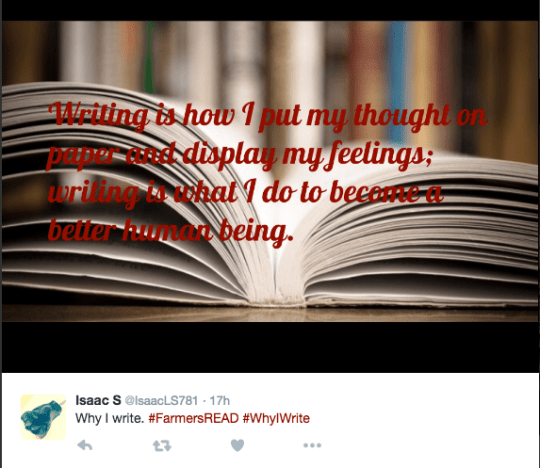
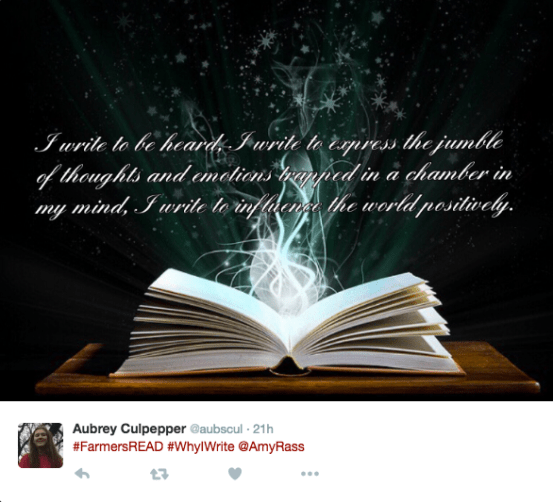
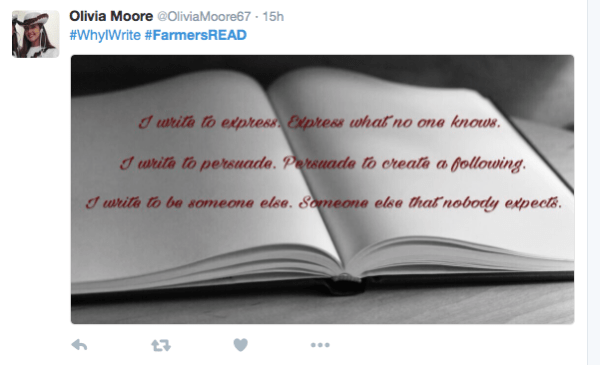
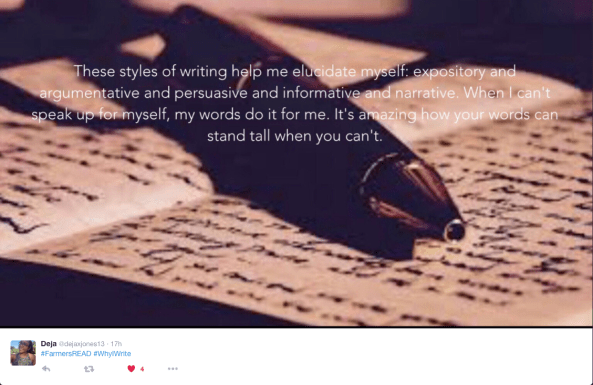
Then, yesterday as a way to join in on the National Day on Writing, I asked students to create a slide that explained why they write. Their slide needed to contain an image, a beautifully crafted sentence that included at least one of the literary or rhetorical devices we’d focused on recently, AND everything had to be correct: capitalization, spelling, punctuation. You might call me out on Olivia’s, but I think it works.

The ratio for correctness on this voluntary assignment was 22:6.

Here’s some of their tweets, evidence of why I love my writers. And also the reasons I hope we can take a little more care as we write. They have such amazing things to say.

screen-shot-2016-10-21-at-8-37-16-amscreen-shot-2016-10-21-at-8-35-42-am
screen-shot-2016-10-21-at-8-23-59-amscreen-shot-2016-10-21-at-9-23-40-amscreen-shot-2016-10-21-at-9-25-23-am


ftc-guideline-%22affiliate-links%22

Try it Tuesday: Partnering Up for Reading Conferences

Sometimes inspiration strikes at the most opportune times.

One day last week I had the honor of hosting two small groups of teachers from a different high school as they observed my classroom, one class period in the morning and another in the afternoon. Many of the teachers on their campus have been exploring and practicing with the workshop model for a while now, and they wanted to see my workshop classroom in action.

After each lesson, we met to debrief and hold a kind of question and answer session. Talk about an awesome experience (except for the voice in my head that kept saying “When did you become the expert on workshop? Yikes.)

I think one of the best things we can do as teachers is invite others into our rooms to watch us teach. Talk about keeping on the A Game. That’s a Try it Tuesday suggestion all in itself.

Here’s another one:

During one of those debriefs, one teacher asked about the conferences I conducted as my students read for the first 15 minutes of class. “What questions did you ask?

I explained that it depends on the student.

If I go with “How’s it going?”

My students answer, “Fine.”

If I go with “What are you thinking?”

My students answer, “Nothing.”

So I usually lead with “Tell me a little something about …will ya?” And then I listen to see what direction the conference might take.

That’s pretty much the genesis of every conference with my readers.

Another teacher mentioned that she and a colleague had been thinking about asking students to bring a question, thought, or problem to their reading conferences. You know, kind of like we ask students to do when we meet with them about writing. I’d never thought about it for a quick reading conference though. She wanted to know if I thought it was a good idea.

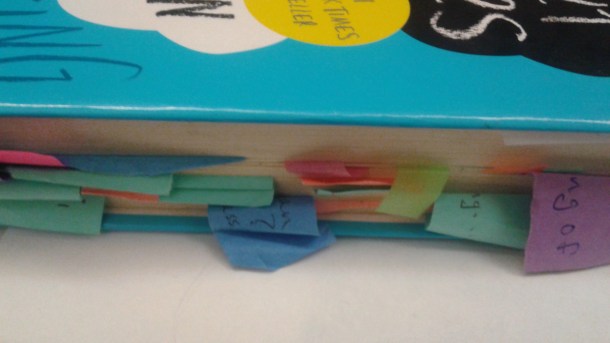
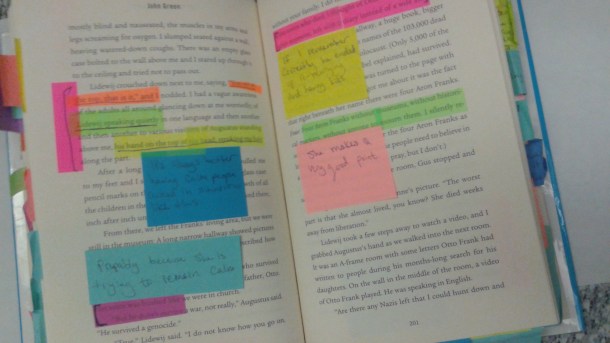
The image of this book came into my head. I found this copy of The Fault in Our Stars at a thrift store. It looked just like this:  plastered with sticky notes that reflect the student’s thinking. Now, I have no idea why this book is tattooed with notes, but I can imagine a not-so-great idea.

tfiosmarkup2tfiosmarkup

I hope a teacher didn’t assign this book and ask students to bring ideas to a reading conference. If that happened, I doubt this student got into reading flow. I doubt this student enjoyed this lovely, heart-wrenching book. I doubt she felt the beauty of the language and felt the loss of a beloved character. Maybe all that happened, but it wouldn’t have happened for me.

I want my students to love to read. I think we have to be careful with what we ask them to do with their independent reading books besides fall in love with the story and the language. Sure, they may recognize craft, they may recognize characterization. But the important thing is that they recognize that they are liking to read. That is so important to so many of my readers. They have to realize they like reading.

I do believe we can, and should, ask students to revisit passages — and maybe even the whole of a book — from time to time, even quite often. We can teach many important reading and writing skills that way, but we have to temper our desire to teach a book to death, even the books students choose to read themselves.

What I told my inquiring friend:  What if before independent reading time, on any given day, we ask students to read for a specific purpose.

Read to find interesting figurative language. Read to notice clever imagery. Read to discover how the writer shares an insight about a character. Read to find a beautiful or startling sentence. Or maybe a sentence that’s not really a sentence.

fabian

Fabian before class sharing his awe at the writing style of Jonathan Safron Foer in Extremely Loud & Incredibly Close

Isn’t this what readers do? I do. When I read a passage that strikes me in some way I want to share it. And let me tell you:  When my students start to do this on their own? That’s celebration time.

“What about the student who cannot find anything to share?” you might ask.

Well, that’s important information, isn’t it? I don’t know, maybe like the kind we might discover in a one-on-one reading conference.

Right?

I’d love to know your thoughts on this. What ideas do you have that work for your reading conferences? Please share in the comments.

Big thanks and shout out to @Sean_G_Hood and @mrs_friend and the inspiring teachers at Hebron High School!


Mini-lesson Monday: Deeper Reading


I posted this on the TTT Facebook page on Saturday, but I think it also makes for a good mini-lesson, so here goes:

I went to a session by Kelly Gallagher at #IRC2016. He shared ideas from his book Deeper Reading, combining ideas he’s using with his students now. I was reminded of his thinking around thinking from a text: What does the text say? and What does the text not say?

Gallagher shared a few images from the news, a fact statement, an ad for a truck, and he modeled how he asks his students these two questions as ways to get them thinking about their reading.

I’d heard these same ideas before, but they resonated with me again. Critical thinking matters. We cannot get thoughtful writing, if we are not helping our students to think thoughtfully through texts.

Objective: Read a visual text, make observations and inferences that push critical thinking about a text. Draw conclusions and write your thinking.

Lesson:  Tell students that critical readers don’t just pay attention to what a text says, we also must pay attention to what a text does not say. This ties into the idea that everything is an argument — sometimes overt, sometimes covert. Bias also comes into play. So to get into some critical thinking today, we’re going to watch a short video about the refugee crisis.

Draw a T-chart. Label one column with “What does it say? and the other column “What does it not say?” As you watch the video make lists that answer these two questions.

Watch the video “Your phone is now a refugee’s phone.”

After students have time to do their own thinking and writing their lists (and maybe watch the video again), have them talk in pairs or small groups about the things they noted.

Hold a short whole class discussion about what it does for our thinking when we consider what the author, or in this case, the video creator, intentionally leaves out of a text.

Follow up:  Ask students to find their own text and apply this same thinking. Tell them they can find an advertisement, a chart or graph, an info graphic, another video — any text that they can answer the following questions:

What does the text say?
What does it not say?
Why does it matter?

Continue to ask students to consider these questions with a variety of texts throughout the year. This may also serve as a good exercise to help students find writing topics. Bonus!


Do you have any videos, ads, or short text suggestions that you use in similar ways to get students thinking critically? Please share them in the comments.


ftc-guideline-%22affiliate-links%22

Try it Tuesday: About that Digital Citizenship

I only had to ask three students to put their phones away on Monday. This is progress.

I know some teachers “outlaw” phones in class. I do not. We use them too often. Besides I have never been in a meeting or in a conference session or anything of the like and been asked to give up my phone. Of course, I know a thing or two about etiquette. Many of our students do not.

Instead of being the phone police, I would rather take the time to teach my students to use their devices appropriately in class — and, of course, with any luck, if the learning sticks, I’d like them to take that “appropriateness” beyond my classroom as well.

If we are not taking the time to teach our students phone etiquette and digital citizenship, we are missing out on important opportunities that may make a startling difference in their lives.

For example, did you see this headline:  “Girl gets kicked out of college for Snapchat photo”? The link lead to a hard sell for why every teacher should take the time to teach students the importance of digital citizenship.

I’ll be sharing it with my students today.

screenshot-2015-09-27-20-18-26-26o2pj7

keystrokes.wonecks.net

What are some ways you teach phone etiquette and digital citizenship in your classroom? Please share in the comments.


Mini-lesson Monday: Remembering 9/11 and a study of language

Our students are too young to remember the events of 9/11. And while we are not history teachers, I do think we have a responsibility and an opportunity to help them try to make sense of the horrors of that September morning and how it impacts their lives today.

hyrum

Pvt. Hyrum Chase Rasmussen

In church yesterday, the congregation stood and sang three verses of “The Star Spangled Banner.” This song has new meaning for me since my son Hyrum joined the Army this summer. It may have new meaning for you if you’ve been following the Colin Kaepernick-taking-a-knee-event-fall-out-and-discussion. I want my students to be able to make sense of their world and one way I can help them do that is to provide them with thought-provoking pieces that help them make connections. Maybe one of these texts will help them find their own “new meaning.”

In honor of September 11, the every day people and every day heroes who lost their lives, the families who still mourn loved ones, the soldiers who valiantly died facing foes in foreign lands, and the men and women willing to serve today in a time of unrest and war, this is the lesson that I will share with my students today.

Objective:  Using the language of the Depth of Knowledge levels, students will react to a first-hand account of 9/11 in their writer’s notebooks. They will formulate ideas on how this one story relates to our growing theme of what it means to be courageously human. Students will then analyze a text and compare the writer’s use of language to a text read previously.

Lesson:  We’ve already discussed the question, “What does it mean to be courageously human?” a phrase I borrowed from a text we read last week. (I read Chequan Lewis’ piece as a read aloud, wanting students to just listen and enjoy his use of language. Then, later we read it again and analyzed the literary and rhetorical devices he uses to create the meaning. I modeled how to annotate and asked students to write their own notes in the margins — something I will expect them to do throughout the year.)

Today I will remind students to read texts with pens in hand, noting the writer’s interesting use of language, any points of confusion, any words they don’t know, the structure of the text, and any and all devices the writer uses to craft meaning. Today’s text is the masterful piece Leonard Pitts, Jr. wrote September 12, 2001.

After students have time to read, annotate, and discuss in small groups, we will come together as a class and craft an anchor chart that details the moves Pitts makes in comparison to those craft moves made by Mr. Lewis. I will charge students to model these moves in their own writing throughout the year.

Follow up:  The anchor chart will hang in the room as a reminder that writers are intentional in the moves they make as they craft meaning. Students will be expected to be intentional in their own writing as they work on various forms of writing in class and on their blogs this year.

How Conferring and a Book Solved the Tissue Issue, and Hopefully, Much More #FridayReads

You know the boys who cannot sit still? I’ve got a gaggle of them in my second period. Now, I’m not talking about elementary school kids, nor middle school. I’m talking about the juniors I teach in high school.

No sooner do I blink, and at least one of them is up walking to the tissue box. He’ll slowly take a tissue. Saunter on back to his seat (for about three minutes — I’ve timed it) and then waltz on over to the trash can to throw the tissue away and then mosey on back to his seat.

With eight of these guys, it’s constant motion. And I need Dramamine.

One class period. Five days. Two boxes of tissues. Gone.

At the end of that first very long week, I realized the reality. All kinds of memories flooded back from Tom Newkirk’s class “Boys, Literacy, and Popular Culture”at UNH Lit Institute the summer of 2015.  (If you haven’t read Tom’s book Misreading Masculinity:  Boys, Literacy, and Popular Culture, it’s insightful.)

My tissue-loving boys were posturing all over the place, and somehow I needed to stop the Tissue Issue.

It’s been easier than I thought. Really, it’s all about getting them into books they want to read.

On the first day of school, I’d prepped my room with stacks of colorful engaging books on every table. We did a book pass and wrote down titles we thought we’d like to read. I showed my passion for books and reading, and my students rolled their eyes at my request they read for three hours a week.

“No way,” I heard one young man mutter, “I ain’t reading.”

This attitude doesn’t deter me.

Even if they were faking it, after just a few days and lots of one-on-one mini-conferences, every kid in a class of 30 at least looked like they were reading. Except two.

I invited these two separately into the hall for private chats about their social PATT (party all the time) moves in the classroom.

“You know, they all follow your lead, right? I need you working with me to make this class work.”

Both agreed, and I asked them to shake my hand on it.

But old habits die hard.

Then, today — 13 days into the school year — gold.

Book gold.

“Hey, Mrs. Ras, can I talk to you in the hall?

“Do you think you could help me find a different book to read — one with music. You already know I like music.” I remembered his free verse rap at the end of class last Friday.

“So give me some ideas –”

“Well, something like that book JaBo’s reading…the long way one.”

A Long Way Gone?” (I’m trying to remember if there’s any music in this memoir about a child soldier.)

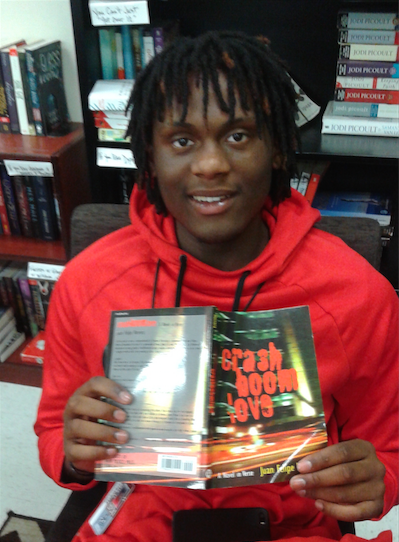
Both of my copies were checked out. I had to think fast. Crash Boom Love, a novel in verse by Juan Felipe Herrera, National Poet Laureate, flashed in the corner of my eye. (Thank you, poetry shelf just inside the door.)

We flipped through the pages, and I explained that it’s a book written in verse — all poems that make a complete story.

“You mean like one long poem?”

“Yep. Do you want to trade me this book for that one?” I said nodding at My Friend Dahmer, the graphic novel in his hand he’d been fake reading for 12 days. (I know he chose it for the pictures. “It’s weird” is all he could tell me in our first conference.)

Not six seconds after we’d entered the room, I saw Kameron flipping through the pages and showing his new book to JaBo.

That’s when you know you’ve got them — or at least got a chance at getting them to read — when they do a book talk to their friend before they’ve even read a page.

screen-shot-2016-09-08-at-11-05-01-pm

Meet Kameron. He may be a famous rapper one day.

I love this work with adolescent readers. I know we can change lives as we help young people grow in literacy skills, as we help them recognize themselves in books, and help them see others so different from themselves in the books they read.

It might be the only hope we have as a nation. Empathy, compassion, tolerance, justice, mercy, and love all wait for discovery like healing treasure and hope in the pages of the books we share with our students.

And when that book gold finally glistens — well, that’s when I have to cross the room for a tissue.


ftc-guideline-%22affiliate-links%22

I Prefer a Community of Confident Writers — Our Jump into Understanding a Writer’s Craft


Before spring term was over, I’d written two pages of notes in the back cover of my writer’s notebook. I titled it “Remember to Do Things to do Differently.” I’m a bit ambitious — and I realize, often, too hard on myself. Although I knew my students learned last yearemember-to-do-things-differentlyr, I wasn’t confident that they couldn’t have learned more.
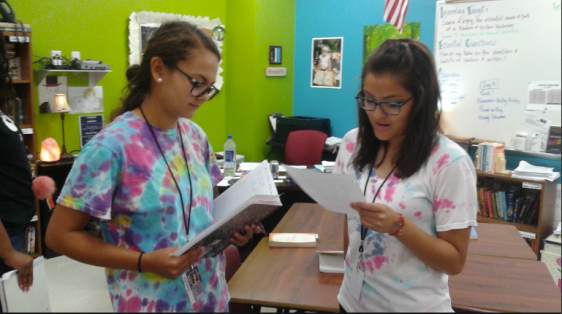
I imagine you’ve been there, too. Always second guessing.

One of the things I knew I needed to improve was my relationships with students — I needed them to be good and strong, faster.  I also needed to help students jump in quicker to the complexities of craft analysis without scaring the poor little dears.

So last week, the second week of school, I did what Lisa just wrote about yesterday. I “Encourage[d] Students to Start Sharing Who They Are,” and I did it by sharing a favorite poem by Wislawa Szymborska: “Possibilities.”

I asked students to study the poet’s language in each line and then write their own “Possibilities” poem, imitating the poet’s sentence structure and word play. I gave them a copy of my annotations and wrote my own poem as a model.

This proved to be an excellent lead into the rhetorical analysis students must be able to do in AP Language. I was able to see which students quickly understood how to look closely at an author’s craft — and which ones did not.

The best part though was what I learned about my students. All their preferences!!

Last Friday, when their poems were due, we did our first Author’s Chair share in class.

First, to help students build confidence, they read their poems to a partner.

faithsharing-possibilitiespoem

sharingpossibilitiespoems

Then, volunteers sat in our Author’s Chair and read their poems to the class.

While the student read his poem, everyone else sat with sticky note and pen in hand ready to offer “blessings,” things they liked about the author’s use of language, or connections they could make to his ideas.

sharingintheauthorschair

After each writer shared, the class flooded him with “blessings.” Smiles grew wide, trust blossomed, and the community that I felt was missing for too long a time last year took root.readingblessings

Bonus:  When students read their little notes, carefully crafted by peers who listened to
their writing, their confidence as writers grew. Too bad we ran out of class time. I might have run out of sticky notes if all students would have felt the desire to share.

readingblessings2

I wouldn’t have minded.

I would not have minded at all.

ciarawithblessings

I would love to hear your ideas on building community and/or introducing students to rhetorical analysis. Please join the conversation and share in the comments.

Try it Tuesday: Silent Sticky Conferences

A burning question I seem to repeat year after year is “How do I talk to more of my students one-on-one beginning on the first day of school?”

I know the value of making eye contact with the adolescents who enter my room. I know the importance of making them feel like they belong here — like they are in a place where they can be themselves, a place where they want to learn.

I confer regularly with my students — about their reading lives and their writing lives — but every year it seems to take me a while to get in the groove. You know, get all the procedures introduced and underway, get students interested in books (and sometimes reading itself), learn names, set up our writer’s notebooks and our blogs and all the different bits of technology we use regularly like Google Classroom and Twitter.

I know all of these things are important, but sometimes I feel like I miss valuable moments of just I-want-to-get-to-know-you in my rush to get everything set up so we can finally begin to learn.

I know myself well.

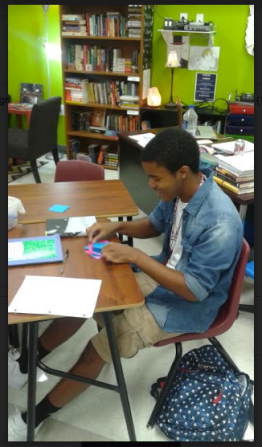
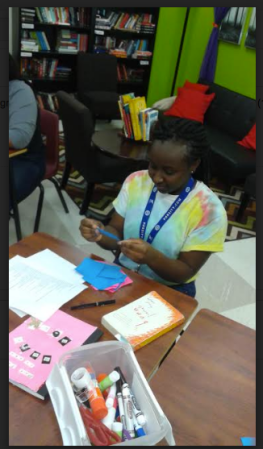
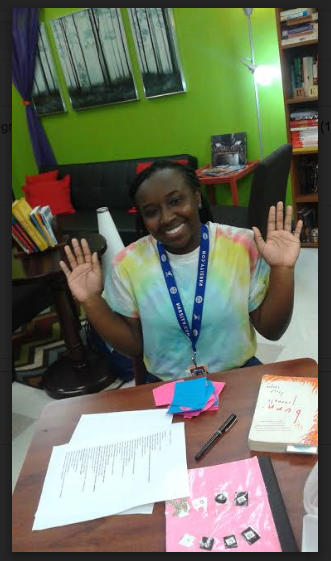
So this year — I’ve slowed the pace a bit. And my students and I are passing notes.

Screen Shot 2016-08-29 at 7.49.08 PM

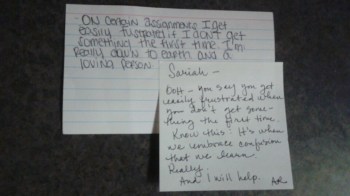
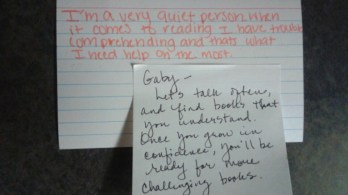
On the first day of school, I asked students to write their names big and bold on one side of a notecard. (I use these throughout the year to select non-volunteers to speak up and share their notebook responses and to answer questions. You know, like the popsicle sticks with everyone’s name on them idea.) Then, on the other side of the card, I asked students to tell me what they think I need to know about them as a learner in relation to the reading and writing we will do in this English class.

Silent confer1Some of my students’ notes were telling:  Many of them lack confidence. Few of them like to read. A couple feel ready for the complex texts they will have to tackle. Some explained in very few words a need to feel validated and cared for and something personal and important to them as learners in my care.
silentconfer3

I responded to each student’s note with a personal note of my own, written on a sticky note that I returned the next day in class. One young man questioned as I walked the room passing them out:  “Miss, you wrote to all of us?”silentconfer2

“Yes,” I told him, ” and I need you to carefully read what I wrote. Let’s see if we can start a conversation about you and what you need from me as a reader and a writer.” His grin grew as golden.

Silent sticky-note conferences have been the norm in my class for quite some time. They bridge the gaps between face-to-face conferences, build relationships, show we care enough to pick up a pen and pen a few words of encouragement or instruction.

With class sizes of 30 (sometimes 30+) we have to find ways to talk to our students one-on-one often. This passing little notes method fulfills my need to touch base with students, and it fuels their need to be recognized, validated, and hopefully inspired.

If you haven’t invested in sticky notes this year, hurry to the store while they are still on the back-to-school sales. I’ve got a whole crate of them.

Next step:  We’ll eventually move into larger pieces of paper, so I want to teach my img_1845students to fold notes like I did way back in seventh grade before the advent of all this technology. Texting friends just cannot be as fun as all those little folded notes.

What are your ideas for more face-to-face and one-on-one conversations with students this year? Please share in the comments.


Every Opportunity on Day One and All Year

Every Opportunity

You’ve probably seen this video. When I watched it this afternoon, it had over 8 million views. If you haven’t seen it, I challenge you to watch it. Then, think for a bit about where you see yourself. I did.

And it’s humbling.

As I start a new year with new students today, I want to remember the me I want to be every single day — the adult with the smile who takes the time to greet each student with a genuine hello, the teacher with a voice of care and concern — even when I’m tired or frustrated or worried about something completely unrelated to school. I want to show every student that they matter — because they do.

We teach students as much by our actions and attitudes as we do by our instruction. We know this, and we love children — that’s why we went into education in the first place, or at least I hope it is.

So today, when my students come to my door, I’ll be there to greet them. I’ll talk to as many of my juniors as I can. I’ll look into their eyes and invite them to think and write and share as much as they are willing to about their lives.

How will I extend this invitation? You guessed it. Our first response of the year will be to this Every Opportunity video. I’m eager for the conversations.

Building community on day one and then working to strengthen community every day throughout the year.

I’d love to hear your ideas for building classroom communities that work to ensure all students feel seen and heard. Please share in the comments.