Tag Archives: Writer’s Notebooks

Mini-Lesson Monday: Connecting to Poetry with Heart Books

Today is my first day back with my students, since my excellent student teacher departed on Friday.  Having observed their learning and their needs for the past six weeks, I have lots of goals for them in mind.  But, most urgently, I am struck by how much I want readers to connect more authentically to literature–to nurture their investment in, and passion about, literacy.  I want to begin helping them do that by creating and curating Heart Books, which I heard the excellent Linda Rief present about at NCTE in 2013.  Thank you to the very thorough Vicki for this excellent description of Heart Books.

Objectives — Using the language of the Depth of Knowledge Levels:  Identify a topic/theme to explore in heart books; Collect and display a variety of poems about this topic/theme over time; Connect your poems to your topic and yourself.

IMG_9708

My heart map

Lesson — We’ll begin the lesson by returning to the Heart Maps (here’s a great handout on those) we created early on in the school year.  “Choose one topic on your heart map that you’d like to explore further.  On my heart map, I think I’m going to choose my students–this kind of includes themes of learning, growth, and teaching, too,” I’ll explain.

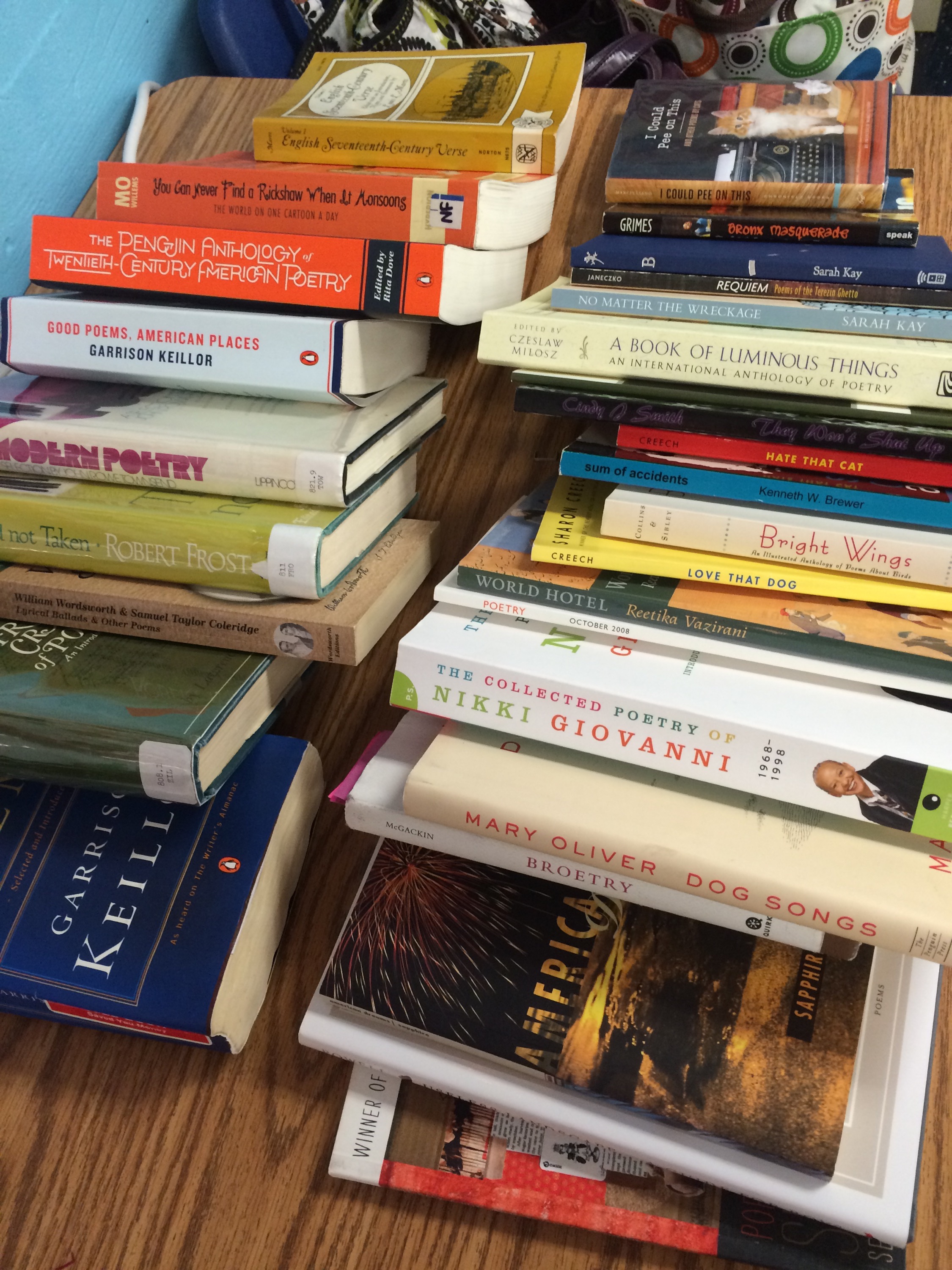
Once students choose topics from their heart maps and expand on what themes they might include, we’ll create a new section in our writer’s notebooks called HEART BOOKS.  Then, we’ll browse various poetry anthologies and collections (check Amy’s selection out if you seek inspiration for building your poetry shelf!), searching for poetry that matches their selected theme.  I’ll ask students to copy the poem into their notebooks once they’ve made a selection.
IMG_9709

My poetry shelf, unshelved

From there, Linda Rief suggests having heart-bookers illustrate the poem, write a response about why it was chosen, and research the poet to find out what he or she might have to say about reading and writing.  I’ll encourage my students to do the same, but also will ask them to make a note of their favorite bits of language from the poem–words, phrases, or even punctuation.  The craft moves poets make are valuable teachers of writing.

Follow-Up — Next class, I’ll ask students to share in groups their Heart Books.  Perhaps we’ll have a notebook pass in which we write in one another’s notebooks, responding to each other’s poems.

For the remainder of the year, once per month, I’ll set class time aside for curating Heart Books.  By the end of the year students will have created a personal anthology of ten poems that help them explore a key theme in their Heart Maps.

What routines do you have in place that help your students connect to literature and explore personal themes?

Studying Vocabulary Through Choice Reading

IMG_2886“Reading increases one’s vocabulary,” I tell incoming freshmen every fall. But up until now, I have had little evidence to support this claim. It is true that reading exposes students to new words, but I never went out of my way to help students sort through these new words.

Instead, as a junior English teacher, I regularly taught SAT vocabulary as part of my Advanced Composition curriculum. Students completed chapters from the Sadlier-Oxford Vocabulary Workshop books and took quizzes every other week. While some students relished the challenge, many saw little relevance to their own lives, retaining few words by the end of the year.

In turn, this year I have turned from my well-worn Sadlier Oxford books and have instead had students reference their independent reading books for new words. Students develop their own lists of eight words every other week. My goal in doing this is not only to have students slow down their reading, but to also expose them to diction and complexity within their independent books. Once again, like many of the mini-lessons within the workshop classroom, this practice also turns into a lesson on craft and intention within a writer’s work.

Too often students skim over large words, failing to activate context clues and prior knowledge to help them draw out meaning. By creating vocabulary lists, students must practice these skills while also recording definitions, synonyms, passages, and parts of speech.

The benefit is twofold: students have a say in their vocabulary and immediately see both the relevance and payoff of understanding a new word. At the same time, having independent vocabulary lists eliminates cheating and encourages independence. Instead of worrying about students’ wandering eyes during quizzes, I spend time helping students understand the words they have picked. In addition, independent vocabulary lists provide insight into students’ reading levels and comprehension. I have learned more about my students’ reading lives simply by becoming aware of the words they find challenging.

Every other week, students complete a summative assessment that helps gauge their understanding of their eight vocabulary words. Two weeks ago I had students complete “Rock and Roll Vocabulary,” an activity that requires students to roll dice and answer questions about their vocabulary corresponding to specific numbers. This week students will complete a grid about various words.

While I am still new to this vocabulary approach, I feel confident in my students’ choices. Oftentimes I have seen the typical “SAT words” pop up in multiple lists, reinforcing that students will indeed choose challenging vocabulary. The process is far from perfect, and my students and I are still ironing out some of the flaws. Some students intentionally pick easy words, but the next assessment will require them to rank the difficulty of their words. In addition, I allow retakes of vocabulary summative assessments considering students made a “good faith effort” according to our school’s retake policy. Finally, not all independent books offer complex language, which can be a struggle for students who love the content yet can’t seem to find their eight or so words. In those instances, students may pull from in-class readings, articles, and textbooks. If they still struggle, I have books of SAT vocabulary they may choose from instead.

While this method of teaching is somewhat nontraditional, it provides students with continued say in their education. Not only are they empowered by their newfound words, but also by the end, I hope my students will see that reading truly does increase one’s vocabulary.

Window Shopping and Writer’s Notebooks

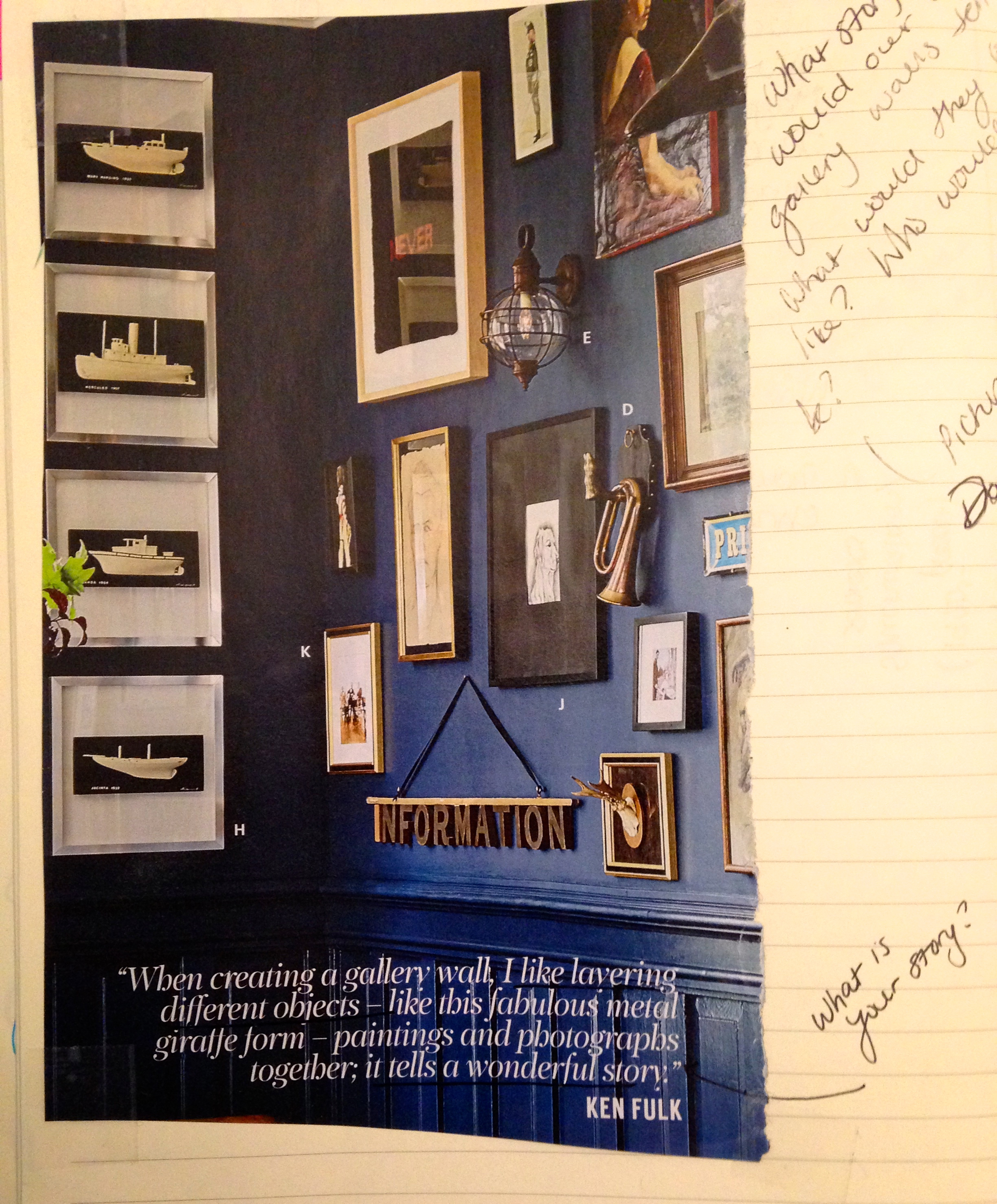
IMG_2848While thumbing through a Pottery Barn catalog, I paused to appreciate a navy gallery wall. Inky prints, gold frames, and brass hardware framed an assortment of images, below them designer Ken Fulk wrote, “When creating a gallery wall, I like layering different objects…paintings and photographs together; it tells a wonderful story.” I looked at the images, trying to decipher the story these antlers, ivory boats, dogs, and pencil sketches communicated. To be honest, I have no idea what he was going for, but I ripped out the page anyway, taped it into my writer’s notebook and started writing around it: “What story would our own gallery walls tell?” “What is your story?”

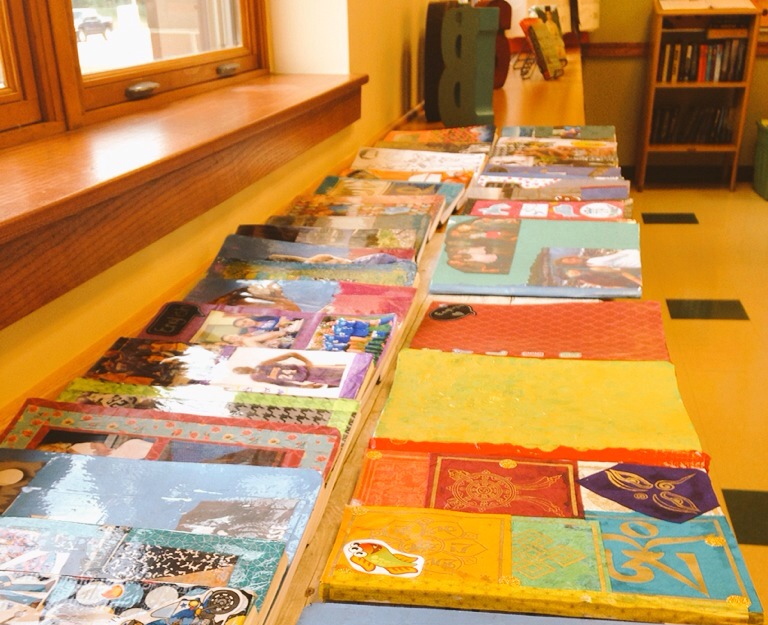
These are the questions I want my students to answer, and bit-by-bit their stories unravel. But all too often the process of answering these questions through writing intimidates them. In turn, one of the first activities we did this year to establish classroom culture involved designing and decorating our writer’s notebook covers. In the past I had students create inspiration page collages on the inside of their notebooks, but these were hidden and personal. They didn’t distinguish one’s self or serve as a conversational piece between peers. These images, which could serve as gallery walls for my students, were tucked away.

Student notebooks ready for writing.

Student notebooks ready for writing.

In turn, this year I stocked my classroom with scrapbook paper, patterned tape, and stickers. I lined tables with butcher paper and allowed for the messy process of gluing and cutting and painting. Together, my class sat listening to music and chatting about TV shows, cars, sports, summer vacations, and the scary transition between middle and high school. While this artistry and expression is typically celebrated at the elementary level, I encounter few secondary teachers who value setting aside class time for these collages. Some of my colleagues use it as a homework assignment, but I love how blocking out one class period and allowing for exploration becomes an icebreaker in and of itself. After all, these interactions mirror the same writing process students will engage in as they begin filling their notebooks and sharing the stories of their images.

Today we’ll circle around the classroom, sharing our notebooks with each other and highlighting one meaningful aspect of our covers. This activity is low stakes and comfortable; they have a choice in how much or how little information they provide. Hopefully they’ll find that these collages are snapshots in time of who

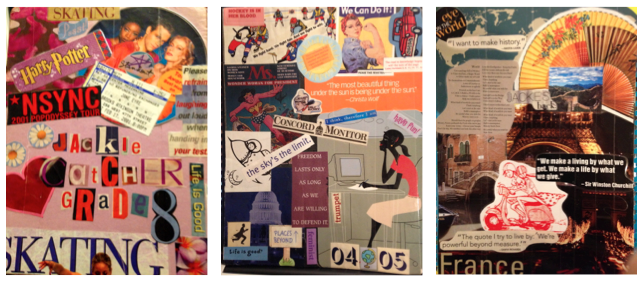
we are, reminders of what we value, and visual hopes for who we’ll become. I know this because as we sit in a circle, I will share, for the first time, the cover I created in 8th grade when I was caught between childhood and adulthood, the cover from 11th grade when I thought I wanted to be a journalist, and the cover from my junior year of college when I left on a great adventure to study abroad in Ireland. In the end, we’ll take a great leap forward in beginning our process of sharing who we are through words and images.

My notebook covers through the ages: 8th grade (far left), 11th grade (middle), junior year of college (far right).

My notebook covers through the ages. 8th grade (far left), 11th grade (middle), junior year of college (far right).

Simplify, Simplify: An Invitation

We’re six days deep into the school year here in West Virginia, and I am so happy, fulfilled, and content.  The start of this year has been the smoothest of my seven years, and our readers and writers workshop is coming together more quickly than it ever has.  I think it’s because of all of the invitations and welcomes that have been flying around our classroom, rather than the commands and directives of years past.

Amy’s post on inviting students to just talk helped me simplify the structure of my first week of lessons.  I strove to make our first days together as inviting as possible–as laid back, relaxed, and caring as I could.  Students were drawn to our classroom library with an invitation to check out whatever book they’d likethoreau-simplify.  They were intrigued by an invitation to write daily–nulla dia sine linea, in the words of the inimitable Donald Murray–as we set up our writer’s notebooks.  I invited students to just read for pleasure, to just listen to a poem to enjoy it, and to just write for fun.
My invitations all centered around simplicity.

I want to slow down my thinking this year.  It seems my brain is always flying at a hundred miles a minute, and I bet my students’ minds are too.  I will invite my students to simplify their thinking–to streamline their thought processes, open their minds, and just write.  Just read.  Just talk.

This year, I’m inviting everyone in our classroom–adults and students–to put away their phones.  We read this article to understand why that may be necessary, as our devices can distract us without our consent.  Part of this conviction came after I read M.T. Anderson’s Feed, an award-winning YA novel about the mindlessness technology can fill our lives with.

I’m inviting learners to resist letting their lives be frittered away by detail, to simplify, simplify.  We will do more with less, and we will do all of our reading, writing, and thinking more deliberately.  These first six days have been marked by that simplicity, and I hope to continue that trend all school year long.

What are your goals this school year?  What do you hope to achieve with your learners?

3 Ways Notebooks Top Digital Writing

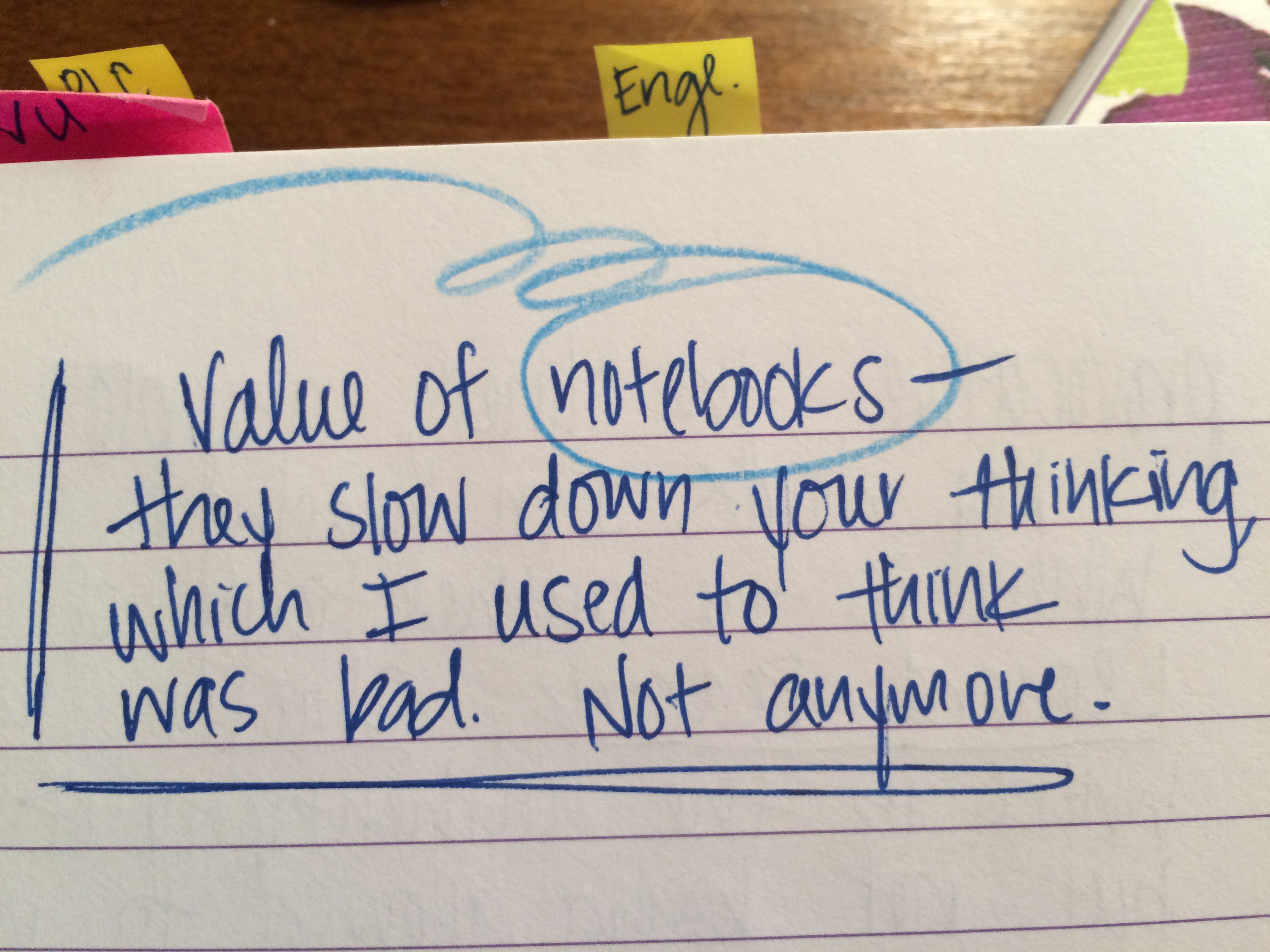
IMG_9111Has it already been two weeks since the last day of #UNHLit15?  Unbelievable.  Time is flying by, as it always does in the sweet summertime.  As I get older, I find myself wanting time to slow down…and that’s one of the perks of a writer’s notebook–it slows down a writer’s thinking.  At right is a note I jotted to myself during Tom Newkirk’s class two short weeks ago.  I’d been pondering the notion of length in my instruction–reading longer texts, writing longer pieces, sustaining an idea or a reflection for a longer period.  While brainstorming ways to do that, I realized notebooks were one way to add length to the thinking process.  They slow down a writer’s thinking, making it keep pace with the measured movement of a hand across a page, which is slower than the tapping of keys across a keyboard.  As Tom Newkirk writes in his credo, “I believe that slow reading runs counter to a media culture that stresses speed, distraction, and a loss of history.”  I believe the same thing of slow writing, in notebook form–it draws out thought in a way digital writing just can’t.

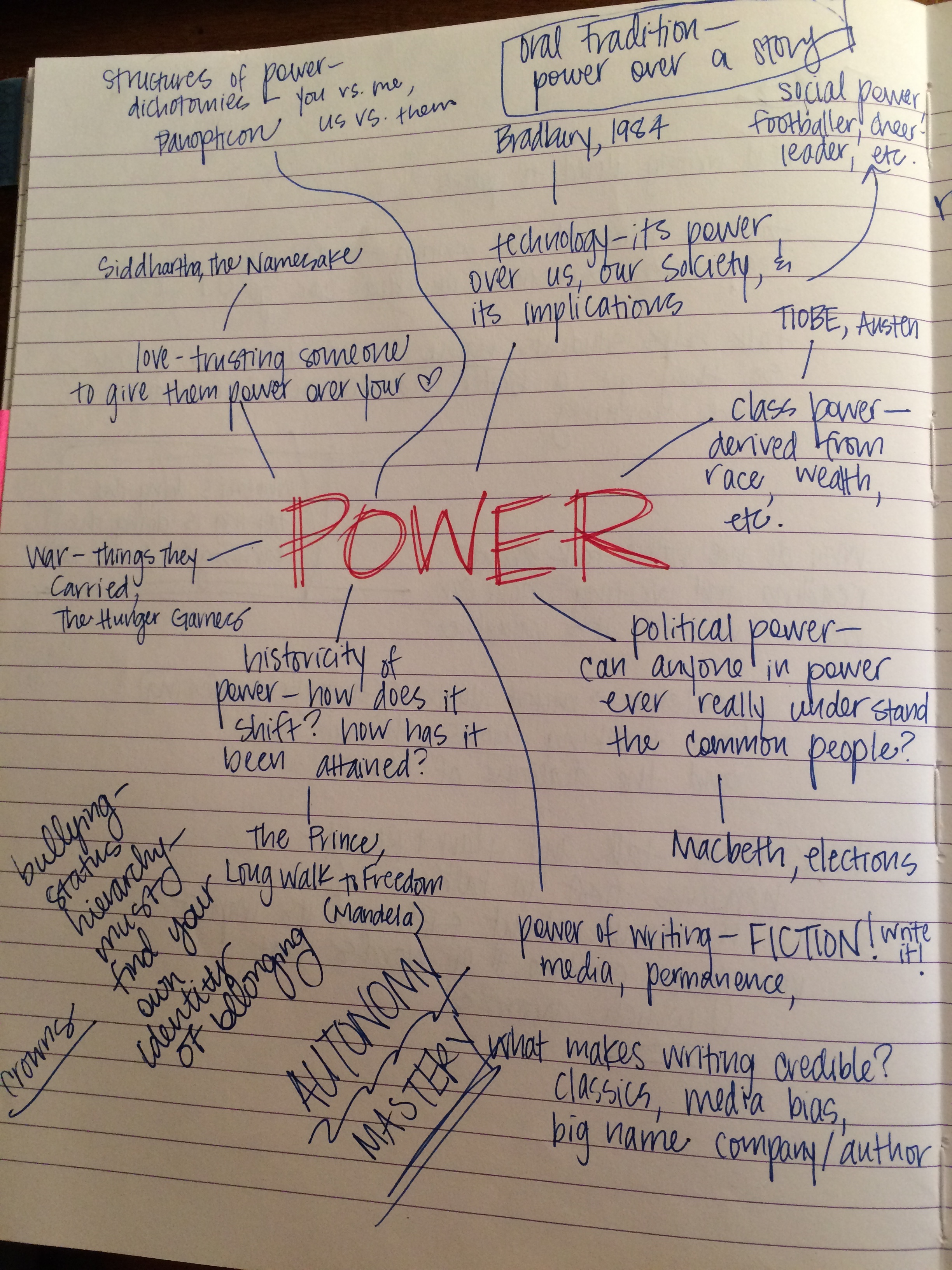
IMG_9110Notebooks also make thinking visual.  There is something about switching colors when revising, drawing lines to connect a tangled web of thoughts, or adding ideas to a pre-existing idea to show tangible growth that just can’t be done with a computer, voice recording, or video.  As I’ve pondered the theme of power–the overarching theme of my English 12 curriculum for this upcoming year–I’ve returned again and again to this page at my right, adding ideas, jotting inspirations, and connecting them to one another.  I’ve loved watching the page become more and more crowded, my thoughts finally spilling over onto the facing page before making it into my typed syllabus and curriculum map.  This visual map of my thinking is the most important part of my writing process, and without it, the typed pages I hand my students would lack coherence, focus, and quality.

Finally, notebooks illustrate volume in a way typed papers or blog posts just can’t.  Revisiting my old notebooks provides me a tangible location to mine ideas from–I can flip back to the summer of 2013 and find wild scrawls from my first class with Penny Kittle, or the fall of 2006 to see a plethora of hearts marking my budding courtship with my husband, or the spring of 2009 when I was frantically finishing my Masters thesis, evidenced by frantic scribbling and much crossing-out of ideas.  All of this evidence of my thinking takes up an entire bookshelf in my office, showing me proof that my thinking has evolved over time.  I want my students to feel that same sense of wonder and growth when they fill their second notebook by the end of our school year together.

Notebooks are a map, a timeline, a guide–to our lives, our minds, and our hearts.  They create a space for creative contagious concentration that is tangible and necessary, and which transcends the nebulous nature of digital writing.

3 Ways to Jump-Start Reluctant Writers

IMG_1703My younger sister Brittany is a phenomenal writer; in school, she excelled in all subjects, including English, but I never saw her struggle quite as much as when she was required to keep a writer’s notebook. For me, writer’s notebooks had always been liberating. I kept one in my spare time after having read Ralph Fletcher’s A Writer’s Notebook the summer before sixth grade. This was not the case for my sister though who, at the urging of her teacher, would write, “I do not know what to write” for ten minutes straight. Her teacher would tell her, “You’ll figure out what to write after a while,” but she clearly didn’t know my sister who is not only brilliant but also strong willed and persistent. In turn, when I told my sister I’d be integrating writer’s notebooks into my classes, she groaned, saying, “I hated those things.”

Brittany’s PTSD was reasonable. When used without encouragement or prompting, writer’s notebooks can become tedious and painful. Students can easily learn to loathe this tool that should otherwise be fun and stimulating. In turn, when my students explore their writing, I make an effort to help fuel their ideas and interests through a variety of writing activities and exercises that oftentimes help even the most particular writers.

  1. Prompt Board: At the beginning of the year, I ask students to write 3-4 pages in their writer’s notebooks. This helps students establish a writing routine and it helps me to learn about my students quickly. That being said, many students stall when it comes to putting pencil to paper. After running into this problem early on, I began posting five writing prompts per week on the side of my main white board. These topics included personal questions about students’ interests or extracurricular activities as well as sentence starters and fictional scenarios intended to lead into creative writing. I compiled the majority of these prompts off of social networks like Twitter and Pinterest, but I also use sentences from my book talks during the week as prompts as well. I post these prompts on my website in a separate section so students can always go back and revisit the prompts from past weeks.
  1. Ideas Shelf: Teens love thumbing through the pages of oddly shaped writing books. One of my most well-loved books is a cube shaped book called The Writer’s Block, which has “786 ideas to jump-start your imagination.” That being said, there are plenty of fantastic average size books that I store on an ideas shelf, which also includes 642 Things to Write About, Now Write: Nonfiction, Now Write: Fiction Writing Exercises From Today’s Best Writers and Teachers, and 100 Quickwrites by Linda Rief. When stuck, students gravitate towards this shelf. In addition, with the help of my Writer’s Club, I am hoping to add a jar of words, images, and prompts this year for students to pull from whenever they are struggling.
  1. Self-Guided Activities: As the adviser of Writer’s Club, I always have trinkets on hand Rory's Story Cubes for StADato help students put their pencils to paper. Some of my students’ favorite toys include Rory’s Story Cubes, which are dice with small pictures on them. Students can toss a handful of dice and incorporate the images into a story. I also have a collection of old skeleton keys I bought at a craft store. Tied to each key is a tag with a sentence starter that discusses where the key might have been found or what the key opens. Another easy activity involves collecting paint strips from your local hardware store and having students write stories involving the absurd color names on each strip.  Finally, I love utilizing found photography like the pictures from Miss Peregrine’s Home for Peculiar Children or old calendar images to get students thinking. I have a collection of small Dana Heacock calendar images, which are brightly colored drawings of New England scenery or objects.  These images oftentimes stir up students’ memories of childhood and lead to fantastic personal stories.

How do you help inspire your reluctant writers?  What methods do you use to jump-start their independent writing process?

Four Ways to Formatively Assess in Workshop

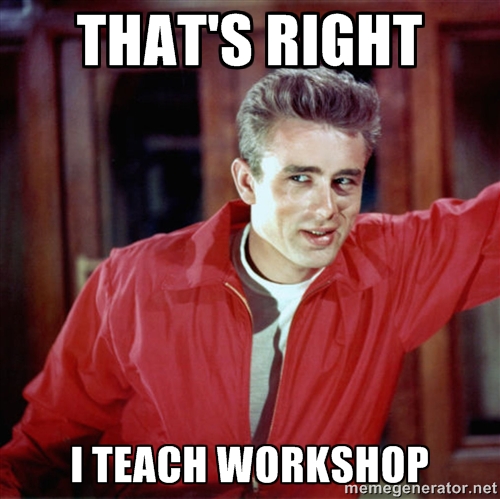
dtrfyguhujSometimes I wake up in the morning, thinking about what I’ll be teaching and learning that day, and feel like a rebel.  That’s right–I think to myself, feeling inexplicably cool–I teach workshop. Yeahhhhh.  Even though this is the most research-based, data-driven form of instruction I’ve encountered in my teaching career, a successful workshop is still such a rarity that I feel like I’m breaking all the rules by employing it every day.  I’m a rebel with a cause.

Still, when I stop feeling like James Dean and reality bites me in the butt, I know I need to be practical and follow the rules by putting some grades in the gradebook–once per week is the suggestion at our school.  If I had it my way, I’d go gradeless and celebrate the myriad acts of literacy within the confines of a classroom.  That’s not possible right now.  I needed another solution, and I think I found it in Amy, right here on this blog.  She writes powerfully about formative assessments in this post.  Her thinking mirrors mine:

I know when I am learning a new skill, I want to be able to practice–free from judgment–so that I might build some confidence before I am formally evaluated.  The same is true for kids.  We should give them opportunities to practice and build confidence.

One grade per week, when I’m grading to evaluate, is impossible.  We don’t master a different skill every single week.  Mastery requires practice.  So, I’ve focused lately on formative assessment for eight out of the nine-week grading periods, and summative for just one.  Here are the four categories I see formative assessment broken down into, and how I put them in the gradebook.

IMG_5605

Un-gradeable, amazing writing

1. Writer’s notebooks – I collect writer’s notebooks every two weeks, and students can receive up to 20 points per collection.  If all of our prompts and exercises are present, and I can see the student’s effort, he or she gets the full 20/20.  I also ask students to mark for me anything they’d like feedback on.  I check to see the status of their to-read, wondrous words (vocab), and cool craft (quotes) sections, but I also look for a telltale pink sticky note.  If I see one, I read the marked piece and write back–just feedback.

2.  Reading logs – Our reading logs are quite messy; you can see one example here.  There are arrows everywhere, new reading rates scribbled in, and tons of titles being read every week.  When students complete their reading goal of two hours per week–determined by individual reading rates–they get 10 points, every week.  Reading logs show me the big picture of a class’s progress, while conferences help me go deeper.  The reading log lets me know, at a glance, who’s soaring and who’s not–helping to give my conferences direction.

IMG_6904

Word play

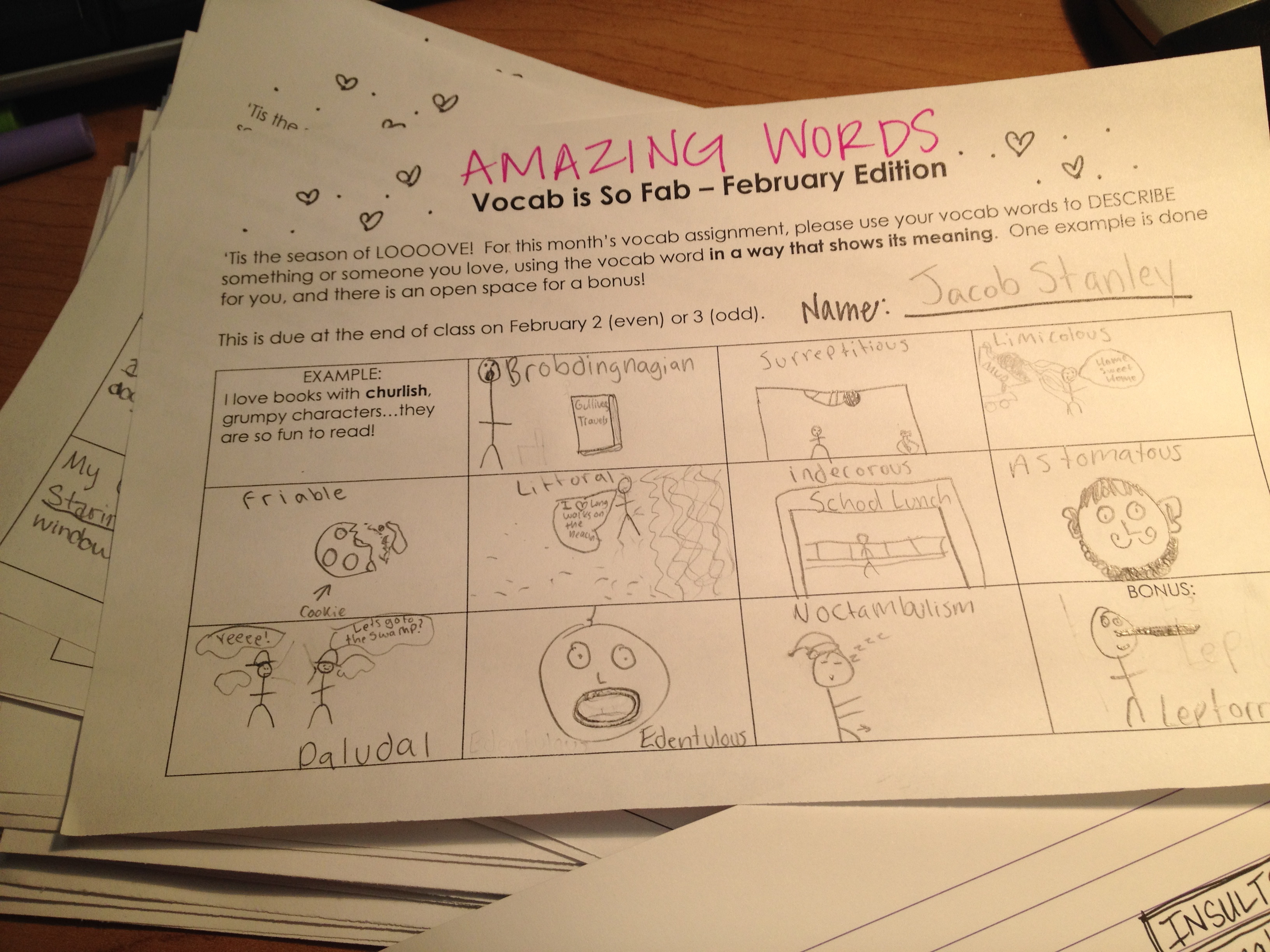
3.  Vocabulary – I still remember my orange Sadlier-Oxford vocab books from high school.  Those well-worn paperbacks were the source of many a cramped hand and a frantic fifteen minutes of homeroom before English class.  I know from personal experience that I don’t retain new words by completing fill-in-the-blank exercises–I learn by reading widely.  So, I ask my students to maintain a “wondrous words” section in their notebooks, writing down unfamiliar or unknown words as they read.  Then, I give them a different activity to complete with those words every two weeks.  The activities are worth 10 points each, and run the gamut from writing stories using the words to drawing pictures illustrating their meanings.

4. Honest self-assessments – When we finish a unit of any kind, usually about once a month–a writing unit, a reading unit, a book club, a challenge–I pass out a half-sheet with self-assessment questions on it.  I begin each half-sheet with a disclaimer:  “Be honest.  There’s no judgment here.  I just want to know why you were as successful as you were with this unit, and to know how I can help others be successful in the future.”  Students answer very truthfully, sometimes humorously so.  If their answers are thorough, they receive 15 points.

These four formative assessments total about 115 points per month.  With 9-week grading periods, students’ grades therefore are made up of about 2/3 formative assessments (230 points or so) and 1/3 summative assessments (100 points or so).  Well over half of the formative assessments are credit for the simple acts of doing the assigned reading and writing–no evaluation of those acts, just credit for the effort.  I value practice and process over product–and this grading system reflects that.

How do you handle grading, formative assessment, evaluation, etc.? Please share in the comments!

Multi-purposing My Quickwrites

Photo Credit: Jennifer

At NCTE last week, Penny Kittle reminded me of the need to consistently share beautiful language with my students. If I ever want them to be able to read it, understand it, and use it in their own writing, I must make conscious choices about voicing that which is lovely. I do a fine job of this right until my students choose their own topics and begin their compositions. Then the room gets stale, and the feeling of “what a chore” begins.

No wonder. I stop sharing short texts and poems. I stop having students respond in their notebooks. I stop allowing them to share their thinking.

While in Boston, I stole a moment with Penny and asked her about my problem, and she simply said, “I keep sharing beautiful language every day.” I must do this, too.

I made a list in my notebook of the things I need to do better when I return to the classroom. Continuing to share poetry and short passages that students can respond to sits at the top of my list, but I want to try to multi-task this activity.

My students are in the process of writing a feature-length article. They chose topics and began drafting before the break. I want them to think about ways to make what they are writing pop into 3D on the page; I want them to see vivid verbs and colorful word choice, and all kinds of devices that they might include in their own writing. My goal is to use poems and passages from now on that will serve several purposes:

1) rhythms of beautiful language,

2) models for sentence structure,

3) examples of figurative language,

4) built-in book talks,

5) questions that aid student thinking about things that matter in their lives.

We will read, and we will respond. We will notice author’s craft as we craft ourselves.

I know, I know, I am slow on this boat. Good planning would make this possible with all my quick writes.  I get that. Thus far, I’ve been a bit disjointed because I struggle with doing it “all:” Independent reading time, quick writes, mini-lessons on craft, grammar, mechanics, student-to-student reading response, reading and writing conferences, book talks. . . I keep most plates spinning, but more and more are crashing lately. My #nerdulation is to do better. (Search that hashtag on Twitter if you don’t have a clue.)

Here’s the passage I will use today. I think it’s appropriate to read a beautiful passage about books since I got a ton of new ones at NCTE. My classroom library welcomes them, but it’s screaming “crowded.” I gotta get a new shelf.

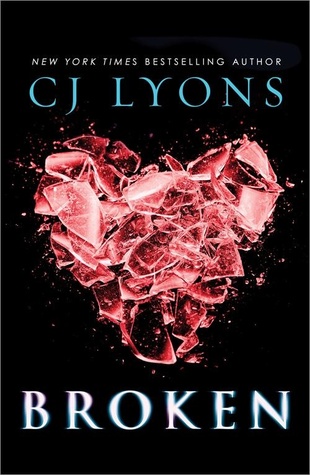
From Broken by C.J. Lyons: 

Kids fill the hall from wall to wall. Despite the unfamiliar press of bodies, I don’t panic. Instead, I let them steer me, like running with a herd of wild, untamed horses. At the end of the corridor, the herd separates into two, leaving me alone in front of a high glass wall.

The library.

Footsteps and lockers banging and voices colliding barrage me. Then I open the door, cross over, and step inside. I’m greeted not by silence, but instead by a hushed burble, relaxing, like the sound of a water fountain. I stand, enjoying the sensations, and take a breath.

School smells so much better than the hospital. And the library smells the best of all. To me, a good book is hot cocoa on a stormy winter day, sleet battering the window while you sit inside, nestled in a quilt.

A room filled with books?

I inhale deeply, a junkie taking her first hit. Sweet, musty paper. Ebony ink so crisp it threatens to rise off the pages and singe my nostrils. Glue and leather and cloth all mixed together in a menage a trois of decadence.

Another breath and I’m drunk with possibilities. Words and stories and people and places so far from here that Planet Earth is a mere dust mote dancing in my rearview mirror.

Hugging myself, containing my glee, I pivot, taking in books stacked two stories high, couches and chairs strategically positioned to catch the light from tall windows lining both sides of the corner, like the bridge of a battle cruiser, broad, high, supremely confident, and comforting. In here, I dare to imagine that I might just survive high school after all.

Respond in your notebook:  Describe a place where you find  peace or refuge?

How do you revision your instruction when you know something isn’t working?

Students Want Simple Things from Teachers

"Love all, trust a few, do wrong to none." ~William Shakespeare

Our Compass Shifts 2-1Start slowly. Ease into it. Take the time to let them trust you. Breathe. Relax. Make sure they know that more than anything they matter. I’ve told myself these things every August as the new school year starts, but I don’t listen. Ever. I am always in a rush. Jump in. Get them working. Show them who’s in control.

No wonder the past few years have been rough:  I took too long to build relationships.

This week I’ve done it differently, and I can already tell a difference.

I have not done the get-to-know you bingo games, the list-your-favorite-things cards, the 2 true/1 lie, or the numerous other “relationship building” activities that rise in the back-to-school Google searches.

I have asked students to write. And I’ve written with them. And we’ve shared.

The first day of school I showed the beautiful video of Shane Koyczan’s poem “To This Day.” We didn’t talk; I simply asked students to respond. They wrote on note cards for five minutes and told me what they thought about name calling, bullying, loving the inner person. I then asked them to flip the card over and on the back tell me why they think I chose that poem, of all the millions of poems available, for the first day of school. They thought and wrote, and I set the expectation that we are a community of writers on the very first day.

I read their responses that evening, and I learned a few things, and a few things made me cry:  the death of a father this summer, the loss of a brother, and the abuse experienced by not one but two of my girls when they were younger. The hurt is still raw. I felt it in their words, and I am honored. They trusted me with their hearts the very first day.

Every day this week I’ve read a poem or a quote or a story, and I’ve asked students to write their thoughts in their notebooks. I wrote along with them. I modeled re-reading and revision. I shared my thinking, and I shared my words on the page. Then I asked if students felt comfortable sharing. Many did.

Yesterday we read the poem “Days” by Billy Collins. I did a quick mini-lesson on imagery and personification, and then I asked students to think about a day in their lives that, if they could, they would live over. Sad day. Happy day. Any day. Just choose one and write. We wrote for five minutes.

I shared first. Or, I tried to. I wrote about my mother, and I got so choked up in first period I could not speak. My students saw me vulnerable. They saw my hurt, and they poured out their sympathy. If there’s anything magical about my mother’s illness, this was it. The bond of our relationship cemented with my tears.My notebook Days

During 5th period, one of my girls volunteered to read her response. She began with something like “It was the day I saw my mother for the first time in three years. We hugged and laughed and cried.” Then she began to sob. The class stilled. Silence. Silence. And then soft snickers. I know students were uncomfortable; they are freshmen after all. I cautioned them about respect, and reminded them of the safe place we are developing as readers and writers–the place where we take risks and trust others to understand. I spoke gently but sternly as I made my way to my sobbing young woman and rested my hand upon her back. “Be kind,” I said, “and please be patient. Let me tell you about my experience in first period. I cried . . . because I miss my mother.” My tears spilled over, and this group of 14-year-olds saw my hurt, too, and we all grew as a community.

It’s Friday afternoon, the end of the first week of school. My feet ache, but I am happy.

Students want simple things from teachers:  kindness, patience, a listening ear. They want to share their hurts, fears, hopes, and dreams. They need to know we care enough to let them.

And, guess what? Students will WRITE when we give them the opportunity to write what they feel. I can do a lot of teaching with what they’ve started in their notebooks this week.

Best blessings all my teacher friends. I hope your school year looks to be as bright as mine.

If you have other ideas for relationship building, please share. I’d love to know what works for you.