Tag Archives: Reflection

What I Didn’t Teach This Year

The end of the year is upon us (finally!), and I’ve been reflecting as I always do.  This year, though, I’m thinking about something I’ve rarely considered before–not just what I taught, what worked, or what I want to do next year.  I’m thinking about all the things I didn’t teach this year.

There are 180 precious days in a school year, and the way my school is structured means I spend 90 days with each set of students.  That seems so fast.  There was no time to waste, so here’s what I didn’t fill that time with:

FullSizeRender

As Sabra stepped up for her reading ladder picture, she said, “This is pretty good for someone who didn’t finish a book until your class!”

Whole class novels.  This was a controversial choice for me, given that I love so many authors of American literature–Mark Twain, Walt Whitman, Nathaniel Hawthorne, etc.  But, no matter what novels I’ve chosen in the past, there’s always a student that book isn’t right for.  Fahrenheit 451, The Absolutely True Diary of a Part Time Indian, The Glass Castle, Maus–none of them is a perfect match for every child.  I’ve used a wide variety of strategies to get students to be able to read those books, and every ounce of passion I can muster to get them to want to read those books, but still–students have been conditioned to not read, to just get on SparkNotes, or ask an older sibling, or use Wikipedia.  When the stacks of matching novels come out, groans abound and engagement tangibly disappears.  I’ve seen this.  I’ve battled it.  No more.

So, I scratched whole class novels altogether.  Students worked in book club groups twice, and engaged in independent reading challenges two other times.  We read tons of short stories, articles, essays, and middle-length writings together.  But we didn’t read a single whole-class novel, and my readers still thrived.
IMG_8294

“I found myself as a reader this year,” Jordan writes.

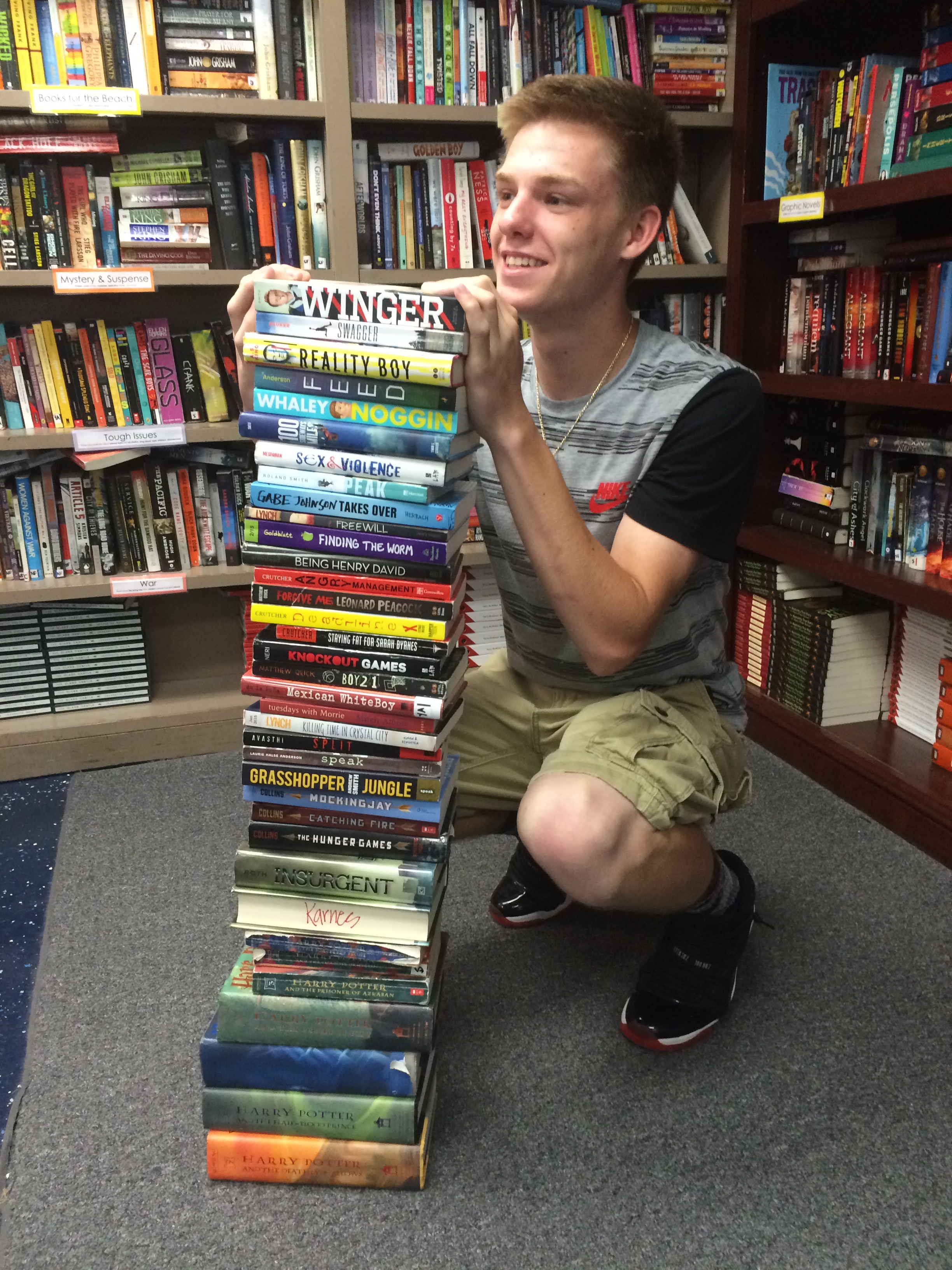
Did my students grow as readers this year?  Yes.  I watched students who hated reading come to love it.  I watched students who couldn’t read well at all increase their stamina, passion, and skills related to reading.  I watched students who were good readers but bored with books fall in love with nonfiction, poetry, graphic novels, or award winners as they discovered new genres.  I watched students who loved to read flourish and challenge themselves with complex texts and childhood favorites alike.  Most of all, I watched a community of real readers spring up in my classroom–students recommending books to one another, self-selecting books and keeping long to-read lists, telling me all about their finds at Barnes & Noble.  These readers have become truly independent.  “Now,” Taylor writes, “I think I can read anything that’s put in front of me…and enjoy it.”

FullSizeRender

Isaac performs a poem for Nathan on poem-in-your-pocket day.

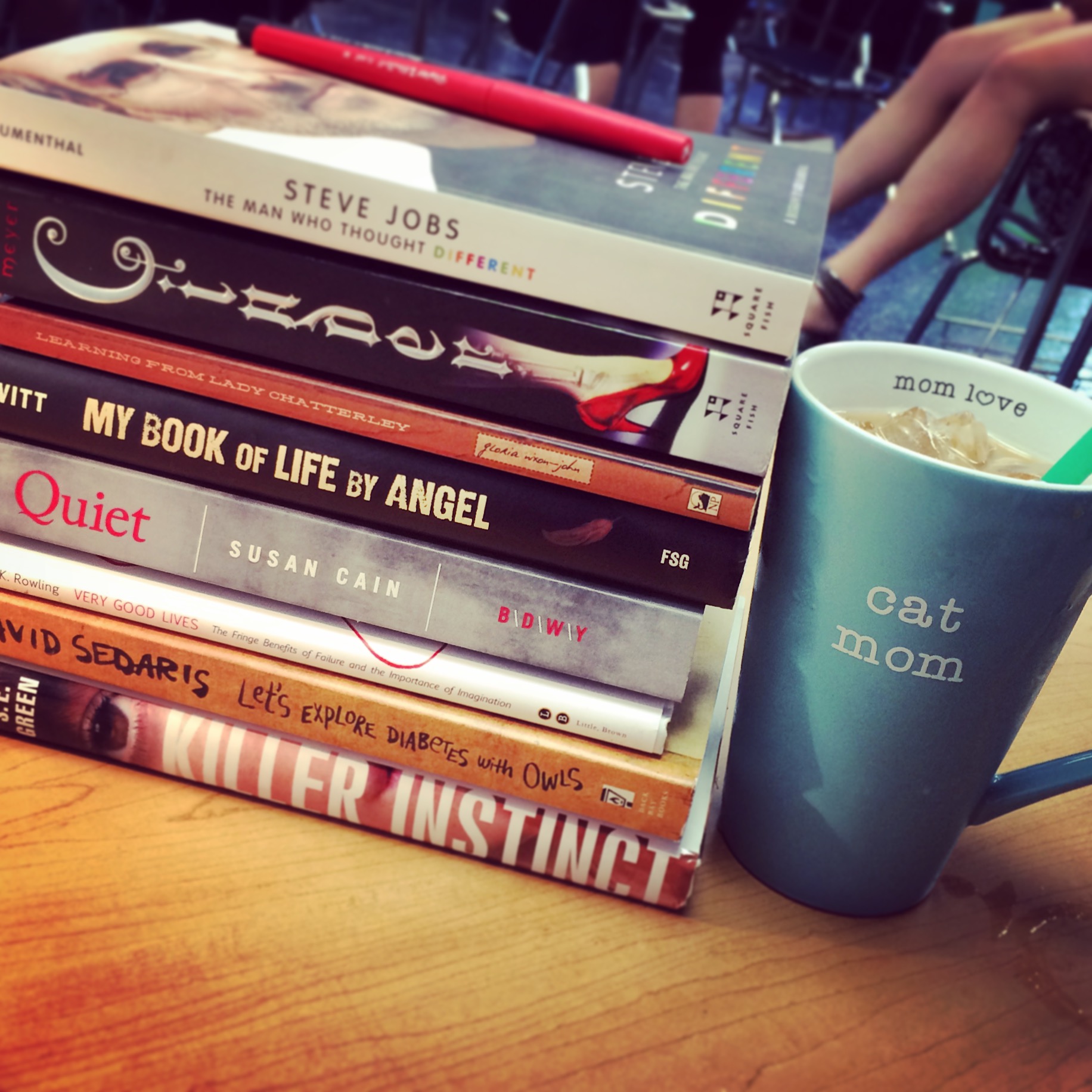
A movie.  As I’ve walked the halls this last week or so, I hear the unmistakeable sounds of cinema from behind closed classroom doors and darkened rooms.  I have no doubt that students are watching relevant films–movie adaptations of Romeo and Juliet in English, Forrest Gump in History, etc.  But this year, I felt I had absolutely no extra time…there was SO MUCH I wanted to do!  I used to love showing O Brother Where Art Thou with The Odyssey, and my students really delved into the symbolism of both texts.  But this year, my SmartBoard was full of YouTube videos, slam poets, or the still, quiet images of a document camera showing some writing.

I didn’t have time to show a movie, but I also wasn’t pressured by the crush of hours of grading that usually prompted me to show films in the past.  I’ve taken Kelly Gallagher’s rule about student work to heart–students should be doing four times as much reading and writing as we could ever grade.  So, I’ve read and responded to about a quarter of my students’ work, and let self-evaluations, peer conferences, and notebook passes do the rest.

Most of what I taught last year.  Last year was great, don’t get me wrong–but this year, my students were a new batch.  They’re different kids than last year’s group, so the same things won’t work for them.  After seven years in teaching, I know that.  I didn’t waste time trying to figure that out…I just started fresh.  I know I’ll do the same thing next year…out with the old, and in with the new.

IMG_0054

Shailyn read almost all of my YA fiction, and wrote reviews about nearly every book for our school newspaper.

Tests or formal essays.  Tom Romano likes to call the typical English essay a “five-paragraph you-know-what,” and it truly is a dirty little assignment.  At an NWP workshop I attended, each teacher was asked to bring some samples of student writing.  All around me emerged typed, double-spaced, Times New Roman, size 12, thesis-at-the-end-of-the-first-paragraph essays.  From my own bag came photocopies of messy scrawls in notebooks, multimedia This I Believes, strongly-voiced commentaries, poetic musings developed from quickwrites, and lengthy, involved, multigenre research papers.  No two pieces looked alike, and they certainly looked nothing like most other teachers’ samples.

I’d be lying if I said I didn’t feel a faint nostalgia for my own high school days, when I took pride in being able to punch out a perfectly formatted five paragraph essay in just under an hour, and which made absolutely no sense but looked great, and which constantly netted me As.  But I listened to my neighbors rant about poorly integrated in-text citations and incoherent thesis statements, I dismissed that nostalgia and read my own students’ work for what truly matters–good writing, heart and soul on a page, and authenticity at work.  As my husband said when he saw me dwarfed behind a pile of multigenre papers to grade, “I could read some of those for you.” “You wouldn’t know what to look for,” I said.

“Good writing is just good writing,” he replied, and he is right.  As the year ends, my students are good writers and good readers–not all of them are great, and there are kids I feel I could’ve pushed harder, but all are certainly better than they were when the year began.  I’ll look forward to our last day of class, when I’ll gift them each a new composition notebook and a pile of classroom library books to read over summer…and to months beyond, when I get to hear their stories of summer literacy in the fall.

Reflection, Rejuvenation, Rebirth

May and June always bring sunnier skies, feistier students, and more hopeful days.  Like Amy, I enjoy the last weeks of school, and often spend many of them feeling proud of my students, making big plans for the next year, and reading a ton in order to ramp up my booktalks.  This time of year is my time for reflection, rejuvenation, and rebirth.

ReflectionFullSizeRender

This spring, I’m excited that I have the opportunity to participate in a National Writing Project course, which is uniting me with other English teachers from my area.  Talking with them has helped to energize me even more so than usual at this time of the year, and some of their words have really helped me reflect.

First, my notebook musings during our first class led me to a powerful play on words–listening is at the heart of our teaching.  I’ve written before about the value of talk, but I’m thinking long and hard now about the power of listening…truly hearing our students’ hopes and strengths and worries and wonders.  I’ve paid special attention to emphasizing listening in my lessons these past few weeks, because I know I won’t get to hear these wonderful students’ words after the year ends.

Later in the NWP class, while assessing some of our students’ written products, we were asked to identify the skill we had been aiming to teach, and then evaluate how well our students internalized that lesson.  Claire, an elementary teacher, said that it was impossible to look for just one thing–“Writing is so…big,” she said.  I couldn’t agree with her more.  As I read my own students’ work, I saw themes of my own pedagogical beliefs running through their writing.  They were using beautiful language, inspired by our daily poem or craft-study quickwrites, in all of their writing–nonfiction too.  They were writing strong pieces thanks to the risks they felt safe taking in their choice of topic, genre, and style.  They were producing prolifically, writing long, short, funny, serious, sad, exciting, fiction, nonfiction, poetry, prose–everything.  Their portfolios are thick with creation.  Writing is big, indeed.

IMG_8049Rejuvenation

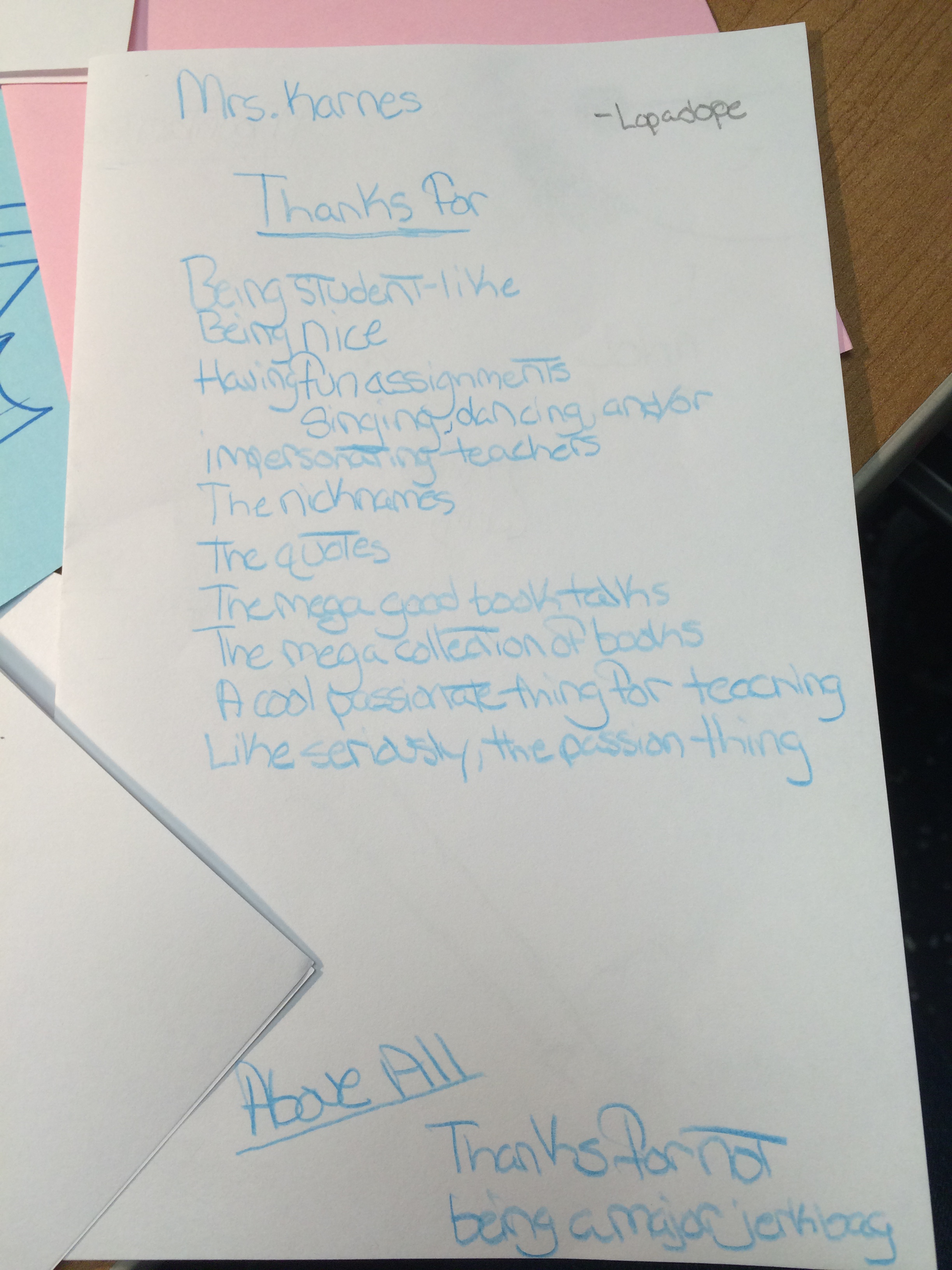
It’s Teacher Appreciation Week, and with that came some delightful thank-you notes from my students.  One student made a list of things he was thankful I did, and he repeated how thankful he was for my “cool passionate thing for teaching…like seriously, the passion thing.”  I recently read an article in the Chronicle of Higher Education that claimed the four properties of powerful teachers were personality, presence, preparation, and passion.  I like to think of passion as fangirling, which I do on a daily basis about books, student writing, authors, and all things bookish.  I’m never sure how much of that passion reaches students, but since this one specifically noted the “mega good booktalks,” I think it gets through to at least some kids.  This thank-you note really rejuvenated me, and now that I know my booktalks are working, I’ll keep at them with new gusto until June 12.

IMG_8027Rebirth

Continuing to revise and change my curriculum doesn’t stop because the year is nearly over.  I’m still wildly out of control on Amazon, buying titles as I get ideas for new units, themes, or genres (like the huge list of novels in verse I jotted down during our #poetrychat Monday night).  A new focus on science fiction, poetry, and nonfiction has been what I’ve noticed in my cart of late.  I am changing as a reader and a teacher, valuing those genres more than I once did, making a strong effort to transfer that new passion to my students.

My teaching philosophy is constantly shifting, evolving, being reborn.  Its biggest shift this year, I think, can be best summed up with a quote from another NWPer from my class last week.  While talking about meeting and learning from great teachers at NCTE, he said he felt like they were “the Wizards of Oz, but they were inviting me to peek behind the curtain.”  I love this analogy, because while great teaching may seem like unattainable magic, I now feel like I understand how to be effective.  I’ve studied living, breathing mentor texts like Penny Kittle, Tom Romano, Amy Rasmussen, Jackie Catcher, and Erika Bogdany, and am looking forward to learning from Tom Newkirk at UNH this summer.  In the past two years, I’ve been reborn as a teacher, whose confidence has grown as I’ve continued to strengthen my practice by dissecting and imitating the successes of others, just like my students do when we analyze mentor texts in class.

Springtime is a time for reflection, rejuvenation, and rebirth.  Nature is no different from my teaching as I think about this year and next, and about the beauty of its constant blossoming and change.  I know our last six weeks will fly by, so I’ll enjoy every moment of them before the luxurious summer begins!

What are you reflecting on this spring?  What has rejuvenated you as the year comes to a close?  What elements of your teaching will be reborn this year or next?  Share in the comments!

Today We Draw

A Five Day Checklist:

Chancellor visit. (Check!)

Superintendent visit. (Check!)

A posse of outside principals observing. (Check!)

Our CBO (community based organization) pulled out = no counseling…or any other services…for students.  Teachers are now ALL of that. (Continual check!)

End of the Cycle (think semester) and the accompanied wildness. (Checking…all week long!)

*THIS WEEK.  Yes, in one week.  And, it’s Wednesday only.

 —–

The above is an email I composed to Amy, Jackie, and Shana in one of our most recent communications. In response, Amy wrote:  You’ve got the world on your shoulders this week, E!  And, it wasn’t until I was greeted with this affirmation that I realized it most definitely felt that way.  I was too busy moving through it to take a moment’s pause and acknowledge the intensity of it all.   The. Weight. Of. The. World.

It got me thinking.  If I felt this way, I couldn’t imagine how students were feeling as they were the reason for all of the visits.  They were the ones ‘on display’.  I just kept it business as usual with our Readers Writers Workshop flow; rigorous expectations, Writer’s Notebooks being utilized, Independent Reading occurring, questions being raised; chuckles here and there.  Yet, it felt off.  As I looked around the room, it occurred to me that students have taken on the weight of the world too.

They’ve been trying to articulate their thoughts wrapped around their chosen literature when the Chancellor asked them about their favorite books.  They’ve tried to be loyal to our collective work and answer the Superintendent’s question about rubrics (aside from the thought provoking work they’ve been creating) knowing that we are currently exploring with our pens and ideas sans a rubric.  They have tried to find comfort in their movement over the last six months, but these pressures have made them second guess themselves.  And the reason I know?  They’ve told me.

Yet, their resilience astounds me.  So, I dug deep.

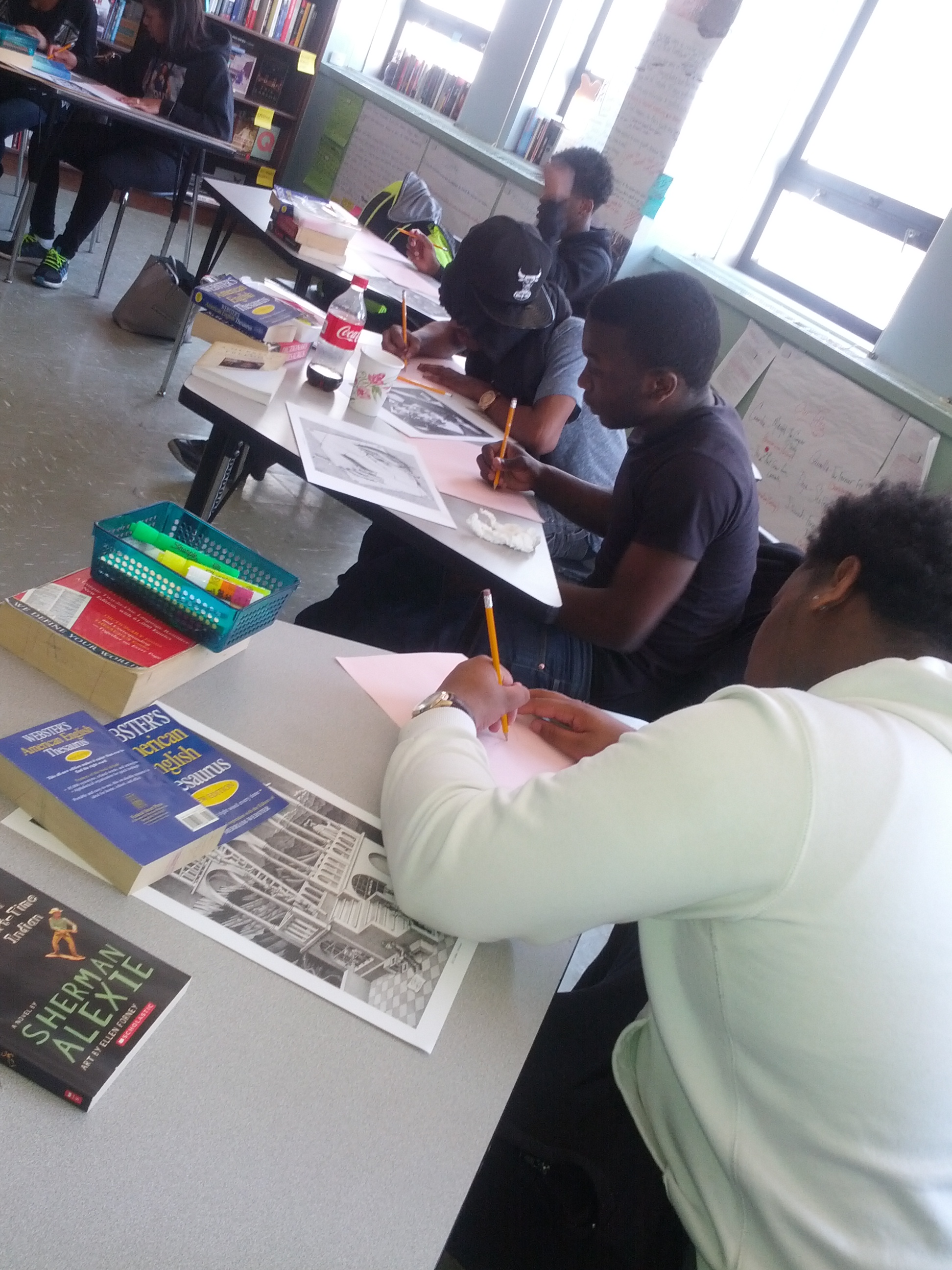
We needed a collective breath.  With all of the tension and uncertainty swirling about Room 382, we needed a class period full of calming zen.  I channelled my extraordinary experience at #UNHLIT13, as I was guided by Penny Kittle in sketching an already created piece of art.  Aside from my internal voices loudly telling me that there was no way I was going to be successful at this; I tried.  And regardless of how my sketch came out I knew the most important lesson is that I didn’t give up.

Calmly, yet intensely, sketching.

Calmly, yet intensely, sketching.

So, today we draw.

The weight lifted immediately and you could feel the energetic life seeping back into 382.  Students were riddled with questions: Wait.  We’re just going to draw today?  You mean, no writing?  We can do that?!  

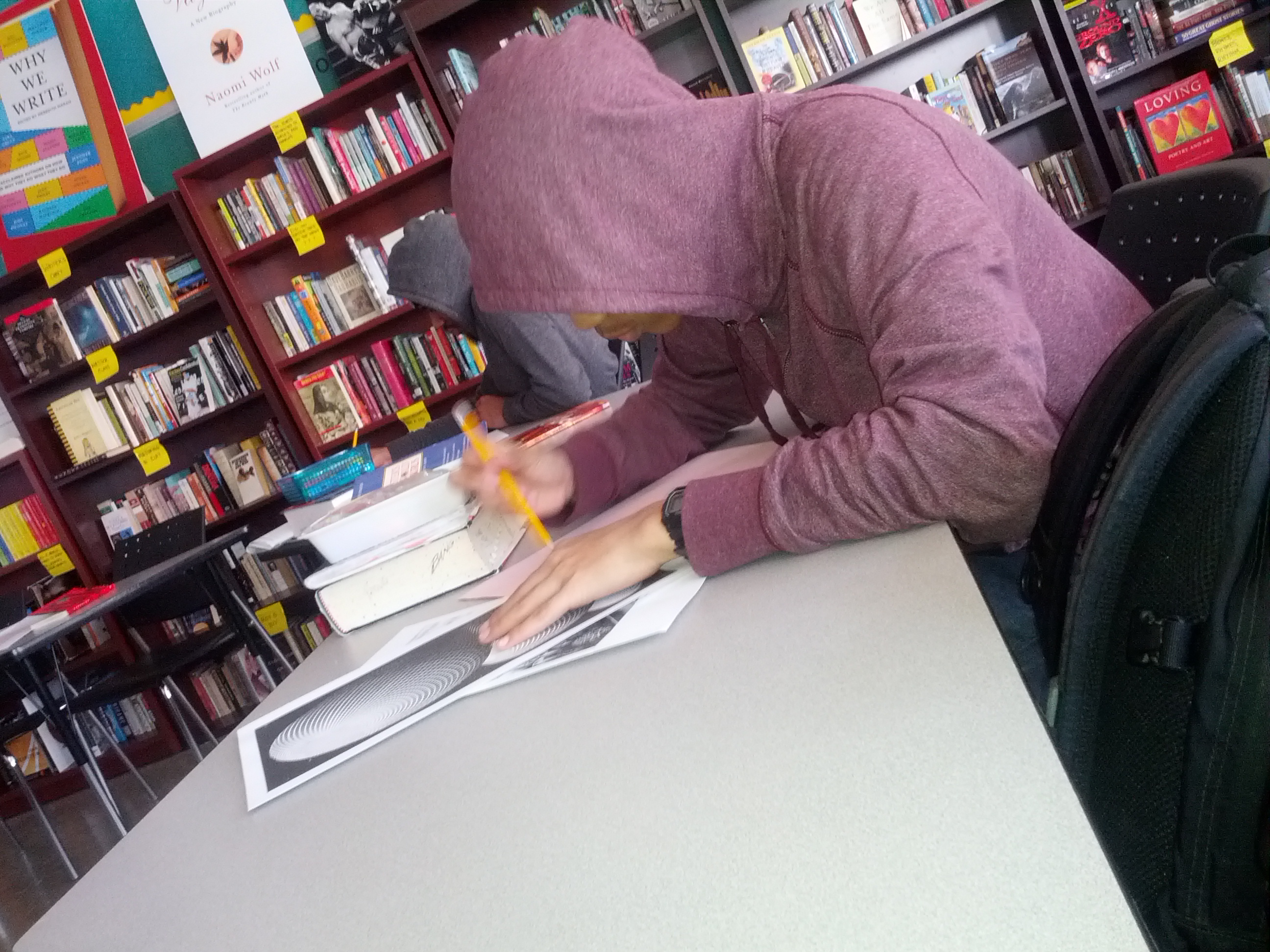
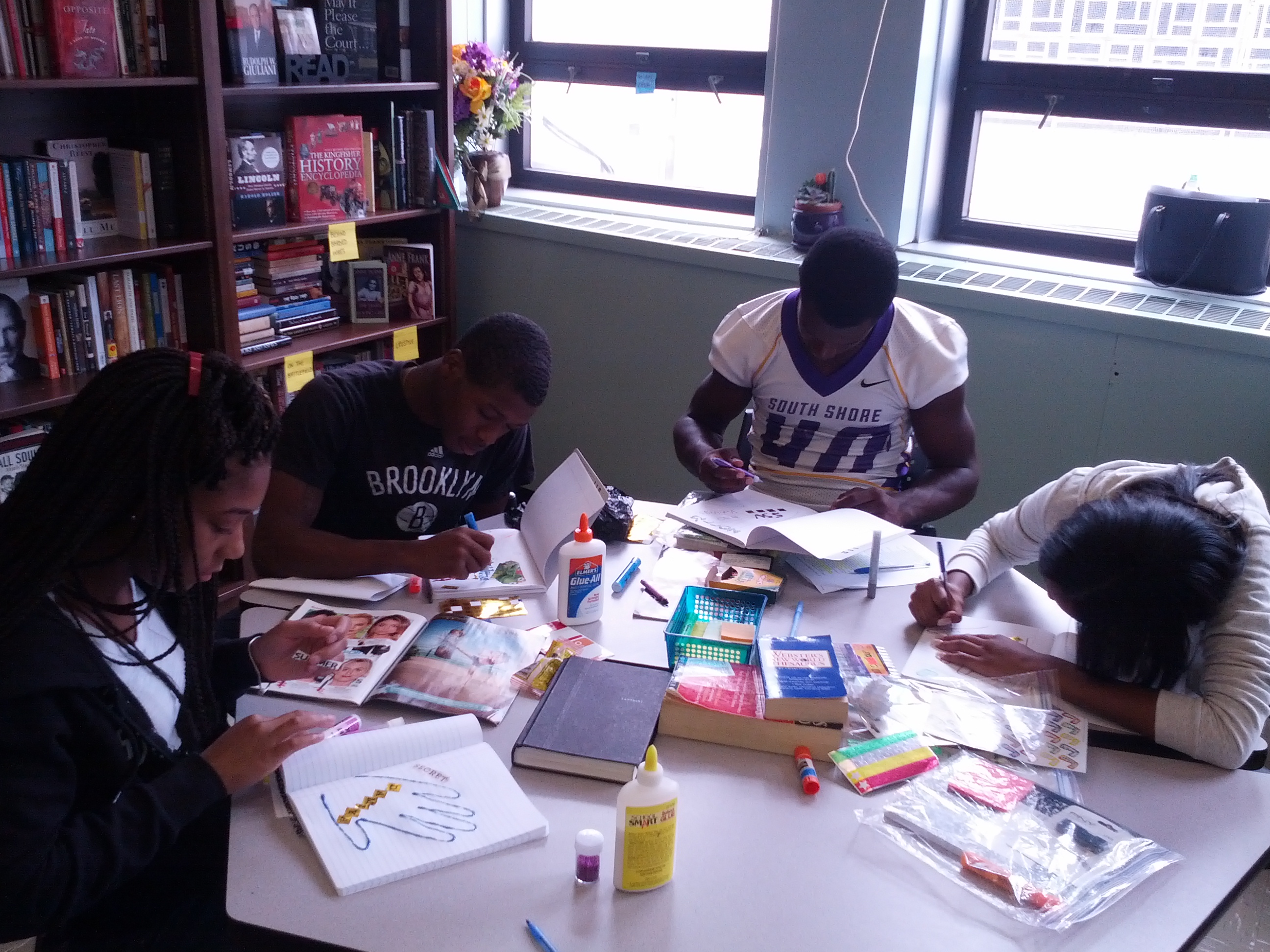
And, while some questions made me laugh and others prompted me to reflect, students were back.  So, everyone grabbed their newly sharpened pencils, chose the drawing that spoke to them most, and got to it.  I mean, really got to it.

Hoodies up.  Concentration in full effect.

Hoodies up. Concentration in full effect.


It was important for me to voice my intention: Folks as we partake in this together, I need you to know that I am wildly uncomfortable with all things drawing!  For the last six months I have asked you to find strength and courage in reading and writing that has challenged you to the core.  Today, I do the same.  (Deep breath)  Here I go…

While students zoned in, I followed their lead.  I sketched under the document camera so students could watch me struggle…and I mean struggle.  Yet, while drawing/sketching isn’t my forte, I needed students to watch me play with a level of discomfort they are not used to observing.  Students engaged in non-literacy conversation (as Shana brilliantly suggests here) while honing in on their focus.  Students approached me to lend their expertise on how to curve lines or align measurements or see the artist’s sketch with a different perspective.  It was exhilarating being the student!

Some of our masterpieces!  My attempt at creating a balcony.

Some of our masterpieces! My attempt at creating a balcony.

All said and done, here’s what I know.  The RWW is about so much more than always reading and writing; it allows the space to explore, mess up, build community, redefine rigor, and just enjoy.  On this given day, the latter is my favorite.

How do you find ways to calm the tension within your learning environment using the Readers Writers Workshop model?


Cliché No More

Yes, I’m going there.  I’m making it wildly obvious and apparent that we have made it to the end of yet another year.  Cliché, I know.

cli·ché – klēˈSHā/ noun –a phrase or opinion that is overused and betrays a lack of original thought.

As if we haven’t been counting down the days for sometime now or looking forward to a fresh start as 2015 rolls around in less than 24 hours; this is a time when we allow ourselves the luxury to think about everything we’d like to leave in the past (and slip into the belief that we actually can leave whatever it is we don’t want anymore in 2014 – simply because the clock strikes twelve).  We’ve been detailing and tweaking our New Year’s resolutions to complete and utter perfection (because in these euphoric (some would argue – desperate) moments we believe perfection actually exists).  We’re ready for a change.

But, should we be?

I’ll be the first to admit that my 2014 was as tumultuous as tumultuous can be.  No, really.  Room 382 has been turned up, shifted around, marked, bruised, taken advantage of, and sadly (at moments) not utilized to its fullest potential.  Yet, every morning with the heat blasting (awaiting student complaint) there’s an essence that is viscerally undeniable.  I walk into a space, a quiet and waiting space, that invites risk, mistakes, setbacks, and quite frankly – the undeniable ugly.  Yet, there is no judgement, discerning undertone, nor slight anticipation that today there will be no progress.

Why would I want to leave all of that in 2014?!

I want these feelings, these realities, these quiet moments of hope to stay tightly tucked in my pocket as I make the invisible leap into 2015.  I don’t want to leave the struggle, nor the beauty, behind – it has become a part of who I am (as an educator, woman, thinker, problem solver, learner…).

can’t forget those moments when students found their way through pieces of literature that sparked their love for reading.  And I’m talking: “we’re-so-thirsty-we-can’t-get-enough”esque love of reading!

won’t allow myself to pretend none of this happened – because it did.  I know it.  Students know it.  It’s been what we’ve all held onto when it seemed there wasn’t anything else to keep us grounded, or stable, or…moving forward.

But, we have moved forward, right into the New Year.IMG_20141223_083315

And, while we are half way through our 2014-2015 winter break, I hold tightly to this: Our Reading Plan for Winter Break.

Students have committed, willingly, to really think through which books they want to explore during our hiatus.  Every student’s list is vastly different than the next, yet their pride in taking on this challenge (an hour of reading per day) is evident.  They are playing with genres; being honest about time constraints and the length of specific books; some wildly ambitious, others playing it safe.  Regardless, this is the tangible that will be welcoming us all into the New Year.

This will be the first thing we talk about upon re-entering room 382 and our time together on January 5, 2015.  We will be exploring all we learned about reading in 2014 and see how we all (myself included) challenged ourselves independently.  How did we fly?  When did we feel our wings getting clipped? What did we learn?  What do we want to share?  And so on and so on.

So, as the New Year always brings new promise and a sense of intrigue, I challenge us all to not lose sight of the beauty of the year past.  Bring with you the moments that challenged you the most. Capture, in vivid detail, the time you (and students) felt alive and connected.  Take a moment to massage the inner strength you know has become dormant sitting right below the surface and embrace it.

We owe it to ourselves and our students to relish in the relaxation, adventure, and exploration that this break offers, yet continue to embrace the challenges of late and invite the unforeseen new ones in.  This year, I am shouting loudly and proudly,”Cliché No More!” because with every year comes a newness balanced with a familiarity of knowing.

Here’s to a happy and healthy to you and yours!

An Important Invitation


“WHAT THE [insert expletive]?!”

I do not move.

“NO WAY!  I can’t believe it!  How the [insert expletive #2]?!  Miss Bogdany, come here!”

I’ve been invited.

As I slowly walk toward Christian, both legs extended and perched atop his desk; he need not move. His eyes are bulging.  Is his look one of momentary panic?  Complete disbelief?  A moment of sadness? Regardless, the look on his face is all the body language needed to understand; this young man has just experienced the beauty of literature.  (Although I bet he would beg to differ that ‘beauty’ may not be the appropriate word choice.)

————

This year has been remarkably challenging in ways that I have had yet to experience.

All gritty yet beautiful.

After three and a half months of trying to persuade…breathing (deeply!) through rejected book recommendations…buckling up for the daily roller coaster ride of never really knowing what opinion will be formed about reading that particular day; this invitation could not have come packaged anymore suiting.

While there have been constant shifts, differentiated activities, mentor texts, book talks (on countless genres), writing topics, unsuccessful attempts at captivating student interest…(we all know how long the list gets); one thing has remained constant.  I committed, at the very beginning of the year, that no matter how many changes are made to our learning community, the Reading Writing Workshop goes nowhere!  Student choice has remained constant…and thank goodness it has because the expletives, the lounging student…this is exactly how today’s position on reading needs to be explored; gritty yet beautiful.

 ————

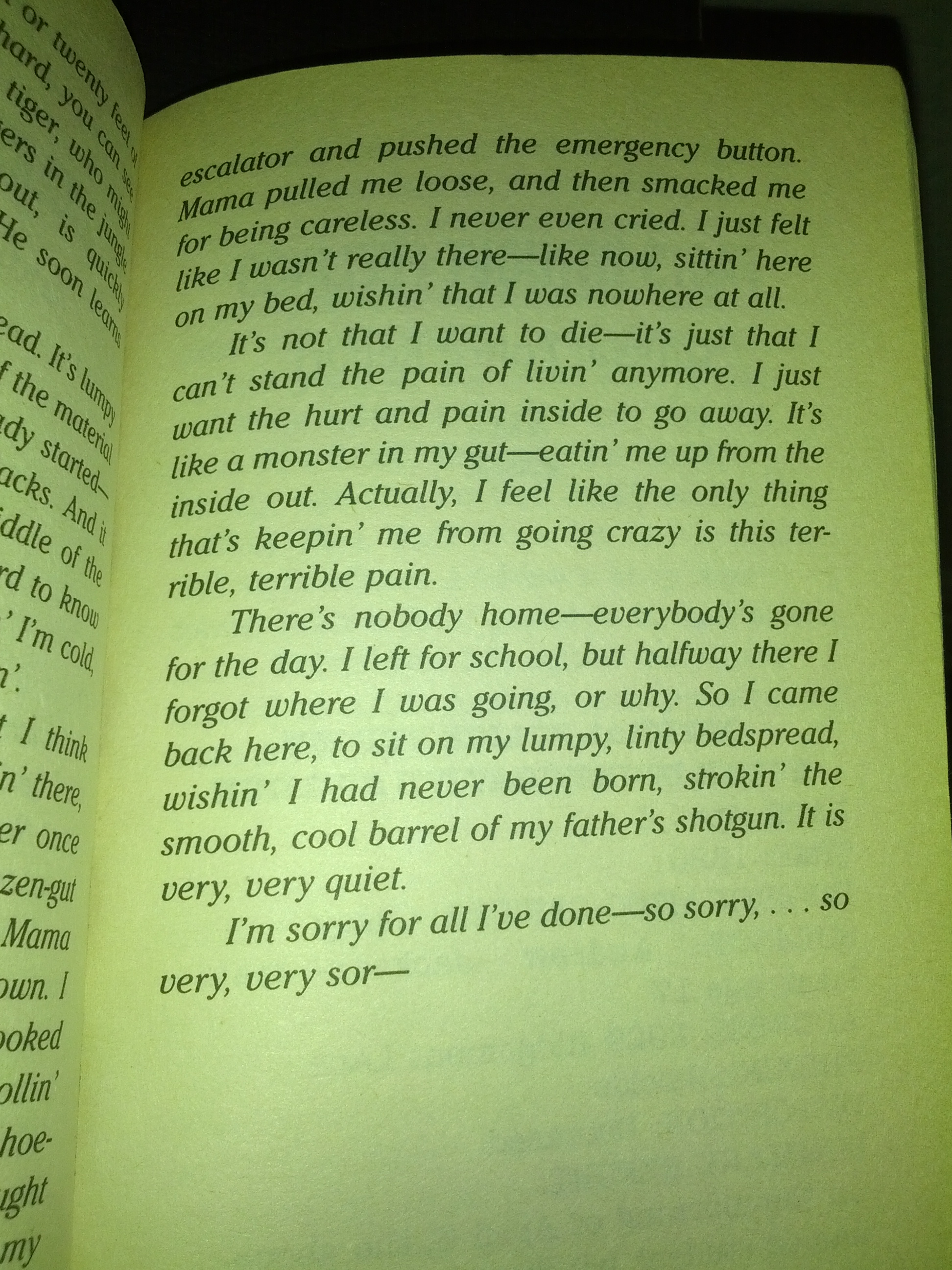
As ChrisIMG_20141215_175627tian holds tight to Tears of a Tiger by Sharon M. Draper (a popular read among students and the first book in the Hazelwood High trilogy), he points to this passage and invisibly underlines each word as he flies through the paragraph that starts “There’s nobody home – 

He then pauses.   His finger moves to the last line, lingers there as he looks up at me, and continues…”I’m sorry for all I’ve done – so sorry, …so very, very sor-

“Ms. Bogdany, did you SEE that?!  He kills himself!  He doesn’t even finish his sentence!”

I am most definitely taken aback.  First by Christian’s intense grasp on the craft of the writer and secondly by the wild intensity of a young man taking his own life.  My eyes bulge too.

Then Christian continues.  Again, his finger leading the way…

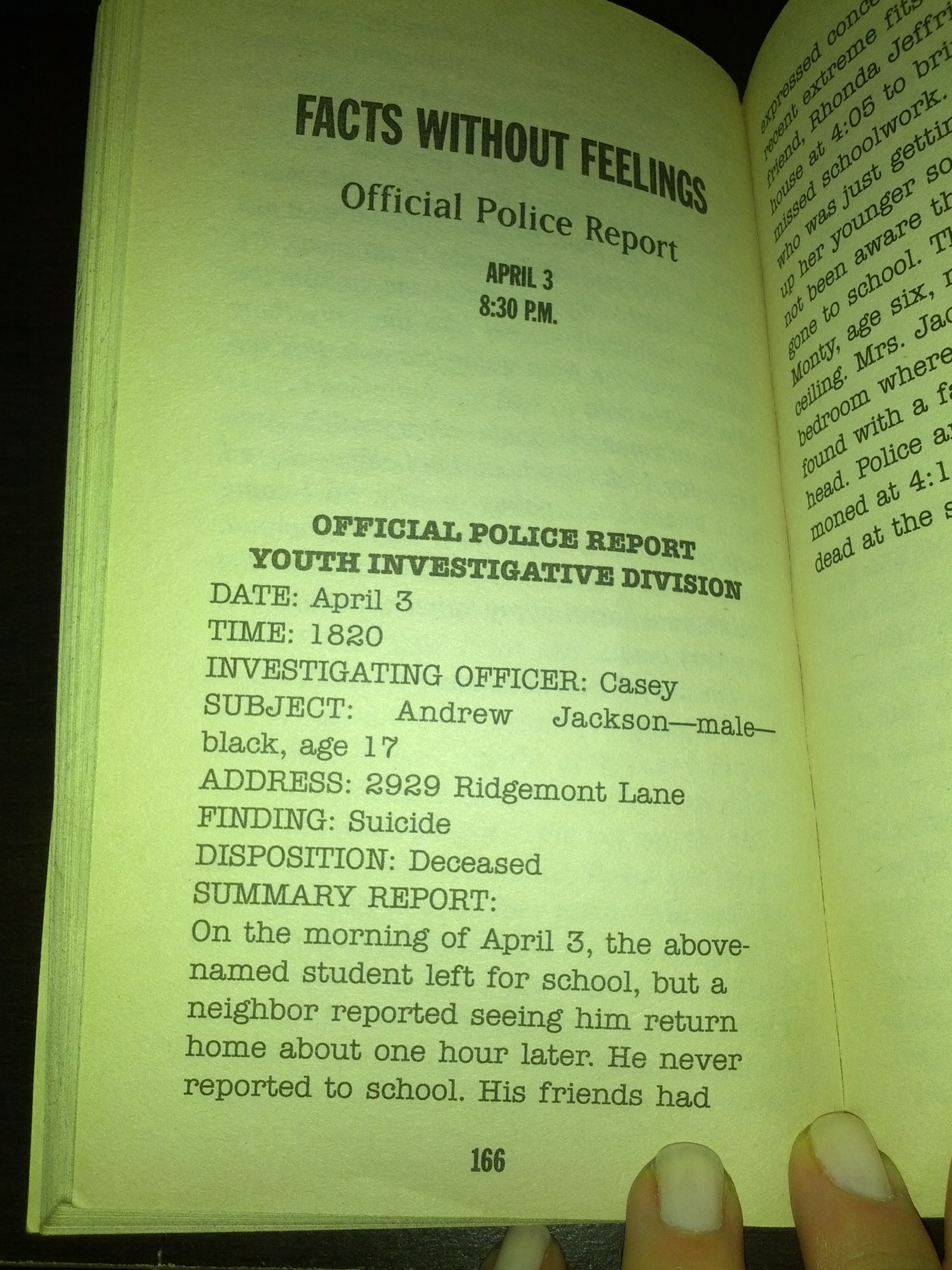
IMG_20141215_175604

“Suicide!  This is the police report.  He killed himself.”

We both pause.  The weight of the word.  We both feel it.

“Ms. Bogdany, I just can’t believe it.  I knew it on the page before, but here it’s confirmed.  I had no idea this would happen.”

————

Christian has chosen many-a-piece that deals with Post Traumatic Stress Disorder (PTSD) and this piece is no different.  Here you have the main character who deals with survivor’s guilt after accidentally killing his best friend in a car accident.  You can only imagine how difficult life, for Andy Jackson, must be.  While attempting to ask for help throughout the piece, Andy feels as though he is alone.  Very alone.

This piece chronicle’s Andy’s journey and the fatality in which it brings.  Please note that students may want (and actually need) to talk about their feelings regarding this heavy issue.  Christian did, albeit the way in which he initially hinted.  Through the expletives I realized that Christian couldn’t be silent about the tragedy he just witnessed.  He needed to voice (in whatever way that surfaced) his knee-jerk reaction to the shock of Andy’s decision.

This piece has connected Christian and I.  It has given us the opportunity to chronicle his study on PTSD…and the real consequences that are associated with it.  He was able to walk me  through the craft of Sharon M. Draper.  This book will remain important for Christian for very specific reasons as it may very well be the piece that is forever etched in his mind.  This piece will also remain incredibly important for me, but for very different reasons.  Regardless of the reason, we are both grateful to Ms. Draper for her dedication to addressing real issues that touch the lives of our youth.

Landscape of Workshop: We have arrived!

Nine years in. I know what certain murmuring really means. We all do. The murmuring of students when they are conferring about their writing. The kind that surfaces when boredom is creeping into our classrooms. The murmuring of confusion and frustration. The one that starts to get louder and louder as passion starts taking shape. Today, is that kind of murmuring day.

Christian: Why? No, really. Why? Why is it that all we do is read and write in here allllll day, Ms. Bogdany? Ev-er-y-day. (Yes, with that level of emphasis.)

Swallowing my smirk, I calmly start explaining the reasons, rationales, and importance again to Christian. Yes, we’ve had this conversation many–a-time. And clearly others’ patience with this subject has become depleted.

Norris: Man, why are you even asking that? We’re in English! It’s what we do!

Christian: No, but I mean seriously. It’s all we do. In my previous high school we used to watch movies and relax. This is crazy.

Norris: That’s why you’re not there anymore! You chose to be educated here. We’re at a transfer school. Here it’s more focused and we’re learning.

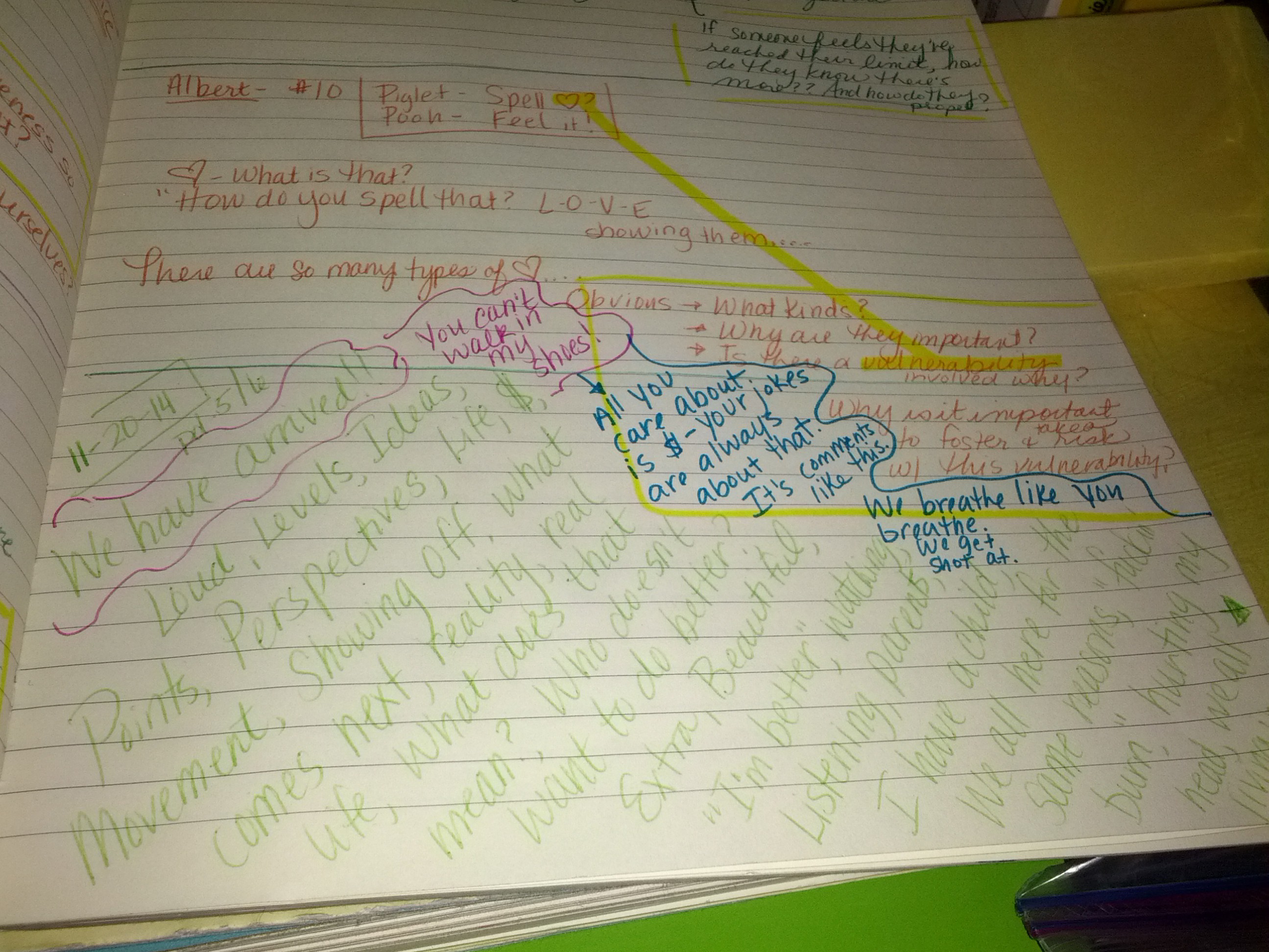
Deja: Oh, listen to you, Norris. Telling Christian all about what’s right…you always think you’re better than everyone!  We breathe the same air you breathe!

Hakeem: Norris, you haven’t walked in my shoes! You don’t know! Last period, you were the one that lied and got caught! Now you’re acting like Christian’s father.

Here, in my Writer's Notebook, I capture voices speaking their truth.

Here, in my Writer’s Notebook, I capture voices speaking their truth.

Here is where I sit back and start listening; very intently. I am becoming quieter and quieter as the room gets more and more animated. (I was hoping to become invisible, truth be told.) Because, this is what happens when students are invested. They challenge each other. They hold each other accountable. They start discussing their level of comfort or lack there of.   They express their inner feelings. They question motives. And yes, sometimes their word choices can be a bit crass, but isn’t that authenticity at its best?

They give me exactly what I need as their educator.

I need to understand who they are, what fuels their fire, how they feel about injustice. How safe are they feeling in our learning community? Well, I can’t always answer all of the questions swirling around in my mind, but today I was able to answer this one confidently: students are feeling wildly comfortable in our shared space. Because when students are brave enough to confront their peers (those that are their roughest critics) I know we’ve arrived. We’ve arrived as an evolving community of learners; as a team not willing to silence our voices when they need to be heard; and we are most definitely letting our guards down as we are emerging ourselves even more deeply in the work of the Reading Writing Workshop (RWW).

I also know that while Christian is literally shifting around in his seat, stretching all of his 5 feet 9 inches; he is moving – physically and as a writer. He doesn’t necessarily see or appreciate it just yet, but it’s there. I see it. I know. And, just like the murmuring that propelled this dialogue in room 382, Christian is pushing boundaries and uncomfortable. Yet, I believe Christian is more resilient than he even recognizes. And that resiliency pushes me to continually find ways to engage Christian in this work. Even, if it means having the same conversation again — because it will resurface.

As I head down to the nation’s capitol to be reunited with my PLN – my nationwide pedagogical lifeline – I take this experience with me. Regardless of how much traffic I may encounter on the trip from Brooklyn, this tipping point (as Malcolm Gladwell would argue) is buckled tightly in my back seat and promising to remind me what I am bringing with me to #NCTE14 – the moments that the RWW affords us when we listen to our learners, their needs, and previously dormant desires.

I cannot wait to further this conversation on Saturday at J.44 starting at 2:45pm. I hope you join us for an hour full of deep thinking, classroom anecdotals, and the energy that attendees from across the country bring to the conversation. See you there!

Chaos

The beginning of each school year is always chaotic.  Sometimes it’s the overwhelming chaos that can feel debilitating.  Other times it’s that quiet chaos that only you know ensues.  At times it creeps up on us in silence, yet we know it’s found its way into our spiraling minds.  But always, it lives within our being because, quite simply, we are so wildly passionate about upping the ante with each and every group of students that crosses our threshold.  This year, I welcome the chaos.

I have complete and utter belief that the Reading Writing Workshop (RWW) is exactly what my students need.  Better yet, I know in my soul, that it’s exactly what they deserve for their lives; both inside and outside of room 382.

Both inside and outside room 382 students are starting their journeys through the RWW.

Students are starting to journey through the RWW: Inside and outside of room 382.

We have a promising year ahead full with mentor texts, writer’s craft, brilliant student generated ideas, ‘aha’ moments, and all of the unknown that we are willingly going to dive into – together.  But, I would be remiss if I pretended that chaos and uncertainty were not eagerly awaiting our arrival.

Between rolling out the RWW in its entirety last year, more summer classes at the lovely campus of UNH’s Literacy Institute, and a month in the Bronx writing with the NYC National Writing Project; I have been planning.  Incessantly.  Yet, I very quickly realized that all of my planning may be better utilized at some other time, in some far off distance, or at the very least, later in the year.

My plans are fantastic.  I feel it in my gut.

Yet I know they will be utilized and enjoyed when the time is…right.

You see, the beauty within the RWW is that the authentic and natural flow is magical.  Straight up, hands down – magic.  The luxurious task of choosing which piece of literature to start with when oh-so-many are enticing.  The creation of one’s Writer’s Notebook.  The roller coaster writing that sheds light on our own movement and development as writers.  The organic inquiry that surfaces.  All of it.  Every piece is essential.

So you can imagine that after rounding day three of educating, fully engulfed by a feeling of unease, I knew that all of my planning was by no means an effort to be mourned but most definitely an effort that needed reshaping.  As to not let the chaos (starting its crawl toward my vulnerability) completely immobilize me, I made a decision right then and there.  I was by no means going to shift my expectations.  Instead, I had decided to rework all ideas I had about what my students would find engaging.  Because the reality is, my new students are not the same students as last year.

Students creating their Writer's Notebooks in ways that feel most authentic.

Students creating their Writer’s Notebooks in ways that feel most authentic.

Mystery books have flown off the shelves – for the first time ever!  Color is most often preferred when expressing themselves vs. the written word.  There is an untapped intellectual power among every young adult occupying each individual seat that is awaiting its own explosion.  Their passions have yet to be discovered within the context of our learning community.  And, not unlike years worth of previous students, they are incredibly focused and hardworking.

When students are not meshing with the material; when the sparkle does not twinkle in the corner of their eyes as they try to explore new found interests; or they have absolutely no questions…something’s wrong.  Very, very wrong.

I am responsible for guiding students through the beauty of the RWW to foster their own strength, perseverance, and dedication toward the development and growth that is inevitable to happen.  I feel the promise and hope.  I am no longer vulnerable nor am I even remotely entertaining the potentially consuming chaos.  Instead I am enjoying the exploration of new mentor texts while listening intently to the views and beliefs of my wildly intelligent learners.

Here’s to an invigorating year full of unforeseeable experiences, ideas reworked, and chaos debunked.


Making the Most of Summer

If you’re anything like me, based on the fact that August is just around the corner, your computer screen probably looks something like this:

Screen shot 2014-07-30 at 6.38.24 AM

Those 10 or so tabs contain articles, blogs, book recommendations, and more for me to mine for ideas.  Once I’m done perusing those, I’ll return to my very full writer’s notebook to sift through the myriad of quotes, lessons, and resources I’ve jotted down while attending various classes this summer.  After that, it all comes down to remembering what I learned and actually applying it in my freshly-waxed classroom.

Honestly, that’s always been somewhat of a struggle for me–managing to sift through those summer lessons and remember all of them well enough to apply them.  So, in order to make the most of this summer, I’ve decided to boil down the biggest takeaways of my three workshops here.

Takeaway from UNH Literacy Institute – “I am the sum of my mentors.”

For two years now, I’ve learned most of my daily classroom practices from Penny Kittle.  However, what I’ve really begun to pay attention to is that by reading Penny’s writings and taking her classes, I’m not just learning from her.  I’m learning from Don Murray, Don Graves, Kelly Gallagher, Louise Rosenblatt, Katie Wood Ray, Tom Romano, Teri Lesesne, Donalyn Miller, Alfie Kohn, Nancie Atwell, and many more.  Penny has expertly absorbed the ideas of all of those other teacher-writers, and seamlessly integrated them into her own philosophy and craft.  That is my goal–not to mimic Penny or any of those other teaching geniuses, but to meld all of their research findings into my own practice; to become the sum of my mentors, as Meenoo Rami says.  Of course, that’s easier said than done, but definitely worth the attempt–and the hefty credit card bill that comes after a Heinemann ordering spree.

IMG_3657

With that being said, there is one idea of Penny’s I’d really like to integrate into my classes this year–storyboarding.  This visual way to process a story’s plot is a gateway into analysis and evaluation.  If talk is rehearsal for writing, then to Penny, so is storyboarding–sketching out little comic-strip squares of events.  This was something that I couldn’t really wrap my mind around how to execute after just reading Book Love, but now that I’ve seen Penny do it, it makes perfect sense, and I can’t wait to try it out.

Another lesson for me came from the fact that I couldn’t grasp the concept of storyboarding without seeing it modeled.  That was another weighty reminder of the importance of my serving as a writing mentor, modeling process for my students.  If I am the sum of my mentors, so are my students–and I am perhaps their only mentor when it comes to being a good reader and writer.  This big responsibility reinforces the importance of staying informed on current research–without great mentors, I can never be a great teacher.  I need those teacher-writers to help me help my students.

Takeaway from Balfour Yearbook Advisers Workshop – “There are two kinds of writers–good writers and quitters.”

In addition to teaching English, I also teach Journalism and Yearbook.  I traveled to Dallas this summer for what I thought would be a boring jaunt through yearbook software and technology, but I was pleasantly surprised by being surrounded by amazing teacher mentors to learn from.  Lori Oglesbee, a Texas teacher and our keynote speaker, spoke about the fact that great journalism comes from strong writing.  She preached that all students, no matter what, can be great writers if we lead them to it.  Lori then proceeded to show us many examples of award-winning yearbook writing, and I grinned–here were mentor texts again!  I really saw the relevance of mentor texts across all disciplines.

Takeaway from ASNE-Reynolds Journalism Institute – “Good writing comes by studying good writing–period.”

IMG_3997

This lesson came in the form of an irreverent lecture by the delightful journalist and author of Radical WriteBobby Hawthorne.  An advocate of “writing for the reader, not the rubric,” Bobby spoke to us about the general lack of quality in student journalism writing.  School newspapers across the land are plagued with crappy writing, he preached!  (I learned that journalism, until very recently, was still laboring under pre-Graves and pre-Murray delusions about writing–no I, no emotion, no personality, no rule-breaking.)  Bobby advocated for throwing out all of our old notions about how to teach journalistic writing and just getting our students to find a story hidden in an event and tell it.  He felt strongly about the power of the narrative form, reminding me of more of Penny’s ideas from Write Beside Them.  And in fact, she agreed with him:

Screen shot 2014-07-30 at 7.52.11 AM

Bobby wasn’t the only speaker at the two-week Institute to urge we teachers of journalism to simply teach our students to find and tell stories.  I heard that message over and over again, from photographers to journalists to writers to teachers.  The power is in the story, they urged.  Find it, and good writing will come naturally.

So, I’ll approach this year with those takeaways in mind.  I’m excited to try the workshop model out on my journalism students, who will be starting a newspaper this year.  I’m curious about how my teaching of the reading and writing workshop will change in its second year.  And, I’m optimistic about having so many new mentors to act as the sum of my teaching.  I hope I’ll make the most of my summer and transform my teaching, as I do every year, by putting my writing and reflecting to work.

Tu Eres Mi Otro Yo

ocs While recently in the throws of February break rejuvenating away from the hubbub of the city in the quaint beach town of Montauk; Malcolm X and I were becoming intimate acquaintances.  We had been for quite some time, actually.  But it was here that I really started questioning him, his motives, and his overall sense of dedication to any cause he finds justified.  As I was making direct connections to my own beliefs and passions, my pen went haywire.  There was, by no means, enough blank space on the pages of this autobiography for my own thinking.  Out came the post-its.  The power button on the iPad came alive and my inquisition and deep thought went ablaze.  While X and I could not be more different human beings the ideal of commonality among passion elated me.

Later that very same day, I was introduced to Dr. Jeff Duncan-Andrade’s invigorating message that immediately added even more fuel to my already-burning fire.  From the moment I pressed play (thank you, Apple TV) I was captivated.  Jeff is an outstanding educator who believes there are three kinds of hope: material, critical and audacious.  He believes that our [urban] students are roses growing in concrete.  I mean, the city has always been referred to as the concrete jungle!  In order to really grasp the intensity and genuine love Jeff exudes with his message, you’ll have to watch for yourself.

There I was, hours away from the city and my students, yet never have I felt so connected.  X’s passion exudes from his autobiography; Jeff’s passion seeps through his pores as his care is so loudly presented; and my passion was turning up the waves in the ocean right outside my window.

On my drive back to work that first Monday morning after break, I made a promise to myself.  I promised to stay true to my passion and invite the new found passions I discovered to reside within me as well.  My focus was by no means on the road, it was zoomed in on Jeff’s mantra: Tu eres mi otro yo! (You are the other me!)  How could it not be?  How could I not be heading back to room 382 thinking, “Students, you are my reflection…you are what I see when I look in the mirror.  We are one.”?

As I headed into our building, my mind automatically trained itself on a female student that I have been working with for six months, but have yet to authentically connect with.  Today was the day that was going to happen.  The day had not begun, but I was sure of it.  I was sure of it because I was going to channel all of the passion, intensity, and love I gathered over the break and pour it all over this student.  I only hoped she wouldn’t mind!

As independent reading commenced I asked this student to join me with her new book, highlighter and pen.  It was a piece well below her reading level (as is typical of her reading selections), but the premise captured her attention immediately: females making decisions based on their desperate need for belonging among other female peers.  There’s no wonder.

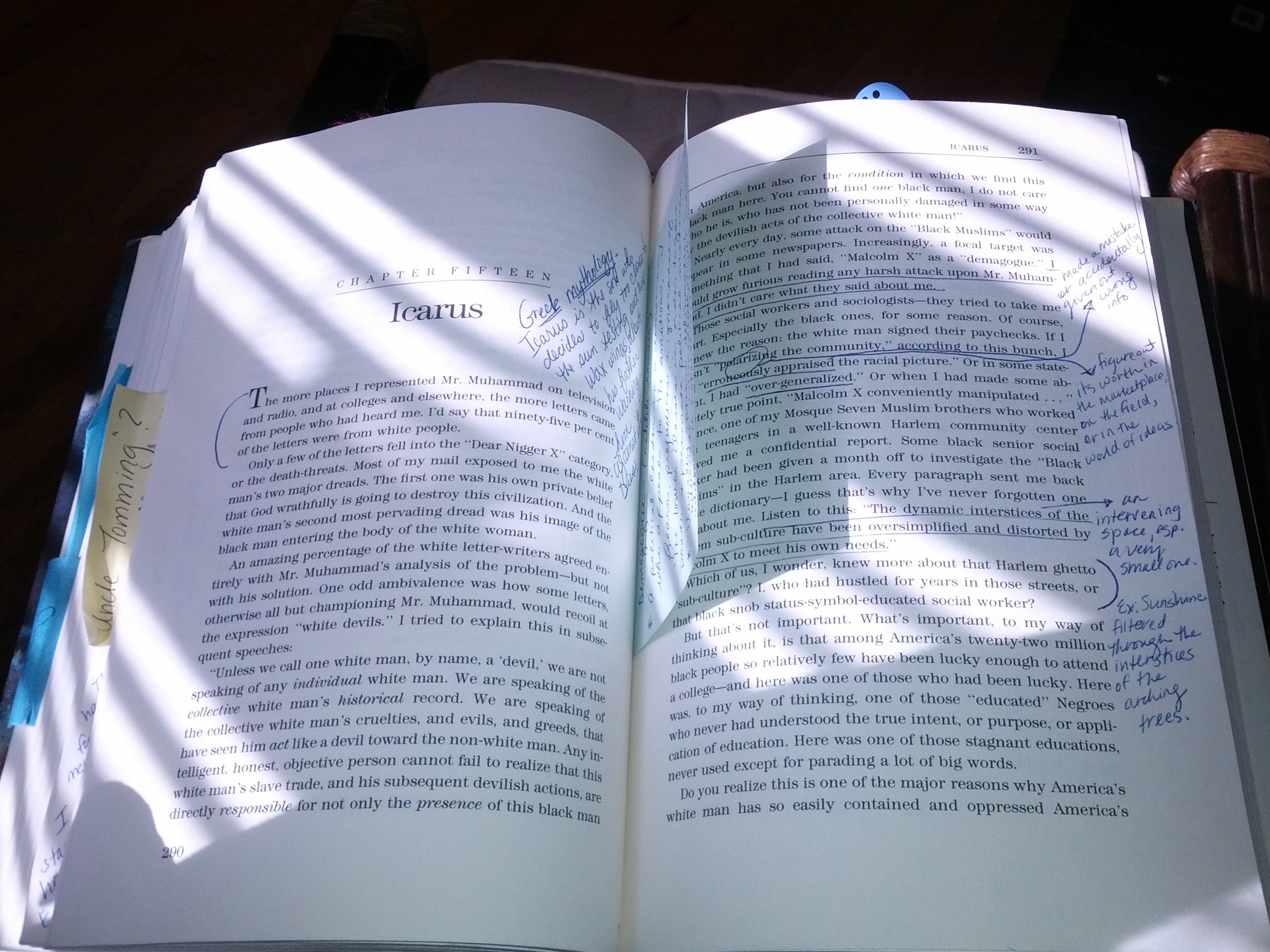
X followed me to class that day, in many regards.  As I put my chosen piece of literature on the table, a ‘huh’ surfaced from this female student.  I opened to the chapter titled Icarus.  IcarusI asked her if she knew what the title meant and the following is the dialogue that surfaced:

B: Nope.

Ms. B.: Neither did I.  I decided I wasn’t going to go any further into this chapter until I understood what this name resembled.

B:  Huh.

Ms. B.: So, I took to the internet and realized Icarus is the name of a Greek mythical figure whose father warned him of not flying too close to the sun with the wax wings in which he created for him.  But, he did.  And he fell straight out of the sky.  Can you imagine?

B: Wow.  Huh.  That’s interesting.

Ms. B.: Isn’t it?  Then, check this out…(I flipped to the last page of the chapter.)  Read this last sentence.  (B does.) Do you see it?

B:  Whoa.  It connects to the title.  It explains what you just did.  (Smile)

And it was at this moment, that the gathered passion, intensity and love I poured all over this student started to work its magic.  Because here’s what happened next:

B: Ms. Bogdany, how do you know what to highlight though?  I never know what to say — I mean annotate.

This may seem like a simple (and potentially expected response) but after working with this student since September, this was the very first time she was confident enough to be vocal with her inquiry.  From there we opened her book (with much fervor) and highlighted a portion that she noted.  I asked her what it meant, and she started to explain it…and, in her book, I wrote down her thoughts.  I then asked her about her own ideas regarding this concept, and (with the longest response to date) she explained her insights about the decisions the main character is making.  So, again…I scribed.  We discussed.  I annotated.  She smiled.

Ms. B.: Do you see it now?

B: Hahah.  I do.  It…it makes you understand more.  Thank you.

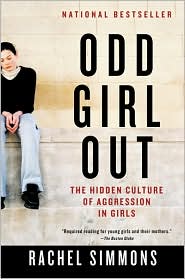
Before she left to resume this process solo, I pointed her in the direction of another female student who had just started reading:                                                                          Odd Girl Out

I explained the premise of this piece.  She raised an eyebrow.  I mentioned that when the other student was done, she may want to engage with it as it’s the same concept that envelopes her piece, yet it’s an informational, non-fiction piece.  This piece is more level appropriate for her.  Same concept, different genre, enhanced level.  We’ll see.

In the meantime, I noticed during the rest of our two hours together that day, B’s book kept finding it’s way back onto her desk; her highlighter was incredibly busy; and her pen was relaying her inner voice on those very pages that previously would have remained untouched.  And instead of refocusing her on the day’s lesson and activity; I whispered internally, “Tu eres mi otro yo.”

The Importance of Being Reflective (as well as Earnest)

ocsI’m going to be honest…I’m feeling pretty bummed as I sit here to write this post. I have had my first “wish-I-could-do-over” teaching days of the school year.  I haven’t felt this icky about a teaching day since…2005.  Oh Amy, you would have flipped out to see my utter lack of zen today.

It’s all too easy for me to focus on what I’ve not been doing well this year, how I have been falling oh-so-very short.  But I’m going to view this opportunity to reflect on my practice as a way to reset and to return to the core of my teaching soul for the coming week.

One bright spot in all of my classes this year has been a small change I’ve made in how I talk about books. One thing Penny Kittle emphasized this past summer (love to #UNHLit13) was the importance of book talks as part of her class every day.  I’ve always gushed about books I’m reading (see Shana’s post “Fangirling About Books”, which may as well have been my post! Kindred spirits!), and I’ve always prided myself on being able to match students with books that resonate with them.  But I decided to make book talks a regular part of each day, right after starting class with independent reading.

This Monday I’ll talk about books #51 (Invisibility by Andrea Cremer and David Levithan) and #52 (Dash & Lily’s Book of Dares by Rachel Cohn and David Levithan).  My students like finding the connection between the two books, though the connection between these is kind of obvious!

There are myriad benefits to having these daily book talks.  Some of the great books I read from and talk about are new to my students, and sometimes there are some who have read them already.  This has created community and conversation around books, as students share opinions, do their own spontaneous plugs for the books, ask questions, and start fighting about who gets to read them first!  Students started a Book Wait List on the white board.

It has surprised me how much the students enjoy the book talks.  One day a couple weeks ago, I forgot to book talk (it’s a verb now!), and Stephanie, who doesn’t ever say anything in class raised her hand and asked, “Are you not going to talk about a book today?”  When a new student joined our class, I had Noe help her get oriented, setting up her notebook and so forth.  I overheard her say, “After we read, she introduces a couple of books. It’s one of my favorite parts of class, no joke.  There’s a lot of cool books she shows us.”  The other day, students pointed out that I neglected to update the titles for book talks on the agenda.

All of the energy around books has helped create a culture of reading in our classroom so that even the most reluctant readers are giving books a try. The books have become a bridge between me and some of the students who are typically “hard to reach.”  It’s still a challenge to be sure, and there are days some students are fake reading, but for the most part, students are realizing the books are here to stay!

For me, it’s always easier to dwell on the negative, but when I stop to think about it, there are quite a few things going well. It’s a process, and I’m growing and figuring out how to make my class an authentic reading and writing workshop. It is a source of strength to know there are people in my PLN all over the country striving to do the same!

(Coming up next month: How to respond to the question, “How do you assess that?!”)