Tag Archives: Readers Writers Workshop

Survival Strategy: Return to Structure

The Google calendar that the Three Teachers share has us on a rotating schedule. Fixed days with suggested ideas around types of posts and the three of us cycle through clock_stockeach week. Today, my friends, the suggestion is “strategy,” and boy do I need one.

After this lovely break from school, my daughter’s sleep schedule is a mess, I think I’ve put on five-ish pounds of cookie related belly weight, and the house is an unmitigated disaster zone of new toys without homes, student papers I’m placing around the house in an effort to combat “out of sight, out of mind,” and the organized chaos that comes with putting away all the holiday decorations while my daughter yells, “But we CAN’T put the tree outside! It will be lonely!”

So, what I guess I’m suggesting with all of that is that, although it has been legitimately lovely, I need to return to some structure or I’m going to lose it. I can’t watch The Grinch one more time, or I might pop Cindy Lou Woo in her tiny little nose. Bah! Humbug!

Was it really only a little over a week ago that I sprinkled unbridled joy across the blog in my Holiday Poem? My…how the Merry has fallen.

handsPlease don’t get me wrong. I’ve had an amazing break from work. Many aren’t able to share in the blessing of having such a richly restorative holiday from their employment, and I am grateful. I spent time watching my three-year-old revel in the magic of the holidays. We shared time with family and friends, laughing, toasting, and just generally enjoying one another’s company. I stayed up late reading. I rediscovered the thrill of flying down a sledding hill, shrieking like a teenager and giggling with my daughter. I even had one day where everyone was out of the house. I napped. On my own couch. Without having to block out Dory telling me to “just keep swimming” for the six millionth time.

However, while summer affords one the opportunity to release from the stresses of work and still find plenty of time to get on a schedule of chosen activities, winter break is a whirlwind, from which, many feel they need a vacation.

So, here is my strategy. A strategy to shake off the crazies and get back to some workshop non negotiables to send us back to school with a renewed enthusiasm around structure:

Step 1. Get back to school. Easier said than done, I’m sure. That alarm is going to go off tomorrow at 5:15 a.m. and I am not going to be happy, but this past week has reminded me that without consistency, I start to lose it. I need more purpose than Netflix programming selection. Much like workshop, I need consistent components of purpose in my everyday. They give me a roadmap to achieve goals. Goal one, get out of bed for work tomorrow.

Step 2. Read with my kids and then talk with them about what they read over break. I’m guilty of getting away from reading/conferring with my kids in the past few weeks. In the flurry of planning, preparing for exams when we return, fifty meetings after school, PD time to plan for, and countless other distractions, I started to let the few precious minutes at the start of class slip back to menial task time. Check email, organize papers, finalize workshop activity, etc. Our first day back, I’m going to read with my students at the start of each class (Warning! Shameless plug for #3TTBookClub to follow: Perhaps I’ll choose East of Eden by John Steinbeck, Between the World and Me by Tah-Nehisi Coates, or  Assessing Writing, Teaching Writers: Putting the Analytic Writing Continuum to Work in Your Classroom by Mary Ann Smith and Sherry Seale Swain. All fantastic choices for the month of January). The next class period, and those that follow, I need to talk with my kids at the beginning of the hour. Their only homework was to read over break. I want to hear about it.

Step 3. Set reading rate goals with my kids (another practice I slipped away from over the weeks between Thanksgiving and Winter Break…talk about a need for resolutions. If the past paragraph didn’t indicate my own failings at upholding a major tenant of workshop, this one sure will. I never slip on giving my kids time to read. We have 82,793 things to work through in a class period, but I don’t take their reading time. It’s just that important. However, holding them accountable for their reading outside of class? That’s a never ending battle. I’m going to get back to students setting goals in their notebooks, then I’m going to employ my newly favorite technique: Have students snap a picture of the page and email it to me. Stacks and stacks of notebooks are occasionally necessary, but they also give me hives. An inbox full of messages is somehow a challenge, as opposed to a stack of notebooks which is somewhat of a burden, meaning I end up collecting them far less than I would really like to.

Step 4. Get back to writing. We religiously write in class each day. Over the weekend, I wrote thank-you cards and last Wednesday, I wrote down my Jimmy John’s order for a friend. On the drive home from my in-laws tonight, I looked out at the last of the Christmas lights on passing houses and smiled at the memory of the big, old fashioned lights on the bushes outside the house where I grew up. The memory was quickly followed by an ache to write about it. I miss writing when I let myself feel “too busy” to do it, so I need to take William Wordsworth’s advice: “Fill your paper with the breathings of your heart.” Tomorrow, we will write about what makes us ache.

Step 5. Reconnect with kids. In one of the many moments I allowed myself to be distracted from work today, I saw a Tweet from literacy specialist Shawna Coppola, who said, “Relationships with students are more important than any curriculum.” Please see step 2 above and repeat that daily during workshop, drafting, small group work, experimentation, last 30 seconds of class, time.

——————–

The New Year is a time to move forward with renewed vigor. My final exams this semester will ask students to reflect on their growth as thinkers over the course of the first half of the school year and discuss specific takeaways from our work. They will then be asked to make suggestions as to how they will apply that learning during second semester.

In much the same way, I’m reflecting on how a lack of structure makes me more tired than teaching, parenting, and living combined. I was certainly ready for a break, but I’m also ready to get back at it.

The strategy is simple: Get back into workshop WITH your kids, and refresh that commitment to do what works each and every day.

Happy New Year, All. Welcome back!

Lisa Dennis spends her school days teaching AP Language and Honors/Pre-AP Sophomores, while also leading the fearless English department at Franklin High School, just outside Milwaukee, Wisconsin. Though loathe to discuss herself in the third person, she does delight in hearing her daughter ask for ‘just one more chapter,’ dreaming about European vacations ala Rick Steves, and sitting in the snugs of authentic Irish pubs. She is a firm believer that a youthful spirit, a kind heart, a big smile, and a good book can ease most of life’s more troublesome quarrels.
Follow Lisa on Twitter @LDennibaum.
disclosure

Join the #3TTBookClub

We’ve probably all seen a ton of posts about the “best” books of 2016, and our To Read Next lists and wish lists and carts in numerous online book shops have grown like crazy. Thankfully, I have some grant money just itching to be spent on new books for my classroom library. Here’s a list all in one place, if you want to take a look. Thanks @shawnacopola!

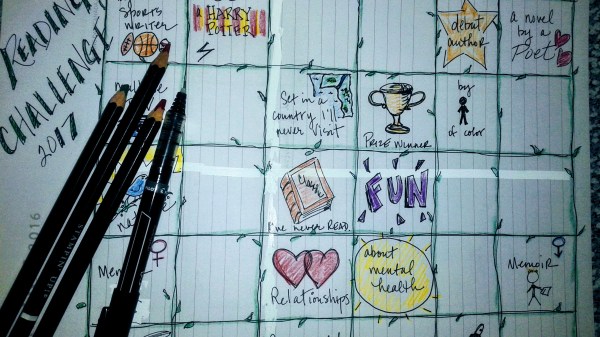
We’ve also probably set reading goals for ourselves. I played in my new planner, setting some goals that I will share with my students when I ask them to create their new challenges.

20170101_200237

If you are looking for a way to spice up your reading in 2017, consider this:

Join the #3TTBookClub on the Three Teachers Talk Facebook page.

Why #3TTBookClub?

In the introduction to her book Reading in the Wild, Donalyn Miller writes: “I want my students to enjoy reading and find it meaningful when they are in my class, but I also want them to understand why reading matters to their lives. A reading workshop classroom provides a temporary scaffold, but eventually students must have self-efficacy and the tools they need to go it alone. The goal of all reading instruction is independence. If students remain depends on teachers to remove all obstacles that prevent them from reading, they won’t become independent readers.”

How do we help our students become independent readers if we are not independent readers ourselves?

I am often surprised at how many English teachers I meet who admit to not reading. I wrote a bit about that in a post last year, and I extend the same invitation:  Are you walking the talk in your content? (The invitation to guest post on this blog stands as well. Every teacher’s voice matters. Your voice matters.)

How will #3TTBookClub work?

We batted this one about a bit, but it didn’t take long to decide that even when it comes to book clubs, choice matters. Each month Shana, Lisa, and I will choose a book. We will introduce our books on the Three Teachers Talk Facebook page and invite other readers to read along with us. Read one of the books, two of them, or all three (My personal goal, but, you know…time… and all that feedback to leave on all those papers.)

We will share ideas on how we might book talk certain books with our students, share insights from pedagogy books we read, share ways we might use excerpts to teach craft, and just overall share our deep and abiding book love.

What have you got to lose?

We hope you will join us in #3TTBookClub in 2017 — and please, use the #3TTBookClub hashtag and invite your friends. See you on the Three Teachers Talk Facebook page.

3ttbookclub


Follow Three Teachers Talk on Twitter @3TeachersTalk, on Instagram at 3TT.us, Pinterest at Three Teachers Talk, and Facebook @ThreeTeachersTalk. Oh, and remember to subscribe to the TTT blog, so you never miss a post.

Amy Rasmussen lives in north Texas and teaches AP English Language and English 3 to the Fighting Farmers at Lewisville High School. She adheres to the words of Emerson: “We aim above the mark to hit the mark,” and Jesus Christ: “Love one another.” Imagine a world if we all love more than we think we can. Follow Amy on Twitter @amyrass.

ftc-guideline-%22affiliate-links%22


Making it Easier to Be Smarter

I am always looking for ways to help my students write. Write more. Write more effectively. Write with more voice.

Not too long ago, I came across The Skimm, an online news source I read every weekday morning. It never ceases to make me smile. Witty and smart just about covers it.

In an effort to help my students stay tuned to what is happening in the world, I’ve asked them to sign up to receive the Daily Skimm. Besides learning the basics about what events headline the news, we will discuss author’s craft, effective summarization skills, using links to build our credibility in online writing, and what ever else we happen to notice in these daily news sound bites.

If you want, follow The Skimm on Twitter, but really, you will want to subscribe. It’s just that good, and like the Skimmers say “the Skimm makes it easier to be smarter.”

Who doesn’t want that?

screen-shot-2016-12-30-at-4-28-40-pm

Me every day during winter break.

Happy Reading, my friends.

And Happy New Year!

‘Tis the Three Teachers Talk Holiday Poem

My dad was an 8th grade Social Studies and English teacher for well over 30 years, and his joy (and frustration) as it relates to education, inspired me to work in the classroom as well. I grew up on stories of my dad’s intelligence, humor, creativity, and passion in the classroom. This and other tales of how I’m pretty sure my dad was incorporating elements of workshop in his classroom in 1968, in a future post.

But it’s not only my choice in profession that was influenced by my dad, it’s the writing you are reading right this very moment. Dad has a gift with words. People are still talking about how clever and touching his speech was at my wedding…almost nine years ago. He has a way of turning phrases to make them as sharp as his wit and as beautifully deep as his heart. I’ve always wanted to write as powerfully as my dad.dad

So, early on, my writing filled with passive voice and right-clicked thesaurus words (the nuances of which I was not skilled enough to use correctly), I wrote. And I often wrote utter crap.

When I would ask my dad to read it,  an old school sea of red comments would flood the page. Arrows, strike-outs, question marks. It was harsh, but fair. And though I was often too stubborn at the time to admit it (a trait I certainly, thankfully, and ironically in this case, inherited from him directly), his insights pushed me to add clarity, depth, and insight to my craft.

Earlier this week, Amy wrote about writing when it’s hard. She spoke of filling the room with beautiful language, getting kids to keep talking with one another, and allowing time to think.

I humbly add to Amy’s list the idea of helping students to find what or who inspires them to write. With the mutual understanding that my “brilliant” quick write ideas aren’t always going to cut it and not everyone is lucky enough to have a writing mentor at home to inspire them, we need to help our students find inspiration. In essence, as their teacher, I need to be that writing mentor by sharing brilliant published writing, encouraging students to share their writing with one another, and in (sometimes with a knotted stomach) sharing my own.

I’m inspired today by both the last day of school and, again, by my dad. For years, Dad would take traditional poems and rewrite the lines to match the happenings at his school. Christmas, the end of the year, retirements…Dad would craft witty quips about teacher’s lounge antics, administrative frustrations, student silliness, and more. He has a gift for playing with the written word.

snow

So, dear readers, Dad, and Robert Frost, forgive me as I try my hand at a holiday poem to warm your workshop hearts. It’s all in the name of holiday cheer.

Stopping By a Workshop Classroom…

Three Teachers write here, I think you know. 
Ideas of workshop and reading to sow;
We read and write each day without stopping
To keep our students’ brains and pens hopping.

Some colleagues certainly must think it strange
To bring to our classrooms such a great change.
A room full of books and pages of scratch;
Such delight when a book with a student we match.

They may even, with concern, their heads firmly shake
To suggest that there must be some grave mistake.
But lives as readers and writers we give
For choice and challenge in our classrooms do live.

This workshop gig can inspire, uplift, and “readicide” it can mend,
But break is here my old dear friend.
So go on and with your family some happy time spend,
Because this week of school is finally (blessedly) at an end.

Merry Christmas, Happy Holidays, and a very Happy New Year to all, and to all, a great break. I’m hoping to settle in for a long winter’s nap.

Who or what inspires your writing? How will you be spending your well-deserved break?
Please share in the comments below!

Keeping Workshop Values at the Heart of Our Teaching

I have written before about what awesome students I had this semester.  It was my first attempt at college teaching, and I was nervous about how to approach everything–my courses, my students, my grading.

I was so close to falling into the trap that I fell into when I first began teaching, and simply reverting to doing what I’d seen done.  The first week assignments were due, when a few kids’ were missing, I almost got mad, and gave them zeroes, and had a serious meeting with them.  You just can’t not turn in work in college!

But, instead of deducting points or getting mad…I asked myself:  what the heck would that achieve?  Do I want these students doing that to their future students?  What is the point!?

So, I just talked to them.  I tried to understand why their work wasn’t done, and I tried to help them understand why deadlines matter in our course.  I gave them the first second chance they’d gotten in college.  And when they turned in their work, I was so glad–it was amazingly high quality.

There were other ways I modified our course, too.  Although according to the course design, all of the students’ long-term assignments–writer’s notebooks, lesson plans, major projects–were slated to come in at the end of the semester, for one bombshell grade, I asked that they turn them in in chunks so I could give them frequent, ungraded feedback.  I didn’t want to wait 16 weeks to discover they’d been way off track the whole semester.  The students were grateful for some of the only formative feedback they’d received while in college.

I asked them to make their notebooks more authentic, their responses to our assigned books and articles more honest, and their research and data analysis more realistic.  I gave a lot of positive, specific feedback in return for their risk-taking, asked them lots of questions to keep them thinking, and in turn, I saw them begin to take more risks in their thinking and writing and teaching.  We built a community of teachers who questioned the status quo, and I could see their growth.

img_6197-1

I’m so thankful that I kept my workshop values in place when I began teaching preservice teachers.

I asked for authenticity, honesty, and dialogue when we engaged in our study of books and articles and our students.  In return, I gave specific, frequent feedback, the opportunity for revision of thinking and writing, and time for students to talk with one another and with me.  Keeping these non-negotiables in place has helped me craft a classroom and a course that I’ve enjoyed teaching and that has allowed my students to grow (although I already have lots of ideas for improving the course next semester!).

We ended our course with a final class period of presentations of the students’ semester-long projects.  Students gave one another feedback, and I wrote beside them, writing in note cards as I’d seen Penny Kittle do in our summer course at UNH.

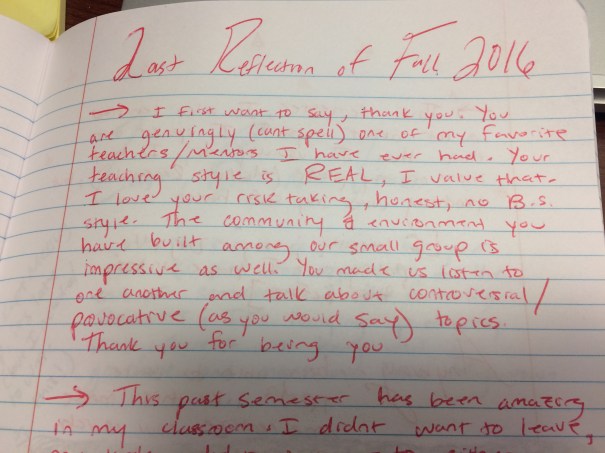
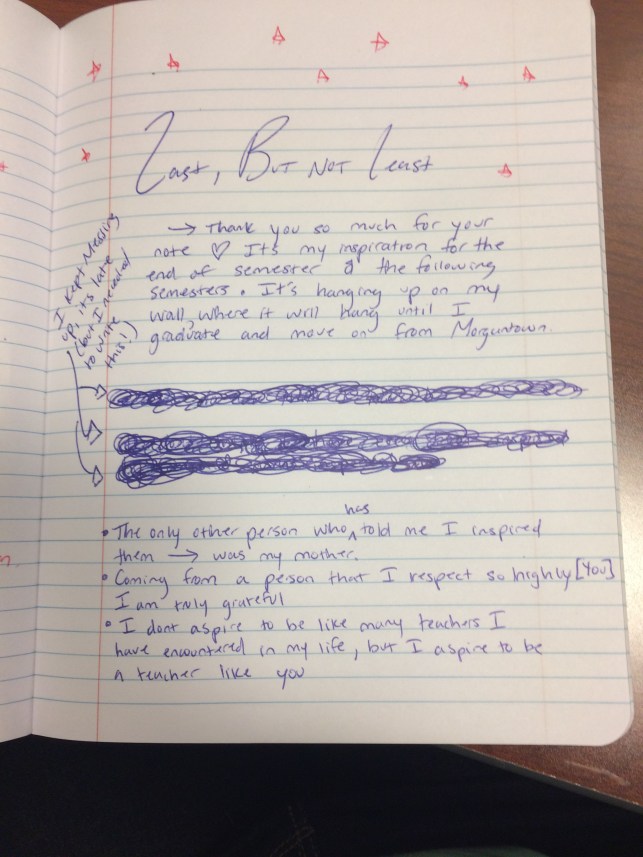
This note from a student in her writer’s notebook proves to me that all students, no matter their age–from kindergarteners to the 21-year-olds I teach–crave the time and attention and care and respect of their teachers.  We should keep that at the heart of our teaching, always.

img_6198-1

I know, like many of you, that I’ll be using winter break to rethink and re-vision my teaching for 2017.  I hope that we’ll all create goals and routines that keep workshop values at the core of our teaching–values of risk-taking, time for talk, revision, reflection, authenticity, dialogue, honesty, and all else that encourages our students’ growth in the most important of ways.

Happy Holidays and Happy New Year!  How will you be spending your time away from school?  Please share in the comments.

Writing When It’s Hard. Or School Should be Out Already.

Let me just say how cruel the school calendar is this year:  We have school through noon Wednesday. Kids are beyond crazy. Last Friday is typically the last school day before break, so it feels a bit like we are making up snow days for snow days that haven’t happened. It’s cold. And no one is going to want to be at school for the next three days. No one.

I’ve been toying with this post all morning. I don’t feel like writing. I just want to shop with my daughters who arrived in town over the weekend, and tend my five month old grandson who came to visit yesterday, and maybe bake some bread pudding in the crock pot. I do not want to write.

So what do I do to get myself to put words on the page? What do I do when I need students to want to put words on the page?

I look for inspiration. I help them find inspiration.

Lately, my students have been writing spoken word poems as arguments. They chose personal or social issues they care about, and they’ve crafted drafts that argue a position about their issues. Some are digging deep and writing with wondrous words. Others — not so much. But I’m not giving up.

I’ve learned that three things will help my writers when they sink low and cannot seem to rise back up. I must consistently —

Flood the room with beautiful language. In a spoken word poetry unit, this is easy. We watch a performance on YouTube most every day. “Spelling Father” by Marshall Davis-Jones is a new favorite. (I love the narrative frame and raw emotion in this piece.) If our goal is to help develop writers who intentionally craft meaning, we have to help students intentionally craft meaning. The more we recognize, analyze, and model the moves of writers, the easier writing with intention becomes.

Allow time for thinking. Waiting on students to think their way into writing can be hard. But I know that writing takes time, and when I rush students who haven’t had a chance to think about their ideas before they begin writing, the finished pieces rarely get the revision they need to be truly effective. Don Murray said, “Writing is self exposure.” It is. And the vulnerability can be immobilizing for some of us. Giving time and then waiting for students to make decisions about their writing pays off on the back end of the writing process. If we truly value student ideas, we have to give them the time to think of them.

Talk to students and keep them talking to one another. One-on-one conferences are a good idea any time, but during a writing unit, conferring time is essential. In large classes, we may have to stagger our live conferences with paper ones, and leave conferring questions, and “I wonders” on their pages. More than anything, students must know we are reading their drafts and offering feedback. I am working on getting faster at leaving quick notes. I find that when I zero in on one skill at a time students find my feedback a lot less intimidating (which is something I had to learn was even a thing.)

screen-shot-2016-12-18-at-10-36-53-pm

Martina’s writing her poem about her culture. “I’m too white to be called Mexican, but I’m a Mexican.”

My plan for this week is to put these three things on a replay loop. We’ll start class with beautiful language, think and write and write and think — all the while talking to one another about our process and our craft.

We may just make it to Christmas break a little bit merry after all.

If you are still in school this week, what’s happening in your classrooms? Please share in the comments.


Finding New Books: A Lesson from Rachel the Book Bandit

I have a lot of awesome students this year.

A LOT.

img_6200One of my preservice teachers is the hilarious Rachel, who, when she stopped by Allen Hall to turn in her writer’s notebook for the semester, was carrying a copy of Chimamanda Ngozi Adichie’s excellent book Americanah.
“Ooooh,” I said.  “That’s a great book.”

“It is, so far,” Rachel agreed.  “I’m only about 40 pages in.”

“Is it for one of your classes?” I asked.

Rachel laughed a little and said no.  “It’s on the African American Literature syllabus, though.”

Well, that was exciting to me for two reasons.  One was that the African American literature class was going beyond Ralph Ellison and Richard Wright and Zora Neale Hurston into the realms of contemporary.  And the other was that clearly, Rachel had been talking to others about books.

I love me some contagious book love!

“Do you have a friend taking the class?” I inquired.

imagesRachel looked sheepish.  “Well, you see,” she explained, “at the beginning of the semester I always go around to all the different English classes and just stay for the first class so I can get a copy of their syllabus.  Then I put all the titles in my Amazon cart and my mom sends me a few books every month!!”

She was gleeful, and I was giddy.  Rachel was…a book bandit!

“Wow,” I said, impressed.  “So you discover all kinds of new titles this way.”

“Yeah,” she agreed.  “I don’t have time to take every single English elective offered, but I need to know a lot of titles if I’m going to be a good English teacher.  So I do this instead.”

I was so impressed that Rachel had discovered, and independently read, award-winning literature this way.

And, I was even more impressed that Rachel knew that to be a successful teacher of readers, you have to know lots of titles so you can match the right kid to the right book at the right time.

Now that winter break is approaching, I’m looking for some new books to read.  So I took a cue from Rachel and discovered the following amazing titles on the syllabi (found through the online university bookstore) for various English courses at our university.

Popular American Culture, ENGL 258:

  1. Do Androids Dream of Electric Sheep? by Philip K. Dick
  2. Fledgling by Octavia Butler
  3. I am Legend by Richard Matheson
  4. The Walking Dead, Vol. 1: Days Gone By by Robert Kirkman

Sexual Diversity in Literature, ENGL 288:

  1. Rubyfruit Jungle by Rita Mae Brown
  2. Fun Home: A Family Tragicomic by Allison Bechdel

Fiction for Adolescents, ENGL 405:  (this one was a gold mine!!)

  1. The Book Thief by Markus Zusak
  2. Fallen Angels by Walter Dean Myers
  3. The Absolutely True Diary of a Part-Time Indian by Sherman Alexie
  4. The Crossover by Kwame Alexander [I bought this, read it one sitting, and cried in public while finishing it]
  5. Simon vs. the Homo Sapiens Agenda by Becky Albertalli
  6. Brown Girl Dreaming by Jacqueline Woodson
  7. Bone Gap by Laura Ruby
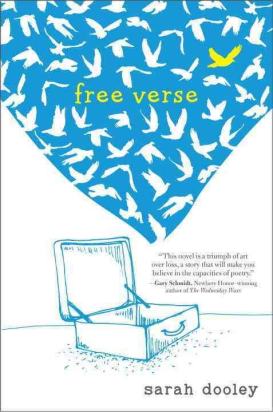
  8. Free Verse by Sarah Dooley [I bought this one ASAP; it’s set in a West Virginia coal mining town]
  9. We Are the Ants by Shaun David Hutchinson

Multiethnic American Literature, ENGL 255:

  1. The Namesake by Jhumpa Lahiri
  2. American Born Chinese by Gene Luen Yang
  3. Everything I Never Told You by Cynthia Ng
  4. Underground Railroad by Colson Whitehead
  5. Make Your Home Among Strangers by Jennine Capo Crucet

Thanks to Rachel for inspiring me with a way to find all of these great new titles!  I hope you’ll find some great new titles this way, too.  Please share them with us in the comments so we can all enjoy!

Appleman’s Lenses by Michael Janney

51rakay9iel-_sx396_bo1204203200_When I hear teachers underestimate their students, it really grates on me. Setting high expectations that aren’t always met doesn’t translate into failure on anyone’s part. It simply notes varying levels of understanding. With time and repeated exposure, all concepts and skills we want to teach can be worthwhile.

I had such a conversation a few years ago with a Ph.D. literature student who had spent some time as a high school English teacher. We were discussing the resource classic “Critical Encounters in High School English: Teaching Literary Theory to Adolescents” By Deborah Appleman. I said that I loved the idea, as I didn’t get much exposure to literary theory in high school — or college for that matter. She disagreed, arguing that “in high school, you’re just not ready for it,” and that literature instructional time would be better spent on close reading.

I still think students are ready for it. We live in a complicated world and teach in highly-politicized public school environments. High school students — and all of us — could take more time to view our surroundings through critical lenses.

Appleman says so herself:

“Literary theory is not intellectual cake for adolescent cake eaters — those who are privileged by social status and other factors to have significant educational advantages. Because many of the theories deal with issues of power, students on the margin, for particular reasons — ethnicity, class, ability — are often more receptive to the basic ideological premises of these theories than are their more privileged peers, who sometimes view theories such as those of gender and class as mechanisms for using the master’s tools to dismantle the master’s house.”

But how to introduce these critical lenses? Of course, students need a concrete definition of each lens as a start. They also need texts that strongly suggest analysis with each of Appleman’s chosen lenses.

Resources that lean toward direct instruction just won’t do either. The readers’/writers’ workshop centers itself around authenticity and treating each text you introduce to students as a work that can stand on its own. It isn’t about supplements, but about connections.

So, it’s got to be something short, familiar, and striking enough to make them remember the learning when they’re analyzing other texts later in their lives.

Cartoons!

Yes, Bugs Bunny, Tom & Jerry, Yogi Bear and all those other other goofy, googly-eyed weirdos; you get a small story that’s entertaining and rich with material to pick apart.

Here are my suggested cartoon pairings for Appleman’s lenses. Try one out when you need students to understand critical literary theory, and let me know how it goes!

Reader Response — “Steamboat Willie”

https://www.youtube.com/watch?v=BBgghnQF6E4

Begin with a classic! While “Steamboat Willie” wasn’t the first cartoon short ever, it’s the first with synchronized sound and it’s synonymous with Walt Disney. Simple in its form, it gives students a chance to offer their interpretation of the text — the essential element of reader response theory — as well as comment on the form of the cartoon short.

Race Theory — “Old Rockin’ Chair Tom”

https://www.youtube.com/watch?v=l6Hfk13LZIQ

This one’s a personal addition, because it isn’t in Appleman’s book, per se. It’s much needed, though, as many of the texts bureaucrats approve for schools lack diversity. This particular short features the recurring “Tom & Jerry” character Mammy Two Shoes, a classic example of the mammy archetype that shows how texts can perpetuate stereotypes and prevent us from recognizing the individual as part of diversity, and not a generic “other.”

Marxist Theory — “Hen House Henery”

https://www.youtube.com/watch?v=d84KcSDUz6M

Henery the Chicken Hawk and ultimate Southern gentleman Foghorn Leghorn battle over farm capital — the hens — in this short. Each character is confined to a particular role in the farm society, and Leghorn gets to use the knowledge afforded through his age and social status to succeed in keeping his and the farm’s wealth.

Gender/Feminism — “Mississippi Hare”

https://www.youtube.com/watch?v=nbQbz3couU4

In one of Bugs’ many gender-bending shorts, he poses as a Southern belle as a last resort to thwart his adversaries. Here, you might ask students why cross-dressing Bugs is taken so lightly as opposed to his true self? Cross dressing is a common gag in comedy, so this cartoon also opens up discussions as to why the act is so funny.

Postcolonialism — “Hiawatha’s Rabbit Hunt”

https://www.youtube.com/watch?v=17BHa_7kTbA

Bugs Bunny runs circles around the subject of the classic Longfellow poem. While the cartoon Hiawatha can be interpreted as a stand-in for Elmer Fudd, he also becomes the brunt of Bug’s antics. It can start a dialogue with students about how colonial powers can marginalize aborigines through cultural works after they’ve already conquered them politically, economically and socially.

Deconstruction — “Duck Amuck”

https://www.youtube.com/watch?v=TrE5fdigIpA

Daffy Duck is ready to star in a cartoon, but the cartoonist keeps changing the rules of the game on him. Bit by bit, the animator rips apart each part of the cartoon: scenery, setting, clothing, sound, etc. Daffy’s frustration grows each time the cartoonist makes a change, precisely because those changes are a contradiction to the Looney Tunes form and what fans have come to expect from his character. This is the essential pivot of deconstruction, and probably one of the most concrete — and hilarious — examples on the list. My personal favorite!

Try one or all of these cartoons as part of your next reading unit and let me know how it goes. You’ll be surprised what connections students can make with applicable examples of each literary theory.


Michael Janney, 9th grade English teacher, Yearbook advisor; Shepherdstown, WV
When I sit down to read a book or write, I’m not concerned about circling the nouns or verbs. I’m not concerned with labels or checklists; right or wrong. Instead I’m focused on purpose and aesthetic— authenticity. If we want our students to become authentic readers and writers, we have to offer them experiences in the classroom that transcend the artificial routines of school culture. These experiences must include choice, creativity and validation so students can realize their power as readers and writers in the grand conversation of English/Language Arts.
screen-shot-2016-11-29-at-7-46-57-am

2 Ways to Prioritize Student Talk in the Classroom

Workshop affords so many opportunities to explore with the students in front of me as opposed to present a set curriculum to whomever happens to be seated in my classroom. It’s teaching through interaction, and in this case, it’s teaching straight from the kids themselves.

We see it in workshop all the time. Students given the tools to explore the world as readers and writers, and encouraged through personalized learning, quite often take their learning to places our old lesson plan books didn’t always accommodate.

One of the best opportunities for this classroom growth is having students do more and more of the talking. With the right modeling and specific expectations around that student talk, the classroom becomes a place students lead through inquiry, as opposed to follow through completion of teacher set tasks.

discussion-2

Morgan quotes Judy Brady’s “I Want a Wife” to analyze how the repetition supports the sarcastic tone and proves the point that since they do SO much, everyone should want a wife. LOL!

It happened yesterday morning, in fact. My AP students were participating in small group graded discussions. Just reading the last sentence makes me cringe (yes we use a rubric, no, the conversations don’t have to be formulaic as a result), but with choice in which readings from our unit they wanted to discuss and some guiding questions throughout the discussion, our conversation about gender and the implications of historical stereotypes on a modern world (their direction for the discussion, not mine) took an interesting turn.

“Mrs. Dennis…you’re smiling weird. What did I say?”

I stop furiously typing comments and look up. “I’m sorry?”

“You had a look. Did I say something wrong?”

“Sarah, you said nothing wrong,” I smile and glance around the table. Seven intrigued faces look back at me. “In the last few minutes this group has, largely unprompted, connected several essays through the lens of analysis, used terminology we’ve not discussed since September, Trinity uttered the words, ‘I don’t believe gender pronouns are even really necessary anymore,’ and then supported her opinion with specific text evidence, and several of you actually just murmured sentiments of excitement to shift the discussion to Judy Brady’s satirical 1971 piece ‘I Want a Wife.’ I’m smiling because I was just thinking about how I used to give short answer reading comprehension quizzes on these pieces.”

“Oh,” said Sarah, “This is way better.”

Yup.  This was a discussion they wanted to have. This was a discussion I wanted to hear. They took the lead, in fact one of our rubric bands demands that, and they came to the

discussion

Part of a small group discussing racial stereotyping colliding with gender stereotyping in the Brent Staples piece “Just Walk On By”

discussion prepared to drive conversation from the perspectives of authors like Brent Staples, Deborah Tannen, John and Abigail Adams, and Judith Ortiz. Perspectives that regard gender through stereotype, race, satire, narrative, an exchange of letters almost 250 years ago, and visual texts.

Did I just sit back and let them talk, free-for-all style? No. This conversation took practice, feedback, and correction over the past few months. Today, it took redirection on some occasions and additionally it took specific intervention for those students reluctant to participate. Additionally, had it been a lower-level class, I would have been a bit more actively involved to start. But as you well know, students at any level are capable of, and actually far more likely, to get actively involved if their efforts for comprehension are supported and their exploration of the text is encouraged. We work specifically on ways to communicate both agreement and polite disagreement, so students can help clarify the text as well as analyze it.

Like any solid workshop component, it involves careful teacher planning and modeling, but equal parts careful student leading as we gradually release them to own their own education. 

We assess students on their preparation for the discussion with visible notes and use of specific text to support their points and their leadership within the group. That leadership can be exhibited through meaningfully involving others to bring them into the discussion with a question, synthesizing ideas they have heard so far, and/or including insights from additional research on a particular topic to extend discussion beyond the reading.

I spend a whole class period for discussions, breaking the class into groups of 7-10 students so all voices have more opportunity to be heard. Students not in the discussion have specific work to complete, sometimes by the end of the hour. For feedback, I type comments and insights while the students are speaking, so I can quickly copy/paste them into the comment section of my feedback form (A Google form emailed directly to students with 2 Common Core based rubric bands as dropdown tabs so I can just click the score for each band, include specific typed feedback, and often get that feedback out to kids the same day).

Another opportunity for seriously impactful student talk, is handing over the daily book talk to the class.

One of the many benefits of this scenario is that I can tap into growing student enthusiasm about books and have my kids spread the book love directly with each other. Don’t get me wrong, my book talks are something to behold. Part forensics piece, part reader’s theater, and part screentest for the literary loony bin, I sell books much like I would envision the traveling vacuum salesmen of yore putting food on the table with a pitch of salvation not just for the home, but the soul. It’s not just going to clean your carpets, it’s going to change you life, Ma’am. Your life. 

But, let’s be real. Though I sprinkle my classroom with good will, good cheer, and good books, I’m not the best salesperson in the room. If you’re going to sell the vacuum with radial root cyclone technology (I Googled that), or the book with 389 scary looking pages on dystopian fantasy rooted in a chromed society, you need to know your audience. You need to relate to your audience. You need to be one with your audience.

There are plenty of reasons to get kids doing your book book talks, not the least of which is I can’t read fast enough these days to keep up with the need for the type of really passionate and informed book talks that come from having read the whole text (Books do sell themselves sometimes, just by reading the back cover and a page or two at the start, but I love to hook kids with a section from the middle to show the impact of the rising action or depth of character development).

book-talk

Priyanka book talking Stitches, a graphic novel by David Small, under the document camera.

  • Students trust one another’s opinions. Yes, often more than mine. I sell hard, but at the end of the day, I’m usually still the biggest book nerd in the room, and therefore I think I am occasionally regarded in much the same way  as the Dancing Grannies in a holiday parade: Enthusiastically adorkable, but a bit of an anomaly to be trusted only at a distance.
  • They find titles, authors, and series that aren’t yet on my radar. Despite my best efforts, I can’t read fast enough or comb enough best of lists to meet the recommendation needs of over 120 kids. But when the classroom experiences a new student perspective on reading each class, additional book talks at their tables after reading, speed dating with books,  and an invitation to help grow our classroom library with tax free, gluten free, guilt free donations of gently used books, everyone wins and the depth of our classroom repertoire grows.
  • Their enthusiasm is relatable and often focused on books that don’t speak to my own bibliophilic tendencies, but can ignite the reading sensibilities of their adolescent peers. For example, I took several YA Lit books home at the start of last summer. Two days in, I was already struggling with the voice. It grated on me (no offense scholars) after hearing it all day in person for 180 days. So when a student book talks The New Guy (and Other Senior Year Distractions) by Amy Spalding, and two sophomores in my class (who have struggled to meet reading goals week after week) add it to their “I Want to Read List”s, that’s another win, because we can’t push kids to deepen their reading if they aren’t reading. First hook them, then book them with more challenging pieces.
  • I offer up the option to produce their book talks digitally and for some students, this is what makes the entire experience meaningful. Students sell their books through book trailers, compilations of related imagery and voice over to meet the same requirements of a live book talk. I’ve had kids include clips of author interviews, live action fight scenes with voiced over dialogue directly from the text, and this year, I have a student who wants to read over the top of a mannequin challenge he plans to shoot to represent some of the major action in the text.

What results is growing book lists, renewed enthusiasm as students go back to books they’ve read and revisit their love for the text, and involving each and every single student as a valued reader in our classroom community.

We’d love to hear from you! What tips and tricks for student talk make their way into your daily workshop practice? Please comment below! 

How I Made the Move to Workshop: 10 Key Steps

Like many teachers, I established a very traditional classroom when I began my career.  I taught whole-class novels, gave multiple choice tests, and assigned long essays that I thought were full of academic rigor.

After struggling to engage kids, battling behavior issues, and watching kids grow to hate reading, I realized:  none of what I was doing was authentic, and much of it was not research based.

I didn’t even know why I was teaching the way that I was teaching.

Of course, in hindsight, I know I was doing what I’d seen modeled:  years of traditional schooling, a 4×4 model, and strict assessment modes.  It was all I’d experienced, and despite learning about more authentic workshop methods in my education program, I didn’t know how to put those in place because I’d never seen them.

But I decided I didn’t care that I had no idea what I was doing…I was tired of seeing kids unhappy, and being unhappy as a teacher myself.  So, slowly, I made the move to workshop.

I’ve been inspired lately by one of our readers, who comments under the handle ML.  “I’m so ready to try workshop,” ML wrote several weeks ago.  I suspect ML was feeling the same fatigue that I was while running a traditional classroom.

Then, ML wrote, “Ok, I’m in!” last Friday on Jessica’s post.  I can’t wait to hear how the move goes, and as I wondered, it got me thinking about my own journey to a workshop classroom.  Apparently, ’tis the season for this kind of large-scale reflective thinking, as I wrote a post about a year ago about what teachers need in order to feel sustained.

But now I’m thinking about what teachers need to make the move to workshop, and how we might take these steps.  Here are the ones I took.

imgresThe first change I made was offering choice.  Keeping the anchor texts and assignments I’d been using in place, I began to offer some choice in assessments.  On essay tests, I gave several options for prompts.  For projects, I created many different possible products.
Next, I began to offer some choice in reading and writing.  I added Free-Write Friday to our daily notebook writing routines, and increased time to do independent reading in class from once per week to every day.  I slowly started to grow my classroom library, too.

Over the course of a year, I gradually stopped making so many of the choices in my classroom and started offering them to students instead.

In terms of reading, we read fewer books as a class, and when we did read a work together, students guided the discussion, and assessments became more authentic and choice-based.  I began to notice that students were much more successful with their reading when our fabulous librarian, Lara Walker, recommended specific titles to kids during our biweekly library visits.  So, I added booktalks to our routine; first weekly, then daily.

My reading life began to change when I started to give booktalks.  I realized that I was quickly running out of titles that I knew would hook kids, so I took a two-pronged approach to fixing that issue:  first, I began to read much more widely.  Second, I redoubled my efforts to grow my library so that it filled up with titles kids would actually read.

Autonomy in reading spread to other areas of my curriculum quickly.  Kids felt emboldened to offer opinions on whole-class texts, so we moved to a more dialogic mode of learning rather than a traditional autocratic one.  I stopped giving tests in the traditional sense, abandoning multiple-choice questions and regurgitation-type essays.  I wanted kids to have some wiggle room in their writing just as they had in their reading.

I knew how to teach a thesis statement or a critical lens, but I’d never had a class on how to teach kids to WRITE commentary or satire or poetry–only how to read them.  In studying those genres to figure out how to teach them, I realized that I was doing exactly what my students needed to do: read like writers.  They began to read not only sample written products like writers, but also the books they were enjoying as well.  Mentor texts came from everywhere, with my students beginning to shoulder more of the cognitive load of finding and analyzing pieces of writing.

Many of my colleagues turned up their noses at my approach, wondering how I knew if my students were reading and writing if I wasn’t reading the same book they were or giving a test or a paper over it.  I argued that teaching was both art and craft, and that I just knew my kids were succeeding:  I talked to them, didn’t I?  I watched them read, I heard them bemoan twist endings with friends, I read their revision-riddled notebooks.

I had mountains of data that weren’t tests.

As all of this happened, my students grew as readers and writers, and we grew closer as teacher and students.  I cultivated friendships with my kids and took on an identity not just as a teacher, but as an usher toward a love of reading and writing.

Love, some colleagues said.  Fun.  Phooey!

But, as the brilliant Pam Allyn said:  love leads to practice, which leads to fluency, which leads to stamina, which leads to mastery.  You can’t do a thing well if you don’t love it.

img_0480

A good representation of my workshop classroom

My traditional classroom faded away.  Rows were replaced by table groups, textbooks were replaced by a huge classroom library, and mountains of essays to grade were replaced by a tower of teetering writer’s notebooks.

I made the move to workshop organically, almost on my own, but aided by the brilliance of classes from the National Writing Project, the University of New Hampshire Literacy Institutes, and the work of many teacher-writers:  Penny Kittle, Tom Romano, Kelly Gallagher, Donalyn Miller, Tom Newkirk, and countless others.  They reaffirmed that the moves I was making were the ones that were best for kids.

In sum, here’s how I made the move to workshop:

  1. Offering choice, slowly at first.
  2. Increasing our use of the writer’s notebook as a space for ungraded, low-stakes writing.
  3. Making time for independent reading every day.
  4. Giving booktalks every day.
  5. Growing my classroom library and my own reading repertoire.
  6. Learning to read like writers and study mentor texts.
  7. Shifting the cognitive load of curricular choice from me to my students.
  8. Valuing talk as an assessment, instructional, and practice tool.
  9. Keeping records and compiling data that were valuable and authentic.
  10. Reading lots of blogs and books and journals and articles that helped me add research-based practices to my pedagogy.

I hope ML will keep commenting and let us know how the move to workshop is going.  In the meantime, can you share with us the story of your move to workshop?  Please tell us in the comments!