Tag Archives: Readers Writers Workshop

Workshopping Yourself

ocsIf I ever write a book about teaching, I will write about the importance of being yourself in your classroom.  For some reason, I used to believe that it was not appropriate to be the real me as a teacher–maybe it was because I was fresh out of college, inspired by professors’ styles that were so very different from my own, or maybe it was because I was so young when I began–just 20 years old–that I felt I should try to put some distance between myself and my students.

Over the years, I’ve dropped the stern, strict, distant persona I tried initially to teach behind…and have just been myself.  I embrace my nerdiness, I’m loud all the time, I never stop smiling, and I don’t try to hide my enthusiasm for what I love (coffee, cats, my husband).  I’ve subscribed to the philosophy that I’m not just modeling reading strategies or writing processes for my students–I’m modeling a life philosophy too, of being oneself.  I have, essentially, workshopped myself…revising, paring down, adding in, and determining what to let alone in order to become the best possible version of Teacher Me.

Still, what I’m beginning to realize is that no matter what lesson plans I write down, what stories I choose to tell from my anecdotal arsenal, or even what clothes I put on in the morning, I’ll never have full control of how my students see me.  We never perceive ourselves the way our students perceive us…we never can.  I’m sure if I perused one of my old literary theory textbooks I could find a name for this phenomenon…but for now, we’ll just say that our students see right through us.  Right through the masks we wear when we’re having a bad day, through the halfhearted energy we try to muster if we’re ill, or through the moment’s hesitation it takes us to consider a diplomatic response to a particularly strange question or comment.  They see right through our sometimes-staged actions to our true beliefs, our values, and our feelings.  They see the real us, which is why I shake my head now at what a fake they must have thought I was during my first year of teaching.

Thanks to the fact that my students (current and former) write me lots of notes, I’ve gotten to do a little bit of research on exactly what they see.

IMG_1434

One thing that they all know is that I spend a lot of time reading and writing.  One student left me a note saying that she hoped I had a good weekend reading since I don’t own a TV.  Another student wrote in an exam response that he was shocked to see me at the gym on a Saturday night, “getting swole,” since he assumed teaching was my “entire life.”  Another student wrote that sometimes when he read books, the voice in his head was “a letdown” because it wasn’t as excited as mine when I read a passage for booktalks.

One of my most excitable learners, a foreign exchange student from Brazil, gave me a goodbye note on her last day of class.  It was a simple list of things she was thankful for, and its straightforwardness couldn’t have been more tearjerking.  She said “thank you” for…

  • being crazy for books
  • being patient about my questions
  • lending me books
  • being happy every day
  • accepting me with open arms
  • being honest
  • saying the things you say
  • being my teacher

There is nothing on that list, or in any of those notes, about becoming a better reader or writer–nothing there about increasing knowledge of domain-specific vocabulary, or learning how to make a strong claim and support it with evidence, or analyzing the development of a theme throughout an extended work.  And yet…that list, and those notes, made me feel like an amazing teacher.

The things our students take away from our classes don’t always have to do with what we write in our lesson plans. Sometimes they do, yes–but so often, the things we teach are so far outside of our content standards that we don’t even know how to name them…when we talk about modeling, we can’t forget that we are also ROLE models…thinking models, reading models, relationship models, fitness models, etc.  Our students absorb the lessons of these models incredibly quickly.  We are influential in ways that we may never intend to be.

In a recent letter from a former student, the following words brought tears to my eyes: “I really do appreciate your kind words and wise ones. If it’s not evident already, your one year in my life has taken the effect of many.”

I don’t know what exactly the effect I have had on that student is, or will be (which is a little bit terrifying, to be honest).  What I do know is that I’m thankful for the chance to affect kids every day in my classroom, and I think the workshop model is an excellent way to do that.  There are so many opportunities for meaningful dialogue in this structure, both between student and teacher and in small or large groups of learners.  As workshop participants, students AND teachers get to be themselves, and get to discover more about themselves (and each other) through talk about reading and writing.  There’s no pressure to conform–the whole POINT is to be yourself and do your own thing, and that right there is more than enough to motivate me to do the outside work the workshop requires.  So, I’ll wrap up this post–and get to the two-foot stack of grading next to me–by leaving you with the wise words of the always-original Oscar Wilde:

by

Finding Success in Hell

Guest Post by Jackie Catcher

flames“Ms. Catcher, do you have Inferno?”

Inferno?” I asked.  I looked up at Sean*, a skinny freshman with small gages in his ears and a bleached blonde buzz cut.  His punk skater image matched the rebellious reputation of the book he had recently finished: The Perks of Being a Wallflower.  This was the first time he had come to me with a book request for his independent reading.

“Yeah, you know that book about hell.”  I couldn’t help but chuckle—when Sean came into my classroom he associated books with being in hell, now he wanted a book on hell.

“Um, yeah, let me find it.  Dante’s Inferno?” I repeated again.  I tried to mask my surprise but could hear my voice crack with the title.

“Yeah, that one,” he said straight-faced.  The image of my tired college English professor popped into my head; the threadbare sports jacket he wore as he droned on about Inferno; I remember feeling like he single-handedly had pulled me through all nine circles of hell.

Sean owned the video game adaptation of the book, which had sparked his interest.  I handed him a copy, warning, “This is a hard read.  Even if you get through part of it, that will be impressive!  I read this in college.”  I felt the need to somehow soothe his frustrations even before he started.

“Ok.” He brushed off my warnings.

Every day I watched Sean crack open Inferno and slowly make his way through the convoluted English translation.  And every day I expected Sean to walk into my classroom and abandon the book.  But he didn’t.

“How much does he really understand though?” asked another teacher after I brought up Sean’s accomplishments.  She made a good point.  Not only was Sean in my academic class, the lowest level in my tracked high school, he had also scored partially proficient in reading on the New Hampshire state standardized tests over the past two years.  Even if Sean didn’t understand the book in its entirety, I believe he gained just as much as any freshman English major dissecting the poem.

Sean might not have delved into the intricacies of the epic poem, but he took away a sense of confidence and pride that can only accompany struggle.  Many students lack the reading stamina Sean exhibited, an essential skill for success in post-secondary schooling.  Students can be quick to abandon books, and I have found that it isn’t until students become more developed, advanced readers that they understand the value of pushing beyond the first ten or even one hundred pages of a book to get to the “good stuff.”  Despite Sean’s distaste for reading prior to this year, his hunger for a challenge paired with the independent reading initiative allowed Sean to build his stamina and prove himself as a reader.  As Sean said, “I kept telling myself it’s just a book.  You can keep reading.”  Reading Inferno stemmed from his curiosity and transformed into an undertaking of pride.

Sean’s experience with Inferno didn’t include deep literary analysis and his takeaway would most likely make my stuffy college professor cringe, but I’d argue that Sean learned the lesson Dante intended: perseverance and hard work lead to significant achievements.


*The name has been changed to protect the identity of the student

 Jacqueline Catcher is a first year teacher at Exeter High School in Exeter, New Hampshire. She teaches Academic and College Preparatory Freshman English and an upper level elective writing course using the workshop model.  She can be reached at jcatcher@sau16.org.

Not the Same Old AP Writing Teacher

ocsWriting takes time. I imagine most English teachers know this. However, I am not sure most English teachers allow students enough time to produce their best work.

I speak from experience. You might be able to relate.

Traditionally, I would give students a writing assignment. We’d pre-write a day, sometimes two. We’d draft a day, sometimes two. We’d revise (or I’d hope they’d revise) maybe a day–or none at all, depending on the student. We’d publish our work and turn it in for a grade.

Oh, how incredibly dull . . .and ineffective. No wonder so many students hated writing.

This year we do writing differently. We are writing a lot more like real writers.

We start with reading. We read an engaging and complex mentor text. The author becomes our writing coach for as long as we are working on the assignment. The piece my students are writing now is a feature article modeled after the work of John Branch in Snowfall:Avalanche at Tunnel Creek, which recently won a Pulitzer Prize. We read the first four pages or so together, stopping to talk about the many devices Branch uses to craft the introduction to this piece. We discussed the rhetorical appeals and how Branch uses them to build credibility and create emotion. Students were mesmerized by the narrative. It’s a lovely day in my teaching life when every sentence in a text has something worthy of taking note–I had to stop myself in Snowfall. Too much talk, and we lose the rhythm of the article.

After we read, my students and I looked at the embedded photos with the captions and watch a couple of the videos. We discussed why the author included these in the piece where and how he did. I then told students that they would be creating their own article, and John Branch just became their writing coach.

Students chose topics after a lot of class discussion and responses to my probing questions in their writing notebooks.

  • If you didn’t have to go to school, or work, or any other responsibility, what would you do with your time?
  • If you could have dinner with three famous people, past or present, who would you invite to dine?
  • If you could travel in time, what era would you want to return to?
  • Where to you see yourself in five years?
  • What do you want your life to be like in 10 years?
  • What is something you have always wondered about?

Students chose some interesting topics:  One young woman is writing about building schools in Mexico, another is writing about neurobiology, and another is writing about hiking across Europe. A young man is writing about what life was like during Jesus’ time, another is writing about game design, and another is writing about becoming a pastry chef.

Initially, I had students jot their topics on a sticky note, so I could see if what they had chosen was “doable.” (We all know those students who choose topics that are so broad, and perhaps the students’  skills are so immature, that there is no way they will ever be able to write anything interesting.) I wrote some quick feedback, pretty much either “Run with it,” or “Wait! narrow this down,” and most students were ready to write.

Then I had this idea that I’d been playing with in some consulting I’ve conducted with North Star of TX madewithOver-2Writing Project. It’s a working structure to get students thinking. And if I teach it right, students will learn four different modes of writing in one go:  definition, narrative, examples, and argument.

I wrote my own working piece, and my students and I read it together. Then I asked them for suggestions on where I could improve and where I could add research. You can see my working document here: Authenticity.

Students then began crafting their own four paragraphs. This ended up being the final summative assessment for fall semester due to the deaths in my family and my many absences. Turned out to be a pretty good resting place.

When we return to class next week, these are our next steps:

First, we will return to Snowfall and read and discuss the piece in more detail. You know, to get us back in the reading and writing groove after our two weeks break.

Then, we will project a few student work samples on the board and talk through them the same way that students did with mine, offering suggestions on improvement and where research may work to advance the meaning. Every student who wants whole class help will have the chance to ask for it. Others might choose to just get help from their small writing groups. Either is fine, as long as all students share their work and get feedback.

Eventually, we will work on revising our structure, moving around paragraphs, and making our writing follow Branch’s award-winning article. Of course, I will pull sentences to study and conduct other mini-lessons all throughout our writing process. And I will confer with students regularly. We will add photos and videos (hopefully originals), and we will polish and polish and polish before we publish.

For the first time ever, I am in no hurry. I will not allow our time to be regulated by grading periods– well, until the very last one at the end of the year.

We will write.

We will revise.

We will confer and share and grow as writers.

And eventually, we will publish.

And celebrate.

I’d love to know how or what you have changed as a writing teacher. Please share.

Make Your New Year Revolutionary

It’s the end of New Year’s Day, and I am pondering resolutions. I should have probably already made some, but the end of 2013 took over my heart, and I am a little behind.

My husband’s grandmother passed away two days before my sweet mother. We attended two funerals in one weekend. Since we had to travel and plan services, I took the last seven days of the semester off, which means I missed reviews and final exams and calculating semester grades. I have a lot to do. And I’m having a hard time feeling like doing it.

But I will. And as I’m thinking about my resolutions I know I need to help my students set some, too.

So many need to read more, write more, do more. And I only have one more semester to help them learn.

So I am going to slow down, be more purposeful in my conversations with students, take more time for allowing them to talk, express, emote.

I am going to extend writing time, allow more hours to create and polish and publish–instead of rushing to meet the end of a grading period like I always seem to do.

I am going to keep filling my award-winning-books-only bookshelf and challenge advanced students to take on more advanced texts.

And finally, I am going to use Twitter more in the classroom: share links to student blog posts, reviews on Goodreads, book suggestions, author tags, and more. Try to model the sharing I do with my own PNL. Twitter made a huge difference in my class two years ago, but I haven’t taken the time to get it set up and going well in class this year. I need to change that.( I’m thinking about Instagram, too, but I’m still mulling around how to use it to promote more reading.)

On Monday I got two messages about resolutions from two of my daughters. Jenna said, “church was all about resolutions. They kept just calling them goals, but I always think a resolution should have a stubbornness to stop something or do something. You know, when people say things, resolutely? There’ something with staying power there. So, yeah, I’ve made some resolute goals for the New Year.”

And Kelly said, “I hope you all are making some New Year’s REVOLUTIONS! Not resolutions because that is lame…And revolutions are big. Make it a year to remember with me!

Next Tuesday my students and I will be back in the classroom. We will talk about being more resolute in revolution readour learning, more intentional as we learn together this spring. We’ll set some new goals.

And if I can figure out how to get students to do all this grading (the one thing that bugs me the most about teaching), well, that will be truly revolutionary.

Happy New Year, friends.

What are your New Year’s Revolutions?

Reel Reading for Real Readers: Bruiser by Neal Shusterman

ReelReading2My students have asked for this one, but I didn’t have it on my shelves. Thankfully, Bruiser is a book I got in my box at the ALAN conference. this book jumped to the top of my TBR pile, and I read it the day I got home from Boston.

I love it when a book makes me want to be a better person. Bruiser did that for me. I am not sure this book trailer does the book justice, but I especially like how the students who made it made the opening look like a real movie trailer.

This is a book that’s going to have a waiting list.


AP English: Improving Our Rhetorical Analysis One Quickwrite at a Time

I’ve mentioned that I am working on finding a way to be more efficient in my writing workshop. I want to expose students to beautifully written language that we can study together, and maybe learn a little grammar, but I also want to use these pieces of text for quick writes. I know that the content (or at least my questioning) has to be compelling enough that students will have something that makes their fingers itch to pick up their pens.

When I read I find myself dog-earing pages and book-marking passages that have been crafted with many rhetorical devices and/or literary elements. By helping students recognize how these strategies, used deliberately by the authors, create meaning, my students’ rhetorical analysis timed writings are scoring higher than they have at this point of the semester in years past.

I love it when my ideas work.

This is the passage we will read and respond to this week:

From An Invisible Thread by Laura Schroff and Alex Tresniowski p4

And so, when Maurice spoke to me, I just kept going. Another thing to remember is that this was New York in the 1980s, a time when vagrants and panhandlers were as common a sight in the city as kids on bikes or moms with strollers. The nation was enjoying an economic boom, and on Wall Street new millionaires were minted every day. But the flip side was a widening gap between the rich and the poor, and nowhere was this more evident than on the streets of New York City. Whatever wealth was supposed to trickle down to the middle class did not come close to reaching the city’s poorest, most desperate people, and for many of them the only recourse was living on the streets. After a while you got used to the sight of them–hard, gaunt men and sad, haunted women, wearing rags, camped on corners, sleeping on grates, asking for change. It is tough to imagine anyone could see them and not feel deeply moved by their plight. Yet they were just so prevalent that most people made an almost subconscious decision to simply look the other way–to, basically, ignore them. The problem seemed so vast, so endemic, that stopping to help a single panhandler could feel all but pointless. And so we swept past them every day, great waves of us going on with our lives and accepting that there was nothing we could really do to help.
Write about a time when you encountered a homeless person or a beggar. How did you feel? What did you do?

I am still working on the questions. Sometimes I think it’s best to say, “Just respond.” Other times I think students need more direction.

What do you think?

Christmas Miracles

ocs

December has traditionally been my least favorite month of the school year.  Something about it bogged me down, without fail, every winter–the dark, sunless days…the mountains of papers to grade…the looming specter of exams–to write, administer, and grade.  I hated my job in December.  From old journals, I know that I was consistently unhappy in the twelfth month of the year, and I wanted to quit teaching every time it rolled around.

This December, though, things couldn’t be more different.  I am LOVING my job!!  Last week, I found myself completely caught up on grading–something that literally hasn’t happened yet this school year.  Somehow, I had plenty of time to plan great lessons, confer with students with no back-of-the-brain worries, AND reorganize my classroom library.  I was a productivity machine–and it didn’t stop at school.  At home, I found the energy to assemble Christmas cards, decorate my apartment, and make some holiday crafts.  As I type this, my fingers are still sticky with powdered sugar from the big batch of cookies I baked this morning.  What’s with the freakish perfection, you ask?  One little, made-up, three-week-old, hashtag of a word:  #nerdlution.

nerdlution-button-tiny-01

Teachers across the country made nerdy resolutions that would be kept for 50 days.  They could be anything–write every day, exercise, a more robust reading life.  A Thanksgiving day Twitter chat gave rise to that wonderful idea, which I hope will become an annual tradition.  Still riding my NCTE13 high, I resolved (nerdsolved? nerdluted?) to spread professional ideas about English teaching any way that I could, every day.

IMG_1036I started by leading an epic two-hour workshop for my English department.  We book-passed (a la Penny Kittle) the entire contents of my professional library, shared best practices in a “gift exchange” of ideas, and made our own heart books (a la Linda Rief) of things we wanted to try.  Afterward, Kristine, a 20-year veteran with a reputation for pessimism, approached me.  “I used to have your energy,” she said.  “I don’t know what happened, but I haven’t had it…for years.”  She teared up, then borrowed Blending Genre, Altering Voice by Tom Romano, a balm for her troubled teaching soul.  Other books from my NCTE haul were checked out, too–Georgia Heard’s brand new Finding the Heart of Nonfiction was battled over by two first-year teachers, Penny Kittle’s incredibly dog-eared and highlighted Book Love and Write Beside Them were taken by veterans, and Tom Newkirk’s well-loved Holding On To Good Ideas in a Time of Bad Ones was checked out by our department head, who has held his position since 1972 (I’ll let you do the math on that one).

I was elated, and my colleagues’ willingness to try new ideas didn’t stop there.  The next day, a friend came and talked through some ideas about having her students do mini multigenre projects on Greek gods.  Enthused, I told her I couldn’t wait to see the results.  The following morning, Kristine, the tired veteran who’d borrowed Tom Romano’s book, stopped me in the hall.  “I came to school every day this week with a new attitude.  I feel the spark again,” she told me.  I nearly cried after we went our separate ways.

IMG_1313The following week, it all seemed to be coming together–our entire English department was on board for trying something new, especially the workshop model.  They wanted to see it in action.  In five days, I was observed eight times by fellow teachers, and they saw my students doing amazing things.  With heads down and pens on paper, their extended narratives were growing to eight…twelve…twenty-six pages long.  They were BEAUTIFULLY written, and on an incredible variety of topics–hunting, car crashes, detectives, breakups, death.  One male student wrote a narrative about rape from a woman’s point of view after hearing me booktalk Speak.

IMG_1314As my colleagues listened in, my students conferred with me about their writing like the confident, thoughtful, reflective authors they are:  “I want it to read like a Rick Riordan story,” Kenneth told me.  “Do you think the pace is too slow?” Nora asked.  “I just need to zoom in a little more on this,” Tevin realized.  “I’ve resorted to writing in my vocab section because the rest of my notebook is full,” Adam admitted with a giggle.  I ended every class with a smile and a feeling of pride threatening to burst out of my chest.  My colleagues were stupefied.  “How are you getting them to read so much?  To write so much?  To work on this stuff in study halls and for homework?”  They were flabbergasted, but all I had to do was point them toward that professional bookshelf, full to bursting (but with more and more empty spaces!!) with the brainchildren of so many of my teaching heroes.

So, my #nerdlution, as well as this little workshop experiment that Emily, Erika, Amy, and I have been trying out, is going beautifully.  The two are combining to bring me the most peace I’ve felt during the holiday hustle and bustle in a long time–and that, for me, is a Christmas miracle.

Excuses: Why I can’t write

no-excusesAfter carefully reading and agreeing to the terms & conditions of wordpress.com, this blog was officially birthed in a tiny hotel room on January 21, 2010 at the annual TCTELA conference. In that time, and really over the last two years, there have been close to 20,000 views of the blog, 10 guest bloggers, and 200 posts.

I account for less than 20% of those posts.

Since August, we have stepped up our blogging efforts and generally are posting consistently four times a week. Four posts a week for 4 months is approximately 64 posts.

I account for 5 of those.

Some may be starting to think, “Gee, Heather, you aren’t pulling your weight around here! Amy should kick you off, or at least ground you until you write some more blog posts.” But before Amy goes and punishes me, I have several reasons, really good reasons I might add, as to why I haven’t been blogging.

1. The Dog Ate My Homework – Ok, I don’t have a dog, but the last several weeks have been littered with catastrophes. From packing up an entire house and moving to a new one, a husband with a chronic tooth ache (heaven forbid he go to the dentist), and me dislocating my kneecap when I fell walking across the street, it seems like there is always something that is getting in the way of my writing.

2. I Don’t Have Time – This year it seems like everybody needs my time. Between family, church, work, friends, my alone time, etc. there simply isn’t enough hours in the day to get it all done.

3. I Have Nothing To Say – I took a new job this year, and it just seems like every time I do sit down to write I have nothing to say. My perspective has changed. I look back on my teaching experience and think it was so much easier to write when I was in the classroom, would try something out, and then reflect on it through my writing.

4. My Writing Isn’t Good Enough – This is probably reason enough to go to counseling and certainly a blog post for another day, but every time I go to type a single word or even get so far as to press the PUBLISH button, I have a voice inside my head (my seventh grade English teacher’s voice actually) saying that not only is my writing not good enough, I’m not good enough.

It is actually quite funny. Knowing I was supposed to post today, I texted Amy last night and joked with her about what my excuse might be for why I wouldn’t get a post done today. Forget the fact that in Texas we have been iced in for the last four days, and I have had more than ample time to get something posted. It made me start to think:

What about the learners that sit before you everyday in your classroom? 

What are their excuses for not writing?

It is easy to look at the monumental amount of standards that have to be covered in a given year, and then start assigning essay after essay after essay. Between the demands pushed down a campus and the looming state test, educators quickly turn from teaching the art of writing to merely assigning writing.

Again, what about your learners? When might they have some of the same excuses I have? If we as educators overlook the excuses of our learners, or maybe even blame them for these excuses, I venture to say we are not really doing everything we can to create a classroom of writers. At the heart of everything we do, we must first look at it through the lenses of the learners that sit before us and carefully craft experiences where they can feel safe enough to not have to make excuses. As educators it is not only our responsibility to teach standards, it is also our responsibility to help break down barriers that hold a student back from learning and being successful.

As an adult, I have to break down my own barriers and excuses. Not having time and having things come up are universal excuses that could be given for anything in life. You have to make time to have time, right? Feelings of inadequacy aren’t always just about writing for me. Truth is though, when you look at the facts my top two posts had over 500 readers each! Now, why would I ever think no one wants to read what I write?  And the excuse about how my perspective has changed, I still have a story to tell and should be brave enough to share that story.  

What are your excuses for not writing? How might a reflection of your own excuses help you to guide learners to break down their excuses?

Reel Reading for Real Readers: Meta Maus

ReelReading2The book Maus by Art Spiegelman made me a believer in graphic novels. Maus II was just as influential.

One year I applied for a grant and got the funds to create a whole set of various war-themed graphic novels for literature circles in a gifted/talented humanities class. I no longer teach that class, but my friend Tess does, and she’s the owner of that box of beautifully written and illustrated graphic novels. I remember the first year we used them, our student Claudia said, “I got a question right on the AP World History exam because of something I read in the book about Gaza.” I had no idea at the time that graphic novels could be so powerful and so important. Now a few years later, I have a small collection that a few students eventually work themselves into.

This is a trailer for Maus completed by some students (not my own) using DSI Flipnote Studio. It’s cool, and now I want to download the software. The trailer is well done, too.

He read ZERO books before he came to me. Not Good Enough.

He came to me pretty much hating to read. This tall freshman, eager to talk and laugh, and constantly wanting to do anything else but open a book. He admitted that he read zero books his 8th grade year.

The first book I got him to attempt was Game, a chapter book of about 160 pages that took him four weeks to get through. Every day I had to put a hand on his shoulder and whisper “Get to reading.” Next, he tried Gym Candy, and while he seemed to read it faster, he couldn’t tell me much about the plot or the characters.

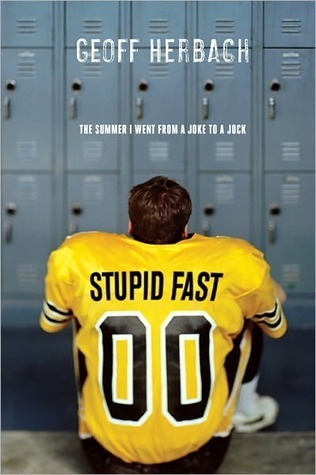
Finally, with a stroke of luck, this young man picked up Stupid Fast by Geoff Herbach. I had book talked it a week or so before, reading the first few pages to the class. At the time, R.J. wasn’t interested. When I saw him with this book, I hurried over and practically begged him to give it a try. “Okay,” he shrugged and moved away from the bookshelf toward his table.
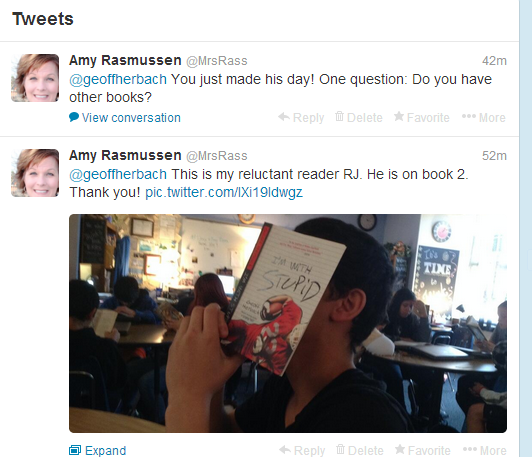
Every day for two weeks, R.J. came to class and told me how much he had read. “I like this book,” he smiled at me more than once. He finished this book in two and a half weeks, and then took himself to the bookshelf to find I’m with Stupid. (At the time, we thought this was the next in the series.)

When I finally made it over to kneel by R. J.’s table and conference with him about his reading, he told me that the beginning was hard to read because the main character’s family was “weird,” but he really liked the parts about football. We talked about character development and how the main character Felton changes throughout the book. “He grows up,” R.J. notices. I asked him what kinds of questions he would ask the author if he had the chance, and then I remembered:  I follow this author on Twitter.

“Hey, R.J., let’s take a picture of you reading this book and tweet it to the author. I bet he’ll respond.”

“No way…. Oh, okay.”

So we did.

RJ tweets to author

RJ tweets to author responses


R.J. left class that day feeling pretty special. He will finish his fourth book this week. His personal reading goal for the whole year was only FIVE.

Now, here’s the really cool thing:  While wondering the exhibition hall at NCTE in Boston, I struck up a conversation with the representatives from Sourcebooks Publishers. They asked if I knew of the books by Geoff Herbach, and, of course, I had to tell them about R.J. Then one of those very sweet insightful women reached under the table and handed me this:

Fat Boy cover

She understands the value of nurturing readers. She’s helped me make a difference in the life of this young man. I wish I could describe the yelp I got when I told R.J. he’d been gifted with an ARC of an ARC — how cool is that?

I’d love to hear your best “Conquering the Reluctant Reader” story. Please share.