Tag Archives: Readers Writers Workshop

#3TTWorkshop — Conferring with Our Readers

Three educators. Three states. Three demographics. All practicing Readers and Writers Workshop in our Secondary Classrooms. Read more about us here.

We are the Modern PLC, and every Wednesday, we share our behind-the-scenes collaboration as we talk about the most urgent moving parts of our classroom pedagogy.

This week’s conversation took root over a year ago in a hotel room at NCTE in Washington D.C.  As with many of our TTT get togethers, we threw out a question from our classrooms and began discussing our struggles, questions, and ideas.  This time it was Amy, asking about conferring.  The three of us mutually agreed that one of the greatest challenges we face as workshop teachers includes conferences, yet while they take time, practice, and diligence, they are one of the most necessary and rewarding components of the workshop classroom.  

In this week’s conversation, Amy and Jackie discuss the the value of conferring within the reader’s writer’s workshop.  Part one of this conversation delves into why conferring matters and how we find time in our classrooms to sit down with each student one-on-one.

Please join the conversation in the comments and check back for the second installment tomorrow!

Conversation Starter:  Why must we confer with our readers?IMG_9734
Amy:  Conferring regularly is what makes a readers’ workshop classroom work. Simple as that. If a teacher says to me “I tried allowing students to read what they want, and it didn’t work — they still won’t read,” I know I have to ask something about how he confers with his students. How often? What do you talk about? How do you make them feel about reading?

I learned about the importance of conferring just like everyone else who makes reading workshop her pedagogy:  If I do not purposefully sit down and talk with students one-on-one and face-to-face on a regular basis, many of them will not read. They are too used to playing the game of high school English. They know how to flip the pages, move their eyes across the page, and lie to my face about how they liked, or did not like, a story. I teach 11th grade. Some students have done this for years.

The only way to create readers is to get them reading. The only way to get many students to even give reading a try is to talk with them in non-threatening conversations about their lives, about what they are interested in, and why this or that book might be something that matters to what they want to know or feel or do. Conferring is conversing about what matters to my students and talking to them as if they are already readers — until they begin to call themselves readers, too.

I also think this applies to every content area. If math teachers spoke to their students like mathematicians, and science teachers spoke to their students as if they were scientists, maybe we’d have many more students interested and invested in math and science. Every teacher should hold regular and consistent conferences with her students. Even if those students never come to like reading or math or science, they will become more engaged in the learning environment because the teacher has shown personal interest in the life of the learner. Face-to-face leader and learner conferences make for genuine and consistent engagement in the learning process. And teacher and student both benefit.

Jackie:  I love the process of conferring with students, particularly at the beginning of the year when students aren’t quite as used to having their teacher sit beside them just to chat.  Even now as I pull up my mini-folding-conferring chair, I enjoy the shift from awkward first interactions to excited chats about their reading.

Reading conferences aren’t just about accountability, although that is one of the many perks.  During these conferences I get a better sense of what books to recommend to students, how their past history affects their reading practices, what they’re coping with on a daily basis, and what they think about when they crack open a book.  As Don Graves writes about his most formative teachers in The Energy to Teach, “All of these teachers expected more of me and we had a strong personal connection that I did not want to disappoint them.”  Reading conferences allow me to connect with my students on a level that not only shows them that I am committed to their reading journey, but it that I am invested in their life and education.

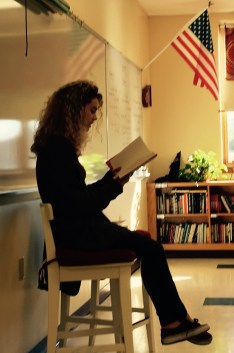
Amy:  I love how you pull up a mini-folding-conferring chair! I used to have a single yellow chair that I invited students to come and sit in — the special chair. I had to leave it at my old school. I saw this nifty rolling stool at a thrift store and almost bought it. I could have rolled from table to table to confer. I talked myself out of it, but there are days a roll-about-the-room would be handy.

Jackie: It’s the best purchase I’ve made all year! Mine looks similar to this one.  What I love most about it though is I sit at the same height as my students, so I can easily set up next to their desk or join in group conversations.

When do you confer?

Amy:  I’d like to say I confer every day. In my heart I want to have a regular system, and on paper I do. In reality, so much administrivia gets in the way. When I am purposeful, I meet with one to three students every day during our independent reading time (usually 15 minutes.) I try to be consistent because I only see my students every other day. If I am not careful, weeks will go by without me talking to some of them.

I have a binder where I keep conferring notes, and I place sticky note reminders to help me remember to get back to certain students who need a quicker follow up time than me making it around the room again. I’ve also started charging my readers to be advocates of their follow up with me. It’s important that juniors in high school take ownership of their learning. If a reader and I discuss a certain skill, and she decides to complete X, I ask her to be the one to remember to come in and confer. Many of my readers remember, and they are the ones who are gain skills and mature as critical readers much faster. Sometimes these conferences happen between class periods or during lunch or at the end of class when students are working on their writing, and sometimes I let them slip into my normal conferring routine. I’ll never turn a reader down who wants to have a quick chat about her book or what she learned.

Jackie: I agree with Amy–my goal every year is to become better at conferring.  I want to make sure to meet with as  many students as possible, but as the year progresses I struggle with the administrative tasks.  That being said, I typically meet with two students within the ten minute reading time we have daily.  On block days when I allow for twenty minutes, I can get around to four.  

My freshmen enjoy the process of chatting about their books, their interests, and their reading.  They enjoy using new vocabulary we’ve learned in class, and I love picking their brain about writer’s craft.  I also try to focus on reflective questions with them so they look at their reading progress holistically.  With my AP Literature students, I focus more on their depth of analysis within their independent challenge books.  I also take this time to check their critical reading journals as well as to discuss whole class novels.

In terms of logistics, I have a cubby where I keep stacks of conferring forms paper-clipped together and sorted in alphabetical order by first name. At the beginning of every period during reading time, I pull out that class’ papers, clip them into my clipboard, and start with the last student I conferred with.  This allows me to quickly keep track of who I met with last and what we discussed.  

Sometimes I can’t keep track of everything and I will reflect back on my notes, jotting down conversations I know I had on Monday when I collected pages or during passing time.  Every minute offers a moment to conference, and while these conferences aren’t always formal, they show students that not only do I hear them but also I am interested in what they have to say.

Amy:  Most days I feel like I do more spontaneous conferences than planned ones. A students needs a new book, so we meet for a chat by the bookshelves. A student finished a book, so we chat for a few minutes in the halls. I almost wrote that these were my favorite kinds of conferences, but that’s not true — I like all conferences. I do like the joy I recognize so readily when my students start identifying themselves as readers though.

Do you have topic ideas you would like us to discuss? Please leave your requests here.

The Best Lesson Series: What Makes a Work of Literature?

NTCE Affiliate Breakfast with Shanna Peeples, 2015 National Teacher of the Year

A few weeks ago I read this post by Shanna Peebles, the 2015 National Teacher of the Year, “Building Bridges with Visual Literacy.” She writes about her lesson in the book The Best Lesson Series, a book in which I also contributed a favorite lesson. Shana includes the background of her lesson, an experience and a realization she had when she began working with refugee students many years ago.

Reading Shana’s blog, I reflected on my own refugee students. Mine come from Myanmar, most having walked through Thailand at night holding the hands of younger siblings while moving toward their fathers who left their villages months before to secure passage for their families. These children grew up fast and they hope for much. They study hard because they know the value of education.

They represent the reason that I teach literacy: It is through literacy that we gain power.

The way to grow as literate individuals is to read. I’ve heard my mentors say it again and again: “The only way to develop readers is to get them reading” and “The only way to learn to read is to, well, read.”

Of course, the same holds true for writing.

The lesson I contributed to The Best Lesson Series pertains to both. Here’s the background of my lesson:

I am not one of those readers who jumps to the last few pages to read how a book ends before I have ever started it. I do not understand those people. At all. I like to savor a good book, take it slow — sip the beauty as I breathe in the language, sigh with pleasure as I see how the words work to shape meaning. Or, I like to devour a book in one sitting, curled up on the couch, holding my breath and gasping for more. So, it’s a little surprising that I pulled the last paragraph of a book to use as a craft study.

I promise it gives nothing away. I also promise:  You may just shudder at the loveliness of the language like I do. Or not. Seems some critics panned The Goldfinch by Donna Tartt while others raved about its uniqueness and style (See the Vanity Fair article “It’s Tartt, But Is It Art?. Of course, critics cannot seem to agree on what makes a text literature either. (See the Harper’s Magazine article “What Is Literature? In Defense of the Canon”.)

The author of the article about Tartt’s work poses the same question I ask my students to ponder each year:  What makes a work of literature, and who gets to decide?

Since mine is a workshop classroom where our primary focus is writing, students choose the books they read. That is not to say we do not read high-quality complex literature or read literature as a whole class. We read many passages together and learn skills that students then apply to their independent reading and the novels they discuss in book clubs four times a year.

My goal with books is to develop readers, and too many of my students did not read when I made all the decisions about their reading. However, many of my students do not know how to choose books they might enjoy or books with enough complexity to challenge their thinking. The drive to fulfill my goal to develop readers becomes multifaceted. Allowing choice means I must constantly be on the lookout for richly written passages that we can study, and I must read volumes of high-quality literature, YA and adult alike, so that I may match my adolescent readers with good books.

I love the last paragraph of The Goldfinch because I can use it for several learning opportunities. This short passage can teach us much about what makes a work of literature. I agree with researcher and reading theorist Louise Rosenblatt:  “Students need to be helped to have personally satisfying and personally meaningful transactions with literature. Then they will develop the habit of turning to literature for the pleasures and insights it offers.”

And that’s the whole point, isn’t it?  We help our students love literature so they learn from it as we do.

____________________________________________________________________________________

It’s an honor to be a part of this work. I am surrounded by inspiring educators with intriguing and thought-provoking ideas, and I hope you will consider adding this title to your professional library so you will be surrounded, too.

Teachers sharing with teachers what works. That’s the best pd I know.

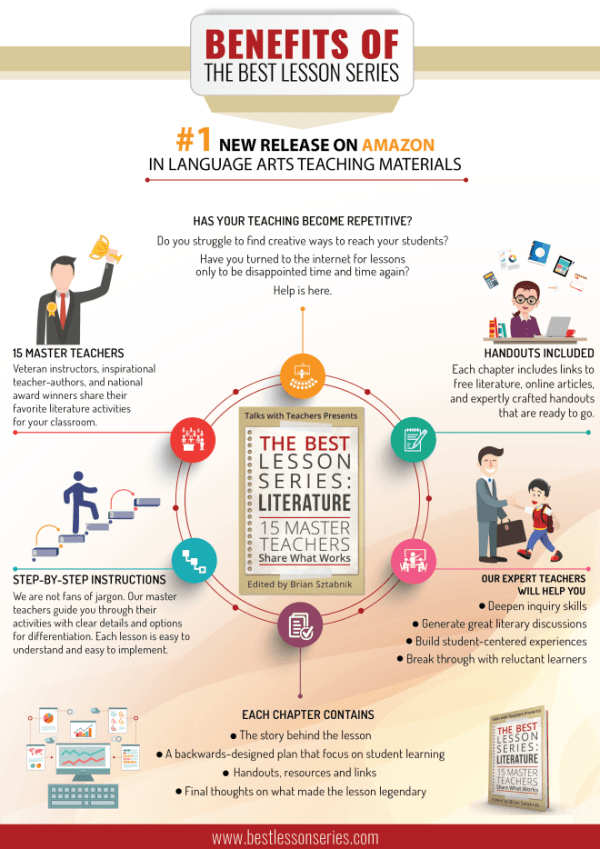
benefits of best lesson series


#FridayReads: Investments, Books, and the Need to Read

I am addicted to books. No question. I am a bibliophile.

And I am proud of it.

I have this not-so-secret hope that my students will be bibliophiles, too. I work very hard to make them so.

This year I’ve had a bit of trouble getting students to read. Okay, I’ve had a lot of trouble getting students to read. It’s been the hardest year for me in the years since I turned to a workshop and choice pedagogy.

I am at fault for not conferring enough, not talking about books enough, not introducing enough books that I know my students will love.  I’ve reflected enough on my practice to get that.

Finally, the light dawned:  Get them investing in the books, not just invested in the reading. But get students making the choices about what books I need in my classroom library.

Fortunately, I’ve been blessed with some kind grant benefactors and have some money to invest in books. (Shana is an expert at grant writing, and I’ve highlighted her post in the past. I do it again here.) It takes some time to write grant proposals, and then once awarded, it takes some time completing books orders — I should have done all this sooner in the year.

In class this week, I gave students an assignment:

  • Search and find a book about social issues you want to read with at least one other person in class. (I’m working on getting multiples of great titles in my classroom library.)
  • Find an award-winning book, or at least a book written by an award-winning author. (At NCTE Penny Kittle said something like “…the more you read of the best literature, the more you’ll recognize it.) I know this is true. Students begin to see it too when they read books that reflect rich and meaningful author’s craft.

So, today for #FridayReads I share with you the list of books my students came up with. I’m pretty sure they will be fantastic reads.

The Martian Andy Weir
Everything I Never Told You Celeste Ng
Challenger Deep Neal Shusterman
Love and Other Ways of Dying Michael Paterniti
Did You Ever Have a Familly Bill Clegg
Fate and Furies Lauren Groff
All the Light We Cannot See Anthony Doer
The Goldfinch Donna Tartt
The Road of Lost Innocence Somaly Mam
Between the World and Me Ta-Nehisi Coates
Inside a Hollow Tree Kevin White
Behind the Beautiful Forevers Katherine Boo
Symphony for the City of the Dead M.T. Anderson
A Little Life Hanya Yanagilhara
Refund: Stories Karen E. Bender
Sickened: the True Story of a Lost Childhood Julie Gregory
The Invisible Girls Sarah Thebarge
Pretty Little Killers Daleen Berry
Columbine Dave Cullen
Redeployment Phil Klay
My Story Elizabeth Smart
Hope: A Memoir of Survival in Cleveland Amanda Berry

Writing My Wrongs: How I’m Learning From My Mistakes

FullSizeRender

A student caught sneaking his independent reading book into his lit circle novel…this is a first.

Every year I arrive at the second quarter with a new approach, idea, or plan.  This will be the solution! I think.  This will sustain momentum.  This will help us make it through the slump.  This will be the difference between dreading quarter two and praying for quarter three, but year after year, I am wrong.  For the past three years I’ve convinced myself it is the book—Lord of the Flies is too boring; they can’t appreciate Bradbury’s language in Fahrenheit 451.

The problem isn’t with my students though—it’s with me.  I am doing it wrong, and while I am ashamed to admit the honest truth, I realize now the error of my ways.

I “gave up” traditional teaching three years ago, when I transitioned to a workshop model of education.  I carved out time for reading, instated notebooks, poured over workshop guides, and asked countless questions of my mentors and colleagues.  The bare bones were in place, and I was convinced that I had the structure necessary to shift from a teacher-centered classroom to a student-centered classroom built on choice.  In many cases I did; every start of the school year began smoothly with excited readers and passionate writers.  We told stories, read poetry, shared quick writes, and analyzed craft, but I dreaded quarter two, the quarter when together, we would read our first of three required whole class novels.

Quarter two was when I lost their voices, their attention, and their passion.  With whole class novels, our focus shifted from “who are you and what are you thinking?” to “who is your author and what is he thinking?” 

Under the weight of scaffolding, curriculum standards, core competencies, and competency based rubrics, my mini-lessons focused on literary terminology instead of literary exploration.  To me, reading mini-lessons meant teaching the same terms I’d grown up with: symbolism, Freytag’s pyramid, direct and indirect characterization, round and flat characters, etc.  This meant my lessons shifted from writing-centered lessons that started with the question, “What do you notice about the author’s craft?” to terminology-centered lessons, that started with, “Apply your understanding of (fill in the blank) to the book.”  The latter produced significantly less empowering results.

So, I asked and probed my students.  I peppered them with questions during study halls and extra help; I snuck in questions with the straggling Writer’s Club members after meetings, gave out surveys, and chatted at lunch with colleagues.  And while I was convinced that it was because I was “forcing” them to read unrelatable classics, I couldn’t shake the fact that I was missing something bigger.

By the time I sat down with my living mentor Linda Rief at a coffee shop in Exeter, I realized I was doing it wrong in quarter two.  The pieces gradually added up—I knew the three reading options I had given them for literature circles weren’t choices at all.  I was hoping they would read the books in their entirety, but I knew that this year would lend itself to additional groans, frustration, and abandonment.  At the end of the day, I was a workshop teacher defaulting to a traditional methodology or worse, was I a traditional teacher pretending to run a workshop?

The two greatest pieces of advice came first via my special educator mother, who asked, “Why not just teach them good writing?  Isn’t that what classics are?” And second through Linda Rief, who pointblank asked me why I needed to teach plot triangles anyways.

Were there successes in my literature circle unit? Most definitely.  Sure, the vast majority didn’t fall in love with Golding, and it breaks my heart that they couldn’t revel in the beauty of Bradbury’s language, but in final surveys, nearly every student appreciated the time they had to discuss the novels in small groups.  They enjoyed talking about the stories with peers, and while not all of them loved the books, many pointed out that this was the first time they engaged in authentic conversations about literature without a teacher moderating the discussions.  They learned; they just didn’t learn the way I had hoped.

Part of me feels like I lost four weeks that we could have spent more effectively growing together as readers and writers while looking at the beauty of craft in book clubs centered on young adult lit of their choosing.  The other part of me feels like I failed my students in providing this idealized version of what I hoped our class would be and then slamming them back to reality with the same sort of stock analysis I question.

I am impatient when it comes to growth, particularly when it comes to my teaching.  While I understand my students’ needs as developing readers and writers, I am quick to judge my own struggles.  Even as an intern, one of my personal goals was “to be at the level of a second year teacher.”  I repeated this mantra knowing full well that the only way to be at the level of a second year teacher was to be a second year teacher.

All I can promise my students is that I will continue to reflect, move forward, and become the teacher they deserve.  But alas, growth takes time, trial, and error.  It requires me to unravel years of traditional education, analyze what works, what doesn’t, what I should carry with me, and what I can discard.  It will take time for me to unwind my own brain just as I ask my students to unwind theirs.  I am still learning to be a writer, a reader, a student, a teacher, and that takes time, time that sometimes feels all too precious when I only have one year with my kids.  Fortunately, teaching is like writing.  Every day, I begin the process of drafting a new story, and every year, I get the chance to revise my work.

5 Non-Negotiables When Designing Writing Instruction

IMG_0528

First draft of a unit plan in my notebook

I plan my units of instruction in three-week chunks, alternating between a reading-focused unit and a writing-focused unit.  In every unit, and in every class period, I keep some routines the same, much like Amy describes here.  While I do most of the big thinking about a unit up front, I do leave some holes in the plans to make space for mini-lessons that are responsive to what I discover students need during our conferences.  And every year, I design brand new units.

While each unit is unique, I was reminded while at the NCTE Annual Convention of five non-negotiables to keep in mind when designing writing instruction.

Writing should be low-stakes.  Students need to write a lot, and a lot of that writing should be ungraded, unread, or worth very few points.  I have felt liberated in terms of grading writing since I read Kelly Gallagher’s research-based statement that students should be reading and writing four times as much as a teacher could ever grade.

I think, since I embraced that philosophy, that my students also feel liberated.  Their notebooks are a “safe place for regular, ungraded practice,” as Penny Kittle described in her Ignite session.  While we write in our notebooks every day, and outside of class in one-pagers, I only collect notebooks every two weeks, and only carefully read and respond to one or two pieces my students have marked.  Indeed, 80% of the writing we do stays in our notebooks and never makes it to ‘published’ form.  This takes the pressure off writers to produce something perfect or error-free, because “our classrooms need to be a safe place to fail,” in the words of Taylor Mali.

IMG_0265

The first two weeks of Kelly Gallagher’s unit plan–week three is filled with revision and getting to best draft #3 at the ‘deep end’

Teaching writing is complex, layered, and nuanced.  In her session on revision, Georgia Heard shared the five things all students need in order to make authentic revision happen:  “opportunities for students to write, mini-lessons on craft and revision, choice in topics, mentor texts, one-on-one conferences with both teachers and students.”  Kelly Gallagher’s unit plan he walked us through adhered to those rules remarkably well.  “Assigning writing and teaching writing are two different things.  Grading writing and assessing writing are two different things,” he reminded us.  It is impossible for students to produce great writing if it is merely assigned.  Thus, when I plan a unit of writing instruction, I leave ample time for craft mini-lessons, modeling my own writing, and talk amongst students and myself.

When teachers are writers ourselves, and experience the process of topic choice, revision, and studying craft moves beside our students, we can become the most effective teachers of writing.  We have to walk the talk.  “Great, effective teachers must be informed AND inspired,” Kwame Alexander asserted.  To be a truly informed teacher of writing, a teacher must be a writer herself. I learned more about writing a strong narrative while participating in NaNoWriMo alongside my students than I ever did just trying to teach fiction before I wrote fiction.  I loved the experience six years ago during my first attempt, and I’ve continued to complete all assignments beside my students ever since.  When we write with our students, inspiration will spread through “the contagion of passion,” in Penny Kittle’s words.

Writing should be personal.  While I love to write about reading, and find it valuable for students to do so often, most of the writing in my classroom is personalized, choice-driven, and often remains private.  When we do a nonfiction writing unit, like the rhetorical analysis we’re in the midst of right now, our written products are focused on the students’ relationships to the texts they’re analyzing–in this case, the misleading rhetoric often found in American politics.  Mostly we write narratives, even in the midst of nonfiction, telling the stories of our connections to the topics we discuss in informative or argumentative genres.

“You can write yourself out of dark places. How much of the writing we do in school nurtures that?” Gary Anderson wondered in his session on reflection.  We have to honor the fact that students are not inherently motivated to write for their futures–for college, job applications, or resumes–but rather they are motivated to write for the here and now, and for themselves.  This is why choice is, and will remain, at the center of my writing instruction.

How do you design writing instruction?  Share your process in the comments!

#3TT Workshop: Assessing Writer’s Notebooks and Sparking Engagement

Three educators. Three states. Three demographics. All practicing Readers and Writers Workshop in our Secondary Classrooms. Read more about us here.

We are the Modern PLC, and every Wednesday, we share our behind-the-scenes collaboration as we talk about the most urgent moving parts of our classroom pedagogy.

Recently Three Teachers Talk received an inquiry regarding our use of Writer’s Notebooks.  Naturally, this question got us talking–what do notebooks look like between New Hampshire and Texas, Freshman English and AP Language and Composition?

We all agree that Writer’s Notebooks are one of the essential tools to a successful classroom, but integrating and sustaining them can prove challenging.  This week’s conversation between Jackie and Amy seeks to explore some of the ins and outs of writer’s notebooks by discussing what we, as teachers, consciously choose to include in our students’ notebooks and what we decide to leave out.

Make sure to visit the first installment of our conversation, and please join the conversation in the comments!

As the year progresses, how do you keep students engaged in their writer’s notebooks?  How do you help students to recognize their inherent value?

Screen Shot 2015-12-01 at 3.34.55 PMAmy:  Well, we do use our notebooks every day. Of course, this helps with keeping students invested in their use. This year I wish I had taken more time to have students decorate their notebooks, really take ownership of them. I love how Jackie setup collage stations and took the time for this with her students. Students care more about their notebooks when they have taken the time to personalize them.

My students also come to value their notebooks more during our conferences. For example, today I met with a student to talk about her reading life. I asked her how she felt she was progressing. She told me that she was stumped because “I keep abandoning books. I’ve started 10 this year, but I’ve only completed four.” I asked to see her Currently Reading List in her writer’s notebook. She did not have it updated. First, we took some time to write all her titles down, and then we marked ‘finished’ or ‘abandoned’ like I’d hoped she would do all along (my fault for not checking notebooks with more fidelity.) Once we had a complete list of the books this students had tried, I was able to talk her through why she might have needed to let them go. We zeroed in on the narrators. The books she has finished have unique narrators:  a dog, a voice in verse, an 11 year old boy, an autistic 16-year-old. We then talked about the narrators of the other books — all third person omniscient, which she did not know, so I taught her the term in a mini mini-lesson. Together we learned that when the narrator “goes off into some other character’s part of the story, I get confused.” This was a powerful learning experience for my student, and a great reminder to me. There is power in the IMG_0163writer’s notebook. It can be our primary teaching resource.

Jackie: Sustaining interest in writer’s notebooks throughout the year can be a difficult task; students must be invested in and committed to their notebooks to understand their full value.  I believe sustained investment comes with consistent use.  As Amy mentioned, the collages at the beginning of the year helped students connect to their notebooks.  Even now I have students adding to their collages or entirely recovering their notebooks.  

Using notebooks everyday also reinforces the value of these tools.  I talk about them constantly, conduct notebook checks throughout the year, and ask to see them during reading conferences.  I display example pages in a giant writer’s notebook, and I typically ask students to write their drafts by hand.

How (and how often) do you assess writer’s notebooks?

Jackie: Writer’s Notebooks provide a safe space for play within the writing process.  To become confident and secure writers, students must have a low stakes area to both visualize and enjoy the process of putting pencil to paper.  That being said, notebooks are also valuable because they provide me with insight into a student’s thought process, progress, and personal exploration.  

FullSizeRender

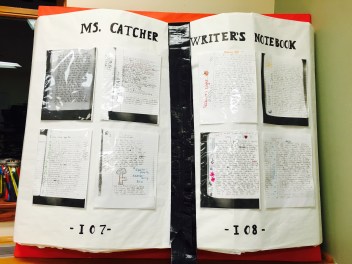
Students’ notebook pages are displayed in a giant writer’s notebook.

My grading process is relatively simple.  I keep a list of notebook contents on a board in my classroom, adding to the board every day.  Notebook checks take place every two-to-three weeks depend on the class content and units.  A week before we have a notebook check, I provide students with a checklist, with which they self-grade and return upon notebook submission.  On notebook check day, students use mini-sticky notes to mark two pages, one page they want me to respond to, and another page they want to display for their peers in our class’ giant writer’s notebook.  This process reinforces that students are writing for a wider audience than myself, while also embracing the messiness and imperfection that comes with writing.  I value the scribbled drafts full of doodles for the sole reason that they model the realness of writing, the fact that these pieces, while fun and entertaining still require molding and modeling to become a polished final piece.

While my grading is low stakes, I file writer’s notebooks under summative assessments for a few different reasons: it helps me assess student’s executive functioning skills, which is particularly important for my freshmen and struggling learners.  In my school, it allows students to “retake” the assessment, requiring them to revisit, revise, and refashion.  The more they return to the contents of their notebook and develop its structure, the more invested they become in the final product.  Finally, notebooks align with the common core, which is essential in my competency-based grading school.  They help “students develop and strengthen writing” (W.9-10.5), “write routinely over extended…and shorter time frames” (W.9-10.10), and “determine the meaning of words and phrases [in their dictionary section]” (RL.9-10.4).

Amy:  I’ve tried scoring the whole of the notebook. I even have a glue in for how I would if I did. I am not disciplined enough. I find short chunks much easier to manage, and I can zip around the room and look at everyone’s personal dictionary to see if it is up-to-date in the first 15 minutes of class while students are reading. Or I can collect notebooks and look at just the skill we practiced that day. These always equate to completion grades. Sometimes I’ll pass out sticky notes and ask students to mark whatever writing they’d like me to read. I learn important information about my students this way. When students share their hearts with me, I value it in a way that is so much more important than a grade. How would I ever grade that anyway?

How do you keep your students excited about their writer’s notebooks throughout the year?  How do you assess notebooks without stifling creativity?


#3TT Workshop — Digital Writing in the Writer’s Workshop

Three educators. Three states. Three demographics. All practicing Readers and Writers Workshop in our Secondary Classrooms. Read more about us here.

We are the Modern PLC, and every Wednesday, we share our behind-the-scenes collaboration as we talk about the most urgent moving parts of our classroom pedagogy.

Despite the proliferation of e-readers, tablets, and digital reading and writing technology, recent research is making digital texts look a little less appealing.  This article discusses the slow reading, complex-text, and comprehension literacy skills we just can’t get from reading electronically.  This one has lots of great links to the reasons digital reading “fail[s] to adequately recreate certain tactile experiences of reading on paper that many people miss and, more importantly, prevent people from navigating long texts in an intuitive and satisfying way.”

As Shana’s school in West Virginia is increasingly making the move to one-to-one technology, digital learning, and an increased emphasis on electronic reading and writing, she wondered how this shift would impact writers’ literacies.  Her discussion with Amy follows.  Please join the conversation in the comments!

writing rhet and digital media_1Why is one-to-one technology such a big deal? Does every child really need a laptop or a tablet?  Isn’t their generation suffused with enough technology as it is?

Shana: I surveyed my students this year, and 98% of them have a smartphone with data access that they’re accustomed to using all day.  This troubled me–there was no space in their routine for slowing down their thinking.  I don’t think the reader’s-writer’s workshop works without deliberate attention to reading, writing, talking, revising, thinking, and pondering.  So, I invited my students to simplify their lives this year by putting away all smartphones, but wondered if I was being a hypocrite when we wrote frequently on the laptops I keep in my classroom.

Now that it’s November, I’ve decided I’m not actually a hypocrite–the experience of writing drafts in print, revising and workshopping them, and then transferring them to a published form digitally is far different than the instant-gratification experience of using a smartphone.  Still, though, I watched a student just yesterday play a game on his smartphone while he waited for his computer to boot up.  My students don’t seem to know how to handle free moments to just think, or wonder, or daydream–at stoplights, in hallways, or just waiting for a computer to load.  I worry that this reliance on technology to fill their time will prevent this generation from thinking slowly enough to learn, grow, solve problems, and just think.

Amy:  Just like the literacy gap that happens between children who grow up in print-rich home and those who do not, I’ve started to see a digital literacy gap. Haven’t you? The idea that students are digital natives does not mean they are digitally savvy. Most of my students do not have internet access at home, but they do have cell phones. They can text like thumb-numbing tornadoes, but they cannot format a Word document to save their lives. And since their thumbs do not work so well on iPad keyboards, most tap at the keys like chickens pecking at the dirt. They are slow typists. Now, having said that — that does not mean that I do not think they should learn how to write digitally, format correctly, and type efficiently. All students in this age need to become digitally savvy, and I haven’t found that one mandatory technology class in high school is enough to help them get there. No even close. As English teachers, our role shifts as the literacy shifts. If we are not including some element of digital literacy, I think we do many students a huge disservice.

Shana: “Thumb-numbing tornadoes.” Amy, you are a wordsmith.  I agree that our role shifts as literacy shifts–it’s scary to have to learn new skills fast enough to teach them to our readers, but it’s our reality.  I know writing at Three Teachers Talk has helped me immensely to learn how to write and publish digitally–and it’s a skill that has benefited my readers and writers in the classroom.

What are some authentic best practices related to digital writing?

Amy:  The cool thing about writing is that the skills we need to write on paper are not so far from the skills we need to write digitally. Typing excepted. We still need to think on the page, study models, learn from experts, practice drafting, review and revise… And publishing can be so much more fun — at least I think so. We have the opportunity to share our writing much more through digital means than we had via paper. I like that. I like that my students can share writing with yours. Yours can share writing with mine. I know, we could stuff a big fat envelope with student essays, but I am not so likely to do that. I will however send you my students’ blog links.

Shana:  In a perfect world, my school would mandate a typing class for all ninth-graders that includes not just keyboarding skills (which they are TERRIBLE at), but also digital publication skills.  There are vast opportunities for meaningful discourse that can take place between readers, writers, and thinkers when we get students writing and publishing digitally.  I still very much believe in the power of print writing–but, I know, thanks particularly to Amy, how valuable digital writing is, too.  As Whitman says– “Do I contradict myself?  Very well, then I contradict myself.  I am large, I contain multitudes.”  I can’t wait to have our students writing digitally with one another!

What are your thoughts on digital vs. print writing?  Join the conversation in the comments, and check out yesterday’s discussion of digital vs. print reading.


#3TT Workshop — Digital Reading in the Reader’s Workshop

Three educators. Three states. Three demographics. All practicing Readers and Writers Workshop in our Secondary Classrooms. Read more about us here.

We are the Modern PLC, and every Wednesday, we share our behind-the-scenes collaboration as we talk about the most urgent moving parts of our classroom pedagogy.

Despite the proliferation of e-readers, tablets, and digital reading and writing technology, recent research is making digital texts look a little less appealing.  This article discusses the slow reading, complex-text, and comprehension literacy skills we just can’t get from reading electronically.  This one has lots of great links to the reasons digital reading “fail[s] to adequately recreate certain tactile experiences of reading on paper that many people miss and, more importantly, prevent people from navigating long texts in an intuitive and satisfying way.”

As Shana’s school in West Virginia is increasingly making the move to one-to-one technology, digital learning, and an increased emphasis on electronic reading and writing, she wondered how this shift would impact readers’ literacies.  Her discussion with Amy follows.  Please join the conversation in the comments!

digireadWhen much of the research points to poorer reading comprehension and lower rates of retention in electronic reading, why are some schools moving toward digital reading?

Shana:  My school recently adopted a new textbook series across multiple content areas that contains a small print book and a massive digital one.  This online textbook features texts, activities, tests, and quizzes that can only be accessed digitally.  By and large, my students have reported immense dissatisfaction with their reading experiences in this digital format–in history class, English, and math.  I wondered if that was because they just weren’t used to reading digitally, but during our reading conferences, they disagreed.  They use e-readers, they read articles on their phones constantly, and they have become accustomed to taking their state tests on computers.  Most students reported that they were more tired after reading digitally, that they didn’t retain the information well in that format, and that they were frustrated by their inability to interact with a physical text by annotating, highlighting, etc.  

After talking with students and experimenting with digital vs. print reading myself, plus reading the articles linked above (and many more), I felt really frustrated about the de-emphasis of print reading in schools.

Amy:  Interesting question. I haven’t seen this move toward digital reading myself. My district does have 1:1 iPads, and I know there was a big technology push just prior to me moving to my school, but I’ve never heard that students should be reading digitally instead of reading in print. I’d probably throw a bit of a fit if I did. Personally, I love paper. I love everything about print on the paper page. I’ve moved to digital in a lot of ways — my students create and write on their own blogs, and they turn most of their drafts in using Google docs, but when I sit down to confer with them, I’d much rather have a look at the printed page. It seems easier to zero in on skills that shine brightly or those that need some work — but that is probably just preference.

It’s an interesting argument though, and really, if I believe so much in the importance of digital writing — and I most definitely do — shouldn’t I also believe in the importance of digital reading? Hmm. Now, you’ve got me thinking.

Shana:  I love paper reading and writing, too, Amy.  This is probably why my desk is currently cluttered with books, notebooks, and stacks of paper.  Certainly electronic reading would be cleaner…but it lacks the tangible presence of print that shows me my progress through a book, a student’s writing process, and physical thinking on a page.

Why are physical textbooks, literary anthologies, and notebooks being phased out of our students’ educational routines?

Amy:  I don’t know much about how this might look in other teachers’ classrooms, districts, or states, but I have not used a literature textbook or anything like an anthology in several years. I find them cumbersome. When my students and I read short passages for analysis, I make copies. I need readers writing on the page. If a text is too long, I give them QR codes, and they all know how to annotate digitally with an app on their iPads (I didn’t teach this. They learned it last year or the year before.) I use a lot of texts that can easily be found online, e.g., columns by Leonard Pitts, Jr., and articles from The New Yorker. For full-length texts, we read in book clubs where my students all purchase their own books, or borrow one of mine. Annotating is a valuable skills, and using a textbook makes doing that quite difficult.

Shana: I love the QR code idea for a longer text!  I’ve always felt that it sucks a bit of the joy of learning reading skills out of students when receive a thick, copied packet that I ask them to read and annotate.  I’m with you on providing print copies of columns, articles, or books to students for teaching specific reading skills.  I love when students check out a book from the classroom library that was previously annotated during a book club reading.  They always ask who read the book previously, and their notes become part of that new reader’s experience with the book.  That experience of seeing a prior reader’s interaction with text on a page is just not possible with textbooks or digital reading.

What are your thoughts on digital vs. print reading?  Join the conversation in the comments, and check back tomorrow as we discuss digital vs. print writing.

#3TTWorkshop — How to Hold Students (and Ourselves) Accountable for Reading

Three educators. Three states. Three demographics. All practicing Readers and Writers Workshop in our Secondary Classrooms. Read more about us here.

We are the Modern PLC, and every Wednesday, we share our behind-the-scenes collaboration as we talk about the most urgent moving parts of our classroom pedagogy.

Reading accountability and grading our students’ reading goes hand in hand. Both are parts of a workshop classroom that can seem daunting, and sometimes we have to be flexible until we figure out what works well for our students and for us. Let’s start the conversation with accountability.

How do you hold students accountable for their reading?

Amy:  More than any other year, holding students accountable for their reading is driving me crazy. I’ve tried passing a clipboard like I learned from Penny Kittle. Many of my students cannot get their heads wrapped around a simple “Write down the page number you are on” and then “tally your reading for the week.” I see my students for half a class period on Mondays and then every other day the rest of the week. Seems if they miss the chart at the first of the week they never get it caught up.

Last year I tried an online reading chart. Each student had a page in a spreadsheet that I asked them to keep updated. I gave them a couple of minutes in class right after independent reading time. That worked a little better, but it was more difficult for me to access at a glance. I really like to get a true state of the class.

The past few weeks, I’ve started walking around on Mondays and recording page numbers myself. I decided to try this since my students were moving into book club reading. I can see if they are on target with the reading goal for their groups. It’s worked better, but this is not the kind of accountability I want to inspire in my readers. I’ve made myself the accountable one, and I am outnumbered.

Jackie: I’ve had a love-hate relationship with accountability like you, Amy.  The initial passing-around-the-clipboard method did not work for me either.  I shifted to checking individually two years ago.  I have a spreadsheet in which I enter their page numbers and reading rates on Mondays.  The spreadsheet then immediately calculates the percentage they completed and whether they fulfilled their reading rate for the week.  It isn’t a perfect system and I would much rather be conferencing with students instead of checking page numbers, but there are both pros and cons.

On the bright side, I do like checking in with every student on Mondays, and with a class of 24, it takes me about 13-15 minutes to record pages for the entire class.  The other benefit is that I also immediately know when students didn’t complete the number of pages they were capable of reading for that week.  Instead of telling them they didn’t complete the assignment though, we have a conversation about their reading overall.

Honestly, for my freshmen, this form of accountability is key.  It is less important for my AP Literature students, but I enjoy walking through the class every Monday, touching base with every student, and ultimately starting my week off by acknowledging their reading successes.

Amy:  Like you, Jackie, I do enjoy checking in with every student on Monday morning. The time is a trade off though, since I try to hold reading conferences when students are silently reading. I just don’t feel like I have the time to really talk to my students who are not getting their reading time in (That might be the crux of my frustration — I have too many students still not doing enough reading), and now meeting with each student for a longer reading conference on a regular basis takes that much longer. Seems like time eats my lunch every day.

I ask my AP Language students to read three hours a week in their self-selected books each week. Some students read voraciously, and I find these readers don’t necessarily like keeping track of the pages they read each week. I love that they read because they want to — something I hope for all my students, so I do not want to penalize them for not marking an accountability chart.

Besides just noting how many pages students read each week, what other accountability structures do you have in place?

Amy:  In our writer’s notebooks, we keep track of the books we start, abandon, and finish. We also pull vocabulary words –5 words a week — from our independent reading to put in our personal dictionaries. I know you and Shana just discussed vocab last week.

This year as another accountability piece,  I started asking students to complete an occasional reading one-pager. I have mixed feelings about this because I know the value of reading for reading’s sake, but marking the reading chart wasn’t working, and I have a difficult time conferring as often as I’d like. I also need my students to practice writing about literature. All they want to do is summarize, and the one-pager is one way to help them move beyond that.

I hope to get my students to think about accountability as self-evaluation. We talk a lot about the reason for reading:  We build fluency, acquire vocabulary, gain empathy, and learn information. “How has your reading this week helped you do that?”

Jackie: We also keep track of the books we start, abandon, and finish.  Students add to their “Books Read” list at the beginning of their writer’s notebook and they check off the books they complete.  Students also pull four words per week from their independent reading and log them in their WNB dictionaries.

Like you, I tried one pagers from Kelly Gallagher two years ago, but they were difficult to track and my strongest readers oftentimes slowed down their reading to avoid the one pagers.  I believe they can work, but I haven’t found a perfect fit just yet.  My AP Literature students do keep a critical reading journal (CRJ), which I started using this year thanks to Sheridan Steelman’s help.  Sheri is a phenomenal AP Literature teacher I met at UNH Literacy Institute.  Her structuring of CRJs has helped me gain even further insight into my AP Lit students’ needs and successes.

At the end of the day, my greatest source of information comes from the conferences I have with my students.  Students want to talk about their books, and it is a pleasure to sit beside them and learn every day.

So how do you grade your students on their reading?  

Jackie:  My school has competency based grading, so I file reading initiative grades under “formative assessments.”  I look at reading time as purely formative in the sense that it is necessary practice time for students to explore their interests while also building reading stamina.

Students in my CP Freshman English class must read two hours in their independent reading books while students in my AP Literature class must read three hours.  Each student has an individual reading rate, which they calculate and recalculate throughout the year. I adjust their reading times based on whether or not students are completing whole class or literature circle novels.  Students then receive a weekly reading initiative grade out of 20 points.  At the end of the day though, this structure is in place to help students carve out time for reading.  

One of the greatest complaints from my AP Lit students at the beginning of the year was that they didn’t have time to read anymore.  They loved it but it had been a long time since they’d picked a book on their own.  After a quarter of independent reading, Jessica said, “I love independent reading.  It gives me a break from everything” while Claudia said, “I have read more this quarter than I have in the past year.”

Amy:  I wish I didn’t have to give a grade for reading. I wish I didn’t have to give a grade for a lot of the work we do in class, but that is a topic for another day. All my little reading checks equate to a reading grade, all formative, except for a self-evaluation of their reading lives students complete about every nine weeks — that’s a summative assessment I model after a reading ladders assignment I learned from Penny Kittle.

Really, when it comes to grades, if my students show me growth and improvement, the grading is easy. It’s all about moving as readers. Eventually, most students come to realize that — and they thank me for making reading matter again.

How do you handle reading accountability and reading grades in your workshop classroom? Please add to the conversation by making a comment.

Do you have topic ideas you would like us to discuss? Please leave your requests here.

I think reading may not be all that important — What?!

I am not often speechless. But it’s not often I hear statements like this — from teachers no less:

“There are so many other ways for students to get information. I think reading may not be all that important to students today.”

We were into the second hour of a three hour workshop on conferring. We had already brainstormed and charted what we believe are the needs of our students:

  • trust in authority
  • time and attention from adults
  • a caring teacher who is a listener and is consistent with discipline and classroom management
  • technology to learn and communicate
  • critical thinking skills
  • a context for what we want them to learn
  • positivity and discernment
  • a focus on what matters/ability to ignore “the noise” of unnecessary information
  • the opportunity to freely think and to take risks
  • the ability to communicate in ways that are socially acceptable and responsible

We had just read research on reading as detailed by Nancy Motley in the book Talk, Read, Talk, Write. I share it here:

Literacy skills for the twenty-first century are far more complex than in previous generations (Goldman, 2012). In addition to the basics of reading comprehension, today’s students must also know how to read with purpose, integrate new information, resolve conflicting content in different texts, and identify the writer’s perspective (Biancarosa & Snow, 2006). Students can only learn these skills by reading. Because many students enter the classroom with underdeveloped literacy skills, we often replace reading tasks with lecture and interactive activities to ensure that students stay engaged and learn the content, Hoyt (1999) explains.

“…expository reading for many students is often a listening experience. Well-meaning teachers, concerned about textbooks that are too difficult, often create situations where one student reads from the text and others listen or attempt to follow along in the book. This situation does little to build conceptual understandings, and it can actually deter from the learning process as the listeners are engaging in very little reading.”

When teachers “deliver” the curriculum to students, students lose the opportunity to construct meaning for themselves (Tovani, 2000). According to the Reading Next (2006) report (a meta-analysis of adolescent reading), three of the most statistically significant practices for increasing the academic achievement of middle and high school students included:

  1. direct, explicit comprehension instruction
  2. reading and writing skills embedded in content area classrooms
  3. text-based collaborative learning

Put simply,

“When we routinely model and make explicit the methods adults use to read, think, and make connections, students learn to do it, too. Furthermore, they will see that such close, insightful reading is within their reach — that they can do such reading and thinking, which is central to an education.” (Schmoker, 2011).

I am not often speechless. But this teacher’s comment left me chewing my lip. Did he read the research? Did he understand what it meant? Does he really believe that reading is not important?

“If I gave my students The Canterbury Tales and expected them to read it, that just wouldn’t happen. I read it to them, and they get a lot of information, and they come to like it,” this teacher continued.

And I countered, embracing my inner Penny Kittle, as I facilitated another hour of professional development:  “What is your purpose for ‘reading’ The Canterbury Tales — or other texts you choose for your students? What skills are you teaching with that book? How do you know your students are learning them? How are you helping your students develop as readers — because that is our job as English teachers. If we are not helping students become better readers than they were when they came to us, we are not doing our job.””

“Today’s students must … know how to read with purpose, integrate new information, resolve conflicting content in different texts, and identify the writer’s perspective.  Students can only learn these skills by reading.” 

They must also know how to discern viable information from the barrage of biased and unreliable information. And know how to understand a rental agreement when they sign a lease, a sales contract when they purchase a car, a speeding ticket when they get one, a ballot in a voting box when they are standing in line next to you and next to me.

Students can only learn to read by reading.

benefits of reading

What do you think? Is reading important to the students we teach? How would you have responded to my teacher friend?