Tag Archives: Poetry

Embedding Poetry in Core Literacy Instruction

TCTELA2015

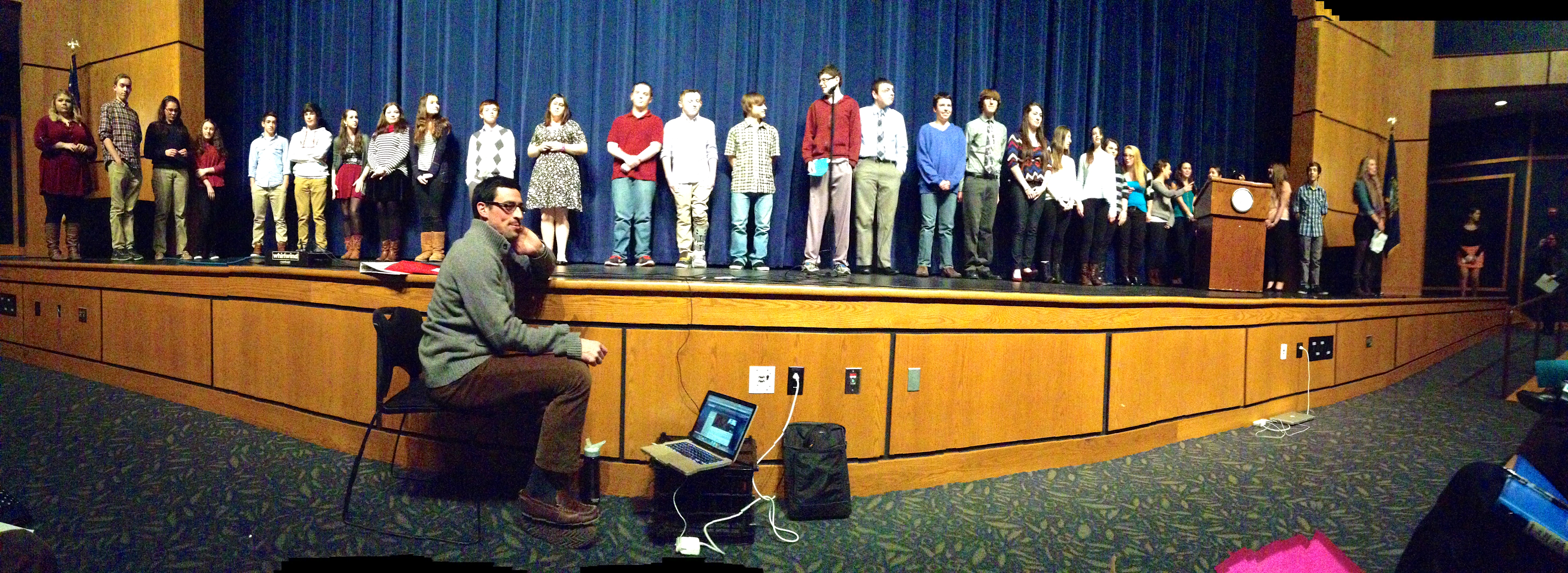
Selfie at our session. –“The Sound of Sense: Putting Poetry at the Core of Literacy Instruction”

Saturday Heather and I presented a session on poetry at the Texas Council of Teachers of English Language Arts. When I wrote the proposal last year, I had been accepted but had not attended The Frost Place Conference on Poetry and Teaching, and I had hope that my life would be transformed through poetry after my stay in Franconia at the end of June. I knew I’d have ideas to share with other teachers at this conference. I was right.

That’s how faith works.

I shared the strategies that have shaped my teaching into fine points for skills acquisition since I learned them at the

Frost Place:

Dictation. When we dictate a poem, slowly, speaking each word and each line with care; when our students write each word, each phrase, each metaphor and simile, they take ownership of the language and see into the craft of the poet. In this ever-moving world, our students need to s-l-o-w-d-o-w-n and feel the beauty of the print on the page. Words become tangible and approachable. Comprehension improves. Analysis advances.

Arguing a Tone. My friend Margaret shared this strategy:  Choose a poem that begins with “how” or “why” or one that you know can be read in opposing tones. (Dickinson’s “How gentle is the little brook” works well.) Divide the class into two teams, and ask one side to read the poem with a tone of anger. Ask the other side to read the poem with a tone of happiness. Instruct students to find text evidence that supports their given tone then hold a debate. After discussing, students can then take their thinking to paper and write paragraphs that show analysis of the tone.

I Wonder for Revision. At the Frost Place, I loved being in the company of working poets. They inspired me with their thinking and their calm. I learned as I listened to their language. One afternoon we sat in a circle as a poet shared his work. We listened and offered feedback in the form of “I wonder…” He listened and took notes. And he left with a page of possibilities that he might have wanted to play with as he revised his poem. I’ve used this strategy with my students and had great success. I wrote about it here: A Feedback Protocol for Revision Workshop.

At the end of our session on Saturday, I read my poem I wrote modeled after Meg Kearney’s poem “Creed.” Just like at the Frost Place, I cried when I read about my mother. Poetry is emotion. And it’s an emotion that we need to help our students see and feel and play with. Sure, we can reserve a unit in our curricular year to devote to poetry, but our students will love it, understand it, and appreciate the wonders of language when we embed poetry in every unit throughout the year.

It is possible, I know, because I do it.

What are some of your ideas for embedding poetry in your core instruction? or, what are some of your favorite poems to share with students?

Unraveling the Mystery of Poetry

My first year of teaching I learned that my students thought poetry was a convoluted, confusing, incomprehensible jumble of words. They believed the more muddled the language, the better the poem. Students would write poetry in their writer’s notebooks and then ask me to translate it for them: “what do you think this means?” or “what do you think I’m saying here?” They’d ask, and I knew it was a dangerous game. I felt like a psychic, asking vague enough questions to pull out some story I could piece together. The students who weren’t writing in garbled tongues were crossing their arms in protest of the poetry unit.

I quickly learned that my students needed to hear contemporary poetry, poetry that pulled them in as readers and allowed them to feel something, anything. Over the years I have sculpted my poetry unit to meet the needs and wants of my students. It has become my favorite unit because it is the one that fits flawlessly into the workshop model; it provides the greatest opportunities for differentiated instruction and unique output. While I integrate poetry into my lessons throughout the year, I eagerly ramp up student exposure during the few weeks that surround our school wide Poetry Out Loud (POL) competition, a national oratory competition in which students perform a poem from the POL website (http://www.poetryoutloud.org/). I have found that four main components within my poetry unit have proven successful in educating students on what poetry has to offer.

 1. Flood students with contemporary poetry

The easiest way to help students connect with poetry is to provide them with examples that speak to them. I begin my poetry unit by playing two songs. They could honestly be any songs that have a story, but my choice this year was “The A Team” by Ed Sheeran and “Wings” by Macklemore. I explain to my students that poetry is all around them. In fact, poetry is the most accessible form of writing they come in contact with on a daily basis because it is used in music, and how many students walk around with ear buds jammed in, listening to the words of poet-musicians.

Students warm up to this thought quickly, but it’s the spoken word poetry that tends to catch them off guard. I lead poem talks instead of book talks during this unit and I expose students to a variety of spoken word performances, my favorites being from Taylor Mali, Sarah Kay, and Shane Koyczan. I also find that spoken word poetry tends to pop up throughout the year. Oftentimes students send me their favorite pieces and I collect these for this unit. This year’s popular video, which was performed by a trio of teenage girls from a program called Get Lit, is called “Somewhere in America.” (http://queenlatifah.com/lifestyle/heroes/get-lit-power-of-poetry/). Last year’s viral video “Look Up” by Gary Turk served as a call to students to put down their technology and start living in the moment (https://www.youtube.com/watch?v=Z7dLU6fk9QY).

Students complete quick writes based on these poems to help them explore the meaning and depth of the poem. I ask them to write about their reaction to the performance, to pick a line from the poem that speaks to them, or to write about memories the poem might stir up; the goal is to get them responding to and talking about poetry in some way while recognizing that their reaction as a reader is valuable.

2. Put Poetry on Display

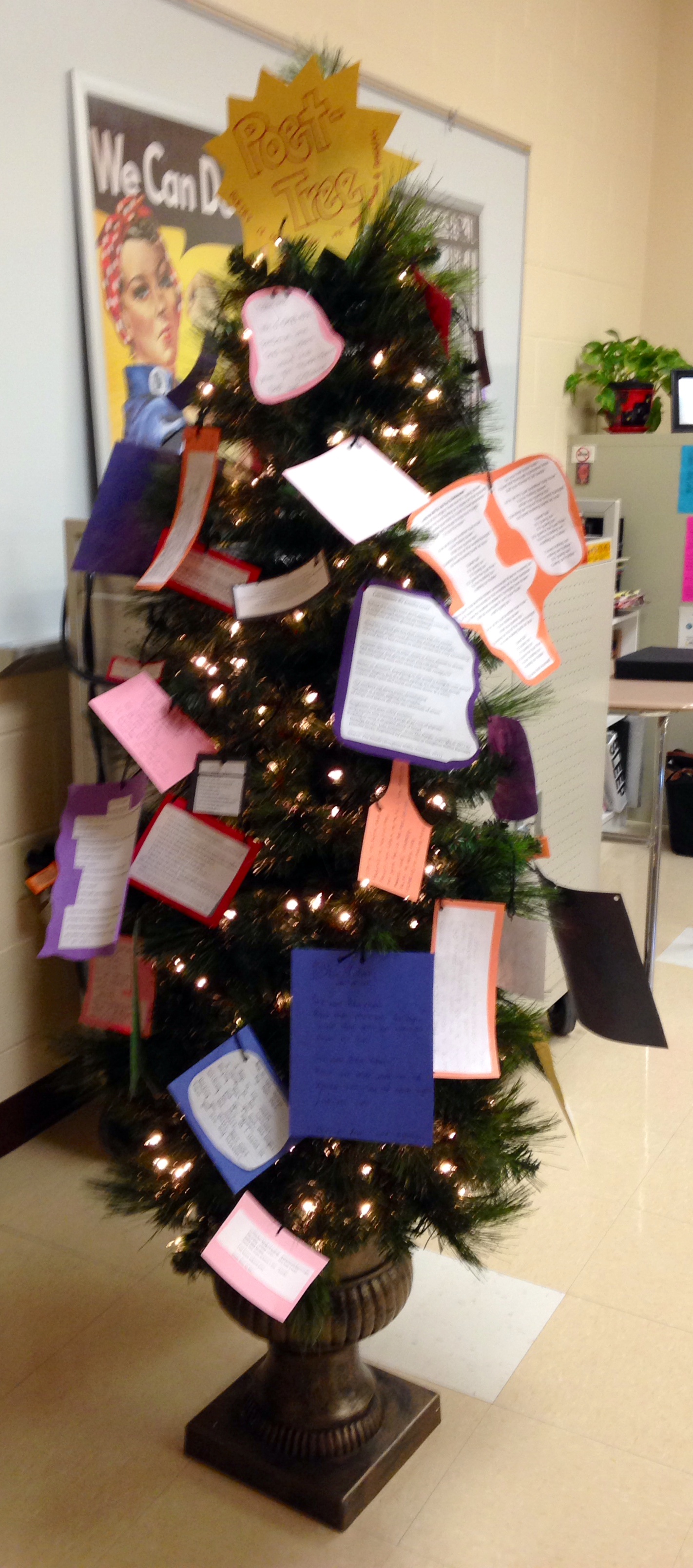
Our class Poet-Tree

Our class Poet-Tree

Part of exposing students to contemporary poetry also involves helping them to recognize poetry within their surroundings. During the poetry unit I make a point to both display and discuss books that include poetry. I like to discuss Ellen Hopkins’ books and use Brian Turner’s war poem anthology Here, Bullet as well Jay-Z’s book Decoded, which includes annotations of his rap lyrics, as mentor texts. I also integrate classic poetry to make sure students are exposed to a wide variety of poets and pieces.

Inspired by a Pinterest pin, I started a Poet-Tree this year. I asked students to take a week to find poetry surrounding them. They could bring in a poem they enjoyed, favorite lyrics from a song, excerpts from a book, or anything they deemed to be poetry. The goal was to reinforce that poetry exists all around us, and judging by the final product, students were able to recognize the larger implications of the poetry unit.

3. Have students Participate in Poetry Out Loud or a poetry reading

Ownership is central to the poetry unit. Students oftentimes give into poetry because they have a say in what poem they would like to memorize, analyze, and perform. Furthermore, they are invested because their peers

A poem displayed on our class Poet-Tree

A poem displayed on our class Poet-Tree

hold them accountable.

I give students ample class time to explore the available poem choices on the Poetry Out Loud website. Once they choose their poem, I lead them through a variety of activities intended to help them fully analyze and understand their poem. We explore the meaning behind the poem, creating a word dictionary to understand the significance of word choice. They research the poet’s background and historical events/facts that might have played a role in the writing of the poem. They learn about the appearance of the poem and how author’s choice plays a role in line lengths and stanza breaks. Finally, we discuss sounds within poetry and how poetic elements affect how a piece is read. This intimate look at the structure and development of the poem prepares students to perform their poetry at our final poetry café.

 4. Create a poetry and post cards match between schools

The post card I traded with the elementary art teacher at one of our local schools.

The postcard I traded with the elementary art teacher at one of our local schools.

Every year our freshmen classes pair up with a group of fifth graders from one of our local elementary schools to participate in a program we call “poetry and postcards.” Fifth graders paint or draw a post card in their art class to send to a high school buddy. In return, our students write a poem to match the post card while also sending a letter to the student with some information about themselves as well as advice for the fifth graders as they move up to middle school. My students are invested in the project and oftentimes receive notes back from their fifth-grade buddy.

While my poetry unit is packed, students move on with an understanding that the process of comprehending and connecting with poetry isn’t so different from the process of reading a novel. They see the relevance and beauty of language and tend to leave with a greater appreciation of an art they otherwise despised.

The school-wide Poetry Out Loud competition

The school-wide Poetry Out Loud competition

Dictation in AP English — It’s a Quiet Your Mind Kind of Thing

The sign on the door of my classroom

I asked my students to turn to a new page in their writers’ notebooks. I told them that I would read aloud a poem. Slowly. I would repeat each line twice. I would spell words that I thought were difficult. I’d tell them where the punctuation went. I’d tell them where the line breaks were. I’d give them time to write.

All they had to do was listen.

You would not believe the moaning.

I explained that to truly understand language they would need to listen to how language works. They needs to hear the words, the rhythm of the sentences, the length of the sentences. They needed to quiet their minds long enough to block everything out but the sounds of each and every word.

“The sound of sense, then. You get that. It is the abstract vitality of our speech. It is pure sound–pure form. One who concerns himself with it more than the subject is an artist. But remember we are still talking merely of the raw material of poetry. An ear and an appetite for these sounds of sense is the first qualification of a writer, be it of prose or verse.” ~Robert Frost

I didn’t expect students to understand so much Frost’s meaning, but I did realize the value of getting students to find a center and make the words their own as they write them down.

I’d experienced this first hand at the Conference on Poetry and Teaching at The Frost Place last summer. Every morning, we’d sit on metal chairs in the small barn behind Robert Frost’s house and listen and write what we heard.

The practice is called DICTATION. “It’s a slowing down and feeling the language in your bones,” says David Cappella, co-author with Baron Wormster of A Surge of Language — Teaching Poetry Day by Day. (Here is a sampling from Heinemann.) Wormster explains, “[Dictation] is a kind of reading aloud to think aloud so you can live out loud. Poetry is life in the slow lane. Poetry tells us to slow down and to pay attention. Poetry directs our attention.”

I have used dictation three times with my students so far this year, and three times we have experienced a calming of the mind that moved us to specific and powerful learning.

1. We focused on word choice, paying particular attention to words we found interesting and unique. This lead to better word choice in our Go World video stories.

2. We focused on sentence length and variety, paying particular attention to the rhythm in the poem. This lead to more purposeful syntax patterns in our next blog post. (All of my students manage their own blogs. See this post here to know more about our blogs.)

3. We focused on figurative language, paying particular attention to the sensory words that created the images. This lead to more colorful, intentional and moving language in our notebook play leading up to narratives.

My second semester starts today. Today I will dictate a poem to get us started, I think it will be this one by Anais Nin:

Screen Shot 2015-01-19 at 5.17.58 PM©Amy Rasmussen, 2011 – 2015

Poetry in AP Lang

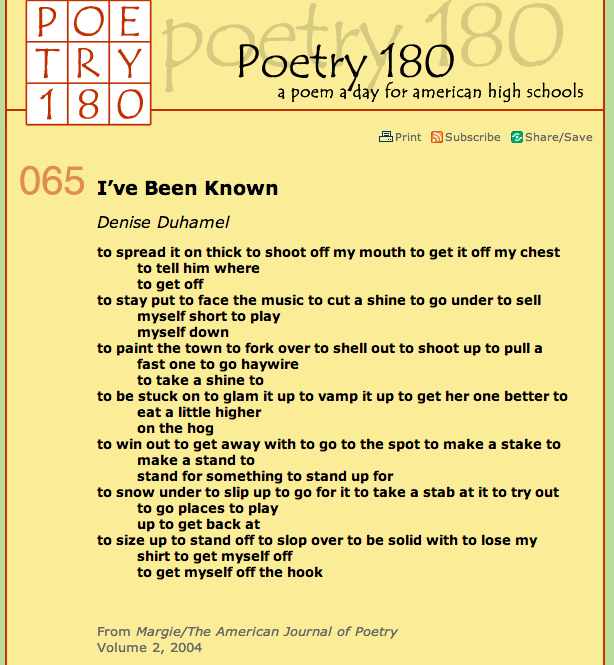
Do you subscribe to Poetry 180 through The Library of Congress? It’s probably the single most valuable thing I’ve done as a way to remind myself to use poetry in my AP English Language and Composition class. We read and write many an argument. I often forget about the poetry.

But I read a poem every day. You can, too. Sign up for a poem in your inbox here.

Some days it’s a natural fit to incorporate the poem into my lesson. Some days it’s a little more complicated. Some days I don’t even try to make the poem fit — we just enjoy the language.

Like this one today:

Screen Shot 2014-12-10 at 6.26.56 PM


Poetry at The Frost Place: Don’t Stop Believing

The Frost Conference on Poetry and Teaching is over. Those who didn’t leave yesterday left today after the Teachers as Writers workshops. The hugs good-bye were those of life-long friends, sad to part, but a little eager to get on the way. The small community grew so quickly. Sharing a love of language will do that to people.

I pull into the Kinsman Inn where I have shared a roof and a home-sized breakfast every day this week with, as Margaret said, “The kindest people I have ever met;” and the gravel lot is full with the cars of total strangers. I walk inside and even Sue the innkeeper says it is not the same. We feel it. The magic of the week is over.

I never cared for poetry. Looking back I know that attitude stems from the way I was taught. I never experienced the simplicity of words that I’ve experienced here. Even when I’ve taught poetry in class, especially those two years with my G/T students, I tortured them with bad teaching. I’m embarrassed to say I gave them a packet, and we read through the poems ‘analyzing’ as we went, never stopping to just listen. Listening is the secret I learned this week, but the secret was never meant to be locked a way so no English teacher could find it. It’s not even a secret really. Poetry is art; art has to be experienced. A packet doesn’t offer that to anyone. I’ll argue no matter the content, but that is an topic for another day.

Imagine this scenario:  Each morning you walk into the small Frost barn. You pull out your pen and wait

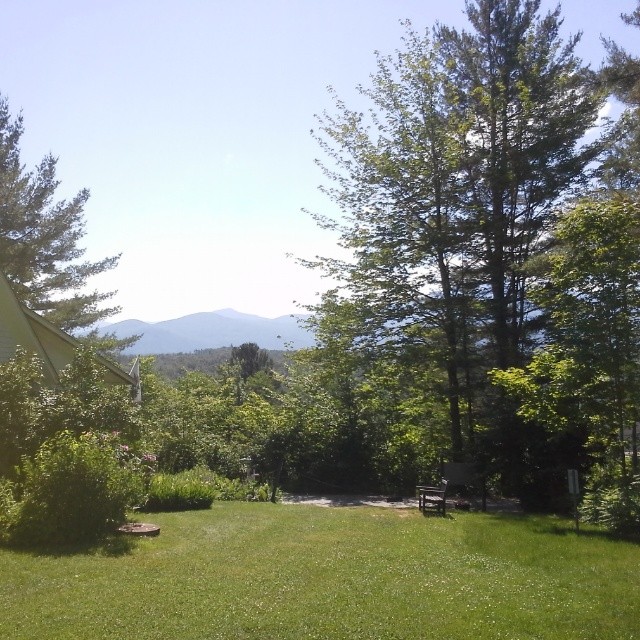
At the evening poetry readings at Frost's barn, the audience is invited to turn around and appreciate the view. Inspirational.

At the evening poetry readings at Frost’s barn, the audience is invited to turn around and appreciate the view. Inspirational.

for the morning’s dictation. Alyssa slowly reads a poem in her soft con-alto, stopping every so often to state a word that is capitalized or where to place a comma or period. You listen, and you write. You focus on the voice, the words, the phrases — the silence created by the pauses. You fill the page with this focused thinking.

After everyone arrives, you welcome the morning, and Teresa opens Robert Frost’s notebook and shares a significant line. “I don’t change my watch every time I see a watch it differs from.” We talk about living in the discipline — not in the product. Dave with a voice to rival God himself finally speaks out:  “We do not live in a culture that embraces silences.” We all nod.

We talk about poetry and teaching and teaching poetry. Then we share presentations filled with classroom practice or philosophy. Again we discuss — “civil engagement,” as Dawn coined it. Our notebooks filled with ideas we can use to give our students similar experiences.

The most impressive thing? We talk to each other like poets.

And that is what needs to happen in the classroom. So often we teach poetry and reading and writing when we should be teaching poets and readers and writers. Of everything I’ve absorbed this week, and this is saying a lot, I believe this simple thing will make the most change in mine, and anyone’s, classroom. 

Today several of us sat around in a circle and shared original poems that we’d composed yesterday. The only instruction for feedback:  What are the possibilities? No critiques. No corrections. Just suggestions on how the poet could play with words.

“If you do not play, you will never know,” Dawn reminds us. Isn’t that the best revision strategy ever? Just play with words, phrases, stanzas, rhythm, structure.

I want my students to play. I want them to have a tiny bit of the silence I’ve experienced this week. I will have them practice dictation — a sure way to quiet the mind and prepare for inspiration. I will continue to allow choice in reading and writing topics, and we will play.

Nicholas told me he never read a book on his own until college, but now he has an MFA and a knack for words. I can’t help but wonder if his gift might have come quicker — not the long sidetrack he took to get here — if in all his English classes he had been spoken to like the poet he is. That is worth a thought. Or two.

Today when I left The Frost Place for the last time, I turned the opposite direction on the road. I’d not gone this way all week. The lane was longer, but the view quite the same. But God must have been the one to turn the wheel because as I came to the T in the road, there stood the stop sign telling me “Don’t STOP believing.”

Don’t STOP believing. Can it be any clearer?

I won’t. I found the seat of my soul, and it is steeped in poetry.

Here’s my poem from the writing time today. I imitated the structure of Hayden Carruth’s poem “Twilight Comes.”

Twilight comes to the busy town

As season’s start. The tree tops

brown with leaves, which colored

And began falling during the heat,

Are moving again, and crack

under the wind’s breath. The buildings

from their place across the highway

crowd close again, as if for a

threatening glare, and with malice

An exposition as the sun slips

low. It is my fiftieth year. Horns

blare out one by one with a clashing

dullness, like the unfelt prayer

in church. I hear the dogs barking

pushing their noises into my peace —

I touch — and clearly — I am quite certain —

tightening muscles; perhaps hot iron

on the right side under my shoulder

or unusable rope on a sea-stuck ship.

It’s true. My man is on the phone,

there inside the living room. Clients

will close soon. I crack my paining neck

And bow my eyes to study the dead

root-bound pot on the patio

in the shadows. I sigh. Then

sigh again, just because it’s true.

I am going to be old. Too soon.

Vocabulary Haiku for Fun Friday

Since it is poetry month, and since the same old same old with vocabulary practice–and getting students to actually use the words they know– is wearing me to the bones, today we wrote Vocabulary Haiku poems.

vocabulary haiku

I love these:

She got so very close

animosity all around

kindness seemed all lost.

~Ruben and Franky

people on the earth

aroused metamorphosis

from dirt to buildings

~ Michelle and Mian

soft leaves hanging on

and hoping to engender

one more light rustle

~Frank and Levi

faces glow like stars

your smile bows from side to side

felicity grows

~Elizabeth and Melissa

the girl felt intense

she was really mad at her mom

she used censored words

~Yohana and Diana

Oh, why, Bill Clinton?

You committed perjury.

Was she worth your time?

serving a purpose

a utilitarian

always serves its role

~Kathryn

from a little pest

the metamorphosis has

made me a nice guy

~Diego

A frown on her face

ANIMOSITY in bold

filled her cold body

~Jesse and Courtnye

church bells are ringing

consecrated passion

Love is Eternal

~Donovan

It’s time for a change

Time for a new look in life

metamorphosis

~Itati and Aaron

Nature smiling bright

Felicity runs along

wild winds with bliss

~Helen

~Michael and Emilio


My Own: What’s not Wrong?

It’s not that I’m a snob. Really. But there is a reason I only follow a few blogs, and I only follow a few people on Twitter. I am compulsive and easily distracted. I admit it. I have a problem.

I know this about myself, so I put my Twitter PLN, all of which I love and learn from, onto comprehensive lists. It’s much easier for me to focus that way. I put the blogs I follow into Feedly and read them when I have the time or sometimes when I just need the inspiration.

This morning was one of those days.

I’ve had a particularly hard week, mainly because of one particular student. I think what bothers me the most is that one student’s negativity can cast a shadow on so many other students’ shining positivity.

Another thing I know about myself: I let things get to me that I need to just let disappear.

I read Gary Anderson’s post this morning. I’ve often wondered why his blog is called What’s Not Wrong?, and now I know.

And I am grateful.

This morning I gave each of my students a square of paper and asked them to write at least one thing that answered the question:  What’s not wrong?

Then I put them into two teams and divided up the papers. I gave them five minutes to work together to compose a poem that used all the ideas, and then they had to perform as a group to the other one.

The mood changed. We laughed. We remembered what it’s like to be in a community of learners.

The poems:

I’m alive

My relationship is 🙂

awesome — my girlfriend hasn’t left me

Courtnye is beautiful, and I get to see her daily.

Attempting to keep up with my

work

passing all my classes

I currently have food. Have my own car.

friends & family (always a plus)

Jr. year is almost over.

the color me rad race is tomorrow.

48 days until I see my family.

So excited

–Alive, Breathing, and Healthy

What’s not wrong?

It’s FRIDAY!!

Junior year is almost over,

and Senior year is starting to look really nice.

My family is alive and healthy.

I’m changing the road I’m heading onto and feel no fear.

Everyone I care about is alive and well.

Everyday I wake up is a chance to live my life.

What’s not wrong?

What’s not wrong?

I have everything I need

people coming to school

Art is really easy

My APUSH grade is

amazing

Michelle is always right

I have a loving family

I’m healthy

life is good

The class periods

Practice for Track

What’s not Wrong?

Baseball isn’t wrong

Friends aren’t wrong

I don’t have to take care of any kids.

Ruben

Taifoor

Adrian Leos

Adolfo

Mian

Jose

Music

Right

What’s not wrong?

What is NOT wrong?

Anything right

Summer is close by

I did my laundry

Breaks from school

We have food

What’s not wrong?

Me and my brother are getting along

My APUSH grade

My grades are good

I have an education

Michelle is never wrong.

What’s not wrong?

dogs

My dog doesn’t smell anymore

My dog is growing

What’s not wrong?

my music

the band’s gone

$ isn’t an issue

the rule of survival

friendships that I have

LUNCH

me

CAPTAIN AMERICA!

NOTE:  With the exception of the “Michelle is always right/never wrong” comments, I just love these poems. Michelle is top of her class and an amazing students; however, the pedestal she is put upon is a little too high. Even she admits that she needs to learn and grow and improve. That is what I love about her. She asks:  What can I do better? Then she listens and tries. Michelle, and the students just like her, are the reason I keep doing this job, even after weeks like this one.

Blessed Friday!

Zombies and Test Prep–Who Knew?

Let me tell you about my Zombie Project.

It all started when I heard my husband and sons talking about that one episode of “The Walking Dead.”

“Oh, man, I didn’t expect that ending.”

“Sheesh, he got it out of the blue, didn’t he?”

“Merle just died. Died. And he was the tough guy.”

I didn’t have a clue what they were talking about, nor why they were so talkative. (I live with four men. It’s true: they usually use up their word allotment by lunch time.)

So, I slipped into my teacher hat and asked some book-chat type questions:  Tell me about this show that has you all riled up. Does this character remind you of anyone you know? Why do you think the show ended this way? Did the characters learn anything?

“Really, Mom?”

One thing led to another, and we were talking about how this zombie craze is a pretty good metaphor for our society.

Then, I talked to my friend Trista, and she told me she was doing this zombie project with her students.

Hmmm. I’m thinking.

Then, like a flailing limb, it hit me:  Standardized testing. Test prep. Zombies. Pretty good metaphor.

I teach English I to mostly non-readers. They are sweet kids with bright smiles and fun personalities, but they are below grade level when it comes to reading and writing. Many of them need a lot more help than I can give them. We have little time for one-on-one when my class size is 32.

Our state testing date is looming. I know I need my students engaged, and I need them thinking and reading critically, and I need them writing effectively. The Golden Question: HOW?

The creepy, undead, flesh eating answer:  ZOMBIES.

First, I made a list of the most pressing skills students needed to review, and then I became a zombie expert.

Did you know there are zombie poets and zombie poems?

Did you know there is an ongoing argument about which is more awesome zombies or unicorns? There’s even a Facebook page.

Did you know that a high school librarian, at a teacher’s request, can find 37 or so books that all have something to do with zombies?

Did you know that there are websites that “match” zombie-loving people to other zombie-loving people? and you can upload a picture and turn your image into a blood oozing zombie?

Really, now. Who knew?

So, I created this Zombie Project that included some pretty intense test prep and a whole lot of fun.

The video below is how I introduced it to my students. They watched it, and then on large poster paper at each table of four students, they did some silent thinking. I gave them each a different colored marker, and they had to write, based on the clues in the video, what they thought they’d have to do in the project.

You try it. Watch the video and see if you can come up with all the parts of the project. I’ll post more –handouts, articles, book lists, etc., as soon as I have a chance.

Mrs. Rasmussen’s Zombie Project

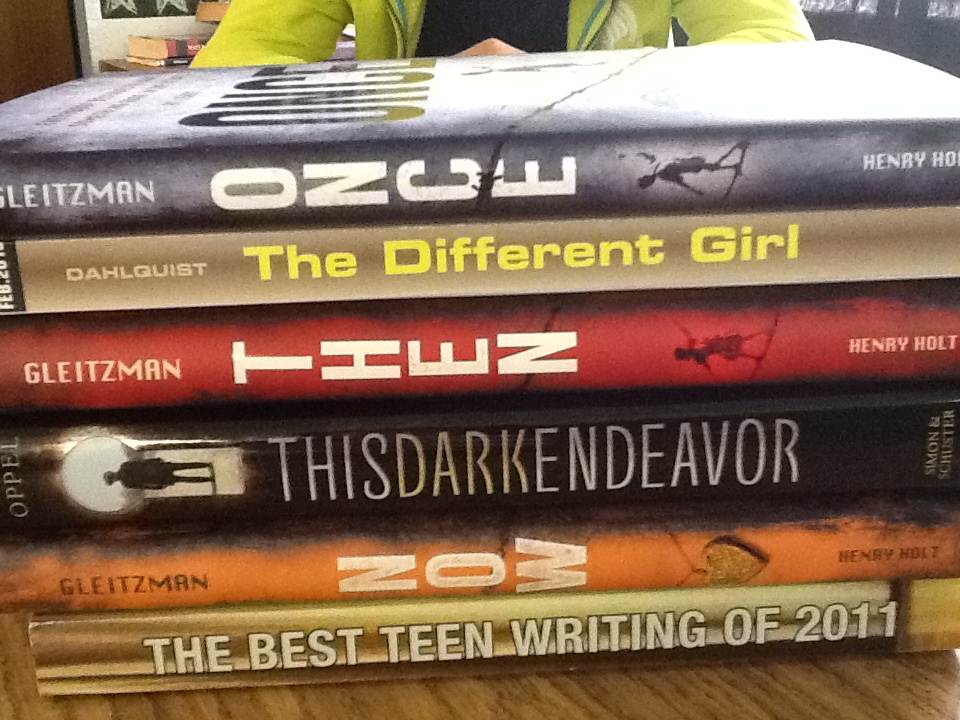
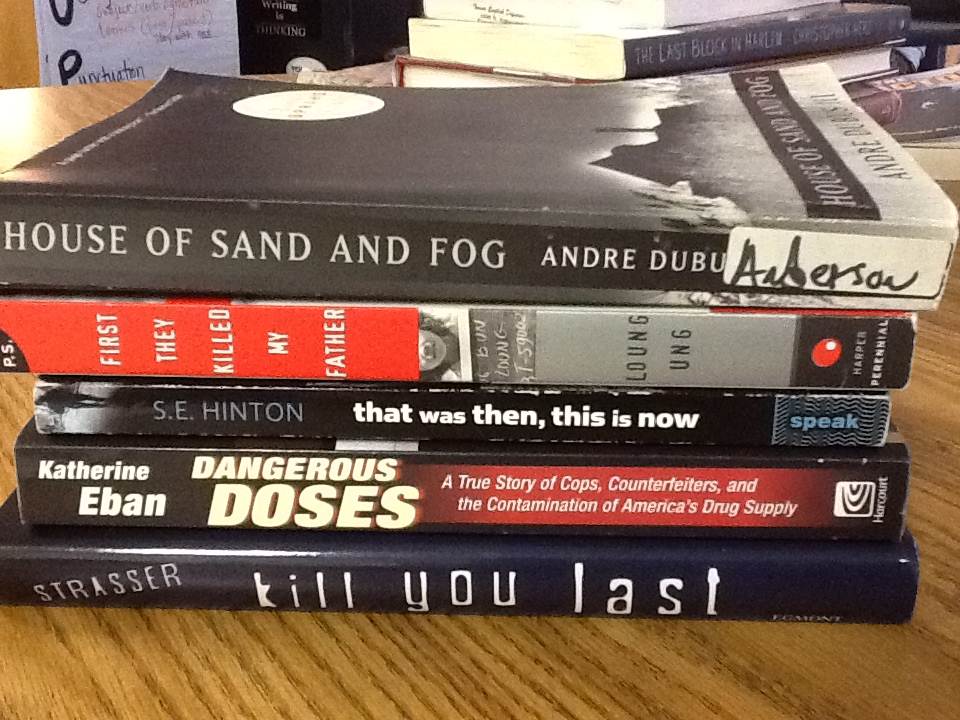
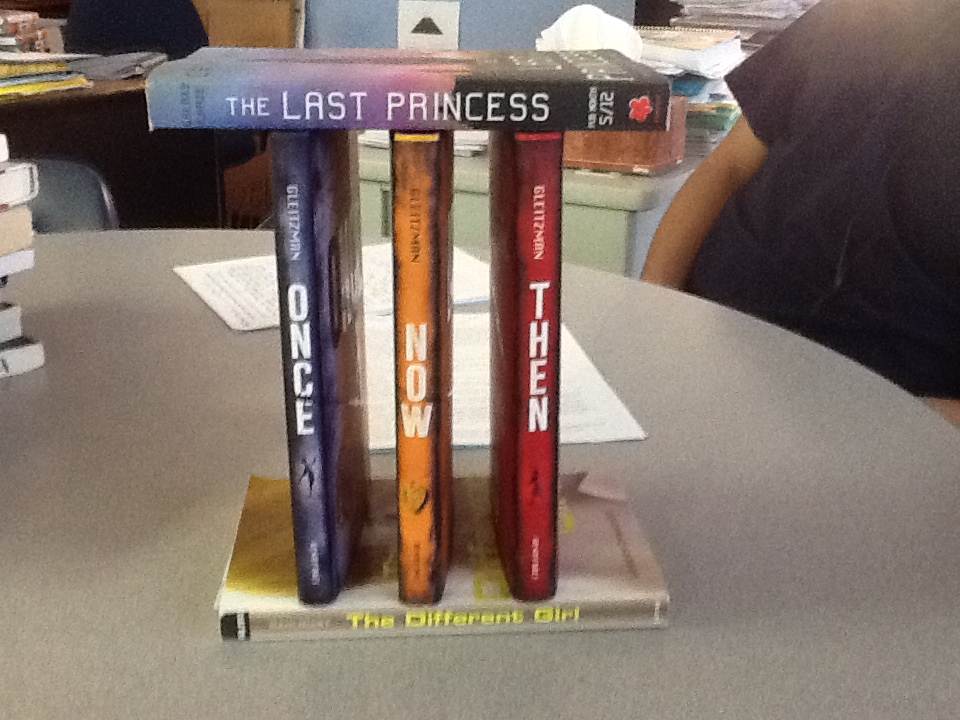
Spine Poetry: A Hit and a Bonus

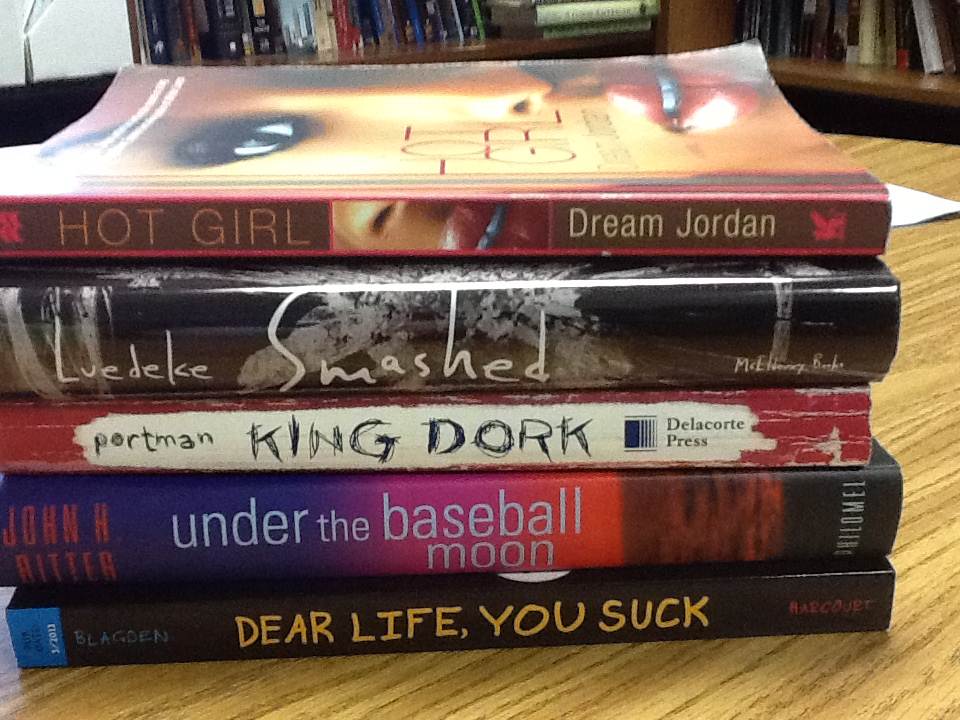
I didn’t carefully read this post Wanted: Any and All Book Spine Poems, but I took the idea and ran with it. Now, I need to let 100 Scope Notes know about our fun as we kick off National Poetry Month.

The Friday before spring break I needed something engaging to do with students whose hearts, minds, and souls were already on vacation. Classes were short, and we only had 35 minutes.

Creating spine poetry did a few key things:

1. Students had to read book covers–and, BONUS, some kids even checked books out from me after class.

2. Students had to think about words that would create topics and themes in order for their poems to make sense.

3. Students had to read their poems aloud, making sure that even without punctuation, their poems could be read with some kind of rhythm.

4. Students got a little introduction to the much more rigorous study of poetry we will do this month.

The Process:  I have eight round tables in my room. I took a big stack of random books from my classroom library shelves and stacked them on each table. I showed the one model in the link above, and told students to get to work.

  • Create a poem, using only the words on the spine of the books.
  • Your poem must make sense–if it has a theme, even better!
  • You must use at least five books.
  • Someone in your group must read your poem aloud to the class.
  • Let me know when you are finished creating, so I can take a picture of your stack of books to show the class.

Here’s what my 9th graders created. Some make me proud.

Picture1

Picture2Picture3Picture4Picture5Picture6Picture7Picture8