Tag Archives: Poetry

Illegal Poetry

While skimming one of my social media feeds I saw an article from the Huffington Post, Arizona Education Officials Say It’s Illegal To Recite This Poem In School. Of course, because Amy and I are presenting about poetry at TCTELA at the end of the week, the title itself peaked my interest. Briefly scanning it, and not thinking much of it, I sent it on to Amy as just one piece in a dozen I’ve scanned while preparing for our presentation.

In Amy fashion, like she always does for me, she shoots back, “Good one. What’s your take on it?”

Well, honestly I hadn’t really thought about my take on the subject, I was really just thinking about it as a reference that there is censorship in schools even in the genre of poetry. But as I started thinking about it I really generated more questions than answers:

1. What role should a state or federal government play in the specific materials that are used in an individual classroom? I certainly know that this question will continue to linger for me as the state legislators are about to reconvene here in Texas.

2. How do we prepare students for the culturally diverse world they live in when they are not given the opportunity to learn about different cultures? The article mentions that, “The law forbids classes that promote … or treat students as members of a group rather than individuals,” but I wonder to what end. Isn’t my individuality in some way tied to my identity to a particular group? And that’s not to say just ethic group, but also as an educator, a mom, a writer, etc.

3. The article also mentions that if the school district will receive 10% less in state funding if they do not comply with the state mandates. I’m not naive enough to believe that a simple slap on the wrist would be an effective punishment, but if there is a funding cut who are they really hurting, the school district officials or the students of that district? 

Above all though, if you read the portion of the poem that is included in the article, I find it most interesting that there are no terroristic anti-democratic overtones, as one might suspect based on the opinions of those that oppose the piece, rather a sentiment of mutual understanding and respect.

I would now like to return the question to you, Amy, and anyone else who would like to join in the conversation. “What’s your take on it?’

7 Ways I Read for Resolutions

I’m pretty sure I started making New Year’s Resolutions in about 1976, the year I got my first notebook for Christmas. I was 12. I’m pretty sure that every list of resolutions since then had “lose weight,” and “keep closet organized” penned on the page. Thanks to my daughter and her contagious 5K-junkie attitude, in 2014 I lost a lot of the weight I’d been lugging around the past several years, but I’ve given up on the closet. (That’s what doors are for.)

This year? I hesitated even thinking about my goals. I simply did not know where to start.

With the hope of getting ideas, I turned to my Personal Learning Network, some I know personally and some online.

1. I read my online-friend Elizabeth Ellington’s “Top 10 Reading Goals of 2015” and got a tiny inkling of ideas and a little overwhelmed. Elizabeth is a sharp educator and a brilliant and prolific blogger. I learn from her often.

2.  I read this post, which I saw Sir Ken Robinson tweeted. It begins like this: “This New Year’s day I will not be trying to moderate Sancerre consumption, cut back on Nicorette gum, exercise more or aim to finish my next book by Easter. I have decided to postpone all resolutions until February 19th which according to the Chinese calendar is the ‘ Year of the Sheep.’”

“Year of the Sheep?! Hmm. More time to think of good resolutions,” I say to myself.

3. I read my colleague Erika Bogdany’s post “Cliche No More,” and it takes me to my knees. Erika writes:

“. . .every morning with the heat blasting . . . there’s an essence that is viscerally undeniable.  I walk into a space, a quiet and waiting space, that invites risk, mistakes, setbacks, and quite frankly – the undeniable ugly.  Yet, there is no judgement, discerning undertone, nor slight anticipation that today there will be no progress.

Why would I want to leave all of that in 2014?!”

The last few weeks before the break were hard. My failure rate was out the roof, and after contacting parents via email and a translator, and meeting with an assistant principal for an hour and a half, and forcing myself to leave a stack of 120+ essays on my desk at the demands of my worried husband, I began to question everything I’d accomplished in the fall. All that choice reading. All that critical writing practice. All the relationships with my students. All of it.

I’ve grown because of my challenges. My students have grown as readers and writers. Why would I leave all of that in 2014?

For some reason God wants me teaching in high poverty schools. (This article helped a few things make more sense: “What if Finland’s Great Teachers Taught in U.S. Schools“)

4.  I read at Electric Lit, one of my favorite new sites: “Writers and Editors on Their Literary Resolutions.” Read it. You’ll see why it made me feel better.

5. I read Seth’s blog: “Used to Be.” And these words resonated:

“Used to be,” is not necessarily a mark of failure or even obsolescence. It’s more often a sign of bravery and progress.

If you were brave enough to leap, who would you choose to ‘used to be’?”

I repeat to myself, “Who would you choose to ‘used to be’?”

6. I read my poet-friend Dawn Potter’s “New Year’s Letter,” and felt the burn of my own candle. Dawn reminded me of my love for words. She sent me back to The Frost Place and the hope I had last summer.

Tweet this: I can do this. I can set goals for the new year. I can push through the closet and other things that annoy and exhaust me. I can be better. Do better.

7. I read a message from my friend Whitney Kelley. She asked if I followed Poets & Writers and got their daily prompts. I do now.

Today’s poetry prompt:

Screen Shot 2015-01-01 at 5.57.16 PM

I pulled out a new notebook that Whitney gave me for my birthday in December. I uncapped a new pen. And I wrote.

I don’t even care that it’s not very good. Just like this new year — It is a beginning.

I’d hope for world peace but

inner peace matters more to me right now

My daughter left this morning

She’s driving to her new life 2,000 miles from mine

I want her to go

Until I don’t —  I can be selfish like that.

I hope for greater love and

out-of-my-way kindness that he needs

That I need

I hope for burning lights and blurring lines and bold declarations

Be me. Be you. Be decisive and strong.

Let’s live a little and live a lot

Seek for understanding and

Understand for seeking


I’ll meet you at the airport with the camera

Poetry in AP Lang

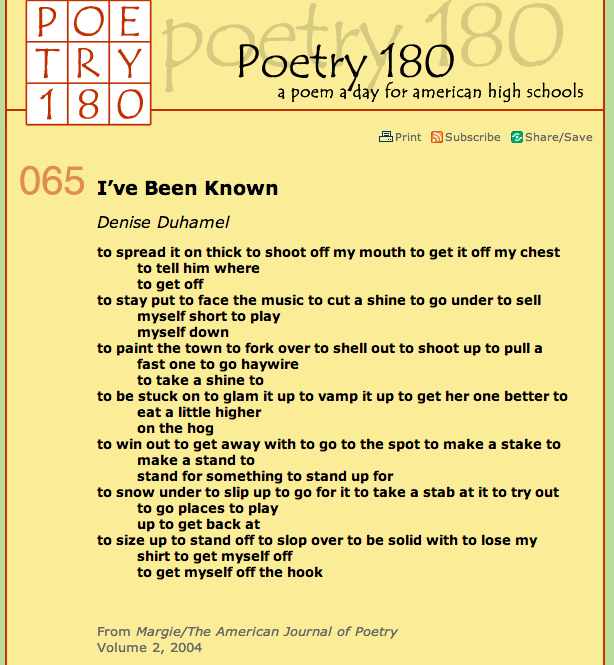
Do you subscribe to Poetry 180 through The Library of Congress? It’s probably the single most valuable thing I’ve done as a way to remind myself to use poetry in my AP English Language and Composition class. We read and write many an argument. I often forget about the poetry.

But I read a poem every day. You can, too. Sign up for a poem in your inbox here.

Some days it’s a natural fit to incorporate the poem into my lesson. Some days it’s a little more complicated. Some days I don’t even try to make the poem fit — we just enjoy the language.

Like this one today:

Screen Shot 2014-12-10 at 6.26.56 PM


Craft Study – Brown Girl Dreaming

20821284Jacqueline Woodson is a native first of Columbus Ohio, then of Greenville, South Carolina, and finally, Brooklyn, New York.  Her nomadic childhood during the tumultuous 1960s and 70s inspired this incredible memoir in verse, which is surely the only autobiography I’ve ever read in poetry.  Layered with tales of tragedy, uprooting, defeat, dreams, and hope, Woodson conjures a nostalgia for her unique upbringing with ease.  She explores themes of family, race, poverty, education, and our life’s callings in this beautiful text.

I can’t wait to share Brown Girl Dreaming with my students. There are so many amazing poems that make up the text as a whole–from the spot-on “stevie and me” (If someone had taken/ that book out of my hand/ said, You’re too old for this/ maybe/ I’d never have believed/ that someone who looked like me/ could be in the pages of the book/ that someone who looked like me/ had a story) to the haunting “what’s left behind” (Sometimes, I don’t know the words for things,/ how to write down the feeling of knowing/ that every dying person leaves something behind.).  But the one we’ll imitate for craft is “what i believe,” which brilliantly combines repetition, deliberate contrast, and an elegant articulation of Woodson’s beliefs.  I hope it will lead my students toward a “This I Believe” essay, and toward wanting to read this book in full.

From Brown Girl Dreaming, p. 317-318

I believe in God and evolution
I believe in the Bible and the Qur’an.
I believe in Christmas and the New World.
I believe that there is good in each of us
no matter who we are or what we believe in.
I believe in the words of my grandfather.
I believe in the city and the South
the past and the present.
I believe in Black people and White people coming together.
I believe in nonviolence and “Power to the People.”
I believe in my little brother’s pale skin and my own dark brown.
I believe in my sister’s brilliance and the too-easy books I love to read.
I believe in my mother on a bus and Black people refusing to ride.
I believe in good friends and good food.
 
I believe in johnny pumps and jump ropes,
Malcolm and Martin, Buckeyes and Birmingham, 
writing and listening, bad words and good words–
I believe in Brooklyn!
 
I believe in one day and someday and this perfect moment called Now.

Getting Students Hooked on Poetry

“Poetry is boring.”

“What does poetry have to do with anything?”

“What does poetry even mean!?”

“I hate poetry.”

Poetry is a timeless form of writing, yet students struggle to see its relevance to their lives.  Further, they struggle to understand the themes and messages poetry attempts to communicate.  After weeks of asking them to read like writers, my students did begin to find some value in poetry, but they still didn’t like it.

Thus began my endeavor to present poetry as exciting, interesting, and most of all–fun.  What follows are three poetry activities my students were engaged and challenged by.

IMG_5382Spine Poetry

Creating book spine poetry is not a new concept–it can be found all over the internet.  I first got the idea to do this activity in last year’s UNH Literacy class with Penny Kittle.  Not only does creating spine poetry get students playing with language, it also exposes them to a wide variety of titles.

I modeled the creation of a spine poem for my students, stacking and re-stacking titles by John Green, Max Brooks, Jon Krakauer, Malcolm Gladwell, and more.  I modeled, with their input, until we had a poem that satisfied us.  I also showed examples of a variety of spine poems on the projector.  Then, students worked in groups to create their own spine poems, eventually writing their finished products in their writer’s notebooks after adding punctuation and a creative title.  I noticed many of them adding new titles to their what-to-read lists, too.

IMG_5332Cemetery Poetry

Edgar Lee Masters’ Spoon River Anthology is a wonderful collection of poems inspired by graveyard epitaphs.  Lives and legacies are explored in Masters’ work in a variety of styles.

I wanted to have students practice imitating this poet’s craft, as he is a master (pun intended!) of showing, not telling.  We have a beautiful old cemetery quite close to our school, and it was a gorgeous September day for a walk.  My students toted their writer’s notebooks to the graveyard and we read three of Masters’ poems together.  I asked students to wander the cemetery and find a gravestone that appealed to them, then imitate one of the poems we’d read, using that headstone as a subject.  My boy students especially loved this assignment–they were drawn in by the quiet atmosphere of the cemetery and its prevalence of Civil War graves.

IMG_5125Spoken Word Poetry

Shane Koyczan, Taylor Mali, and Saul Williams have soared to YouTube fame with their spoken word and slam poetry performances.  They are forceful presences on stage, and their-in-your-face styles often hook my students.

Sarah Kay provides a lovely contrast with her soft-spoken performances, her clear voice spinning tales of love, motherhood, and femininity.  We read “Point B”, pulled out its richest lines, and hung them around the room.  There were eight in total, and students responded freely to these beautiful words on post-it notes in a silent discussion.  They wandered the room, sticking their responses onto their favorite lines, and then responded to one another.  Their close readings gave way to analysis as they challenged each other, left questions, and cheered classmates on.  Weeks later, a student quoted a line from “Point B” in a discussion–this activity had seared “this life will hit you hard in the face” into her memory.

Stacking books into spine poetry, imitating poems about gravestones in a cemetery, and silently discussing spoken word poems transformed my students’ perceptions of poetry.  Words that were once lifeless on the page came alive.  This week, they reshape their own identities and wear new hats as poets and writers–hats that, thanks to our poetry fun, are not as unappealing as they once seemed.

Poetry at The Frost Place: Don’t Stop Believing

The Frost Conference on Poetry and Teaching is over. Those who didn’t leave yesterday left today after the Teachers as Writers workshops. The hugs good-bye were those of life-long friends, sad to part, but a little eager to get on the way. The small community grew so quickly. Sharing a love of language will do that to people.

I pull into the Kinsman Inn where I have shared a roof and a home-sized breakfast every day this week with, as Margaret said, “The kindest people I have ever met;” and the gravel lot is full with the cars of total strangers. I walk inside and even Sue the innkeeper says it is not the same. We feel it. The magic of the week is over.

I never cared for poetry. Looking back I know that attitude stems from the way I was taught. I never experienced the simplicity of words that I’ve experienced here. Even when I’ve taught poetry in class, especially those two years with my G/T students, I tortured them with bad teaching. I’m embarrassed to say I gave them a packet, and we read through the poems ‘analyzing’ as we went, never stopping to just listen. Listening is the secret I learned this week, but the secret was never meant to be locked a way so no English teacher could find it. It’s not even a secret really. Poetry is art; art has to be experienced. A packet doesn’t offer that to anyone. I’ll argue no matter the content, but that is an topic for another day.

Imagine this scenario:  Each morning you walk into the small Frost barn. You pull out your pen and wait

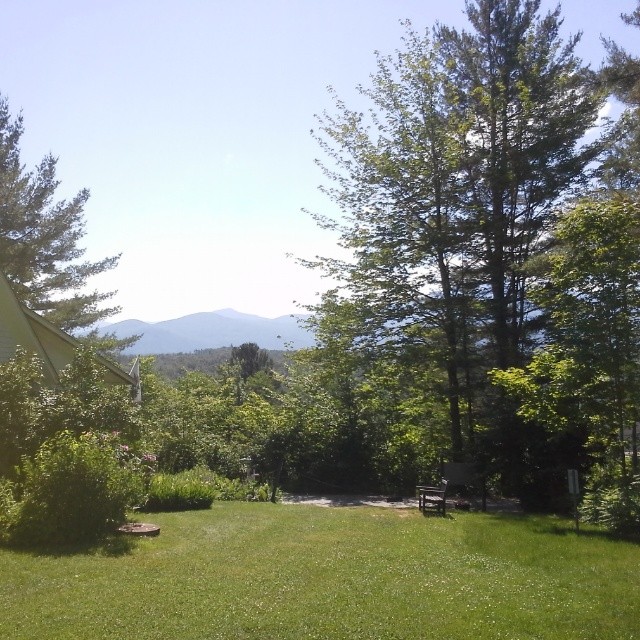
At the evening poetry readings at Frost's barn, the audience is invited to turn around and appreciate the view. Inspirational.

At the evening poetry readings at Frost’s barn, the audience is invited to turn around and appreciate the view. Inspirational.

for the morning’s dictation. Alyssa slowly reads a poem in her soft con-alto, stopping every so often to state a word that is capitalized or where to place a comma or period. You listen, and you write. You focus on the voice, the words, the phrases — the silence created by the pauses. You fill the page with this focused thinking.

After everyone arrives, you welcome the morning, and Teresa opens Robert Frost’s notebook and shares a significant line. “I don’t change my watch every time I see a watch it differs from.” We talk about living in the discipline — not in the product. Dave with a voice to rival God himself finally speaks out:  “We do not live in a culture that embraces silences.” We all nod.

We talk about poetry and teaching and teaching poetry. Then we share presentations filled with classroom practice or philosophy. Again we discuss — “civil engagement,” as Dawn coined it. Our notebooks filled with ideas we can use to give our students similar experiences.

The most impressive thing? We talk to each other like poets.

And that is what needs to happen in the classroom. So often we teach poetry and reading and writing when we should be teaching poets and readers and writers. Of everything I’ve absorbed this week, and this is saying a lot, I believe this simple thing will make the most change in mine, and anyone’s, classroom. 

Today several of us sat around in a circle and shared original poems that we’d composed yesterday. The only instruction for feedback:  What are the possibilities? No critiques. No corrections. Just suggestions on how the poet could play with words.

“If you do not play, you will never know,” Dawn reminds us. Isn’t that the best revision strategy ever? Just play with words, phrases, stanzas, rhythm, structure.

I want my students to play. I want them to have a tiny bit of the silence I’ve experienced this week. I will have them practice dictation — a sure way to quiet the mind and prepare for inspiration. I will continue to allow choice in reading and writing topics, and we will play.

Nicholas told me he never read a book on his own until college, but now he has an MFA and a knack for words. I can’t help but wonder if his gift might have come quicker — not the long sidetrack he took to get here — if in all his English classes he had been spoken to like the poet he is. That is worth a thought. Or two.

Today when I left The Frost Place for the last time, I turned the opposite direction on the road. I’d not gone this way all week. The lane was longer, but the view quite the same. But God must have been the one to turn the wheel because as I came to the T in the road, there stood the stop sign telling me “Don’t STOP believing.”

Don’t STOP believing. Can it be any clearer?

I won’t. I found the seat of my soul, and it is steeped in poetry.

Here’s my poem from the writing time today. I imitated the structure of Hayden Carruth’s poem “Twilight Comes.”

Twilight comes to the busy town

As season’s start. The tree tops

brown with leaves, which colored

And began falling during the heat,

Are moving again, and crack

under the wind’s breath. The buildings

from their place across the highway

crowd close again, as if for a

threatening glare, and with malice

An exposition as the sun slips

low. It is my fiftieth year. Horns

blare out one by one with a clashing

dullness, like the unfelt prayer

in church. I hear the dogs barking

pushing their noises into my peace —

I touch — and clearly — I am quite certain —

tightening muscles; perhaps hot iron

on the right side under my shoulder

or unusable rope on a sea-stuck ship.

It’s true. My man is on the phone,

there inside the living room. Clients

will close soon. I crack my paining neck

And bow my eyes to study the dead

root-bound pot on the patio

in the shadows. I sigh. Then

sigh again, just because it’s true.

I am going to be old. Too soon.

Zen and the Art of Conferences

Last year I needed to find zen or I would die. My muscles were in such knots at the end of the school year my chiropractor prescribed regular massages, hot baths, and as many vacations as I could manage.

I went to New Hampshire.

Here I am again. This time I am at the Conference on Poetry and Teaching at the Frost Place in Franconia, a tiny little place where the air is clear and the nights are darker than I’ve experienced in a long time.

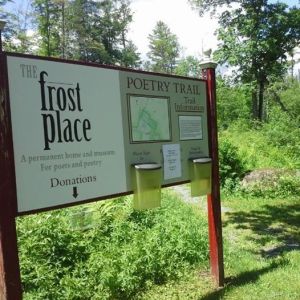
This conference is different: Only 14 participants this year. All focused on the art of poetry. Some are frost place signworking poets. Most are working teachers. I heard about this conference on a Twitter chat, and since my return trip to the UNH Literacy Institute, which was already planned, happened to be on the calendar for next week, the stars aligned. I find myself here, staying at a gorgeous bed and breakfast listening to rain fall gently on the old but sturdy roof.
It is day four, and I’ve learned more about poetry and poets and revision and analysis than I learned in all the classes leading up to my degree in literature. Oh, to give this kind of learning to my students!

Here’s some highlights and why you will want to come to this place as soon as you are able:

1. Guest poet workshops. Iain Hailey Pollock visited first. He shared lessons from his classroom, his experiences as a writer, and the most engaging Poetry Death Match, a contest with one poem survivor. That evening Iain read his work. If you are not familiar with his poetry, order the collection Spit Back a Boy immediately. Next, Meg Kearney, poet and author of two YA novels in verse:  The Secret of Me and The Girl in the Mirror, taught some creative writing activities with a selection of extended metaphor poems, and we wrote our own (or tried.) Meg read a piece she’d been asked to write about her evolution/revolution as a poet, which stung my heart — her hope and search for her birth mother, her raven dreams. So beautiful and haunting. When she read that evening my heart was on fire. I know why people fall in love with poems and poets.

2. Teacher presentations. Each day individuals have 20 minutes to share ideas. Might be something from their classrooms, something they are reading, some questions they just want to ask. Lisa from Indiana shared a packet with titles and descriptions of YA novels in verse. (Can you guess what the next shelf I’ll build in my classroom library?) Nicholas read an argument he wrote about the need to introduce students to contemporary, accessible poetry, before they meet the master, William Shakespeare. Michael shared a random word activity, and we all wrote random poems. Here’s mine:

(thunderstorm, mouse, moose, faster, shark)

Like a thunderstorm during a shark attack

my heart beat faster and then exploded

like a mouse with the soul of a bull moose.

I present tomorrow. Before I came I was nervous. Poetry was never my thing. Now, I am confident. A community can do that to a person.

3. (Although I haven’t done it yet) Each participant was challenged, just short of pressured, to read a poem tonight at the evening reading. Talk about scary and intimidating. The director Dawn Potter is a working poet. Read her poems and you will see why my knees are already shaking. Her collection of poems is Same Old Story. You will want to own it. And Teresa Carson’s My Crooked House, too. Teresa read on Sunday.

Encouraged and inspired by Teresa and Dawn’s work, and Meg’s awesome poem “Creed,” I wrote my own that I will share tonight. It’s modeled after Meg’s in form, but I only lifted three of her lines.

I believe in heaven and hell

although hell seems easier to believe in. I believe

writing is a key to knowledge earned

through paper and pen; I believe peanut M & Ms

are good for stress; I believe I am a petite

in a full-sized dress, which does not

make me weak, indulgent, brazen, or fat.

I believe “mother” is the greatest name

on the planet; I believe my hands

have the power to heal tho words

soothe wounds much swifter. I believe in dancing;

I believe in email; I believe in knocking on wood, we make our own luck,

and if I finally have the perfect hair day, it

will rain — not because I am vain, but

because life is often a pain. I believe in pain:

kidney stones, a grandma’s death, a small child’s heartache,

child birth, child birth, plus four more. I believe in the long tight

hugs of my friend Kenny who holds on like each moment is 

the last. I believe in drinking the last can of Coke, and

it’s a good idea to hide the evidence. Holding grandbabies

is a blessing of the good life unless they live too far away.

I believe marriage should be between a man and a woman, and 

the foundation of my Faith rests on it. I believe in God, and if I pray enough,

everything is easier. Do you know He loves you? Do you know His son?

I believe the day my mother died her mom and dad were there to greet her,

and when I felt her squeeze my shoulder from

an earthlife away, I knew the spirit goes on living. 

We never got to say goodbye. The disease robbed much more

than her words. I believe that’s why I have this ache

in my heart. Sometimes it’s a whisper. Sometimes it’s a

tornado. I believe I will miss my mother every day of my life.

I believe that holy scripture is the best kind of poetry. I believe

good teachers plan, great teachers plan with students, and if I’d only stop trying to

control everything I’d need less massage. I believe

fathers should be present; I believe plants are better gifts than flowers. I believe milk 

should be pink on Valentine’s Day, and “There’s a Right Way to Live and

Be Happy,” Cowboy Stadium could have bought a billion books, and the best frozen custard

is in St. Louis. I believe in action movies, White Christmas, Michael Buble, and 

Friday Night Football, and that my future grandchildren

are my guardian angels. I believe in the honest work of my children, and if you touch me

righthere, right here at my heart, you’ll feel the

wholeness of a mother’s love and the completeness in my marriage.


I have fallen in love with poetry. You, dear reader, should meet me at this conference at the Frost Place next year. Simply amazing.

I am blessed.

Ending Our Year with 60 Second Shakepeare

Sometimes we just need to celebrate. My sophomores just finished their Shakespeare projects, and a few of them are so fun!

Small groups chose one of Shakespeare’s plays. They read the graphic novel of it, read the summaries to be sure the graphic novel hadn’t left out any crucial information, read all the most familiar quotes from that play, and then had to get to work.

We watched examples of 60 Second Shakespeare found here. And we laughed and talked about our plays and the messages Shakespeare conveyed in them. We discussed topic vs. theme. (Mistaking the two is close to the top of my list of pet peeves.)

As a whole class we decided on the elements that we would need to include in our own 60 Second Shakespeare project. Students took ownership.

This is the guide they created that lead to their learning:

60 Second Shakespeare Project

I’m sharing a student project that surprised me. Two young women, both ESL,  who have struggled all year, made this four part set of GoAnimate.com movies for their project. Of course, five parts (Acts) would have been better, but still.

Twelfth Night

Part I

Part II

Part III

Part IV

Lest anyone think we didn’t give the Bard his due and read critically, analyzing symbols, word choice, and more, we did. We just did it with sonnets and speeches from a couple of his works.

All the Worlds a Stage argument essay ties the skills and the content for the unit together.

Thanks to students who were willing to take a risk with some Shakespeare, we’ve ended the year in Pre-AP English II with some laughs and deep learning. And they can for sure tell you why we read Shakespeare so many centuries after he wrote this great literature.

“It’s all about humanity and how we relate to one another,” said one student. He gets it!

P.S.  This one got presented late, but it’s too great not to share:  Hamlet

Playing with Poetry

They think poetry is boring. And hard. They do not think it is beautiful, bold, or bursting with meaning. For the past two weeks, I have tried to change that for my PreAP English I and 2 students.

I copied a variety of poems. Some long. Some short. Some richly complex. Some easy. We glued them in our notebooks, and we took our time reading them each day. Sometimes we wrote responses. Sometimes we just read and talked. They liked this talking best.

We watched some spoken word poets share their love of language in moving poems they shared with the world. This one by a young poet at a school across town helped students see hat imagery creates emotion.  This one by Sarah Kay helped students see that repetition does more than just “emphasize” a point.  And this one by Shane Koyczan that we’d watched at the beginning of the year and watched again helped students see that poems — more than anything else — allow us to express the ache that can eat our souls if we don’t release it.

Oh, words.

I heard over and over again as we read, discussed, and listened: “Oh, I get it.”

Lights of understanding twinkled over teenage heads.

I learned a valuable lesson (or two). I must integrate more poetry throughout my lessons ALL YEAR LONG. My students and I both enjoyed it. Go figure.

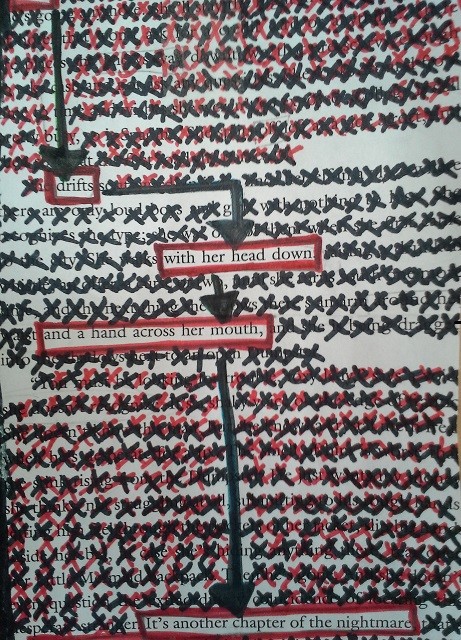
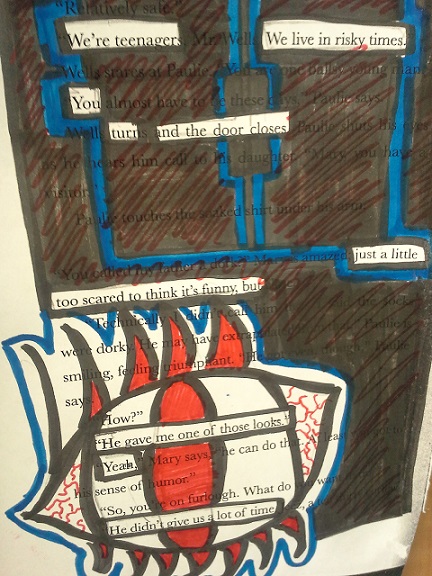
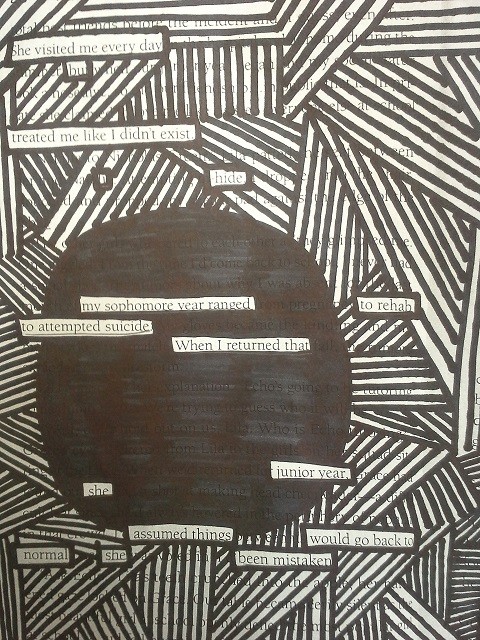
We especially had fun for just a day. And we “wrote” black out poems. black out poem AilsaSome were pretty sloppy, but some were pretty cool. See?black out poem Lifeblack out Truthblack out Ariannablack out designblack out Alexa

black ot Yulisa


Vocabulary Haiku for Fun Friday

Since it is poetry month, and since the same old same old with vocabulary practice–and getting students to actually use the words they know– is wearing me to the bones, today we wrote Vocabulary Haiku poems.

vocabulary haiku

I love these:

She got so very close

animosity all around

kindness seemed all lost.

~Ruben and Franky

people on the earth

aroused metamorphosis

from dirt to buildings

~ Michelle and Mian

soft leaves hanging on

and hoping to engender

one more light rustle

~Frank and Levi

faces glow like stars

your smile bows from side to side

felicity grows

~Elizabeth and Melissa

the girl felt intense

she was really mad at her mom

she used censored words

~Yohana and Diana

Oh, why, Bill Clinton?

You committed perjury.

Was she worth your time?

serving a purpose

a utilitarian

always serves its role

~Kathryn

from a little pest

the metamorphosis has

made me a nice guy

~Diego

A frown on her face

ANIMOSITY in bold

filled her cold body

~Jesse and Courtnye

church bells are ringing

consecrated passion

Love is Eternal

~Donovan

It’s time for a change

Time for a new look in life

metamorphosis

~Itati and Aaron

Nature smiling bright

Felicity runs along

wild winds with bliss

~Helen

~Michael and Emilio