Tag Archives: Organization/Planning

Making Workshop Work in my AP English Class

Our Compass Shifts 2-1It wasn’t as bad as I thought.

For those of you who read my post on Thursday where I bemoaned the weak essays my students produced on their most recent mock exam, you know what IT is. My students’ lack of application–the skills I’ve taught merged with their own deep thinking.

All in all, scores, compared to those in the fall, showed improvement, especially in multiple choice. I must celebrate that.

I know that year after year it’s the students who are readers who score well on the exam. The best readers are also the best writers. That’s not surprising.

What is surprising is the arrogance of many of my students, or maybe it’s not as much arrogance as naïveté. They think they know more than they do. They think their skills are sharper than they are.

I know this because they told me.

Friday morning, I began class with the opportunity for students to reflect on their performance on the mock exam. I put a large sheet of paper on each table and asked students to have a silent conversation with their table mates.

“Write what you feel you did well? And then respond to the writing of your peers.” I gave them about two minutes and then moved the papers among the tables and had students read and think and respond again.

Then I had them turn the papers over and write again. This time: “Write what you think you need to improve on. Remember to think about all the different parts of the exam.”

This is where I learned the most about my students. They wrote things like:

  • I need to manage my time better.
  • I need help with the synthesis question (or rhetorical analysis or persuasive).
  • I need help understanding the multiple choice questions.
  • I need help organizing my essays.

And on and on and on. They all know they need help with something. This is good.

But when I asked:  “Did any of you write ‘I need to become a better reader?'”

Silence. In both class periods. Not one of my 49 AP students thought to write “I need to be a better critical reader.”

Therein lies the problem.

Students misread the prompts, and on the synthesis, the sources, as often as they lacked organization in their essays. A lot.

The AP Language and Composition exam is as much a reading test as it is a writing one. I imagine the other AP exams are as much about reading as their contents, too. Students must be critical readers to do well.

So, how does this matter when it comes to my instruction?

Simple. If I want my students to keep improving,  I need to not only continue to get them to read MORE, I must keep teaching them how to read BETTER.

We’ll study short passages, looking for connotative meanings and nuances. We’ll discuss the function of this and the organization of that. We’ll slow down and discuss more.

I heard Kylene Beers say once, “The smartest person in the room is The Room.” I know I need to allow more time for class discussions where students can learn from one another.

I know I need to more effectively model how to think as we read. I learned from Cris Tovani to teach kids to keep the little man in their heads focused on the reading at hand. Too often students do not know that they have to train the little man before he will stay focused.

Tomorrow, we get out the training net.

Tomorrow, I change the balance up a bit. I revise my instruction yet again.

The constant reflection, the feedback, the changes — all parts that make readers/writers workshop in an AP class, or any other, work.

Reflections of a No Good Very Bad Day

The scores kept getting worse. With every essay, hope died. A slow and agonizingly painful death. How could my students have done so poorly on this mock exam? We just reviewed the day before: Remember to do this and this and this. Remember to read and think and annotate. Remember to organize your thinking and write and write and write.

How can there be blank pages in these question packets? How can there be no thesis statements? No organization? No evidence of thinking?

Really??

Why do days like this make me feel that on other days I must be talking to my self? Yep, I stand right there in that classroom I’ve made so homey and have a conversation with myself about the skills needed in order to successfully master AP Language.

I know I taught how to deconstruct a prompt. I know I taught how to use the rhetorical situation. I know I taught how to craft a position statement and how to develop it. I know I taught how to synthesize sources and cite them in an essay. I know I did. The anchor charts with all the details line my walls as proof of my instruction.

But this stack of essays? These essays tell me something I already knew half way through the second stack:  You might have taught it, but they certainly didn’t learn it.

So, whatcha gonna do now?

And therein lies the reason for yet another sleepless night.

Sometimes I dream of what it would be like to teach at a school with little or no poverty. To teach students who read at and above grade level. To teach students who not only have a plan for college but know who their roommates will be and the dates of pledge week. To teach students who really are AP ready.

I have a handful, but on days like today, after scoring essay after essay after essay for almost 8 hours, I cannot help but wonder.

And then I remember:

I love the challenge of matching books with kids. I love the glow they get when the book stings their hearts, like The Fault in Our Stars did for Adam, and Redeeming Love did for Katie.

I love the awe when we analyze a piece, and the light bulbs burst, and they “get” it, like Kelly’s understanding of the alliteration in George Bernard Shaw’s Joan of Arc. “She’s the devil…diabolical…satan.”

I love knowing that while I may never move them to where they get a qualifying score on an AP exam, I can move them into writing more purposeful pieces.

I can move them into living more literate lives.

And with that thought, maybe I will sleep tonight.


And tomorrow I will figure out how to teach this all again in a way that they will learn it. Really learn it.

haLfwaY tHerE

ocs

The buzzing alarm clock that startles you out of sweet, sweet dreams into the darkness of your frazzled morning is by no means friendly.  (BUZZZZZ…)  Open your eyes.  Quickly!  The abnormally freezing cold of winter; the unimaginable storms that continue to blanket our front lawns and backyard swing sets; the must to have snow boots handy at any given moment accompanied by a shovel and ice brush are in need of your attention – immediately.  The closed-eyed shower.  Fumbling and bumbling around while simultaneously getting dressed, blow drying your hair, making coffee all the while trying your darndest to remain quiet as to not wake other household members is…

Well…quite frankly…getting old; quickly.

The harried morning commute – windshield wipers flailing against the hail and tires shifting in the opposite direction to protect you from skidding– allows you to greet your students (with a smile, but of course!) on yet another cold and unpredictable winter morning.

You made it.

I made it.

We made it.

We have all made it to the half way point of our school year.  Students have pushed themselves in ways we could not have anticipated.  Educators have moved through obstacles with grace and poise.  Administration is pushing harder than ever.  Mother Nature has joined the club.

In the vein of reflection, doesn’t this seem like an integral point to stop…reflect…plan…and dig deep to find our reasons for trailblazing forth?  I think so.  So, here’s what I’ve been doing to keep warm during a brutally chilling winter:

To warm my HEART: I stop planning.  Aside from lesson plans, I have no plan.  I realize that when I stop planning every minute of my day, the most beautiful of moments surface.

From a quick drop in (“Just checking in, Ms. Bogdany.  You good?”) to a first-time-independent-reader so engrossed in Hill Harper’s Letters to an Incarcerated Brother he insists on marking pages to share with me as he passes by during the day.

From a very simple high-five in celebration of a special moment to a poet sky writing his inner most thoughts regarding his hometown.

Sky Writing

See the island of Manhattan, smaller borough
Back on Staten
Cross the county of the kings, then you make your way
to Queens…..

From a post-Regents philosophical discussion about Malcolm X’s beliefs and convictions to a colleague swinging by with, “Your previous Multi-Genre Writing students insisted that Ashlee, whom you didn’t have, show you her creative writing piece because it’s astounding.  They wanted you to see it.  Here it is.”

If my door was closed and my agenda had continued to take control of my day, these beautiful moments that inspire me, would be lost.

To warm my SOUL: I read voraciouslyI live in a sea of literature.  From gathering books from the laundry room’s shared library to the continually growing Francis Gittens Lending Library; I am never sans a book.  Often, I am juggling a few and that includes my new found interest with audio books.  From Room 382 to Apt. 2 (whether themed by topic or color) my soul sings in the presence of literature.

Books Everywhere

New books on display. Students love working among literature…lots and lots of literature.

Rainbow Library

Welcome to my rainbow library. It continues to grow with pieces I’d never imagined would find their home here.
(Feel free to click on the picture to take a peek at the titles.)

And really, what better way to keep warm (during this winter full of icicles) than with a book of choice; pomegranate spice scented candles; and blackberry-vanilla decaf tea?

To warm my MIND: I ask for help when I know I need it.  Yup, pride aside.  Wild, I know.  While I try to be all things for my students, there’s a reality.  And that reality is simple – no one educator can be all things for his/her students.  So, we must find those we trust, branch out, ask for a helping hand and push forward together.  It would be an injustice to not bring them into my ‘teaching loop’ to help motivate and encourage each student they’ve built trust with.  I need them to show me the way.

I also reach out to my PLN, no matter how far, they are always there to help guide, attempt humor, and support in soulful ways.  Their insight and guidance is always a surefire way to refocus my attention to the authenticity of educating.  Of this I could not be more grateful.

So, while we are all bundling up this winter and trying our very best to remain focused in-spite of the blistery weather – which does not seem to be going anywhere, anytime soon – we have much to celebrate.  We’re halfway there!  And instead of looking toward the finish line, let’s all take a moment to enjoy the snow filled scenery and the halfway mark.  It really is a warm place to be.

snow

It’s warm in here! And so beautiful out there!

Make Your New Year Revolutionary

It’s the end of New Year’s Day, and I am pondering resolutions. I should have probably already made some, but the end of 2013 took over my heart, and I am a little behind.

My husband’s grandmother passed away two days before my sweet mother. We attended two funerals in one weekend. Since we had to travel and plan services, I took the last seven days of the semester off, which means I missed reviews and final exams and calculating semester grades. I have a lot to do. And I’m having a hard time feeling like doing it.

But I will. And as I’m thinking about my resolutions I know I need to help my students set some, too.

So many need to read more, write more, do more. And I only have one more semester to help them learn.

So I am going to slow down, be more purposeful in my conversations with students, take more time for allowing them to talk, express, emote.

I am going to extend writing time, allow more hours to create and polish and publish–instead of rushing to meet the end of a grading period like I always seem to do.

I am going to keep filling my award-winning-books-only bookshelf and challenge advanced students to take on more advanced texts.

And finally, I am going to use Twitter more in the classroom: share links to student blog posts, reviews on Goodreads, book suggestions, author tags, and more. Try to model the sharing I do with my own PNL. Twitter made a huge difference in my class two years ago, but I haven’t taken the time to get it set up and going well in class this year. I need to change that.( I’m thinking about Instagram, too, but I’m still mulling around how to use it to promote more reading.)

On Monday I got two messages about resolutions from two of my daughters. Jenna said, “church was all about resolutions. They kept just calling them goals, but I always think a resolution should have a stubbornness to stop something or do something. You know, when people say things, resolutely? There’ something with staying power there. So, yeah, I’ve made some resolute goals for the New Year.”

And Kelly said, “I hope you all are making some New Year’s REVOLUTIONS! Not resolutions because that is lame…And revolutions are big. Make it a year to remember with me!

Next Tuesday my students and I will be back in the classroom. We will talk about being more resolute in revolution readour learning, more intentional as we learn together this spring. We’ll set some new goals.

And if I can figure out how to get students to do all this grading (the one thing that bugs me the most about teaching), well, that will be truly revolutionary.

Happy New Year, friends.

What are your New Year’s Revolutions?

Shhh…We’re Thinking!

Our Compass Shifts 2-1  As we near the end of 2013, there is an exuberance that has sprinkled itself all along the United States as Winter Break has arrived.  Holiday lights decorate homes.  The unbelievable smell that emanates from wood burning fire places gently floats through the chilly night air.  The streets are bustling with last minute holiday shoppers.  Celebratory gatherings have begun.  The decadent hot chocolate, whose heat, penetrates our gloved hands.  Yet I have cuddled into one of my favorite nooks on my oh-so-comfortable couch to think…reflect…and wonder, “How will 2014 be a year that embraces the power of introverts?”

Random?  No.

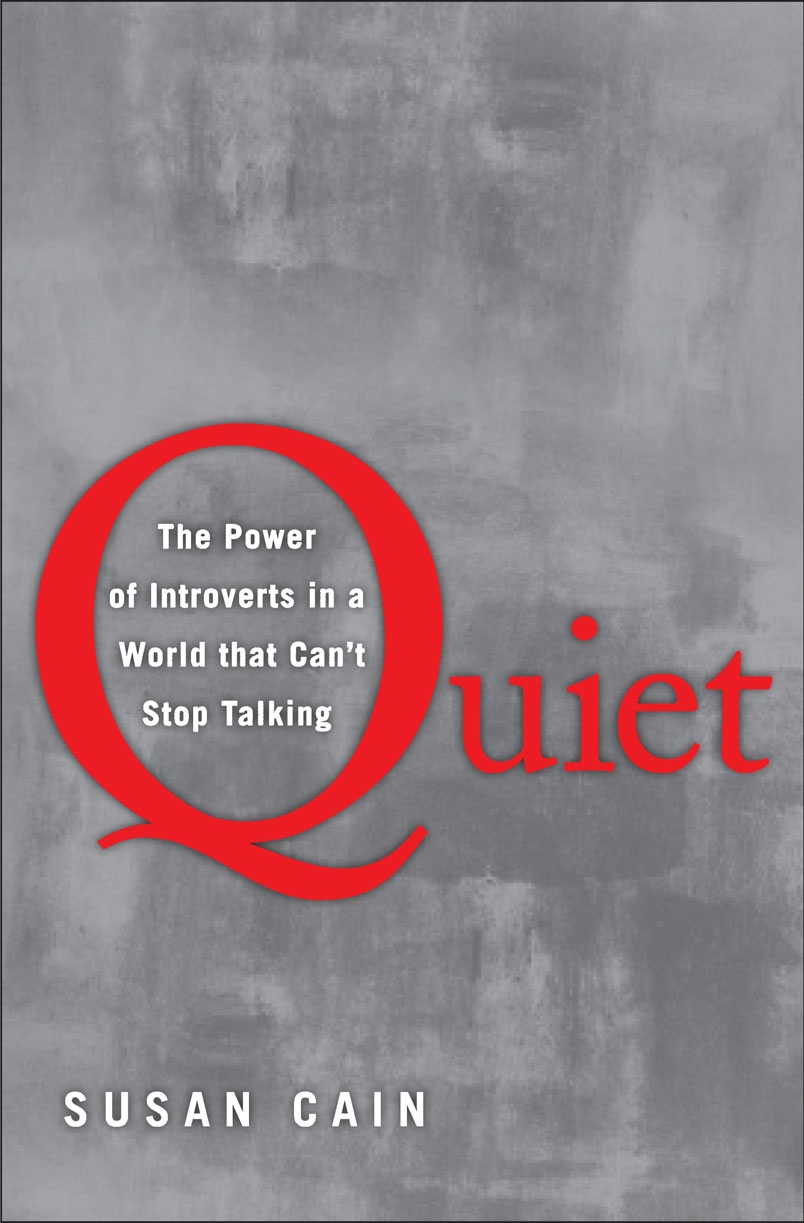
Understanding the world of introversion has been very prevalent, as of late.  My principal finished Quiet by Susan CainQuiet:The Power of Introverts in a World that Can’t Stop Talking by Susan Cain during Book End (our school wide reading program) and placed it in my hands for my own research and understanding.  As I started flipping through the piece, I felt compelled to do more research because the concepts surfacing were a detailed description of how I  move through the world.  Before I allowed my vulnerability to take over and believe everything I read in this book, I wanted to know exactly who Susan Cain was.  As an introvert, deep and thorough understanding of theoretical ideals feeds my soul.  Just saying.

After watching Susan Cain: The Power of Introverts, I felt this overwhelming sense of needing to message this information to my students.  I know, in my own journey as an introvert, there have been moments of painstaking chaos when all I needed was time.  I needed time to gather my thoughts; time to sift through all of those insights; time to expand my ideas; time to understand the surfaced layers of complexity…  I recognize students suffering through the same struggle in room 382 as well.

All students who struggle to find their voice in writing, reading, and communicating need time to build confidence and skill; and this does not necessarily mean they are introverts.  A safe space to explore is essential.  Risk-taking allows students to recognize their mistakes and empowers them to find ways to feel success; and only happens when they know their vulnerability will not be taken advantage of.  We, as educators, are aware of this.

However, the idea of knowing who our introverts are would not stop gnawing at me.  Which students find comfort and growth utilizing outside factors and people to fuel their creativity? (Extroverts)  Which students are comforted by finding their ‘nook’ and looking inside of themselves to embrace their creativity?  (Introverts)  So I decided as a community, we were going to get to know the ‘real’ personalities learning in 382.

If you haven’t already, I highly recommend taking the Myers Briggs Personality Test to gain insight into your own world of learning and understanding.  I introduced the concept to students, passed out laptops, and off they went…embracing an activity that was soon to explain why they are who they are!  Chuckles along the way made the process that much more beautiful.

Students read all about their personality type and were captivated by its accuracy in some circumstances, and inaccuracy in others.  That’s the beauty of this experience; people are “not all or nothing” in any circumstance, this one included.  However, the assessment allows us to be privy to the dominant features of our personality.  This information is priceless.  I love having a better understanding of who the procrastinators are in the room because it’s my obligation to direct anti-procrastinating skills at these students.  Who needs just those few extra minutes when free writing in our Writer’s Notebooks in order to complete a detailed thought?  What students will ‘go with the flow’ because it’s innately who they are?  What students thrive on making decisions with their own best interest in mind vs. the students who think of the impact on others based on their decision?

To understand who is occupying 382 daily; we physically moved to one side of the room or the other as we debunked each category and made sense of what it all means.  It was insightful to see students embracing who they are as young adults; and most importantly, as part of humanity.  Students went on to create posters filled with insight, activities, and “Aha!”s that described the four categories of one’s personality.  The buzz throughout the room was infectious and not one student sat this one out.  Because, when students are invested in learning about themselves, each other, and the world that surrounds them; they thrive.

As students moved about the room, I had a moment.  I was shocked to see 2/3 of my students as introverts!  What?!  Shocked.  I had rationales as to why there was chaos ensuing as the new cycle (and new infusion of students) just started.  I know that deficiencies in literacy typically lead to behavioral concerns if not managed.  I know a two hour intervention course pushes students to limits.  Yet, I had NEVER contemplated that the majority of my students could be introverts.  I mean, the room is always so loud…and chaotic.  Introverts?

Yes. Introverts.

It was at that moment that I realized the loud, chaotic vibe encircling us all was simple.  Students’ innate needs were not being met.  Students did not have the time they needed to think, write, and communicate.  So, after the activity we took straight to our Writer’s Notebooks and reflected.  One student proudly announced, “Many people who think they know me think I’m an extrovert.  They’re wrong.”

So, as I continue to ponder (in awe) about the world of introversion, I can’t help but wonder: How will 2014 be a year that embraces the power of introverts?

Christmas Miracles

ocs

December has traditionally been my least favorite month of the school year.  Something about it bogged me down, without fail, every winter–the dark, sunless days…the mountains of papers to grade…the looming specter of exams–to write, administer, and grade.  I hated my job in December.  From old journals, I know that I was consistently unhappy in the twelfth month of the year, and I wanted to quit teaching every time it rolled around.

This December, though, things couldn’t be more different.  I am LOVING my job!!  Last week, I found myself completely caught up on grading–something that literally hasn’t happened yet this school year.  Somehow, I had plenty of time to plan great lessons, confer with students with no back-of-the-brain worries, AND reorganize my classroom library.  I was a productivity machine–and it didn’t stop at school.  At home, I found the energy to assemble Christmas cards, decorate my apartment, and make some holiday crafts.  As I type this, my fingers are still sticky with powdered sugar from the big batch of cookies I baked this morning.  What’s with the freakish perfection, you ask?  One little, made-up, three-week-old, hashtag of a word:  #nerdlution.

nerdlution-button-tiny-01

Teachers across the country made nerdy resolutions that would be kept for 50 days.  They could be anything–write every day, exercise, a more robust reading life.  A Thanksgiving day Twitter chat gave rise to that wonderful idea, which I hope will become an annual tradition.  Still riding my NCTE13 high, I resolved (nerdsolved? nerdluted?) to spread professional ideas about English teaching any way that I could, every day.

IMG_1036I started by leading an epic two-hour workshop for my English department.  We book-passed (a la Penny Kittle) the entire contents of my professional library, shared best practices in a “gift exchange” of ideas, and made our own heart books (a la Linda Rief) of things we wanted to try.  Afterward, Kristine, a 20-year veteran with a reputation for pessimism, approached me.  “I used to have your energy,” she said.  “I don’t know what happened, but I haven’t had it…for years.”  She teared up, then borrowed Blending Genre, Altering Voice by Tom Romano, a balm for her troubled teaching soul.  Other books from my NCTE haul were checked out, too–Georgia Heard’s brand new Finding the Heart of Nonfiction was battled over by two first-year teachers, Penny Kittle’s incredibly dog-eared and highlighted Book Love and Write Beside Them were taken by veterans, and Tom Newkirk’s well-loved Holding On To Good Ideas in a Time of Bad Ones was checked out by our department head, who has held his position since 1972 (I’ll let you do the math on that one).

I was elated, and my colleagues’ willingness to try new ideas didn’t stop there.  The next day, a friend came and talked through some ideas about having her students do mini multigenre projects on Greek gods.  Enthused, I told her I couldn’t wait to see the results.  The following morning, Kristine, the tired veteran who’d borrowed Tom Romano’s book, stopped me in the hall.  “I came to school every day this week with a new attitude.  I feel the spark again,” she told me.  I nearly cried after we went our separate ways.

IMG_1313The following week, it all seemed to be coming together–our entire English department was on board for trying something new, especially the workshop model.  They wanted to see it in action.  In five days, I was observed eight times by fellow teachers, and they saw my students doing amazing things.  With heads down and pens on paper, their extended narratives were growing to eight…twelve…twenty-six pages long.  They were BEAUTIFULLY written, and on an incredible variety of topics–hunting, car crashes, detectives, breakups, death.  One male student wrote a narrative about rape from a woman’s point of view after hearing me booktalk Speak.

IMG_1314As my colleagues listened in, my students conferred with me about their writing like the confident, thoughtful, reflective authors they are:  “I want it to read like a Rick Riordan story,” Kenneth told me.  “Do you think the pace is too slow?” Nora asked.  “I just need to zoom in a little more on this,” Tevin realized.  “I’ve resorted to writing in my vocab section because the rest of my notebook is full,” Adam admitted with a giggle.  I ended every class with a smile and a feeling of pride threatening to burst out of my chest.  My colleagues were stupefied.  “How are you getting them to read so much?  To write so much?  To work on this stuff in study halls and for homework?”  They were flabbergasted, but all I had to do was point them toward that professional bookshelf, full to bursting (but with more and more empty spaces!!) with the brainchildren of so many of my teaching heroes.

So, my #nerdlution, as well as this little workshop experiment that Emily, Erika, Amy, and I have been trying out, is going beautifully.  The two are combining to bring me the most peace I’ve felt during the holiday hustle and bustle in a long time–and that, for me, is a Christmas miracle.

Multi-purposing My Quickwrites

Photo Credit: Jennifer

At NCTE last week, Penny Kittle reminded me of the need to consistently share beautiful language with my students. If I ever want them to be able to read it, understand it, and use it in their own writing, I must make conscious choices about voicing that which is lovely. I do a fine job of this right until my students choose their own topics and begin their compositions. Then the room gets stale, and the feeling of “what a chore” begins.

No wonder. I stop sharing short texts and poems. I stop having students respond in their notebooks. I stop allowing them to share their thinking.

While in Boston, I stole a moment with Penny and asked her about my problem, and she simply said, “I keep sharing beautiful language every day.” I must do this, too.

I made a list in my notebook of the things I need to do better when I return to the classroom. Continuing to share poetry and short passages that students can respond to sits at the top of my list, but I want to try to multi-task this activity.

My students are in the process of writing a feature-length article. They chose topics and began drafting before the break. I want them to think about ways to make what they are writing pop into 3D on the page; I want them to see vivid verbs and colorful word choice, and all kinds of devices that they might include in their own writing. My goal is to use poems and passages from now on that will serve several purposes:

1) rhythms of beautiful language,

2) models for sentence structure,

3) examples of figurative language,

4) built-in book talks,

5) questions that aid student thinking about things that matter in their lives.

We will read, and we will respond. We will notice author’s craft as we craft ourselves.

I know, I know, I am slow on this boat. Good planning would make this possible with all my quick writes.  I get that. Thus far, I’ve been a bit disjointed because I struggle with doing it “all:” Independent reading time, quick writes, mini-lessons on craft, grammar, mechanics, student-to-student reading response, reading and writing conferences, book talks. . . I keep most plates spinning, but more and more are crashing lately. My #nerdulation is to do better. (Search that hashtag on Twitter if you don’t have a clue.)

Here’s the passage I will use today. I think it’s appropriate to read a beautiful passage about books since I got a ton of new ones at NCTE. My classroom library welcomes them, but it’s screaming “crowded.” I gotta get a new shelf.

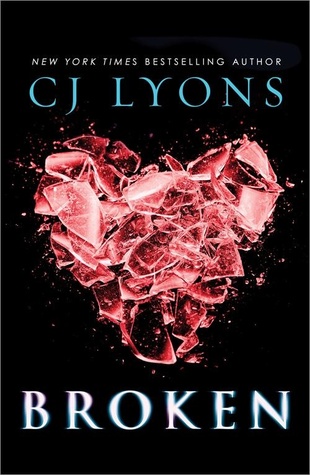
From Broken by C.J. Lyons: 

Kids fill the hall from wall to wall. Despite the unfamiliar press of bodies, I don’t panic. Instead, I let them steer me, like running with a herd of wild, untamed horses. At the end of the corridor, the herd separates into two, leaving me alone in front of a high glass wall.

The library.

Footsteps and lockers banging and voices colliding barrage me. Then I open the door, cross over, and step inside. I’m greeted not by silence, but instead by a hushed burble, relaxing, like the sound of a water fountain. I stand, enjoying the sensations, and take a breath.

School smells so much better than the hospital. And the library smells the best of all. To me, a good book is hot cocoa on a stormy winter day, sleet battering the window while you sit inside, nestled in a quilt.

A room filled with books?

I inhale deeply, a junkie taking her first hit. Sweet, musty paper. Ebony ink so crisp it threatens to rise off the pages and singe my nostrils. Glue and leather and cloth all mixed together in a menage a trois of decadence.

Another breath and I’m drunk with possibilities. Words and stories and people and places so far from here that Planet Earth is a mere dust mote dancing in my rearview mirror.

Hugging myself, containing my glee, I pivot, taking in books stacked two stories high, couches and chairs strategically positioned to catch the light from tall windows lining both sides of the corner, like the bridge of a battle cruiser, broad, high, supremely confident, and comforting. In here, I dare to imagine that I might just survive high school after all.

Respond in your notebook:  Describe a place where you find  peace or refuge?

How do you revision your instruction when you know something isn’t working?

Teaching the Lessons of #NCTE13

ocsBeing in Boston with all of these excellent minds has been a balm for my bedraggled teaching soul.  Something about November wears me down every year, as both my students and I yearn for the holiday breaks that are dangling just out of our reach.  Every year, I just pray for the second quarter to speed by so it’s out of the way and over with, but this year, that is not the case.  Reinvigorated by NCTE, I’m now filled with wonderful new ideas that I can’t wait to introduce my students to, and I’m wishing for more time before winter break so I can squeeze more of them in!!  I know without a doubt that my winter is now going to be much more pleasant, but it’s no longer me I’m worried about–it’s all the other teachers, those who are still suffering in the winters of their discontent.

According to the census bureau, as of last year there were 3.3 million public school teachers in America.  Three million, and that’s not including private and charter schools.  Yet, I’ve heard that only around 10,000 of us will attend the NCTE Annual Convention.  That’s an abysmally low percentage, and even assuming there are another 10,000 out there who will access the materials on the Connected Community, that’s still not enough.  We need more teachers aware of the best practices shared here, more educators experiencing the energy of this conference, and more students benefiting from the meetings of great minds.

IMG_0891

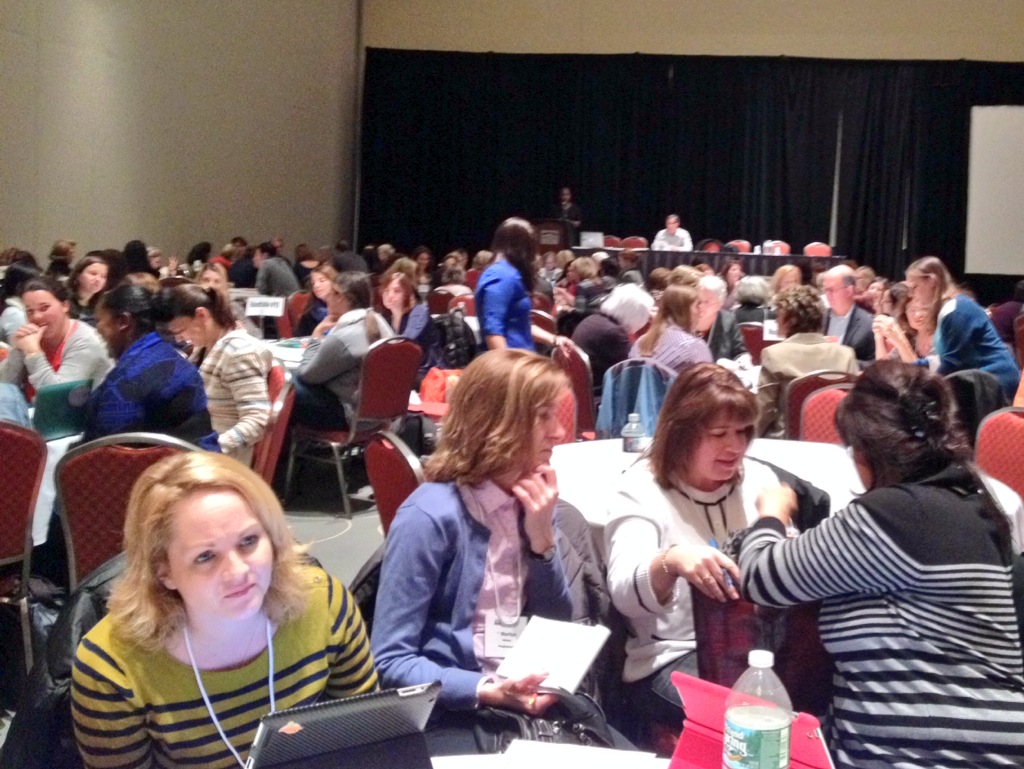
Teachers converse between talks by Carol Jago and Kelly Gallagher

I’m normally a very optimistic person, but I really don’t think enough people know about some of the wonderful teaching mentors in our country.  Yesterday while walking through the Heinemann booth, I watched a woman pick up Penny Kittle’s Book Love, glance at the back, and then replace it on the shelf.  WHAT??!!  I simply had to intervene.  “That’s an amazing book,” I told her, and she turned toward me, interested.  “It completely changed the way I teach, and my students are reading more now than they ever have.”

“Really?” she said. “Well, that’s a ringing endorsement.”  I smiled and urged, “Read it.”  She added the book to her little pile.

IMG_0886

Nancie Atwell sits on the floor to listen to Romano, Rief, and Heard

I felt a small sense of victory–I’d introduced her to a new mentor!  A wonderful set of best practices!  A beautiful book about the love of reading!!  But over the next few hours, the sense of discomfort returned to me.  There are still far too many teachers clinging to antiquated, alienating practices.  There are still too many teacher education programs whose students have never heard of Cris Tovani, Louise Rosenblatt, or Ralph Fletcher.  There are still too many attendees of this conference, even, who don’t understand the elation I felt as I sat on the floor beside Nancie Atwell, Tom Newkirk, and Katie Wood Ray while listening to a talk by Linda Rief, Tom Romano, and Georgia Heard.

Why do so few people know about the insane genius of Penny Kittle? Don Graves? Peter Johnston? Teri Lesesne, Richard Kent, Jim Burke?  These, my teacher heroes, are unknowns to too many.  How can we spread their ideas around?

My hope is that others will do what I’m going to do, and share these findings formally with our departments, districts, and colleagues.  We’ll blog about them, and tweet about them, and most importantly, practice them, so that they spread as rapidly as possible.  So if you’re here at #NCTE13, share these ideas.  Spread the love.  And enjoy the rush that you will ride on for weeks to come.

The Unexpected Trio

Our Compass Shifts 2-1“Miss Bogdany, isn’t writing a narrative the same thing as writing a story?”

“Yes, it is.  However, we’re going to spend time exploring writer’s craft by infusing a few strategies.  We’re going to be in tune with our five senses; explore the power of short sentences; and work through personification all while sharing an important moment in our lives.  Ready to play?”

Over the course of the next two weeks, the playing had begun. My students were charged with the task of choosing a moment in their lives that has, and continues to, shape them as individuals.  As students took to their Writer’s Notebooks and scribbled words and ideas as they began to chronicle the very moment that guided their paths – struggle, strength, and empowerment; you could feel the intensity.

***

Since my time at UNHLIT13 this summer, I have been experimenting with ways in which to inspire my students’ writing.  While asking students to ‘play with’ their five senses, short sentences, and personification may seem like a tall order, or at the very least, completely random; I realized they were willing to try.  (I’m still not exactly sure why I grouped these three concepts together.  I’ll chalk it up to trusting a whim!) As each skill was introduced, it was partnered with Mentor Activities and/or Mentor Texts so students could see how other authors used these strategies.  Take a peek – Craft- Mentor Texts, Activities and Skills

I know giving students the time to think through what they’re thinking (I love this concept!) is vital to building their self trust, worth, and importance as writers.  So, I made sure to do just that.  I took each concept and taught it as a separate entity so students could narrow their focus to just one concept at a time.  We started with the five senses.

And yes, while the five senses have been part of their writing journeys for the last ten years, I was asking them to do it in a way that was elevated – full with adjectives and adverbs – so we could start with the fundamentals and work our way through.  A mentor activity involved pairing students together so they could collectively guide their readers on a vibrant, sensory tour of a destination.  Giving students access to this foundational, yet imperative, practice empowered them.  They made the leap from understanding the descriptive power of touring a destination to the descriptive power in bringing their own moments to life.  Here is an excerpt from one young woman’s journey:

I remember picking her up off them white sheets on the hospital bed and laid her on my white spaghetti strapped dress that was then covered in the blood that fell from baby N’s mouth.  I rocked her and rocked her until she got cold and stiff.  I held her hands.  Her little fingers got hard around my finger and I couldn’t even get my finger out of hers. 

I breathe deeply.  Saniyyah’s use of setting and color infuses wonderfully into the stark reality of what is happening.  You can’t help but to be invested, and then saddened, through this experience.

*

This summer, I also had the luxury of moving through Dave Cullen’s work (Columbine) with my ever- wonderful book group consisting of Amy, Emily and Lauren; and it could not have been a more exhilarating experience.  For the first time I was combing through a text, peering in with the scope of a writer not a reader.  This was formative in elevating my own view on literature and imperative for my students.

So, when we started studying Mastering the Short Sentence, I brought Columbine into our community and shared how beautifully (and masterfully) Cullen utilizes this technique.  (How could I not?!  It was where my own literacy scope shifted profoundly.)  The short sentences were highlighted prior so when students received their copies the ‘skill’ jumped out at them immediately upon first glanceWe took our time in debunking their individual power.

I also showcased some of my own writing with Day One Disaster? to show students where and how I played with this technique.  When I have writer’s craft questions, I secretly wish I had the opportunity to converse directly with the author who made the decisions, yet in most cases I’m left to my own analysis.  So sharing my efforts (albeit scary at times); affords students the opportunity to engage in dialogue around specific techniques, writing, and literacy as a whole.  Here’s an excerpt from a writer who is willing to take risks:

“I have a confession… I like you more than a friend and I think we will make a great couple”, he began to say. He stutters and chokes on his words. It was so cute to see him choke on those words.

My body starts to fill up with all sorts of amazing emotions. It’s unexplainable. I can’t think straight. He asks me what I think about him. My plan was to say I feel the same way.

Or, so I thought.

The next thing that comes out my mouth changed my whole life completely.

My heart and soul is working against each other like the U.S. vs. Vietnam. Blood and Crips.  A war against Heaven or Hell.

“I think I love you Sherwin”

Everything stopped. Everything except my heart.  Beating ever so loud at that. Boom, boom. Boom, boom.

The court case: Ife’s heart vs. Ife’s mind is finally over. My heart wins.

I’m Free.

Do we not all remember specific encounters with love?  Ife uses the power of short sentences to bring us into her piece; shares her inner-most thoughts with us, and affords us the opportunity to watch her play with mastering the use of short sentences.

*

If you haven’t had the chance to read I AM MALALA by Malala Yousafzai, make it a priority.  This piece is so beautifully written that I found myself rereading excerpts just to hear the words (and arrangement) over and over.  Beyond the craft, you can’t help but to take this young woman (and her journey) home with you, on your morning commute, to a coffee house on a rainy afternoon…or into your classroom to book talk and indulge in during independent reading.

I burst into class the day we started studying personification with MALALA and projected, “M’s, p’s and k’s were all enemies lying in wait.”, a line so eloquently phrased I read it three times over and each time students were awed that Malala chose to chronicle her father’s speech impediment so carefully, precise, and through the use of personification.  They couldn’t wait to try it out in their writing:

Cue me, seven or so years old standing on the flat of the plateau that was my grandfather’s land. A red hillside dirt road leads to a house, body made of wood and a roof of zinc. Being in front of it after all those decades of it being desolate, you almost felt as though the termites couldn’t eat away at it faster than the unfilled silence of children turned adults.

Kurt explores the use of personification while journeying his readers through this historic moment in his life.  “The body made of wood”…wow.


I am in awe (you can see why).  I am awed by students’ bravery, courage, and commitment to developing their moments and their crafts.  Who would have thought that the five senses, mastering short sentences, and personification would prove to be a beneficial trio?  While I was riding the wave of a whim, students were firmly grounded in their trust – trusting me to guide them and trusting themselves in taking risks.

What skills and techniques have you (accidentally!) combined to challenge and motivate students to push beyond their limits in writing?    

The Practicalities of Reading Workshop

ocs

Incorporating reading workshop into your curriculum is easy once you have access to lots of great books for your students.  Some of you might be lucky enough to have a wonderful librarian at your school who cultivates a diverse collection of books (like I was last year), but others may be without that (like I am now).  After running into dead ends with our school and public libraries, I thought the best solution was to focus on building my own.

DSC03271

Books donated from a Donors Choose project

Anyone who is a reading fiend like me knows that books are expensive.  Because I haven’t won the lottery yet, I had to seek alternative means for funding my future fabulous library.  Great suggestions from Amy and Erika led me to Donors Choose, an amazing charity website that funds classroom projects for teachers.  Writing grants on this website has netted me over $1,500 worth of books of my choice!  I also had great success with Half Price Books, who donated hundreds of young adult and teen novels to my classroom.  Lastly, I’ve tapped an unusual resource–local businesses.  Large companies like Target, Sam’s Club, and Kroger have a budget they can only use for donations, and anything they give is tax deductible.  I wrote letters to these businesses explaining my needs, and they have donated gift cards each month, netting me a total of $450 in books.  All of this grant/letter/request-writing has paid off, and I’ve been able to build a large, dynamic library.

IMG_0129

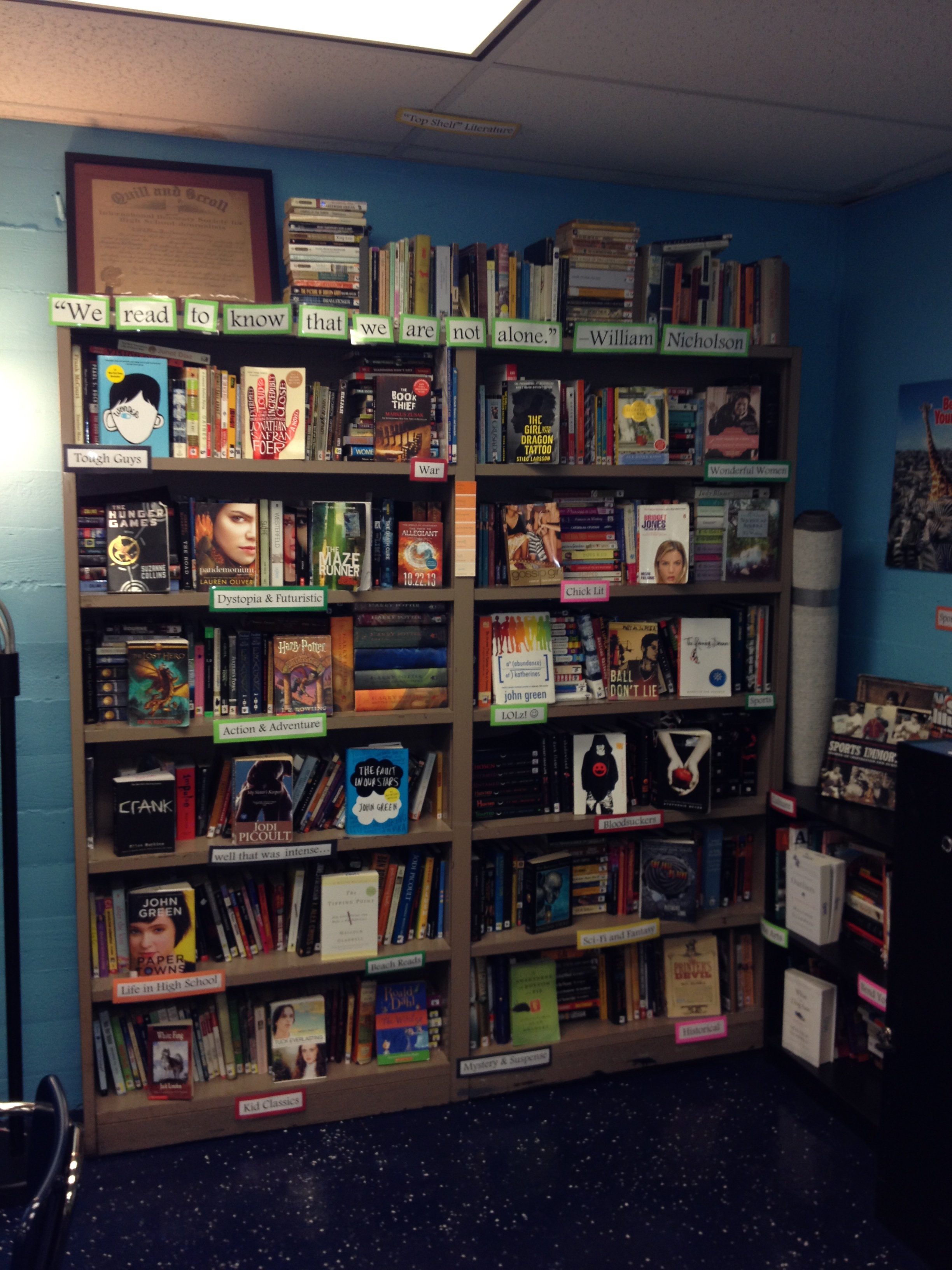
Once I had my books, I knew I wanted to organize them in a fun way that spoke to my teaching style.  My students and I came up with some inventive categories–“Top Shelf Lit” (classics, which are actually on the top shelf), “Bloodsuckers” (vampire novels), “LOLz” (humor), and “well that was intense” (books about death/powerful issues that will make you cry).  A wonderful problem I’ll need to tackle soon is where to find another bookshelf!

IMG_0138

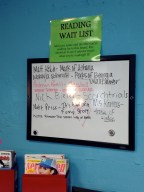
I’ve already written about fangirling in such a way that gets students excited and informed about books.  Once a student knows what he or she wants to read, the only problem is tracking that book down.  I took an idea from Emily and started a “reading wait list” whiteboard, where students can leave a public request for something they’ve been clamoring for.  In terms of determining who’s got what, I have a binder that lies on the cabinet near the bookshelf where kids check books in and out.  Because I show them my grants and letters, and I rip open the boxes of freshly-delivered books in front of them, they can see the hard work being done to build the library.  I think that’s what makes them so conscientious about returning books, because they’ve been great about that so far.

IMG_0140

Once you’ve built your library, and once your students are reading the books they’ve been dying for, you have to somehow keep track of all that they’re doing.  I’ve modified Penny Kittle’s excellent reading log sheets just a bit to make tracking my students’ reading easier.  These logs get passed around every bell, and students write down what page they’re on of their independent reading book.  I’ve added a “Last Friday page #” column, in which they copy down their latest page number from the previous week.  This makes giving them credit for weekend reading much simpler.  At the end of the week, my student Teacher Assistants count up the pages read and write them in the column on the far right.  It’s a simple matter to compare this number to the students’ reading rates and give them a quick grade based on how much they’re reading (two hours per week is the requirement).

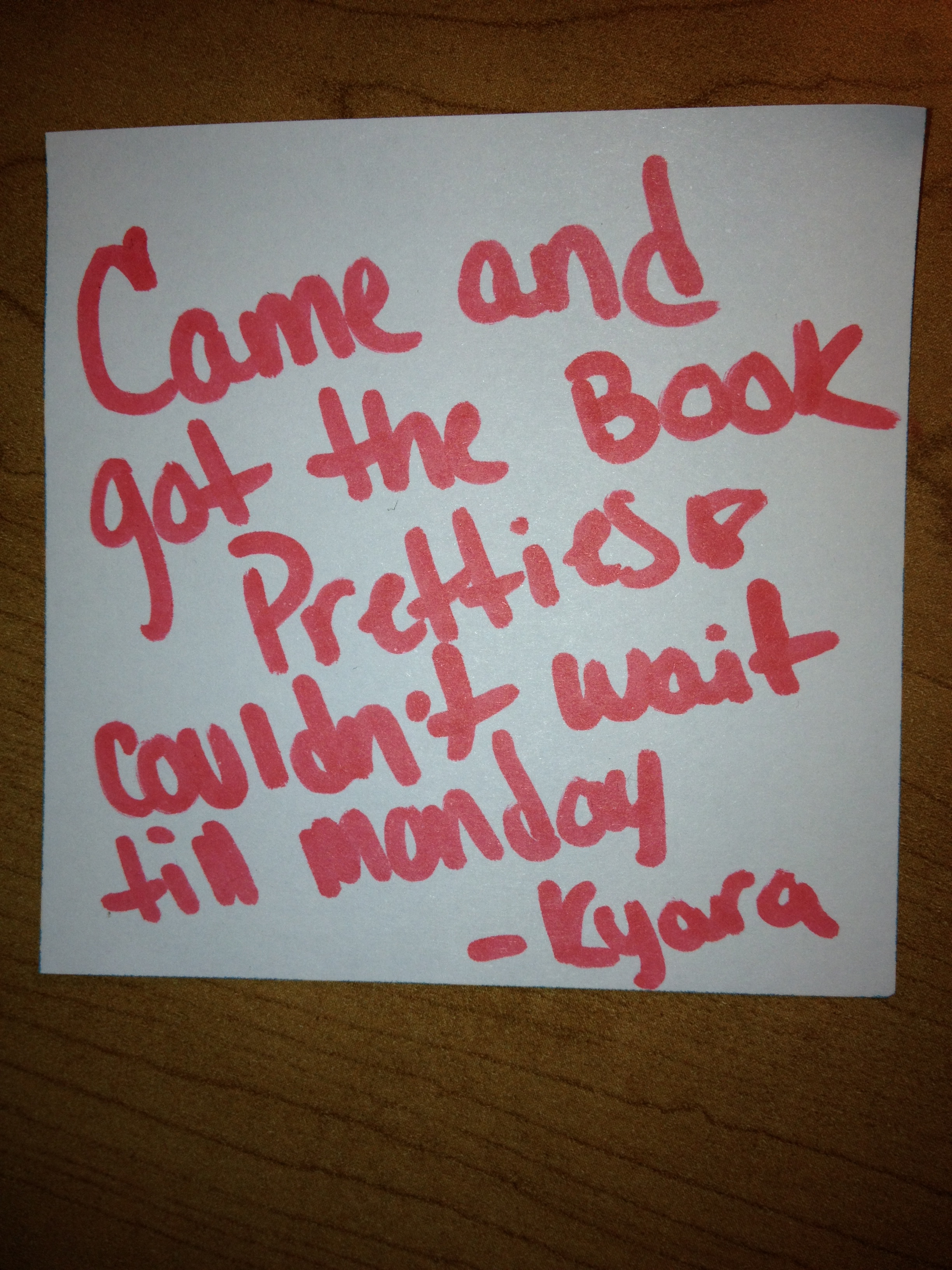
So, there you have it…all of my tips and tricks for building, organizing, keeping track of, and assessing the reading of books in a classroom library.  I’m still working hard to keep improving mine, and I’m sure things will continue to change.  However, it seems like my current system is doing its job, since I found this note on my desk yesterday after school…

IMG_0128

…and there’s no more rewarding way to end your week than that.