Tag Archives: Mini-lesson Monday

Mini-Lesson Monday: Sentence Boundaries and Adding Some Variety

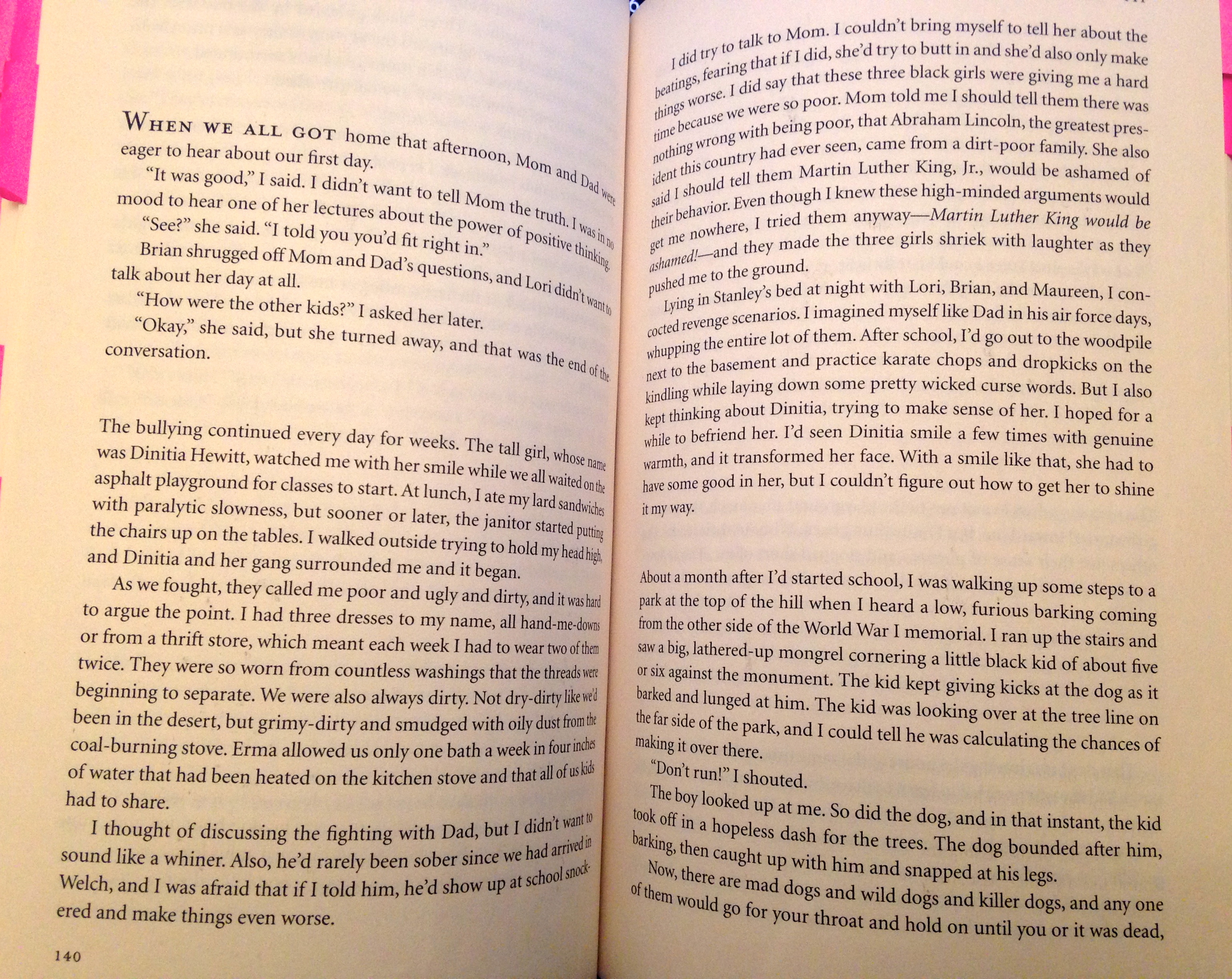
Sorry, I forgot to record the book’s title.

Even the students in my AP English class struggle with correct punctuation and varying their sentences. In one-on-one conferences, I’ve started to remind them more often to pay attention to how the author of their self-selected books craft meaning. I used to get glossy-eyed blank stares, but students are beginning to understand that writers make intentional moves to draw us in, and keep us within, the pages of their books.

“As a writer, you must do that, too,” I remind them.

This lesson grew out of a conferring conversation with a student who told me:  “I just do not understand all the comma and semicolon stuff, but I have a pretty good idea of what I want to say in my writing.”

Objective:  Using the language of the Depth of Knowledge levels, students will recognize the sentence boundaries and the variety of sentence structures in their self-selected books. They will make observations about the author’s use of punctuation in these sentences, assessing the writer’s effectiveness in crafting meaning. Students will then use their author as a mentor as they apply their knowledge of sentence boundaries and sentence variety and create, revise, and rewrite sentences in their own pieces of writing. Finally, through peer-to-peer conferring, students will evaluate the accuracy and effectiveness of one another’s sentences.

Lesson:  Every student needs their independent reading book. If a student is reading a book of poems, or a graphic novel without many sentences, you will want to supply a stand in book for this lesson or ask the student to find a book she’s previously read.

Tell students that you’ve noticed in their writing that they are ready to make their sentences more sophisticated. Correctness is one way to do this. Varying the length of sentences is another way. Instruct students to turn to a random page in their books, say page 51. Ask them to read the page in search of one long sentence and one short sentence. Give students sentence stips or blank paper and have them write out the sentences they find in their books. They should spell and punctuate the sentences exactly like the author does.
sentence boundaries lessonNext, in small groups, ask students to discuss with one another the structure of the sentences. They might put all the short sentences together and compare them. Then they might put the long sentences together and look at how the authors use commas to separate ideas. Some students will know more about grammatical terms than others, and that is okay. The idea is to get students noticing how writers compose within the boundaries of standard English and to get them to understand how punctuation works to craft meaning. Ask questions that help them discover why boundaries and variety work to produce effective writing.

You may choose to have students imitate the sentences they chose from their books. Imitation is a useful tool for many writers.

Using self-selected books, not just to practice wide reading, but to teach students to read like writers, adds an important element to the workshop classroom. Our writing improves when we take the time to notice and apply the skills of professional writers.

Follow up:  Have students review a piece of their own writing. The writing can be in any stage of the writing process. They should study their writing to evaluate their use of sentence boundaries and variety. Encourage students to revise their writing as necessary, remembering to use the author of their books as their mentors.

Extension:  This lesson works to have students study leads, similar to what Jackie wrote about in the mini-lesson Pick up Lines and Leads. It also works to have students search their books for sentences that include imagery.


©Amy Rasmussen, 2011 – 2015

Mini-Lesson Monday: The Power of “I”

Recently, Jackie humorously infused pickup lines and leads into her lesson to engage students in narrative writing.  It got me thinking.  While I am not nearly as funny as she is, I still needed to find a way to minimize the angst with starting a written piece.  Students deserve an opportunity to look at opening lines so they are innately thinking like writers.  Providing them the opportunity to authentically explore various ways to open their stories is key.  So, we gave it a whirl.

Objectives:  Students will recall moments in their lives that have shaped who they are today.  Drawing from their own life experiences students will distinguish what moments they are willing to chronicle in their personal narratives.  Students will construct meaning about their personal experiences by creating a written piece that utilizes author’s craft that has been studied and analyzed.

Lesson:  Let me say that I typically do not focus on opening lines, hooks, what have you until after students have written their pieces.  I find that students are able to more easily and comfortably play with their opening once they know where they’re going…or have gone… with their narratives.  Yet, I was curious to see how this would pan out.

 As we started to jog our memories for those defining moments that have occurred in our lives, we started thinking about questions that would help us dig deep into our own thinking.  A few included:

What do I believe?  (About life, the world, society, family, education, etc.)

What moment has occurred in my life that I am (still) confused by?

What is the most life changing experience I’ve encountered?  What decisions have I made during this situation that have shaped who I am today?

Who is important to me?  Who has made a tremendous impact on me (positive, negative)?  Do I find conflict in this?

What simple pleasures do I relish in when times get tough/stressful?

These questions, among many others, started getting our process underway.  Students had choice and freedom in picking what they wanted to write about – as we know personal narratives are sometimes brutal to compose: sometimes we want to forget what we’ve been through.  Yet, in order to foster the writers in room 369, these questions were written in the first person.  When we write questions for our writers in the second person (What simple pleasure do you relish in when times get tough and stressful?) we are providing them an opportunity to take a step back; to be a bit removed.  When we shift our curiosities to “I” “Me” “My”, it becomes personal.

IMG_20150928_083251

Then, we played with various different ways we could open our stories.  Each student played with concepts, moments, memories, and experiences after seeing how the authors of our independent reading books played with theirs.  Having heard about fifteen authors’ opening lines, students were willing to really dive in and try different ways to start: sounds, quotes, internal thinking, advice they’d been given, visuals, third person…

This visual represents our thinking at the very beginning of this school year.  Students are playing with this deep level of thinking and crafting for the very first time.  There is still some apprehension and hesitation, but for the most part students are willing to try…and play…and craft…and find their inner brave.


Follow Up:  Once students have created numerous ways to start their piece, they will narrow it down to two.  From there, students will start their narratives.  Yet, they are being asked to start their narratives using two different openings…

As writers we know that it takes much patience and practice to feel satisfied with our writing; specifically our opening lines.  Asking students to try writing their pieces from two different starting points allows us to see where our writing goes.  Maybe one start is stronger, prompts more thinking while the other falls flat.  Maybe they both prompt great confidence in continuing to see how they develop.  Maybe the best draft ends up being an infusion of both.

Regardless of where our personal narratives go, starting the process with options both in craft and experience, the pressure of writing is minimized and students feel more at home reliving some of the moments that would have never made it to the paper prior.

How do you foster the willingness to write when fear or apprehension stand in the way of our writers?  What techniques do you use as a writer that you channel to your student writers?

Mini-lesson Monday: Exploring a Page’s White Space in the Writer’s Workshop

PrintCircling the room, I hand out books in preparation for book speed dating. I place Ellen Hopkins’ Crank on a student’s desk.

“There’s no way I’m reading this,” she mutters to her friend. “This thing is huge.”

“Open it up.” I turn towards her, waiting for her to crack the book. She flips to a page and realizes the entire book is in verse. She flips again and again, every page has a minimalist feel, the text spread out, placing emphasis on each word within the sea of white. The sheer length of the book disappears and she is sucked into Hopkins’ narrative.

The more time I spend with teenagers, the more I value the use of that essential “white space.” I love book talking Patricia McCormick’s Sold or Jonathan Safran Foer’s Extremely Loud and Incredibly Close; despite their complex and emotional content, the books are instantly more accessible simply because of their unique structure.

This is why when we discuss paragraph breaks in writing and aesthetics and structure in reading, we also discuss the glory of giving the reader’s eye a break.

Objectives: Using the language of the Depth of Knowledge levels, students will recognize the use of white space within a piece of writing. They will make observations about the author’s use of this tactic, assessing the writer’s effectiveness in employing the use of white space. Finally, use choice reading and whole class examples as mentor texts, they will practice using white space within their own writing by formulating paragraphs at various lengths, revising these paragraphs through peer conferencing, and applying this craft in future writing assignments.

Lesson: Divide students into groups of three or four and have them open up their independent reading books to any page. Ask them to brainstorm what they see based on the page—tell them not to look at content, but instead the structure of the page—the text, paragraph breaks, and length. Have them compare their pages to each other, noting the similarities and differences. Once they have completed this, bring them back together into a whole class discussion. While they discuss their observations, compile a list on the board of what they noticed.

I love to breathe life into authors and remind students that a writer consciously makes decisions on the craft of their pieces. In turn, I have them to return to the structure of their page, focusing mostly on the line breaks, white space, and the spacing and formatting of the text in general. They reflect on this in their writer’s notebook, asking themselves: why do you think the author made this decision? What did they want the reader to think and/or experience?

IMG_2906Following their reflection, we return to discuss their individual pages as a class. Students volunteer to share why their author might have made the stylistic or structural decisions they did, which in turn, inspires other students to reflect further on their own page choices.

We discuss “one sentence paragraphs” and how they stand out surrounded by the white space of heavier paragraphs. They explore how white space can frame longer paragraphs and why exactly writers might use longer paragraphs to convey their point or tell a denser story. We notice how the white space of line breaks can show the passing of time and why it is important for readers to visually have a moment to internalize this time lapse. And finally, as readers, we share how we respond to cramped passages versus double spaced books.

The process of using choice books paired with class discussion helps students recognize the value of their role as a reader as well as how they can utilize these methods within their own writing.

Following our discussion, I take a few minutes to reinforce the points we’ve made either on the white board or through a prepared PowerPoint. These slides provide visual examples from books I am currently reading as well as some tips for applying this knowledge to our own writing.

Follow-Up: At the beginning of the year, students complete a snapshot narrative followed by a longer personal narrative. Using the mentor examples as well as the examples from our choice reading, we look at how we can integrate white space into our own pieces either through line breaks, diverse paragraph lengths, or one-sentence paragraphs. Based on this mini-lesson, they can also trade narratives and provide peer feedback to one another.

What are some mini-lessons you use to help students analyzing the structure of books? How do you help them integrate these observations into their own writing?

Mini-Lesson Monday: Self-Monitoring Reading Homework

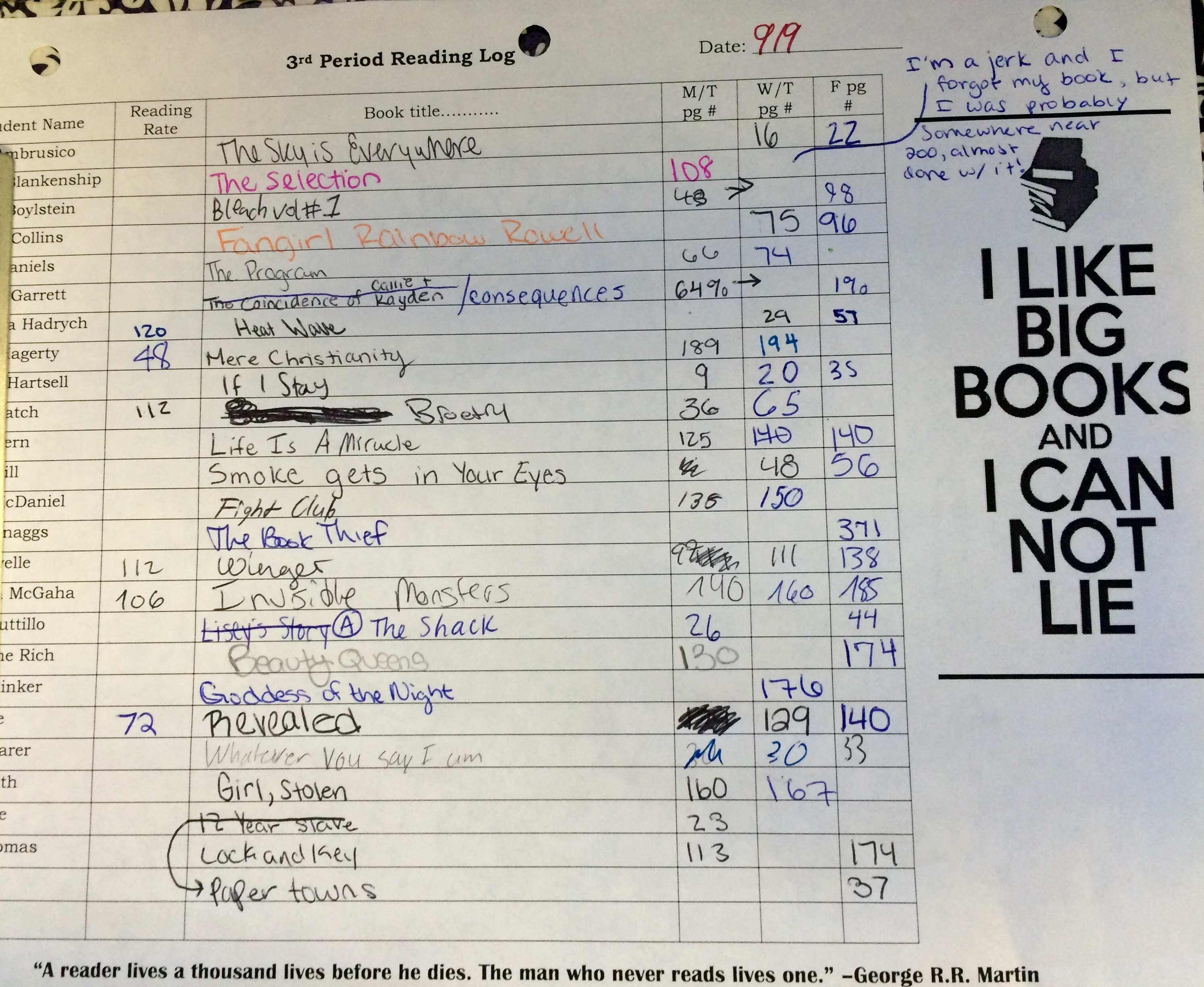
It’s the fourth week of school, and some students are starting to panic as their weekly reading homework grades are showing up in our online gradebook.  When they come to me, concerned, I ask, “Have you been doing your reading homework?”

Sheepish grins, embarrassed blushes, and nervous giggles follow.  I know I need to give my students some tangible reminder of why they need to be reading two hours per week.

Objectives — Using the language of the Depth of Knowledge Levels:  Calculate how much you can read in two hours; Estimate how your reading rate will change over a two-hour time period; Assess your own reading fluency and growth.  Or, from the Common Core: Read and comprehend complex literary and informational texts independently and proficiently.

IMG_9336

Shailyn, Justin, and Mrs. Karnes’ paint strip bookmarks

Lesson — We begin class, as always, with independent reading.  I ask students to pay attention to what page they’re starting on and start a timer for 15 minutes on the board.

At the end of the 15-minute reading period, I ask students to count the number of pages read and multiply that number by eight to calculate their reading rate.  They complete their calculations and jot down their reading rates as I pass out paint strips and Sharpies.

“Today I want to remind one another about the importance of frequent reading.  We can’t become better readers without lots of practice reading, which is why your weekly homework is to read for two hours.  So, we’re going to make some bookmarks reminding us why we read, and also reminding us how much we should be reading.”

I ask students to take out their phones and look up a quote about reading.  Once we all choose quotes, I model on the document camera, writing my chosen quote on my own paint strip.  Students grab some Sharpies and a paint strip in their favorite color and doodle their quotes on their paint strip bookmarks.

IMG_9335

Students modify their reading rates in the Reading Rate column

“Once you’ve gotten your quote down, add your reading rate to your paint strip, nice and small.  You’ll want to change your reading rate whenever you switch books, and you’ll also want to note your new reading rates on the log sheet as it goes around each day.”

Then, I ask students to think about what might happen to their reading rates over time.  Jared predicts, “I think if I sit down for a solid two hours and read, I might read more than my reading rate.  When I really get going I can read pretty fast.”  Shailyn predicts, “My reading rate will increase…majorly!”

“What about if you read a harder book?” I ask.

“Um, I think I’d probably start out slow at the beginning, but as I get into the book, I’ll read it faster,” Shailyn adds.

“Awesome,” I say.  “We’ll have to see what happens.  So, as you use your bookmarks in the coming weeks, keep an eye on how your reading rate changes week to week, and how quickly or slowly you read your required number of pages.  I’ll check in with you in reading conferences soon.”

Follow-Up — Now that students have a tangible reminder of their reading homework to use as a bookmark, they can hold themselves more accountable.  The quotes give them a rationale for reading, and the written reading rates give them a reminder of their reading goals.  By self-monitoring both, students can assess their own reading progress far better than I can, and we’ll confer about that self-assessment during class for weeks to come.

Mini-lesson Monday: Student Writing as Our Mentors for Sentences

I read Learning by Teaching by Donald Murray this summer, and I finally understand the importance of using student writing as the main text in my writing class. While I’ve believed students can learn from

I lurked on this chat. Many positive examples of learning from student writing.

I lurked on this chat. Many positive examples of learning from student writing.

reading one another’s work, and I’ve often asked them to read and give feedback — on drafts and published pieces — I’ve never thought to actually use the text to teach a concept. I don’t know why. I supposed I’ve always relied on mentor texts by The Pros for that.

I am changing my tune. Here’s a bit of a lesson that worked better than I could have imagined.

Objectives:  Using the language of the Depth of Knowledge levels, students will write about their lives, and share their writing. They will recognize a wide variety of sentence structures. They will identify patterns, devices, and/or figurative language and discuss its effectiveness in creating meaning. They will revise their writing, formulate their own sentences, and apply their understanding to future writing assignments.

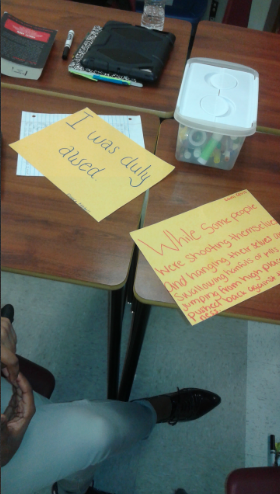
Lesson: Project the image, and ask students to write in their writer’s notebooks one sentence that answers the question. Remind them about what they know about various sentence structures and how punctuation works within a sentence.

“We can pack a sentence with a lot of information if we punctuate it correctly. Pay attention and see how you do. You can write any sentence, but try to not write a simple one.”

Give students about five minutes to write.

Next, ask for a couple of volunteers who are willing to write their sentences on the board. Be sure they understand that there is no judgment.

“We just want to talk about sentences.”

While two or three students write their sentences on the board, ask the other students in the class to read their sentences to each other.

one sentence

One at a time, read the student sentences on the board. Ask:  “What do you notice?”

Ethan sentenceTalk through the various comments students make, noting parallels, punctuation, clauses, word choice, etc.

Watch for teaching points. Ethan’s sentence on the left gave us a lot to talk about:  parallelism, use of semi-colons, colons, …

Next, ask students to return to their notebooks. “How can you make your sentence better?”

Allow time for revision (and time permitting, more sharing.)

Why this lesson works, especially for a writing lesson at the beginning of the year:  It’s just a sentence!

And sometimes we get a bonus gift like this one my class got from Edward:Edward C sentence

“I am the guy who picks people up when I, myself, am down; I am the guy who cares so much over things so little; I am the missing piece to a puzzle that has been forgotten; I am now by a sad and quiet shell of my former self; I am Edward Campos.”

The class hushed. All eyes turned to Edward.

“Wow,” I said, “Thank you for sharing this writing today. You’ve made yourself vulnerable, and we value that.

“First of all, we need to know that you are okay. Will you explain a little more what you mean here?”

Edward explained that he used to be fun and outgoing. He felt strong and powerful. Then at the end of last year and over the summer he learned his friends weren’t really his friends so much. Now, he feels alone and like he’s not the person he used to be.

“Hey, everyone, how many of you have ever felt like Edward?

“Look around, my friend, do you see all those hands? Everyone here has been where you are. We understand. You have new friends here.”

Two girls at Edward’s table leaned forward and touched his arm. “We’ll be your friends,” they said smiling.

And he smiled back.

Of course, because I am me — and I never leave a teaching moment untapped — we talked about the structure of Edward’s sentence. And we talked about the word choice:  “Why ‘forgotten’ instead of ‘lost’?”

When we watch for teaching moments in student writing, we will find them. Every single time.

Follow up:  In class the next day we did some free-writing in our notebooks in response to the spoken word poem “Hands” by Sarah Kay. Before we wrote I reminded students to pay attention to their sentences. Then instead of sharing the whole of what we wrote with the class, we only shared our favorite sentence. I consider this valuable formative assessment.

Now, I will hold students accountable for crafting their sentences with care in their upcoming writing assignment.

“The words of the world want to make sentences,” said Gaston Bachelard. I say, “We have to help them.”

Please share your best tips on getting students to pay attention to their sentences.


©Amy Rasmussen, 2011 – 2015


Mini-Lesson Monday: What Will You be Book Talking?

IMG_20140903_204732

At the very beginning of the year, I relish in choosing the books that I want to expose students to via Book Talks to hook ’em, spark an interest, or at the very least; have them raise an eyebrow.  With over 3,000 books on our lending library, it can be a daunting and downright overwhelming process for reluctant readers to choose a book to kick off the year. To start their reading journey.  To be brave enough to try something they haven’t before. To simply engage in the process.

Sometimes a mini-lesson is about exploration; such is the case as students are trying to find their way through the minefields of endless books.  While it’s important to educate students on skills and techniques; it’s also just as beneficial to teach them how to authentically explore letting their interest and intrigue guide their process.

So, we pull back and take it slow…

Objectives – Using the language of the Depth of Knowledge Levels: Students will draw from their own interests and personal experiences to predict the literature that will capture their attention and support their literacy growth.  Students will assess their reading fluency and stamina through analyzing their reading rates, commitment to completing books, and data that supports their movement.

Lesson: To kick off the introduction to the library, I choose a few pieces to Book Talk – share an excerpt, a few paragraphs, sometimes a page or two…but nothing too long.  I keep it short.  To keep the energy high and interest levels peaking, I want the process to flow and be completely full with variety.  (After all, at the beginning of the year, I am unfamiliar with who many of my students are as readers.)  I ask students to jot down titles in their Writer’s Notebooks that have caught their attention as to keep them in mind – now or in the future.

Next, we physically tour the library where I expose students to the themes (not genres) that categorize our books.  Fun ones such as:  No Sleep Till Brooklyn (compliments of the Beastie Boys – books on our favorite borough), Behind Barbed Wires (Holocaust affiliated literature), A Day in the Life (stories of all kind)…  Along the way I show students where I grabbed the books that were Book Talked.  This is essential because, if students are interested in a particular piece, this process provides them with a focus.  With so many books to choose from, initially narrowing down their interest to a section or two makes the process manageable…and quite enjoyable.

Once we’ve toured our library, students are given time to explore.  They choose books that have caught their attention.  Eventually, stacks of books are taken off the shelves and brought back to our tables. Students are then given an opportunity to interview their books of choice by having time to explore them – covers, flaps, table of contents, page 107; whatever they are drawn to.

To guide students along in this process I also provide them with The Six Steps to an Effective Book Interview:

1. Jot down the title and author of the book.

2. Study the cover.  Jot down some of your thinking… What do you think this piece may be about?  What do the colors and visuals represent?  Does the cover alone capture your attention?

3. Read the back of the book or the inside flaps.  What is this book about?  What is intriguing or off-putting about this book?  What questions do you have?

4. Open the book to any page of your choosing.  Read three consecutive pages.  

5. What do you foresee being an obstacle when reading this book? (Language, vocabulary, author’s point of view, etc.)

6. Are you interested in reading this book either now or in the future? Will it be going on your Next-to-Read List?  Explain your rationale.

In the meantime, I am conferring with students all over the room: the ones at the library scoping things out, students who seem a bit disengaged, those who have chosen a piece at lightening speed, ones already interacting with The Book Interview and everyone in between.  There becomes a buzz in the room which signifies the learning process has begun!

Before class rounds an end, I ask students to bring at least one book home with them and read for 45 minutes.  This is a process.  Some students are psyched about their choosings and others are disappointed that they didn’t find ‘the one’.  We talk it through.  It’s imperative for each student to leave with literature, yet we also leave with an understanding that if it does not feel like a right fit after they’ve had time outside of class to ‘play with it’, then we go back to the drawing board again tomorrow – knowing just a bit more about why it wasn’t the one. And the cycle of collecting data on students’ interests and needs commences.

Follow-Up: As the year progresses and students and I learn collectively what they enjoy reading (and what they are willing to be challenged by), Book Talks become more tailored to student interest. Sometimes they are done with specific students in mind, other times they are presented based on big ideas/themes (love, injustice, the power to overcome, etc.).

The beauty of this process is that although Book Talks remain a constant all year, students do not bore of them; every day they are different.  And, students become more in-tune with what they enjoy, are curious about, want to challenge themselves with, etc.  Typically by mid-year, students are no longer needing to use the The Book Interview because, by that point, it has become an innate part of their process.

What initial strategies do you instill in your classroom to make the rest of the year’s learning fruitful?

Mini-lesson Monday: Pickup Lines and Leads

709bdc7d84adf63af46e2d12dffae90eEvery book has a pickup line, a sexy statement right at the beginning that either draws you in immediately or leaves you wishing for the end.

I knew that first lines could either make or break a student’s date with a book, but I’d never thought of them as “pickup lines” until I read Thomas C. Foster’s How to Read Novels Like a Professor. We’ve all had that one awful date; I remember one sorry soul singing Coldplay’s “Green Eyes” to me: “And honey you should know/That I could never go on without you/Green eyes.” The problem was I don’t have green eyes; they’re unmistakably blue (and he wasn’t colorblind either—I asked).

So in the spirit of bad pickup lines…and some outright phenomenal ones, an early minilesson I teach is on leads in narrative writing, how to catch a reader’s attention, and how to miss it altogether.

Objectives: Using the language of the Depth of Knowledge levels, students will recognize a wide variety of opening sentences (leads) in writing. They will identify patterns and compare effectiveness through discussion. They will formulate their own leads, revising them, and finally applying their understanding to future writing assignments.

Lesson: To begin the lesson, I start with a list of opening lines from past students. The sentences are at least five years old and from a different district; they have no identifying details, and they range from outright hilarious to cryptic. Independently students pick their three favorite and three least favorite; they combine these within small groups. We then compile this list on the white board, noting which sentences show up multiple times. While I jot down their observations on the board, students discuss what drew them to the leads they liked and what made them dislike other leads. This provides us with a framework for what makes a lead strong and how we can model this in our own writing. If there is anything they have missed, I take the time to add it in at this point, backing it up with an example.

Following the discussion, I share Thomas Foster’s explanation of an opening page: “We’re being asked to commit a lot of time and energy to an enterprise with very little in the way of guarantee of what’s in it for us…The opening of a novel is an invitation to come inside and play. The first page, in this context, is not so much a guarantee as a promissory note: ‘Hey,’ it says, ‘I’ve got something good here. You’ll like it. You can trust me. Give me a whirl.’ And that’s why the very first line is so important” (How to Read Novels Like a Professor 21-22). I reinforce that we’re are creating this atmosphere for our own readers by convincing them that our story is worth their time and effort.

Finally, we turn to our own independent reading books, looking at the first line on the first page (or if they’d like the first line of any chapter). Students copy down the line in their writer’s notebooks, recognizing what about the lead makes it strong, weak, exciting, or lackluster. We come back together to discuss their findings once again before breaking into writer’s workshop.

Follow-Up: At the beginning of the year, students complete a snapshot narrative followed by a longer personal narrative. Using the mentor examples or the mentor lead from their independent reading book, students can explore multiple ways to write or revise the lead of their story. Based on this minilesson, they can also trade stories and provide peer feedback to one another

What are some narrative mini-lessons you use to kick off the year? Share in the comments!

Mini-Lesson Monday: Read Like A Writer

B9qMI_GIMAEriTZEstablishing the structure of the readers and writers workshop is one of the things I’m most excited about for the beginning of the school year.  The way these early lessons are structured will make all the difference in the way students view our work, our time, and our goals as a team of learners.  As such, “reading like a writer” is one of the earliest mini-lessons I teach when we return to school.

Objectives – Using the language of the Depth of Knowledge Levels:  Make observations about how a writer conveys what he conveys; Apply what you learn to your own writing.  Or, from the Common Core:  Analyze how style and content contribute to the power, persuasiveness or beauty of the text.

Lesson – My students and I begin this lesson by discussing the notion of apprenticeship.  Many of them are studying a trade–electrical work, HVAC, autobody repair, etc.  They are able to quickly explain that an apprentice studies a master in order to learn how to master a particular set of skills.

I then share with students Katie Wood Ray’s excellent description of writing being a craft apprenticeship:  “Like any other craftspeople, professional writers know that to learn their craft, they must stand on the shoulders of writers who have gone before them” (Wondrous Words, pp. 10-11).

Next, I invite students to turn to their newly-selected choice reading books and open to the first page.  I work beside them, opening my own book.  “Usually when I start a book, I’m mostly paying attention to who the characters are, when and where the book is set, and all of those usual details,” I say, thinking aloud, modeling my process.  “Now, I want to re-read this first page of chapter one and pay attention to how this story is written, instead of what the story is about.  I want to learn from this writer.”

We re-read, and after a few minutes, I ask students to talk with their tables about what they’ve noticed.  After some time, I model once more my process.  “I’m just going to take one skill I noticed this writer using and try to name it.  This particular writer is using lots of repetition here on page one–see how the beginnings of all of these sentences look the same?”  I’m pointing to the writing, displayed on the document camera.  “I like how the repetition draws my attention to what comes next in those sentences–I think it might be important.  I’d like to use repetition in my personal narrative.”  I invite students to name one craft move that they might also use in their personal narratives, and to jot that skill down in their writer’s notebooks.  They use each other as resources if their own books didn’t offer anything they felt truly drawn to.

Follow-Up – Following the mini-lesson, we’ll move into writer’s workshop.  At the beginning of the year, we’re crafting personal narratives, and we’ll study a variety of mentor texts to help us understand the possibilities of what that genre might look like.  As we do, I’ll continue to reinforce the idea of reading like writers–apprentices to the craft of writing.

What are some of your earliest mini-lessons? Share in the comments!