If you’ve ever taught juniors, you probably know my struggle. The third quarter of every year, students hit some kind of mountain of a speed bump. I think they are tired, overwhelmed, a little undone.
Junior year is hard for many of my readers. It’s the first time most have taken an AP class, and some are taking two or three. Competing with APUSH is something I’ve become accustomed to —students choose to do their history homework over English every year. Textbook reading for history looks like homework while the reading I need students to do, reading books that fill their heads with knowledge and stories and vocabulary and empathy does not.
When we hit the wall this spring, I asked a group of my students to help me design a plan to get our reading lives re-energized. They kept it simple:
- We should create personal reading challenges.
- You should talk to us more about what we are reading.
- We should talk to each other more about what we are reading.
This lesson shows how we created our challenges. The more talk part? That was a reminder to up my game with conference and to remember to schedule time for more talk around books.
Objective: Using the language of the Depth of Knowledge Levels, students will assess their reading lives so far this year, predict how many books they can read this spring, and design a personal challenge that will help them continue to grow as readers.
Lesson: I projected this question on the board at the beginning of class and asked students to write for five minutes in response: Think about your reading growth and improvement this year. Can you honestly say you are better now than you when you walked in the classroom in the fall?
I then asked students to talk to one another about their responses. And then we talked as a group about how we can up our reading game. I explained that a few of their peers had suggested that everyone craft their own reading challenge, and I showed them mine.
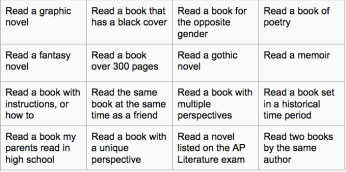
Then, I gave everyone a notecard, and they went to work. Here’s a sampling of some of my students’ personal reading challenges for the end of the year. I think they’ve decided we are playing bingo. (An interesting idea for the beginning of next year, too.)
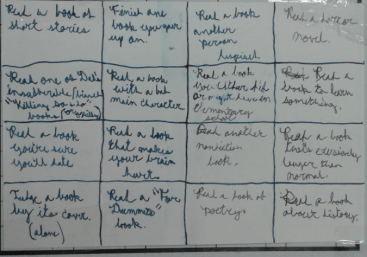
Read a book that makes your brain hurt. That’s my favorite!
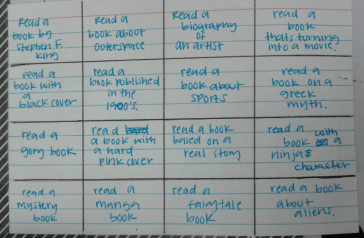
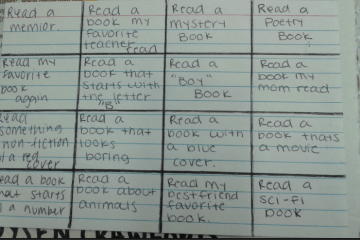
Follow up: I’ve met with more students the past week than I had in the three weeks prior to creating these challenge cards. I appreciate my students reminding me — and wanting me to talk to them more about their reading. The cards serve as excellent talking points for our conferences.
We can never talk to our students one-on-one enough! I know that is true, and I know we get caught up in a million other things that consumes our conferring time. I am recommitted. I want my students to leave me with a sure knowledge that they’ve advances as critical and thoughtful readers who know how to choose books they enjoy and books that challenge their thinking and their abilities. Since students came up with the idea for this little challenge, they have shown much more interest in it than other challenges I’ve created in the past. A good reminder for me. Now, I see kids standing at the books shelves, and when I ask what they are looking for or if I can help them find a book, more often than not, they tell me they need to find a book on their challenge card.

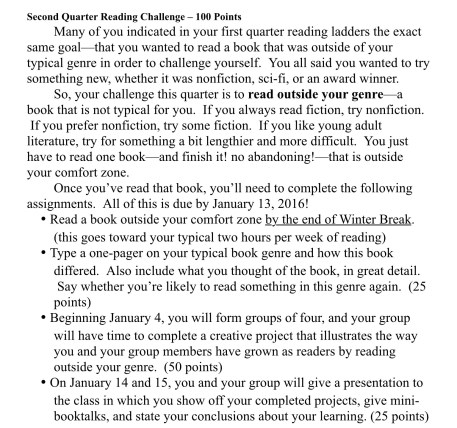 Lesson: With their first quarter reading ladders on hand, I’ll ask students to reflect on their goals from that ladder with their tablemates. I expect that each table will arrive at the consensus that they wanted to challenge themselves in terms of genre or text difficulty.



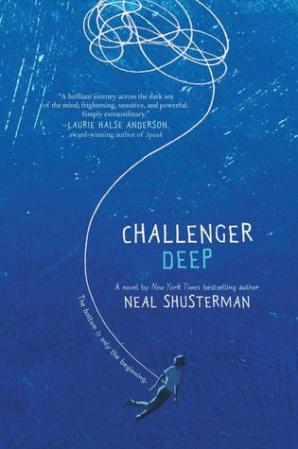 which has three interesting quotes: 1. “A brilliant journey across the dark sea of the mind; frieghtening, sensitive, and powerful. Simply extraordinary.” ~Laurie Halse Anderson, award-winning author of Speak; then two from the book: 2. “The bottom is only the beginning.” and 3. “My feet are on safe, solid ground, but that’s just an illusion.”
 Objectives: Using the language of the Depth of Knowledge Levels: students will make observations about a writer’s craft, identifying patterns in sentence structure, punctuation, and word choice to help define voice. Or, in the Common Core, students will interpret words and phrases phrases as they are used in a text and analyze how [they] shape meaning or tone.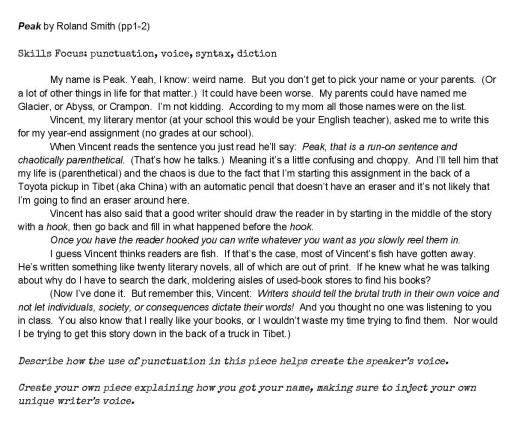


 It’s -4 degrees in West Virginia today, which might explain why I’m thinking about the narrative skill of freezing time. I’m also thinking about it because I’m reading the fantastic Dumplin’ by Julie Murphy, the story of an unconventional small-town beauty pageant contestant. As I read, I was aware of how quickly the writing hooked me–I began to look for reasons why, inspired by


 Lesson: We’ll pass out copies of the article for students to read and annotate, and they’ll also have their writer’s notebooks out.

 Three Teachers Talk