Tag Archives: Mentor Texts

Integrating Reading & Writing Instruction: Craft Studies & Mentor Texts

This is a continuation of our post from yesterday.
#3TTWorkshopWhat are you reading now, and/or what are your latest finds that could be strong mentor texts?  

Jackie:  For fun, I am currently reading Ready Player One by Ernest Cline, and for AP Literature, I am currently reading Othello.  I read Ready Player One as a departure from my typical YA reads.  I was never a gamer or 80s enthusiast, so I wanted to “challenge” myself by choosing a new genre.  Ernest Cline brilliantly writes action pieces.  Somehow he manages to translate the video game structure into a novel AND make it interesting for non-gamers like me; I am planning to use an excerpt to discuss movement of time either when we work on our multi-genre project this year or our fictional writing next year.  

Most recently, my CP freshmen read the picture book The Promise by Nicola Davies as a mentor for our narrative fiction unit.  In my academic freshman classes, we recently completed process papers based on The Compound by S.A. Bodeen.  Mentors for these included “What you will need in class today” by Matthew Foley and “Instructions for a bad day” by Shane Koyczan.  Students used each as a mentor text by which to craft their own poems and then eventually built them into unique survival guides ranging from “How to survive a zombie apocalypse” to “How to survive a friend’s breakup.”  As Shana said yesterday, I like pairing professional work with my own to show them the messy process of writing, so prior to class I get a head start on my own piece and then I continue developing it while projecting my writer’s notebook on the board at the beginning of workshop time.    
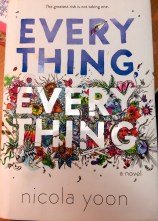
img_1056-1Shana:  I just finished the beautiful Everything, Everything by Nicola Yoon.  I love it as a mentor text because it’s a bit multigenre, and it’s an engaging YA love story, AND it’s gorgeously written.  With tons of parallel structure and a short-chapter format, it’s a quick read but one that lends itself to lots of frequent re-reading.  I’ll use this text for craft studies at the sentence and paragraph level to teach things like repetition, parallel structure, and varied sentence structure.

Another book I just read was Caitlin Doughty’s memoir Smoke Gets In Your Eyes, and Other Lessons from the Crematory, which I usually booktalk with Mary Roach’s Stiff.  This tale of Caitlin’s experiences working in a crematory will be useful for my students to analyze at the chapter level, during which she employs narrative to blend her adult experiences in the crematory with the formative experiences of her youth in order to make a claim about the nature of human life and death.  It’s a powerful example of the use of narrative within nonfiction.

I also recently read Memoirs of a Teenage Amnesiac by Gabrielle Zevin, which tells the story of a high school senior who falls and loses all memory of everything after sixth grade.  As a result, most of her life story is revealed through dialogue with other characters, so this will be a fantastic mentor text at the whole-text level–how can we craft a short story that uses dialogue to reveal movement through time, a character’s background, or a character’s personality traits–all without that dialogue being spoken by that character?


How will you integrate your current reads into your practice?

Shana:  I like to share this article about noticing beautiful writing with my students.  We use it as the basis for two sections in our notebook–“Quotes & Craft Study” and “Wondrous Words.”  I like to break down with my students why a particular line or paragraph or chapter in a piece of writing is so powerful–at the word level, the structural level, the punctuation level.  When we read like writers, we can notice all of those details and begin to imitate them in our own writing.  
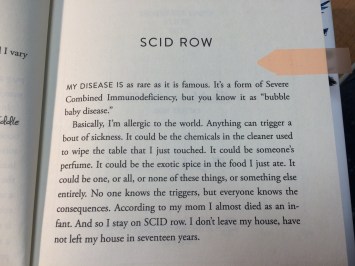
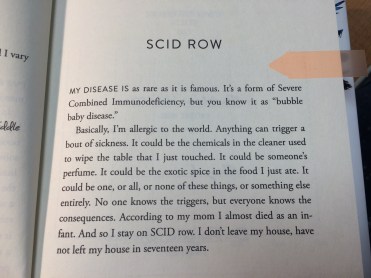
img_1057My students asked for more craft study and grammar instruction in their midterm exams.  With our new notebook setups, I’m hoping to create a routine for the wordplay we’ll need to constantly return to in order to strengthen our use of punctuation, specific diction, sentence structures, and other craft moves.  I want to employ more “triple-plays,” as Penny Kittle calls them–books that act as a booktalk, a quickwrite, and a craft study mini-lesson.  For example, I’ll take the chunk of Everything, Everything pictured at right and make copies of it for my students to glue into their notebooks.  Beneath it, we’ll imitate the parallel structure of the sentences, and the exercise will serve to teach parallelism, talk up the book itself, and be a quickwrite we’ll call “it could be.”

Jackie:  Inspired by a course we took this summer with Tom Newkirk, my colleague and I are putting together a superhero unit for our academic Freshman English classes.  The unit will involve both a persuasive essay and a comic strip students make about a hero in their life.  In turn, I’ve been skimming comics and graphic novels to find inspiration for students.  

In this unit, students will practice storyboarding their own comics while studying the use of craft like onomatopoeia, movement of time, and internal and external dialogue.  My hope is that these building blocks will provide a foundation for us to further discuss the use of colors to portray goodness and evil within a comic (or novel) as well as the use of framing or perspective in the pieces as well.

Please join the conversation–how do you approach the study of craft with your student writers?

Finding Mentor Texts & Craft Studies

#3TTWorkshop MemeWhat prompted you to begin the process of noticing examples of mentor texts or craft study?
Jackie:  When I first started teaching, finding mentor texts proved to be difficult.  While I knew what made writing strong or well-crafted, I didn’t always know what I was looking for.  Instead, I would eat up a plot line, soaking in word choice (I have always loved words), but rarely did I stop to think about how an author sculpted a line or page or chapter.  Finally, after struggling with structuring a piece of fiction writing, I referred back to To Kill A Mockingbird by Harper Lee.  Intrigued by her ability to create a scenes that showed the progression of time, I read and re-read the novel, observing her intentional moves as a writer.  Gradually, I began understanding the value of mentor texts to my own writing.  

The skill is not easy, and I have learned more about myself as a reader in the time I have taught than I ever did during my schooling.  While reading like a writer does slow down the reading process, it also makes me appreciate the artistry of writing.  It makes me aware of my own moves as a writer and how writing, like any other form of art, is about discipline, awareness, and interpretation.

Shana:  I didn’t know about the concept of mentor texts, or craft studies, or imitating great writers, or even reading like a writer…until I took Penny Kittle’s UNHLit class in 2013.  Everything that summer blew my mind, and I was hungry to begin looking for strong examples of real writing for my students to study, imitate, and craft.  I learned about lots of authors, nonfiction writers, poets, journalists, and more while I was at UNH, and in the year following I learned to think back to my own favorites and ask my students for their recommendations when I needed more mentor texts.

Once I began thinking about writing instruction in terms of products I wanted my students to create, I learned to start searching for examples of those strong products.  Sometimes I seek out a specific genre of mentor text if I want to teach a unit about narrative fiction.  Other times, I find an amazing mentor text and design a unit around getting kids to create that specific genre.


Describe your process as you search for examples of mentor texts and craft studies.

Shana:  I read much more slowly now.  Almost all of my reading is of texts that could be used for craft study in my classroom, or books that might go well on the shelves of my classroom library.  I think about writing and reading in such new ways now that I almost unconsciously note a good page for a booktalk, a beautiful line for craft study, or an interesting segment of writing for a mentor text.  

To build an arsenal of texts for use in my classroom, I began to scour the award lists for the National Book Award, the Pulitzer Prize, the Man Booker Prize, and lists of recommendations by groups like ALA, Kirkus, and more.  I also value the recommendations of literacy greats in our field like Donalyn Miller, Carol Jago, and Penny Kittle.  I want strong, complex writing to hand my students, so that they can absorb the craft of good writing through constant, diverse exposure.

img_1057

The page I’ll booktalk from Everything, Everything by Nicola Yoon

Now, most of the mentor texts I discover are incidental–I stumble upon a lovely sentence in a book I’m reading, or I see someone tweet a link to a good article, or I’m struck by a student’s craft as I’m reading their writing.  I try to give a published example, a student example, and my own example as an “in-progress” mentor text, in keeping with the recommendations of Katie Wood Ray in Wondrous Words.

Jackie:  Now that I have begun practicing reading as a writer, I am more aware of the mentor texts that surround me every day.  It took about a year of intentionally slowing down my reading, contemplating the craft, and thinking about where to file the piece within my units for me to develop this practice.  

From Pinterest finds to articles to book excerpts to poems, I am constantly searching for pieces that will inspire and engage my students.  Most of my finds feed into mini-lessons that tackle current skills with which my students struggle.  For example, Many of my students grapple with the use of second person point of view and use it as a default instead of intentionally employing it to reach out to and connect with their audience.  After the November Paris attacks, I found a piece that brilliantly uses second person point of view to help students develop empathy with Syrian refugees.  This piece serves to not only guide them but also make them think about the intentional moves needed to connect with one’s readers.

I also look for mentor texts in classic literature and young adult reads.  These short excerpts teach my students phenomenal craft while dually serving as a mini-book talk.  The writing sells itself.  I always have students request The Glass Castle by Jeanette Walls after I use the first chapter as a mentor text for multi-scene narratives as well as a craft study for opening lines.  The same goes for when I use The Goldfinch by Donna Tartt when I use a short explosion scene to discuss snapshot narratives.

Tomorrow we’ll discuss how we employ found mentor texts in our classrooms.  Join the conversation in the comments–how and why do you seek out mentor texts?


Using Picture Books as Secondary Mentor Texts

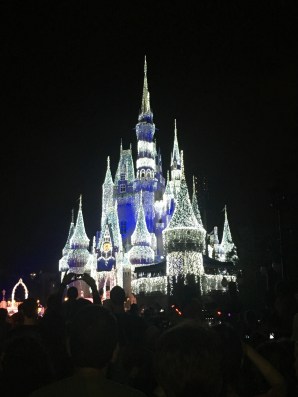
This year my family ditched the traditional Christmas festivities for a week in Orlando,

IMG_1606

Disney started his work as a cartoonist in high school.  How can we carve these same creative spaces for our own students?

Florida.  Swapping fur boots for flip flops, we ran around Walt Disney World, weaving in and out of storybook rides and watching teeny princesses wobble around Cinderella’s castle.  Only now that I am grown do I have a true appreciation for the sheer magnitude of Walt Disney’s brilliance.  He built a physical world of stories.

Disney doodled his way through high school; he honed his craft through drawing and photography classes.  Unfortunately, few curricula allow for the same creative exploration for students.  Oftentimes, the countless possibilities for storytelling and narration tend to center on only real-life experiences, personal narratives, when in reality, writing fiction opens up an entirely different world for self-exploration.

This year I swapped out our traditional multi-scene personal narrative for a story unit in which I taught many of the same narrative craft marks using a combination of fiction and non-fiction mentor texts.

The greatest challenge I faced was in finding short, succinct, and well-crafted stories that weren’t twenty pages long.  While I love short stories, I knew many of my freshmen would not only lose stamina if asked to write such lengthy pieces , but they would also struggle with translating the story structure of these mentors into their own pieces.  I began my hunt for a strong mentor text in, of all places, the children’s section of the library.

Objectives:  In alignment with the Common Core, students will write narratives to develop real or imagined experiences or events using effective technique, well-chosen detail, and well-structured event sequences. Using the language of the Depth of Knowledge levels, students will recognize a wide variety of craft marks in fictional writing.  They will identify patterns and compare effectiveness through discussion. They will formulate their own stories, revising them, and finally applying their understanding to future writing assignments.

Lesson:  I find writing fictional stories intimidating.  My plots seem to sag in some areas, or my dialogue doesn’t feel authentic, but many of my students love leaving their reality to explore their own creative worlds.  The vast majority read fiction, so its only natural that their reading interests feed into their writing curiosity.  The problem is that their greatest mentor texts are, on average, 250 pages long.

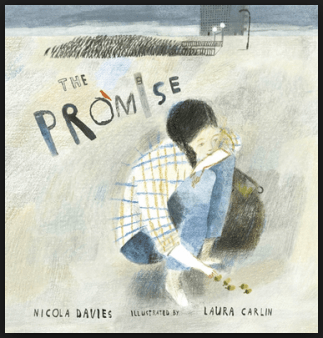
Screen-Shot-2014-11-07-at-1.51.36-PM-1514mm8The Promise written by Nicola Davies and illustrated by Laura Carlin is a beautifully crafted story of a girl growing up in a hardened city. After stealing a purse from a pedestrian, the main character makes a promise out of desperation, only to realize that the purse she has stolen has no value and is instead full of acorns, which she must now plant across the city.  The story reads more like a poem and has a cyclical ending that allows students to see the succinct structure of a short story.
Prior to sharing the story I type up the entire story book (which comes out to two pages) so that the students may access the text without the pictures.  I present it to them as a short story, and we read it aloud like any other mentor text, but I do not tell them it is a picture book!

I ask students to look at the structure of the story—what do they notice about how the author formatted the story as a whole.  Since we just finished studying plot in our literature circles, many of the students dig in to find the rising action and climax while others simply read and re-read to comb through the intricacies of the structure.  Almost all of the students notice The Promise’s cyclical ending that reinforces the story’s themes of redemption and the beauty of nature.

I have them return a second time to the story to look at the writer’s craft.  Students make a list of author’s moves within their writer’s notebook.  If they see something that intrigues them but they aren’t sure of the name, I have them describe what they notice and we develop a name for the skill together as a class.  Finally, we compile our observations onto a large sticky note that remains on display throughout the unit.  Students must then choose two of the craft marks to experiment with in their own writing.

Finally, once we have finished working with the piece, I reveal to students that The Promise is a picture book and I read it aloud.  Oftentimes students are shocked to hear that such a complex story is written for children, but their initial reading makes them value the intricacy of the writer’s work even more.

Follow-Up:  Not only did my students fall in love with the writing process, but they also asked thoughtful questions and engaged in deeper conversations about their writing.  One of my favorite conversations between two jocks involved the complexity of a fight between an alien, human, and zombie.

As a final follow-up, I had students complete a self-revision sheet.  They peer reviewed each other’s work and finally wrote a metacognitive reflection in which they discussed the craft moves they made and how they structured their story.

The freedom to write fiction or nonfiction opened doors for many of the students who tend to struggle with developing ideas while reinforcing many of the craft marks we studied (leads, plot, sensory details, concrete details, internal and external dialogue) in our snapshot narrative unit. As Griffin said, “It’s the best thing I’ve ever written because I’ve gone back and looked at my work in the past.  Fiction is easier because you can make up whatever you want.”


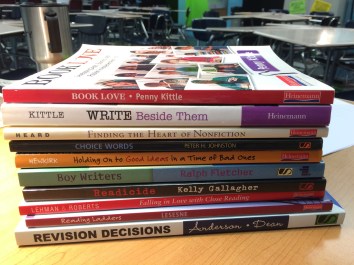
10 Pedagogical Must-Reads for Workshop Teachers

IMG_0650I met with my new student teacher a few weeks ago, and he asked me to borrow any books that might help him get going on the readers-writers workshop–the “theory” version of Jackie’s starter kit.  He’s been in my classroom before, so he knows the general routine and character of our work, but he wanted to know the ins and outs of how I thought and planned and conceptualized the whole thing.

I sat at my desk and looked at all of the titles I had on hand, remembering how influential reading them for the first time had been.  As a result, it was hard not to just dump my entire professional bookshelf onto a cart for him, but I managed to pick out a few titles that have guided me most adeptly in one aspect or another of my current classroom practice.

  1. Book Love by Penny Kittle – This was the book that helped to solidify my vision of an ideal classroom.  Before I read it, I had already been doing many of the best practices Penny mentions–writer’s notebooks, choice reading, personalized writing.  But I didn’t know how to bring it all together until Book Love.  As such, this is my #1 recommendation for any teacher looking to jump-start their individualized workshop curriculum.
  2. Write Beside Them by Penny Kittle – This book introduced me to the concepts of mentor texts, reading like a writer, and best draft/publication of writing.  I learned about quickwrites, constant revision, writing conferences, and a great deal more of what are now standard routines in my classroom.  This is the book for anyone curious about the big picture of writing instruction.
  3. Finding the Heart of Nonfiction by Georgia Heard – I was raised in the tradition of literature as containing mostly fiction and poetry, but Penny’s books helped me see the great value of nonfiction.  I wanted to know how to integrate it well into my thematic units, and this book helped me do that.  Georgia’s book is full of wisdom about finding the soul of good nonfiction writing and matching it to your students’ needs.
  4. Choice Words by Peter Johnston – This book taught me how to talk to students.  It is my #1 recommendation for anyone looking to address those pesky Speaking and Listening standards in the Common Core–this book teaches you about the delicate, volatile power of a few choice words between you and your students.  I re-read it every year, and it might be the most important book in this stack.
  5. Holding On to Good Ideas in a Time of Bad Ones by Tom Newkirk – This book is subtitled “Six Literacy Principles Worth Fighting For,” and Tom Newkirk certainly made me want to engage some of my former teachers in fisticuffs when I finished it.  This text is full of common-sense brilliance that will transform the way you think about why we teach reading and what kinds of texts we teach.
  6. Boy Writers by Ralph Fletcher – Why do my students keep writing about violent gun battles?  Why do they always ask if they can swear in their writing?  What’s up with the complete unwillingness of my boys to be vulnerable?  If you’ve asked yourself these questions…this book is for you.  Ralph writes about everything you ever wondered about boy writers and how to move them forward in their writing.
  7. Readicide by Kelly Gallagher – Schools have been killing reading for many years, Kelly argues, and then presents ways you can stop the slaughter.  He fires away at pop quizzes, assigned chapters, multiple-choice tests, and all the practices that steer our students toward SparkNotes.  Then he reveals ways to get students authentically engaging in literature in a way that doesn’t kill their love of reading.
  8. Falling in Love with Close Reading by Chris Lehman and Kate Roberts – After finishing Readicide and wanting to abandon the eight or so whole-class novels I once felt chained to, I wasn’t sure how to teach close reading skills.  This book answered that question for me, and more.  Chris and Kate reveal how to use poems, articles, short stories, and selections from novels to get kids interacting with the beauty and power of language in all kinds of texts.
  9. Reading Ladders by Teri Lesesne – When all of your students have finally found a book they will actually read–then what?  Teri Lesesne taught me how to help students climb a reading ladder of text complexity with this book.  It’s a tough battle to get all kids reading, but it’s even tougher to get them to all challenge themselves once they are.  Reading ladders are the solution to the increasing complexity question–now they’re a consistent part of my instruction.
  10. Revision Decisions by Jeff Anderson and Deborah Dean – After reading the first nine books on this list, I still wasn’t sure where grammar instruction fit in.  I knew to have students read like writers and learn from language and sentence structures that way, but I wasn’t sure how to structure my mini-lessons, until I read this book.  Jeff and Deborah helped me find strong craft study lessons and bring them into the classroom in a way that appealed to students and also benefited them immediately in their writing.

This is by no means an exhaustive list–That Workshop Book by Stephanie Harvey, Read Write Teach by Linda Rief, The Book Whisperer by Donalyn Miller, and many other integral titles were simply not on my shelf when I gave this stack to Mike.  But these top ten are ones I wouldn’t be the same teacher without.

What other titles are essential to your practice?  Please share in the comments!

Update:  Here are must-read folks that readers have suggested via Twitter and Facebook, as well as in the comments:

  1. Lucy Calkins
  2. Nancie Atwell
  3. Linda Rief
  4. Katie Wood Ray
  5. Donalyn Miller
  6. Don Graves
  7. Donald Murray
  8. Peter Elbow
  9. Ariel Sacks
  10. James Moffett
  11. Louise Rosenblatt

Mini-Lesson Monday: Sentence Boundaries and Adding Some Variety

Sorry, I forgot to record the book’s title.

Even the students in my AP English class struggle with correct punctuation and varying their sentences. In one-on-one conferences, I’ve started to remind them more often to pay attention to how the author of their self-selected books craft meaning. I used to get glossy-eyed blank stares, but students are beginning to understand that writers make intentional moves to draw us in, and keep us within, the pages of their books.

“As a writer, you must do that, too,” I remind them.

This lesson grew out of a conferring conversation with a student who told me:  “I just do not understand all the comma and semicolon stuff, but I have a pretty good idea of what I want to say in my writing.”

Objective:  Using the language of the Depth of Knowledge levels, students will recognize the sentence boundaries and the variety of sentence structures in their self-selected books. They will make observations about the author’s use of punctuation in these sentences, assessing the writer’s effectiveness in crafting meaning. Students will then use their author as a mentor as they apply their knowledge of sentence boundaries and sentence variety and create, revise, and rewrite sentences in their own pieces of writing. Finally, through peer-to-peer conferring, students will evaluate the accuracy and effectiveness of one another’s sentences.

Lesson:  Every student needs their independent reading book. If a student is reading a book of poems, or a graphic novel without many sentences, you will want to supply a stand in book for this lesson or ask the student to find a book she’s previously read.

Tell students that you’ve noticed in their writing that they are ready to make their sentences more sophisticated. Correctness is one way to do this. Varying the length of sentences is another way. Instruct students to turn to a random page in their books, say page 51. Ask them to read the page in search of one long sentence and one short sentence. Give students sentence stips or blank paper and have them write out the sentences they find in their books. They should spell and punctuate the sentences exactly like the author does.

sentence boundaries lessonNext, in small groups, ask students to discuss with one another the structure of the sentences. They might put all the short sentences together and compare them. Then they might put the long sentences together and look at how the authors use commas to separate ideas. Some students will know more about grammatical terms than others, and that is okay. The idea is to get students noticing how writers compose within the boundaries of standard English and to get them to understand how punctuation works to craft meaning. Ask questions that help them discover why boundaries and variety work to produce effective writing.

You may choose to have students imitate the sentences they chose from their books. Imitation is a useful tool for many writers.

Using self-selected books, not just to practice wide reading, but to teach students to read like writers, adds an important element to the workshop classroom. Our writing improves when we take the time to notice and apply the skills of professional writers.

Follow up:  Have students review a piece of their own writing. The writing can be in any stage of the writing process. They should study their writing to evaluate their use of sentence boundaries and variety. Encourage students to revise their writing as necessary, remembering to use the author of their books as their mentors.

Extension:  This lesson works to have students study leads, similar to what Jackie wrote about in the mini-lesson Pick up Lines and Leads. It also works to have students search their books for sentences that include imagery.


©Amy Rasmussen, 2011 – 2015

Behind Barbed Wires

sticker,375x360.u1In honor of the recent Holocaust Remembrance Day, I find it befitting to share Room 382’s shelf comprised of pieces in which those, who experienced the nightmare, share their stories.  Each piece on this shelf is dedicated to bringing awareness, and hopefully shed light on how history truly can repeat itself, if we do not prevent it.

While this shelf hosts stories of tragedy, suffering, and insurmountable pain and loss; it serves a purpose. Aside from the devastating, these pieces share with us the true essence of humanity.  Often, this is the first time students are diving into this 80-year-old genocide and trying to make sense of it. Many times we can’t; and other times we are able to connect over the beauty that surfaced. It’s all very complex.

Elie Wiesel’s story (and bravery) is shared via his trilogy starting with Night then moving us through Dawn and eventually through the Day.  See what he did here?

Anne Frank shares her experience as a young woman budding into adolescence in a time where her beautiful spirit defeated the confines of her attic.  Various types of literature have been compiled so IMG_20150424_083609students (and all readers) can experience Anne’s story in various ways: her published diary, actual footage restored via the Anne Frank House (a gift from a friend’s visit to Amsterdam), the play, and many others.

Maus, an incredible two-part graphic novel, utilizes the “Cat and Mouse” metaphor to portray the Nazis
vs. the Jews during the Holocaust.  This two part series is detailed and brings to life the realities of the inner workings; the emotional turmoil yet amazing perseverance of those living through this moment in history.

Those are three pieces among many.  There are books here (and ones that are currently signed out) that chronicle voices of the children of the Holocaust, novels that use real-life situations yet tell a fictional story, perspectives from a Nazi’s Jewish wife, the bravery of a journalist who swapped places with a Jew to ultimately expose the hidden…

Students are typically surprised, fascinated, uncertain, saddened and sometimes hesitant when it comes to this shelf.  Understandably.  This shelf asks us to inquire and then sit with our findings.  Yet, the conversations and rich discussions that float around this shelf are beautiful; truly beautiful and strengthen our understanding of what it truly means to be human.


In Search of Hope

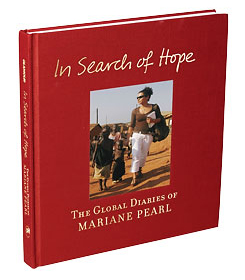
mariane pearl book coverI first fell in love with Mariane Pearl’s writing when I read her memoir: A Mighty Heart where she chronicles the events leading up to her husband’s murder in the Middle East.  It was devastating.  Tragic, really.  Yet, her voice sang from the pages even while sharing the most intimate moments associated with a murder that was so incredibly public.

So, to no surprise, when I came across In Search of Hope: The Global Diaries of Mariane Pearl,  I was thrilled. Pearl, a journalist for Glamour Magazine, took on the world – visiting twelve different countries. She was escorted through these countries by powerful women that are all on missions to bring positivity, safety, and change to countries that are broken.

Pearl visits with courageous women who share the most private details of their work – and passion.  She learns about a Cambodian sex slave’s liberation; Liberia’s presidency from the perspective of President Ellen Johnson Sirleaf (2006); an AIDs orphan turned healer in Uganda; a New Yorker who leads children needing guidance; how justice is getting a voice in Mexico…and so much more.

As you read these short stories full with dynamite photographs, writing that is powerful, and experiences that shed light on women fighting through the injustices associated with their countries, culture, and neighborhoods; you can’t help but to feel as though you are on a year long excursion around the world – one that authentically changes your core as a human being.

Students love this piece.  They are awed by the bravery of these women; Mariane for exposing truths that do not get adequate recognition and the women who are willing to risk their own safety in order to save others.  For every reader, Pearl puts life into perspective.

The richness found within these pages comforts you.  It makes you believe that anything truly is possible.  Well, because it is.  It provides students access to beautiful moments experienced within other cultures and propels them to reflect on their own morals and values – what are they really willing to fight for?

In Search of Hope is a piece that leaves you feeling compelled to explore.  Travel.  Find your own truth.  And when you do, write about it.

G. Neri’s Yummy


yummy

Synopsis

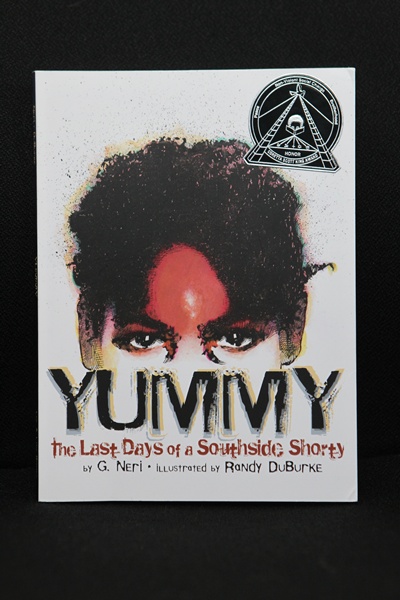
In this award-winning graphic novel, Robert “Yummy” Sandifer’s life becomes interwoven with other true events from a period in time where Chicago’s south side was running rampant with gang activity and violence. The year: 1994. Yet, its relevance still holds weight today in urban communities throughout our country. Unfortunately.

Narration and Writer’s Craft

Through third person narration, eleven year old Roger, guides us through the ongoings, thoughts, chaos, family ties, brotherhood, fears, ponderings, love, realities and insecurities most young adolescent males experience.

Roger lives on Normal Street.  He addresses what many readers are already thinking:  But I guess “normal” is different to different folks.

In studying craft, this one liner opens up dialogue, the use of language and repetition, and the importance of quotation marks in varying situations.  Throughout the entire story, you are greeted with on-point vernacular, literary devices, and a storyline that pulls at the heart strings.  (Just ask my students.)

Additionally, the incredible illustrations allow us the luxury of experiencing Yummy’s journey through his eyes, Roger’s eyes, and the eyes of all of those that take part in the journey.

It’s pretty loaded.

 Essential Ideas and ThemesYummy: The Last Days of a Southside Short

This gritty exploration of Yummy’s life forces readers (of all ages) to question their own understandings of good and bad, right or wrong, yes vs. no.

It searches for truth.

It provides us with the inner-workings of [the downfall of] self-worth and naturally asks us to question it.

Ultimately, we are challenged to think on a macro level about society; why are so many of our youth feeling forced into a life where statistics are alarmingly glaring?


Yummy is a piece that everyone needs to read.  It’s important.  It’s relevant.  It affords us a window into the lives of so many of our youth.  No wonder it has won just under 30 honors and awards.  This is one piece of literature you cannot afford to miss.

For more books by G. Neri feel free to visit his website: http://www.gregneri.com

——-

Yummy Time

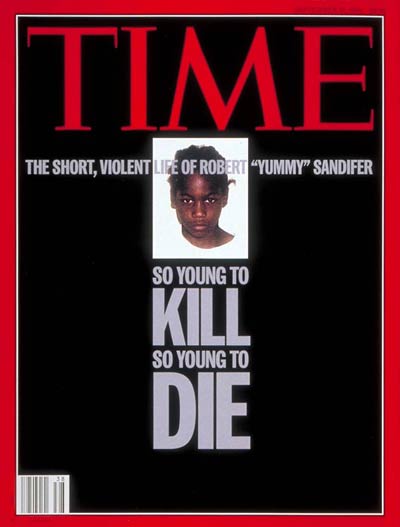
Here is the cover of TIME Magazine’s issue detailing the story of Robert “Yummy” Sandifer.  Tragic and important.

My Top 3 Tips on How to Find #MentorTexts

Yesterday I met with a teacher-leader, and she said that one of her main concerns in implementing writer’s workshop into her classroom is finding the right mentor texts. I’ve heard other teachers say the same. Knowing what mentor text to use to teach which skill can be daunting for teachers just starting out using the workshop model.

Here’s my top three tips on how to find mentor texts to teach writing (and some reading):

1. Read. Read everything from novels to plays to news articles and food reviews. The more we read a variety of texts the more we will have little “aha!” moments when we realize how the whole text, or even a part of it, will work to teach our writers.

2. Tweet. Twitter is the place for educators. Join in, or just tune in, to an #engchat or an #elachat or a number of other chats on Twitter. See Cybrary Man’s Educational Chats Schedule. You are sure to find a chat suited to your needs. Educators use Twitter to share ideas:  mentor texts, strategies, links to blog posts that share mentor texts and strategies. If you need it, you can find it on Twitter. And if you cannot find it, tweet a question and someone is apt to find the answer for you.

3. Follow or favorite or sign up for RSS feeds. I find mentor texts in a variety of places. I watch for updates from Izzit.org, and Essay5W.com. I also visit MovingWriters.org Mentor Text Dropbox Project. On Twitter I follow @brainpickings and @voxdotcom and and @NewYorker and many other news sources.

(Bonus:  A source for texts, specifically to use for reading and practicing the Notice and Note signposts, is the Notice and Note Facebook Group when I found these links to video clips and short stories and poems that can be used to teach the signposts. Thanks @msetha23 for these docs.)

What about you, do you have any ideas or resources you are willing to share? Leave a comment.

©Amy Rasmussen, 2011 – 2015

The Classroom and The Cell

ClassroomCell-cover.jpg (320×512)

Yes, the title is as provocative as the text found inside the 177 pages crafted as a conversation between both activists; one serving a life sentence in Waynesburg, PA and the other an Ivy League professor sharing his knowledge with the educational elite.

If the title alone does not grab your attention, or at the very least, shed light on the dark realities of the school to prison pipeline; then find comfort in knowing that asha bandele’s fingerprints have touched this piece as well – as editor.

Abu-Jamal and Lamont Hill take on the discourse so many African Americans engage in, yet so few human beings have any insight unto – which instills a blindness to the indifference that still persists. Each chapter is dedicated to components of the African American experience that are real, raw, and in dire need of attention.

In bringing necessary awareness to the issues, concerns, and realities found within this piece, take a look at Marc Lamont Hill on the creation of The Classroom and The Cell.

Here’s an excerpt found within the first few pages: (Please note, due to the nature of the content, some chosen words are a bit colorful, yet essential.)

Mumia: When you talk about your lack of freedom, you’re talking about the golden chains that are on you.  They’re pretty as a [expletive], but they’re still chains.  I think it’s interesting that our people, of all the people in the world, chose chains as a fashion accessory.

Marc: Crazy right?  And we call our cars “whips!”

Mumia:  Damn! Whips and chains.  That ain’t a Freudian slip.  Ain’t no such thing!  We’re not even free in our language.  You dig what I’m saying?

This excerpt sets the tone for the entire piece; it’s no wonder that I have felt compelled and propelled to research both men in greater detail.  This is also the excerpt I read aloud to students when they ask what I’m reading.  And every time, without skipping a beat, students are viscerally moved by it.  They ask to sign it out; immediately.  Some students are so enamored by the text, craft, and connection that they find an urge to read other books also authored by these men.  Innately what happens next is stunning – author studies are being explored and students’ identities are being validated.

What titles do you and your students collectively enjoy that provide opportunities  for understanding cultural ideologies while fostering honest dialogue?