Tag Archives: choice reading

#FridayReads: Some of the Classics

IMG_20150729_181804

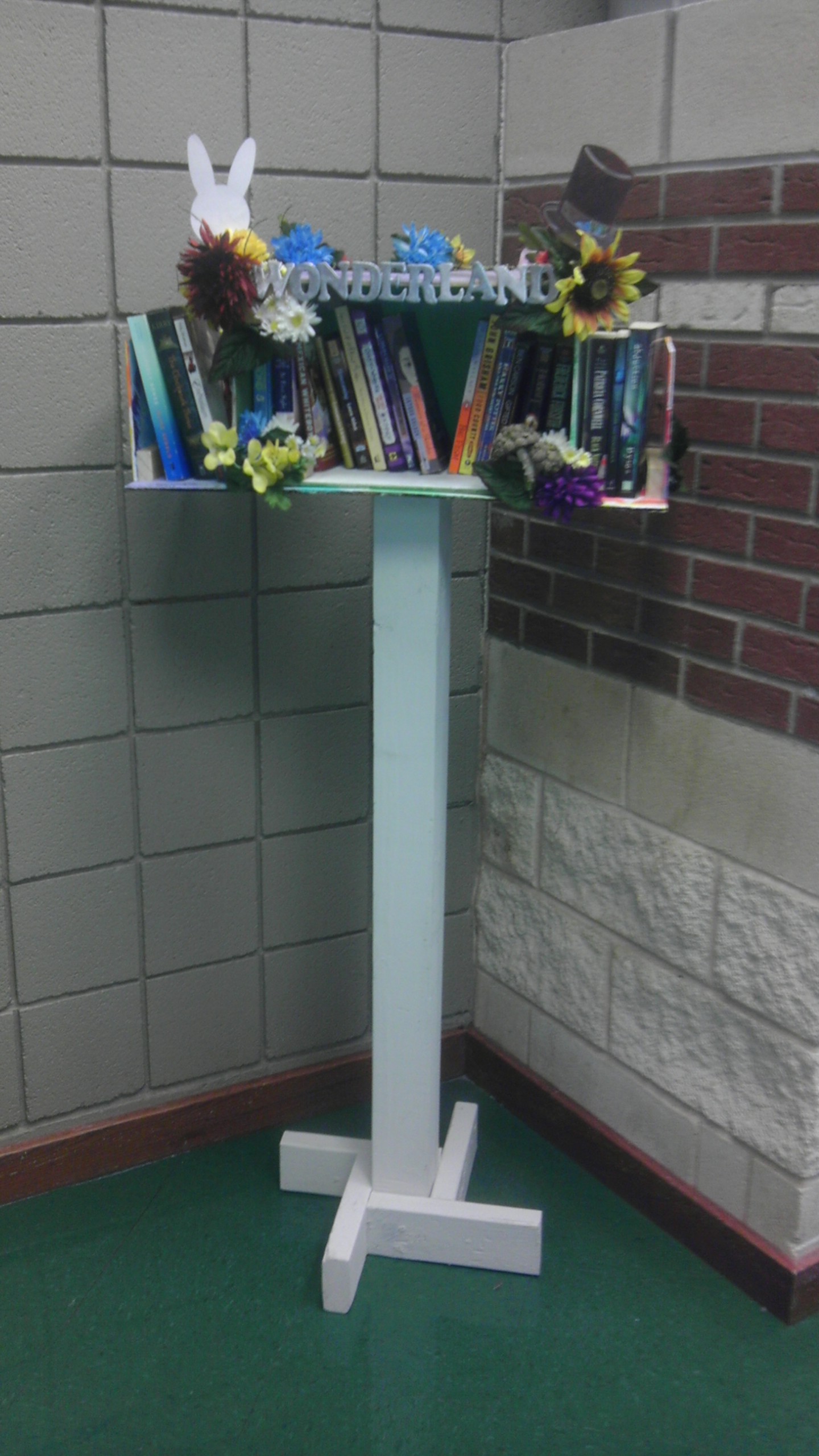
Alice in Wonderland pop-up book – full with rich colors, adventure, and 3D visuals.

“Oh, one of your students is reading Alice in Wonderland?!  I love that.  Are they captivated by it?  I wrote my entire master’s thesis on that piece.”

Last year, a colleague of mine was through the roof to hear about some of the children’s classics that my students were engaging in:  E.B. White’s pieces, Peter Pan, The Secret Garden, The Tao of Pooh, Alice in Wonderland – which holds a very special place in her heart.  But, for some reason students across the board have been guided away from these treasures.  Why are we steering them away from the simplicity of tapping into their inner nostalgia, re-entering times in their lives where there was quiet innocence and a simplicity that innately dissipates as we mature?

IMG_20141208_121037

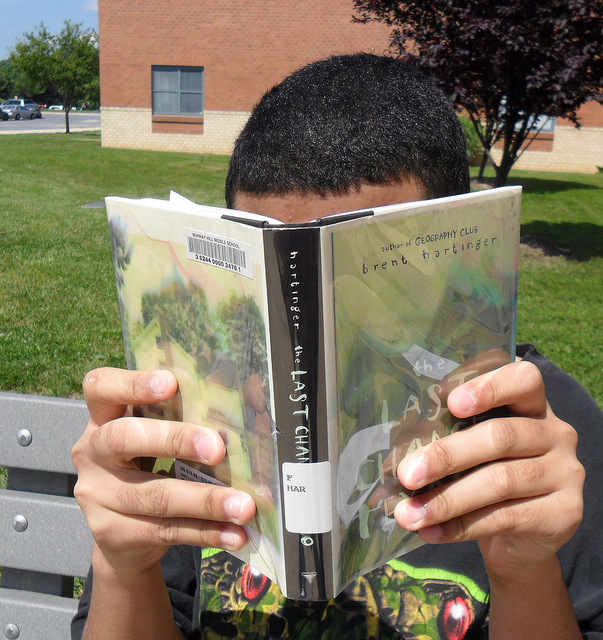
In between reading The Classroom and The Cell and I Am Malala, this young man enjoyed the layered themes of a charming classic.

Charlotte’s Web was just as powerful for me as a thirty-something adult as it was as a seven-year-old little girl.  The latter was an opportunity to finish a chapter book full with robust (animal) characters and an opportunity to connect with Fern, the moralist. The former was a rich experience as I explored the theme of love, relationships, sacrifice, and an understanding of death (as I had recently lost my grandmother).

One of the important elements of the Readers Writers Workshop model is the idea of roller coaster reading. As Penny Kittle adequately puts it; adults read books on all different levels based on interest – students deserve the same.

I couldn’t agree more.

Think back to a time you dedicated your reading to a piece that was difficult – for you – for whatever reasons affiliated with that experience.  Often times, we decide to ‘take it easy’ once we’ve conquered a book of that caliber.  We’ll play with levels and genres and graphic novels and page numbers…and any other factors that play into our decision making.  But, we typically veer from the intensity.

Until we’re ready to try again.  And, we typically are ready at some point because we experienced the pride that comes with such a challenge.  It just may not be our next book…or the one after that…  But, we will find ourselves back there because it’s important to do so.  Students will too.

Roller Coaster Reading : All readers should have the luxury to go on such a ride!

Roller Coaster Reading : All readers should have the luxury to go on such a ride!

And while there is the push for lexile reading, and all of the other ways to monitor student reading, we must let students read what their souls ache for.  Whether it be luxuriating in a time of childhood innocence or challenging their vocabulary with a much more difficult piece.  When we provide space for students to explore (and yes, children’s books included) students find the roller coaster that suits them – a bit of scare and intrigue balanced with comfort and adventure.

A wonderful way to provide students the opportunity to monitor such reading is through the creation of a Reading Ladder.  (Scroll down to Q1 and Q3 to find information on how to create ladders and see examples.)  Simply, by reading various books on differing levels, students have the opportunity to review their learning, progress, fluency, and stamina…all the while having choice.

This year, I intend to watch our I’ll Always Be A Kid shelf grow as more and more students find themselves drawn to some of the classics from their childhood.  A handful of students love this shelf because they reminisce about reading (or having that book read to them) while others are exploring children’s literature for the first time.  Our adolescent parents are intrigued as they scope for titles that they want to bring home to read to their own little ones – because passing on the gift of literacy is priceless.  Regardless of the rationale, students end up falling in love with the magic.

What hesitations or fears surface when thinking about high school students reading children’s literature?


Guest Post: The Case for Teaching Reading in High School

cherry-blossoms-from-our-bedroom-window-april-2014As spring arrives, the cherry blossoms start to bloom, the daffodils open their petals towards the sun, and high schools across the country begin their own feverish rite of spring, end of course test intervention and remediation. Schools will hold after school opportunities to help students prepare for a reading test that they must pass. In my state, Virginia, if students don’t pass the test, they don’t graduate, the school’s graduation rate is affected, and accreditation is considered. All this is not to say that schools don’t want to do what is absolutely best for students, because we do. We know that a high school diploma can make the difference between a mediocre job and a career. But we don’t grant a high school diploma unless a student passes the reading test. The irony is that, undoubtedly, when we sit down with these students to help them prepare, we will be doing little reading at all.

What are the costs of not reading well? The Alliance for Excellent Education, estimates the cost in terms of lost wages over a lifetime due to low literacy skills is around $335 billion per year. According to Reading at Risk, a survey conducted by the National Endowment of Arts, there is a sharp divide in reading skills of incarcerated adults versus non-prisoners. On the flip side, those who read more for pleasure exercise and volunteer more. They even vote more. And students are not going to read more, are not going to become avid readers, if they are not reading. Students should be engaged in what they are reading in order to become more competent readers. Not surprisingly, reading more makes us better readers. The Department of Education reports that frequency of reading for pleasure correlates strongly with better test scores in reading and writing. Students who read outside of school see more vocabulary, reading comprehension, verbal fluency, and background knowledge growth, all of which are skills students need in order to pass the reading test. Right now, there is a decline in voluntary reading rates among teenagers while at the same time reading skills in schools remain stagnant or worsen. A required reading test is not the problem. Students graduating from high school should have the skills and strategies to pass the test. The problem, instead, is that in this era of high stakes testing and accountability, schools, divisions, and states have lost track of the original goal of the test, to ensure that all students who graduate from high school in the United States are competent readers. Instead, we are focused on teaching for and to a test.

According to the most recent National Assessment of Educational Progress (NAEP), our country’s 4th grade reading scores are slowly moving up and are the highest they have been in the past 33 years. This is great news as it shows the achievement gap is shrinking with our elementary school population. Unfortunately, the numbers are much different for our adolescent learners. The 2013 average reading score for adolescents has gone down from the first assessment and remains unchanged since 2009. In Virginia, only 36% of eighth grade students scored at or above proficiency level on the NAEP reading test. Students with disabilities and English language learners are often struggling readers, and schools have a difficult time meeting accreditation as these subgroups continue to score poorly on state reading tests. In fact, the achievement gap among high school seniors with and without disabilities is growing.

In our current era of accountability, it is required for states to have a reading test in order to be accountable to the federal government. States need to show that students are making adequate progress in reading. These scores are not only used for accountability at a state level but also on a more local level. Community members look at these scores in an effort to understand the needs of a school or division. Unfortunately, when we look at the demographics of the students we are currently cajoling to stay after school for extra test preparation, we don’t see good results. Last year, although 90% of students in Virginia passed the end of course reading test, only 62% of students with disabilities and 70% of limited English proficient students passed. This, in turn, is affecting Virginia’s accountability score for the federal government, as students with disabilities and limited English proficient gap groups did not make adequate progress.

Instead of prepping students to pass a specific test, schools should focus on teaching students how to girl-reading1read better. Schools can do this by teaching students at the appropriate reading level and using explicit instruction while at the same time increasing teachers’ professional development on literacy. Students need to be reading high interest books that aren’t too difficult or they will give up and not read at all. English language learners may start school with little literacy preparation which, according to the NAEP study, results in only 3% of English language learners in the 8th grade scoring at or above proficient in reading. These students will not pass a test by having test prep. Instead, they should be reading, analyzing, and talking about books and passages that they can read so that they can do the rigorous work asked of them.

In Reading Next, a Carnegie Corporation report, researchers map out fifteen elements of effective adolescent literacy programs, none of which include test preparation. Instead, this report focuses on the importance of explicit instruction in comprehension, vocabulary, fluency, writing, and motivation for struggling readers. Schools should be providing these literacy interventions in the school day every day, not just after school as the test looms near. Time must be spent in class with texts in order to read and write effectively. Research suggests that these texts should ideally consist of good literature on and slightly above students’ reading level to grow as readers. Professional development should be provided for teachers so that students who struggle can work on strategic reading skills in all their content classes.

boy readingWe cannot better prepare students for the test by having them practice process of elimination in answering the multiple choice questions. Instead, we must require a shift in instruction to do the hard work of teaching students to be more strategic, aware, and yes, avid readers. We can do this by helping students where they are, providing support where they need, and allowing them time to read. Schools should shift our focus towards real reading in order to better prepare for the reading test. We need to prepare stronger readers to help them be successful both in their professional lives as well as in their community. So as spring is upon us, we cannot get caught up in the flurry of test prep remediation but instead should teach reading by having students read. What a better season for it? For surely, it is not a coincidence that a perfect way to enjoy this spring weather is to sit outside and read a good book.

References Pfautz article

Jeannie Pfautz is a reading specialist in Charlottesville, Virginia.  She loves the opportunities she gets to work on reading and writing every day with her students.

Guest Post: How a High School Improved Reading by Building Little Free Libraries

busLast summer, I became a Penny Kittle convert. I originally didn’t know what I was signing up for, but something kept driving me to be sure I was where she was. Turns out, it’s been the best hunch of my teaching career. The mind shift I was searching for. A complete game-changer. And this is year eighteen.

After 2 ½ days with Penny, I spent the rest of my summer trying to keep up with my churning brain. I wrote more than I have since I was a slightly over dramatic, totally drowning-in-love teen. I read. And I read. And I read. I rediscovered that lust for story I had almost forgotten. I freed myself from the idea that pleasure reading was fluff and gripped the concept of reading what speaks to me as a means of improvement – just like I would soon ask my students to do.

In the midst of my mid-career crisis (maybe crisis is too harsh?), I found a tweet about the site littlefreelibrary.org. The various clever wooden boxes built for books captivated me. I loved the idea of a take-one-leave-one system designed to build community. What fun! I wanted one! Maybe a home project with my own children? Then, I had a thought. What if we put these book boxes in the hallway at our high school? What if this could be the reading take-over Penny Kittle encouraged? So, on my wild whim, I retweeted the link with that very suggestion.

Soon (which means mere seconds in the Twitter world), my teacher peers of all disciplines — math, sharkscience, history, technology, world languages — responded with enthusiasm! They wanted to build wooden cubbies! They wanted to donate books! They were all on board! So, the fun began…

In an August inservice session, I presented the idea to the full faculty, highlighting the importance of choice-reading in ALL classrooms. I used so many of Kittle’s words in an effort to begin a movement. We have to get all of our kids reading – the rich, the poor, the gifted, the challenged, even the ones who don’t eat their vegetables. And, in a school as diverse and unique as ours, we couldn’t wait another second. Of course, there was one small glitch; I didn’t know or have the means yet to build the little libraries. But I knew we could.

Following my first session, our new theater tech teacher immediately approached me, and he offered to have his tech class build the first set! I cried. I usually do at most sentimental things, but I just didn’t expect this outpouring. Books began to appear in my classroom from teachers and then parents. Some opted to write an inscription inside their favorite books, explaining to the future reader the special significance of that particular tale.

#hebronreads was born.

The theater tech class created the first five Book Nooks, as they are now called, from lumber and Slide2supplies donated by our community. In true theater style, the Nooks have flare – a shark, an Alice in Wonderland, a school bus, the Parthenon, and, of course, a book! All student created! All on pedestals in various niches in our halls. At our fall open house night, books poured in from parents who heard our call to promote literacy, and books continue to appear in my classroom like gifts from the Tooth Fairy.

Students in our advertising and marketing classes competed to create a campaign for the program. On World Read Aloud Day in March, we paused to read to our students, and we passed out bookmarks and talked books during lunches. Students have daily choice-reading time in math classes and business classes in addition to English classes. Another book drive is slated during our spring football game in May. A spring literacy night with former Hebron High School grad now YA author Lindsay Cummings is in talks.

alice


This is only the beginning.  

In my hopes and dreams, we will build more Book Nooks and litter the building with choices. We will continue the book drives until all classrooms have some sort of libraries. We will keep talking reading and promoting ideas via @hebronreads. And one day, when we are feeling pretty confident in our literacy push, we will make Nooks and take them filled with books to neighboring schools who need more stories in their lives too. Hebron High School is now a thriving community of readers, and it is truly glorious!

Parent quote:

“My son has always loved to read (‘loved’ is probably an understatement), so when he found these books in Hebron’s hallways, he was very excited.  He came home telling me what a neat thing this was — books for the taking, any book, all kinds. Once he understood the program, he commented on what a great idea . . . read a book, replace a book, or just bring it back. Great idea, Hebron!”    Carolyn Sherry

Donna Friend teaches at Hebron High School in Carrollton, Texas. She is making readers out of English III students and leads her department into the chaos of educational risk-taking. Currently, she is honored to be her campus as well as the Lewisville Independent School District’s Secondary Teacher of the Year, an accolade that, despite her 18 years of teaching, she doesn’t yet feel old enough to have earned! Her current favorite book is Jandy Nelson’s The Sky is Everywhere, and she is practicing being a regular reader and writer along with her students. She has a 9 year old son, a 6 year old daughter, a hubby, two cats, and a few fish. She once dreamed a young adult novel and still regrets not writing it down immediately after waking. Find Donna on Twitter @mrs_friend

Not Your Same AP English Summer Reading List

I started counting Mondays. I try not to get overly excited for summer but I cannot seem to help it. I have so many grand plans. I’m lucky that way. I get to travel to conferences I want to go to and see friends I want to see.

My students are not so fortunate. Most of their summer will be spent within a few miles of their homes. That’s usually how it goes for kids in less affluent areas. They hang out. Do nothing. At least that’s what they tell me.

I want them to read. The summer slide goes right on sliding right into high school.

Some of my students will read because they’ve come to identify themselves as readers this year. They’ve crafted lists of books that interest them, and they’ll make their way to the library and check out books that look intriguing. Some will make their way to the book store. Several of my students have spent their part-time paychecks on books we’ve talked about in class.

They are learning what it means to value books. Of course, I’m pleased.

Summer reading is a tricky thing. I know many students will not read if they do not have an assignment that requires it. That is what we’ve taught them to expect. Expectations engrained like this are hard to change.

Change is possible though.

We can change the books we put on our ‘required’ reading lists (I like the word recommended or suggested so much better.)

We can allow choice of titles instead of Screen Shot 2015-04-28 at 9.43.41 PMmandating one specific book.

If we want our students to want to read, we have to make it easy for them. The article Those Tired Summer Reading Lists. Here’s What to Do offers more to this argument. (And it’s got some nice alternatives for reading logs, too.)

I wonder how you are prepping your students for summer reading?

Me? I have already started the pep talk: The senior AP English teachers on my campus are mandating A Brave New World and Beowulf.

I’ll just leave that right there.

I am proud of my AP English Language team. We’re providing an annotated list of paired texts for our incoming juniors: Summer Reading with a Challenge and a Choice. This is not your same AP English summer reading list. I am confident we will win over more readers this way.

Choice always does.

Maybe we can help more teachers remember:  Is summer reading about the reader or about the book?

In the next few weeks, I’ll talk up books with my students. I’ll remind them of the choices they had in our book clubs. Maybe they’ll remember how hard it was to choose just one title at the time and read another this summer. I’ll show some book trailers and encourage students to grow their TBR lists. We talk a lot about readers having reading plans.

I lose a lot of books throughout the year, but I’ve also got a lot of books on my shelves that never move. I’m thinking of having some kind of check out system, maybe a $2 sale (if I can do that). I’d rather have books in student hands than sitting all alone on shelves all summer. Anyone have ideas here?

What are your plans to encourage readers to read this summer?

©Amy Rasmussen, 2011 – 2015

Behind Barbed Wires

sticker,375x360.u1In honor of the recent Holocaust Remembrance Day, I find it befitting to share Room 382’s shelf comprised of pieces in which those, who experienced the nightmare, share their stories.  Each piece on this shelf is dedicated to bringing awareness, and hopefully shed light on how history truly can repeat itself, if we do not prevent it.

While this shelf hosts stories of tragedy, suffering, and insurmountable pain and loss; it serves a purpose. Aside from the devastating, these pieces share with us the true essence of humanity.  Often, this is the first time students are diving into this 80-year-old genocide and trying to make sense of it. Many times we can’t; and other times we are able to connect over the beauty that surfaced. It’s all very complex.

Elie Wiesel’s story (and bravery) is shared via his trilogy starting with Night then moving us through Dawn and eventually through the Day.  See what he did here?

Anne Frank shares her experience as a young woman budding into adolescence in a time where her beautiful spirit defeated the confines of her attic.  Various types of literature have been compiled so IMG_20150424_083609students (and all readers) can experience Anne’s story in various ways: her published diary, actual footage restored via the Anne Frank House (a gift from a friend’s visit to Amsterdam), the play, and many others.

Maus, an incredible two-part graphic novel, utilizes the “Cat and Mouse” metaphor to portray the Nazis
vs. the Jews during the Holocaust.  This two part series is detailed and brings to life the realities of the inner workings; the emotional turmoil yet amazing perseverance of those living through this moment in history.

Those are three pieces among many.  There are books here (and ones that are currently signed out) that chronicle voices of the children of the Holocaust, novels that use real-life situations yet tell a fictional story, perspectives from a Nazi’s Jewish wife, the bravery of a journalist who swapped places with a Jew to ultimately expose the hidden…

Students are typically surprised, fascinated, uncertain, saddened and sometimes hesitant when it comes to this shelf.  Understandably.  This shelf asks us to inquire and then sit with our findings.  Yet, the conversations and rich discussions that float around this shelf are beautiful; truly beautiful and strengthen our understanding of what it truly means to be human.


In Search of Hope

mariane pearl book coverI first fell in love with Mariane Pearl’s writing when I read her memoir: A Mighty Heart where she chronicles the events leading up to her husband’s murder in the Middle East.  It was devastating.  Tragic, really.  Yet, her voice sang from the pages even while sharing the most intimate moments associated with a murder that was so incredibly public.

So, to no surprise, when I came across In Search of Hope: The Global Diaries of Mariane Pearl,  I was thrilled. Pearl, a journalist for Glamour Magazine, took on the world – visiting twelve different countries. She was escorted through these countries by powerful women that are all on missions to bring positivity, safety, and change to countries that are broken.

Pearl visits with courageous women who share the most private details of their work – and passion.  She learns about a Cambodian sex slave’s liberation; Liberia’s presidency from the perspective of President Ellen Johnson Sirleaf (2006); an AIDs orphan turned healer in Uganda; a New Yorker who leads children needing guidance; how justice is getting a voice in Mexico…and so much more.

As you read these short stories full with dynamite photographs, writing that is powerful, and experiences that shed light on women fighting through the injustices associated with their countries, culture, and neighborhoods; you can’t help but to feel as though you are on a year long excursion around the world – one that authentically changes your core as a human being.

Students love this piece.  They are awed by the bravery of these women; Mariane for exposing truths that do not get adequate recognition and the women who are willing to risk their own safety in order to save others.  For every reader, Pearl puts life into perspective.

The richness found within these pages comforts you.  It makes you believe that anything truly is possible.  Well, because it is.  It provides students access to beautiful moments experienced within other cultures and propels them to reflect on their own morals and values – what are they really willing to fight for?

In Search of Hope is a piece that leaves you feeling compelled to explore.  Travel.  Find your own truth.  And when you do, write about it.

Everywhere You Turn

Over the last three years, our Francis Gittens Memorial Lending Library has grown literally by thousands of books.  And, it’s a beautiful sight.  One in which provides comfort, challenge, and dialogue among students and educators.  It propels interest in reading and provides options and choice; students sometimes pull up a chair and use the edge of any given shelf to rest their Writer’s Notebook while they write and find inspiration.  It’s our staple here in room 382.

But, as more and more donations come through the door, I panic: Where will they all go?!  We are currently wall-to-wall with bookshelves (many that tower over us) and the remaining space is either wall-to-wall windows or full of technology.  So, I started to utilize every open surface: our computer cart, window sills, filing cabinets, my own desk.  Now, literally everywhere you turn, your gaze lands upon books…stacks and stacks of books.

Initially I felt overwhelmed by having books everywhere; I thought it felt chaotic.  But, the perceived chaos actually provides students even more choice and an innate awareness of their surroundings. Students have started to become even more in-tune with their reading journeys and have been feeling more compelled to explore.  For more reluctant readers they have access to books without it feeling as though there is the need for any sort of grandiose gesture; trekking across the room to the wildly overwhelming library.  It’s subtle yet powerful beyond measure.  Everything is within their reach.

IMG_20150421_093753

Books resting on technology…

Everything.  Even our mobile technology cart full of laptops. The books on top are stacked in four piles; they are our newest additions.  Because the cart find its way across the room, near different seats, and at various different spots depending on the day; it’s equivalent to an ice cream truck making its rounds – no one is to be missed.  These piles change as the new additions continue to stream through the door.  Many students, as they are accessing the cart for a computer, find themselves pausing for a moment because a book title…or cover…or piece they realized was on their next-to-read list…has caught their attention.  I love the irony that’s often captured here when a student is simply going to return their computer, hears the bell ring, and runs to their Writer’s Notebook to jot the title down; yet forgets to put the computer back!

IMG_20150421_094028

Here is one of three window sills adorned with literature – and some added nature.  During the winter months in room 382 the heat tends to be unbearable (hence the cactus) which is quite unfortunate.  Yet fortunately, students like to get a breath of fresh air.  So, while doing so they find themselves multi-tasking – breathing in the fresh city air while perusing through the new titles that greet them at the window.  Many times, a lesson or writing workshop will be interrupted with, “Miss Bogdany, I found another book about XXX!”

Books decorating ugly steel surfaces...

Books decorating ugly steel surfaces…

Many students have just recently begun to proudly embrace their love for graphic novels. Typically,they believe that they’re for ‘young kids’ because of ‘all the pictures and stuff’.  I whole-heartedly disagree.  So, in the vein of supporting students’ interest in visual literacy, many are found atop an industrial filing cabinet adding color, texture, and accessibility.  Because this surface is also used for additional supplies, students access it often.  Every time they are wanting to find their zen (see butterfly book box on the top left) they happen upon literature that excites them.  Many times, the zen garden and a new book escorts them back to their seat.     

IMG_20150421_093914

Exhibiting my literary interests. The left stack is comprised of pieces I want to read. The ones on the right are my absolute favorites. And, the ones in the middle are a fantastic mix of professional resources, gifts, and tools.

I know students will not produce work if they are not comfortable; both physically and in feeling safe within a community.  I create a visually stimulating space at my desk because it’s what fuels my passion for all things literacy. I also know, when a student needs their own unique space, they tend to gravitate toward wherever it is that I’ve set up shop.  It has been labeled ‘their corner office’ – and yes, they get right down to business!

There are other times when I conduct 1:1 conferences and ask a student to engage in dialogue in our bright back corner.  I watch their eyes drift from their writing to the options resting atop my wooden workspace.  Students will reach across the desk to pick up a piece they have never seen there before and while I try to get their attention refocused on our conference, sometimes the book they’ve chosen is much more convincing than whatever it is I’m trying to do.  I also think some of the intrigue is that students know that what they find there are pieces I can really talk about because I’m passionate about them.

So, as the year starts coming to an end and we start thinking strategically about how we are going to start minimizing our inventory and organizing it for our summer packing; please don’t!  Keep moving things around and keeping it fresh.  Put books in places you haven’t before – students will find them trust me.  Play around with what you have displayed in your area and invite students to engage in conversation wrapped around them.  But, most importantly, enjoy these remaining few months with our inquisitive and dedicated readers as they continue to look around our learning environments and find exactly what they didn’t even know they were looking for.

Where do you keep literature aside from your library shelves?  What successes have students found when they happen upon a book in the most unlikely of places?


Keeping Them Reading: Speed Dating with a Book

Confession:  I have never been speed dating.

I just love the idea of it.

In 2012 I wrote about an activity we did in my AP English class that got everyone talking as we prepared for the AP exam. I hadn’t even thought about that, until I started to write about our latest foray into the talkative world of speed dating with books.

Neydy and LauraI know many teachers have tried some version of this activity. I want to add my voice to theirs:  this is a F.U.N. way to get students talking about what they have read and what they might want to read — both important factors in helping students of all ages develop their identities as readers.

How to Speed Date with a Book

As students entered my classroom, I asked them to

1) find a book from the shelves that they had read and liked enough to share with another person,

2) find a second book that they thought they might like to read — maybe they liked the cover or the title; maybe they had heard someone talk about this book. Didn’t matter.

Everyone needed two book.

Then, we tried this “speed dating” thing.

First, we formed two circles, one inside the other. One circle faced outward. The other faced inward.
Students stood in front of one another, and I with the easy job stood with the timer and the camera.

“One minute,” I said, “You’ve got to stay on topic, and talk about one or both of the books in your hand for one minute. Your goal is to ‘sell’ the other person on why they want to read these books.”

GO!

 We talked books for as many minutes as it took for every student to talk one-on-one with every other student. It was exhausting. And wonderful.

After we completed all our rounds, we set all of the books out on one table, and students picked up their writer’s notebooks and turned to their “What Shall I Read Next?” lists, adding any titles they might want to read during the last two months of school. Every student wrote down at least one book. Some wrote down several.

Why Talking About Books Must Be a Constant

I teach juniors in high school. Before this year, most of my students did not consider themselves readers. They have had to learn what it means to

a. like books,

b. like to read books,

c. like to talk about books,

d. know how to find books they like.

The moment I stop holding up books at the beginning of class, reading a bit, and encouraging them to give it a try, many they stop reading.

They are one year and a couple of months away from graduating high school, and they are Baby Readers, fledglings not ready to leave the roost and fly off on their own. (In more ways than one, I know.)

I don’t know if my readers will be strong enough to keep reading when they leave me the first week in June.

I hope so.

In the mean time, I will keep up the talk and keep up the expectations:

You must read if you are a student in my class.

You are a reader who reads every single day.


What are some activities you do to keep your babies reading?


©Amy Rasmussen, 2011 – 2015

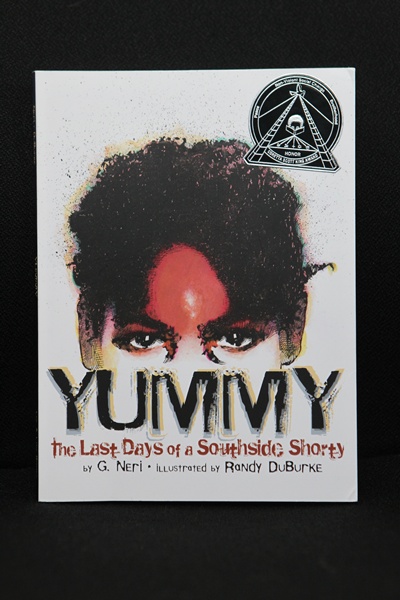
G. Neri’s Yummy


yummy

Synopsis

In this award-winning graphic novel, Robert “Yummy” Sandifer’s life becomes interwoven with other true events from a period in time where Chicago’s south side was running rampant with gang activity and violence. The year: 1994. Yet, its relevance still holds weight today in urban communities throughout our country. Unfortunately.

Narration and Writer’s Craft

Through third person narration, eleven year old Roger, guides us through the ongoings, thoughts, chaos, family ties, brotherhood, fears, ponderings, love, realities and insecurities most young adolescent males experience.

Roger lives on Normal Street.  He addresses what many readers are already thinking:  But I guess “normal” is different to different folks.

In studying craft, this one liner opens up dialogue, the use of language and repetition, and the importance of quotation marks in varying situations.  Throughout the entire story, you are greeted with on-point vernacular, literary devices, and a storyline that pulls at the heart strings.  (Just ask my students.)

Additionally, the incredible illustrations allow us the luxury of experiencing Yummy’s journey through his eyes, Roger’s eyes, and the eyes of all of those that take part in the journey.

It’s pretty loaded.

 Essential Ideas and ThemesYummy: The Last Days of a Southside Short

This gritty exploration of Yummy’s life forces readers (of all ages) to question their own understandings of good and bad, right or wrong, yes vs. no.

It searches for truth.

It provides us with the inner-workings of [the downfall of] self-worth and naturally asks us to question it.

Ultimately, we are challenged to think on a macro level about society; why are so many of our youth feeling forced into a life where statistics are alarmingly glaring?


Yummy is a piece that everyone needs to read.  It’s important.  It’s relevant.  It affords us a window into the lives of so many of our youth.  No wonder it has won just under 30 honors and awards.  This is one piece of literature you cannot afford to miss.

For more books by G. Neri feel free to visit his website: http://www.gregneri.com

——-

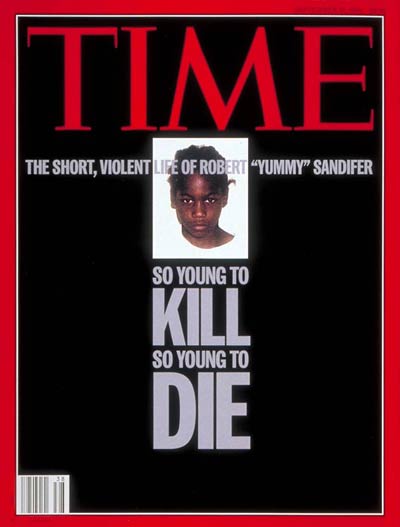
Yummy Time

Here is the cover of TIME Magazine’s issue detailing the story of Robert “Yummy” Sandifer.  Tragic and important.

Why I Applaud The Student Who Reads Only Two Books

imageedit_5_2583117499Author, teacher, and reading-writing workshop guru Nancie Atwell recently won the $1 million Global Teacher Prize. I have been a fan of Atwell’s work since I read her book In the Middle during my first year of graduate school. In fact, I was star struck two years ago when Atwell sat on the floor next to me during an NCTE workshop (note my shoulder proudly photo bombing Shana’s picture of the goddess herself). While I have subscribed to Atwell’s philosophy since I began my career in education, I was shocked to read in the media coverage that her students on average read 40 books per year.

My students do not.

Don’t get me wrong; the majority of my students read a large amount, yet while I could calculate the average, it would grossly misrepresent the true value of their accomplishments. I have some students who breathe books and complete them at breakneck speed. They add leaves to our book tree at an astonishing rate, yet admittedly not all my students are like that. By the end of the year, some have only completed two or three independent books in total. As a first year teacher (last year), I felt like I had failed these students. As far as I was concerned, the good teachers didn’t run into this problem. They only spoke about the record-breaking kids, not the ones that kept me wracking my brain for a solution. It felt like I was the only teacher who had the two-book-reader.

Last year, mine was TJ. TJ couldn’t seem to make it through a book. Many of my hesitant readers have learning disabilities or attention deficit disorders; in past classes, they have felt little success in reading whole class novels. When they arrive in my classroom they are resistant to choosing their own independent reading books. TJ was no exception; he had ADHD and struggled to focus on his reading both in and out of class. I’d watch him stare at a page for five minutes straight without being able to settle his mind and read a line. During conferences TJ discussed his book and claimed he was interested in it, yet he moved at a snail’s pace. By the end of his foray with Jarhead, I couldn’t imagine him undergoing the same tedious process with another book. I thought he’d quit. But he didn’t. Through reading conferences, daily reading time, and check-ins with his parents, I was able to help TJ develop a routine and gradually become a reader. Yet the greatest influence was TJ’s friends. Seeing so many of his peers reading on a daily basis motivated TJ to continue working towards his goals.

By the end of the year, TJ had read two independent reading books and three whole class reads, “more books than [he] had ever read before.” This was a feat arguably equal to if not mightier than some of my students who read 80 or more books. TJ developed persistence and stamina even if he couldn’t keep up with many of his peers. He was proud of his accomplishments and determined to become a better reader the following year. As a teacher, that’s what I want for my students—to push them to succeed and accomplish more than they thought they were capable of.

We all have those students (or maybe it’s still just me) but we must praise and hold these students in high esteem. We must brag about their successes and triumphs just as much as we praise the work of our highly motivated readers. After all, every book is a learning experience and an accomplishment.

Do you have a “two-book reader”? What is your story, and how did you work to motivate that student?