Sometimes others write my thoughts. Shana did that this week in her post about Reading Resolutions.
Well, not the part about traveling to England and visiting all the awe-inspiring places she mentions. (“Someday,” I tell my self daily.) But the part about losing her way as a reader, and the part about needing to “read my roots.” This is so me.
When we run a readers and writers workshop classroom, we read so we can encourage our students to read. Sure, we can book talk titles that we’ve only heard of — there is a little art to that though. Sure, we can have students book talk to one another — this works well when we’ve modeled talking books enough times. And while most of the YA literature I have read over the past several years has held my attention and given me insights into the minds and hearts of my students, it is still not my roots. (Honestly, I get a little tired of all the teen angst that my students love to read.)
Like Shana, my roots run deep into literature. I love the classics. I mean the real old classics — a little Homer, Greek tragedy, a comedy or two, definitely a book of Will’s plays, maybe some Milton, and more.
I teach none of it. And I’m okay with that.
In AP Language, our focus in non-fiction: speeches, essays, op-ed pieces, arguments, and I have managed to include literature in our book clubs and poetry into our writing workshops. This works great for the purposes of my course design and my teaching. I just sometimes miss the me kind of reads.
Right now I need to think about me.
Here’s three things I’m doing to focus on the Reader who responded to Shana’s post with a “Yes, yes, yes, a thousand times yes”:
1. Participate in a Book Club. We’ve only met twice, but we’ve read two interesting texts: State of Wonder by Ann Patchett and Unbroken by Laura Hildebrand, and our next book is Station Eleven by Emily St. John Mandel. Grown up talk about books we read for pleasure. That’s about my favorite thing.
2. Challenge myself to read author’s I’ve never read: James Joyce, Kurt Vonnegut (ok, I read “Harris Bergeron”), J.K. Rowling. I have many more, but these are the first three that came to mind.
3. Attend an event at the Dallas Institute of Humanities. A new colleague filled me in on the offerings here. I had no idea. On-going classes, and then in the summer a Teacher’s Institute to study Tragedy/Comedy and Epic Tradition.
“Children born into families that raise them with love and with care to see that they acquire knowledge, values and discipline that will make them valuable members of society have far more chances of economic and other success in adulthood than children raised in families that lack these qualities.
Studies show that children whose parents have professional careers speak nearly twice as many words per hour to them as children with working class parents — and several times as many words per hour as children in families on welfare. There is no way that children from these different backgrounds are going to have equal chances of economic or other success in adulthood.” -Thomas Sowell
Read the whole of “The ‘Equality’ Racket when you get a chance. I would love to know what other educators think in terms of how this argument relates to your experiences with your students.
I’m struggling and would love to have a conversation.
My teaching world grew when I changed my pedagogy to readers and writers workshop. Over time, I also became so passionate about helping my students move as readers and writers I kind of lost my love for what started this change in the first place. Sometimes I get so busy reading the next great YA novel, or searching for mentor texts, or inventing new ways to get my reluctant students to write that I forget that I really just love my students. I love them.
I need to let them know that.
With all my musings about resolutions, (If you haven’t seen my posts for the past three days…) I probably need to give it up and follow the trail of those leaving the #onelittleword hashtag.
My word is L-O-V-E.
Do you remember when you first learned to spell it? I do. I wrote it everywhere. On notebooks. On desks. On the wooden slat holding my sister’s bunk bed above my head. (Years later I would also write the names of every boy I ever crushed on. It’s quite a collection.)
I need to reclaim the feeling I felt when I first learned to spell love. I need to spread it like I spread the lead of those pencils so long ago. My students will respond to my urgings to read and to write with quality and care, if they know I love them — not as readers and writers, although that is true, but as humans who deserve it because all humans do.
So, I’m thinking about how. How do I show my students love?
I read this post by my friend Jennifer: Teach Like An Artist. I like this idea of minimalism. I need to clear the clutter and refocus on the things I know work. My values are similar to Jennifer’s, and it’s by focusing on these things that I will show greater love for the students in my care. [It only looks like I copied Jen’s values. We just hunk alike.]
The Core Values of My Classroom
1. Empathy. We talk about windows and mirrors in my class a lot. We read to know what it means to be human. Do you see yourself in this book? What do you learn about someone else in this one? Do we make connections with individuals and characters as we read. Do we try to learn where their thoughts and feelings are coming from?
My classes are more diverse than they’d been in years. We have an incredible opportunity to step inside another’s shoes — if we only will.
Also, I must learn about my students lives.
(from Empathy in Education) Empathy has long been an intrinsic part of the education system, “if schools are involved in intellectual development, they are inherently involved in emotional development” (Hinton, 2008, p. 90). A student’s emotions coming into the class affect the way, and how much they learn. Educators must be able to connect to, and understand their students in order to best serve those students’ needs “focused on nurturing learning rather than judging performance” (Hinton, 2008, p. 91). Teachers in the classroom face students from all different backgrounds, sometimes very different from their own.
I think about this at the start of every school year. I am glad I’m thinking about it again now. I can do more now.
2. Authenticity. I cannot keep touting choice when I sometimes forget that “Choice without boundaries is no choice at all,” per Don Graves. I need to make sure that students are able to explore what matters to them, but I must guide them in directions that truly help them explore. Too many are afraid of the struggle of research and evaluation. They take first pick or rely on me to share my opinion. I want them learning how to form their own. I believe this is where TALK in the classroom is so important. Students are free to be themselves because we’ve established a comfortable learning environment — it’s safe — so students know they can express and share their beliefs.
I mentioned in another post that I used to write every assignment I gave my students. I commit to doing that again. They need to see me struggle and grow and share as a writer just like I ask them to.
3. Quality. Somewhere along their learning journey, many of my students missed the bit on producing and turning in quality work. They focus on completion instead of quality. So far this year, it’s been an uphill battle with students expecting to do well on work that is poorly done. I spoke with a colleague just today. She said that she’s noticed the same problem in the business world: a bank telling a customer to go to a different branch because “I’ve never done this before,” instead of attempting to learn how to do a task. Imagine if doctors, mechanics, the engineers who build our roads just shirk their duties and look for the quick and easy way through tasks? We are in trouble. My students need to know the value of producing work they know represents their best selves. I will refuse to take anything less.
“If it’s not worth doing well, it’s not worth doing,” my mother often said (mostly about chores around the house, but still.) I must make sure my students see the value in the tasks I ask them to complete. The quality of these tasks will reflect the quality of the work students put into them.
More talk, better conference, additional Harkness discussions. That is how I will show my love for my students, and how I will help them have an even better than the first second semester.
Penny Kittle taught me that “writing floats on a sea of talk.” Natalie Goldberg taught me “Talk is the exercise ground.” I believe that when students talk about their thinking, about their plans for writing, they write more — and they write better. I believe that when the classroom is lively with energetic voices we learn and grow together. We learn to listen and to care for the thoughts and feelings of others. It’s through our formal class discussions that my students have learned how to analyze a text. It’s through my one-on-one discussions that I’ve learned where they struggle and how to help them grow as individual readers, writers, thinkers, and contributors in our society.
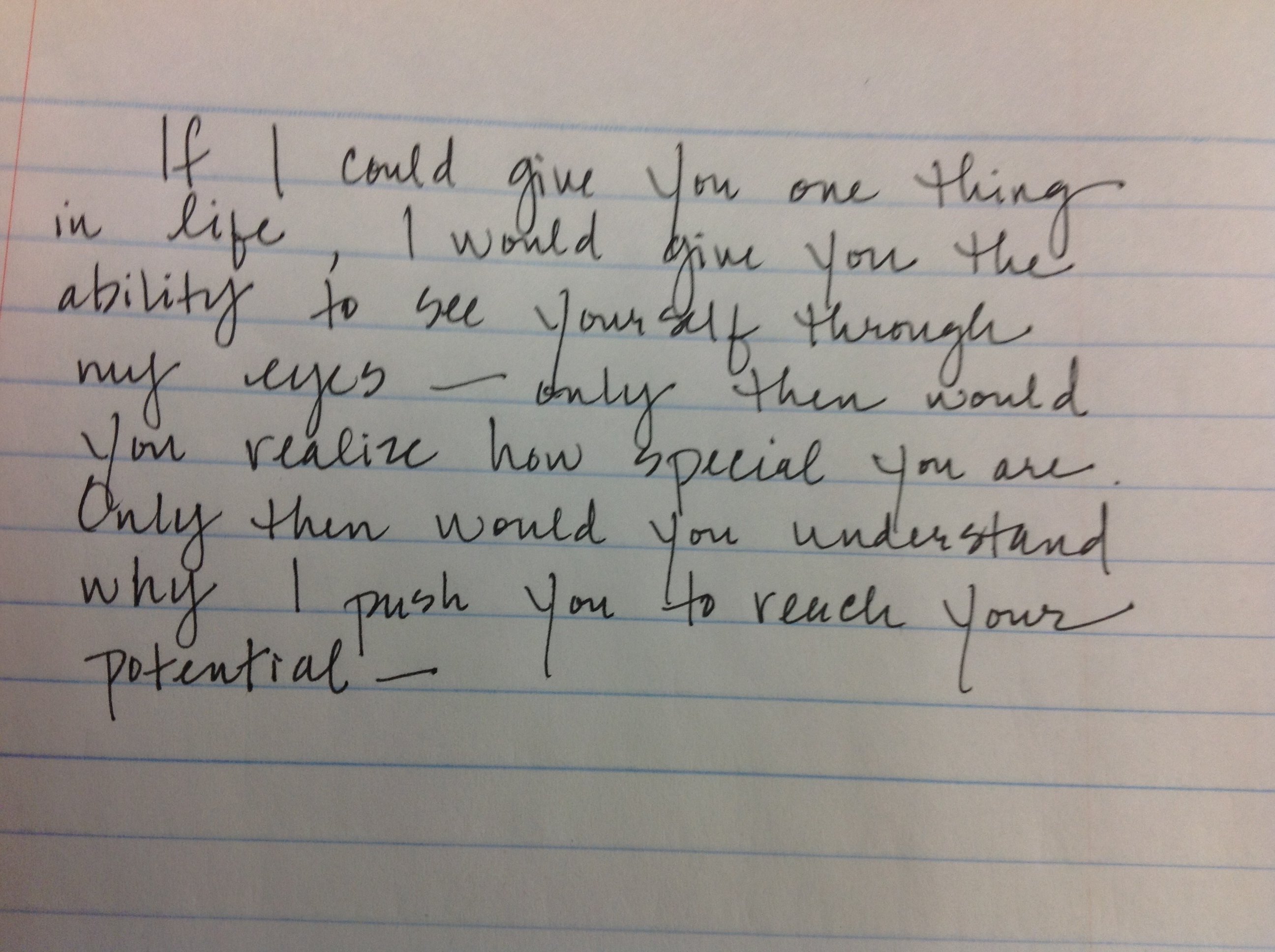
I’ve started writing notes to my students. Here’s another thing I used to do that brought positive results. I bought nice cards (Half Price Books has a lovely selection as teacher-friendly prices.) Every day I write one or two notes per class period. I highlight traits that I admire. I encourage. I notice. Students respond with higher quality work, more participation in class, sometimes even happier faces. My handwritten message, signed “Warmly, Mrs. Rasmussen” often works better than any conference with a student face-to-face.
And tomorrow students think and explore and decide upon their own #onelittleword.
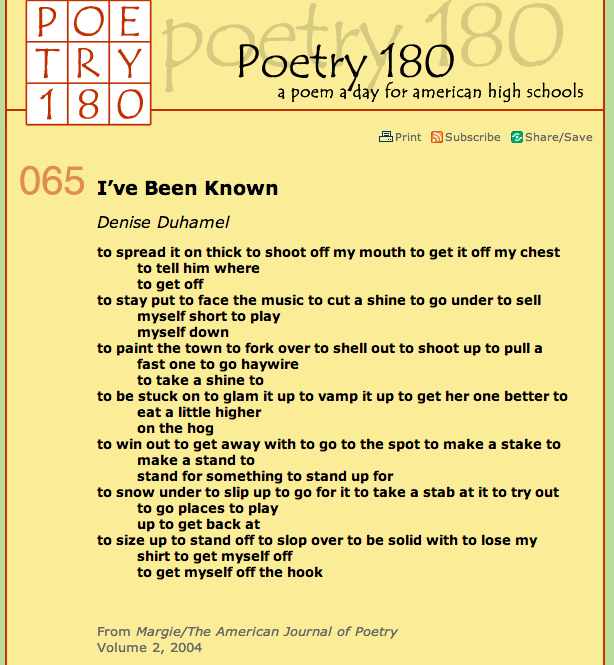
Do you subscribe to Poetry 180 through The Library of Congress? It’s probably the single most valuable thing I’ve done as a way to remind myself to use poetry in my AP English Language and Composition class. We read and write many an argument. I often forget about the poetry.
But I read a poem every day. You can, too. Sign up for a poem in your inbox here.
Some days it’s a natural fit to incorporate the poem into my lesson. Some days it’s a little more complicated. Some days I don’t even try to make the poem fit — we just enjoy the language.
“I think parents should read this book — these kinds of books, too,” Monica said as we chatted about the book she just finished, Impulse by Ellen Hopkins. “They need to know what we go through and how we think about things. It would help so much.”
I listened as she shared her feelings. She needed me to hear her disappointment at the ending. The characters mattered to her, so I knew they needed to matter to me.
The relationship between student and teacher changed in that moment. We gave each other a gift in that brief conversation about a book.
When we consider our conferring moments with students, do we give enough gifts? Do we allow our students to?
Think about the origin of confer: Latin conferre to bring together, from com- + ferre to carry.
At the end of that three-minute conference with Monica, I carried a bit of the burden she had on her heart, and she carried the knowledge that one more adult cares about what she thinks. A conversation about a book brought us together.
I love that.
At NCTE I asked a room of teachers what part of their workshop classroom they struggle with the most. They all said student conferences.
Finding the time, being consistent, knowing how to prod students into thinking, allowing students to do most of the talking — these concerns all emerged as trouble spots that we’d like to overcome.
In a perfect classroom with perfect students it would be easy. What’s the big deal? Just talk to your students. Yeah, right.
I asked one colleague how she conducts her reading conferences. She replied quickly, “Oh, I don’t do those. I cannot talk to one kid without the other 35 talking.”
Yes, that can be a problem.
I don’t think we stop trying though.
One-on-one conversations with students create the heart of my workshop classroom. Our relationships grow and change as we gift one another with ideas and information. We learn and change together as individuals who are trying to make sense of our world. Regular conversations make this happen.
I’m reminded of a line I boxed in bold when reading Choice Words by Peter Johnston: “Talk is the central tool of their trade.” Their meaning teachers who create environments wherein through language they help students “make sense of learning, literacy, life, and themselves” (4).
That’s what I want as I create opportunities to confer with the students in my classroom. I want to help my students make sense of all it: what happens in the classroom, what they read in books, what they’ll face in the future, and what they see in themselves. That’s a tall order, and the only way I know how to do it is to talk to more of my kids more often.
My burning question now circles on student conferences. How can I improve the precious moments of time I have with each of my students?
I am paying a lot more attention to the gifts we give as we converse with one another.
What about you? What are your ideas, concerns, questions about student conferences?
When Highland Park ISD banned (suspended, officially–then reinstated w/parent permission required) some books during Banned Books Week, my students and I paid attention. Of course, I pulled the books in question from my shelves — and book talked them right then and there.
The True Story of a Part-time Indian is one of the hottest titles in my classroom library year after year. I know it gets raw in places. I know that it’s the grit that makes kids want to read it. I get that this book is not for everyone.
Few books are.
And that is why choice is so important.
I had the chance to share my thoughts on this in an interview for KERA, NPR nor the Texas. You can read/hear the news article here.
In a few days I will return to my classroom, fresh from NCTE and ALAN with boxes of new books for my students to read.
My box of books at ALAN
We talk a lot in my class about books being windows and mirrors. Windows help us see outside ourselves into the lives of others. We grow in empathy. Mirrors help us see ourselves so we know we aren’t alone. We read literature to learn what it means to be human afterall.
It would be hard to learn the truth if we never read the raw and the grit that makes humanity humanity.
My students are pretty good at noticing rhetorical devices in texts; they aren’t so good at analyzing what effect they have on meaning. Since we immerse ourselves in independent reading all year, and we read bookshelf after bookshelf of YA novels, I find that using bits from those books and then talking about why the author wrote the text that way helps when students need to analyze these devices in more complex texts. Somehow this practice takes their tentative and repetitive “for emphasis” away and makes their analysis so much richer. (Most of the time.)
Like this passage from Please Ignore Vera Dietz by A.S. King:
I wonder if I’d called the police back when I was ten or thirteen or fifteen, would Charlie be alive now. I regret it. I regret every minute I lived keeping that secret. I regret every time I didn’t talk to Charlie about it. I regret having parents who couldn’t try to help or seem to care. I regret not being reason enough to make them care more. I regret never saying what I was thinking, never saying, “But what if that was me? What if I marry some loser who hits me? Would you care then? Would you help?” And I regret not called the police that first day we met the pervert. Because I’m sure he had something to do with how Charlie was acting at the end. p264
Shana, Jackie, Erika, and I will be presenting at NCTE in Washington, D.C. on Saturday at 2:45 pm. Penny Kittle is our Chair. We are session J.44. Please, come and join the conversation.
Readers and Writers Workshop was a mystery to me for a while, literally. I didn’t even know about it. I’m still puzzled that I made it through my teacher education program without learning about it.
My first three years of teaching, I pretty much taught the same way I was taught in high school. I chose the books we read. I chose the topics students wrote about. I was queen of my classroom, and I decreed that my preAP freshmen would read Dickens. They hated it. No, that’s not right. They hated trying to read it. So they didn’t. Gratefully, at least a few of my first-year students don’t hold it against me. We got together this summer for dinner, and Cara and Marcus relieved my growing guilt.
When I finally came to understand how Workshop could revamp my instruction, that guilt grew. I wasted so much time. I could have done so much more to help my students become readers and writers.
I am different now.
My goal as an educator is to foster the literacy skills in my students that will provide them with the confidence and the capability to contribute to our community and our world.
A week ago I sat in a department meeting and listened as the department manager explained the direction our district is moving in terms of English instruction: Readers and Writers Workshop. Skills-based instruction. Exactly the instruction I believe in. Exactly the instruction I try to provide my students every day.
I sat there stumped when one veteran teacher began to fidget. His face turned red. His hands twitched on the desk. Finally, he spoke up when the conversation turned to assessments and the need for skills-based exams to match skills-based teaching, not exams based on the content in books read (or not read) in class.
“What’s the point then? We might as well not even call it an English class then,” he said, and several other heads nodded.
What?!?
Because you are being asked to foster a love of reading in your students, allow them choice in reading materials, encourage them to write about their reading, model the life of a reader, and do something similar in the way of writing instruction, you think that is not an English class?
I remembered a conversation I had with someone struggling with letting go of only reading classic novels with their students. I asked what her number one question was. She said, “Equity. Shouldn’t our students be reading the same timeless texts as so many students do in wealthier areas?”
Shouldn’t the equity be in the literacy skills our students possess more than the books they have read?
With the College Board and school districts and schools promoting more and more students take advantage of Open Enrollment in Advanced Placement classes, in my experience, many of those students do not have the prerequisite skills to be successful in an advanced English class. Many of the students I have this year have not passed their state-mandated English I and English II test, and now they are expecting to be successful in a college-level course. I am all for differentiation, but it gets difficult when students are on so many levels, struggling to the exceptionally talented gifted student.
Readers and Writers Workshop has helped solve a lot of my challenge. I teach the reader not the reading. I teach the writer not the writing. And every student is different.
So many students are hurting, and isn’t it part of our job as teachers of teens to help them learn about what it means to be human: empathetic, kind, compassionate, intelligent, courageous? All the characteristics we learn from the best protagonists in the best literature. That is what I tell my students: We read literature to learn what it means to be human in a world that would like us to forget. Books in hand make us slow down, quiet our minds, embrace moments of stillness — something we so badly need in this social-media, speed-of-light world.
Read this entry in a student’s notebook. She gave me permission to share. It’s raw and frightening.
We were brainstorming topics for a narrative we’ll write soon. I asked students to think about their lives and write to the question
“What if ______?”
Can you even imagine?
Every day students face challenges, fears, and troubles that no child should have to face. I believe teachers can be healers. We can be healers when we value the student more than our content. When we embrace the individual and focus on her needs, academically and emotionally.
Three of my students cried as they told me of their worries before second period was over on Friday. I am honored that they trust me.
Community matters.
Conferences matter.
Mentor texts and Modeling matter.
Choice matters.
TIME matters.
All students, advanced or otherwise, need teachers who are willing to let them make choices that lead to profound learning, relieving their worry sure helps that happen.
Watch this clip of some of my students sharing what they like about our Readers and Writers Workshop instruction:
And here’s my slide presentation for NCTE. I will only talk about a tad of what I wrote on this post there. I hope that if you are in Washington, D.C. you will come to our session. And if you are not, join the conversation on Twitter beginning on Saturday at 2:45. #NCTE14
The Good Luck of Right Now is the first book by Matthew Quick that I read. It is a good book. I love the quirkiness of the narrator’s voice. It reminds me a little of the narrator in The Curious Incident of the Dog in the Night Time. I don’t know which I like better.
I am not sure this is a book that my students will want to read, although I will share it with them with my high praise. I do know that there are several passages that I can use for mini-lessons. I especially like this one with an extended metaphor. I think students will be able to write their own, and maybe add it into their narratives, once we take a close look at the way Quick uses this one here:
The Good Luck of Right Now by Matthew Quick, p111
(I have to say that everything seems to be unraveling lately. Or maybe it seems as though I am a flower myself, opening up to the world for the first time. I don’t know why this is, and I’m not really in control of it either. Flowers do not think. Okay, it is now May, so I will reach up toward the sun and relax my fist of petals into an open hand. They do not think at all. Flowers just grow, and when it is time, they shoot colors out of their stems and become beautiful. I am no more beautiful than I was when Mom was alive, but I feel as though I am a fist opening, a flower blooming, a match ignited, a beautiful mane of hair loosened from a bun –that so many things previously impossible are now possible. And I have been wondering if that is the reason I did not cry and become upset when Mom died. Do the colorful flower petals cry and mourn when they are no longer contained within a green stem? I wonder if the first thirty-eight years of my life were spent within the stem of me — myself. I have been wondering a lot about a lot of things, Richard Gere, and when I read about your life I get to thinking that you also have similar thoughts, which is why you dropped out of college and did not become a farmer like your grandfather or an insurance salesman like your father. And it’s also why so many people thought you were aloof, when you were only trying to be you. I read that you used to go to the movies by yourself when you were in college and you’d stay at the movie house for hours and hours studying the craft of acting and storytelling and moviemaking. You did all of this alone. This way maybe when you were in the stem–before you exploded into the bloom of internationally famous movie star Richard Gere. Such vivid colors you boast now! But it wasn’t easy for you. I have been learning by researching your life. So much time spent acting on the stage. You lived in a New York City apartment without heat or water, one book reported. And then you made many movies before you became famous –always trying to beat out John Travolta for roles, and being paid so much less than him. But now you are Richard Gere. Richard Gere!)
Do you have other passages that work well to teach extended metaphor?
I recently read my first Ellen Hopkin’s novel in verse — all 666 pages. I’d often wondered why some of my most reluctant readers, girls mostly, would stick with and finish Hopkin’s books. Now I know.
While the thickness of the book is intimidating, the number of words on each page is not. The poems are short and beautifully worded, using language that makes the storyline pop like a 3D movie.
Impulse is the story of three characters, all with distinct voices, portrayed in their own series of poems. The point of view shifts from character to character, which I love because that adds to the complex thinking students must do to understand what is happening in the story.
All three characters suffer from some of the worst abuses that can happen in the lives of individuals. All are in a facility trying to figure out themselves and their horrid lives — primarily as result of the actions of adults.
This morning while checking my Twitter feed I was reminded of the need to introduce students to books as mirrors and windows. Students should be able to see themselves within the characters they read about, and they should be able to see into the lives of others that they may never know. Sometimes books allow students to do both. Impulse is one of those books.
I think it would be interesting to use this poem from page 2 as an exercise in imitation. What four verbs might students choose to write into their four sentence poem?





 The Good Luck of Right Now is the first book by Matthew Quick that I read. It is a good book. I love the quirkiness of the narrator’s voice. It reminds me a little of the narrator in The Curious Incident of the Dog in the Night Time. I don’t know which I like better.
 I recently read my first Ellen Hopkin’s novel in verse — all 666 pages. I’d often wondered why some of my most reluctant readers, girls mostly, would stick with and finish Hopkin’s books. Now I know.
 Three Teachers Talk