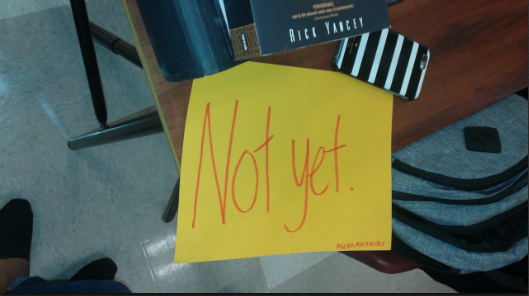
Mini-Lesson Monday: Sentence Boundaries and Adding Some Variety

Sorry, I forgot to record the book’s title.

Even the students in my AP English class struggle with correct punctuation and varying their sentences. In one-on-one conferences, I’ve started to remind them more often to pay attention to how the author of their self-selected books craft meaning. I used to get glossy-eyed blank stares, but students are beginning to understand that writers make intentional moves to draw us in, and keep us within, the pages of their books.

“As a writer, you must do that, too,” I remind them.

This lesson grew out of a conferring conversation with a student who told me:  “I just do not understand all the comma and semicolon stuff, but I have a pretty good idea of what I want to say in my writing.”

Objective:  Using the language of the Depth of Knowledge levels, students will recognize the sentence boundaries and the variety of sentence structures in their self-selected books. They will make observations about the author’s use of punctuation in these sentences, assessing the writer’s effectiveness in crafting meaning. Students will then use their author as a mentor as they apply their knowledge of sentence boundaries and sentence variety and create, revise, and rewrite sentences in their own pieces of writing. Finally, through peer-to-peer conferring, students will evaluate the accuracy and effectiveness of one another’s sentences.

Lesson:  Every student needs their independent reading book. If a student is reading a book of poems, or a graphic novel without many sentences, you will want to supply a stand in book for this lesson or ask the student to find a book she’s previously read.

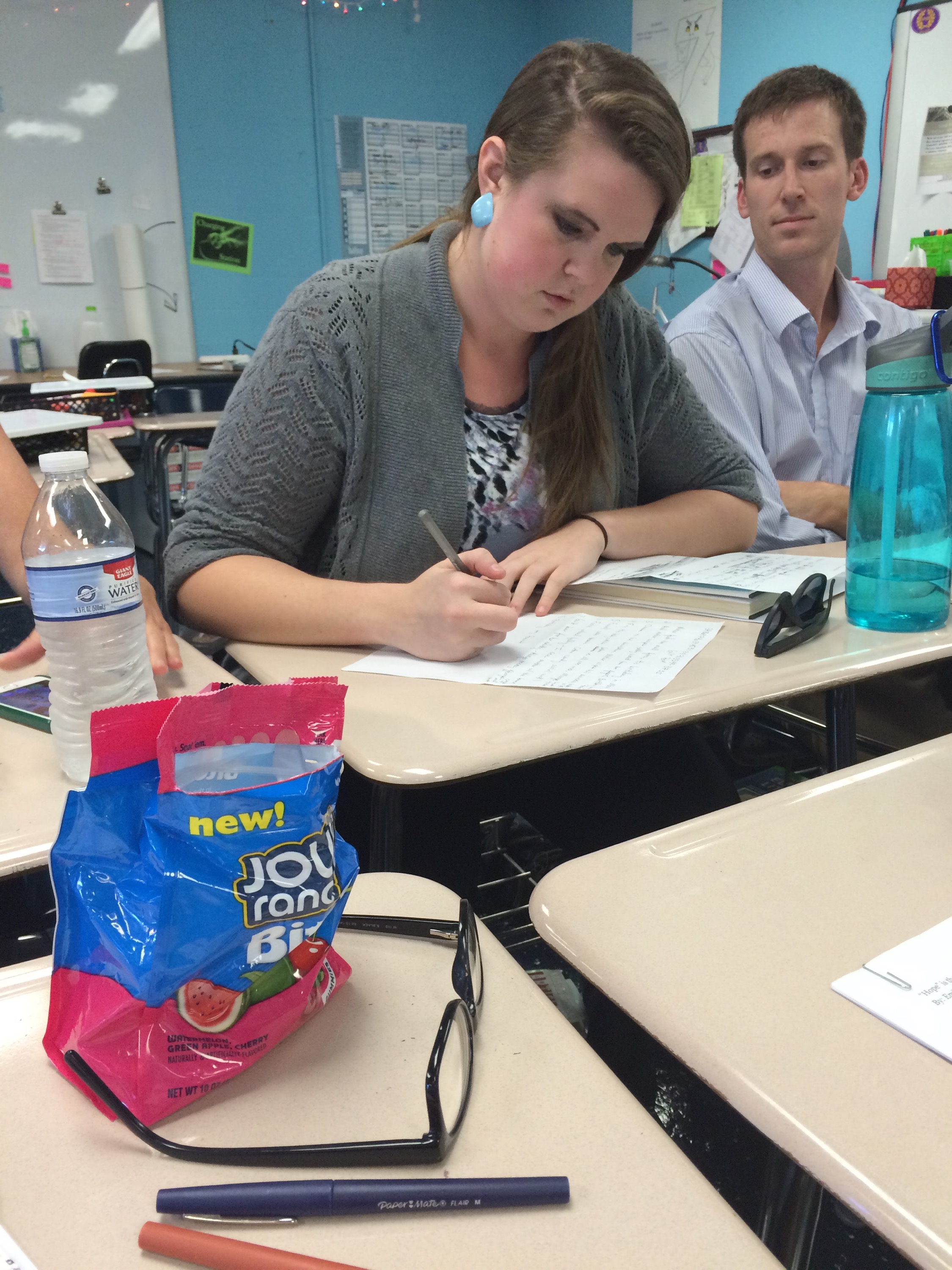
Tell students that you’ve noticed in their writing that they are ready to make their sentences more sophisticated. Correctness is one way to do this. Varying the length of sentences is another way. Instruct students to turn to a random page in their books, say page 51. Ask them to read the page in search of one long sentence and one short sentence. Give students sentence stips or blank paper and have them write out the sentences they find in their books. They should spell and punctuate the sentences exactly like the author does.
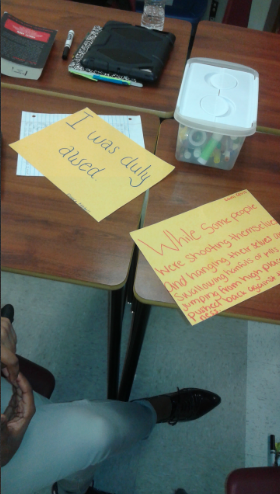
sentence boundaries lessonNext, in small groups, ask students to discuss with one another the structure of the sentences. They might put all the short sentences together and compare them. Then they might put the long sentences together and look at how the authors use commas to separate ideas. Some students will know more about grammatical terms than others, and that is okay. The idea is to get students noticing how writers compose within the boundaries of standard English and to get them to understand how punctuation works to craft meaning. Ask questions that help them discover why boundaries and variety work to produce effective writing.

You may choose to have students imitate the sentences they chose from their books. Imitation is a useful tool for many writers.

Using self-selected books, not just to practice wide reading, but to teach students to read like writers, adds an important element to the workshop classroom. Our writing improves when we take the time to notice and apply the skills of professional writers.

Follow up:  Have students review a piece of their own writing. The writing can be in any stage of the writing process. They should study their writing to evaluate their use of sentence boundaries and variety. Encourage students to revise their writing as necessary, remembering to use the author of their books as their mentors.

Extension:  This lesson works to have students study leads, similar to what Jackie wrote about in the mini-lesson Pick up Lines and Leads. It also works to have students search their books for sentences that include imagery.


©Amy Rasmussen, 2011 – 2015

#FridayReads — Oh, Mercy! Have I got a plan for this mentor text

Usually I read about four books at a time. This makes for a mess on the bedside table, the coffee table, the kitchen table. I rarely use bookmarks, which is a shame because I have quite a lovely collection.

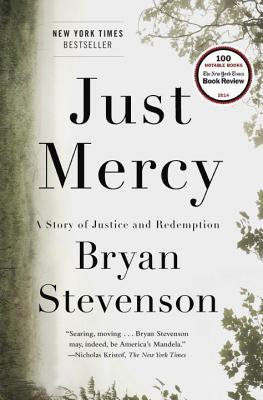
I end up leaving books split open and sound asleep right where I left them –sometimes just so I can remember the parts I know I want to use in class. I refuse to read on until I capture the sentence or passage that gives me pause. Such is the case with my new now bent-spine-copy of Just Mercy, a Story of Justice and Redemption by Bryan Stevenson. I’ve been stuck on page 18.

Here’s a portion of the passage I will use with my AP Lang students. You will, of course, find the rest of it when you buy the book, or here.

     When I first went to death row in December 1983, America was in the early stages of a radical transformation that would turn us into an unprecedentedly harsh and punitive nation and result in mass imprisonment that has no historical parallel. Today we have the highest rate of incarceration in the world. The prison population has increased from 300,000 people in the early 1970s to 2.3 million people today. There are nearly six million people on probation or on parole. One in every fifteen people born in the United States in 2001 is expected to go to jail or prison: one in every three black males babies born in this century is expected to be incarcerated.

     We have shot, hanged, gassed, electrocuted, and lethally injected hundreds of people to carry out legally sanctioned executions. Thousands more await their execution on death row. Some states have no minimum age for prosecuting children as adults; we’ve sent a quarter million kids to adult jails and prisons to serve long prison terms, some under the age of twelve. For years, we’ve been the only country in the world that condemns children to life imprisonment without parole; nearly three thousand juveniles have been sentenced to die in prison.

     We also make terrible mistakes. Scores of innocent people have been exonerated after being sentenced to death and nearly executed . Hundreds more have been released after being proved innocent of noncapital crimes through DNA testing. Presumptions of guild, poverty, racial bias, and a host of other social, structural, and political dynamics have created a system that is defined by error, a system in which thousands of innocent people now suffer in prison.

…..

     We are all implicated when we allow other people to be mistreated. An absence of compassion can corrupt the decency of a community, a state, a nation. Fear and anger can make us vindictive and abusive, unjust and unfair, until we all suffer from the absence of mercy and we condemn ourselves as much as we victimize others. The closer we get to mass incarceration and extreme levels of punishment, the more I believe it’s necessary to recognize that we all need mercy, we all need justice, and — perhaps — we all need some measure of unmerited grace. 


Before we ever read the text, and I did pull much more of it than I’ve posted here, we’ll spark our thinking with an image like this, posted at The Sentencing Project, and then write our initial responses in our writer’s notebooks:

Next, we will TALK. I know my students will want to share what they think about this graphic. Many will identify personally with it because they know a family member or a friend who’s served prison time.

When I introduce them to Stevenson’s text, I’ll give them a purpose for reading — besides just comprehending the message (identifying the purpose is a breeze since he tells us the reason he writes the book) — I want my students to notice the structure, the progression between ideas, the repetition and patterns they will see in the language. All the clues that build the tone.

I will ask them to mark the text, noting their thinking about these things. Without a purpose for reading, too many of my students struggle with the stamina they need to make it through even a page when I ask them to read critically.

Next, we will TALK. Talking will help some students understand what they read. It will help other students clarify their understanding. Some students will have noted what I asked them to notice as they read. I will rely on them to help the others — skill level is just one way my students are diverse.

I will also hand them a stack of questions that prepare them to write. They will read something like this:

What do you know about the writer based on what he writes?

What is the Stevenson’s purpose? Why does he come out and tell us so plainly?

What are the facts in this piece? What are opinions? How do you know?

What do you notice about the structure, any patterns, repetition? What do they do for the message?

How does Stevenson move between ideas?

And then we will write. Maybe I’ll give a prompt like this: Based on the text, and our discussion, is Stevenson’s opening argument effective, why or why not?  Maybe I’ll ask students to come up with their own analytical-style question to respond to. (I like this idea a lot.)  [see Talk Read Talk Write]

That’s probably enough for one class period, but my mind is still stirring:

  • What if I ask students to problematize the issue? Who are the stakeholders? Think all the way around the issue. Why do they care? Why do we care? What kinds of questions do we have about the claims Stevenson makes? What kinds of evidence do we need to convince us they are valid? How and when could anything regarding this issue change?
  • What if I ask students to identify just one of Stevenson’s claims and then research it? I assume the author provides support throughout the book. I’ll know when I keep reading. But what if students did a bit of research and then collaborated on substantiating Stevenson’s claims. Collaborative writing can be a powerful learning experience.
  • What if I ask students to brainstorm other issues Stevenson’s text suggests? We could probably create a pretty elaborate bubble map of ideas. These could lead to student choice in research topics.

What do you think? Any other ideas?

©Amy Rasmussen, 2011 – 2015

Readers & Writers Workshop–Beyond English and Into Journalism

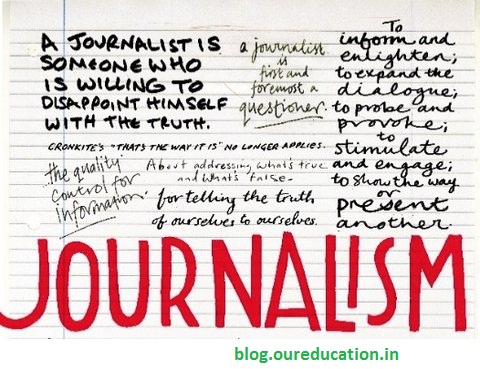
dotCJR-blog480Are any of us really just English teachers?

It has been rare in my teaching tenure to only teach English–and in my current position, my schedule is no different.  I teach Yearbook and Newspaper, in addition to four English classes.

Learning the content of those new-to-me courses has been one of the biggest (and most fruitful) challenges of my teaching career.  While writing instruction is naturally paramount in journalism courses, teaching photography, design, AP style, and the interview process were foreign concepts to me prior to starting this job.

So, when I discovered that I’d be teaching journalism, I did what any good teacher does–I began to research.  This article describing the four properties of powerful teaching–presence, personality, passion, and preparation–reminded me that I had the first three qualities when it came to teaching journalism.  I just had to do the work of preparation.

After a long summer of workshops and self-teaching, I felt well-versed in lens aperture and the inverted pyramid, but I wasn’t sure how I wanted to structure my journalism courses.  When I boiled down the values I wanted my young journalists to prize, though, they came down to doing good writing, good research, and good thinking–all values that are foundational parts of the readers and writers workshop.

So, each day in Newspaper and Yearbook, we begin with ten minutes of reading.  I confer with students and we discuss how to read like writers.  We analyze how a writer sets a scene, much like how a photographer composes a picture.  We note the author’s style, filing away their craft moves for use in our own copy writing.  We speculate about the writer’s inspiration for the story, trying to find our own topics to write about.

After two booktalks (often nonfiction), we then move into a quickwrite, thinking in writing for ten minutes about a variety of subjects–sometimes responding to simple questions, sometimes practicing journalistic writing skills, and sometimes brainstorming ideas for articles, photo stories, or coverage.

A ten- to fifteen-minute mini-lesson follows, taught either by me or the editor-in-chief of the day’s publication.  These mini-lessons are based on trends the editors and I notice as students submit their work.  Yesterday we worked on strengthening our headlines; today we’ll focus on brushing up on the conventions of AP style in our copy.

We leave ourselves with a sixty-minute writers’ workshop every day, which is packed full of collaboration, conferring, and chaos.  That last hour is productive until the bell rings, with every student journalist working toward a unique deadline or assignment, receiving guidance from any and every other person in the room.

Watching and participating in the organized, creative chaos of a journalistic writers’ workshop is probably my favorite time of day.

I asked two students how they felt that the workshop enhanced their journalistic learning.  Ryan feels the quickwrites are most valuable:  “Your notebook allows you to open up and be yourself when you write,” he says.  “You learn to still have a voice in journalism, which is usually just really formulaic.”

“I really like that you learn while you write,” he emphasizes, repeating that twice in our brief conference.

Gabi agrees.  “You’re learning as you do the writing–learning from your mistakes–rather than having concepts spoonfed to you,” she says.  “I think everyone likes to learn hands-on, by actually writing, instead of just reading other people’s articles.”

In what electives or non-English classes do you employ the workshop model?

Weekly One-Pagers to Develop Writing Fluency

IMG_9425

Janelle, now in college, appreciates the one-pagers belatedly

This summer, Amy and I talked a lot about what we wanted for our students.  While there were lots of complex ideas tossed around, we knew that our goals boiled down to two simple ones:  for our students to become real writers and real readers.

We had lots of structures in place to help our students become authentic, fluent readers–weekly reading homework, daily booktalks, reading conferences, reading workshops, and more.  But writing was a bit different.  Daily quickwrites and longer compositions were already in place, but I wanted to add something more to get students writing more regularly outside of class on topics of their choice.  I wanted them to gain the same fluency with writing that they did through their weekly reading homework.

So, I was reminded of something I used to require my AP and Honors English students to do–a weekly one-pager.  Every Monday, a one page, single-spaced, typed paper was due.  I offered topic suggestions, but ultimately, students could choose what to write about.  I decided to revive this routine, inspired by Kelly Gallagher’s powerful claim that students should be writing four times as much as teachers could ever assess.  Why shouldn’t all students–not just the AP and Honors level students–write this much?

This year, I only have one Honors class, but all four of my English classes write weekly one-pagers.  We have a section in our notebooks called “Weekly Writing,” which is rapidly filling up with writing on a variety of topics.  During bi-weekly notebook collections, I check to see that these weekly one-pagers are being completed, but I don’t “grade” them–that’s not the point.  The point is to build writing fluency.

These one-pagers are low stakes–ten points apiece, so on a particularly busy week, if students just don’t have time to write, it’s no big deal.  But the frequent follow-up and sharing activities we do in class with these writings, combined with the autonomy students have in their topics, make the missed one-pager a rare occurrence.

I was initially inspired to create this routine by some of my greatest college professors, for whose classes a written response was due each day.  Alan Frager’s “study guides,” Tom Romano’s “one-pagers,” and Don Daiker’s “reading responses” were handed in at the start of each class period.  By writing a short paper every single day for most of my college years, I developed incredible writing fluency.  I knew I wanted my students to develop this written fluency as well, partially in preparation for their own college experiences, but also to bridge the gap between a writer’s thoughts and his words on the page.

As evidenced by Janelle’s testimony above, building this writing fluency pays off.  Already this year, students are remarking that it’s becoming much easier to write a full page, after only writing eight of them thus far.  I’m enthused by the growth I see in all my students’ writing fluency, and looking forward to seeing how much they can develop as writers by the end of this school year thanks to the weekly one-pager.

What routines are in place in your classes to help build students’ writing fluency?

Studying Vocabulary Through Choice Reading

IMG_2886“Reading increases one’s vocabulary,” I tell incoming freshmen every fall. But up until now, I have had little evidence to support this claim. It is true that reading exposes students to new words, but I never went out of my way to help students sort through these new words.

Instead, as a junior English teacher, I regularly taught SAT vocabulary as part of my Advanced Composition curriculum. Students completed chapters from the Sadlier-Oxford Vocabulary Workshop books and took quizzes every other week. While some students relished the challenge, many saw little relevance to their own lives, retaining few words by the end of the year.

In turn, this year I have turned from my well-worn Sadlier Oxford books and have instead had students reference their independent reading books for new words. Students develop their own lists of eight words every other week. My goal in doing this is not only to have students slow down their reading, but to also expose them to diction and complexity within their independent books. Once again, like many of the mini-lessons within the workshop classroom, this practice also turns into a lesson on craft and intention within a writer’s work.

Too often students skim over large words, failing to activate context clues and prior knowledge to help them draw out meaning. By creating vocabulary lists, students must practice these skills while also recording definitions, synonyms, passages, and parts of speech.

The benefit is twofold: students have a say in their vocabulary and immediately see both the relevance and payoff of understanding a new word. At the same time, having independent vocabulary lists eliminates cheating and encourages independence. Instead of worrying about students’ wandering eyes during quizzes, I spend time helping students understand the words they have picked. In addition, independent vocabulary lists provide insight into students’ reading levels and comprehension. I have learned more about my students’ reading lives simply by becoming aware of the words they find challenging.

Every other week, students complete a summative assessment that helps gauge their understanding of their eight vocabulary words. Two weeks ago I had students complete “Rock and Roll Vocabulary,” an activity that requires students to roll dice and answer questions about their vocabulary corresponding to specific numbers. This week students will complete a grid about various words.

While I am still new to this vocabulary approach, I feel confident in my students’ choices. Oftentimes I have seen the typical “SAT words” pop up in multiple lists, reinforcing that students will indeed choose challenging vocabulary. The process is far from perfect, and my students and I are still ironing out some of the flaws. Some students intentionally pick easy words, but the next assessment will require them to rank the difficulty of their words. In addition, I allow retakes of vocabulary summative assessments considering students made a “good faith effort” according to our school’s retake policy. Finally, not all independent books offer complex language, which can be a struggle for students who love the content yet can’t seem to find their eight or so words. In those instances, students may pull from in-class readings, articles, and textbooks. If they still struggle, I have books of SAT vocabulary they may choose from instead.

While this method of teaching is somewhat nontraditional, it provides students with continued say in their education. Not only are they empowered by their newfound words, but also by the end, I hope my students will see that reading truly does increase one’s vocabulary.

Mini-Lesson Monday: The Power of “I”

Recently, Jackie humorously infused pickup lines and leads into her lesson to engage students in narrative writing.  It got me thinking.  While I am not nearly as funny as she is, I still needed to find a way to minimize the angst with starting a written piece.  Students deserve an opportunity to look at opening lines so they are innately thinking like writers.  Providing them the opportunity to authentically explore various ways to open their stories is key.  So, we gave it a whirl.

Objectives:  Students will recall moments in their lives that have shaped who they are today.  Drawing from their own life experiences students will distinguish what moments they are willing to chronicle in their personal narratives.  Students will construct meaning about their personal experiences by creating a written piece that utilizes author’s craft that has been studied and analyzed.

Lesson:  Let me say that I typically do not focus on opening lines, hooks, what have you until after students have written their pieces.  I find that students are able to more easily and comfortably play with their opening once they know where they’re going…or have gone… with their narratives.  Yet, I was curious to see how this would pan out.

 As we started to jog our memories for those defining moments that have occurred in our lives, we started thinking about questions that would help us dig deep into our own thinking.  A few included:

What do I believe?  (About life, the world, society, family, education, etc.)

What moment has occurred in my life that I am (still) confused by?

What is the most life changing experience I’ve encountered?  What decisions have I made during this situation that have shaped who I am today?

Who is important to me?  Who has made a tremendous impact on me (positive, negative)?  Do I find conflict in this?

What simple pleasures do I relish in when times get tough/stressful?

These questions, among many others, started getting our process underway.  Students had choice and freedom in picking what they wanted to write about – as we know personal narratives are sometimes brutal to compose: sometimes we want to forget what we’ve been through.  Yet, in order to foster the writers in room 369, these questions were written in the first person.  When we write questions for our writers in the second person (What simple pleasure do you relish in when times get tough and stressful?) we are providing them an opportunity to take a step back; to be a bit removed.  When we shift our curiosities to “I” “Me” “My”, it becomes personal.

IMG_20150928_083251

Then, we played with various different ways we could open our stories.  Each student played with concepts, moments, memories, and experiences after seeing how the authors of our independent reading books played with theirs.  Having heard about fifteen authors’ opening lines, students were willing to really dive in and try different ways to start: sounds, quotes, internal thinking, advice they’d been given, visuals, third person…

This visual represents our thinking at the very beginning of this school year.  Students are playing with this deep level of thinking and crafting for the very first time.  There is still some apprehension and hesitation, but for the most part students are willing to try…and play…and craft…and find their inner brave.


Follow Up:  Once students have created numerous ways to start their piece, they will narrow it down to two.  From there, students will start their narratives.  Yet, they are being asked to start their narratives using two different openings…

As writers we know that it takes much patience and practice to feel satisfied with our writing; specifically our opening lines.  Asking students to try writing their pieces from two different starting points allows us to see where our writing goes.  Maybe one start is stronger, prompts more thinking while the other falls flat.  Maybe they both prompt great confidence in continuing to see how they develop.  Maybe the best draft ends up being an infusion of both.

Regardless of where our personal narratives go, starting the process with options both in craft and experience, the pressure of writing is minimized and students feel more at home reliving some of the moments that would have never made it to the paper prior.

How do you foster the willingness to write when fear or apprehension stand in the way of our writers?  What techniques do you use as a writer that you channel to your student writers?

Are you noticing what matters?

I learned a valuable lesson when my children were young. I do not remember the speaker who said it, nor do I remember much of anything else he said. I do know that two words changed me as a parent.

Notice them.

Notice your child when he enters a room. Acknowledge him with a hello, a question, a compliment. Non-threatening. Kind. Seems rather simple, doesn’t it? I remember thinking: “Sure, I can do that. no big deal.”

Oh, but it is — a very big deal. It’s a big deal to the child who grows in confidence, knowing we are intently aware of him as a person — an individual who matters when he walks in the room.

While i’ve been thinking and writing about conferring with students, I’ve done a lot of thinking about what it means to notice, really notice, the students in my charge. Do I take the time to speak to every student individually? What about my body language — am I open and approachable? How about eye contact — am I making it?

Last week I collected my students’ writer’s notebooks. Marked with a sticky note for me to read and scrawled on the back of one student’s writing territories was an entry that gave me pause and broke my heart. It said something like: “I remember asking my grandma about why my mother left. All she would say was that my mom said she could always have other children.”

Just that morning I’d been short with this student for not completing yet another assignment. I bit out a plea to get the work done without once considering why she’d not done it. I made it about the assignment instead of about my learner. Sadly, I do this often and have to continually remind myself of what matters.

Noticing the girl with the dark brooding eyes matters.

And once again I vow to be better than I’ve been.

from BrainPickings.org


[student writing used with permission]

©Amy Rasmussen, 2011 – 2015

Part I. Blogging with My Writers and You Can, too.

“Mrs. Rasmussen, can we write on our blogs more than just for assignments for class?”

After we set up our personal blogs, I received a similar message from several of my students. Of course, I replied, “Yes.” (Inside I yelled “YAY!!” and danced around the room a few times.)

Students want to write other than when I assign it. Wow.

And we are off…

I doubt anyone would argue that digital writing is important. Most of our students do it anyway:  texting, tweeting, commenting on YouTube videos. We might as well help them do it well.

We might as well help them share their ideas, opinions, stories, and arguments in a way that allows them to show their learning — and build their credibility as citizen scholars. That’s what I want for my students anyway. I want them to know that their voices matter. Their writing matters.

They have to have an audience other than me to truly understand that. That’s why I blog with my students.

Every year I ask student to personalize an online writing space. I’ve blogged with students when we had to reserve the writing lab. I’ve blogged with students when I had 12 computers we shared in my classroom. Another year I had an ipad cart with 30 devices. Now I’m at a 1:1 ipad school. It is easier, but it is not necessary.

If you want students to blog, you can find a way to make it work. I urge you to not let the lack of technology prevent you from at least doing something with digital writing.

Every year I try something new to help students take ownership of their blogging.  I’ve learned a few things about setting up blogs and getting students to write on them.

blogwordle

Here’s my blogging basics in a nutshell:

  • Build a case for blogging. I read “Blogging is the New Persuasive Essay” a few years back, and it helped me wrap my head around the how and why blogging works for the 21C student. I’ve even used this text as a reading piece with my students. They read, determine the author’s argument, and then have to defend, challenge, or qualify it. I can see pretty easily if a student is climbing on my blogging training willingly.


  • Conduct a little inventory of the blogsospere. Simply ask students to type “most popular blogs” into Google. Then ask them to do a bit of light reading. They might find “Top 15 Most Popular Blogs,” and they might recognize a few. They might find “The Top 10 Top Earning Bloggers in the World,” and you might see some jaws hit the floor. They might find “The 10 Most Inspirational Bloggers in the World,” and if we give them time to explore and read and think and play with the idea of become a blogger, we might get lucky, and our students might think: Hey, I can do this. This could be me!


  • Choose a platform. I’ve use Edublogs and WordPress in the past, and this year I am using Blogger because in my new district all students have google accounts. I’ve had no trouble learning blogger. It’s a Google product, so I figure if I cannot figure something out — or if kids can’t — we “Google it.” There’s a handy chart in this article that compares different blogging platforms used in education. You can decide for yourself which will work best for you and your students.


  • Take the time to get everyone set up. In year’s past I’ve expected students to know more than they do about using technology. Not every student is confident on a computer. Texting, yes. Applications, not so much. This year we took it slow. I created my own Blogger account and then modeled creating a new blog step-by-step in front of each of my six classes. I talked them through every step of their set up. Then I shared these instructions in writing, which include how they will be assessed for creating their blogs and their first blog post.


  • Show off students’ initial work. Besides asking students to follow each other, I think it is important to project their blogs and let everyone see what the class has created. Many students decide to change titles or themes or add different gadgets after they see the work of their peers. Here’s a few of my students’ blogs:  Jessica Ortiz, Mary SassamanDianna Sosa, Beatriz Vargas, Allie Tate.  (I do have male students; however, I have many more young women this year than young men. I just haven’t managed to follow all my writers’ blogs yet.)


Watch for Part 2 soon. I’ll write about how my students and I decide what we’ll blog about and what those choices look like in our AP English Language class.

Please share your questions about student blogging in the comments section. I’ll do my best to answer.


©Amy Rasmussen, 2011 – 2015

Why We Should Challenge Our Students–And Ourselves

I’ve recently found myself in a learning situation I’ve rarely experienced before–a classroom where I am the slowest, lowest, and neediest learner.  The one whose work is nowhere near the level of everyone else’s.  The one who asks the dumbest questions.  The one who is silent and stricken after asking the dumb question.

IMG_9356

My own messy attempt at a poetry exercise

Those of us who grow up to become English teachers are skilled readers and writers, for the most part, and we were generally successful in educational settings.  We loved reading, we enjoyed writing papers, we received positive feedback from our teachers about our work, and we got good grades.  This is eminently true of my own educational experience, so I’ve never been able to truly empathize with how my struggling students might feel about our class time together.

The work of learning is tough in general, but standing out as the worst learner is a pretty unsettling feeling, I’m finding out.

The poetry workshop I’m involved in, which has shattered my confidence as a writer (while simultaneously strengthening my writing skills) is taught by award-winning poet Mary Ann Samyn.  This Bolton Professor for Teaching and Mentoring is the leader of our little band of misfit poets, and has been “poem-ing it up” for decades.

Mary Ann’s resulting ease with the language of writing and teaching poetry is obvious to witness.  She has clearly internalized and automatized much of the vocabulary of poetry–she tosses out phrases about meter and iambs and syllables and line breaks with such grace that I can tell she’s been thinking and talking about poetry for years.  “A line of poetry is a unit of measure,” she said.  I hastened to write down that line, marveling at its simple wisdom.

IMG_9355

My classmate, an MFA student, scrawls her own messy poem

It occurred to me, as I jotted down that poetic utterance of Mary Ann’s, that this is how I must sound to some of my students–as though I’m speaking another language.

As I sit in the workshop on Thursdays, surrounded by MFA students who have years of experience as real writers of fiction, nonfiction, and poetry, as well as teacher-poets who have published their own verse, I feel so lost.  I am in a world I don’t feel I belong to–I do not yet identify as a poet, but I feel surrounded by them, trying to do the work of writing poetry and reading poetry and thinking about teaching poetry.  I wonder if I’ll ever get to their level as they gently question me about my writing, trying to make sense of my meaning, and give me suggestions about my work.

Regardless of how I view myself in the group, one thing is clear during the workshop–I am part of the community of poets, for 90 minutes every other Thursday.  I give and receive feedback in the same way the other writers do.  I participate in the exercises everyone else does.  I write poetry within the same time constraints as the others.  I am treated as a poet, even if I don’t think I am one.

Being part of a writing community with such rigor is hard, but it’s valuable.  I would never use the word “fun” to describe my time in the Bolton workshop, but I would argue that perhaps the best learning is not fun.  I find myself determined to write poetry alongside those real poets, even as I dread reading my words aloud to them moments later.  In Drive: The Surprising Truth About What Motivates Us, Daniel Pink argues that my drive to do this is innate to all learners:

“We have three innate psychological needs—competence, autonomy, and relatedness. When those needs are satisfied, we’re motivated, productive, and happy.”

I make an effort to improve as a poet because I need to feel competent, much like our students work to improve as readers and writers because they desire competence, too.  In all educational situations, learners perform not because of the dangling promise of a grade, the threat of failure, or the pressure to comply with a controlling teacher.  They perform because they want to prove competence to themselves.

I asked a few students about this topic.  This summer, Shailyn read the Pulitzer-winning All the Light We Cannot See by Anthony Doerr.  She said the vocabulary was difficult, the book was long, and the writing style was strange–it was one of the toughest books she’s read.  “Why did you have the confidence you could read it?” I asked her.  “When you encountered those challenges, what made you say, ‘I don’t care.  I’m gonna read this anyway.’?”

“Because I have goals.  I like to feel challenged, and when I finally figured out how [the protagonists’] stories came together, I felt satisfied.  And I felt like I learned a lot from that book when I finished it,” she said.  Shailyn wanted to know that she was a competent reader–comprehending that book showed her she was.

Hunter, too, recently finished a book that challenged him.  “I hate this book,” he told me in the midst of Lone Survivor.  “You can abandon it,” I reminded him.  “No!” he said, forcefully.  “I’ve gotten two-thirds of the way through it.  I’m not giving up now.”  Hunter finished the book of his own accord, exercising his autonomy.

Lakynn agreed that learning is intrinsically motivated.  “You feel better about yourself when you’re more educated about a topic,” she told me.  “If you’re not knowledgeable about something, you can’t relate to someone more educated.  You want to learn about things so you can have those conversations with people about them,” she explained.  The social aspect of a learning community is evident and powerful here–Lakynn sought information about the Republican presidential candidates to fulfill her relatedness needs.

The more I talked with students, the more I discovered that what I thought was frustration with my difficult learning experience was actually profound satisfaction.  Yes, my confidence was crushed–I thought I was a good writer.  But knowing that I had so much room to grow created a hunger for more knowledge–I needed to learn, to belong, to feel competent again.  And so, I leave the Bolton workshop energized, confused, and with my mental wheels turning, every time.  The rigor of that learning–the toughness of it–is what makes it so satisfying.  I’ll remember that the next time I sit down beside the accomplished poets in my class, and every day I design lessons for my students.

Our students flourish when we create an authentic, rigorous learning community for them to be part of.  Difficult books, intimidating writing pieces, and high expectations combine to create an ideal situation in which autonomous learning can occur.  The beauty–and the learning–lie in the challenge.

I’ll leave you with a gem from one of Mary Ann Samyn’s collections of poetry, Beauty Breaks In:

Beauty breaks in everywhere.
Welcome to the wind-powered poem.
Like the ocean or the woodcut of the ocean.
I heard the hardest thing and listened.
Syntax says, you first. Shimmer half-scolds.
I said, I am loved. Sometimes a correction happens.
Fear made it one full week. A human action.
I stopped making it worse than it was.

Mini-lesson Monday: Exploring a Page’s White Space in the Writer’s Workshop

PrintCircling the room, I hand out books in preparation for book speed dating. I place Ellen Hopkins’ Crank on a student’s desk.

“There’s no way I’m reading this,” she mutters to her friend. “This thing is huge.”

“Open it up.” I turn towards her, waiting for her to crack the book. She flips to a page and realizes the entire book is in verse. She flips again and again, every page has a minimalist feel, the text spread out, placing emphasis on each word within the sea of white. The sheer length of the book disappears and she is sucked into Hopkins’ narrative.

The more time I spend with teenagers, the more I value the use of that essential “white space.” I love book talking Patricia McCormick’s Sold or Jonathan Safran Foer’s Extremely Loud and Incredibly Close; despite their complex and emotional content, the books are instantly more accessible simply because of their unique structure.

This is why when we discuss paragraph breaks in writing and aesthetics and structure in reading, we also discuss the glory of giving the reader’s eye a break.

Objectives: Using the language of the Depth of Knowledge levels, students will recognize the use of white space within a piece of writing. They will make observations about the author’s use of this tactic, assessing the writer’s effectiveness in employing the use of white space. Finally, use choice reading and whole class examples as mentor texts, they will practice using white space within their own writing by formulating paragraphs at various lengths, revising these paragraphs through peer conferencing, and applying this craft in future writing assignments.

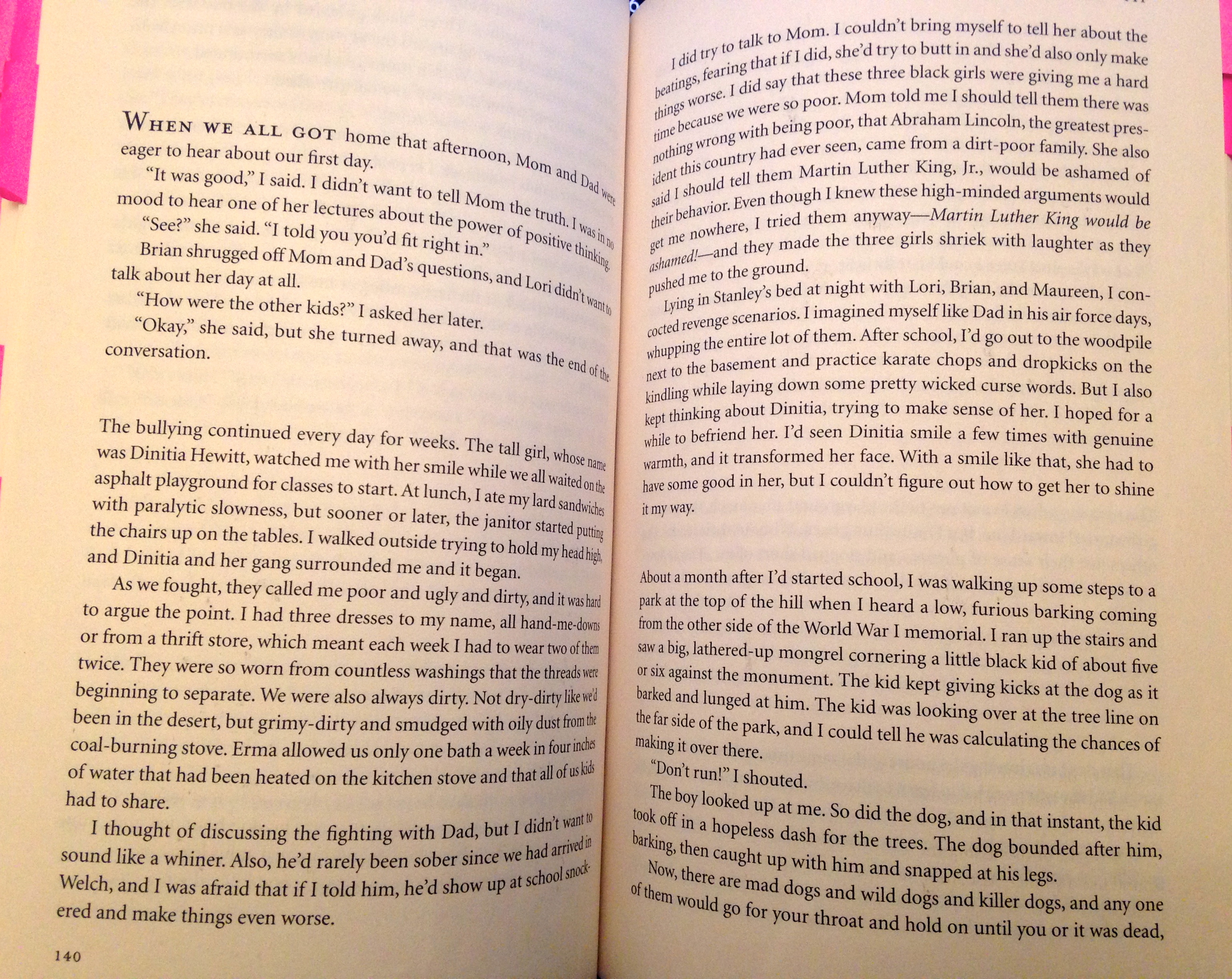
Lesson: Divide students into groups of three or four and have them open up their independent reading books to any page. Ask them to brainstorm what they see based on the page—tell them not to look at content, but instead the structure of the page—the text, paragraph breaks, and length. Have them compare their pages to each other, noting the similarities and differences. Once they have completed this, bring them back together into a whole class discussion. While they discuss their observations, compile a list on the board of what they noticed.

I love to breathe life into authors and remind students that a writer consciously makes decisions on the craft of their pieces. In turn, I have them to return to the structure of their page, focusing mostly on the line breaks, white space, and the spacing and formatting of the text in general. They reflect on this in their writer’s notebook, asking themselves: why do you think the author made this decision? What did they want the reader to think and/or experience?

IMG_2906Following their reflection, we return to discuss their individual pages as a class. Students volunteer to share why their author might have made the stylistic or structural decisions they did, which in turn, inspires other students to reflect further on their own page choices.

We discuss “one sentence paragraphs” and how they stand out surrounded by the white space of heavier paragraphs. They explore how white space can frame longer paragraphs and why exactly writers might use longer paragraphs to convey their point or tell a denser story. We notice how the white space of line breaks can show the passing of time and why it is important for readers to visually have a moment to internalize this time lapse. And finally, as readers, we share how we respond to cramped passages versus double spaced books.

The process of using choice books paired with class discussion helps students recognize the value of their role as a reader as well as how they can utilize these methods within their own writing.

Following our discussion, I take a few minutes to reinforce the points we’ve made either on the white board or through a prepared PowerPoint. These slides provide visual examples from books I am currently reading as well as some tips for applying this knowledge to our own writing.

Follow-Up: At the beginning of the year, students complete a snapshot narrative followed by a longer personal narrative. Using the mentor examples as well as the examples from our choice reading, we look at how we can integrate white space into our own pieces either through line breaks, diverse paragraph lengths, or one-sentence paragraphs. Based on this mini-lesson, they can also trade narratives and provide peer feedback to one another.

What are some mini-lessons you use to help students analyzing the structure of books? How do you help them integrate these observations into their own writing?