7 Reasons to Stop Asking about AP Test Scores

The question took me by surprise.

I’d just spent an hour or so sharing how I facilitate readers and writers workshop in my AP English Language classroom. I’d shared a video that showed my students testifying to how much they like having a choice in the books they read and why they feel like they will learn through choice reading this year. I’d shared a mini-lesson on how I teach skills using the books students choose to read, even when they are reading 30 different texts. I’d answered a variety of questions asked by pre-service teachers in Dr. Leavell-Carter’s master’s class at the University of North Texas and started to pack my things.

“What about your AP scores, did they go up?” one young woman asked, “I mean, I just think that would be a double benefit,” she said with a smile.

They say there are no bad questions, but I’ll go to the mat arguing that this is one we really need to stop asking.

I answered as honest as I could: “No. . .well, yes, when I began facilitating writer’s workshop, my scores increased double digits, but I don’t put much stock in AP scores, any standardized test scores, really, there are so many variables, you know; the students and their abilities differ from year to year, and since I’ve only taught in Title I schools where open enrollment is an invitation for all students to take AP classes with no prerequisites or even any preparation for the rigorous coursework, it’s difficult to prepare all students all the time at the same level of learning…”

Then I kicked myself all the way home. Why was I trying to justify my test scores? I’ve written about this before. I have much better proof that workshop works than any kind of testing data:

  1. Many of my students read more during the nine months they spend in my class than they do in
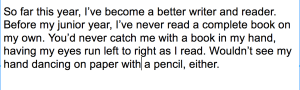
    from Joseph’s reading self-evaluation

    all of the 10 years of school they’ve had prior to coming to me.

  2. Almost all of my students read more books the year they spend with me than they read the year before.
  3. Many students read their first book cover to cover their junior year in my AP English class.
  4. Most students move into complex reading on their own because choice not only gets students reading; it gets them reading critically.
  5. Students tell me every year, “Thank you for allowing me to love reading again.”
  6. My readers learn to see themselves, and to see beyond themselves, by participating in book clubs with peers in non-threatening conversations about literature.
  7. My writers take ownership of their writing and compose beautifully and skillfully crafted texts.

There is no test that measures what my student come to appreciate as readers or what they come to realize as writers.

Sure, I want my students who choose to take the AP exam to do well, but I do not believe it shows what they come to understand about language. (And after scoring essays in Kansas City in June, I believe that even less.) Sure, I’ll keep encouraging my students to take the exam, but I believe most of them will benefit from taking freshman comp in college — even if they read and write well enough to score a 5. At least one English professor agrees with me:

“AP-credits are not always an accurate gauge of student learning. High AP scores in chemistry, for example, may indicate that students understand the basic concepts, but that doesn’t mean they know what to do at a laboratory bench.” (Bobby Fong, college dean and English professor).

I say what’s true for chemistry is also true for English. That doesn’t mean they know what to do when writing an essay for graduate school or a blog post for their employer or reading a report for their business or a decree in a divorce settlement.

Let’s focus on the skills our students need to be successful in the lives that lay before them.

For me, readers and writers workshop helps me do that.


©Amy Rasmussen, 2011 – 2015

The Importance of Narrative: Stories That Stay With Us

I was reading a weekly one-pager yesterday and came upon this little note from a student:

IMG_9850

This student, Aleigha, had taken an elective writing class with me as a sophomore.  Now, as a senior, she wanted to revisit the story she’d begun two years ago, and give it a different ending.  I was surprised that Aleigha had remembered that story, and that its ending had nagged her for two years.  I was even more surprised, as I started to read her one-pager, that I remembered her story, too–a fictional narrative in which two soulmates are torn asunder by circumstance.  She’d ended the story unhappily, leaving the two protagonists separate.  In this year’s one-pagers, though, she’s slowly bringing them back together.

Aleigha’s narrative was powerful to her, and personal, despite its fictional genre.  Her peers’ feedback indicated that her characters’ situations were relateable–that everyone wants people in love to end up together, because it’s something we all strive for as humans.  Narratives give us something to root for.

During a Google Hangout this summer, Jackie talked about her students’ writing of narratives, and how “the transformative power of common stories” brought out their best and most vulnerable writing.  “Every child has a story to tell,” agrees Don Graves.  Because of this truth, narratives are my favorite genre to teach.

We all have a story to tell–a story that stays with us, that we can’t get out of our minds, no matter how long it’s been since the idea was seeded.

As my students write their narratives, I’m shocked by how naturally the words are flowing out of their pens.  When the topic is powerful, I feel like I have little to do in the way of writing instruction–I simply have to get out of the way and let them write.  I have mini-lessons planned on pacing, setting, sensory details, and characterization.  But I’m finding beautiful writing already extant in their drafts:

“Every time I step onto the ice, it takes me to my childhood,” Mitchell’s story begins.

Kaylee stuns me with: “The musky smell of burning wood rose into the air as the sound of water crackling split the silence.”

“Realizing you’re gay, and accepting you’re gay, are two very different things,” another story leads with.

The brilliant Tom Newkirk explains why students are able to effortlessly write this way in Minds Made for Stories:  “The hero of the story is a narrative itself…Narrative is there to help us ‘compose’ ourselves when we meet difficulty or loss. It is there to ground abstract ideas, to help us see the pattern in a set of numerical data, to illuminate the human consequences of political action. It is home base.”

We make sense of the world by weaving its happenings into a story–by the time our students come to their notebooks with an idea, they’ve already rehearsed this story many times.  They are just bursting to tell it.  It is home base.

While narrative may not be considered the most “rigorous” of genres, I believe it is the most important one.  It is the writing that demands to be done–the genre that is the most personally fulfilling, the most emotionally wrenching to write, but the most necessary to exorcise from our minds.  Let your students write their stories–write your own beside them–and watch your community of writers bloom.

Mini-Lesson Monday: This lesson stinks, literally.  Teaching Sensory Details in Narrative Writing.

FullSizeRender-1I, like many of my students, am a kinesthetic learner.  Not only do I learn by doing, but for many tasks, I require a hands-on approach to fully grasp the complexity of a concept.  Yet as a teacher, applying kinesthetic techniques to English concepts can be somewhat challenging.  While we write and read and physically play with words, I try to create simulations and activities that allow my students to experiment with writing in unique ways.  This activity, which is one of my favorites of the year, uses students’ olfactory sense to stimulate sensory detail writing within their personal narratives.

Objectives:  Using the language of the Depth of Knowledge levels, students will identify personal memories associated with unidentified scents.  Recalling prior and newly acquired knowledge, they will translate their observations into descriptive writing by constructing sentences that rely on sensory details.  Finally, students will apply their understanding of descriptive writing to their own personal narratives.

Lesson:  This mini-lesson takes preparation, but students’ responses are worth the extra time.  First, collect the following supplies: Plastic cups (I use blue Solo cups), a permanent marker, tinfoil, a toothpick, rubber bands (optional), and a variety of objects that have a scent.  This year I used lime juice, perfume, scented wax blocks from Walmart, BBQ sauce, apple cider vinegar, garlic, mint extract, crayons, and Play-Doh.  Every year is different though and I typically rely on what I have around my home.

I put the scented sauces, liquids, and objects in each of the cups, cover the cups with tin-foil, and wrap a rubber band around the top to secure the foil.  I label each cup with a number and poke holes in the tin-foil with a toothpick.  Next I place the cups around the room. After taking some notes on the concept of “show don’t tell,” students walk around the room smelling the contents of each cup.  They must not peek (believe me they will try)!

FullSizeRender

My students were convinced I had a tiny Abercrombie and Fitch model in this cup. In reality, it was a block of scented wax from Walmart.

I provide each student with a grid in which they fill in the cup number, adjectives to describe the scent, and personal memories the scent conjures.  They must then write a two-to-three-line story or scenario in which they describe the scent without identifying what the scent is.  By the end of the activity, when we come back together as a group, students excitedly volunteer to read their sentences in order to reveal the contents of the cup.

Follow Up:  Following this activity, we identify sensory details within our independent reading books and take turns discussing these details within our groups.  Finally, during workshop time, students add sensory details to their personal narrative rough drafts, in turn “showing” images rather than “telling” them.  The process of digging into their narratives and writing in the margins reinforces the messy, step-by-step process of revision that many of my students struggle to grasp.  If time allows, students partake in a whip share in which we each share one line from our narratives that includes sensory details.

What are some untraditional writing activities you use? How do you get your students moving around the classroom?

#FridayReads: Whole-Class Novels to Teach, and How to Frame Them

This past summer Shana and Jackie found that we’d both taken on a unique experiment within some of our classes–we had decided to strip them of whole class novels and instead focus on independent reading, book clubs, and smaller whole-class texts.  As workshop teachers confident in the power of choice reading, we each felt that this shift would be both empowering and inspiring within our classrooms.  After our year of experimentation, we both left our classrooms with unique perspectives on the power of whole-class novels as well as how we would incorporate them moving forward.

Today is the third and final installment of our week-long discussion using Google Docs.  Please, join the conversation in the comments!

41Cx8mY2UNL._SY344_BO1,204,203,200_Question 6: How is it different to be forced to teach a certain novel versus to be able to choose the ones you teach?

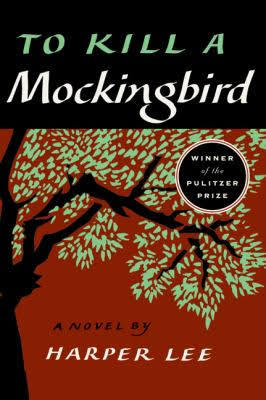
Jackie: I will readily admit that I am “forced” to teach To Kill A Mockingbird and Macbeth at the freshman level.  That being said, I love teaching both of them and am fortunate that my students respond well to both pieces.  The challenges are certainly different though.  I must create student buy-in or else my students will drag through the next four to six weeks of our unit.  I frame each lesson to fit their needs and I make sure to fit the book into a workshop structure the best I can to create consistency.

I do believe that teachers must have a choice in what they teach, though.  We must be allowed to tailor our lessons to fit the needs of our students.  Independent reading allows us to understand our students as readers and individuals, which in turn, allows us to further assess what books our students might connect with best.  Fortunately for me, the freshman team I work on is progressive and forward-thinking.  They’re always willing to try new things, which oftentimes involves integrating contemporary works.

Shana:  This summer in Tom Newkirk’s class, he innocently posed this question to our class:  “Why is the defining novel about race in our country written by a white woman?”  He was referring to To Kill a Mockingbird, of course, as many of us were discussing its lately-released sequel.  That question, so casually tossed into our midst, made me think about why the canonized novels taught in schools are often so heavily prescripted.  Why does Harper Lee have a voice of authority about being black in America?  Why do my rural students need to read a particular story about race?  I know why it’s important to read stories about people different than us–I would argue that it’s essential to building empathy and a broader worldview to read widely–but why does Harper Lee hold the monopoly on that topic, and not someone like Toni Morrison or Zora Neale Hurston?

As usual, I have raised more questions than I’ve even attempted to answer, but I’m still not sure of the correct solutions.  I think it’s preposterous to have a rote schedule of “books to teach” for all teachers in a school when it’s blatantly obvious that the community of every classroom is different, which means the culture of its students is always unique, which means that no child ever needs the same book at the same time.

Jackie: It’s funny that you bring up Tom Newkirk’s question.  As I was sitting next to you, I had one of those hide-your-face-moments when I thought, “Oh geez, I teach To Kill A Mockingbird!”  As I said earlier, I am required to teach this book, and while I love it, it does not meet the needs of all of my students.  Teaching in New Hampshire, I have a predominantly white population.  This means that their understanding of race relations and their exposure to diverse literature is rather whitewashed.  We desperately need new, diverse voices to help our students understand and empathize with a variety of individuals.  The precious few books we read together should be based on the needs and interests of our students instead of being dictated by a one-size-fits-all approach.

Question 4: What is the most effective way to frame a whole-class novel and create student buy-in?

Jackie: At the beginning of the school year I discuss the different types of reading we encounter as lifelong students.  I explain that, as a reader, I read for pleasure as well as for knowledge.  Oftentimes those two paths can and may cross, but typically my personal reading life looks drastically different from my professional reading life.  I love pouring through popular YA lit, but in the same breath, I can’t get enough of dissecting poetry with my AP Literature class.

This same pattern applies to my students’ reading within our classroom.  As a class we must learn to maintain a fruitful and engaging personal reading life that allows us to not only learn from our literature but to also explore our own interests and passions.  That being said, we mustn’t overlook the power of dissecting and discussing language and craft as a class.  Reading whole class novels reinforces the fact that no two people read a book the same way.

Shana:  If choice is the golden guide to teaching of reading, then I think the culture of a classroom must dictate the novel we read.  While A Raisin in the Sun was immensely popular in my inner-city Cincinnati classroom, it completely flopped here in West Virginia when I tried to teach it.  The inverse is true of Huck Finn; wildly successful in WV, but a total fail in Ohio.  Thus, I seek to hear the themes my students return to again and in again in their writing and conversations–this year, we are engaged in many discussions about political rhetoric, the origin of power, and the struggle that class/social/financial/ethnic differences create.  Thus, I’ll seek out novels that explore those themes to help us engage with them more fully.

In closing, we leave you with a list of the most successful whole class novels we have taught as well as a list of the books we would teach our current students if given the opportunity.

Most successful novels I taught, from Shana:28c4d1f2e8d048f702c3dbf0990aca8c

A Separate Peace by John Knowles

The Absolutely True Diary of a Part-Time Indian by Sherman Alexie

Macbeth by William Shakespeare

Fahrenheit 451 by Ray Bradbury

What I’d love to teach, based on my current students, from Shana:

Peace Like a River by Leif Enger

Boy21 by Matthew Quick

Poisonwood Bible by Barbara Kingsolver

Into the Wild by Jon Krakauer

Most successful novels I taught, from Jackie…(you’ll notice some repeats):51BWES5VL2L

Of Mice and Men by John Steinbeck (read aloud and performed as a play)

On Writing by Stephen King

The Absolutely True Diary of a Part-Time Indian by Sherman Alexie

The Glass Castle by Jeannette Walls

Macbeth by William Shakespeare

Fahrenheit 451 by Ray Bradbury

What I’d love to teach, based on my current students, from Jackie:

Sold by Patricia McCormick

Here, Bullet by Brian Turner

One Flew Over the Cuckoo’s Nest by Ken Kesey

All the Light We Cannot See by Anthony Doerr

Be sure to join the conversation today in the comments! We would love to hear your perspective on whole class novels and how you incorporate them into your classroom.

Click here to read day two of our conversation.

Click here to read day one of our conversation.

Whole-Class Novels: Why Do We Teach Them, Anyway?

This past summer Shana and Jackie found that we’d both taken on a unique experiment within some of our classes–we had decided to strip them of whole class novels and instead focus on independent reading, book clubs, and smaller whole-class texts.  As workshop teachers confident in the power of choice reading, we each felt that this shift would be both empowering and inspiring within our classrooms.  After our year of experimentation, we both left our classrooms with unique perspectives on the power of whole-class novels as well as how we would incorporate them moving forward.

Here is day two of our insights and discussion we’ve had over the past week using Google Docs (click here for day one).  Please, join the conversation in the comments!

Question 3: After a year without whole-class novels, how did you feel?MTI5MzY0OTk4NTM0MjQwNzM0

Jackie: At the beginning of the year, I felt like a rebel.  The thought of not only allowing but also empowering students through independent reading went against the entire curriculum within our department.  All of my colleagues taught whole class novels, which meant that none of my students had experienced the pure freedom of choice.  That being said, three-quarters of the way through the year, I missed whole class novels.  Despite having unique successes with the independent reading, my classes lacked the communal experiences of reading, discussing, and simply just enjoying (or sometimes hating) a novel together.  By the end of the year, I found that both my students and I missed some components of reading whole class novels.

Shana:  I reflected on my teaching after a year without whole-class novels (mind you, many novels were read through book clubs, literature circles, reading challenges, and independent reading), but I felt like the one thing that was lacking in all of my instruction was the idea of sustenance.  I wasn’t seeing my students sustain an idea for an extended period, or grapple with an issue over time, or try to live with a topic for more than two drafts and three weeks.  The case was the same in their reading and writing–I wanted them to have more length in their thought processes and I wanted us to engage in those long thought processes together.

Question 4: Why is teaching a whole-class novel valuable?  More specifically, why do we do it, and what skills are taught?

brave-new-world-bookShana:  I am not sure why I used to teach whole class novels, or, specifically, why I taught the novels I taught.  I know that there were valuable instructional methods behind the way I taught them (thematic units, Socratic circles, exploratory essays), but I don’t know if I had a sound rationale behind the obligation I felt to actually teach multiple novels to all of my students.

After a year without them, though, I find that the collective classroom experience of reading, interpreting, and discussing a novel produces a route for a unique connection to a text that cannot be achieved without reading as a group.  I missed the experience of coming to a new, shared understanding of a text as a whole class, and I felt that my students missed out on that experience as well.  I don’t believe that when I read plays independently in my undergraduate Shakespeare capstone that I would have comprehended, connected to, or engaged as passionately with those plays alone as much as I did through our frequent in-class discussions, activities, and writings.  I don’t want my students to miss out on that experience either.

Jackie: This year I am teaching AP Literature for the first time.  I took the challenge believing that this new course would be somewhat of a paradigm shift for me compared to my contemporary-lit based freshman English class.  The more I prepared, the more I yearned to discuss my thoughts, questions, and analyses of texts.  I went so far as to ask everyone around me to read these canonical classics and discuss them with me.  Preparing to teach AP Lit reinforced the social significance of reading literature.  At its base, dissecting stories as a group is interesting and engaging.  Beating the crap out of them is not.  I agree with you, Shana, in that the experience of sharing a text is one of the blessings of being in an English classroom.  Once students graduate from high school, they rarely have the opportunity to interact with texts in a classroom setting.

Shana: I love that the way you prepared to teach was to ask friends to read books with you, then discuss them.  You engaged in an authentic book club there, as I know you have your students do now.

More of our discussion will follow tomorrow.  Be sure to join the conversation today in the comments!

Whole-Class Novels: To Teach, Or Not to Teach?

This past summer Shana and Jackie found that we’d both taken on a unique experiment within some of our classes–we had decided to strip them of whole class novels and instead focus on independent reading, book clubs, and smaller whole-class texts.  As workshop teachers confident in the power of choice reading, we each felt that this shift would be both empowering and inspiring within our classrooms.  After our year of experimentation, we both left our classrooms with unique perspectives on the power of whole-class novels as well as how we would incorporate them moving forward.

Over the next three days, we will post our insights and discussion we’ve had over the past week using Google Docs.  Please, join the conversation in the comments!

imagesQuestion 1: How did you decide to get rid of of whole class novels?

Jackie: Last year I was faced with a unique opportunity: the English Department voted to end popular College Preparatory Advanced Composition course.  Despite the well established curriculum, I tossed aside the typical whole class novels in favor of independent reading. As a primarily freshman English teacher, I am required to teach one Shakespeare play and To Kill A Mockingbird.  Advanced Composition gave me the opportunity to focus on smaller whole class reads and mentor texts within daily writing workshops without devoting whole units to one book.

Shana:  After six years of teaching, I wasn’t really sure why I felt compelled to teach whole-class novels.  Every year, when I picked up Catcher in the Rye, I dreaded my job.  I hated that book, and I had no idea how to get my students to love it or connect with it.  It felt like a chore to drag my students through “reading” that text (mostly they were SparkNoting it, sometimes with the assistance of their football coaches–true story).  I knew that not every student loved every novel that I did (particularly Their Eyes Were Watching God), and I knew that I didn’t love every novel my students read on their own (particularly everything by Nicholas Sparks).  I started to wonder–what would my teaching be like if I didn’t feel compelled to teach a whole-class novel…merely because I should?

Jackie: The eye opening experience for me was definitely during my first year of teaching.  I began integrating independent reading into my curriculum and I suddenly found out how many voracious readers I had in class.  My teaching was getting in the way of these students’ education! I like how Shana puts it–I also knew that my students didn’t love the novels I did (Speak by Laurie Halse Anderson) and in the end, if I gave them freedom, I too would learn much more about literature, reading, and teenagers.

Shana:  I like that Jackie mentions the issue of devoting whole units to a book–I loved having the freedom to design units of study that weren’t anchored around a novel, but rather a different genre.

Rye_catcherQuestion 2: What were the positives of having no whole class novels and what were the negatives?

Jackie:  After a year, I have found both positives and negatives to removing whole class novels.  Getting rid of whole class novels allowed me more time to focus on the positive aspects of the workshop model.  Naturally student choice led to easier student buy-in, and I spent less time convincing students of the value of reading.  As a result, we spent more time cracking apart smaller whole class reads like essays, poems, and articles and truly contemplating the author’s choices and craft.  Additionally, I liked that I could assess students and discuss their growth based on their own reading goals and progress.  

I have yet to find a solution to the “be on this page by this day” debacle that comes with teaching whole class novels.  Too often whole class novels lead to less differentiation and more stress, which can lead to the “gotcha” feel that comes with discussing larger, longer texts.  

That being said, there was a lot that I missed about having whole class novels.  Losing a longer common text meant that students didn’t have the common classroom experience of connecting over both the successes and frustrations of working through a complex text together.  I was surprised by how much students want to discuss their reading with classmates.  While reading can at times feel solitary and maybe even isolating during the actual act, in reality, reading complex texts is a communal activity that unites groups through a variety of perspectives, opinions, and interpretations.

Shana:  The positives were that I felt like my curriculum map was much more relaxed and flexible, in contrast to the years where I felt like I had to teach a minimum number of novels and “fit them in.”  I also loved seeing my students’ love of reading skyrocket as they engaged in choice and challenges on only an independent or small-group basis.

The negatives were more nebulous–I just felt like something was missing.  Our learners crave a challenge, and navigating a difficult novel is a challenge all readers relish if they have autonomy in their reading of that novel.  Reading a novel together provides an opportunity for me to create instruction that scaffolds a student’s reading skills up to the level of that novel, allowing them to participate in a reading experience they may not have been able to enjoy otherwise.

I also really missed being able to ascertain the barometer of a class’s feelings on a certain theme or issue through discussions of a complex text.  Crime and Punishment explores issues of morality, regret, and psychology in a far more complex way than “The Tell-Tale Heart” ever could, and although both stories have very similar themes, the novel lends itself to the sustenance of thought, evolution of a character, and length of a reading experience that I so craved for my students.  I also think that some reading skills specific to stamina, fluency, and automaticity cannot be practiced or taught effectively without a lengthy text, so I felt that last year, my students missed out on practicing those skills.

Jackie: While we both feel similar in the value of whole class novels , I know that neither of us would return to a set list of novels.  Whole class novels allow us to engage in common discussions but independent reading lays the groundwork for students’ stamina and confidence.  I don’t start my first round of literature circles until the second quarter because of this.  As much as students need a communal reading experience, I believe they first need a taste of independence and success.
Shana:  I still haven’t figured out the whole reading schedule thing either, nor how to create buy-in for every single student so that they autonomously, independently want to read a novel.  I struggle with the this-page-by-this-day conundrum, too, mostly because I feel like that creates a certain accountability that kids get hung up on, because it relates to the dreaded word GRADES. 

More of our discussion will follow tomorrow.  Be sure to join the conversation today in the comments!

Click here to read day two of our discussion.

Developing Habits of Mind Through Readers and Writers Workshop

Grades might be the death of me. Not grading — I can handle that. It’s my students’ obsession with grades that is beginning to break my already aching back.

Right after we’d spent 75 minutes of our 85 minute class period color-coding our best drafts and revising what we thought was pretty good writing to craft better writing, a student — we’ll call him JWP — asked me if I would read his essay.

I thought he asked for a writing conference.

Not quite.

“Sure, what would you like me to look for in your essay?”

“Um, I don’t know,” he said, “I just want to know what grade I’ll get on this.”

“But, you haven’t done anything with the ideas you got in the discussion today,” I said.

“Yeah, I know. But I really just want to know if this will get me a passing grade.”

I can feel my breathing change. I sigh.

“I am happy to read your essay,” I said taking the paper, noticing the green and red marks from our color-coding session but no blue, orange, or purple. I tried to think fast, not sure of the best way to bridge the obvious gap:  Writing for a grade versus writing to convey meaning because we care about our message and our craft.

I hope what I said to JWP made a difference. I thought of a million things to say but knew he wasn’t in a place to hear anything more that this:  “Are you proud of this piece? Does it represent what you’ve learned about the writing process?”

I guess I’ll know if what I said made a difference when JWP turns in his essay today.

How do we get students to care more about the learning than about the grades?

I believe it has to do with helping them change what they might believe about school. This is hard. My students are juniors in high school with 11 years that have shaped their beliefs. Somehow I have to get them to want more.

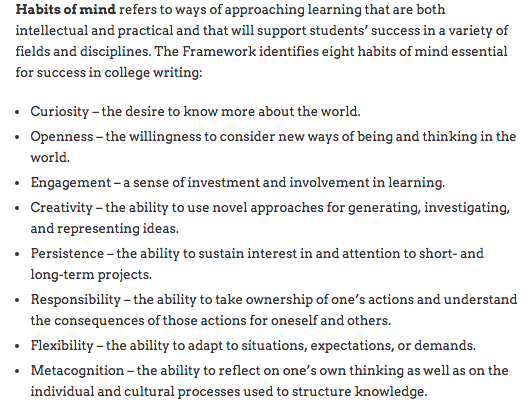
Searching the NCTE website for info unrelated to the topic of this blog post, I found this page, which discusses the Framework for Success in Postsecondary Writing, a collaborative piece by NCTE, NWP, and representatives from Council of Writing Program Administrators that details what it means for the 21 Century student to be “college ready.”

from Framework for Success in Postsecondary Writing

from Framework for Success in Postsecondary Writing

The aha hits me:  These habits of mind are what my readers and writers workshop instruction is all about:  a “way of approaching learning that is both intellectual and practical and that will support students’ success in a variety of fields and disciplines.” At least I try to make it so.

My students need these habits of mind. They need them so they can be successful in college and careers years after they leave my classroom. They need them if they are to be the change agents in the workplace and the world they inherit.

I am persistent. Little by little we embrace this thinking in my classroom. I keep inviting and encouraging.

“Make choices,” I say. “Choose the books you read and the topics you write about. Let’s think about issues that matter to us. Let’s experiment with risk.”

I meet with my learners to help them think through their thinking, conferring with every student as often as I can.

We explore different texts we can write and different authors we want to read. We talk about our reading experiences. We share our writing and our writing processes because everyone has a different way of practicing their craft. We discuss complex texts and practice complex thinking. We choose projects that challenge our comfort and lead to deeper learning.

Many students quickly adjust to the freedom and uncertainty of workshop. Others struggle. Like JWP.

He’ll get there — we have until June.

Do you have JWPs (Just Wanna Pass) or, on the other end of the spectrum, those students who grub for grades? How do you deal with the grades over learning conversations? Please leave a comment and join this conversation.

Mini-Lesson Monday: Connecting to Poetry with Heart Books

Today is my first day back with my students, since my excellent student teacher departed on Friday.  Having observed their learning and their needs for the past six weeks, I have lots of goals for them in mind.  But, most urgently, I am struck by how much I want readers to connect more authentically to literature–to nurture their investment in, and passion about, literacy.  I want to begin helping them do that by creating and curating Heart Books, which I heard the excellent Linda Rief present about at NCTE in 2013.  Thank you to the very thorough Vicki for this excellent description of Heart Books.

Objectives — Using the language of the Depth of Knowledge Levels:  Identify a topic/theme to explore in heart books; Collect and display a variety of poems about this topic/theme over time; Connect your poems to your topic and yourself.

IMG_9708

My heart map

Lesson — We’ll begin the lesson by returning to the Heart Maps (here’s a great handout on those) we created early on in the school year.  “Choose one topic on your heart map that you’d like to explore further.  On my heart map, I think I’m going to choose my students–this kind of includes themes of learning, growth, and teaching, too,” I’ll explain.

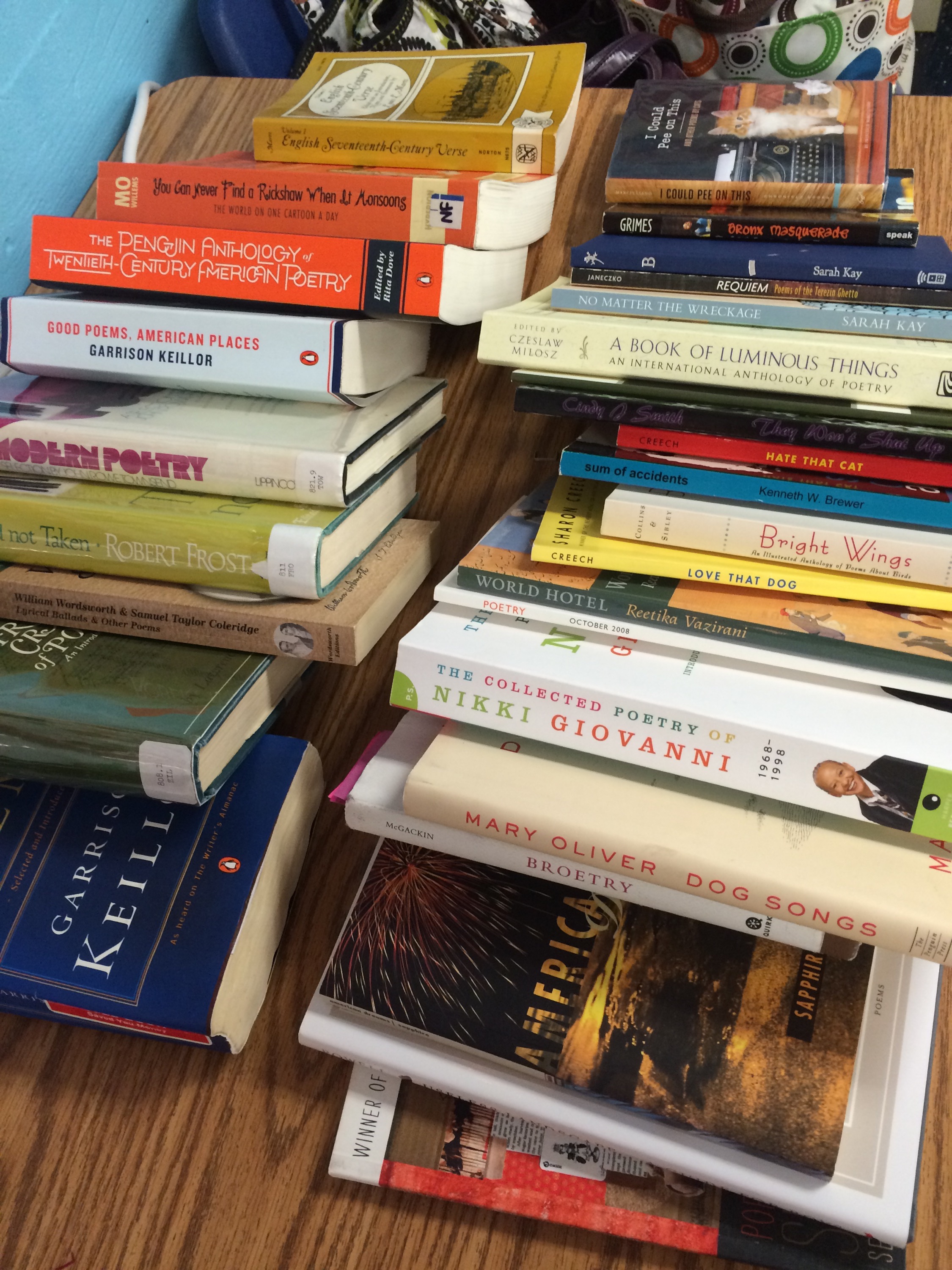
Once students choose topics from their heart maps and expand on what themes they might include, we’ll create a new section in our writer’s notebooks called HEART BOOKS.  Then, we’ll browse various poetry anthologies and collections (check Amy’s selection out if you seek inspiration for building your poetry shelf!), searching for poetry that matches their selected theme.  I’ll ask students to copy the poem into their notebooks once they’ve made a selection.

IMG_9709

My poetry shelf, unshelved

From there, Linda Rief suggests having heart-bookers illustrate the poem, write a response about why it was chosen, and research the poet to find out what he or she might have to say about reading and writing.  I’ll encourage my students to do the same, but also will ask them to make a note of their favorite bits of language from the poem–words, phrases, or even punctuation.  The craft moves poets make are valuable teachers of writing.

Follow-Up — Next class, I’ll ask students to share in groups their Heart Books.  Perhaps we’ll have a notebook pass in which we write in one another’s notebooks, responding to each other’s poems.

For the remainder of the year, once per month, I’ll set class time aside for curating Heart Books.  By the end of the year students will have created a personal anthology of ten poems that help them explore a key theme in their Heart Maps.

What routines do you have in place that help your students connect to literature and explore personal themes?

#FridayReads: Fast YA Picks

My life has been pretty hectic lately–full of some wonderful things–but it’s left little to no time for reading.

When life hits me hard, I don’t like to slog through a difficult classic, or plod through some dense nonfiction.  I like to crest down the hill of a reading rollercoaster, at top speed, with some fast-paced YA literature.  Here are three great YA titles I’ve read of late, at full speed.

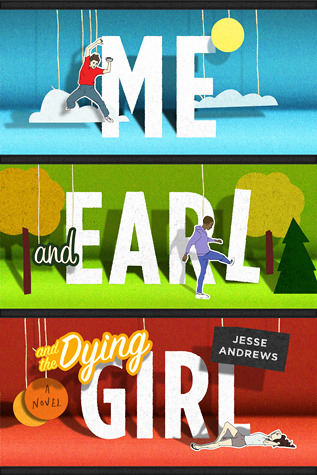
12700353Me and Earl and the Dying Girl by Jesse Andrews – This book is full of voice and fun, and I absolutely loved it.  The narrator, an awkward teen named Greg, is encouraged by his mom to befriend Rachel, a cancer-stricken childhood friend.  Together with his film-making Earl, Greg sets out to try to make Rachel smile during her last days on earth, through awkward jokes and films and companionship.

This story rang much truer for me than The Fault in Our Stars, as it seems to reflect more accurately what teens go through when sudden death strikes their midst.  I adored Greg’s sarcastic writing voice, which is often self-deprecating and rather obtuse.  The believable plot, humorous writing, and fast pace of this book made it the perfect Saturday morning distraction from my busy life.

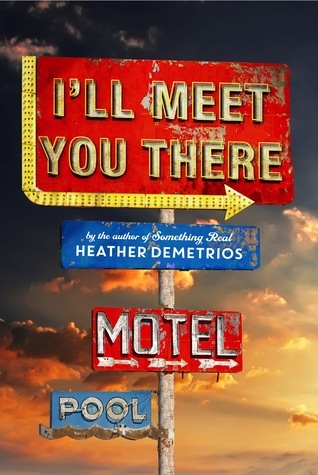
21469068I’ll Meet You There by Heather Demetrios – Augh, this book!  It was the only YA I heard Penny Kittle recommend at UNH this summer, so I knew it had to be good, and when I picked it up, I was not disappointed.  The protagonist, Skylar, is working her way through her post-graduation summer, excited for college and a departure from her small town.  That is, she’s excited until her friend Josh returns from war in Afghanistan, missing a leg.  She’s excited until her widowed mother falls into a funk of depression and alcoholism.  She’s excited until she realizes she may never be able to leave her small town, and this book is the story of her quest for freedom.

This book had so many great themes–issues of war, teenage love, poverty, familial duty, and friendship make this story appealing to many students.  Additionally, Demetrios’ writing is gripping and beautiful, and she made me laugh, cry, and hold my breath for the brief afternoon it took me to read this compelling novel.

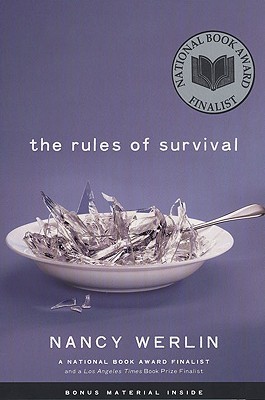
6219358The Rules of Survival by Nancy Werlin – I’m in the middle of this book, and I’m so happy I picked it up.  It was an impulse buy when I was sucked in by the cover–a National Book Award Finalist stamp, and a picture of a bowl full of broken glass.  It’s the story of a boy named Matt and the life he lives with his physically and emotionally abusive mother.  He tells his story often through letters to his younger sibling, and it is a story of hope, desperation, and heartbreak.  The writing is beautiful, personal, and simple, making the sheer plot of the story that much more poignant.  Most powerful are the five simple rules Matt lives by:

  1. Sometimes, the people who mean you harm are the ones who say they love you.
  2. Fear is your friend. When you feel it, act.
  3. Protect the little ones.
  4. If you coped before, you can cope now.
  5. Always remember: in the end, the survivor gets to tell the story.

These books fly off the shelves of my “Life in High School” section, allowing my students and I to become lost in the stories of others, blissfully distracted from our own lives through reading.  I highly recommend these three YA picks if you’re looking for a good, fast read.

What are some great YA titles you or your students have loved recently?

Cliché College Essays and Why I Hate the “Three Ds”

IMG_0040On the Monday their essay was due, I handed out a rubric. “I cannot and will not grade you on this essay,” I said to my AP Literature class.

In all honesty, I don’t care what they get for a grade on this piece. After days, weeks, and months of toil, a number cannot and will not determine the actual value of this paper: the college essay.

I have a love-hate relationship with the college essay. I love that students have the opportunity to express themselves through writing and that they are encouraged to provide personal stories. I especially love the emphasis on creativity that draws them away from the rigidity and structure of standardized tests and check-box-surveys. What I hate is the overwhelming weight that accompanies telling “your story,” the crowning piece of one’s 17 years of life.

My first year of teaching, I fretted over college essay advice. I told students to steer clear of the three Ds—death, disease, and divorce—and to instead explore a wider variety of ideas that included mundane moments. I wanted them to beware the standard cliché essays of human suffering.

What I found was in restricting these three topics, I also restricted the very stories that shaped these students’ identities. After all, our students are still teenagers; they have many more stories to live and we mustn’t undermine those stories of death, disease, and divorce that have framed their present reality.

Sarah’s essay on her father’s death and her inability to hold his hand during his last moments tears at my heart every time I read it, and I have been working with Sarah on this piece for a year. She writes:

It is nearly two years after my father has passed, and my inability to hold my father’s hand on his deathbed still haunts my dreams and consumes my thoughts. I am sixteen years old, I have done regretful things in my life, but the singular moment I regret most in my life is not holding my dad’s hand during the one time he needed it to be held by me.

Sammie’s poetic piece on coping with her best friend’s severe eating disorder and eventual hospitalization and rehabilitation has a place in Sammie’s college folder. Maddie’s experience meeting her mother’s boyfriend for the first time after the shock of her parents’ divorce belongs filed alongside her SAT scores.

Instead of limiting their stories or categorizing them as cliche, we, as teachers, must help our students explore these experiences through expert narration and craft. After all, doesn’t the beauty in literature rest in its familiarity? Its common story? Its trumpeting of empathy, underdogs, and resilience?

How do you approach college essays, and how do you help students who are struggling with essay topics?