#3TTWorkshop — Making Workshop Work in AP English

#3TTWorkshop Meme


How do you balance teaching the workshop model with also teaching to a test?

Amy:  First of all, teaching to a test is not good practice. We know that. I know we want to prepare students to take and pass the AP exam, but if we structure our classes around test prep, we are doing a disservice to our students. We provide the only 11th or 12th grade English classes our students will take — we have a responsibility to help them understand how language (and literature) works, how it moves the world, how it relates to our lives. And we have a responsibility to help every student advance as readers and writers — no matter where they are in their abilities when they come to us. If we do these things we are doing our jobs, if not, we are not. Test prep does not help with either of these responsibilities. As a matter of fact, it can inhibit it.

Jackie: I am a first year AP Literature teacher, so I still have the underlying anxiety that comes with teaching my first class of AP students.  I love these students–they are kind, passionate, mature, and motivated.  They work tirelessly to succeed and they have a passion for literature and thirst for knowledge unmatched by any of the students I’ve taught in the past.  In turn, I want to do everything in my power to provide them with the steps to succeed, but I have found, as the year goes on, that I cannot simply focus on the test.  In the beginning, I felt like every assignment I designed began with the thought, how will this help them on the exam?! Once I shoved aside my anxieties and found my stride, I focused less on their testing success and more on what I truly wanted them to walk away with at the end of the year.  I am blessed with the gift of teaching students the individual pleasure of reading paired with the social process of dissecting intricate texts.  
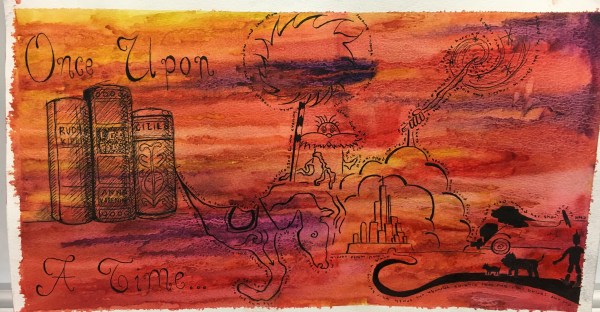
Created by Jackie's student. Doesn't it embody the essence of AP Lit?

Created by Jackie’s student. Doesn’t it embody the essence of AP Lit?

How do you balance whole class novels with independent reading in AP classes?

Amy:  My students and I do not read any whole class novels. It’s not that I am against them. It is that I have not found a book that I think will work to move all of my students. Wait, that’s not quite true. When I read David and Goliath by Malcolm Gladwell, I thought “Here is a book that would make for a whole class read.” The book is an argument, and within each chapter is an argument that supports the overall one. That would be a good book for all AP Language students. Have I used it as a whole class read yet? No, but if I can find the funds to buy enough copies, someday I will.

Jackie: Unlike Amy, I do teach whole class novels.  Last year I experimented with teaching no whole class novels in my junior-level Advanced Composition course.  The experience had its pros and cons, but I found that I missed the common experience of reading a sustained text together.  It wasn’t something I wanted to do everyday in my classes, but one of the reasons I loved studying English in graduate school was to gain the communal opportunity of cracking apart texts and sharing perspectives.  In AP Literature I reinforce the concept that literary analysis isn’t a competition; it is instead a social experience that requires us to open up to our peers in pursuit of greater knowledge and understanding.

While I teach whole class novels, I do not believe AP Literature classrooms must revolve around them. Instead, AP Lit classes should have a smattering of diverse novels and plays with a large focus on poetry, short stories, and even excerpts.

My AP students just finished Invisible Man by Ralph Ellison, a 580 page episodic novel that is the most used novel on the test.  It is brilliant in so many ways, relevant and valuable.  It discusses issues of race and police brutality that eerily parallel issues we face today.  For many, it is also the first whole class novel on race my students read that was actually written by a black man (they read To Kill A Mockingbird their freshman year and The Adventures of Huckleberry Finn their sophomore year).  I choose the novel because it is invaluable, but I also acknowledge that it is LONG.  If I taught lengthy canonical texts constantly, my students would hate me.  I would hate me.

20160105_090107 (1)

Fabian reading to his table mates. He’s so involved in the story of Extremely Loud & Incredibly Close he could not wait for our book club discussions.

Amy: We read a ton of short text together; discuss them, analyze them, write about them. We enjoy many rich reading experiences together — all centered around short texts. I’ve heard a lot of noise lately around the argument for a literary canon so students enjoy shared experiences versus independent reading and the lack thereof, and I think the dichotomy is wrong. Can we only have shared experiences around whole class reading? No. It’s not that those of us who advocate for choice reading do not facilitate rich reading experiences and discussions with our students as whole classes, it’s that we choose to do so with shorter texts rather than full-length novels — or we choose to do so with themes instead of one book.

My experiences with too many students not reading longer texts I pulled from the canon — and the length of time it took to complete a unit — made me choose to let the novel go. Too many students faked their way through the classic literature I forced them to read my first few years teaching. (They brag about it later on Facebook.) And by offering choice, whether it be self-selected reading or book clubs, I have better chances of advancing all of my readers, not just the few who commit to doing all the reading.

We have a lot to say, so join us tomorrow for part two of this discussion. And as always, please join the conversation in the comments.

Mini-Lesson Monday: Setting Up New Notebooks

img_0966

Our first semester notebook sections

My students and I have filled up one notebook thus far this school year, and as the second quarter comes to a close, we’re going to buy new ones and decorate, personalize, and organize them together.

At the beginning of the year, I asked my students to create quite a few sections in our notebooks.  This helped us stay organized at first, but as the year went on and sections filled up, the variety of sections caused more stress than they relieved.

img_0959

Brand new notebook! I love this one by “Punctuate” from Barnes & Noble.

Over break, our friend Erika shared an excellent article about the health benefits of journaling.  Amy said this about the article: “I wish composition notebooks were cheap right now. I’d get new ones for my students, read this piece, and start over when we get back to school. We’ve got notebooks, but we are not as into them as I would like. Could be a jump start.”

I feel the same way Amy does.  Our notebooks have turned more into workspaces and less into journals.  I want to change that as we begin the second semester.

Objectives — Using the language of the Depth of Knowledge Levels:  Formulate ideas about topics during quickwrite time; Construct language that reflects beliefs and ideas. Or, from the Common Core: Write routinely over extended time frames (time for research, reflection, and revision) and shorter time frames (a single sitting or a day or two) for a range of tasks and purposes.

Lesson — I’ll begin by telling students this story:  “I read Tom Romano’s Write What Matters again over break, looking for ideas for meaningful notebook activities.  From his chapter titled “Notebook: Playground, Workshop, Repository,” Tom gives this advice about journals:

“Buy one. Write in it every day. You’ll strengthen your writing muscles and keep them supple. You’ll learn to accept words your mind offers. You’ll consolidate writing skills you’re developing. You’ll sharpen your perceptions, live more alertly. You’ll expand your vocabulary, too.

img_0961

My first page of all my notebooks–a photo and a tracing of my hand, inspired by Penny Kittle and Sarah Kay’s poem “Hands.”

“This quote resonates with me.  It reminds me why I write, and why we should all write often.  Why do you find value in writing?”

We’ll have a conversation about the meaningfulness of writing, then set up our notebooks together.

“Last semester felt hectic when all of our sections filled up.  This semester I want to keep it simple.”  I’ll put the following guidelines on the board:

  • What-to-read list goes on very last page
  • Vocab words go on the page before that (see our posts here and here to know how we “do” vocab)
  • Quotes go on the page before that (craft studies usually go here)
  • Small section for heart books at the very end

“And that’s it.  I want to just write in chronological order every day, keeping just a few pages in the back for our usual routines.”

We’ll spend the remainder of class setting up our sections and collage-ing our notebooks to personalize them, as Jackie describes here.  I’ll do this alongside my students, adding ultrasound pictures and magazine cutouts to represent the upcoming year of change that’s in store for me.

Over the coming weeks, we’ll focus on using mini-lessons from Write What Matters–ones that involve drawing, writing therapeutically, and telling the narratives of our writing places and experiences.  I’ll hope to jump start, in Amy’s words, my students’ passion for writing with new notebooks and new notebook routines.

What routines will you change as the first semester ends?  What elements of your teaching will you revise?  Please share in the comments.

10 Pedagogical Must-Reads for Workshop Teachers

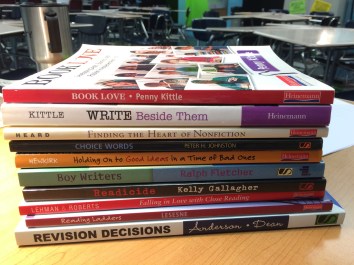
IMG_0650I met with my new student teacher a few weeks ago, and he asked me to borrow any books that might help him get going on the readers-writers workshop–the “theory” version of Jackie’s starter kit.  He’s been in my classroom before, so he knows the general routine and character of our work, but he wanted to know the ins and outs of how I thought and planned and conceptualized the whole thing.

I sat at my desk and looked at all of the titles I had on hand, remembering how influential reading them for the first time had been.  As a result, it was hard not to just dump my entire professional bookshelf onto a cart for him, but I managed to pick out a few titles that have guided me most adeptly in one aspect or another of my current classroom practice.

  1. Book Love by Penny Kittle – This was the book that helped to solidify my vision of an ideal classroom.  Before I read it, I had already been doing many of the best practices Penny mentions–writer’s notebooks, choice reading, personalized writing.  But I didn’t know how to bring it all together until Book Love.  As such, this is my #1 recommendation for any teacher looking to jump-start their individualized workshop curriculum.
  2. Write Beside Them by Penny Kittle – This book introduced me to the concepts of mentor texts, reading like a writer, and best draft/publication of writing.  I learned about quickwrites, constant revision, writing conferences, and a great deal more of what are now standard routines in my classroom.  This is the book for anyone curious about the big picture of writing instruction.
  3. Finding the Heart of Nonfiction by Georgia Heard – I was raised in the tradition of literature as containing mostly fiction and poetry, but Penny’s books helped me see the great value of nonfiction.  I wanted to know how to integrate it well into my thematic units, and this book helped me do that.  Georgia’s book is full of wisdom about finding the soul of good nonfiction writing and matching it to your students’ needs.
  4. Choice Words by Peter Johnston – This book taught me how to talk to students.  It is my #1 recommendation for anyone looking to address those pesky Speaking and Listening standards in the Common Core–this book teaches you about the delicate, volatile power of a few choice words between you and your students.  I re-read it every year, and it might be the most important book in this stack.
  5. Holding On to Good Ideas in a Time of Bad Ones by Tom Newkirk – This book is subtitled “Six Literacy Principles Worth Fighting For,” and Tom Newkirk certainly made me want to engage some of my former teachers in fisticuffs when I finished it.  This text is full of common-sense brilliance that will transform the way you think about why we teach reading and what kinds of texts we teach.
  6. Boy Writers by Ralph Fletcher – Why do my students keep writing about violent gun battles?  Why do they always ask if they can swear in their writing?  What’s up with the complete unwillingness of my boys to be vulnerable?  If you’ve asked yourself these questions…this book is for you.  Ralph writes about everything you ever wondered about boy writers and how to move them forward in their writing.
  7. Readicide by Kelly Gallagher – Schools have been killing reading for many years, Kelly argues, and then presents ways you can stop the slaughter.  He fires away at pop quizzes, assigned chapters, multiple-choice tests, and all the practices that steer our students toward SparkNotes.  Then he reveals ways to get students authentically engaging in literature in a way that doesn’t kill their love of reading.
  8. Falling in Love with Close Reading by Chris Lehman and Kate Roberts – After finishing Readicide and wanting to abandon the eight or so whole-class novels I once felt chained to, I wasn’t sure how to teach close reading skills.  This book answered that question for me, and more.  Chris and Kate reveal how to use poems, articles, short stories, and selections from novels to get kids interacting with the beauty and power of language in all kinds of texts.
  9. Reading Ladders by Teri Lesesne – When all of your students have finally found a book they will actually read–then what?  Teri Lesesne taught me how to help students climb a reading ladder of text complexity with this book.  It’s a tough battle to get all kids reading, but it’s even tougher to get them to all challenge themselves once they are.  Reading ladders are the solution to the increasing complexity question–now they’re a consistent part of my instruction.
  10. Revision Decisions by Jeff Anderson and Deborah Dean – After reading the first nine books on this list, I still wasn’t sure where grammar instruction fit in.  I knew to have students read like writers and learn from language and sentence structures that way, but I wasn’t sure how to structure my mini-lessons, until I read this book.  Jeff and Deborah helped me find strong craft study lessons and bring them into the classroom in a way that appealed to students and also benefited them immediately in their writing.

This is by no means an exhaustive list–That Workshop Book by Stephanie Harvey, Read Write Teach by Linda Rief, The Book Whisperer by Donalyn Miller, and many other integral titles were simply not on my shelf when I gave this stack to Mike.  But these top ten are ones I wouldn’t be the same teacher without.

What other titles are essential to your practice?  Please share in the comments!

Update:  Here are must-read folks that readers have suggested via Twitter and Facebook, as well as in the comments:

  1. Lucy Calkins
  2. Nancie Atwell
  3. Linda Rief
  4. Katie Wood Ray
  5. Donalyn Miller
  6. Don Graves
  7. Donald Murray
  8. Peter Elbow
  9. Ariel Sacks
  10. James Moffett
  11. Louise Rosenblatt

Starting with Why

“People don’t buy WHAT you do, they buy WHY you do it” ~Simon Sinek, Start With Why

I first heard of Simon Sinek from my son Zachary. He came home from work one day excited to share a TED Talk he’d listened to during his break. I had not seen my youngest son so animated in months. Zach had big dreams, but he made some poor choices that led to him having to wait a while after high school to start making those dreams a reality. This young man needed some inspiration. Simon Sinek gave it to him.

At Zach’s request, I watched Sinek’s TED Talk “How Great Leaders Inspire Action,” and talked with my son about Sinek’s message:

“There are leaders and there are those who lead. Leaders hold a position of power or influence. Those who lead inspire us. Whether individuals or organizations, we follow those who lead not because we have to, but because we want to. We follow those who lead not for them, but for ourselves.”

Zachin Taiwan

Elder Zachary Rasmussen

Zach watched that TED Talk multiple times, and my husband pulled Sinek’s book from a shelf in our hallway. “You ought to read it,” he said.

“I want to be that kind of leader, the one who inspires,” Zach told me, and he began to make choices based on his drive to help people instead of what he thought he would get out of helping people. As I write this, Zach is in Taiwan. He gave up his cell phone and his friends and jumped into learning Mandarin Chinese. His 6’4” frame dons white shirts and ties everyday as he rides a bike through Taipei, serving a full-time two year Mormon mission.

My son found the WHY that Sinek inspires, and it changed the direction of his life.


Sinek’s book is about identifying why some leaders are able, not just to sell a product, but to create a movement. He explains his purpose: “to inspire others to do the things that inspire them so that together we may build the companies, the economy, and a world in which trust and loyalty are the norm and not the exception” (7).

That reads like a nice idea for educators, too, doesn’t it? I do not know a teacher who does not want “to inspire [students] to do the things that inspire them.” However, according to Sinek many in business go about it backwards. By extension, I argue that many in education do, too. We focus on the WHAT and the HOW– like making learning relevant, engaging our students, teaching them grit, focusing on achievement, calculating grades, teaching a specific book, giving them a quiz — instead of WHY we teach our students in the first place.

Sinek says, “All the inspiring leaders and companies, regardless of size or industry, think, act and communicate exactly alike. And it’s the complete opposite of everyone else.” They start with WHY. Instead of a focus on the WHAT they produce or sell, or HOW they produce or sell it, they focus on WHY they produce and sell it in the first place. Apple, for example, obviously sells computers. That is their WHAT, but their WHY is to challenge the status quo. It always has been. Stay with me here with Sinek’s explanation:

“A marketing message from Apple, if they were like everyone else, might sound like this:

We make great computers.

They’re beautifully designed, simple to use and user-friendly.

Wanna buy one?

When we rewrite the Apple example again, and rewrite the example in the order Apple actually communicates, this time the example starts with WHY:

Everything we do, we believe in challenging the status quo. We believe in thinking differently.

The way we challenge the status quo is by making our products beautifully designed, simple to use and user-friendly.

And we happen to make great computers. Wanna buy one?

Apple doesn’t simply reverse the order of information, their message starts with WHY, a purpose, cause, or belief that has nothing to do with WHAT they do” (40-41).

Now, let’s think about this as educators:  Most of the time, we think and talk about WHAT we do. “I teach English,” or “I teach high school,” or even “I teach kids.” Sometimes we talk about HOW we do it. “I teach readers and writers in workshop,” or “I advocate for choice independent reading,” or even “I teach To Kill a Mockingbird, ” or “I teach Hamlet.” These are different from WHY we teach and have nothing to do with what motivates us to greet our students each morning, armed with carefully crafted lesson plans, and a smile.

According to Sinek, when we focus on WHAT we do instead of WHY we do it, we are like most of the businesses and companies in the world that drive their work with manipulations and punitive rewards, which might work in the short-term, but do not breed loyalty and long term change. We see this in education all the time:  threats of in-school suspension and failing grades, mandatory tutorials, new test-prep programs, increased numbers of safety nets designed to keep students from failing, changes in grading policies, and more. “There are only two ways to influence human behavior: you can manipulate it or you can inspire it,” writes Sinek. Most decisions we make to motivate students are based on manipulation, and we fail to inspire long-term change. No wonder we see the same students in the same trouble year after year. When we define ourselves, or our schools, by WHAT we do, that’s all we will ever be able to do (45), and that is not enough “to inspire [students] to do the things that inspire them,” or to build a world where trust and loyalty are the norm. We need what Sinek calls “inside out thinking.” To inspire lasting change, we must start with WHY.

Let’s take that example of Apple from before and apply it to our schools. If we are like everyone else, we might talk about our school like this:

We teach high school.

Our school culture is spirited and sound. Our curriculum is rich. Our test scores are high.

Wanna come here?

When we rewrite the example again, and rewrite the example in the order an inspiring school leader actually communicates, this time the example starts with WHY:

Everything we do, we believe in challenging our students’ thinking. We believe in genuine and individual inquiry.

The way we challenge our students is by making our school safe and innovative, with passionate and knowledgeable teachers who are caring and compassionate, who cater to the needs of all students.

And we happen to graduate honorable and educated citizens. Wanna come here?

Does that example make you feel a little different?

As I read Sinek’s book, I kept imagining what his argument looked like when applied to education, but more specifically, I kept imagining what it would look like applied to me as a literacy leader in my classroom. The way I talked about teaching was like everyone else I knew; I focused on what I did as an educator instead of WHY I did it.

I taught AP English Language and Composition. I taught skills to pass a test. I taught students to love books and to like reading. I taught students to write.  Although I had changed my instruction from when I first began teaching, from whole class novel studies with little writing instruction, to readers and writers workshop with choice, modeling, and mentoring, I still struggled. I struggled until I turned my thinking inside out. I took that example Sinek uses to explain what makes Apple such an innovative force in the market and applied it to my belief about myself as an educator and how I make that belief happen in my classroom.

See how I start with WHY:

WHY:  Everything I do as a teacher, I believe in helping my students identify as citizens, scholars, and individuals whose voices matter. I believe our world is better when individuals understand their value, believe in their capacity to cause change, and take action to better the world around them.

HOW:  The way I challenge my students is by making my classroom safe and inquisitive for my individual learners, with instruction that centers on trust, esteem, equity, and autonomy. Through the rituals and routines in my workshop classroom, students gain a sense of belonging, identify themselves as readers and writers, develop their voices, advance in literacy skills, and take risks that have the potential to change their worlds and the world around them.

WHAT:  And I happen to teach English by modeling my reading life and writing life.

It works.

My readers and writers advance because they know we are in the business of learning about ourselves and our world — together.

Simon Sinek is right:  “[Students] don’t buy what we [teach], they buy why we [teach] it.”

My challenge for you:

Follow Sinek’s model like I have above, and write your WHY. Please share it in the comments.

Mini-lesson Monday: Thinking about Complexity

Many of my writers seem stuck in simple sentences. I think this has something to do with their reading fluency. When I ask them to read me a few lines out loud, they read in monotone with faltering phrases and seemingly little knowledge of the workings of punctuation. One of the best assessment tools I have for knowing what my readers need to help them become better writers is these few moments of one-on-one read alouds– them to me — in conferences. These conferences also remind me how closely my reading and writing instruction must be aligned. If my students cannot read well, I cannot really expect them to write well. (And it shows the huge variance of abilities in my AP Language classes.)

In an effort to move my readers and writers into more complexity, and to get them to start paying more attention to sentence structure in their independent reading, I know I must expect them to take action with what they learn. But I do not want to mandate anything I cannot keep up with, nor anything that will make students not want to read. So I decide to start a new challenge with our “quotes board” — the one that’s remained largely empty for most of this year.

Objective:  Using the language of the Depth of Knowledge Levels students will recognize and identify interesting and complex sentence structures; they will then copy the sentence into their writer’s notebooks and/or onto a notecard to use it as a mentor; then in their weekly blog posts, they will write and practice their craft, including at least one beautifully constructed sentence in their post. (If they choose to share their mentor sentence, they will pin it to our “quotes board” to display it for the week.)

Lesson:  First, I remind students that we’ve talked about sentence boundaries and sentence structure since the beginning of the year. I tell them that today we’re going to learn two different types of sentences:  periodic, and loose or cumulative, and look at how writers link details and ideas within sentences that create description and often rhythm.

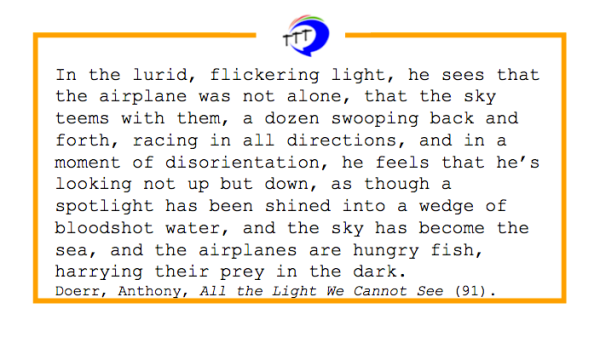
I say, “We are going to study sentences from the 2015 Pulitzer Prize Winner All the Light We Cannot See by Anthony Doerr. Doerr is our writing coach for the week. Let’s see what we can learn about writing more interesting sentences.”

I project the loose sentence, and we talk about where the independent clause lies within it. “How do all the details trailing off of the main idea make the sentence more interesting? What do you notice?”

loose sentence 1

After we’ve discussed the loose sentence, and I feel like students understand what makes it loose and how to identify this type of sentence, we move to the periodic sentence.

I project the following periodic sentence, and we talk about where the independent clause lies within it. “Why put the main idea of the sentence at the end?” I ask.

periodic sentence 1

We discuss why the author might have chosen to craft the sentence this way. “What does putting the main clause of the sentence at the end do for the meaning?” I ask.

Next, we study a few other beautifully crafted sentences I pulled from the novel. (There are so many!) Each time encouraging students to talk with one another to first identify the independent clause and then determine if the sentence is loose or periodic or an interesting combination. I remind them to discuss the meaning of the sentence and why the structure might matter.

We study.

beautiful sentence

and

beautiful sentence 2

And before we move into searching for loose and/or periodic sentences in our own independent reading books, I ask students to practice reading these four sentences aloud to one another.

“Pay attention to the rhythm of the sentence and what the punctuation does to create that rhythm,” I say. I give them a few moments to read sentences to one another at their tables. Low stakes. They know one another well, and there is no pressure. They help each other read, which is exactly what I want in my community of learners.

Follow up: I ask students to pay attention to the sentences in their independent reading books. “Watch for loose or periodic sentences,” I say, “and here’s the challenge:   When you find one, write it out on a notecard, and post it on the quotes board. Let’s see how many of these beautiful sentences we can collect this week.”

And remember to write at least one loose or periodic sentence in your blog post this week. Let’s work on crafting beautiful sentences like Doerr in our own works.

Five things you can do to guarantee your students will read

“Pull up a chair. Take a taste. Come join us. [Books are] so endlessly delicious.”
― Ruth Reichl

I’ve spent a lot of time with the love birds my children gave me for my birthday. They are beautiful. Marianne and Colonel Brandon And scared. I made the mistake of not reading enough about them before I tried my hand at training. Now, I am having to back track just to get them to like me. I knew better. Should have done my research.

It all starts with trust. Every day I put my hand inside the cage, hold it there, and just talk. I talk about the weather — it’s been quite tragic in north TX lately. I talk about the book their names come from — Sense and Sensibility. (My daughter dubbed them Marianne and Colonel Brandon.) I talk about how we will be the best of friends if they will just trust me.

Colonel Brandon bit my finger and held on so hard I stamped my feet for five full seconds hoping he would let go.

I’ve even tried speaking my limited Spanish. (The birds came from a Mexican vendor at an outdoor market.)

“Hola, buenos dias.”

Sitting on the floor near the cage is my school bag. In it is my conferring notebook. It holds a roster with check marks for books read and pages for each student where I record our conversations about books and reading.

This morning I was finally able to get Marianne to step up on to a perch and gently pull her from the cage. She sat on the top, eating happily on a millet twig. Progress.

I flipped through the notebook, remembering conversations I’ve had with students this fall.

“I used to love to read,” Henry told me, but then I didn’t like textbooks so I didn’t read anything again until 8th grade.

“What do you mean textbooks, you mean like an anthology of stories and poems and such?”

“Yes, those,” he said, “I hated those, so I just didn’t read anything in middle school. Then my teacher in 8th grade let us choose the books we wanted, and I read a ton. Hunger Games, Divergent, all those dystopian books. Then in 9th and 10th it was back to textbooks. I stopped reading.”

Henry was a hard sell at first. I’d already set up the routines in my reader’s workshop classroom. He missed the read arounds, the notebook set up, the initial book talks with the titles I know students love every year. And just like with my birds, I started wrong with Henry.

I expected him to step up without question into our reading world. He didn’t.

I had to back track and build some trust. I’d do a book talk and then set the book not far from him. I’d talk to other students about their reading near enough so Henry could hear. I’d ask Henry questions and I’d listen to his answers, so he would know I cared about him as a person more than as a reader.

And Henry started reading.

Henry has read four books since September when he joined my class:  Article 5, Friday Night Lights, Peace Like a River, and Labron James’ Dream Team.  Not bad for a young man who went two years without reading anything in 9th and 10th grade.

For any teacher who says independent reading just doesn’t work for you or your students, I issue this challenge:  Backtrack and try again.

Five things you can do to guarantee your students will read:

  1. Read. The more you read books you think your students will enjoy, the more you will be able to talk about books your students will enjoy. Don’t have a clue about YA? Read anything by Matthew Quick, A.S. King, Jandy Nelson, or John Green (my personal favorites). You’ll have a good start.
  2. Share book talks daily. Talk about books you know students love. If you don’t know titles, ask your librarian for help, read book lists like this one, read lists we’ve shared in previous posts.
  3. Show book trailers. I used to post book trailers on this blog. You’ll find many post with trailers, interviews, and other ideas here.
  4. Get students talking. The more students talk to one another about their reading the better your chances of getting all students to read. One favorite activity in my classroom is speed dating with a book.
  5. Give students time. I heard it first from Penny Kittle:  “If they aren’t reading with you, they are not reading without you.” We must give students time to read during class. Too many teachers and administrators think silent reading is not a good use of instruction time. FALSE. The only way to become a reader — or to become a better reader — is to read. If we want students to develop the habits of life-long readers, we must help them develop the habits in class where we can help them 1) stay focused, 2) learn what readers do when they get stuck, 3) practice choosing books for learning and for pleasure, 4) make plans for future reading.


What tips can you share for anyone who’s struggling with independent reading? Please leave your suggestions in the comments. Thanks!


4 Questions We Answer about Exams #3TTWorkshop

We read this tweet, and first of all, let me just say how honored we are to be included with the likes of Screen Shot 2015-12-22 at 10.44.35 AMPenny Kittle and Kelly Gallagher. The link took us to this post:  Reading (R)evolution post where we read about three high school English teachers much like us who are committed to independent reading and working hard to do right by their students. They asked about semester exams, and since Shana and I recently had a conversation that answered many of their questions, we jumped on the opportunity to share that discussion. We think our friends at Mamaroneck High School will find it helpful– maybe you will, too.

#3TTWorkshop Meme

Do you have topic ideas you would like us to discuss? Please leave your requests here.


What are your thoughts on mid-terms/finals and what should be on them?

Shana:  By their very nature, a lengthy exam of any sort measures a student’s fluency with reading and writing, and that’s one of the reasons I like them.  I’ve been thinking a lot this year about sustaining length of thought and what that looks like–not just thinking about one subject for a long period of time, but continuing to read and write and experiment with that subject for a long period of time.  Thus, I’ve tried to create routines that foster fluency, and a lengthy exam is one way to measure whether or not I’ve been successful with that goal.

As for the exam itself, I believe the format matters most.  If we never do worksheets with multiple-choice answers during class time, why start now?  I try to make my exam mirror our daily routines in class–there is a section for independent reading, for sustained writing, for critical reflection, and for goal setting.

Amy:  Like you, I like the idea of measuring fluency with a lengthy exam — and while I do not think one exam on any one day can give an accurate measure of a student’s knowledge, I do think that sometimes it can give us a clear picture of a student’s growth. The exam itself is only one part though. Really, it all comes down to our alignment. How tightly do we align our standards and the skills we need students to master to our lessons and to our assessments, both formative and summative, within our unit cycle? Our semester and final exams should be another extension of that alignment. Too often, it is not.


What does a 2-hour exam look like?

Shana:  My written exams all start with a message from me to my students–a missive that this is not an exam one can or should study for, but rather one where students have the opportunity to demonstrate growth, effort, risk-taking, and clear thinking.

From there, I separate the exam into options by subject, and for each subject, I give students a choice of three tasks to complete.  For example, subject one is independent reading, and option one is creating a video booktalk, option two is creating a themed top ten list, and option three is creating a book trailer.

Amy:  When I first moved to a workshop pedagogy, the thing I had to learn is the idea of skills-based instruction and helping students form habits of mind that relate directly to improving as readers and writers. I was no longer teaching a book. Thinking about the skills helped me choose mentor texts and design mini-lessons that would move my readers and writers. Since my instruction changed, I knew my exams had to change as well. And my exams never look the same from year to year.

In my previous district, and especially for grades 9th and 10th, which take the Texas state assessment, half of the semester exam was a common assessment created by the district. It mirrored the state assessment and could be used as a diagnostic tool to measure student growth as they prepared for the end-of-course exam. The other half of the assessment we created in grade-level teams. The second half was difficult because I was the only workshop teacher devoting time to independent reading and writing on my campus. I was able to convince my team to assess skills rather books, but even then, it was difficult to craft an assessment that reflected the practices in my classroom instruction when I was the only teacher with those practices.

A two-hour exam needs to give students the opportunity to show what they have learned about reading and writing, and I absolutely agree:   it needs to mirror the practices we do in our daily instruction, but I also think it needs to give students the opportunity to show how their mastery of those practices help them tackle the kinds of critical reading and writing they must do in their lives beyond my classroom. For example, my students read independently and for sustained periods of time throughout the semester because I want them to learn to appreciate both the efferent and aesthetic value of books –we discuss this a lot as I conduct book talks, and they discuss books with each other. We read to enjoy but we also read to learn. My students write arguments on their blogs weekly, so one option for at least part of their semester exam is to write an argument about their reading. They marry what they’ve gleaned from their independent reading with the skills they’ve learned about writing. (I often give this portion of the exam in advance since it takes time for me to read and assess, but I’ve also given it as a timed writing on exam days. Students know the specifics of what I am looking for in their writing — this ties directly to the AP writing rubric I use to assess their blog posts — so I am able to score these holistically. And quickly.)


What should major assessments like an exam measure?

Shana:  What makes a good reader or writer is not necessarily comprehensively covered in any set of curricular standards that I know about.  Instead of feeling obligated to adhere strictly to the Common Core standards, or our WV Next Generation standards.  Because what we value in our classroom is the process of becoming a strong reader and writer, my exam highlights process as well as product.

In addition, some things I really value, like students’ ability to talk to me and one another about their learning using specific academic vocabulary and evidence-based claims, are not measurable by a written exam.  Thus, I assess those things at other times, like during conferences, rather than during exam week.  I don’t feel obligated to try to assess “everything” on one exam–it’s simply impossible to do so.

Amy:  Ideally, an exam should allow students the opportunity to show they have learned the material, right? If our exams are cumulative, and test the acquisition of skills, students should be able to earn credit by showing mastery — or at least growth — as indicated by their exam scores. This goes back to what I said before about alignment. It also represents a big problem in what I see with “grades.” Too often students receive scores on tasks that have more to do with their responsibility (or lack thereof) than on what they have actually learned. Take this scenario:  say a student does not complete x, y, and z assignments for whatever reason. By nature of many grading policies, she receives zeroes for not doing the work instead of not being capable of doing the work. A major assessment should be an assessment that evaluates a student’s ability as it relates to what we have taught, and if she didn’t do x, y, and z, the final assessment should be a last stop measure to show she’s learned what we needed her to learn that semester.

Shana:  I completely agree with the gap between grades and ability.  The whole grade-feedback-evaluation-assessment-ability conundrum has been frustrating us for a while, I know.  Some of my students did not finish the exam by the end of the week, but I won’t hold that against them–they will take it home over break and return it to me in the New Year.  I’m not sure, really, if I ever feel confident “grading” an exam item by item.  Instead, I consider the urging I give at the beginning of my exam–deep thought, strong effort, and time spent–and give a letter grade based on how well it is apparent that the student did those things well.


What would your ideal semester-ending assignment look like?

Shana:  I usually end the first semester with a series of activities like I described above, but I always end the second semester with a multigenre project of some sort.

For my first semester exam, Amy and I brainstormed together how to preserve student choice, our values of having students create products rather than just complete tasks, and how to allow for the showcasing of learned skills rather than a “gotcha” mentality with new material.  In our notebooks, we jotted down ideas and I wrote this up.  I made it available to students the Monday before finals week, so they’d have about a week and a half to work on it.  I think what’s important is that the last activity is reflection and goal-setting–looking back on 2015, and looking forward to 2016.

For this year’s end-of-course assignment, I’m excited to do a spin on Tom Romano’s literature relationship paper, in which students create a multigenre series of writings focusing on their relationship with and reading of a text.  I hope to have students re-read a favorite independent reading novel and write in many genres that include reflection, craft analysis, narrative, poetry, and more.  With that end goal in mind, I have designed more written product assignments that deal with narrative and analysis than I usually do.

Amy: My midterm exam is much different than my end-of-course exam. I loved how we talked through what our exams would look like when we were together at NCTE. As you know, what you wrote up will work well for me. Thanks for sharing that and saving me the time of having to write my own. I did a few revisions, and mine looks like yours, except with one less choice of options — and it is only for 50% of the test. Students will work on it in class the week or so leading up to the end of the semester. We have a week and a half after winter break.

The other 50% will be practice for the critical reading part of the AP exam. The 90 minute block will be enough time to take a full-length practice test, important for stamina, and then talk through a few of the passages. Of course, the second portion of the exam will be more diagnostic for me than anything — although we have analyzed texts in much the same way the exam asks students to do.  I haven’t decided how, or if, I’ll take a grade on it yet — my students are all over the place in terms of their critical reading abilities, so no doubt there will be a curve somewhere. I thought about taking a grade on the level of thinking I see in their annotations, but that isn’t fair. Not everyone needs to annotate the same way to truly think about a text. What I may do is have students write a one page reflection about that critical reading test after they take it, maybe set some goals for how they want to continue to grow as a reader during the spring semester. If they are honest with themselves, this reflection would be more specific about tackling complex texts than the reflection they write about their independent reading for the first portion of the exam. (And now I am just thinking as I write.)

Like yours, my students do a complex writing piece at the end of the year, which combines several different genres of writing. For the past few years, we’ve studied multi-modal feature articles and then written our own. On exam day we present our favorite parts to the class. Here’s a few examples of students’ published work from last year. Anthony wrote “Current and Future Sources of Energy,” Maribel wrote “Beauty Unlimited and Undefined,” Bryan wrote his immigration story. These types of assessments are my favorite.

Students take ownership of their writing and take pride in their finished products. They also evaluate their writing process and give themselves their own grade. After all, they do all the work:  thinking, planning, researching, drafting, revising. They are the ones who know if they’ve accomplished what they set out to do.

Please join the conversation:  What are your thoughts on exams in a workshop classroom?

The Best Gift You Can Give Your Students

A few weeks ago, when I sat down to confer with Asia, she told me that she bought me a Christmas gift. She was really excited about it. “I’ve never bought a teacher a gift before!”

She’s a senior in high school.

img_0731

My scarf from Asia

I asked her why she’d never bought a teacher a gift before. She thought for a moment. “No teacher ever gave me respect automatically, like I deserved it.”

It breaks my heart that in twelve years of public education, this girl never felt that a teacher respected and cared about her.

“How did you know I respected you?” I asked her. A few other kids sitting with us answered this question too.

“You talk to us every day, like we’re adults, about our learning, and you really care what we say.”

We confer.

“You do all our assignments with us so we know they’re not busywork.” This from Shailyn.

I write beside them.

“You always expect us to know more than we do, and you don’t take BS excuses about why our work isn’t done,” Jocelyn said.

I have high expectations.

“You know exactly what your students are capable of,” Jocelyn further explained.

I know them, well, through frequent talk about their choice reading and writing.

“You just seem to really like me, and see me,” Asia finished.

A few days later, she eagerly presented her gift to me, and waited eagerly for me to open it.  It’s a lovely seasonal scarf much like the ones I always wear–a very thoughtful gift that, when I thought about her reason behind giving it and combined that with my pregnancy hormones, made me completely bawl.  I love it, because Asia gave me much more than just this scarf–she gave me proof that my teaching is important, if only just to her.


Readers and writers workshop is about more than just nurturing literacy skills–it’s about nurturing people, their thinking and creativity and confidence.  Conferring isn’t always about teaching into a standard–it’s often about just talking with another person about what’s in your mind, helping to flesh it out through talk before writing.  Writing beside your students isn’t just valuable because it’s modeling–it’s essential to creating a true community of learners committed to growing as readers and writers and thinkers.

This holiday season, give your students the best gift possible–respect, love, value, and the equal footing that comes with shared learning and the collaborative creation of knowledge.

Mini-Lesson Monday: Mining Memories to Begin a Writing Unit

Narrative is, to me, the most powerful genre of writing one can do.  Whether the narrative rests in a fictional or true story, or acts as an anecdote within an argumentative text, or helps to illustrate a concept in an informative one, story is central to great writing.  Students know and live this, and are natural storytellers once they get going…but sometimes knowing what story to tell is easier said than done.

I find that stories students have rehearsed well through talk or reflection are the best stories to get them to write.  As a result, we mine our memories to harness our most powerful topics for writing all narratives.

Objectives — Using the language of the Depth of Knowledge Levels:  Identify memories that are rich with complexity to write from. Or, from the Common Core:  Write narratives to develop real or imagined experiences or events using effective technique, well-chosen details, and well-structured event sequences.

Lesson — My students in West Virginia are well familiar with the concept of a mine.  For them, a mine is “an abundant source of something,” while to mine means “delve into (an abundant source) to extract something of value, especially information or skill.”  Using this metaphor for brainstorming topics is comforting for them, since they know we’re digging for existing ideas and knowledge–not crafting something new.

img_0728

My scars maps

One of my favorite activities for mining memories came from Tom Romano, which he simply calls “Scars.”

I begin by drawing a stick figure on the board and then turning to my students.  I point to my knee, then draw a small dot on my stick-figure knee.  “When I was about eight,” I begin, “I really thought I could jump down a whole flight of stairs and land on my feet.”  I get them laughing as I tell them the story of how I got that particular scar.  Then I draw a little dot on my left stick-figure eye, and tell them the story of how I got chicken pox so badly that it went into my eyeballs.  They cringe in horror, so then I draw a little dot on my left wrist and tell them about how my new kitten just really won’t stop using my arm as a scratching post.

We laugh together.

“All scars have a great story behind them.  Draw a stick figure in your notebook and label your own scars.”

They do this, unable to keep silent as they show their neighbor their stick figures and begin to tell their stories in brief.

After a few minutes, I draw their attention back to the board and draw a large heart.

“All scars have stories, but not all scars are visible.  Sometimes we carry scars on our hearts, where no others can see.”  The classroom always gets eerily quiet at this point.  I write the name “MeMe” in my heart on the board, and tell about my awesome Tennesseean grandmother and her fabulous Southern drawl and feisty persona, and how she passed away on my very first day of teaching.

“It was basically impossible to get through my very first day of this career that I so love,” I share.

Then, I write the word “miscarriage” in my heart, and tell about that worldview-shifting event in my life.

“Go ahead and draw your own hearts and label your own heart scars.  We all have them.  Don’t be scared.  This is just for your notebook, for now.  It will stay private.”

img_0729

My scars story

The classroom falls silent and I open my notebook under the document camera while they scrawl, not telling any stories to neighbors this time.

“Beneath your stick figure and your heart, let’s take eight minutes to write about any one of these scars.  Tell the story of how it came to be.  It could be a funny story, or a sad one, or a scary one.  But tell the truth and tell it well.”

We write together, revisiting a routine that has become commonplace in our classroom–I model not just the act of writing, but the act of vulnerability, and my students dive headfirst into the tough stuff as a result.  This is just one practice that builds a strong community of readers and writers.

Follow-Up — After we write, we revise briefly, then elect whether or not to share at our tables only.

The next class, we mine another set of memories by creating a map of our childhood homes, then telling the story of one of the places on the map–a Penny Kittle gem.

Another day, we go through our playlists, choose a song that is the soundtrack of our life, then tell the story that made it so.

We continue with five seed prompts in a row, five class periods in a row.  Then we select one of those stories to refine and workshop into a narrative.  I teach a mini-lesson each day about a narrative skill, so that by the time we’ve really committed to a topic, students are well-versed in pacing, dialogue, descriptive detail, and the like.  We confer and workshop and revise.

I’ll employ this routine when we return from break, focusing on reflection and rejuvenation and resolutions in the new year, working to craft multimodal “This I Believe” essays as we read Siddhartha together.

How do you get your students to come up with meaningful topics for writing?

#FridayReads: 8 Stocking Stuffers That Will Change Your Classroom

While I love the beautiful handmade gifts of my students the most, there are a couple untraditional stocking stuffers that I’m putting on my Christmas wish list this year.  These are the tried and true tools that somehow keep my classroom just a bit more sane during those hectic moments (like the days leading up to holiday break).  So in the last eight days before Christmas, here are eight stocking stuffers for a colleague, teaching friend, or even yourself!

  1. Headphones: This was the greatest gift my cooperating teacher gave me. His secret was to always keep extra sets of ear buds handy.  To this day, I stock up on cheap headphones from Marshalls (and alcohol wipes to clean them) at the beginning of the school year. Oftentimes it helps some of my antsier students tune out their surroundings and dial into their writing.
  1. Crazy Aaron’s Thinking Putty: Amy bought this for me this past candy-cane-9summer, and it is a miracle worker.  I initially brought it in for a student who has severe ADHD.  He was oftentimes overstimulated by his peers.  Playing with the thinking putty changed his behavior drastically.  What I love most is the thicker viscosity of the putty keeps students more engaged…and it comes in holiday colors, including white christmas, gelt, and candy cane.
  1. Conferring Chair: I wrote about my conferring chair here, but I cannot stress enough what an impact having this chair has had on accessing my students within the classroom. Last year I spent time kneeling next to students or awkwardly standing over them as they sat at their desks. Purchasing a conferring chair that was lightweight, foldable, and small allowed me to discreetly enter conversations, conference with students, and set up mini workshop areas throughout the classroom.
  1. Awesome Citations: I love giving my students small pick-me-ups, 12098_Awesome_1which include these quirky “awesome citations” I found at a novelty shop. I enjoy filling them out, leaving a small note at the bottom, and either tucking them into writer’s notebooks or dropping them off at unexpected times.
  1. Writing Prompt Books: As the advisor of Writer’s Club, I can’t get enough of writing prompt books like The Writer’s Block: 786 Ideas to Jump-Start Your Imagination by Jason Rekulak, 642 Things to Write About by the San Francisco Writers’ Grotto, and 100 Quickwrites by Linda Rief. Not only do I pull them out during club meetings, but I use them as inspiration for class quick-writes, or to begin brainstorming for independent writing pieces.
  1. Magnets: Magnets might not be on the top of your wish list, but they are exceptionally convenient when it comes to students’ presentations of writing, artwork, or posters. Odd, yes, but I love when my students can present hands-free without the awkwardness of holding large posters or pictures for other group members.
  1. Coloring Meditation Books: I love keeping photocopied pages from coloring meditation books on hand for spare moments. Not only are they calming for many students, particularly those with anxiety, but 51N8TdfrZ6L._SX331_BO1,204,203,200_they are also great for extra time during club meetings and advisory or homeroom periods…or, as one of my students said, “My mom loves doing those when she drinks wine.” That is always an option for tired teachers too.
  1. My True Love Gave to Me: High school English teachers (and their students) will love this anthology of Christmas stories from top YA authors including some of my favorites, Rainbow Rowell, David Levithan, and Matt De La Pena!


What is on your teaching wish list or gift list this season?