Think Big and Grow Friends

My colleagues here at TTT and I met in a Google Hangout for a long long time last week. I love being surrounded by wise and witty people who make me feel more wise and witty.

When I was a teen my dad had me read How to Win Friends and Influence People by Dale Carnegie and Think and Grow Rich by Napoleon Hill. I don’t remember Dad ever reading for pleasure*, but I know he got pleasure from reading self-help books, and he read to learn. Then he shared what he learned with anyone who would listen.


I was a willing listener, always seeking to please my father.

I learned from Carnegie powerful truths that improved my interactions with strangers, friends, peers, and colleagues. And when I began teaching, I put into action these truths as I interacted with students. I believe trusting relationships and conferring moments rest heavily on Carnegie’s principles.

I learned from Hill seemingly simple steps that gave me vision, taught me to set goals —Screen Shot 2016-06-28 at 1.54.04 PMand to surround myself with those who would help me see them through. I’ve followed his advice for several decades now — each time developing skills, gaining trust and gaining knowledge, more readily and passionately. And while I am not rich in terms of monetary wealth, I am rich in all the ways that matter.

My TTT colleagues and the readers of this blog add to that wealth.

Thank you for subscribing, reading, sharing, commenting. Thank you for giving me a focus, a place to sharpen my skills as a teacher and a writer, a place to think big and make friends.

For the next several weeks, Shana, Lisa, Jackie, and I will take a break from writing posts. Like you, we are tired. We’ll use July to refine some plans and rev up for fall and a brand new school year. Maybe one of us will get the urge to write and post, but in the meantime, we’ll schedule some repeats of our favorite topics so you will keep getting content about how to make readers and writers workshop even more effective in your classroom.

We’ve got some plans for TTT that we know you’ll like. Please like the Three Teachers Talk page on Facebook if you haven’t already, and follow us on Twitter @3TeachersTalk.

And if you want to get in on some practical tips we’ll be sending to our readers’ inboxes starting when school comes back around, be sure you follow this blog by clicking on the “follow” link and providing us with your email address.

If you have questions that just cannot wait, feel free to email me at amyprasmussen@yahoo.com.

Join us as we continue the conversation in August. Until then, happy summer!

Try It Tuesday: Cite the Research that Drives Your Practice

In a session at the NTCTELA Conference a couple of weeks ago, Cris Tovani began her session asking us to reflect on this statement:  I can site the research that supports the beliefs that drive my practice. This got me thinking — not just about Cris’ inspiring session but about how we make decisions regarding the best practices we bring into our classrooms.

Do we have research that supports the moves we make as we teach our students to become better readers and writers?

It’s an important question. And for those of us who instruct via  readers and writers workshop, the research can be a powerful motivator to keep doing what we know works for our kids.

My favorite go-to research? The article by Richard Allington and Rachael Gabriel: Every Child, Every Day. They outline six easy-to-implement essentials to effective reading instruction — and learning to teach reading is not something I got much of in my education classes to become a high school English teacher. But many high school students still need help learning how to read, especially my ELL population. Every English teacher can implement these six essentials.

If you’ve never read Every Child, Every Day, I challenge you to read it. If you haven’t read it in awhile, I challenge you to read it again. Then, give yourself a quiz:  Does this research support the moves you make as you teach your students to become better readers and writers? If not, what will you do about it?

The resources at the end of the article can lead us down a rabbit hole but not take us on a goose chase. These researchers provide us with important information:  We can read about effective practices and then bring those practices into our classrooms. We can share these articles with colleagues and administrators with the hope of garnering more support for instructional practices that our best for our students — and proven to work.

If you’ve ever wondered why student reading engagement and success begin to wane as kids begin to enter middle school, read You Can’t Learn Much from Books You Can’t Read, another text by Allington.

If you teach in a low SES school like I do, you may find “The Early Catastrophe: the 30 Million Word Gap by Age 3” by Betty Hart and Todd R. Risley interesting. It’s a popular read. It might spark some thinking as to why so many of our students read far below grade level — and give you a poke in the gut to do more about child poverty.

Then, because the validity of that article sparked lots of commentary by other educators who wrote other research articles, spend some time reading “Debunking the Word Gap.” (Aha and Aha. And lots of validation for my practice. Choice and voice matter!)

If you don’t follow the blog of Paul Thomas, The Becoming Radical, you may want to. Thomas gets me thinking with everything he writes. I especially appreciate his post of yesterday: “To High School English Teachers (And All Teachers).” (Where I found the Debunking article and so much more and had to update this original post.)

Remember that rabbit hole?  I read every link Thomas shares and added to my research storehouse, tweeting links to colleagues, and I found a text by Ralph Ellison I’ll use with my AP Lang class in the fall. Bonus.

Of course, if you really want to explore and extrapolate, look up the articles Penny Kittle cites in Book Love or Donalyn Miller cites in The Book Whisperer or any other of your favorite teacher-leaders cite in their books.

It’s summer. Time to enjoy a little (not so light) reading. I promise, the research is worth it!

Please leave your suggestions for other insightful research articles in the comments.

The Importance of Summer Reading by Sarah Krajewkski

guest post iconIt’s that time of year again when the beauty of our classrooms begin to disappear. Posters and signs that inspired students vanish from walls and doors. Classroom supplies get dumped into storage bins and closets. Those smiling cherubs are no longer waiting for us to greet them. It’s summer.

Summertime doesn’t mean that reading has to stop, but too often it does for our students. For many students in low-income areas, the moment they leave school on the last day is the last time a book enters their hands until the following school year. Reading is not a priority over the summer for these students, and it should be. Study after study proves what Richard Allington has been saying for decades: the achievement gap between high and low income children continues to widen. Allington states that as they enter public school, children go “from less than a year’s difference upon entering Kindergarten to almost 3 years’ difference by the end of 6th grade” (Allington and McGill-Franzen 4-5). Summer reading loss is a huge part of the problem, for students who do not pick up a single book in those 10 weeks of summer are 10 weeks further behind in the fall. My district has a high poverty rate, so this concerns me. Each school year, I aim to do more to promote the importance of independent reading in my district. I also do all I can to show students that reading can provide them with as much entertainment as their iPhones can. Now, I am revising my goal to include summer vacation.

Picture1

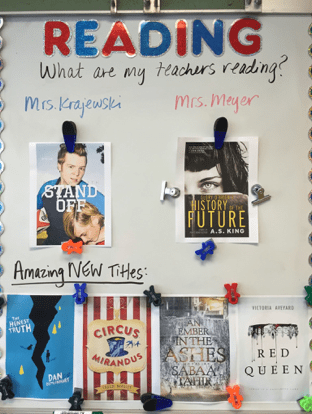
One of the front whiteboards in my classroom

Picture2

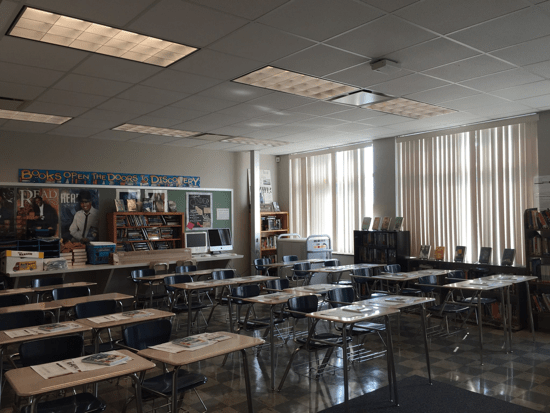
Five of the 12 bookshelves in my classroom library


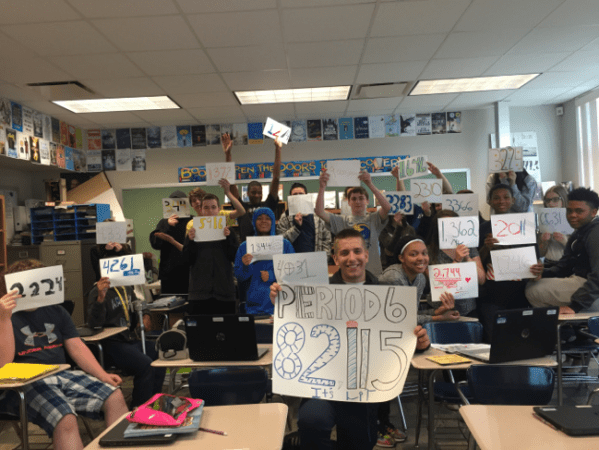
It all starts with falling in love with reading during the school year. If students aren’t reading consistently from September to June, they won’t read on their own over the summer. So, starting that very first week, I gave all of my students time to read in class EVERY DAY. It became a habit. After those 15 minutes, I always “book talked” an intriguing new title I read myself or heard about from a trusted source. I really had to know my books, as well as the various genres my students enjoyed. I made sure my classroom library was visible. I surrounded my students in a sea of books. “Book passes” got students into new titles they didn’t know about. (Think speed dating with books.) We used Goodreads to reflect and share our reading experiences with peers, which created a reading community outside of our classroom. We Skyped with some of their favorite authors. I showed them all the important reading statistics I could find. Most importantly, I never gave up on those students that said they “just hated reading” or “couldn’t find a good book.” By the end of the year, my 94 9th graders read over 366,000 pages, and all but three read at least 1,000 pages. ALL of them said they found books that they enjoyed. They are readers, and I want them to stay readers, so I began thinking about encouraging summer reading.

Picture3

My 6th period English 9 class shares how proud they are of all that they read


Throughout the last few weeks of school, I began the prep work. I started promoting my all-important “summer library hours” during the daily announcements so students knew when their trusted reading sanctuary would be available to them. Almost every Tuesday and Wednesday they will be able to check out a few books, preview new titles, or even just stay and read quietly for a few hours. (Soon weekly emails will be sent out to parents with reminders about these summer hours, as well as “reading tips” to get their children reading, and a link to my blog that contains the Class of 2019’s favorite books of the year.) Next, I began book talking titles that would be coming out over the summer to lure my students into my classroom library. At the beginning of June, I encouraged my students to help me promote the Little Free Libraries our district would be getting at the end of August. These libraries will serve as an additional reading reminder, for students will be coming into my classroom to paint and stock them. I also told them I will be attempting Donalyn Miller’s #bookaday challenge. Many students were shocked by this, but I told them some of the books would be picture books I’d be reading with my own young children. I mentioned that I am still aiming to read at least 30 YA titles, and some students are challenging themselves to read even more than that!

As of today, many districts are already a few weeks into their summer vacation, but in my Western New York district, final exams are just wrapping up. I only have a few days left to take care of some paperwork and get my classroom in order. I hope that, starting next week, some familiar faces pop in to see what new titles I have awaiting them. I can only wait and hope that reading has become its own incentive.

How do you encourage summer reading?  Please share in the comments!

Sarah Krajewski is a 9th grade English teacher at Cleveland Hill High School in Cheektowaga, New York.  She is just finishing her 14th year of teaching, and is always looking for new, creative ways to help her students enjoy learning, reading, and writing. She is anxiously awaiting another trip to the NCTE Annual Convention to expand her literacy knowledge. At school, she is known for her dedication to her students and for being a devoted reader who “knows her books.” At home, she is a proud wife and mother to three avid readers.  You can follow Sarah on Twitter @shkrajewski and her blog can be viewed at http://skrajewski.wordpress.com/.

Source:
Allington, Richard L., and Anne McGill-Franzen. Summer Reading: Closing the Rich/Poor Reading
Achievement Gap. New York, NY: Teachers College, 2013. 4-5. Print.

Try It Tuesday: Red Thread Notebooks

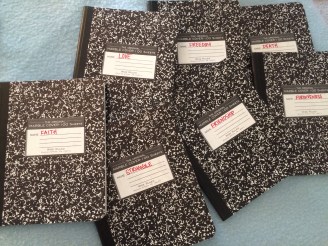
img_3173-1So much of a workshop philosophy centers on the assumption that reading and writing are forever intertwined.  Vocabulary, grammar, poetry–they’re all pieces of the puzzle that make up literacy and a passion for words, too.  It was with this in mind that I created Red Thread Notebooks.

The idea came from two places–one was Penny Kittle’s “big idea books” (found on page 8-9 of those handouts), which are reading response notebooks  centered around themes in literature.  The other was Tom Romano‘s “red thread” assignment, in which teachers had to write about which parts of our teaching philosophy would run through all of our teaching, like a red thread.

img_3177

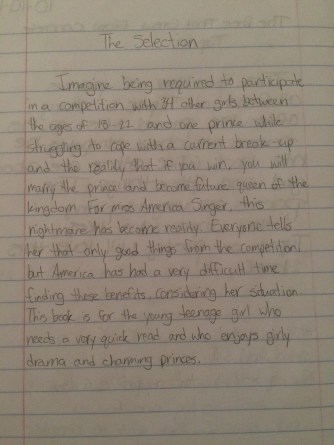
This student booktalks The Selection in the “STRUGGLE” notebook.

So, when composition notebooks are just a nickel in the summer, I buy 60 of them each year.  My students and I begin the year by brainstorming themes and topics that are important to us–love, cell phones, faith, music, family, video games, death, high school, forgiveness, four wheelers.  We label our notebooks and use them all year long.

There are a variety of ways I invite students to write in these notebooks:

  • Vocabulary practice: list related words, synonyms, word associations, etc. similar to the notebook title
  • Skill practice: write dialogue, revise sentence structure, practice figurative language, craft descriptive writing, about the notebook’s title
  • Book talks: write about how the book you’re currently reading might add to a conversation about the notebook’s title
  • Grammar instruction: revise a sentence, imitate a paragraph, tinker with style, while writing about the notebook title
  • Free writing: write your thoughts and musings on the notebook title
  • Poetry: find an existing poem, craft your own poem, or create a found poem about the notebook’s title
img_3179

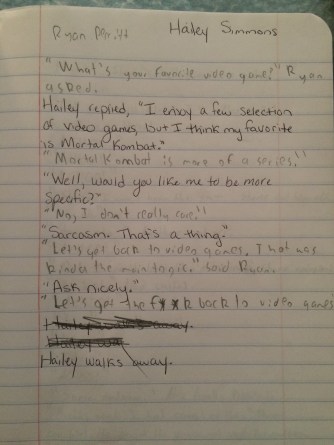
Hailey and Ryan practice dialogue in the “VIDEO GAMES” notebook after I teach a mini-lesson on its conventions.

Because these are shared notebooks, I ask students to refrain from using profanity in them or writing about any of their peers.  I don’t require names, but many students like to sign their writing.  Those are the only rules.

Once the notebooks have begun to fill up, students can refer to them to find book recommendations, writing topic ideas, or vocabulary words to add to their personal dictionaries.  They can also look for examples of skills practice, craft studies, or grammar lessons that we’ve done for additional guidance.  One year students even selected multigenre topics based on our red thread notebooks.

These notebooks are a lovely way to make permanent a yearlong conversation about literacy.  The topics change every year–Michael Jackson had his own notebook my first year of teaching, and this year Lebron James had one–but the opportunities to write, reflect, and make connections remain the same.

Do you think you’ll try Red Thread Notebooks next year?  Do you do something similar?  Please share in the comments!

Mini-lesson Monday: Poetic Literary Movements

This year was a balancing act. Bridging the old and the new. The curriculum I’m used to and the possibilities of workshop. Along with that came plenty of challenges, but also plenty of opportunities to improve on what I know by learning more about what my students can create with choice.

This lesson is from my American Literature class (sophomores) and occurred this past April when we were studying Realism. Students had conducted some research on what thematic and stylistic elements characterized the Realist movement in America and I turned to poetry to make the 19th Century ideas come to life.

Objective/s: Using the language of the Depth of Knowledge Levels, students will analyze their Realism research and examples of Realist poetry in order to synthesize characteristics of the time period with original ideas in the form of Realist inspired poetry.

Lesson: Students came to class with notes they took on American Realism. I had asked them to research the major authors of the time period, famous works, common themes and stylistic elements of writing from that time, and the historical events that led to a shift away from Romanticism.

We started by taking a look at Stephen Crane’s “I Saw a Man Pursuing the Horizon.”

I saw a man

I modeled for students my own analysis, suggesting the elements of Realism I saw in the poem. The clash of Romantic thought and Realist. The futility Realists saw in trying to escape reality. The simple construction of sentences and relatively plain diction.

We then talked about connections to these realist ideas today. “Many of us are Romantics,” I said, “I think I’m one. But I bet many of you are Realists too. What does that look like in your life?”

I asked students to jot down some ideas in their writer’s notebooks of everyday events that speak to these same themes…what some would call the ordinary struggles of life. As I walked around and took a look at the ideas my students were generating, several jumped out at me:

  • Watching someone get bullied and not knowing how to help
  • Dealing with the hand you’re dealt
  • Unavoidable accidents
  • The ‘you’ no one would suspect

Holy poetry material! I shared aloud several examples of ideas I saw from their notebooks and then shifted to have them look at one more example to solidify the simplicity (and power) of realist diction and images.

“Now, I am of the opinion that some of the best poetry is exceedingly simple. The raw, honest truth of life, just like some of the ideas I saw when I walked around and peeked into your notebooks. Let’s take a look at one more example of realist poetry – a modern example.” I showed students  “The End,” a poem (no author found) I discovered when searching for examples of Realism:


The End

It didn’t come with a bang

or a big explosion.

It didn’t come with an inevitable apocalypse

or an armageddon.

It didn’t come with collision

or a war.

It didn’t end with a dying sun

or a waking moon.

It didn’t end in breached dimensions

or shattered realities.

It didn’t end with entropy.

It came when Existence stopped dreaming

And fell into a deep sleep.


Students read the poem silently a few times and I asked them to write down the lines that they felt were especially impactful, powerful, and/or moving. I then read the poem out loud and we discussed our thoughts on the lines they wrote in their notebooks.

Next up was time to explore. Students took their knowledge of Realism, their explorations of realist topics, and our discussion on the power of simple construction with simple ideas and set to work on their own realist poems in their notebooks.

Follow up: After students had time to work on their poems, I had them share at their tables. Each table elected one student whose poem they thought was particularly pointed and either that student stood to read it or asked someone else at the table to read his/her work. We always talk about taking pride and ownership in our writing to build community. Sometimes this means letting someone’s enthusiasm over the work of his/her peers fuel an energetic reading of the work as well. Kids love to read the work of their peers and I can see in the faces of the authors a pride often unmatched when they read their own work.

A few class periods later, I asked them to find additional poems with Realist characteristics. We used these as mentor texts for small group discussion and to compare with our own work.
Do you sometimes have to bridge the gap between old school and workshop? How do you make the old seem new again? Please share in the comments below.

#FridayReads — Picture Books in AP English

Sometimes speakers make you want to write. Last week when I listened to Lester Laminack was one of those times.

The North TX Council of Teachers of English Language Arts one-day conference was one week ago today. As president I had the honor of calling the meeting to order, and looking out at the audience of almost 600 ELA teachers, grades K-12, I could not help but think how fortunate the children in Texas are to have such dedicated teachers, teachers who want to help kids write, teachers who practice writing themselves.

Listening to Lester’s keynote as he talked about his writing process made my memories swirl, and my fingers get itchy.

I was not the only one.

Screen Shot 2016-06-17 at 3.29.59 PM

I left wondering:  What if more teachers stirred that kind of memory moment in the students we want to move as writers?

Picture books have that power. Elementary teachers know this. They read books aloud to little writers. They talk about meaning around moments their students can relate to.

Sometimes I think we secondary teachers forget the power in stories. We forget that seemingly simple things can spark big thinking. I want to remember.

Here’s a list of 15 of the books I will read with my not-so-little writers in the coming year: Screen Shot 2016-06-17 at 4.45.37 PM

Saturdays and Teacakes by Lester Laminack

All the Places to Love by Patricia MacLachlan

The Other Side by Jacqueline Woodson

The Hundred Penny Box by Sharon Bell Mathis

Is There Really a Human Race? by Jamie Lee Curtis

Harold and the Purple Crayon by Crockett Johnson

The Dot by Peter H. Reynolds

Chrysanthemum by Kevin Henkes

Henry’s Freedom Box by Ellen Levine

The Wretched Stone by Chris Van Allsburg

I Want my Hat Back by Jon Klassen

It’s a Book by Lane Smith

The Dark by Lemony Snicket

The Secret Olivia Told Me by N. Joy

Beautiful Oops by Barney Saltzburg

And I’ll probably use several of these:  wordless picture books

Please share your suggested titles for picture books you use in your secondary classroom.


Finding Solace in our Students

IMG_2666

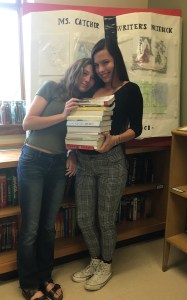
End of the year pics with friends and books.

The shooting in Orlando this weekend has weighed heavily on my mind for the past few days; it has settled into the back of my brain, penetrating my thoughts whenever I get a moment to rest between the hectic last days of school.  While I only know victims through six degrees of separation, I can’t help but see the images of friends, family, and students in the 49 faces of those murdered.

I’m not sure if it is the lockdown drills at school that make these tragedies feel all the more chilling and real, or if it’s the targeting of LGBTQ+ populations when I, oftentimes for the first time, watch young people finding their true identities in my classroom, but this time I feel nauseous and weak and powerless.

To think that this is the world my students are graduating into and growing up in, is frightening.

But as I scrolled through the profiles of the deceased, I found a statement from the father of victim Mercedez Flores.  He wrote, “We must all come together, we must all be at peace, we must all love each other, because this hatred cannot continue for the rest of our lives.”  That is what the workshop classroom allows me to share with my students—a corner of this peace and love.  It opens a door for me to connect with them on a personal level, allowing them to find not only acceptance but also stories, understanding, and success in their books.  Allowing them to open up to new literature and explore themselves as a reader sends the message that I not only value them as learners, but I value them as diverse people with a wide variety of needs, curiosities, and interests.  This avenue may only be minor, but in the wake of all the hatred and fear, I hope my classroom is a respite from the world.  A place where students can learn to at least respect one another’s differences without judgment or condescension, a place where we can explore the difficult themes and navigate challenging conversations in safety.

IMG_2693Everyday gives me a little more hope that this next generation has begun thinking about the innumerable struggles they will have to face.  As one of my students wrote about the universality of To Kill A Mockingbird, “For an innocent man to be found guilty is a miscarriage of justice, but for an innocent man to be found guilty for being black is a result of bigotry and prejudice, and shouldn’t happen…Sadly, as seen with Trayvon Martin, Mike Brown, and others, racism still does exist in this country. To Kill A Mockingbird is a constant reminder of how far we have come and how far left we still have to go when it comes to overcoming racism.”  Charlie’s words remind us that stories show us both the fallibility and overwhelming strength of the human condition.

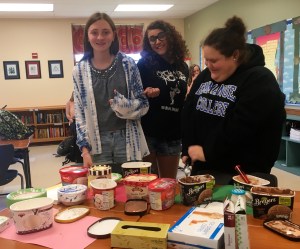
Yesterday morning, as I prepared for my last day of classes (we still have three more days of exams), I reminded myself that teaching allows me to model a life of acceptance and love, of caring and compassion, of concern and advocacy.  It may not be much in the general scheme of things, but it is the most productive way I can handle the tragedies our country continues to face.  Between cramming in grading and pulling together final assessments, I spent invaluable time writing notes to my classes, collecting ice cream toppings for our last day parties and signing the backs of photos of my students with the books they read this year.

The best part is that the love is returned as graduating seniors from years prior show

IMG_2701

Ice cream parties to finish up our yearlong adventure together.

up at my door to hug me good bye and have me sign their yearbooks.  College students visit to update me on their lives, current students voluntarily help me pack up my room, and former students spend their first summer afternoon organizing my bookshelves for future students.  For all the hate that exists in this world, there is far more kindness, far more compassion, and far more love.  I know because my students remind me of this every day.


Try It Tuesday: 11 Weeks to Regroup

In Wisconsin, we talk a lot about the weather. This may be due, in part, to the fact that it’s downright frigid, cold, and/or disturbingly chilly for (conservatively) seven months of the year. Block off October through April for likely snow (and as a special bonus, when I was nine years old, it snowed eight inches on May 10th), September and early May for possible winter jacket wear, and viola! Summer arrives and all residents are forbidden from complaining about heat. Ever.

must-see-imagery-wisconsin-summer-one-day

Thankfully, I find myself at the start of that all too brief period when summer is brand spanking new. In the last three days I’ve picnicked with my family, gone kite flying in the park, attended a Sam Beam concert, returned to running after a few weeks break, randomly decided to try yoga last night, cleaned out two closets, and finally had time to finish reading The Handmaid’s Tale (I am in love by the way. Mandatory reading for all progressively minded ladies and the men that love them, I think.  I’d never stand for being Ofnick, though I love my husband so, and that’s really the point of the dystopian adventure, yes? A quick bucket of ice water to the face in avoidance of complacency.)

Then, two nights ago, I picked up Hillary Jordan’s Mudbound and I cannot put it down. And you know what? I don’t have to. It’s summer.

But I digress. Over the past few weeks, the Three Teachers have been reflecting on the school year that was. Its trials, tribulations, successes, explorations, and even goodbyes (That’s four links to awesome posts, by the way. Enjoy!) And as we approached the end of the school year, and worked to reflect on so many experiences and experiments of thought, I noticed an underlying current of…weariness. Or rather, some well veiled (crippling) stress and (abject) exhaustion.

Now, don’t get me wrong. We love our work. We love our students, we love to read, we love to write, and we love to challenge ourselves and our craft. We love to blog. However, the reality is, it’s hard work and the four of us are tired (I love that Three Teachers Talk is really four teachers. Surprise! More bang for your workshop buck.) Between the four of us we have a wedding to plan, a new baby to attend to, a toddler to wrangle, grandbabies to dote after, and full time employment as teachers, readers, and writers. Any teacher on the planet will tell you – we love what we do, but sweet mother of mercy, can an educator get a nap up in here?

So here is my summer edition of Try it Tuesday:

I want you to rest.

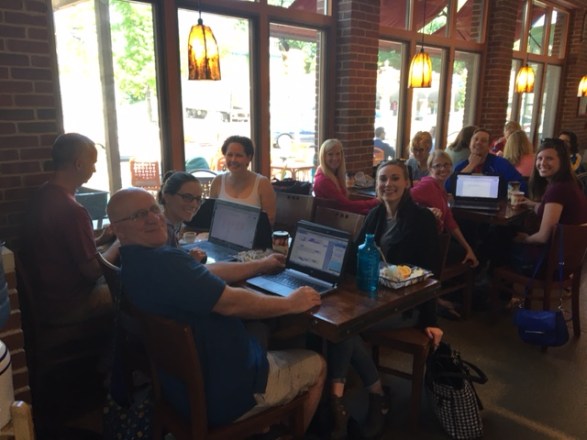
I know it’s contrary to our nature. I know that just four paragraphs ago I detailed all that I’ve crammed into the last three days (It’s like my soul sensed a vacuum created by the absence of school and sucked up anything and everything to fill the sudden void. Panic! Panic!) I know many of us have conventions to prepare for, curriculum to refine, classrooms to organize, final exams to score, and some have relatively beleaguered personal lives that need attention (My daughter asked me this morning if we were going to sit down to eat our toast today or take it in the car. Sigh. This lesson in slowing down brought to you by a three year old.)  I also know we are dedicated to a fault. Please see the following…my beautiful English colleagues working on the day after school let out.
IMG_1516

Exhibit A: This was day one of summer. Our entire team got together to finish up some district level curriculum work. They are all so sweet to look so pleased to be there.

The summer will be rich with opportunities, no doubt. Some of us will be blessed with opportunities to travel, attend workshops, dig into pedagogical texts, reflect on our craft, and excitedly (because teachers are downright adorkable) plan for next year.

But it can wait. A week? Two? I’m not sure. I’m betting it differs for everyone. But there is a reason we all get vacation at one time or another. Be it a stretch of summer or smaller breaks throughout the year, we all need to rest. In order to be our best selves when we return to the classroom, we all need time to recharge. I have eleven weeks, five of which already have one or more meetings in them. So right now…I’m going to take a few deep breaths and stare. At everything. Or nothing. Could be both. 

Don’t let anyone make you feel like you don’t deserve this break. Without it, I fear, many of us wouldn’t make it. Not for lack of trying, of course, but teacher burn out is horribly high with time away. And we all know the percentage of the coming weeks that we will (happily) dedicate to continued work as educators will be high anyway. Then, before you know it, we’ll be back at it.
IMG_1499

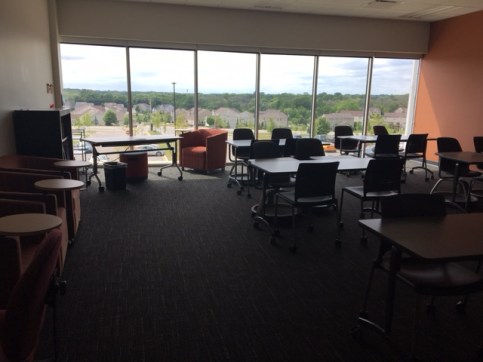
All quiet. For now.

So, take a bit of time for you. Catch up on Scandal or check out that Downton Abbey you’ve heard so much about (It’s over, you know, but I won’t tell anyone you’ve never seen it.) Pay someone to cut your lawn. Get in the car and drive with no real destination in mind. Sit next to the pool (Do you have one? Can I come over?) Sit down at a table to eat your breakfast, take more than 27 minutes for lunch, and demand that someone else make you dinner. Stare. 

IMG_1593

Heck, read a…wait. That suggestion’s a bit loaded.

Oh, alright. Read a book.

Read several.

I know I can’t stop you and why would I want to try?

I’m right there with you (Did I mention Mudbound is incredible?) 

Enjoy! You deserve it.

What are you doing to take a much needed break? Post your plans in the comments below!


Giveaway WINNERS!!

Thank you to everyone who entered our giveaway!  We’re so excited to award books to so many amazing teachers.

Without further ado, here are the winners:

  1. Andrea Anderson from Parkway Central High in Chesterfield, Missouri
  2. Hope Bobonick from Trumbull County Career and Tech Center in Warren, Ohio
  3. Melinda Buchanan from Sanger High School in Sanger, Texas
  4. Lindsey Cary from Peru High School in Peru, Indiana
  5. Janelle Christensen from Henry Sibley High School in Mendota Heights, Minnesota
  6. Karen Drake from Lee-Davis High School in Mechanicsville, Virginia
  7. Kopper Ernst from Riverheads High School in Staunton, Virginia
  8. Amanda Gaul from Waukee High School in Clive, Iowa
  9. Jill Gerber from Whitfield School in Creve Coeur, Missouri
  10. Amanda Graham from Latta High School in Dillon County, South Carolina
  11. Benjie Haugen from Monticello Middle School in Monticello, Illinois
  12. Colleen Kiley from Mount Abraham Union MS/HS in Bristol, Vermont
  13. Kimberly Kroll from Lapeer High School in Lapeer, Michigan
  14. Ashlee Kuhry-Larsen from Waukesha South High School in Waukesha, Wisconsin
  15. Kyla Louis from Hood River Middle School in Hood River, Oregon
  16. Anita Miller from Miami Trace Middle School in Washington Court House, Ohio
  17. Kyle Nelson from Lone Peak High School in Highland, Utah
  18. Tasha Rios from Grand Rapids Catholic Central in Grand Rapids, Michigan
  19. Paola Ruocco from Evanston Township High School in Evanston, Illinois
  20. Sarah Whitman from Collingswood Middle School in Collingswood, New Jersey

Be on the lookout for your books to arrive to your school addresses!  If you’d prefer for me to ship your books to your home address, please feel free to email it to me at shanakarnes@gmail.com.

Thanks to everyone who joined the Three Teachers Talk conversation!  Happy Summer!

Mini-Lesson Monday: First and Last Lines

In the spirit of all the books we’re giving away (winners announced tonight!), today’s mini-lesson is one of my favorites to do with independent reading books.  It celebrates the beauty and power of language, no matter the text–poetry, nonfiction, YA, award-winners, graphic novels, and more.  It also celebrates the pure joy of discovery; the launch into a new world attained only by opening to the first page of a new book.

Objectives:  Using the language of the Depth of Knowledge levels, students will identify patterns in opening and closing lines of texts, synthesize their noticings, and draw conclusions about a text’s craft and structure.

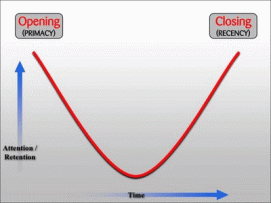
primcacyLesson:  “Have y’all learned about the concepts of primacy and recency in psychology yet?  Who can refresh us?”
A student reminds us that the concept says that the first and last items in a series are easier and more likely to be committed to memory.

“Well, this concept isn’t just for psychology.  It applies to books too.  The first and last lines of books are the most powerful, and the most likely to stick with us.  Let’s talk in our table groups about why the first and last lines are so powerful.”

I wander the room for three minutes as students discuss, in groups of 3-4, these concepts.  They conclude that the first line often sets the tone, introduces a new world, or hooks the reader with some mystique.  The last line, they say, helps keep the reader wondering, or solves a lingering mystery, or even makes you cry.

I write these conclusions on the board, or elicit them from groups if necessary, so that we’re all on the same page.

“Okay, let’s take a look at some of our current reads and see how they can grab our attention.  Open up your independent reading book and read the first line again, and then read the very last line, too.”  (There’s always some anxiety about this, but I reassure them that last lines rarely contain plot giveaways.)

618698KrJJL._SX325_BO1,204,203,200_

(OMG, have you read this? It exploded in popularity the last few weeks of this school year. Read it!)

I ask a few students to give me examples:

  • Miss Peregrine’s Home for Peculiar Children begins with “I had just come to accept that my life would be ordinary when extraordinary things began to happen,” and ends with, “We rowed faster.”  
  • A Prayer for Owen Meany opens with “I am doomed to remember a boy with a wrecked voice—not because of his voice, or because he was the smallest person I ever knew, or even because he was the instrument of my mother’s death, but because he is the reason I believe in God; I am a Christian because of Owen Meaney,” and ends with, “I shall keep asking you.”
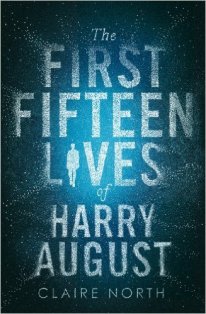
  • The First Fifteen Lives of Harry August begins with “The second cataclysm began in my eleventh life, in 1996,” and concludes, “Instead, for those few days you have left, you are mortal at last.”
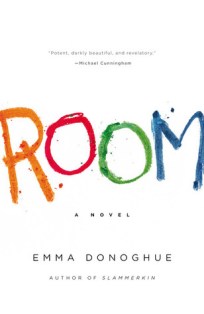
  • Room opens with “Today I’m five,” and ends with “Then we go out the door.”

I ask students to write for a few minutes about all that they can learn from the first and last lines, based on what they already know of the text from reading.  This is key–the lesson is much different than a simple craft study of a text they’re not already invested in, because they’re bringing lots more prior knowledge to their text analysis.

7937843I quickly model with Room, whose plot is simply explained and well known from a recent booktalk.  “I notice the sentence structure first–both lines are short, simple sentences.  Then I get a sense of the narrator’s voice, as he is obviously five years old, and that shapes how I’m going to view the text.  I also know that while they start out trapped in Room, they manage to escape somehow, either literally or figuratively, because of the last line.  I’m intrigued by all of these things, and it sets me up for what sounds like a pretty good read.”  As I talk, I note on the board the kinds of things I’m noticing–craft, tone, characterization, theme, plot, sentence structure.

Students write for five minutes about these topics.  Because they’re midway through these books, they have more knowledge of the text than just the first and last lines.  After a few minutes of writing about what they’ve noticed, I ask, “Now, how does revisiting the first line, and looking ahead to the last line, shape your reading of the text?  What do you find yourself thinking about?  What do you predict might happen?”

Follow-Up:  After students have written their reflections, I ask that they pass notebooks.  They’ll read all of their table mates’ entries, providing 2-3 mini-booktalks–a variation on speed dating.

This lesson could also be a great companion to Jackie’s mini-lesson on writing leads.

This lesson also acts as one of a series of lessons leading up to the students’ writing of a craft analysis of their independent reading books.