Feel Good Friday

It’s been a looooooong week.

We had parent teacher conferences on Monday night. Monday night. It felt a little cruel and usual at the time. Then it just felt like this week might never end.

But end it has. Here we are..FRIDAY!

I feel like celebrating, because this, my friends, has been a week when feel good moments snuck up on my classroom when I was almost too sleepy to notice.

Such as…

Logan is a self proclaimed sports man.

His dad teaches PE here at Franklin and coaches our wildly successful football team. I believe Logan said not long ago that he “lives for sports.” But this week, it seems, he’s been living for books.

So far this year, Logan has completed four books ranging from Redeployment by Phil Klay to Sky on Fire by Emmy Laybourne. He is currently eating up Dark Matter by Blake Crouch, so much so that he enthusiastically book talked it this week before he even finished it.

Last class period, before the bell rang, I let Logan know that he needed to run to guidance and clear up a little confusion around signing up for AP tests. To my heart’s delight, Logan said the following words:

“Can I go after reading time? I want to read first.”

Amen.

img_0269

Logan devouring Dark Matter 


Priyanka stopped by my desk only moments ago.

association“Mrs. Dennis, do you remember emailing me about my one pager this week? You asked how I was liking The Association of Small Bombs.”

“I do! I was wondering how it’s going. You’re the first to read it and I was so excited to get that free copy at NCTE.”

“I LOVE it. You know how sometimes you aren’t sure what the theme of a book is? Like, you have to work to find it? This book’s theme IS THE COVER! All of these intricate stories and characters coming together. I can’t put this down.”

“Making you think, hmmmmm?”


Nathan was struggling to read at the start of the year.

Not his thing, he told me. Then…he found Suzanne Young’s The Program series. He couldn’t put it down and flew through all three books.

Then he launched into A Dog’s Purpose by Bruce Cameron. He finished it in class today.

img_0266

This was Nathan at the end of class. A fellow student asked him if he was ok.

“It was just…SO good.”

A few moments later, Nathan was at the bookshelf returning the text. And I observed, “Nathan, you look like a man without a country. You ok?”

“Mrs. Dennis, I just found out this book has a sequel. I wanted to read The Kite Runner next, but…a sequel. I want to read that now too!”

“How about I give you The Kite Runner while you wait to get the next Cameron book and you read that quick over the long weekend. You won’t be able to put this that down either.”

“Oooooo…good idea. Yeah, can you get me a copy?”

(Clapping excitedly in her head, Mrs. Dennis sprints next door to get a copy of The Kite Runner. He’s reading!!) 


We are fighting fake news in our classrooms.

Today, the posters I had made of the IFLA’s infographic on how to vet sources and avoid getting duped by fake news got delivered. I’m geeking out over these posters.

img_0267


Lastly, this just made me laugh out loud.
apple-2


Happy Friday, everyone!

What made you smile this week? Please share in the comments below! 


Lisa Dennis teaches English and leads a department of English superheros at Franklin High School near Milwaukee. Fridays make her happy, but so do books that smell old, buffets that include ice cream for dessert, and infographics made into classroom posters. 


#BookLove and #BookPride

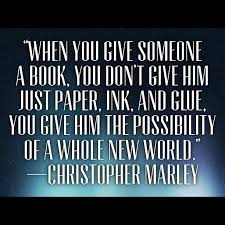
give-books

Angel slept with Trash in his hand for almost the entire first semester.

I hope you caught the italics in that last sentence, but nevertheless, Andy Mulligan’s tiny novel was his first choice for the semester, and Angel would not put it down until he finished.  No, he didn’t even put it down when he dozed off.

We battled the whole first semester.  It was a whispering battle which I tried to handle delicately. I nudged him during reading time.  I conferenced with him.  I suggested new books that he might have found more interesting.  In our conferences, he would say, “Mrs. Paxson, I’m just not much of a reader.”  It wasn’t the usual tone of determination and resistance I heard coupled with this sentence.  I have the occasional student gripping the desk or running in the other direction for fear the Love of Reading will catch them.

That wasn’t Angel.

Instead, he shook his head and hung it with disappointment–even embarrassment.  It was as though this wasn’t something he thought, but something he was told.

He finished Trash at the end of the first semester and started The 5th Wave over the break.

When we came back this semester, I noticed Angel kept leaving his book at home, and picking up Noggin’.  He said two things that caught my attention at the beginning of the semester.

First, he asked me, “Mrs. Paxson, you mean it’s okay if we switch books?”  I emphatically said, “OF COURSE you can switch books!  Your reading life is too important to read what you don’t like.”  It seemed like he was afraid to mess reading up, to defile it or do it wrong in some way.

Second, when I asked the class what they’ve noticed about reading throughout the year, he reluctantly raised his hand, saying, “You know, I’ve actually noticed I read a lot faster now.”

A few weeks later, I extended an opportunity to my ever-drowning sufferers of Senioritis.  I proverbial life-preserver was an opportunity to drop a low daily grade if they had accomplished at least three reading challenge squares.

Again, reluctantly, Angel walked up with a half-finished Noggin’, and asked, “If I finish this book and one more, a total of three, I can have a grade dropped, right?”  This imperfect teacher had some doubts, considering Angel’s history of finishing books and also considering the tendency for seniors to game an opportunity like this.  I said “yes,” but made sure to clarify a few points.

About three days and an equal amount of frantic e-mails later, Angel came into class having finished his books.  He was so eager to talk to me about his ‘feat that he begged for a reading conference.  He beamed from ear to ear as he said, “This book looks old, and it IS. My middle school teacher recommended it to me and I threw it under my bed and never read it.  I pulled it back out and I couldn’t stop reading till I was finished.”  He spoke of the book .  Second, when I asked him about his second book, Noggin’, he detailed the story and the surprise ending with such confidence and nuance, I had no question he read and LOVED the book.  After our conference he said, “Don’t worry, I’ll send you a summary of the books so you don’t think I cheated and didn’t read.”  I explained to him that the conference was all I needed.

Besides, didn’t he give me so much more than he would achieve in a summary?  Angel showed me an enthusiasm, a drive to learn, and a new-found fervor to read that would not quickly fade, but would likely grow in the years to come.  Angel showed me Book Love.

angel

I asked Angel one more question as we walked back to the bookshelf to find his next read. Me: Hey, have you ever read three books in a matter of months before?

Him: (Trying to hide a smile of pride) No ma’am, I haven’t.

Me: Feels pretty amazing, right?

Him: Yes, it really does.

Jessica Paxson is an English IV and Creative Writing teacher in Arlington, TX. She also attempts to grapple with life and all of its complexities and hilarities over at www.jessicajordana.com. Follow her on Twitter or Instagram @jessjordana.


Stop the Slaughter: Lifeless Literary Analysis

Teaching is a reflective practice. If you’re doing it right, that is.

We question, we research, we dig deep to update, invigorate, and refresh our work on a daily basis. And while this can be utterly exhausting (I think we need to investigate the ingenious cultural practice of siestas), it’s also exciting. As we push ourselves to grow and change as teachers, we impart that commitment to be better to our students.

I remember when I was student teaching several (cough, cough) years ago. The English and Social Studies departments shared an enormous office, and I was lucky enough to be afforded some space in that room to work. The fresh-faced 21 year old with boundless energy and enthusiasm for making a difference and connecting with “kids” (I was teaching 18 year olds. I’m pretty sure I was in elementary school with one of my students).

Then, I met *Mr. Pumblechook. (Names have been changed to protect the identities of very nice, well meaning people whose educational practices make me shutter.)

Pumblechook was a social studies teacher with perhaps six or seven years under his belt. He had a bright smile, hearty laugh, great expectations for his students (I had to. Thanks Dickens) and a file cabinet.

But this, ladies and gentlemen of the jury ( got serious quick, didn’t I?)this was no ordinary file cabinet. For in this file cabinet was a collection of folders. And in those folders were lesson plans.

One folder for each day of the year containing (because I pretended to be impressed with his organization and asked to see): a lesson plan, several worksheets to make copies of (even leftover handouts from the year before), and overhead slides of prewritten notes.

Was I student teaching in 1962? No.
Was I student teaching under a dictatorial regime? No.

This was 2002, people. Suburban Milwaukee.

And every time I tell this story to fellow educators, they nod, and I hear similar stories of educators from days gone by. Worksheet after worksheet, recorded lessons from first hour played to subsequent hours, teachers knitting in the back of the room, and countless acts of readicide across the land. Is seems Mr. Pumblechook had good historical precedent for imparting knowledge to children by opening up their brains and pouring in the same ideas year after year without regard to their role in that programming or real world applications of classroom material.

Enter: My classroom last week.

My AP students are armpit deep (my quip to convey complexity over the waist, but less perilous than the nose) in literary analysis. I wrote last week about our journey with diction analysis, as we got down and dirty with how an author conveys meaning with words.

Along my merry way I skipped, confident in this unit that I’ve taught several times, the tweaks I’d made in planning it for this year (updated mentors, current event references, jokes that students last year hadn’t heard yet – he he), and last year’s solid AP test scores. Not quite a folder for each day, but not too terribly far off either.

Then, I read Rebekah O’Dell’s post from Moving Writer’s, “Three Reasons Literary Analysis Must be Authentic.”

Gulp. Authentic.

I (shamefully) hadn’t really thought of that. I was preparing my students for the AP Language test. Wasn’t that authentic enough?

Of course, the skills of analysis are invaluable. Critical thinking across the curriculum is bolstered by the development of analysis skills which help students recognize patterns, decode information, compare and contrast concepts, classify elements under examination, and utilize inferences to support ideas. As one of the elements utilized by the College Board to determine students’ readiness for college level curriculum in English, rhetorical analysis is obviously important. The traditional essay format is required to pass this test and the analytical skills necessary to do so are a benefit to students far beyond the classroom.

But here’s the rub…

Even AP readers are looking for students to write outside the box. Yes, the skills of analysis must be present. But top scoring papers are those that challenge convention, take risks, and (I’m hanging my head in shame here) speak to a more authentic and far-reaching audience.

O’Dell’s post, like literary providence, reminded me that I needed to climb out of my car with tinted windows (I’m in here doing my thing. Nothing to see here) and pick up a mirror to reflect why I was doing what I was doing.

Her 3 key reflections on teaching literary analysis hit me right between the pencils. She reminds us that:

  1. Our job isn’t to produce English teachers.
  2. Writers need models in order to write.
  3. The traditional academic, literary analysis essay hurts student writing.

So,  am I hurting my students with what I’ve been doing? Absolutely not.
Could it be better? Absolutely, Mr. Pumblechook, because they might be better at formulaic writing with what I’ve been working on, but we’ve taken some steps back in their growth as authentic writers.

To address each of O’Dell’s points, which I felt compelled to do immediately (I had the mirror up and didn’t like what I was seeing), I changed some plans for this week and next.

  1. Our job isn’t to produce English teachers: I have to tell myself this more and more. O’Dell reminds us that 2% of college students major in English, and of those 2%, only 1% will enter professional academics.

    It did occur to me though, that our students will need to engage with the world around them and likely need to synthesize ideas in order to share them. As such, I had my kids choose editorials on current events and topics of interest to present 1-2 minute speeches on. They needed to make claims about how the author achieved his/her purpose through DIDLS.The fluency of their writing for these speeches has blown me away. We’d been “writing analysis” last week, but none had the same voice, passion, or deep analysis that these had. Speaking the analysis had the power to remove the formula. Students concentrated on engaging their audience in a way that a practice AP prompt could not replicate.

    When my students sat down to write a full AP analysis practice today, I reminded them of how they had to work to capture the audience of their peers through their speeches, and that the nameless/faceless AP writers still wanted that same engagement. They want students to be successful on the test. This exercise seemed to solidify that and afford my kids the opportunity to reignite that natural voice we have been working with all year.

    img_0180

    Katie presents her editorial analysis speech this morning

    speech-form

    A quick Google form that I fill out as students are speaking provides immediate feedback via email 

    speech-feedback

    A sample of the detailed feedback on both content (helps with literary analysis prep) and public speaking (a real life skill for all)

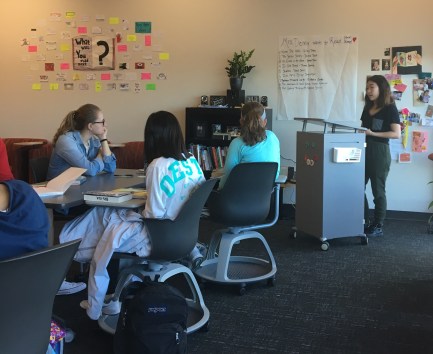
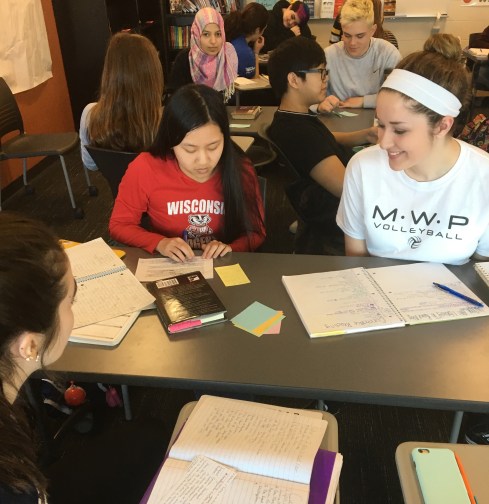
    img_0179

    Students give peer feedback on the rhetorical analysis they heard, as well as the speech overall. 

  2. Writers need models in order to write: I’ve been using student samples from AP to accompany the prompts we’ve been analyzing for years. That’s honestly helpful. I have students score them and discuss with peers what constitutes a high, middle, and unacceptable essay according to AP so they can apply or avoid the same ideas.

    However, those high scoring essays were always met by my students with comments that suggested that top scoring essays held some undefinable magical quality.

    What is it? Style.

    Those essays, as I said earlier, not only develop complex ideas, but they do so in a way that keeps the reader engaged.To work with this, I’m going to share with my students some of the literary analysis that O’Dell’s post links to as well. The Atlantic‘s “By Heart” where authors share their insights on their own favorite passages in literature, is a website that makes literary analysis real, full of voice, and peppered with references to texts/authors my students know.
    My post a few weeks back on Arts and Letters Daily is another place we’re going to explore. How do writers write about texts without using a five paragraph essay? How can we, as Penny Kittle says, stand on their shoulders as writers and work to write as they do?

    al-daily

  3. The traditional academic, literary analysis essay hurts student writing: We want our students to be able to master the structure and form, but yet we want them them to break free of it too.I’ve often told my kids over the years that you have to know the rules in order to effectively break them.

    Maybe it’s true. Maybe, I just don’t have them break them soon enough and get to that authentic voice for an authentic audience.Because there, in the place where they have something to say with confidence, passion, precision, and critical thoughts developed by honed skills, will they bridge the gap between possessing the skills we want them to master and making their writing shine with the creative use of those same skills.

And now…it’s Wednesday morning and the lovely Tricia Ebarvia just ran a post about authentic audience through blogging. I’m headed there next.

I should just carry a mirror. I need it. Always.

How do you help move students move beyond the traditional literary analysis? We’d love to hear your ideas in the comments below! 


Lisa Dennis teaches English and leads a department of English superheros at Franklin High School near Milwaukee. A joke her students haven’t heard yet, but soon will, is:  Why did the librarian miss the conference? She was overbooked. Her students are sure to chuckle, if not pumblechook (used as a verb with creative credit to Dickens), at that one. 


Why Conferring Matters

Conferring is the interaction missing from many of our students lives.

Consider this:  the current generation thrives on one-on-one attention. They do not remember a time before social media, and many live much of their lives online via their smartphones. They turn to instantaneous interactions that have a direct impact on how they feel about themselves:  Snapchat, Vine, and Instagram over Facebook, which they are abandoning in droves because “it’s for old people.”

Our students crave immediate feedback. They seek personal communication — and they need it.

Think of the implications of this virtual-reality world on long-term relationships and problem-solving. We have already seen how it impacts our students in the classroom: short attention spans, skimming versus sustained reading to name a couple, not to mention the addiction to notifications.

Our students need to experience and understand the importance of eye contact, facial expressions, and body language, and how these physical features create non-verbal communication. They need to interpret and explicate tone.

The students in our classrooms today are different from Millenials. Anyone born after 1995 earns the new title of Generation Z, also called iGen, Centennials, Founders, and my favorite title: Gen Edgers.

As a whole, these students use technology as their primary source of communication — to validate, and to feel validated.

They also value genuine relationships, loyalty, and honesty and are increasingly more careful than the previous generation with the friendships they form online. They want to know their voices matter and that they are okay just being themselves instead of being the perfectly-phrased word count they must craft online.

Our students need opportunities to share thoughts, feelings, ideas, and knowledge in non-threatening situations through real face-to-face conversations.

Conferring opens opportunities to meet the needs of our students at the core of their longing.

When we invite students to talk and affective filters lower. Students relax. They respond.

When teachers confer with genuine interest in the well-being of the child, we grant students permission to be their genuine selves. Research on the brain shows that “positive comments and positive conversations cause a chemical “high,”” and with less pretense and stress, students experience more learning.

Conferring gives students the chance to share their stories; and besides creating trusting relationships, conferring allows us to meet them where they are and help them advance in knowledge and skills from there.

On-going regular conferences ensure that every student receives the one-on-one interaction and instruction they deserve. Peter Johnston reminds us that every student has a personal history that affects our ability to help them advance in their literacy skills.

Through conferring we learn the cultural and personal backgrounds that shape our learners, along with the experiences that shaped them in the past as readers. Both are important factors. By asking questions that invite students to recall their learning histories, we initiate future learning.

Conferring also sparks critical thinking, creativity, and curiosity.

No matter the teaching style — be it an English class where the teacher makes the choices about books and writing topics, or a workshop inspired classroom where students choose what they read and write, or even a classroom of another content area — when conferring becomes a norm, students proactively engage in learning, which results in more growth, independence, and mastery of content and concepts.

Our students learn to ask questions, ponder responses, and seek for interesting ways to show they are learning. Differentiation happens naturally.

Imagine the opportunities students may create and the innovative energy they will have in the future if they experience this kind of learning in their secondary schools.

The children in our classrooms are part of the fastest growing force in the workplace and the marketplace. Their influence is changing companies, marketing styles, and consumer habits.

This generation wants to make a difference in the world. They are pragmatic, self-aware, goal-oriented, and self-taught via YouTube. They’ve grown up “dealing with too much vs. too little information their entire lives.”

They will soon become our peers standing in voting lines, our colleagues standing near the copy machines, maybe even our bosses, or perhaps the officials that govern our cities and our states.

As adults we must provide each child with the education that prepares them for the future they are moving into.

We cannot keep teaching the way we have always taught with one-size-fits-all lesson plans and instructional models. We cannot keep making all the choices about books and reading or essay topics.

We must talk to our students one-on-one about what matters to them personally. Our future, and theirs, depends on it.

And for the teacher who worries about time, conferring provides a means of easy and accurate formative assessment, which saves valuable time spent grading:  time teachers may spend planning effective lessons or conferring with more students.

When done with fidelity, conferring improves the effectiveness of our teaching. I don’t know one teacher who doesn’t want that.

Please share your thoughts on conferring in the comments. What are your conferring routines?

Amy Rasmussen lives in north Texas and teaches AP English Language and English 3 to the Fighting Farmers at Lewisville High School. She adheres to the words of Emerson: “We aim above the mark to hit the mark,” and Jesus Christ: “Love one another.” Imagine a world if we were to all aim higher to love our fellow man. Follow Amy on Twitter @amyrass.

Learning to Teach from Writing Book Reviews

For over a year now I’ve written and published book reviews.


More specifically, I force myself to write book reviews.  


Sometimes I have to set an appointment on my calendar.  Sometimes I have to shove off other things I want to get done.  Sometimes I find ways to creatively prolong my book review journey with the beauties of the internet.  Truth be told, there are some kinds of writing that I prefer to do over others, and book reviews are not one of my favorite genres.


With experience and practice, though, I’ve found a book review method that works for me:


Step 1: Read a book carefully (in this case, March Book 3)  and annotate with small post-it notes.  Annotate for ideas and for details: character names, locations, major events. In other words, scribble down words.


march-book-three


Implications for teaching: My “jots” during the my heat of the moment reading on my mini-post its are a few words at most and are my internal language for ideas that aren’t full-fledged yet.  Like many students, I just want to get back to the story and I don’t want to be bothered writing the whole idea out right now.     I want to rethink whether I ask students to share their initial jots and annotations with me, and I might instead ask students to revisit and polish up an initial jot into a 2-3 sentence complete idea jot.


Given a chance to stretch out my initial “law and enforcement of the law” jot, I might write:


Civil rights demonstrators were actively testing the practice of federal laws, such as the right to vote, while local law enforcement were breaking the law by preventing the law from being practiced.  It’s ironic that the demonstrators are the lawful ones and the police are the criminals, and yet the demonstrators are the ones who end up in jail.


Step 2: Take a break.


Step 3: Engage in some form of “writing off the page” as Nancie Atwell called it in which you engage in low-stakes discovery writing.     If I’m in a super-hurry, I skip this step, but I think my reviews suffer for it.


Implications for teaching: I noticed that I needed a sentence started to shape my thinking (this book made me think more about….)  I’ve transitioned from calling this process “brainstorming” to “discovery writing” in order  to emphasize its true purpose – discovery.  I find some students have significant difficulty with true “brainstorming,” only writing down an idea once they’ve thoroughly chewed it over and deemed it good enough.   Discovery writing is “good enough” when you discover an idea you didn’t know you had before you sat down to write.  


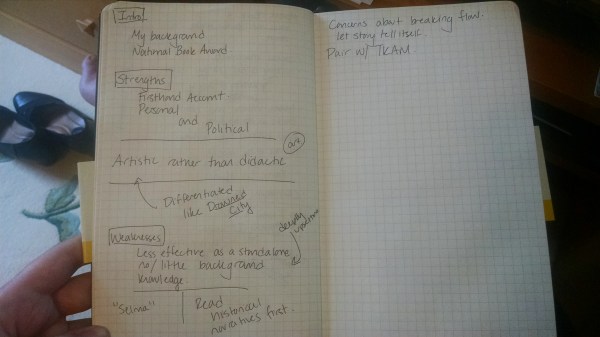
Step 4:  Given my knowledge of how book reviews go, I plan for each section.  When I was a kid, I used to be disappointed that the New York Times book review didn’t come with “thumbs up” or star ratings like the movies did.  After some frustrating trials, I figured out a book review’s secret: the last paragraph is the most important paragraph, and the rest of the review serves as a windup to that last paragraph’s pitch, describing the book’s strengths and then its weaknesses.  

photo-4-planning

I labeled my notebook with the most important components of the book review: Introduction, Strengths, Weaknesses and Conclusion.  (Note too that I added a component for “art” — I find it hard to write about a comic book’s art!)

Implications for teaching: We need to teach readers and writers the essential components to the genres they are writing and reading in and the shortcuts.  Just the way we might model a character arc with a novel, we should model the expectations of what to read for within a genre and help students notice when a piece conforms to those general expectations.  We can also teach students how to skim nonfiction and how to go back in to understand details after an initial reading.


Step 5: Write the review.  My final review almost never looks exactly like my plan, as I do some discovery along the way.  However, the outline allows me to “see” my work from beginning to end before I write it, so I write with confidence.  

Implications for teaching: We should encourage students to outline, but we should also encourage students to improvise as well.  The inexperienced cook refers back to her recipe constantly, always wondering if she got the measurements right, while the more experienced chef can add, improvise, and change along the way if he wants to try out an idea.  I’ll be honest – I keep my outline in front of me as an artifact more than anything else to remind myself that I have something to say.  


Amy Estersohn is a middle school English teacher in New York.  She has purchased an additional copy of March: Book 3 because she wanted a copy that had the award stickers on it.  It’s not the silliest reason she’s ever purchased a book.


What Will You Read Next?

I’m always on the lookout for ways to keep moving my readers forward. To stave off the lethargy that unrelenting mid-forties temperatures and 17 weeks of gray skies (winter makes me hyperbolic) can leave in a classroom. The novelty of a new year, with its resolutions and fresh semester, has succumb to the bleak midwinter pall of third quarter and we need something that says, “If that groundhog claims six more weeks of winter (rat-face that he is), we’re going to need a plan…and a good book or two.”

Well, thank goodness I have an unhealthy addiction to Twitter (Ummm…Cornelius Minor just started following me last night. I’m going to need to step up my game. Significantly).  Years ago, it was Pinterest, but that was back when I had time to scroll and save ‘Best Brunch Recipes to Feed a Hangry Crowd’ and ’19 Ways to Burn Booty Fat’ (not to say I couldn’t still use both).

My scrolling these days, however, is far more literary in focus and professional in nature (19 Ways to Burn Booty Fat for Educators – Conferring as Cardio). Seriously though, Twitter has led me to countless quick write topics, mentor text ideas, blogs to follow, inspirational quotes, professional development opportunities, booklists, laughs, collegial exchanges, and pedagogical articles to stretch my practice. #TrachersWin, #LoveToLearn, #StrongThumbs, #TwitterScrollingSavesLives.

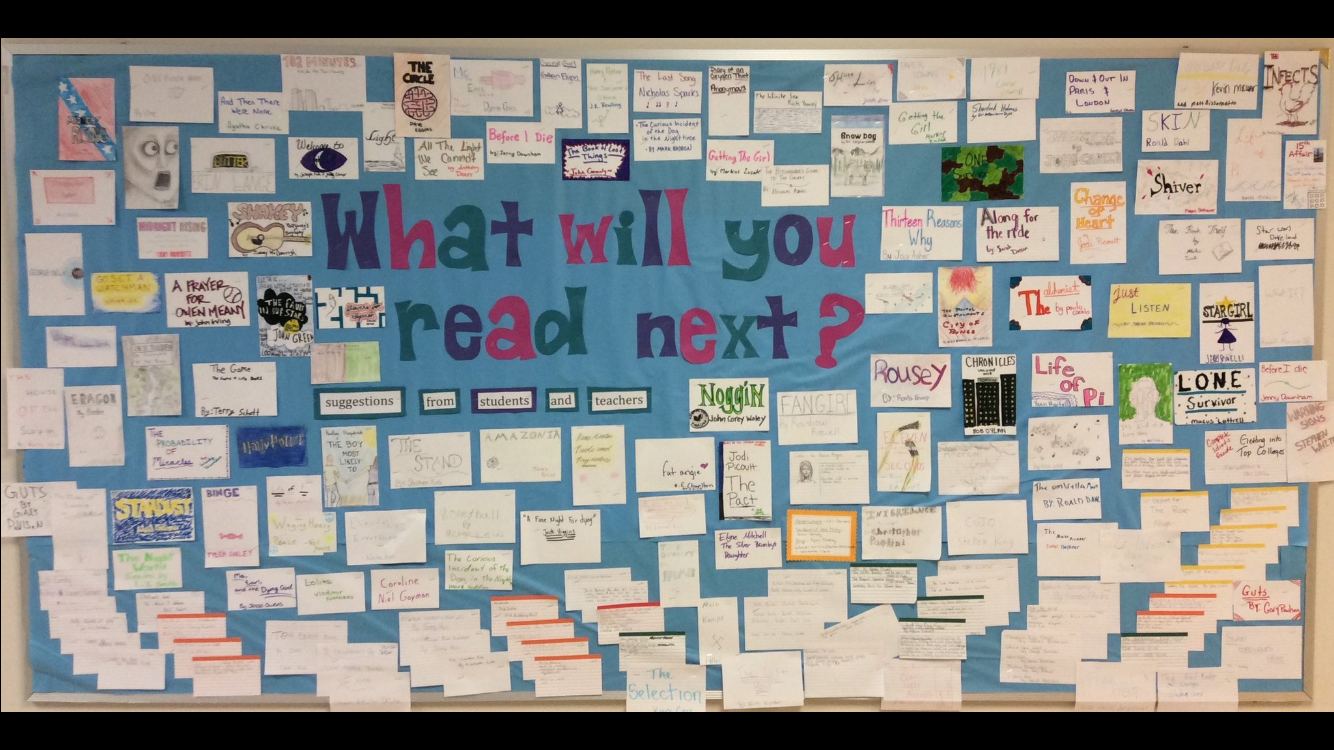
A few days back, Penny Kittle posted this photo:

I quickly screenshotted the image to replicate in my room. This visual reminder of where we’re headed (another book and/or a swing toward spring) will provide the push forward we need. Get it on the wall!

My students needed something to set their sights on, so I asked them to take a look at their ‘I Want to Read List’ and choose what their next reading would be. This wouldn’t just be a goal to finish our current texts, but would also give us something to look forward to.

I encouraged students to take this as an opportunity to challenge themselves outside what they have been consistently reading, either in complexity or genre, and select a book they were excited to get their hands on.

Each student then took an index card, on which went the name of the book, the author, and the date they plan to start this next text.


My aide, an artistic genius, drew the book that would be the center our our display (It even has dozens of book titles written on the first page – I LOVE it, Hailey!) and started arranging the ‘Next Text’ cards around it. The whole back wall of my classroom is going to be a sea of texts we can look forward to.

I’m loving my current read (Shout Out: #3TTTBookClub – Jodi Picoult’s Small Great Things), but I too will be adding a card: In Cold Blood by Truman Capote.

(A freak and serious arrest of my artistic development in the second grade prevents me from sharing my card with you. Please imagine it’s simplistic beauty and that might help me create something wall worthy)


Let’s Get Excited About Where We Are Heading! What Will You Read Next? Please leave your text choices in the comments below. Happy Friday. 


Lisa Dennis spends her school days teaching AP Language and Honors/Pre-AP Sophomores, while also leading the fearless English department at Franklin High School, just outside Milwaukee, Wisconsin where she lives with her husband Nick, daughter Ellie, and beagle Scout.  She is a firm believer that a youthful spirit, a kind heart, a big smile, and a good book can ease most of life’s more troublesome quarrels. Follow Lisa on Twitter @LDennibaum.

Honoring Culture and Voice Through Code-Switching

One of the most beautiful things about workshop teaching is flexibility.

I know you’re thinking, What’s that?  The Type-A Personality talking about flexibility?  Yes.  I’m floored.  I’ve grown to love the ability to change plans at a moment’s notice because something pops up on my Twitter feed or a student has a great idea.  It only slightly gives me anxiety now, rather than entirely.  That’s progress, people.

During our current focus on Elements of Drama, including some Shakespeare and some Hamilton, the most frequent point of conversation has been language and translation.  In the wake of political and social tsunamis currently taking place, my students are constantly coming back to ideas of connection, or lack thereof.

In one of his interviews with NPR, Lin-Manuel Miranda discusses the fact that he’s “been code-switching since he was five.”  He uses this term to refer to his social predicament growing up between nights and weekends in a Hispanic, immigrant neighborhood and daylight hours at a school for the gifted on the Upper East Side.  This idea seemed to be what my students and I were discussing, so I decided to do some Googling.  Was anyone else talking about this idea?

I came across this TED Talk by Jamila Lyiscott: 3 Ways to Speak English.  Aside from causing me to further lament that I haven’t yet begun to moonlight as a spoken word poet, it also took me aback at how little I’ve honored my students and their own culture and voice in writing.

language-world

The truth is, many have felt like strangers in their own land long before this current administration took hold.

In an effort to facilitate my students’ ability to “speak academic,” I never realized just how much it feels like a foreign language.  I also never considered, by default, this deemed their language “unacademic.”  This classification might feel belittling, or at the very least, may cause them to put their own culture and language on a shelf while they’re at school, and as a result, while they’re writing.

The beauty of language is connection.  Insecurity happens when you feel your words skip over or go right through whoever you’re around.  The art of language is mastering each of your dialects so completely, that you can connect with many different types of people at once.

The thing I hate about flexibility is that you often find things around which you want to plan an entire unit.  Unfortunately, I found it too late this time around.

Here’s what we actually did:

Each student imagined a story they might tell in a friendly setting and an academic setting.  The only requirement was to write the SAME STORY in TWO DIFFERENT WAYS.  This hit so many skills, I don’t know if I can list them all.  We discussed purpose, but also discussed the need for knowing audience before you can likely get to purpose.  We played with word choice, and we experimented with plucking words from friendly dialect and plopping them into academic dialect to amp up connectivity and relatable tone.  We obviously discussed tone.  We discussed brevity/length and how it relates to purpose.  I could teach an entire semester of English skills with this single theme.

Here’s what I would do for a unit:

  • Begin with Amy’s Matter of Perspective and Crossing the Line activity.
  • Notebook writing and discussing about how language has made us feel out of place in the past.
  • Explore the question: Can their truly be connection without separation?
  • Watch 3 Ways to Speak English & challenge students to write either a two-voice poem or a spoken word poem like Jamila’s in which they integrate all of their languages together, using her performance as a mentor text.

The goal in this unit, and in the single writing I managed to facilitate this year, is that every portion of a person’s identity should be honored and valued.  It is all these facets that make a writer with true voice.  I want to grow writers with voice, not just writers who learn to regurgitate and operate within the box that academia occasionally presents.

Jessica Paxson is an English IV and Creative Writing teacher in Arlington, TX. She also attempts to grapple with life and all of its complexities and hilarities over at www.jessicajordana.com. Follow her on Twitter or Instagram @jessjordana.

The Three Comic Book Commandments

I went to a college known for giving students a lot of reading.  The main library stays open until 11 on Friday and Saturday nights.  If that wasn’t enough, there were five bookstores within walking distance of campus.   The best bookstore of the bunch was in a church basement that was so big and so confusing it had a map.  


So here I was in book paradise, where everybody had opinions on books down to which translation of the Iliad was most legit and which edition of Shakespare’s plays had the best commentary.  But no kinds of books could get us as worked up as comic books could, and it was comic books we were trading with abandon, not different versions of Troilus and Cressida.


As passionate readers, we realized that books can do many things, including feed the soul.  Comic books fed our souls.


We were not “smart” with comics the way we might be “smart” with Heidegger.  We did not underline, post-it note, highlight, or read with a lens for character or theme.  Instead, we just read.  And after we read, we traded.


Comic books (or graphic novels, I use the words interchangeably) are a crucial part of my reading life, and I urge you to make them a part of yours, too by honoring three comic book commandments:

  1. Resist temptation to privilege text over image in conversation with students.


I can hear a well-intentioned adult telling a teen, “It’s great that you’re reading The Walking Dead, but when are you going to read a real book again?”  Similarly, I cringe a bit when teachers suggest that graphic novels are a good book to read when a student left a book at home.  When we say things like this, we send a message that graphic novels are not considered legitimate forms of literature.


Similarly, students may be afraid to pick up a graphic novel because they fear you or others will judge their reading choices as “too easy.”


  1.  Read at least two graphic novels this year.


If you’re a graphic novel newbie, I’d recommend reading Nimona, American Born Chinese, and March: Book Three, which have all received major literary awards.  If you want a list of recent greats for kids  and teens, I’d recommend the Cybils Awards lists and YALSA’s Great Graphic Novels for Teens lists.


  1. Pick up some graphic novels for your classroom library.

If you don’t already have a collection, I encourage you to start one this year!


Amy Estersohn is an English teacher in New York, and the best translation of The Illiad is from Robert Fagles.

AP English and Choice Reading

Last week Lisa inspired me with a post she called Books Can’t Be Bullied. Her last line:

“Let’s produce millions of resilient readers, hungry for truth, who will open books and listen, because a book is always ready to talk, and frankly, we could all stand to listen a lot more than we do.”

Then, a friend and colleague of mine wrote a post on her blog about the importance of choice in her AP Literature class, a topic near and dear to my own AP English heart. (I’ve written about choice in AP and how I feel about AP test scores quite a lot.)

And I knew I would share Amber’s testament to readers-writers workshop in AP English. She builds resilient readers, hungry for the truth, who open books and listen.

In this world of fake news and clickbait sharing, we might all want to evaluate how we can provide more opportunities for our students, at every level, to take more ownership of their learning and grow as resilient readers who are hungry for the truth.

Let’s stop saying choice does not work in AP English. It does. And it’s the students’ voices that prove it the most.

Here’s an excerpt from Amber’s post. I especially love the student comments:

. . .

I am currently in my fifth year of teaching AP Lit., and I feel confident that the feedback I have received supports the idea that choice and Advanced Placement courses are not mutually exclusive; in fact, choice might just be essential to our students’ future as readers. Not only have my AP scores supported this (I taught the class of 2013 using full-class novels which were chosen based on how many times they were referenced on the AP exam as well as the desire to cover all of the major literary eras, and my AP scores have increased, and have remained above national averages, since I began to offer students some choice in which texts they read), but my students have also provided positive feedback about how the ability to choose what they read has provided them with more incentive to thoroughly read and explore their texts.

I should probably note that the reason I felt compelled to write this post is because recently, I heard several well-meaning, experienced teachers express genuine concern that the classics “are not being taught anymore” and that “we should make students read them because if we don’t, they won’t ever choose to read them on their own.” Yes, that’s right – I clearly heard the words “make them read…” – because yeah, that works.

Here are a few snippets from students:

  • “Being able to pick our own book to read made the class even better, because we got to choose something to read that would fit our own styles instead of being forced to read something we may not like.” –Tiffany
  • “The book I enjoyed the most…are all the ones I chose to read. I had been wanting to read 1984 for a while and I got the chance. It was so interesting to me because my favorite books to read are dystopias. I liked The Picture of Dorian Gray because it’s different form what I’m used to reading. I like the fact that it was controversial. The Nightingale just had me feeling all kinds of emotions. It was hard to put it down because it was full of suspense. Although I loved 1984, Animal Farm was not for me. I was excited to read it, but it let me down. I don’t think it was the book itself, just the fact that it was assigned with a lot of work. Also, that we had assigned chapters every week, so I couldn’t read it and enjoy it at my own pace.” -Isela
  • “By you giving us freedom, we’ve been able to produce more creative ideas and products. You have definitely helped me prepare just a little bit more for college. Thank you!” –Kara
  • “I suppose I should designate Beowulf as my least favorite book that I had been assigned to read in the duration of my high school years.  I did not despise it entirely; it simply was not very appealing.  In addition, I never completed it.  With only a handful of chapters left, it is one of the few books I have not at least forced myself to finish.  Thus, it will always be a sore spot on my conscious. For my final remarks (at least my final mandated remarks, but I am not making any promises), I would like to state that I prioritized this class over my others even though from the grading perspective this made the least amount of sense.  I honestly felt the need to learn and not just merely make last minute memorizations.”  –Allison
  • “The book I liked best that I read for the class was Les Miserables because I liked it the best and because it was so long I cracked and got the audio book, and I enjoyed having the book read to me as I followed along even though it was a 12 1/2 hour audiobook. My all time least favorite book from my high school Englishes was Bless Me Ultima. It was plainly a boring book and the more I tried to read it the less I was interested in it. I didn’t even end up reading it, honestly. I just sat in class and listened to everyone else’s discussions and from that I got the general gist of the story and such.” –Clancy

countsquote

Read Amber’s full post Choosing Readers Over Texts with the whole of her students comments. You’ll get it.

What are you thinking? Please let me know in the comments.

Amy Rasmussen lives in north Texas and teaches AP English Language and English 3 to the Fighting Farmers at Lewisville High School. She adheres to the words of Emerson: “We aim above the mark to hit the mark,” and Jesus Christ: “Love one another.” Imagine a world if we all love more than we think we can. Follow Amy on Twitter @amyrass.


Books Can’t Be Bullied

Books: “They don’t get tired and give in, they don’t rearrange their words to soothe their reader’s ego or get a better position on the shelf, and they can’t be bullied”  – Josh Corman for Book Riot.

I’m not going to get political here. I promise.

I’m quite frankly exhausted by, though no less involved in, politics these past few weeks, but when I saw this quote, I knew I needed to explore it. It does (fair warning) come from a pretty politically charged piece that you can seek out and read, if you like, but I first saw this quote completely out of context and feel that it’s a powerful statement in and of itself.

The push and pull of it intrigues me.

I first pictured a book: proud, immovable, and cool. Spine bent ever so slightly, tantalizing a reader with the ideas inside, like the love interest in a dark romance who reads Goethe in tiny coffee shops and spells color with a “u”:

I’ve got what you need, but I’m in charge here. We go at my pace. Turn my pages to see where I will lead you. You aren’t the first and you won’t be the last. 

Aloof in the face of need, careful not to promise too much. If you come to this book looking for fulfillment, it won’t permit you to find it. Too easy. It’s not about you. It’s about the message.

I can also see this book as a soldier on the front lines, battling to retain pride in its themes. Beat down by two star Amazon reviews, milk spilled across its pages, and the misrepresentation of translation, reprinting, and censorship. Not desperate, but insistent:

See me. See what I really am. What I have to offer. I am not what you purport me to be. I am not what others say I am. Think. Judge for yourself. 

But what does any of this mean for our classrooms?

For my students, It means we are going to write about it. I want to know what they think. What identity this quote suggests books have, and thereby what role in our lives? What impact?

See, in an age that not so subtly suggests that books are made better by individual interpretation, I would argue we sometimes give ourselves too much credit.

I might go so far as to suggest that we need books to be a bit immovable these days.

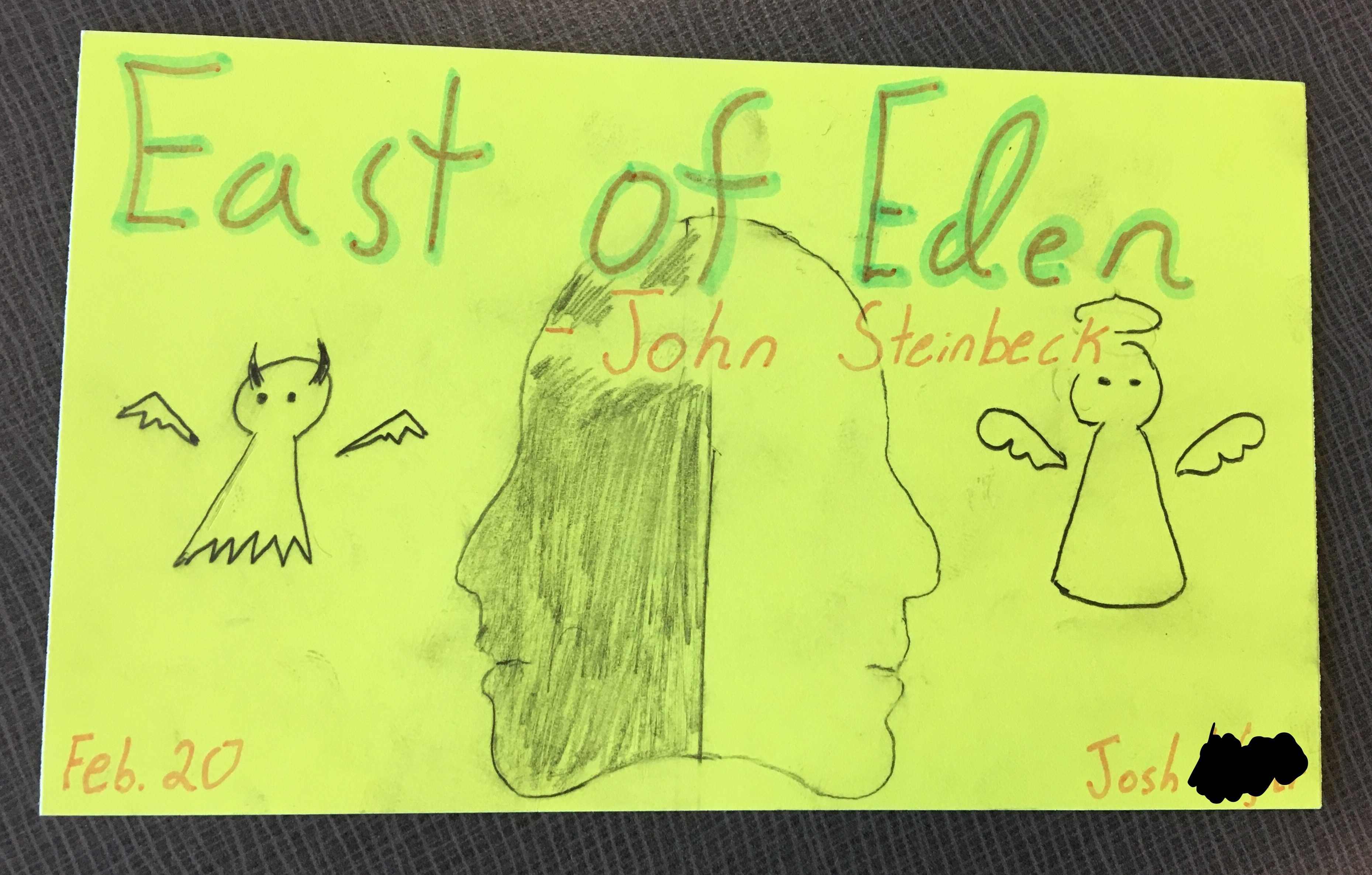
It’s not all about us. What we like. What we need. What we get out of an experience.  Of course, authors need to make money to keep writing books, but on the back of my copy of East of Eden, Steinbeck is casually smoking a cigarette and weaving a tale of good and evil. Is there really so much room for interpretation there? Should there be?

Yes, we, and our students, benefit immensely from challenging conventional thought and learning to build meaning from difficult texts through personal connection, but at the end of that journey, the book remains. The nuance may be up for debate, but the message, perhaps not.

Books offer us a place to see that which does not grow old. The words are pressed between the pages, meaning what they did when they were published. It is we who change and must work to balance how perception influences theme.

Tweets scroll past in soundbites on the screen. Facebook spins and updates with a thousand new ideas with every pull of a thumb. Books remain what they always have been. They cannot be bullied to change with the times. They are timeless, and as such, essential to our survival in the era of eight second attention spans.

So as we bring ourselves to a text, we must be willing to meet it halfway.

It’s not about you, or not only about you.  It’s about the two of us. Book and reader. We can only succeed if we work at this together. 

What better lesson for these times, political or no, than to meet in the middle and align our unchangeable past with the possibilities that carefully crafted ideas can suggest for our future? A book, afterall, still needs a reader.

Let’s produce millions of resilient readers, hungry for truth, who will open books and listen, because a book is always ready to talk, and frankly, we could all stand to listen a lot more than we do.

I’d love to hear your reflection on the quote. Please feel free to join the discussion below in the comments. 

Lisa Dennis spends her school days teaching AP Language and Honors/Pre-AP Sophomores, while also leading the fearless English department at Franklin High School, just outside Milwaukee, Wisconsin where she lives with her husband Nick, daughter Ellie, and beagle Scout. She is a firm believer that a youthful spirit, a kind heart, a big smile, and a good book can ease most of life’s more troublesome quarrels. Follow Lisa on Twitter @LDennibaum.