A Lot of Dancing, Please — Guest Post by Billy Eastman

My beautiful and vivacious and pernicious six-year-old daughter frequents a Kindergarten class. She pretends her way through life these days; it’s a problem. But, a problem I refuse to address. Because, one day, that problem with vault her to success in something.

Violet uses a wheelchair. She doesn’t use it all the time. Most of the time, she traverses time and space with arm crutches — but at school, she uses her wheelchair so she doesn’t become fatigued from chasing other small people around.

The other day, an adult at Violet’s school admitted something to me:  she caused Violet to school hallwaytip over in her wheelchair in the hallway (Don’t worry, no daughters were harmed in the making of this short narrative). Really, Violet wasn’t hurt, but the big person was distraught.

I thanked her. For tipping my daughter’s wheelchair over in the hallway. You see, they were dancing. An educator was dancing with Violet in her wheelchair. They were spinning and twirling and tipping and falling. I prefer that.

So, this is what we should prefer in our classrooms as well:  possibilities, no limitations, risk and reward, fear and excitement, falling down, getting up and saying “I’m OK, and some dancing (at least on the page). A lot of dancing, please.

Random undiscernibly identifiable adult:  please continue to dance with Violet in the hallways.

Teachers:  dancing is better than walking in straight lines with bubbles in your mouth.

And, this clearly applies to reading, writing, and thinking—which is what I was writing about this whole time.

Billy Eastman is a curriculum coordinator for English Language Arts and World Languages and Culture in League City, TX. He enjoys talking with folks and finding ways to make smart ideas happen. Follow Billy on Twitter @thebillyeastman


I really like grading papers

I have something to tell you, and you’re not going to like it:


I enjoy grading papers.


I do.


miranda sings haters back off

I learned about Miranda Sings from paper grading.

When I grade papers, I learn about the world.  I ask questions I never thought I’d ask.  I become more informed.  Grading papers, when it is going well, is like reading a really, really, really long newspaper.


Some of the things I’ve learned from student papers:


  1. Superstar quarterback Tom Brady wasn’t a top draft pick back in the day.
  2. The NFL has a lot of strange rules and has an even stranger escalating fine scale for the strange rules.  
  3. In some states there’s a different minimum wage depending on whether you receive tips or not.
  4. The Denver Broncos have a home field advantage because they are used to breathing in that Mile-High air.
  5. The Jets had a miserable season and we’re still pointing fingers all over the place as to who is to blame.
  6. Disney Channel shows are NOT what they used to be.
  7. It will be difficult, but not entirely impossible, for Donald Trump to build a wall against the Mexican border.
  8. Caffeine has some health benefits.
  9. There are child YouTube celebrities.


It’s fun to grade papers when students know they have something they want to share.  Getting students to that point, however, requires some heavy lifting.


  • I model and post my brainstorms.  If I am asking 100 students to come up with new ideas, I have to come up with some fresh ideas, too.  I share my brainstorming at the beginning of a unit and continue to post and share brainstorms throughout the unit, and students who feel stuck take to or modify my original ideas.  This is not unlike the editorial meeting where the editors toss out a variety of ideas and writers pick up the assignment.
  • I try to develop a “yes” culture that empowers risk-taking.  My students are age-young and experience-young.  They don’t know that there are culturally hip, feminist publications like Teen Vogue or analytical commentary pieces like those in Vulture.  They don’t know that The Economist blends news pieces and opinion pieces.  Or that published writers often figure out what they want to write as they write it.  I have a lot of teaching to do around the words “Yes,”  “Try it!” and “Other writers already do something like this.”
  • I meet writers slightly above eye-level.   As teachers, writers, and readers, I think it’s partly our responsibility to share knowledge and resources with our students.  If they wrote about cell phone addiction last year (and they all did, they all do), then this year I have to talk to you about privacy and apps on your phone.  If you’re reading the MARCH graphic novel series, I have to tell you about the time a Harvard professor was arrested for trying to break into his own home.  When they ask me “Is that real?” “Did that really happen?” I know I’ve struck writer’s notebook gold.


How do you help students brainstorm new topics so that you aren’t reading the same paper hundreds of times over?


Amy Estersohn is a middle school English teacher in New York.  She defers to her students’ judgment on good YouTubers.  She tweets at @HMX_MSE

Ask Your Students: What is Engagement?

Between the World and Me

A few weeks ago I ran into a brick wall with a project in my classroom.  I promised an update, but what I have for you is so much more.

I took Shana’s advice and asked my students, WHAT WILL ENGAGE YOU?!  However, as I thought about asking them that question, I found myself wondering if they would know what I meant.

All teachers aim for engagement, administrators search for engagement and attempt to quantify it, but how many students have been explicitly taught what it is we truly desire from them?

I set out to do just that last week.  I knew we would be working with three different concepts that I think are frequently muddled in the classroom.

Fun.  Compliance.  Engagement.

I also knew we needed a purpose/audience for the discussion, so I explained to the students that they would be assisting me in writing this blog post.

I never knew it would be necessary to define these words, but as I doled out a different word to each table group, I walked around to notice a lot of the same conversations happening at each table.

What would a fun classroom feel like?

It would feel like everyone doing what they want, being productive, and everyone would be happy.

What would a compliant classroom feel like?

A compliant classroom would feel how school is supposed to feel; come in, get your work done, leave. 

What would an engaged classroom feel like?

It would feel like students being able to choose their paths.  It would feel like happiness because the students would know the teacher and classmates cared about them.

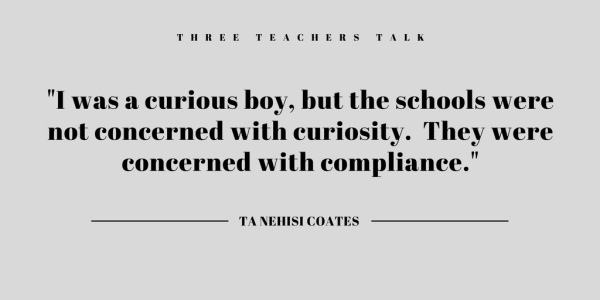
These students have been taught to be compliant their entire educational career.  Sure, it is necessary to be compliant in terms of respect, but if you are ONLY EVER compliant, you’re being robbed of the best part of learning: Recognizing you can push your mind further than you ever imagined.

I want an engaged classroom.  You want an engaged classroom. Oprah wants an engaged classroom.  EVERYBODY WANTS AN ENGAGED CLASSROOM.

So if compliant and engaged classrooms both get work done, what’s the difference?

Engage: (v.) pledge or enter into a contract to do something; establish a meaningful connection with.

Did you catch that?

To engage means to commit and connect.  That doesn’t just change classrooms, it changes lives.

So why is it so hard? Commitment and connection don’t come through passivity or apathy, they require effort and exertion.  They require pushing past the point of comfort (for both students and teachers), and sitting in the pain–not because you want to, but because you committed to it.

As we discussed why a classroom should not be all fun, Andy had an enlightening thought.  He said, “I think the problem is, any time you take part in something, you’re sacrificing something else.  I think a lot of students are afraid to sacrifice their own comfort to make a connection with someone.  There’s always the risk, too, that you won’t connect, and then it’s like you lost twice.”

Sometimes I forget the amount of fear that exists in the classroom on a daily basis.  Commitment asks us to sacrifice the easy path.  Connection asks us to say goodbye to selfishness.  All of this has to take place before engaged learning can happen!

It takes a straight up ninja to pull that out of every student in every class period!

We ended this mini-unit with a Socratic Seminar.  I love me some good structured talk.

PTT5

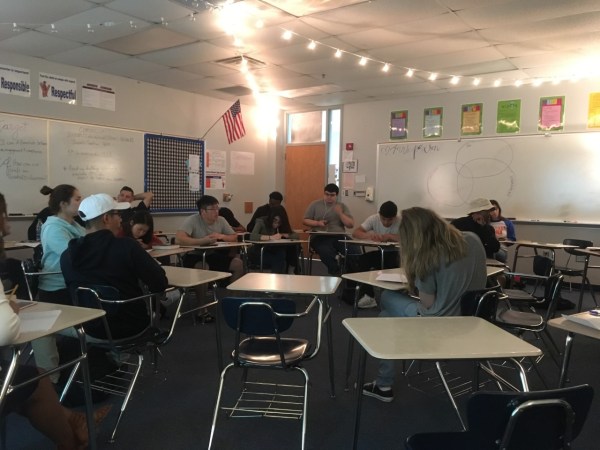
2nd Period Preparing for Socratic Seminar/Live Tweeting

What is the purpose and direction of our learning?  How can we make our classroom a space of authentic dialogue and engagement? (Question credit goes to my emergency lesson-saver, Shana.)

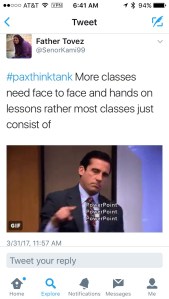
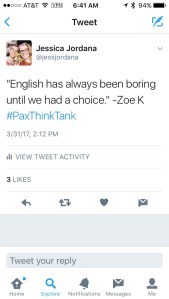
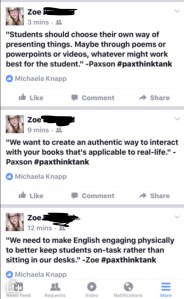
Zoe said she never liked English until she had choice.  She also said she wanted to do more talking about books in a way that connected with her classmates and what they were reading.

Dee said she enjoys higher level thinking.  What might happen if _____ happened to someone you know?  Would you handle things the way this character did?  What would you change? (Her suggested questions.)

4th period agreed they would like to deal with real world issues, and have choice in how they present their findings (poetry, video, podcast, etc.).

2nd period explained it should be about the learning, not about the grades, but it’s been that way for so long that they don’t know how else to operate.

Grady said, “School gives you a chance to do something great with your life, but you have to DO SOMETHING to be great.”

Shahin said, “Compliance is a downfall because you just follow orders and don’t think for yourself.  It makes it to where you will always need a boss, or you won’t know how to operate.”

PTT1PTT4

PTT2PTT6

Listening most often leads to learning, and I sure learned a LOT last week! Thanks for the ideas, #PaxThinkTank!!

Is your classroom one of compliance, engagement, fun, or a mixture?  How do you communicate with your students what you expect from them each day?

Jessica Paxson is an English IV and Creative Writing teacher in Arlington, TX.  She frequently feels as though someone made a mistake in allowing her to hold the futures of over 100 teenagers in her jittery, over-caffeinated hands for the past two years.  If you enjoy watching her make a fool of herself by being unbearably vulnerable, you can catch more of that over at www.jessicajordana.com. Follow her on Twitter or Instagram @jessjordana.


10 Things Worth Sharing Right Now

I love the little ripple of a thrill that runs through to my fingertips when I find something that I want to share with my students. That borderline codependent excitement that comes with wanting to share a book, an article, a statistic…immediately.

“They NEED to see this,” I think, fumbling around on my phone to figure out how and where to save it.

“They NEED to read this,” I say to my husband, as I make him pause his own life to listen to yet another passage of my latest read.

“They NEED to know about this,” I mutter, linking wildly to our syllabus (just another in a long line of moments where I’m grateful that life happens and we share it in class).

So today, I’m taking a page from one of my newest obsessions, the newsletter put together weekly by the brilliant, inspiring, and wildly creative, Austin Kleon. Each week, delivered to your inbox, arrives a list of “10 things [he thinks are] worth sharing.” Simple. Intriguing. Very, very useful in the classroom.

I’m honestly not sure how I stumbled on this one, but in the month since subscribing, I’ve used three of his images to inspire quick writes, and book talked (loosely) the newsletter itself, suggesting to students that they should subscribe in order to broaden their horizons to current happenings, inspiring visuals, and commentary on books, shows, and cultural phenomenon. In other words, link up to something that delivers items to keep you reading texts other than social media updates (“Made a sandwich guys…bet you’re all jelly. Get it? Jealous, but jelly instead.? God, I am such a genius”).

  1. Austin Kleon’s Weekly Newsletter
    Kleon reflects on a central image each week, along with linking to intriguing articles, a poem of the week, ear candy audio, eye candy visuals, and other noteworthy insights from across the vast expanse of the internet. If someone comes up to you and says, “Hey, did you see…?” chances are Kleon will have it linked on his list for the week.
  2. The Power of Exemplars
    A few weeks back, I was bemoaning to my fellow Three Teachers Ladies, how disappointed I was in a recent project my sophomores had completed. My vision for a poster that brilliantly illustrated their insights on their latest reading, was met with large sheets of paper with haphazard cutouts of text, crudely taped across the page, accompanied by printed book covers in black and white, and the occasional hurried pencil addition to the project (last minute insight for forgotten components). Needless to say, I was frustrated AND without any way to hold students accountable for the quality of the visual they submitted (not the central point, for sure, but a consideration certainly). Take pride in your product, and all that, had fallen short. In my irritation, I searched in vain for something in the Common Core that might suggest students consider carefully how they convey their ideas.

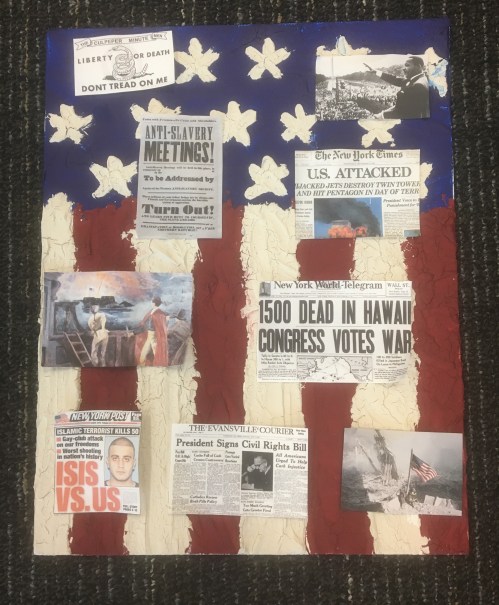
    Then, I took a deep breath. I realized I had what I needed, I just hadn’t used it. See below the power of exemplars. My AP students were completing their community visuals (which I wrote about last year in a reflection on the use of essential questions), and I had no rubric for this work either. However, the power of suggestion, in showing them some of the brilliant work from the year before, was more than enough. They knew the expectation, saw what I thought was praiseworthy when it comes to presenting their insights, and we enjoyed some brilliant symbolism in the presentation of these visuals. Amen.
    img_1163

  3. Musical Genius
    One of my groups took a creative leap for their community unit visual and put together a musical. Franklin’s production of Joseph and the Amazing Technicolor Dreamcoat opened this past weekend. Several members of the cast in my first period class asked if they could complete the project in a slightly different way. Their project would still include analysis, present their ideas to the class, and involve audience feedback after the presentation, but…there would be singing.

    img_1092

    Francesca, Joe, and Parker

    Since I always joke with my kids about presenting their ideas through interpretative dance, this musical idea intrigued me. Their mini musical included several skits that detailed life within the community of a musical cast/crew. Watching students sing their way through a summative, I was reminded that my vision for a project is rarely as broad and brilliant as what students can come up with on their own. My exemplar pool had just expanded in verse.
    img_1095

  4. Bag o’ Books
    Remember to beg for books. Want to build that classroom library? Get down on your knees and remind your students of how good it feels to give back…to you.Maija recommend the book Dangerous Minds a few weeks back. When a fellow student was at the bookshelf looking for it the other day, I asked Maija if she’d be willing to bring it so, AJ could borrow it. I even turned on a sweet smile and said, “If you don’t need it anymore, I’d be happy to take it off your hands.”

    The book was outside my door the next day, in a bag with a sweet note and several other books. Score.

  5. Amy Poehler on Writing
    I’m training for a half marathon. Without audiobooks, I might not make it. Seriously. I need to get lost in a story to pound out the miles. So, when I started 10 miles on Sunday and realized my Overdrive audiobook had expired, I had to quick download something new. Ugh.Enter, Amy Poehler’s Yes, PleaseI smiled for nine miles (it takes awhile to download when you’re actively running down the street). Poehler’s voice is sincere, relatable, and funny as all get out. Easy to book talk.

    Here’s the golden ticket: The Preface. I heard it and knew I needed to play it for my students. Poehler writes with undeniable voice about writing. She says of her text and the writing process that she “had no business agreeing to write this book” and wrote it “ugly and in pieces,” because “everyone lies about writing…they lie about how easy it is or how hard it was.” She says, and students really related to the idea, that “writing is hard and boring and occasionally great, but usually not.” In reflection afterward, students also noted her use of stream of consciousness, aside, and self deprecating banter to tell her story, not just inform her audience about what the book would be about. Classes agreed that they could really get behind her idea that, “Great people do things before they are ready.” Amen, Ms. Poehler. Let’s all put pen to paper.

  6. langchat#17
    I recently started following the brilliant Elizabeth Matheny on Twitter. Her AP insights and resources have helped fuel my work recently and her AP Language slow chat last week was a great opportunity to have my kids practicing analysis with students across the country. I’m thinking of several things to extend this activity:
    – Have students organize a slow chat for peers
    – Get students to live tweet peer feedback during speeches or discussion
    – See #7 below
  7. Tweeting Authors
    I tweeted Angie Thomas to tell her that her book The Hate You Give is stunning and I’d be getting into the hands of as many students as possible.She liked my tweet.Fangirl moment.img_1024
    Have your students reach out to authors. They often reach back.
  8. Creativity Visual
    I love what this suggests to students about the power they possess.
    img_1157
  9. Get it to the Big (or small) Screen
    My students often buy into the idea that great books are made into (sometimes great) movies. The Underground Railroad is being made into a series with the director from Moonlight. Having just finished this intriguing read myself, I book talked the text this week and shared the movie plans.
  10. Quick Write – Psychopath
    This came across my Facebook feed the other day, and I tossed it on my PowerPoint. As is the way in educator, my students surprised in noticing it, and we ended up doing a quick, quick write about changing social norms. AP Language test prep comes in many , many forms.
    img_1122
    What would make your list of 10 things we need to see and share this week? Add your ideas in the comments below! 

Lisa Dennis teaches English and leads a department of English educating gods and goddesses at Franklin High School near Milwaukee. She loves lists, especially lists with links to beautiful thoughts and ideas. Follow Lisa on Twitter @LDennibaum 

disclosure


Goodbye Days: a Craft Study and a Gorgeous Grand Slam

I love language. I love sharing my love of language with students.

When I read a book, I often dog-ear the pages, thinking of how I might use a passage to help my writers. Sometimes a book just does me in — so many beautiful words I cannot keep up. It’s a bonus if the story does me in.

Like Goodbye Days by Jeff Zentner. 30649795

If you haven’t read this book, oh, you’ll want to. Zenter’s first book, The Serpent King, kissed my soul. Goodbye Days took a hammer to it.

In a good way.

I started marking passages at page 36. I think because I forgot to think about it. Just read the first line of this YA novel:  “Depending on who — sorry, whom — you ask, I may have killed my three best friends.”

Mini-lesson opportunity one (whom), two (parenthetical with the dash), three (participial phrase), and four (voice)– all in one sentence.

The first time I really thought about using language from YA novels to teach my writers was in a class at UNH Literacy Institute taught by Penny Kittle. She showed us mentors of sentences and passages, pulled from the books she introduced to her students. She talked about how these craft studies also could serve as quickwrite prompts and book talks. A triple play.

Since then, Shana (who sat with me in Penny’s class) and I upped the ante:  some of our favorite mentors are hard-hitting home runs. But the following passage from Goodbye Days –It’s a gorgeous Grand Slam.


Excerpt from Goodbye Days by Jeff Zentner (p36)

     I feel like I’m watching something heavy and fragile slide slowly off a high shelf. My mind swirls with mysteries. The eternities. Life. Death. I can’t stop it. It’s like staring in the mirror for too long or saying your name too many times and becoming disconnected from any sense of yourself. I begin to wonder if I’m even still alive; if I exist. Maybe I was in the car too.

     The room dims.

     I’m tingling.

     I’ve fallen through ice into frigid black water.

     I can’t breathe.

     My heart screams.

     This is not right. I’m not fine.

     My vision narrows, as if I’m standing deep in a cave, looking out. Spots form in front of my eyes. The walls are crushing me.

     I’m gasping. I need air. My heart.

     Gray, desolate dread descends on me — a cloud of ash blocking the sun. A complete absence of light or warmth. A tangible, mold-scented obscurity. A revelation:  I will never again experience happiness.

     Air. I need air. I need air. I need air. I need.

     I try to stand. The room pitches and tosses, heaving. I’m walking on a sheet of Jell-O. I try again to stand. I lose my balance and fall backward, over my chair, thudding on the hardwood floor.

     It’s one of those nightmares where you can’t run or scream. And it’s happening to me this moment in the dying light of this day of dying. AND I AM DYING TOO.


What writing mini-lessons could you teach with this passage?

A Workshop Approach to a Whole Class Novel

I spent my President’s Day-Week vacation (the one that New York teachers and students get- yes, a whole week off for President’s Day!) scrapping my whole-class unit on The Outsiders and rebuilding it to reflect the values of a reader’s workshop.  First, I had to define my values:

read and write in english class


  • Choice in what we read and what we read “for” (information, entertainment, character chemistry, therapy, etc.)
  • Diversity in opinions, experiences, and interpretations
  • Engagement in ideas.  I always like to tell students that you don’t need to read to think, but a book can make you think something you haven’t thought about yet


I also had to define my teacher non-negotiables:


  • Reading for ideas. Students will be able to read a scene from a book and connect it to an idea
  • Tracking how that idea changes over time.  Students will be able to see how ideas unfold and develop over the course of a story, either by using a chronological progression to explain how an idea unfolds (At the beginning of the story… in the middle….at the end) or a more conceptual approach (At first I thought…. Then I realized….)


Here’s how a typical lesson on a typical day looks like in this unit:


  1. A visual reminder of what we’re reading for when we’re reading The Outsiders
  2. A mini-lecture on the chapter.  After I summarize the chapter, I choose a passage and my readers help me write an entry.  I make sure my passages reflect “small moments” of the book instead of the plot-heavy moments of the story to show how careful reading leads to intellectual rewards.  
  3. A group “crowdsourced” journal entry on my chosen passage. This requires a lot of fast, on-the-spot teacher thinking, as I will call on one student to begin the entry and another student to provide a follow-up sentence.  I like the idea of composing a paragraph in real time under real demands, because it allows me to ask the questions that writers should be asking when they write, like “What more can I say here?” and “Do I have any evidence to explain this idea?”  Later on, I post each class’s journal entry for other students to see and appreciate.  I emphasize that four different classes will have four different readings of the same scene.
  4. Time for individual journal entries on one of our four major ideas.  I invite students to post-it note possible scenes to write about as they read, through I don’t require it and I don’t encourage students to annotate as they read, either.  (Incidentally, my low-stakes approach to post-its has resulted in more student requests for more post-its than I ever thought possible.)  Most students have a scene or two that they want to take ownership of in their own notebooks.  Some students will continue the conversation we had as a whole class in their own notebooks, taking the scene I chose and adding something new to it.
  5. Time to share our thinking at the end of class.

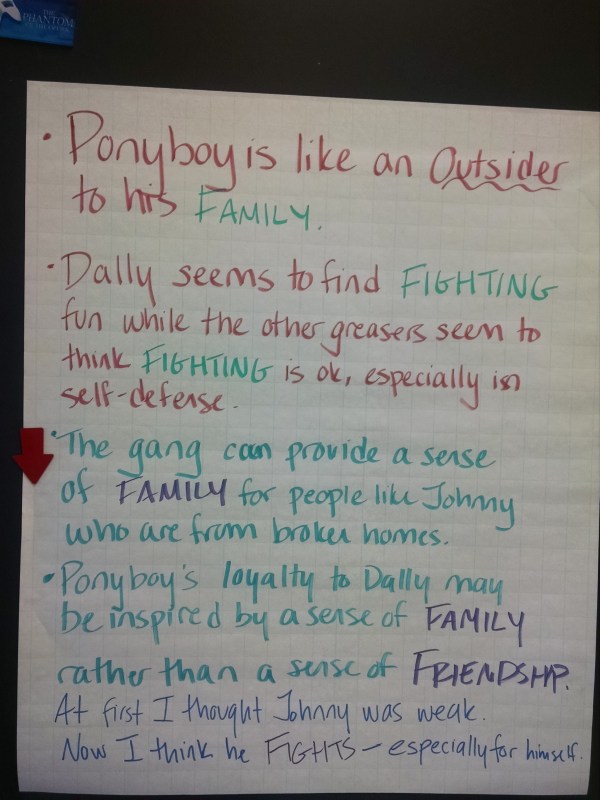
I also posting and tracking some of the “greatest hits” ideas, ideas that I know will inspire strong thesis statements once readers finish the book.  By the time students prepare to write an essay, they will have a menu of student-generated thesis statements along with their own thinking about the book to reflect on.

IMG_20170303_075827356

Adapting this teaching to other books.


I was thinking about how I might teach other works using the same approach.  Here’s one thing I’ll say to high school teachers in particular: if you try this, you’ll find yourself making careful decisions about what you really want students to know and what you will let them figure out on their own.   It means letting some “juice” of the book drop and appreciating that you won’t have time to discuss the importance of every reference with every student.


For example, if I were teaching The Great Gatsby, I think I would let readers encounter and interpret the Valley of Ashes and Dr. T.J. Eckleburg on their own.  I would want to instead focus on Nick’s first description of Gatsby as a quasi-Moses figure and the fact that he dropped out of St. Olaf College — small details that lead to powerful and enduring interpretations and ideas.


Some suggested ideas and topics for popular high school books:


The Adventures of Huckleberry Finn

  • Civilization
  • Friendship
  • Trust
  • #ownvoices (if you aren’t familiar with this twitter hashtag, look it up!)


The Great Gatsby

  • Sin and Religious Iconography
  • Money


Macbeth


  • Greed
  • Lies/Lying
  • Power
  • Dreams/Reality


How are you using workshop methods and thinking to approach whole class novels?


Amy Estersohn is a middle school English teacher in New York.  When she was in middle school, her favorite authors were William Shakespeare and Meg Cabot.  Follow her on twitter @HMX_MSE


What We Teach vs. How We Teach

We all struggle constantly to find balance in our classroom.  The demands of our students, our workplaces, our curricula, our standards, our colleagues, and ourselves are all but impossible to manage.

Generally, as a teacher, when I struggled with that balancing act, it looked something like this:

tumblr_ncvodo1Fg91saf2tdo1_500.gif

Yeah.  It wasn’t pretty.

Although I’ll probably never manage the perfect balance, I think I’ve edged a little closer to some sort of evenness through the process of tweaking, refining, revising, and rethinking how and what I teach.

I primarily do this by considering all things through the lens, first, of who I teach.

But I don’t think it’s enough to just say, hey, I know my students really well through lots of conferring and they know my expectations really well through lots of modeling and boom! learning occurs!

I think it’s really important to consider how and what we teach, too.

As a new teacher, I spent AGES pondering what I’d teach.  I was manic about designing thematic units, creating a complicated web I’d fill in before I introduced each central text, whether read or written.  I’d make sure I had some contemporary stuff and some old stuff, some poetry and some music, some fiction and some nonfiction.

My units were full of variety, that was for sure, but they all centered on classic books and pretty classic compositions, too–The Catcher in the Rye, a literary analysis; A Separate Peace, an argument essay.  I didn’t understand why students weren’t engaging with what I was teaching.  I mean, it was awesome!

Then I happened upon Alfie Kohn’s excellent article in Education Week, It’s Not What We Teach, It’s What They Learn.  I felt a little stupid, as I often do when I read Kohn’s matter-of-fact words–I picture him saying, duh, Shana. What you’re teaching doesn’t matter. You have to change how you teach it.

So, I threw myself into a focus on my methods.  How were students supposed to thrive if everything we did was so high-stakes?  How were they supposed to feel any agency or empowerment if they didn’t have as much choice as I did in their curriculum?

41v68aRP5UL._SX329_BO1,204,203,200_.jpgI did a lot of reading about the importance of how we do things.  Penny Kittle mentioned Dov Seidman’s How at NCTE, and I jotted the title down, thinking it was one my husband would enjoy.  I bought it for him, but ended up devouring it myself.  Thomas Friedmann applied Seidman’s principles to the economy; why couldn’t I apply it to teaching, too?

That was when I committed to full-on workshop teaching, and that was the year I experimentally abandoned teaching whole-class novels, too.  I liked a lot of the changes I saw in my students, but with my focus on how I was teaching, I felt that my curriculum began to weaken.  Units felt disjointed since I wasn’t spending as much time obsessing about what to teach.  Something intangible felt lacking.

I had to move back toward strengthening my curriculum, while maintaining the benefits of an added focus on my methods, in a new kind of classroom.

I realized that I needed to combine all three of those things to get closer to achieving a good balance:  knowing who I taught, thoughtfully considering how I taught, and carefully selecting what I taught.

It wasn’t enough to teach with a pedagogy of engagement if what I was teaching didn’t match who I was teaching.  Similarly, it wasn’t enough to design layered, high-interest units of study that featured reading and writing and talk and practice and joy if the things we read and wrote and talked about and practiced didn’t match what my students cared about.

With every lesson and unit I design, I struggle to find the sweet spot that balances who and what and how I teach.  Like all teaching, it will always be a great deal of work to find that balance–but being aware of the necessity of all three of those factors has without a doubt improved my practice.

Shana Karnes lives in West Virginia and teaches sophomore, junior, and senior preservice teachers at West Virginia University.  She finds joy in all things learning, love, and literature as she teaches, mothers, and sings her way through life.  Follow Shana on Twitter at @litreader or join her for the Slice of Life Writing Challenge here.

Can We Talk? The Silence is Killing Me.

Let me start by acknowledging the following : We all work hard.

Day in, day out, passionately, for hours outside the classroom, over breaks, through the night, in the summer, at the expense of our own health, sanity, and in some cases children, tirelessly, endlessly, hard.

We wrestle with accountability, making the right choices, bankrupting our personal finances, moving in new directions, providing substantive feedback, reinventing our curriculum, and capturing that often elusive “I’m making a difference” feeling.

And all of these opportunities, obstacles, maneuvers, struggles, negotiations, blessings…are well worth the effort. We know this to be true.

We grow. Students grow. The world brightens.

This week, however, a week of extra meetings, assigned readings, professional development planning, ACT Interim test data analysis, sophomore research papers and practice AP tests in all of my classes, has me feeling cranky, irritable, and disenchanted with the whole thing (and apparently listy, because I’ve got a lot of lists rolling here).

But it’s not all of these “bonuses” to my week that really have me in a funk. silence2
It’s the quiet.
The file in and file out of my classroom.
The silence of compliance.

My students have not been talking the past few class periods, and the absence of their ideas has me crankdified.

While it might seem nice to have a “break” to work while kids complete practice tests and independent study, it didn’t feel nice. It felt…empty.

It hit me last week during a discussion of Scott Brown’s “Facebook Friendonomics.”

We’re in a unit on community in AP Language and wrestling with the following:

What is the individual’s responsibility to the community? 

I had just read the piece aloud, asked students to respond to it in a quick write, and was now listening to a discussion on the author’s use of allusion. Brown suggests that the natural evolution of friendships is corrupted by social media.

The discussion was not initially brilliant. Students wrestled with some examples of allusion that meant nothing to them (the author details contacts in a Rolodex, quips about watching 90210, and references Garbage Pail Kids), so I suggested we try to update references, eliciting an enthusiastic walk (dance) down memory lane for my seventeen year olds, back to Pokemon cards and “Soulja Boy” (Ahhhh…2007).

As I listened to them reminisce about cultural touchstones in their lives, I had to smile.

“So, what is this author trying to tell us about community?” I asked.

Our discussion continued for another few minutes, encompassing author craft, the existence of Finsta (I am suddenly SO old), the unnatural qualities of social media “friends,” and the duality of both fake and fulfilling relationships through online communities. I sent my students back to their notebooks and they reflected a bit further on how discussion had expanded their understanding of the ways this piece answered our essential question.

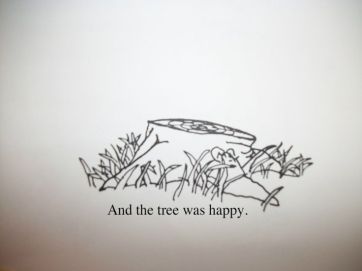
And I…was happy. tree
I had listened, mostly. Invited a few students into the discussion who hadn’t shared. Pulled us back to the task at hand.

But I had let them talk. No agenda. No time limit. No right answers.

Now, I’m not here to suggest that having a discussion with your class is revolutionary. Obviously it’s not, but it occurred to me:

My individual responsibility to this community is to keep my students talking.

And while I’m on this soapbox (it’s not my preferred method of communication, thankfully, but I sort of like it up here), I’ll say it another way:

We need to listen. More.

Educators the world over, both seasoned and virginal, know, but all too often forget (so guilty myself), that the talk in our classrooms that is most vital to engagement, progression, retention, and overall enthusiasm for learning, is not our own.

Facilitated and guided by the teacher – yes.
Framed by objectives, teaching points, and standards – of course.
Aimed at gradual release – ideally.
Supplemented with our insights, passions, and ideas – I certainly hope so.

Talk to their small groups, talk to the class, talk to me, talk to their notebooks, talk about talk. It’s all talk that can promote discovery.

We need students talking, not just to check comprehension (flashback to the initiate, respond, evaluate cycle of classrooms I grew up in), but far more importantly, to develop their thinking.

My modeling and guided instruction is far more beneficial in the long run, as the goal of each is to get students involved in a way that has them taking the torch and forging ahead on their own.

That’s where the emptiness of this past week had come from. We weren’t involved in anything together, and I felt the absence of the interaction keenly.

With the testing behind us and the research papers waiting patiently for another hour (or seven hours, if my calculation for that stack is correct), I conferred with several students during reading time, to selfishly feel better myself. During our quick write, I sat down at a table with my kids and wrote, as opposed to staying at my desk. I started several writing conferences during workshop time with, “Tell me about…”

I’m not in any sort of denial that what I’ve written here is new or different in any way,  but I am certain that the reminder did me good. I hope it does for you too.

Let’s talk about talk in the comments below. I’m a good listener. 

Lisa Dennis teaches English and leads a department of English educating gods and goddesses at Franklin High School near Milwaukee. She loves to listen to the Decemberists, the call of redwing blackbirds, and audiobooks read with British accents. Follow Lisa on Twitter @LDennibaum 


Will You Share Your AP Scores? Here We Go Again

I am not mean very often, but last week I was mean. Okay, not mean exactly, but certainly snarky.

I friend asked me about my AP scores. Innocent question. Struck a nerve.

I’ve written about AP English and AP test scores in the past, and I imagine as long as I teach AP English Language and Composition, I will continue to do so. I really do not mean to be snarky, but the more I talk with kids about their reading lives, the more I keep hoping more and more teachers Aim Higher — not just in AP classes, but in all English classes.

In the signature line of my school email, I include this quote by Emerson:  “We aim above the mark to hit the mark.”

I like that it helps me focus on what matters in my practice:  Teaching beyond a test. Always teaching beyond a test.

So what does this look like in my practice? Mostly, it looks like helping readers find their way back to a love of reading. After all, the best readers are usually the best writers, and the best readers and writers are usually the best test takers.

When Jessica asked me about my test scores last week, I know she was just working on building a case for choice books on her campus, a case for a workshop pedagogy. And while my scores did improve 50% the first year I moved to readers-writers workshop, no testing data captures the learning that happens in my classroom. No data shows an accurate picture of my students’ growth as readers and writers.

See for yourself:

For our midterm last week, my students wrote self-evaluations of their reading lives. Their words are much more valuable than mine when it comes to adding weight to the debate for time to read and choice of books in all English classes.

Leslie is a talker. She speaks with a beautiful Spanish accent and loves to use the new

LeslieandGiselle

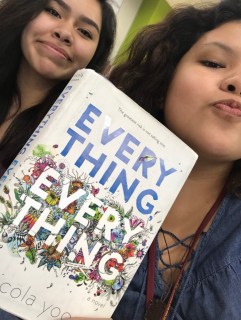
Giselle and Leslie, Nicola Yoon fans, dying for the movie!

vocabulary words she’s studying. I often have to hush her table because these girls like to talk about what they are reading during reading time. The fuss over Everything Everything by Nicola Yoon is on-going. They LOVE that book! Leslie writes:

“My reading goal for next nine weeks is seven books, I want to reach my reading goal and I will make it happen by reading more and do it because I enjoy it not just because I have to do it. I can gladly say that I love reading now, back then I used to be allergic to books and never touch them to read the beautiful stories that they have inside their covers.  After I become the perfect reader I intend to become the perfect writer.”

Giselle’s list of books she’s read so far this year reads like a spine poem. When she writes about whole class novels, she means our book club titles. I use book clubs to push many students into reading more complex books.

Lissbeth has been in the U.S. for three years. She titled her post “No Excuses for Not Reading.” My favorite line: “One of the things that I have learn thanks to my English teachers, is that reading is not just something you do for entertainment, it can also become a lifestyle.” Of course!

image2

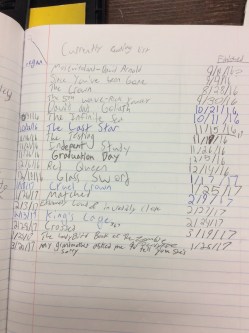
Audrey’s Currently Reading list

Already a reader when she entered my class, Audrey explains her reading experience since last August:

I have learned some about myself as a reader. I’ve learned that I like to stay in my reading comfort zone, but with a little nudge I’m able to read other genres and enjoy it. I’ve learned that I’m always growing as a reader. My reading rate can always improve. My vocabulary can always improve. As a reader I know that with due time, and with a lot of reading and determination, I can read ANYTHING!” [Note: If you read Audrey’s full post, when she mentions me giving the class a list, she’s referring to our book club choices. I do not have a list of all the books in my classroom library.]


Some students are in my block class, so I’ve only had them since mid January.

Cheyenne, who has read 14 books since the beginning of the semester, feels pretty strongly

blogger2bpt2b5

Cheyenne’s book stack

about the whole class novel. She writes: “I definitely have a deep dislike for class novels. This has more to do with the fact that I hate being forced to read certain books by certain deadlines, for me, it defeats the thrill, if you will, of reading the book in the first place.”

This year was the first time since middle school that I have been excited to read in class, and that was because we weren’t assigned a class book to read and we got to choose a book we wanted to read,” Rachel writes.

If you don’t believe some students lose a love of reading because of school, ask them. Ask them questions about what happened. Every kid I know was once an excited reader. Few are when they get to me in 11th grade.

Reghan confirms this in her post. She writes:

From elementary school through middle school, I read every kind of book, big or small. From nonfiction books about the unsinkable, sunken ship: the Titanic, to fantasy books about alternate universes and dystopian societies, I was a reader.

“Until my freshman year of high school.

“Ninth grade wasn’t easy for me. A lot went on that year with my family and personal life, causing me to be unfocused on school, my grades, and reading…and my transcript made that very obvious. I don’t think I read even one book in that entire year, summer included. This carried into my sophomore year, as well as part of my Junior year too. Zero books read, many to go.

“Being in AP English this semester and having to work hard to stay afloat has helped me tremendously and it wouldn’t be possible without my teachers . . . I’ve read four books this nine weeks including: Paper Towns by John Green, Will Grayson, Will Grayson by John Green and David Levithan, Extremely Loud and Incredibly Close by Jonathan Safran Foerand Sharp Objects by Gillian Flynn and I’m on my fifth: Columbine by Dave Cullen. That’s more than I’ve read in the last three years, combined. I’ve been introduced to books that I’ve never heard of and books that I never would’ve picked on my own. In fact, thanks to our assigned book clubs, I now have a new favorite book which is the aforementioned, Extremely Loud and Incredibly Close.

” I credit Mrs. Rasmussen with my progress because of her belief that we as students are more likely to read if we’re choosing books that we want, not that our chosen for us. In my experience, any book that has been chosen for me by a teacher, has been uninteresting and/or hard to finish. Being able to choose has only helped me and there’s proof in the numbers. Not only has this freedom improved my desire to read, but it has showed me who I am and what I like as a reader.”

And then there’s Ciara, who wrote “The Oprah Winfrey (with a little twist) Show.” Here’s a reader I am still working on, but oh, her writing voice. And her taste in TV shows! (We’ve bonded lately over quite a few.)


So in a post with AP test scores in the title, I give you a post about what students have to say about their reading lives.

That’s gonna be my answer every single time.

I happen to be assigned to teach AP English Language and Comp, but what I teach is how to love reading to students who miss it. Most of them miss it.

What are you doing about it?


Amy Rasmussen lives in north Texas and teaches AP English Language and English 3 to the Fighting Farmers at Lewisville High School. She also facilitates professional development for other teachers making the move into a workshop pedagogy. She adheres to the words of Emerson: “We aim above the mark to hit the mark,” and Jesus Christ: “Love one another.” Imagine a world if we all love more than we think we can. Follow Amy on Twitter @amyrass.

PD Book Review: BETWEEN THE LINES by Michael Anthony and Joan F. Kaywell

Between the Lines by Michael Anthony and Joan F. Kaywell is frank teacher-to-teacher talk about how you can run a reading/writing workshop in a high school environment even when school administrators aren’t invested in “low-brow” reading.  This book is the pep talk you need if you want to steer your classroom towards workshop but are tied in by constraints.


This book lays out the following:


  1. Ways to fit in independent reading and writing inside a highly scripted (and highly controlled) curriculum.betweenthelines
  2. How to talk to administrators about the value of the work.
  3. Example lessons and Common Core-aligned activities centered around independent reading.
  4. Suggestions for connecting independent reading to whole-class novels.
  5. Models of authentic student responses …. And examples of “phony, lookalike, and limited letters.”
  6. Examples of teacher prompting, and means of assessment.
  7. Specific advice for building up classroom libraries.
  8. Detailed appendices of awards for YA books to follow and popular YA books for classroom library collections.  (This list is almost 20 pages long!)


The implications are clear: even if there are a lot of things in this book you can’t do, there is something here that you can incorporate.  Can the movie on the day before vacation and do some booktalks or play some book trailers instead.  Spend less time reviewing quizzes and more time sharing reading responses.  Be proactive about book donations and procuring used books.  Talk to administrators about repurposing homerooms and study halls as time for independent reading.


Since Anthony and Faywell’s attitudes are all about flexibility, I would add three considerations to any teacher using this book to implement new routines around independent reading and writing:


  1. Anthony and Faywell ask students to fill out reading logs and include a signature from an adult who is accountable for that reading.  I feel iffy on logs to begin with, and even more iffy on asking teens who are old enough to drive for an adult “reference” for their reading progress.   Adult signature gives an air of “I don’t trust you” and “You are not yet fully responsible for your own growth.”
  2. Anthony and Faywell’s reading accountability is based on peer-to-peer correspondence and peer-to-teacher writing.  Casual correspondence is lovely, especially if you do not have time to confer with readers.   However if writing were the only way I was holding readers accountable to independent reading, I would think about opening up the reading response beyond just I think/I wonder/I notice approaches to new genres and styles.  If you are already committed to teaching impartial literary analysis and other “old school” writing modes, why not open it up when it comes to the fun stuff?  Why not invite the reader to become creative and revise the ending or to be critical and write a review?  Why not retell part of the story from another character’s point of view?  Why not allow for students to journal about reading and their feelings towards reading?  Why not write a comic?
  3. I would have liked to have seen more attention to graphic novels and magazines in this book, as these texts include valuable reading experience and are closer to the brain candy that teens are likeliest to reach for once they leave our classrooms.  


Amy Estersohn is a middle school English teacher in New York.  Her best reading experiences as a kid happened without adult knowledge or supervision.  Follow her on twitter at @HMX_MSE