We all love those days when everything goes perfectly. I’m not talking about getting your grading done and entered, sending all the emails you meant to send, or making sure you’ve made the requisite parent contacts.
I’m talking about days where your lesson planning paid off and the students engaged in a meaningful learning opportunity. Think about those days where the kids work bell to bell and it feels like all you did was confer with as many writers as possible (Amy wrote about the importance of conferences here). I’m slowing building toward a place where this happens more and more and it’s both exciting and rewarding.
Teacher Book Talk:
Maja Wilson’s book, Reimagining Writing Assessment: From Scales to Stories, is introducing me the ideas of John Dewey, someone who’s thinking I need to know more about. Its also a well-written book with some amazing insight.
When talking about Dewey’s phrase, “growth in the right direction,” Maja suggests, “I have to be transparent about my primary aim: the healthy and sustainable growth of young writers within an inclusive and equal democracy.”
….Um, wow.
Growing young writers….within an inclusive and equal…democracy.
Lesson Talk:
Our English IV classes are investigating research through several modes this year. We’ve read, talked about, and written: Letters to the Editor, Op Eds, Infographics, and now we are looking at TED Talks.
I wanted this exploration to be as pure to the workshop pedagogy as possible. Instead of giving them an anchor chart or watching a TED Talk as a whole class, I asked them what they already knew about the medium and invited them to create a list of traits they looked for when consuming media. Each class period was slightly different in what appealed to them and what they wanted to see in a TED Talk. Of course I guided them through this process of discovery, but one way I formatively assess them is by noticing what they already know and planning my lessons around filling in the blanks or extending their experience.
We laid the ground work of noticing by accessing our schema and I set them loose to seek out TED talks that appealed to their thinking. The students engaged themselves in media that appealed to them. They wrote about what they saw in their self-selected TED Talks that engaged the media as learners. I gave up control and gave them choice.
Of course, our forward looking thoughts aren’t just towards making us more savvy consumers of digital media. Our thoughts should guide us toward being savvy producers of media as well.
Growing young writers….within an inclusive and equal…democracy.
By late February, the seniors at my campus will produce a research project. The fun part is that they will have choice in how they publish it.
I think the choices that we made as teachers are facilitating the, “sustainable growth of young writers within an inclusive and equal democracy.” I’m proud of this work. I’m also thankful for the teachers I have the pleasure of working with every single day.
How have others set free their students to explore their place in our democracy? What are other modes within which we can explore the research process? Please share your successes; they are powerful.
Charles Moore has now totally lost control over his book spending habits. So much so that the cashiers at Barnes and Nobles don’t even ask for his teacher discount card and Amazon chose his house for their newest headquarters. He loves the sound of a classroom full of readers and he likes to imagine word counts ticking higher as they hover above the students’ heads during reading time. His sometimes humourous musing can be viewed on his twitter page @ctcoach and his embarrasing short form poetry and, eventually, book recommendations are on instagram @mooreliteracy1




 ne of our central texts for the institute was Pose, Wobble, Flow by Antero Garcia and Cindy O’Donnell-Allen. This text makes lots of wonderful arguments for teachers to inhabit “poses” as more thoughtful, authentic practitioners through the metaphor of yoga. The idea is that when we try new things as teachers, we are trying to get into a pose. We inevitably wobble as we try to master this new stance, but eventually attain the flow characterized by doing this pose without thinking.


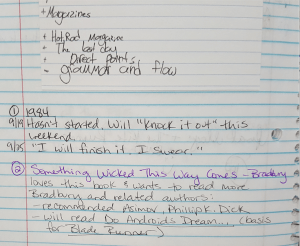 On the left-hand side, I pasted in a notebook card that students filled out on the first day of class with information about their favorite genre(s) of books, their favorite book, their least favorite book, one writing strength, and an aspect of their writing which they wanted to improve. Below this card, I kept a record of reading conferences with the student. Here, I not only kept a list of what books students read, but I also jotted down notes during our conversations about the text.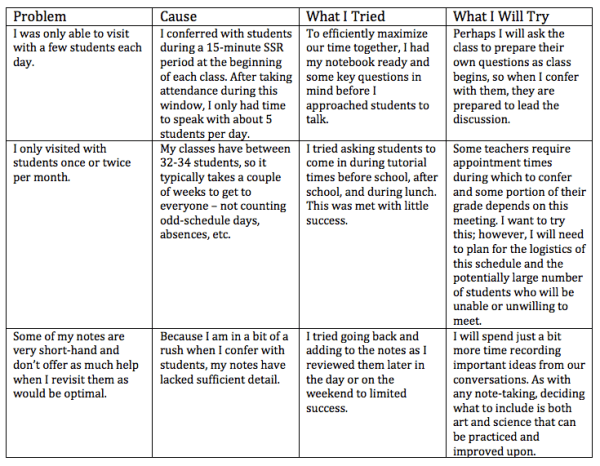


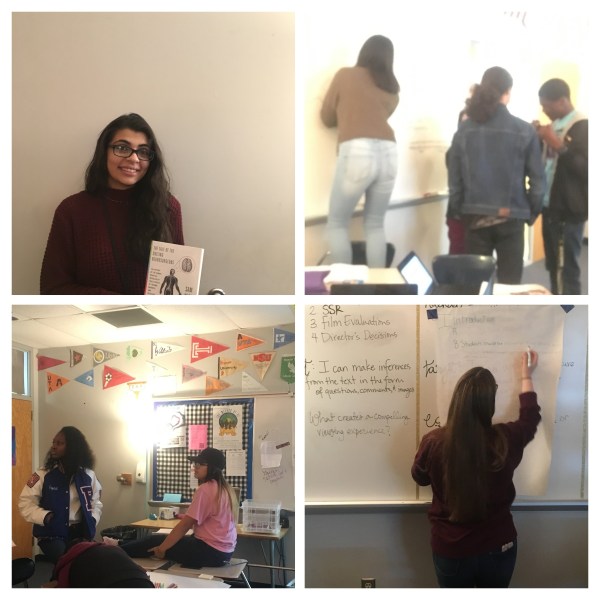 There were about two weeks of school when we came back that I wondered if I was doing something wrong. It seemed like I had WAY too much time on my hands, and I wasn’t quite sure if I was just forgetting about responsibilities, and therefore shirking them in some way, or if I actually was managing my time better.






 Three Teachers Talk