Category Archives: Shana Karnes

Designing a Unit in Workshop: Just Try It

The NCTE Annual Convention begins this week, and as always, its onset has prompted me to try and synthesize a year’s worth of thinking around one pressing topic.  What I’ve been considering this year is the value of units of study within a workshop classroom–the hows and whys and what ifs of planning for complex, themed units.

So, we know that teachers who engage in a workshop classroom often have many of the same routines in their schedules:  time to read, time to write, time to talk.  They often have many of the same components:  mini-lessons, booktalks, mentor texts, conferring.

These are all good things.

They are all engaging practices on their own, but to take on real power, they need to be strung together, applied again and again, over the course of units of study and throughout the year.

When I work with teachers who are diving into the workshop model for the first time, I model as many of these components as I can.  Teachers are engaged–they write, they read, they look at the craft of poetry, they analyze articles.  They are energized and enthused to try these strategies with their students.

But every time, I see one smart teacher, her brow furrowed, her face concerned, in the back of the room.  She tells me, either in person or on her evaluation card:  I don’t see the rigor in this model.

And she is right.  In one day’s work, students are only advancing incrementally.  If we just have fun every day playing with words in our notebooks, listening to podcasts to study their craft, or doing book passes ’til the cows come home, our students are not growing by leaps and bounds as readers or writers.

And that’s where designing strong units of instruction comes in.

Whether it’s reading or writing instruction, harnessing the daily moves of a workshop routine to build toward an authentic product is where rigor lives.

I like Kelly Gallagher’s words to sum up the idea of starting at the end when designing a unit:

Screen Shot 2016-11-14 at 9.53.49 AM.png

Begin by thinking about what you’d like your students to achieve.  Did you just hear an amazing commentary on NPR?  Wow, what a great writer that guy is–I want my students writing like that.

Start with your vision.  That’s where you begin.  Then you ask yourself:  what do my students need to know in order to write like that?

That’s where the workshop routines come in:  booktalk examples of strong nonfiction writing.  Teach mini-lessons that get at the craft of strong commentary writing.  Flood your students with mentor texts, both published pieces and each other’s work, so they can see both the process and the product.  Let them experiment with drafts in their writer’s notebooks–lots of ungraded, low-stakes practice should live there.

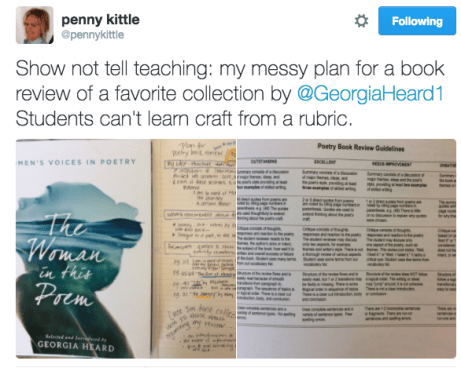
At the end of the unit, don’t destroy all of your hard work by trying to “grade” everything objectively with a rubric.  Our beautiful mentor Penny Kittle sums that up nicely:
Screen Shot 2016-11-14 at 10.06.44 AM.png

When best drafts land on your desk, ask:  how do I know students achieved what I wanted them to?  Utilize self-assessments, celebrate the writing, respond authentically.  Consider how each student advanced individually.

Our students deserve high quality instruction that offers them choice, volume, and authenticity.  They deserve units that will allow them to continue to build on their constantly-increasing mastery of their reading and writing skills.

I’ll be sharing more about planning units in an Ignite Session on Saturday morning, from 9:30-10:45, in room A412.  

And I’ll discuss how and why to build rigor into your workshop units in more depth on Sunday afternoon, from 1:30-2:45, in room B211.

Will you be at NCTE?  Please let us know in the comments.  We would love to meet you!

If you can’t make it to Atlanta, you won’t be missing out–tune in to Twitter using the hashtag #NCTE16 during our session times to join the conversation.

 

Mini-Lesson Monday: Great Sportswriting is Worth Two Reads

In fifth grade, I attended a writing workshop with sportswriter Paul Daugherty at the helm.  A columnist for the Cincinnati Enquirer, he encouraged we wee ten-year-olds to think about how we might revise more quickly and do our prewriting in our heads.  He spoke about his experiences writing half a story while watching a game unfold, sometimes being tempted to write the ending before the ending had even occurred.  At age ten, I found him eloquent, mysterious, and inspiring–I decided then that I wanted to be a journalist.

Although I dropped my journalism major after one year in college, I still enjoy Daughterty’s columns in the Enquirer and occasionally Sports Illustrated.  And as an adult, I see his process in his product.  The craft of Daugherty’s writing is one of the things that made me enjoy sportswriting, and now, strong pieces about America’s most-loved athletic pastimes are some of my favorite things to read.

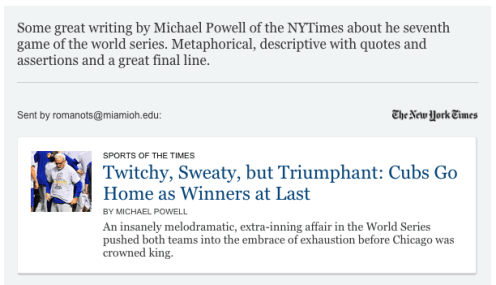
So, when Tom Romano sent me this piece from the New York Times, I thought immediately of how students would love the “metaphorical, descriptive” writing “with quotes and assertions and a great final line.”

Screen Shot 2016-11-07 at 5.56.48 AM.png

Tom Romano’s great description of this piece in the Times.

Objectives: Identify patterns in the author’s writing to characterize his voice; find where the author cites evidence that supports his claims; infer the writer’s process; apply concepts of writer’s voice and strong argument writing to your own nonfiction pieces.

Lesson:  I’ll distribute copies of “Twitchy, Sweaty, but Triumphant” by Michael Powell for students to read, but I’ll also have the piece projected on the Smart Board so kids can see the great accompanying photography.

Because ’tis the season of moving past narrative and into nonfiction writing (in which we often harness the power of narrative, by the way) students will have already been immersed in a study of making claims supported by evidence, crafting a clear and purposeful structure, and maintaining a voice and style that defy the conventions of a five-paragraph you-know-what.  This article will serve as a mentor text that features all three, plus some insight into that long-ago lesson I learned from Paul Daugherty: the speed of a sportswriter’s process.

“We’ve been studying a variety of nonfiction pieces that have great style as well as strong claims–commentaries, columns, and speeches.  And here’s another example of those traits in this sports article.

“As you read it, look for the writer’s voice and the way the writer makes claims and supports them with evidence, as we’ve been doing throughout this unit,” I request.

We take ten minutes to read through the article, annotating quickly and noting writerly moves that jump out at us.  I model on the document camera, noting what I see–the unnamed players throughout the first paragraphs of the piece, creating a universal scene; the sheer entertainment of his vocabulary (words like gluttonous, beatnik, facsimile that you wouldn’t expect in a sports article); his unique turns of phrase.

I then ask students to share in table groups what they noticed about craft and claims.  After they share and we debrief, I return to the article.

“One of the things I find fascinating about sportswriting is how quickly it has to happen.  The turnaround is so quick–we spend a few weeks polishing pieces of this length, but these writers only have a few hours.”

(In keeping choice central to my curriculum, students always get to choose either their process, genre, or topic.  Because in this unit students are constrained to one genre–nonfiction–I will make an effort to help them choose their own topics and processes.  That’s wisdom I gleaned from Writing With Mentors.)

“I want to consider the writer’s process, and I found some good evidence of it:  let’s look at Powell’s tweets from during the game.”

I pull up Powell’s Twitter account and we scroll down to see his game-time tweets, many of which contain some of the same phrases  in the article: the Dead End Kids, the Lackawanna freight train rolling through, the pitchers being gassed.  Students notice these unique phrases immediately.

“What could you infer about Powell, given that this game ended at around 1:00 am and his piece ran at 9:00 am?”

I elicit students to share:  “He was already writing a bit during the game.”  “He writes sports all the time so he can already pull up a lot of the jargon quickly.”  “He really loves his subject, since he’s up watching the game and tweeting and having fun with it.”  “He’s knowledgeable about the history of these teams–maybe he did a lot of research beforehand or maybe he just knows it from writing about it a lot.”

Now, students have painted a picture of the piece’s author.  We can go into the reading warm, not cold.

“So, let’s read again, and consider his process this time,” I ask.  “Look now to see how his tweets–evidence of his prewriting–are in the article and what that teaches you about his process.”

We read the article again, a fresh purpose for reading helping us see the writer’s process come to life.  Once we’ve finished, we talk in table groups and then debrief as a whole class about the evidence we see of Powell’s writing process based on his tweets and what we know about sportswriters as a group.

These two reads give us three things:  another example of writer’s craft, more examples of claims with supporting evidence, and an example of process.

BN-QP490_2PgCZ_M_20161103011549.jpg

I love this great photo of the Cubs’ moment of triumph from the Wall Street Journal. 

Follow-Up:  After students read this piece, there are many opportunities for follow-up.  One is to simply have them apply its writing lessons to their own nonfiction pieces.  Another is to have a lengthy conversation on writing processes, and how they can be short yet incredibly effective–students can see that prewriting doesn’t have to take the form of a web or an outline, but that it can be tweets, too.

Daugherty’s work, the now-defunct Grantland, and The New York Times sports section are some of my favorite places  to find great sportswriting.  What are some of your favorite resources for finding great nonfiction for your students? Please share in the comments!

11 Nonfiction Titles to Use Across the Curriculum

We’ve been saying it for years–teaching reading isn’t just the job of English teachers.  In an ideal world, it is a nationwide cultural endeavor to produce a literate citizenry who is both able to decode words and passionate about responding to their meanings.

The Common Core, for all its flaws, attempts to get students there–the standards say that kids should be reading 50% nonfiction altogether (that’s not just in English class; it’s across the curriculum).  In that vein, here are 11 nonfiction titles that could be used across the curriculum–or booktalked by any teacher in an English class.

img_5198Science

The Double Helix, a fascinating biography by one of the discoverers of DNA, hooks me every time by bringing the textbook personas of Watson himself and his partner Francis Crick to life.  Many of my students interested in a career in the biological sciences were hooked by this text immediately.

Being Mortal forces the reader to ask some tough questions–should I really prolong my life as much as medicine enables me to, through decades of pain and suffering?  Or does that run counter to the human spirit?  Gawande uses all of his knowledge as a practicing surgeon to get the reader to question the industry that is medicine.

Into Thin Air, an oldie but a goodie, is Jon Krakauer’s harrowing first-person account of the deadliest season on Mt. Everest in history.  Its early promise that most of its characters would soon be dead grabs my students’ attention every time.

A Short History of Nearly Everything, aka the longest but most interesting book about science ever, explains everything I never understood about the subject from The Big Bang to the possibility of someday colonizing Mars.  Students are always wildly impressed when I flip through the list of Bryson’s references in the back.

Social Studies

Hiroshima is John Hersey’s unflinching masterwork, a journalistic symphony of six survivors’ stories of the dropping of the first atomic bomb.  It is powerful and devastating and horrifying and beautiful all at once, and just reading the first page aloud to students gets them wide-eyed and entranced right away.

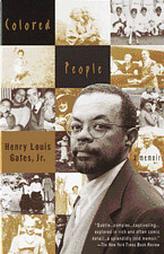
henrylouisgatesjr1Colored People, Henry Louis Gates Jr.’s biography of growing up black in rural West Virginia during the Civil Rights movement.  It’s a book that hooks my students because of its ties to our home state, but it’s universally appealing in that Gates creates a colorful cast of characters early on in the book, most of whom he defies in order to graduate summa cum laude from Yale University.
To Sell is Human is a favorite for students in Psychology class as it brings the social sciences to life in a very Malcolm Gladwell-esque way–short stories and then quick aphorisms make complex ideas simple to digest in this quick, fascinating read by Daniel Pink.

English

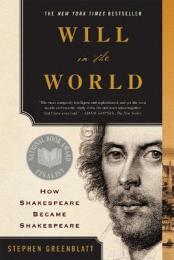
137717Will in the World, written by everyone’s favorite long-winded Shakespearean scholar Stephen Greenblatt, brings William Shakespeare to life in this detailed biography of both the playwright and his Elizabethan London.  I love reading this book as a shameless English nerd and London-lover, but my students love it because it’s a classic tale of an average guy succeeding against all odds.
The Mother Tongue, the second book by the excellent Bill Bryson on this list, is a glorious history of the English language.  My students especially adore the chapter on swear words.

Math

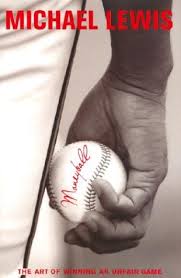
imgresMoneyball, one of Michael Lewis’ earliest books, hooks students often because it has a great movie adaptation to accompany it.  But when you sit down with the book itself, it blends both narrative and statistics, the least “mathy” part of math that I can understand.

The Hot Zone, a terrifying account of the origins of the Ebola virus, will give you actual nightmares if the ideas of biological warfare or global pandemics freak you out.  It’s a very detailed narrative of the virus’ structure, symptoms, and Hail Mary-type treatments that “proves that truth really is scarier than fiction.” (Tell that to Stephen King.)

What titles do you use to introduce your students to subjects across the curriculum? Please share in the comments!

Try It Tuesday: 7 Ways to Shake Up Notebooks

October is nearing its end, and you know what that means…’tis the season of needing inspiration! The back-to-school spark of fierce, creative lesson planning has ended, and now we’re all just praying Thanksgiving gets here ASAP.

So, if you’re getting a little worn out from reading the same-old same-old genres in your writer’s notebooks, try these seven ways to shake them up.

Write down the language you hear around you.  From quotes in independent reading books to funny things our friends say, the act of noticing language helps us think like writers and expand our linguistic repertoires.

img_5205

Annotate a booktalk.  Instead of a focused craft study, or a question-and-response to a booktalk, try just taping it into your notebook and noting what stands out.  This, too, helps build the skill of reading like writers.

img_5200

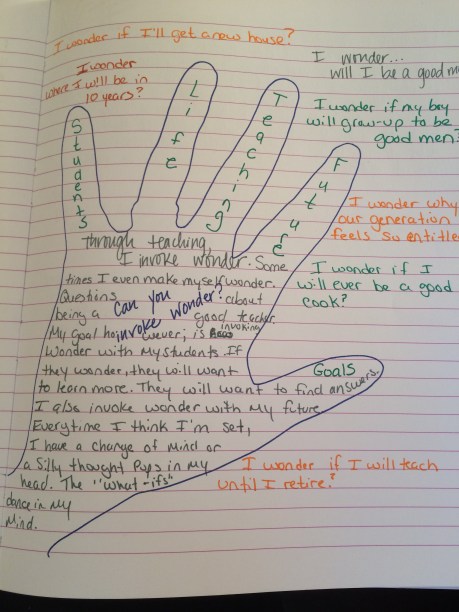
Write in someone else’s notebook.  Shake up page after page of your own handwriting by switching notebooks with someone else when responding to a prompt.  Here, my friend Bethany wrote in my notebook as we wrote about invoking wonder.

img_5211

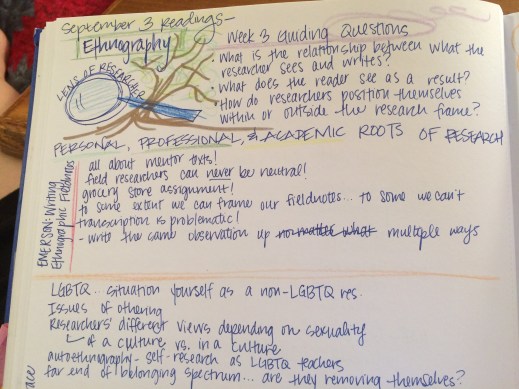
Try beautiful note-taking.  Sometime, somewhere, everyone needs to just jot down some notes…whether it’s in for readings from a class or in a staff meeting, try to beautify those notes with some doodles or colors.

img_5203

Attempt some literary analysis.  I love the classics, and I bet many of you do too–but sometimes we beat their beauty to death when we spend hour after hour analyzing them with our students.  Try pasting in a page of whatever you’re reading and just responding to how amazing the writing is.

img_5201

Jot down fun vocabulary words.  I love to note down both words that I don’t know and words that I just love, with no pressure to define them or use them in a sentence.  It helps me notice wordplay and attempt it myself.

img_5206

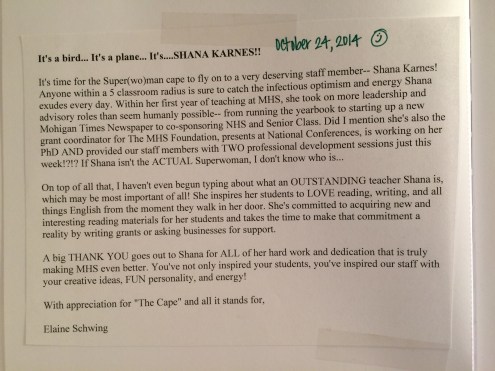
Paste in things you’d like to remember.  It’s too easy to throw keepsakes in boxes or delete emails that flatter us…so glue them into your notebook and flip back through when you need a lift.

img_5199

Shaking up notebooks in these seven ways will help your students curate a scrapbook of sorts–a place to return to and look back at long after it’s been filled up and the year has ended.  A notebook is a wonderful place to practice reading and writing skills, but it becomes most effective when it’s an authentic placeholder for growth, play, and memory.

How do you shake up notebook time with unconventional genres and prompts? Please share in the comments!

Mini-Lesson Monday: Developing Social Imagination by Making Connections

imgresI’ve been reading Peter Johnston’s excellent Opening Minds with my preservice teachers, and it’s a must-read.  One of the skills Johnston says the most open-minded students possess is that of social imagination, or being able to understand “what others are feeling, to read people’s faces and expressions, to imagine different perspectives, to make sense of abstract ideas, and to reason through this.”  In other words–empathy on all levels.  It strikes me that this is both a reading skill and a life skill.
To have your students practice social imagination, as well as grapple with a complex issue, try the following mini-lesson–which I believe I’d stretch out over two class periods.

ObjectivesDistinguish the differences between meaningfulness and happiness according to the article; Connect the concepts of meaningfulness and happiness to yourself, the characters in your independent reading books, and people in the world.

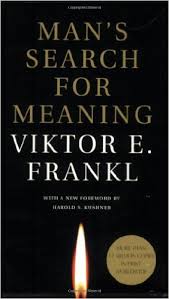
Lesson: First, I’ll emphatically booktalk Viktor Frankl’s 1946 classic, Man’s Search for Meaning.  This book, written in just seven days while Frankl was imprisoned in Auschwitz, argues that life is always worth living as long as one feels they have a purpose.

Next, I’ll distribute copies of The Atlantic‘s article “There’s More to Life than Happiness,” which pairs Frankl’s book with current research on happiness vs. meaningfulness.  To give students a purpose for reading, I’ll ask them to read the article with a pen in hand, noting the differences between a happy life and a meaningful life.  

To get kids synthesizing the information, I’ll ask, “Once you’ve finished the article, answer this in your notebook for a quickwrite: which do you think is more valuable–a happy life or a meaningful life?”

The article is lengthy, and I’ll allot 30 minutes for students to read and respond in writing before we debrief.  As a whole class, we’ll have a discussion in which we focus on what the article argues, what the students believe, and how culture may have nudged us to believe those things.

imgres-1The next day in class, we’ll refer back to the article before beginning independent reading time.  “As you read today, pay attention to the characters in your book–are their lives more happy, or more meaningful?”

When we wrap up silent reading time, I’ll ask students to turn to a neighbor and tell about the characters in their book, and whether they’re happier or more purpose-driven.  This time will double as peer book recommendations as well as a quick assessment of the text-to-text connection.

After asking students to share out any really great characters they heard about (to give the class more reading recommendations), I’ll ask students to open their notebooks and quickwrite about a text-to-self connection–“is your life right now filled with happiness or meaning?  Or both?  What do you want for the future–happiness or meaningfulness?  Freewrite about this issue in general.  These responses will stay private.”

After writing, I’ll ask students to grab a post-it note and make a text-to-world connection–from their parents to friends to public figures to entire communities, countries, or cultures.  I’ll collect the post-its for a quick assessment.

Follow-Up: I’d like to return to the idea of meaningfulness vs. happiness with a reading or writing unit on the issue.  We could collaboratively study almost any novel, poem, story, or article in reading workshop through the lens of identifying purpose vs. happiness, or explore the issue further in a writing workshop geared toward either narrative, informative, or argumentative pieces.

How might you have your students consider the issue of meaningfulness vs. happiness?


Try It Tuesday: Book Pass

While writing about ways to hook readers a few weeks ago, I realized that while we’ve mentioned book passes several times on this blog, we’ve never actually written a post dedicated to how to do them.  So, here that post is!

Book passes are beautiful in their simplicity. Their purpose is to expose potential readers to a wide variety of books in just a few minutes. All you need are a number of books greater than or equal to your students, their writer’s notebooks, and the power of social capital.

img_5005

Victoria browses through Peter Johnston’s Choice Words, while Brianna tries to decide between a few choices herself.

When students enter the classroom the day of the book pass, I always have piles of books ready to go on their table groupings. They can’t help but pick them up right away (really, they can’t–sometimes it drives me nuts when they paw through materials we’re not ready to get to, but in this case, I LOVE watching them be drawn to a book), so the book’s contagion begins to spread immediately.

When we begin, I ask students to turn to their TBR pages in their notebooks. “Go ahead and grab a book that’s on the desk in front of you,” I invite, and wham, books are in the hands of readers. “Spend about one minute with this book–look at the front cover, the back cover, the inside flaps, the first page. Decide if you think it might be a good fit for you.” With my preservice teachers of all content areas, I ask them how they might use this book, or excerpts from it, in their future teaching.

img_5011

Habbiba gets excited about Will in the World, and nerds out with Alexis.

I set my timer on my phone for 60 seconds as kids flip through pages. Of course, book love is contagious, so some kids share with others what they find–the power of social capital is at work once again here.

When the timer dings, I ask kids to pass their book to the left. “But first,” I remind them, “write down that title on your TBR list if you think it’s something you might want to read.”

Now the students have new books in their hands, made more powerful if they’ve already watched their neighbor write that title down. I love to watch, after multiple passes, when one title gets written down by nearly everyone, and the students who’ve yet to get that book in their hands begin to practically salivate.

img_5010-1

Nick and Ryan thumb through The Double Helix and Moneyball, respectively

The book pass can go on for as many passes as you have time for–enough for every kid to see every title, or just five minutes’ worth, if you prefer. I do this activity multiple times at the beginning of the year, and then again sprinkled throughout the year when I get lots of new books in. It’s a wonderful way to expose students to several titles in a day as an alternative to the traditional booktalk. It’s also a great way to shake up the typical routine in the classroom with a hands-on activity that gets kids excited about books.

I often conduct book passes in this open-ended way–“see if this book is a good fit for you”–but sometimes I do them as a way to expose students to a “new” genre in particular (novels in verse, or graphic novels); a way to introduce the theme of a unit (by finding books all about that theme); or to introduce a reading challenge (read an award winner, or a book of nonfiction). Just passing books around and getting them in the hands of readers does wonders to grow students’ universes of what’s possible when we read.

How might you use a book pass in your classroom? Please share in the comments!

Mini-Lesson Monday: Low-Stakes Community Building With Post-It Blessings

I am always searching for low-risk ways to build community in my classroom during the first weeks of school.  In order to build norms of sharing our writing, responding to one another’s writing, and writing a whole lot in general, I like to combine some low-stakes activities like imitation writing and positive feedback protocols so students become confident members of a community of real writers.

Objectives — Create your own version of Langston Hughes’ “I, Too, Sing America,” Critique your peers’ poems positively.

img_4904

Lesson — I recently read Nancy P. Gallavan’s article “I, Too, Am an American: Preservice Teachers Reflect Upon National Identity” with my students.  The article includes a sample of students’ imitation poems of Hughes’ classic poem, which they wrote in the weeks after 9/11.  The poems sought to make students aware of the stereotypes each one faced, and to defy those stereotypes.

I asked students to read the article before coming to class, to write their own version of the poem, and to bring a copy to class because we’d be sharing it.

(It’s important to disclose to students before they write that a poem will be shared in order to build the norm of openness with their peers.)

With a pile of post-its waiting on each desk, I asked students to take out their poems.

“We’re going to share our writing today, and we’re going to practice giving each other positive, specific feedback.  To begin, pass your poem to the left, and then grab a post-it note.

img_4840“The feedback we’re going to give today is part of the Bless, Press, Address protocol by the NWP. Blessing the writing means to give specific feedback on what you like about the poem. Pressing the writer means pushing him or her to strengthen their piece in some way. Addressing an issue the writer asks you for help on means giving responsive feedback in order to help the writer achieve his or her goals. Today we’re just going to bless one another, since it’s the first time we’re sharing our writing.”

(I think it’s important to begin with positive feedback because it removes the stigma of “peer editing,” which is often vague or negative if not structured properly.)

“So, take a post-it and write a response to a line, or give a compliment about word choice, or discuss something you agree with.  When you finish, pass your poem on to give your neighbor a subtle nudge to keep things moving.”

The room hums with rustling paper and murmured conversation, and I have the students pass the poem five times.

Follow-Up — After giving feedback, students receive their original poems back and read their peers’ comments.  I ask them how it felt to receive this type of feedback, how this activity helps build community, and what other assignments they could use this feedback protocol with.  Their responses to the last question were so creative–DBQs, lab reports, narratives, essays, published works of literature, math activities, thesis statements, and more.

After our discussion, I ask the students to put their poems and post-its into their notebooks to remain a permanent artifact of their peer feedback.

How will you use the Bless, Press, Address protocol with your students? Please share in the comments?

9 Books to Hook Your Holdouts

This fall is my first out of a high school classroom, and I miss this season of watching teens fall in love with books. I relished the task of matching every kid with the right book, armed with the energy that a crisp autumn morning and a pumpkin spice latte afforded me. By this time in September, I’d usually managed to hook most of my readers, but I had also identified my holdouts–those few skeptics who just didn’t think there was a book for them, who I couldn’t entice with a booktalk, or bribe with a “just try it,” or persuade through a conference.

So, I always turn at this time to the power of social capital, harnessing tools like speed dating with books, book passes, or writings in Red Thread Notebooks, to get my students recommending books to one another.  If I couldn’t hook my holdouts, well, their friends were my last hope.

So, to recommend some titles to hook your holdouts, I decided to ask my former students for their recommendations: what’s the last book you read that really hooked you?  Their responses, via Snapchat, are as follows:

img_4790-1

Anna recommended Men Explain Things To Me by Rebecca Solnit, a collection of essays that are both scathingly funny and weightily serious about communication between men and women. It’s a great pick for your holdout who doesn’t want something long–he or she can devour one of these essays in no time.

img_4794-1

Connor recommends the National Book Award winner Between the World and Me by Ta-Nehisi Coates.  This beautiful text, a commentary on race in modern America written in the form of a letter from father to son, “was intriguing because it touched on social justice issues in a way that I could relate to even though I had never had to deal with those issues,” according to Connor. It’s a fantastic, fast read whose subject matter will really draw you in.

img_4793-1

Gabi’s recommendation is Just Mercy by Bryan Stevenson, a story of twisted justice told by a young, new lawyer. Stevenson’s idealism wars with the machinations of politics and injustice and biases, and is written in a voice that has made many compare the narrator to Atticus Finch. If that doesn’t make your holdouts fall in love, I don’t know what will!

img_4792-1

Jocelyn recommends Leslye Walton’s award-winning The Strange and Beautiful Sorrows of Ava Lavender, a prose book of fiction that reads more like beautiful poetry. Ava is born with wings, and writes in a voice direct and melancholy–she reminded me of Madeleine from Everything, Everything. And, as Jocelyn notes, the cover is gorgeous, which is sure to help hook your holdouts.

img_4791-1

Claire recommends Donna Tartt’s layered novel of accidentally-murderous friends, The Secret History.  Tartt, the Pultizer-winning author of The Goldfinch, introduces us to a group of college students who, through their readings and conversations, begin to fancy themselves above the law–both legal and moral. As Claire says, it’s a brow-wrinkler that’d be great to recommend to a reader you just can’t challenge enough–and its writing is amazing.

img_4807-1

Olivia recommends John Green’s Paper Towns, of course!  Recently adapted into a film, it’s the story of a misfit boy who loves a supercool girl from afar, and then is inexorably sucked into her world of adventure in the tale that ensues. John Green is a YA favorite for a reason, and you’re sure to hook some holdouts with the knowledge that the book was big-screen worthy.

img_4806-1

Caleb recommends Ashlee Vance’s exceedingly well-written biography, Elon Musk: Inventing the Future. Musk, described as a “real-life Tony Stark,” founded PayPal, Tesla, SpaceX, and other billion-dollar companies throughout a life filled with both struggle and success. While telling Musk’s tale, Vance compares his work to inventors from Thomas Edison to Steve Jobs, and entices the reader to wonder whether anyone can compete with geniuses such as Musk in a technology industry as competitive as today’s.

img_4797-1

Garrett recommends Hank Haney’s The Big Miss, an inside look at Tiger Woods’ golf game through the eyes of his coach. While Tiger was always a gifted athlete, his mental game made him constantly fear a “big miss”–a wild shot that could ruin an entire round. Haney gives insight into Tiger as an athlete as well as a man, who ultimately committed a big miss in his personal life that derailed his golf game far more than he ever saw coming. This is a great pick for any athlete who’s holding out on reading.

img_4802-1

Allison recommends C.S. Lewis’ The Great Divorce, a book I equate to a modern version of Dante’s Inferno. The story begins with the narrator boarding a bus, which takes him on a long journey of discovery about himself, great truths, and the nature of good and evil via a trip through Heaven and Hell. Described by many as their “favorite book by C.S. Lewis” (a real feat, since The Lion, the Witch, and the Wardrobe is so colossal in our culture), this allegory will be sure to hook any holdout into some irresistibly deep thinking.


Now that I’ve had my proud-teacher moment of so many of my former students continuing to be lifelong readers (and look at all their actual BOOKS lying around!!!), and significantly expanded my own TBR list, I hope you’ll ask your students to recommend some engrossing titles to help hook your holdouts.

What books are your students recommending to one another? Please share in the comments!

Try It Tuesday: Notebook Write-Arounds

Tom Romano calls writer’s notebooks “playgrounds, workshops, repositories” in Write What Matters.  As such, the writer’s notebook employed in a workshop classroom is much more than a place to store drafts, brainstorm ideas, or take notes.  It becomes a sacred space that is personal, meaningful, and enjoyable.  To fill it with writing and wordplay that spurs a love of language, I like to write around various artifacts in my notebooks, and urge my students to do so too.

img_4597

I cheated and wrote around a poem and a picture here

Write around a poem – In this lesson, inspired by advice from Penny Kittle (she told me her writing got more beautiful when she read poems more intentionally), I ask students to cut out a poem and glue it into their notebooks.  This activity can change with its purpose–sometimes students can respond to the language in a poem, sometimes they can write from a line, and sometimes they can work to analyze the text for literary devices and figurative elements.  The act, though, of gluing a poem into our notebooks keeps beautiful language at the center of our work, made visible when we flip backwards through our pages.

Write around a picture – Like Amy, I like to see my students’ notebooks full of pictures.  I ask students to bring in or print photos of any sort, then write descriptions, craft imagined dialogue, or narrate a memory the photo evokes.  In addition to being personal and meaningful, these quickwrite activities often serve as jumping off points for longer pieces of writing.

img_4595

Lisa sent me flowers, and I wrote around her note

Write around a note – My friends and I are big note-writers, and I’ve always had the compulsion to write “thank you for your thank you note” notes (maybe that’s just me, but Lisa is a dork so she might do it too!).  Because that’s socially awkward, I like to glue notes into my notebook and respond to them that way.  I also have students glue in their Bless, Press, Address responses from other students, or my own written feedback (like Amy’s Silent Sticky Notes), and respond to it in their notebooks.

Write around an object – Whenever I unearth something meaningful from the depths of my glove box, I like to glue it into my notebook and write around it.  I have Starbucks

img_4598

I’ve memorized my library card number, so I no longer need to carry it in my wallet…

sleeves, library cards, ticket stubs, and even an old necklace glued into my notebook, surrounded by writing.  In this era of electronic communication, I think it’s important for students to put physical objects into their notebooks–I still have shoeboxes full of notes from my friends in high school, and I like their tangible power more than just a series of saved text messages.

Write around an idea – A written version of the Four Corners activity, students write down a statement in the center of a page and then exercise some critical thinking around the statement.  The top left corner represents the “strongly agree” perspective, the top right is “agree,” bottom left is “disagree,” and bottom right is “strongly disagree.”  I’ve also experimented with just having students respond to the statement in general, but I like the Four Corners because it forces them to consider multiple perspectives.  Mostly recently, I asked my preservice teachers to respond to the idea that “Teachers are responsible for 100% of their students’ learning” using the Four Corners method–I can’t wait to see their responses when I collect notebooks next week.

What ideas or artifacts might you have your students write around? Please share in the comments!

Making Workshop Work in 45 Minutes

Kerry wrote:

“One of the seemingly overwhelming hurdles I feel I have is to engage my students with only 45 minutes each day! Do you have any tips or tricks for me to do this?”

Screen Shot 2016-08-23 at 7.52.17 AM.png

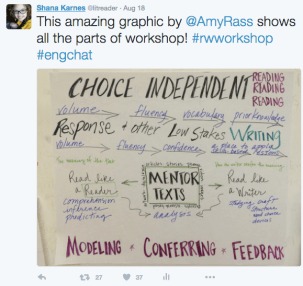
Amy’s diagram of all the moving parts of workshop

So many teachers ask this question.  When one considers all of the moving parts of workshop instruction–reading, conferring, mini-lessons, booktalks, quickwrites, workshop time, choice–it’s tough to conceptualize how to fit it all in to any duration of class time.


What’s important to consider is what Penny Kittle referred to as the “currency of time”–what you spend your time on, and what will give you your biggest return for the investment of that time, is equally as important as what you DON’T spend your time on.  You can make workshop work in any time period, with or without all of these elements in one class period, if you invest your time wisely.

What’s most important for our students?  What is the most valuable use of our time?

Time to read.

Time to confer.

Time to write.

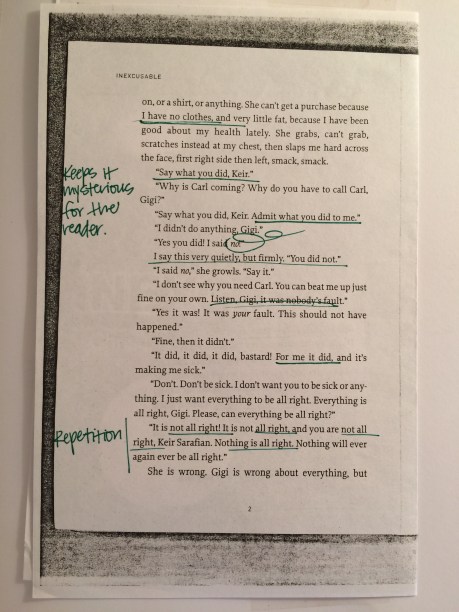
That’s it.  If I have those three elements in every single day of workshop, I feel our _Time_-_is_money_095207_.jpgtime has been well spent.  Every workshop classroom will–and should!–look a bit different.  That’s one of the most valuable things about workshop:  not only does it provide for student choice, it gives teachers autonomy, too.

Here’s what I responded to Kerry:

“What I did when I taught those shorter classes was essentially break up my typical workshop into two days, plus I had lots of activities that I always did on certain days of the week.  Fridays, for example, were free-write Fridays in writer’s notebooks, and every Monday always had a sentence study lesson to learn grammar.  We always started with 10 minutes of independent reading, then moved into EITHER a mini-lesson or a quickwrite, then had either a reading or writing workshop.  We had a long workshop every few days or so applying the previous day’s mini-lesson, which they only had a short time to practice the day before.
So, let’s say I’m teaching Macbeth:
Monday: 10 min Independent Reading, 10 min sentence study (using a mentor sentence from the text or a related thematic text like a poem), 15 min mini-lesson on some aspect of whatever part of the play we might be reading that day, 20 min of reading the text with a directed reading activity (close reading type of stuff)
Tuesday:  10 min IR, 15 min mini-lesson or quickwrite (maybe a journal prompt on the nature of evil or something), 20 min reading of the play
Wednesday:  10 min IR, 5 min reminder of yesterday and Monday’s mini-lessons, 30 min reading of the play
Thursday:  10 min IR, 15 min vocab activity, 20 min directed reading activity (discussion, etc.)
Friday:  10 min IR, 10 min free write, 25 min reading of the play
I’d do that for about 3 weeks until the unit was done. (I try not to let a unit go longer than 3 weeks.)
Let’s say I’m teaching narrative writing:
Monday:  10 min IR, 10 min sentence study (using a mentor sentence from a model narrative), 15 min mini-lesson on a writing skill, 20 min writing time (content creation day)
Tuesday:  10 min IR, 10 min mini-lesson follow up, 25 min writing time (lots of revision or tweaking here)
Wednesday:  10 min IR, 5 min reminder, 30 min writing workshop (lots of one-on-one conferring with a combo of content creation and revision)
Thursday:  10 min IR, 10 min vocab activity in notebooks, 10 min writing mini-lesson based on previous day’s workshop, 15 min tinkering workshop
Friday:  10 min IR, 10 min free write, 25 min writing time (straight content creation)
Those days were PACKED.  There was really no free time, so kids who were absent, kids who had questions beyond workshop or conference time, etc. really had to come and see me outside of class (after school, lunch, etc.).  And, there was a lot more homework…we just didn’t have time for everything during 45 minutes.”
How do you make workshop work in any duration of time?  Share with us in the comments a brief outline your daily schedule, please!!  It will be invaluable to see the variety.