Category Archives: Writers

Not Your Same AP English Summer Reading List

I started counting Mondays. I try not to get overly excited for summer but I cannot seem to help it. I have so many grand plans. I’m lucky that way. I get to travel to conferences I want to go to and see friends I want to see.

My students are not so fortunate. Most of their summer will be spent within a few miles of their homes. That’s usually how it goes for kids in less affluent areas. They hang out. Do nothing. At least that’s what they tell me.

I want them to read. The summer slide goes right on sliding right into high school.

Some of my students will read because they’ve come to identify themselves as readers this year. They’ve crafted lists of books that interest them, and they’ll make their way to the library and check out books that look intriguing. Some will make their way to the book store. Several of my students have spent their part-time paychecks on books we’ve talked about in class.

They are learning what it means to value books. Of course, I’m pleased.

Summer reading is a tricky thing. I know many students will not read if they do not have an assignment that requires it. That is what we’ve taught them to expect. Expectations engrained like this are hard to change.

Change is possible though.

We can change the books we put on our ‘required’ reading lists (I like the word recommended or suggested so much better.)

We can allow choice of titles instead of Screen Shot 2015-04-28 at 9.43.41 PMmandating one specific book.
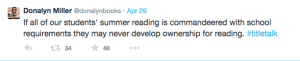
If we want our students to want to read, we have to make it easy for them. The article Those Tired Summer Reading Lists. Here’s What to Do offers more to this argument. (And it’s got some nice alternatives for reading logs, too.)

I wonder how you are prepping your students for summer reading?

Me? I have already started the pep talk: The senior AP English teachers on my campus are mandating A Brave New World and Beowulf.

I’ll just leave that right there.

I am proud of my AP English Language team. We’re providing an annotated list of paired texts for our incoming juniors: Summer Reading with a Challenge and a Choice. This is not your same AP English summer reading list. I am confident we will win over more readers this way.

Choice always does.

Maybe we can help more teachers remember:  Is summer reading about the reader or about the book?

In the next few weeks, I’ll talk up books with my students. I’ll remind them of the choices they had in our book clubs. Maybe they’ll remember how hard it was to choose just one title at the time and read another this summer. I’ll show some book trailers and encourage students to grow their TBR lists. We talk a lot about readers having reading plans.

I lose a lot of books throughout the year, but I’ve also got a lot of books on my shelves that never move. I’m thinking of having some kind of check out system, maybe a $2 sale (if I can do that). I’d rather have books in student hands than sitting all alone on shelves all summer. Anyone have ideas here?

What are your plans to encourage readers to read this summer?

©Amy Rasmussen, 2011 – 2015

Behind Barbed Wires

sticker,375x360.u1In honor of the recent Holocaust Remembrance Day, I find it befitting to share Room 382’s shelf comprised of pieces in which those, who experienced the nightmare, share their stories.  Each piece on this shelf is dedicated to bringing awareness, and hopefully shed light on how history truly can repeat itself, if we do not prevent it.

While this shelf hosts stories of tragedy, suffering, and insurmountable pain and loss; it serves a purpose. Aside from the devastating, these pieces share with us the true essence of humanity.  Often, this is the first time students are diving into this 80-year-old genocide and trying to make sense of it. Many times we can’t; and other times we are able to connect over the beauty that surfaced. It’s all very complex.

Elie Wiesel’s story (and bravery) is shared via his trilogy starting with Night then moving us through Dawn and eventually through the Day.  See what he did here?

Anne Frank shares her experience as a young woman budding into adolescence in a time where her beautiful spirit defeated the confines of her attic.  Various types of literature have been compiled so IMG_20150424_083609students (and all readers) can experience Anne’s story in various ways: her published diary, actual footage restored via the Anne Frank House (a gift from a friend’s visit to Amsterdam), the play, and many others.

Maus, an incredible two-part graphic novel, utilizes the “Cat and Mouse” metaphor to portray the Nazis
vs. the Jews during the Holocaust.  This two part series is detailed and brings to life the realities of the inner workings; the emotional turmoil yet amazing perseverance of those living through this moment in history.

Those are three pieces among many.  There are books here (and ones that are currently signed out) that chronicle voices of the children of the Holocaust, novels that use real-life situations yet tell a fictional story, perspectives from a Nazi’s Jewish wife, the bravery of a journalist who swapped places with a Jew to ultimately expose the hidden…

Students are typically surprised, fascinated, uncertain, saddened and sometimes hesitant when it comes to this shelf.  Understandably.  This shelf asks us to inquire and then sit with our findings.  Yet, the conversations and rich discussions that float around this shelf are beautiful; truly beautiful and strengthen our understanding of what it truly means to be human.


Launching an Official Monthly #poetrychat

Screen Shot 2015-04-23 at 2.49.34 PM

Evidently, there is not an official #poetrychat, but isn’t it a sweet idea?

Poetry serves as an important and beautiful lens into the literary world, and it deserves more than a hurrah during National Poetry Month.

I find that the more I talk about poetry the more I use poems in my classroom. Not like that’s a big surprise. The more I talk about books the more my students read.

So, I’ve been giving this a ton of thought. Do I want one more grape on my plate? And the answer has to be yes.

Today @JasonCarney5 artistic director of Young DFW Writers gave a pitch to my English department. Would we like to be a school that takes advantage of the Louder Than a Bomb program?

Um, yeah.

Meeting Jason and hearing about how his introduction to poetry changed the trajectory of his life was another testament to the power of poetry and what reading and writing it can do for a young person.

Aren’t we as literacy educators always looking for ways to engage and empower our young people and give them opportunities to grow as readers and writers?

So, yes, even if I get YDFW at my school next year (which I’m pretty sure is a done deal), I still feel the need to join other educators who are passionate about the “art” in language arts for a monthly poetry chat.

The teacher-writers at Three Teachers Talk are starting a monthly poetry chat. We hope to connect educators and poets, and work to infuse poetry into the year-long curriculum of ELA classrooms.

“A Poem about Topics for a Poetry Chat”

Spoken-word poems,

prose poems

found poems

spine poems


Ways to share student-written poems


Poetry to teach allusion,

imagery

syntax

grammar

self-respect


Books in verse

Verses for book talks


We will meet the first Monday of each month at 8:00ET, directly following #engchat at 7. Remember to use the hashtag #poetrychat — and to have links ready to your favorite poems and lesson ideas.

Mark your calendar for Monday, May 4 at 7:00 pm Central Time.

Leave your ideas for topics in the comments. Thanks!

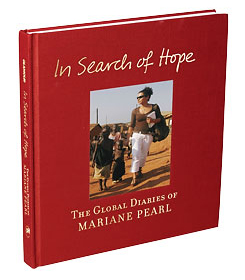
In Search of Hope

mariane pearl book coverI first fell in love with Mariane Pearl’s writing when I read her memoir: A Mighty Heart where she chronicles the events leading up to her husband’s murder in the Middle East.  It was devastating.  Tragic, really.  Yet, her voice sang from the pages even while sharing the most intimate moments associated with a murder that was so incredibly public.

So, to no surprise, when I came across In Search of Hope: The Global Diaries of Mariane Pearl,  I was thrilled. Pearl, a journalist for Glamour Magazine, took on the world – visiting twelve different countries. She was escorted through these countries by powerful women that are all on missions to bring positivity, safety, and change to countries that are broken.

Pearl visits with courageous women who share the most private details of their work – and passion.  She learns about a Cambodian sex slave’s liberation; Liberia’s presidency from the perspective of President Ellen Johnson Sirleaf (2006); an AIDs orphan turned healer in Uganda; a New Yorker who leads children needing guidance; how justice is getting a voice in Mexico…and so much more.

As you read these short stories full with dynamite photographs, writing that is powerful, and experiences that shed light on women fighting through the injustices associated with their countries, culture, and neighborhoods; you can’t help but to feel as though you are on a year long excursion around the world – one that authentically changes your core as a human being.

Students love this piece.  They are awed by the bravery of these women; Mariane for exposing truths that do not get adequate recognition and the women who are willing to risk their own safety in order to save others.  For every reader, Pearl puts life into perspective.

The richness found within these pages comforts you.  It makes you believe that anything truly is possible.  Well, because it is.  It provides students access to beautiful moments experienced within other cultures and propels them to reflect on their own morals and values – what are they really willing to fight for?

In Search of Hope is a piece that leaves you feeling compelled to explore.  Travel.  Find your own truth.  And when you do, write about it.

Everywhere You Turn

Over the last three years, our Francis Gittens Memorial Lending Library has grown literally by thousands of books.  And, it’s a beautiful sight.  One in which provides comfort, challenge, and dialogue among students and educators.  It propels interest in reading and provides options and choice; students sometimes pull up a chair and use the edge of any given shelf to rest their Writer’s Notebook while they write and find inspiration.  It’s our staple here in room 382.

But, as more and more donations come through the door, I panic: Where will they all go?!  We are currently wall-to-wall with bookshelves (many that tower over us) and the remaining space is either wall-to-wall windows or full of technology.  So, I started to utilize every open surface: our computer cart, window sills, filing cabinets, my own desk.  Now, literally everywhere you turn, your gaze lands upon books…stacks and stacks of books.

Initially I felt overwhelmed by having books everywhere; I thought it felt chaotic.  But, the perceived chaos actually provides students even more choice and an innate awareness of their surroundings. Students have started to become even more in-tune with their reading journeys and have been feeling more compelled to explore.  For more reluctant readers they have access to books without it feeling as though there is the need for any sort of grandiose gesture; trekking across the room to the wildly overwhelming library.  It’s subtle yet powerful beyond measure.  Everything is within their reach.

IMG_20150421_093753

Books resting on technology…

Everything.  Even our mobile technology cart full of laptops. The books on top are stacked in four piles; they are our newest additions.  Because the cart find its way across the room, near different seats, and at various different spots depending on the day; it’s equivalent to an ice cream truck making its rounds – no one is to be missed.  These piles change as the new additions continue to stream through the door.  Many students, as they are accessing the cart for a computer, find themselves pausing for a moment because a book title…or cover…or piece they realized was on their next-to-read list…has caught their attention.  I love the irony that’s often captured here when a student is simply going to return their computer, hears the bell ring, and runs to their Writer’s Notebook to jot the title down; yet forgets to put the computer back!

IMG_20150421_094028

Here is one of three window sills adorned with literature – and some added nature.  During the winter months in room 382 the heat tends to be unbearable (hence the cactus) which is quite unfortunate.  Yet fortunately, students like to get a breath of fresh air.  So, while doing so they find themselves multi-tasking – breathing in the fresh city air while perusing through the new titles that greet them at the window.  Many times, a lesson or writing workshop will be interrupted with, “Miss Bogdany, I found another book about XXX!”

Books decorating ugly steel surfaces...

Books decorating ugly steel surfaces…

Many students have just recently begun to proudly embrace their love for graphic novels. Typically,they believe that they’re for ‘young kids’ because of ‘all the pictures and stuff’.  I whole-heartedly disagree.  So, in the vein of supporting students’ interest in visual literacy, many are found atop an industrial filing cabinet adding color, texture, and accessibility.  Because this surface is also used for additional supplies, students access it often.  Every time they are wanting to find their zen (see butterfly book box on the top left) they happen upon literature that excites them.  Many times, the zen garden and a new book escorts them back to their seat.     

IMG_20150421_093914

Exhibiting my literary interests. The left stack is comprised of pieces I want to read. The ones on the right are my absolute favorites. And, the ones in the middle are a fantastic mix of professional resources, gifts, and tools.

I know students will not produce work if they are not comfortable; both physically and in feeling safe within a community.  I create a visually stimulating space at my desk because it’s what fuels my passion for all things literacy. I also know, when a student needs their own unique space, they tend to gravitate toward wherever it is that I’ve set up shop.  It has been labeled ‘their corner office’ – and yes, they get right down to business!

There are other times when I conduct 1:1 conferences and ask a student to engage in dialogue in our bright back corner.  I watch their eyes drift from their writing to the options resting atop my wooden workspace.  Students will reach across the desk to pick up a piece they have never seen there before and while I try to get their attention refocused on our conference, sometimes the book they’ve chosen is much more convincing than whatever it is I’m trying to do.  I also think some of the intrigue is that students know that what they find there are pieces I can really talk about because I’m passionate about them.

So, as the year starts coming to an end and we start thinking strategically about how we are going to start minimizing our inventory and organizing it for our summer packing; please don’t!  Keep moving things around and keeping it fresh.  Put books in places you haven’t before – students will find them trust me.  Play around with what you have displayed in your area and invite students to engage in conversation wrapped around them.  But, most importantly, enjoy these remaining few months with our inquisitive and dedicated readers as they continue to look around our learning environments and find exactly what they didn’t even know they were looking for.

Where do you keep literature aside from your library shelves?  What successes have students found when they happen upon a book in the most unlikely of places?


An Invitation: Are You Walking the Talk in Your Content?

Now, that is the way to walk the talk.

knowyourphrase.com

knowyourphrase.com

I attended a Vocal Majority concert Saturday. This is one awesome men’s chorus. When the emcee introduced a quartet, I sat up a bit. There, singing with The Essentials was the choir director from my high school. Wow, what a voice.

As he sang, I kept thinking: There is a teacher who walks the walk. His presence on the stage, singing first in a group, then in a quartet, and later even as a soloist, shows that he knows exactly what his students must do — and feel — when they engage in activities and performances in the LHS choir.

Credibility is huge.

I think about this as I talk with other English teachers. I should stop being surprised when I learn that they do not read — “unless it’s a book I’m about to teach, of course.”

I’ve heard that more than once.

Perhaps even a bigger concern than not reading:  many English teachers are not writers.

The thing that has helped me be a better writing instructor — not attending conferences or classes, not reading pedagogy books — the single most thing that’s improved my ability to teach writing:  Becoming a writer myself.

I understand the struggle to think of ideas, the headache of revision, the joy of finally getting something right. My students need to know that I know what all of this feels like.

Like my colleague the choir teacher, I try to walk the walk of my content. I am an individual intent on improving my literacy skills, just like I want my students to be. I talk about my reading life, and I share my writing life with my students, regularly.

I think they trust me more because they know I read as much as I ask them to read. I write as much as I ask them to write, and every major assignment I give to them I write myself (plus this blog and a book I’ve been working on for awhile now.) I even write blog posts about improving my writing: 5 Ways to Meet Your Writing Goals.

It is not hard to have credibility. But it does take commitment.

The Best Writing Teachers are Writers Themselves.

A couple of weeks ago, i joined in a #litlead chat. The topic turned to teacher-bloggers and why and how to become one. A few participants in that discussion spoke out and said they were nervous about starting their own blogs, but they know it is a good idea. I’m sure their reasons for wanting to blog are varied, but there are three possible truths:

Teachers who blog are more likely to 1) reflect on their practices, 2) seek out new ideas for topics to write about, 3) show their students that they practice the craft of writing — like they hope their students will do.

I offered to let those nervous about blogging to wade it a little and publish a piece here at Three Teachers Talk. One stipulation: You have to be an advocate for readers and writers workshop. (That is the main topic of this blog after all.)

So think about it:  Do you walk the talk and walk the walk? Do your students see you as an adult with passion for your content outside the classroom walls?

Would you like to write a guest post? Send me an email with your idea, and I’ll respond and set up a date. (amyprasmussen@yahoo.com)

I’d like to help you walk a better walk.

©Amy Rasmussen, 2011 – 2015

Craft Study for a Monday: Billy Lynn’s Long Halftime Walk, again

For now, my new favorite book is Billy Lynn’s Long Halftime Walk by Ben Fountain. 

This surprises me. Maybe it’s the setting — Dallas Cowboys’ Stadium. Maybe it’s the protagonist — Billy, a 19 year-old-soldier. (I have twenty-year-old twin sons who want to join the military in a few years.)

Maybe it’s Fountain’s poetic language. It startles and soothes. It makes my mother’s heart shake.

I’ve dog-eared pages and underlined lines. I’ve even posted about this book in February.

Here’s the part I will share in class this week. My students are working on a major writing project. They chose their own topics. They’ll write in a variety of forms. But, even with only a few weeks left in the school year, I still need to show them beautiful language. I still want them to work on their craft.

“Look at Fountain’s style,” I’ll say. “What do you notice just on this one page?”

And we’ll talk about word choice and repetition. We’ll talk about lists and mood. We’ll talk about intentional fragments and why an author might make that kind of choice when writing a sentence.

My students will notice many things in this short passage. There are so many things to notice.

That’s probably why I am in love with this book. Thank you, Mr. Fountain.

excerpt from Billy Lynn’s Long Halftime Walk 

Don’t be scared, Shroom said. Because you’re going to be scared. So when you start to get scared, don’t be scared. Billy has thought about this a lot, not just the Zen teaser of it but what exactly does it mean to be scared out of your mind. Shroom, again. Fear is the mother of all emotion. Before love, hate, spite, grief, rage, and all the rest, there was fear, and fear gave birth to them all, and as every combat soldier knows there are as many incarnations and species of fear as the Eskimo language has words for snow. Spend any amount of time in the realms of deadly force and you will witness certain of its fraught and terrible forms. Billy has seen men shrieking with the burden of it, others can’t stop cursing, still others lose their powers of speech altogether. Lots of sphincter or bladder control, classic. Giggling, weeping, trembling, numbing out, classic. One day he saw an officer roll under his Humvee during a rocket attack, then flatly refuse to come out when it was over. Or Captain Tripp, a pretty good man in the clutch, but when they’re really getting whacked his brow flaps up and down like a loose tarp in a high wind. His soldiers might feel embarrassed for him, but no one actually thinks the worse of him for it, for this is pure motor reflex, the body rebels. Certain combat stress reactions are coded in the genes just as surely as cowlicks or flat feet, while for a golden few fear seems not to register at all. Sergeant Dim, for example, an awesome soldier who Billy has seen walking around calmly eating Skittles while mortars rained down mere meters away. Or a man will be fearless one day and freak the next, as fickle and spooky as that, as pointless, as dumb. Works on your mind, all that. The randomness. He gets so tired of living with the daily beat down of it, not just the normal animal fear of pain and death but the uniquely human fear of fear itself like a CD stuck on skip-repeat, an ever-narrowing self-referential loop that may well be a form of madness. Thus all our other emotions evolved as coping mechanisms for the purpose of possibly keeping us sane? And so you start to sense the humanity even in feelings of hate. Sometimes your body feels dead with weariness of it, other times it’s like a migraine you think you can reason with, you bend your mind to the pain, analyze it, break it down into ions and atoms, go deeper and deeper into the theory of it until the pain dissolves in a flatus of logic, and yet after all that your head still hurts (114-115).

Note: The book is being made into a movie with a Veteran’s Day 2016 release date. Rarely, do I like the movie as well as the book, but I still go see them.

©Amy Rasmussen, 2011 – 2015

The Modern PLC

1. Send out a Doodle for easy scheduling.

2. Receive Doodle responses and confirm date/time that works for four educators in four different states in two time zones.

3. Wait a week or so.

4. Sign into Google and click on hangout.

5. Invite friends.

6. Wait for Jackie, who when she finally connects calls herself “the 90 year old collaborator” although she is the youngest of the group by close to a decade.

7. Catch up. Chat. Plan. Collaborate on this blog for a good three hours on a Saturday morning.

Screen Shot 2015-04-18 at 6.02.01 PM

Erika, where are you?

We shared struggles and successes. We laughed. And we planned how we can write and share and learn and grow — a lot of it right here at Three Teachers Talk.

This, my friends, is the Modern Professional Learning Community.

Not long ago I read Live From Small Town America: Teachers Who Blog to Stay in Touch.

Well, I can tell you — it’s not just teachers in small towns.

Erika in NYC and me in Dallas both make the nation’s Top 10 for largest cities. (Of course, I am in a suburb north of Dallas but still..)

Educators are making connections all over the world. Blogging, Twitter chats, Facebook Groups, and more. And most of the educators who make these connections will tell you that the professional development they engage in online gives them more engagement, more information, more ideas, more solutions than most of what they receive on their home campuses.

If you are reading this blog, you already know this.

So, I am wondering:  How do we get more of our colleagues to engage in online PD? How do we change the model of PD in our schools to reflect the kind of sharing and growth we experience online?

Maybe most importantly, how can we model the kind of collaborative work we do online for our own professional growth for our students, so they can do it, too? Is that even possible?

©Amy Rasmussen, 2011 – 2015

Shelfie Saturday

sticker,375x360.u1While my last name is Catcher, I’m far from a natural athlete. In fact, my high school softball career ended after I “caught” a stray throw with my forehead, landing me in the ER with a swollen eye and thirteen stitches. Still, I can appreciate a brilliant sports story, the type that moves beyond the game and captures the essence of teamwork, leadership, and friendship. The “Sports” section of my classroom library does just this.

Over the past year, I have cultivated the sports section to reflect the varied abilities, ages, and interests of my students. I teach freshmen, juniors, and seniors ranging from struggling to gifted readers. Because of my diverse students, my library must appeal to 14-year old freshmen and 18-year old seniors alike. Fortunately, sports can oftentimes bridge this age gap while also pushing students to gradually engage with more complex texts.

My somewhat anemic-looking sports section.  Many of the books (particularly the ones not pictured here) have waiting lists and won't return to this shelf until the end of the year.

My somewhat anemic-looking sports section. Many of the books (particularly the ones not pictured here) have waiting lists and won’t return to this shelf until the end of the year.

My younger students (and even some of my older) tend to gravitate towards popular young adult novels at the beginning of the year, like those written by Matt de la Pena and Mike Lupica. After they exhaust the options on my shelves, they inch towards lengthier and more complex analytical or historical books like Moneyball: The Art of Winning An Unfair Game by financial journalist Michael Lewis or The Punch by sports writer and commentator John Feinstein. More than any other genre, these brilliantly crafted pieces serve as strong mentor texts for a wide variety of mediums including nonfiction, narrative, research, and persuasive writing. This year, books like Ice Time by Jay Atkinson inspired many of my hockey players to explore their sport through personal narratives while Shoeless Joe by W.P. Kinsella served as the basis for one of my freshman student’s research papers on the Black Sox Scandal.

Sports hold leverage within our society, particularly amongst teenagers. From die-hard fans to benchwarmers, both athletes and non-athletes can appreciate a sports story, particularly when it transports us into a world packed with suspense and action.

Join the conversation by posting your own shelfies!  Share a shelfie with #shelfieshare and let us know if it’s a #classroomshelfie, #bookstoreshelfie, or other miscellaneous find.

Keeping Them Reading: Speed Dating with a Book

Confession:  I have never been speed dating.

I just love the idea of it.

In 2012 I wrote about an activity we did in my AP English class that got everyone talking as we prepared for the AP exam. I hadn’t even thought about that, until I started to write about our latest foray into the talkative world of speed dating with books.

Neydy and LauraI know many teachers have tried some version of this activity. I want to add my voice to theirs:  this is a F.U.N. way to get students talking about what they have read and what they might want to read — both important factors in helping students of all ages develop their identities as readers.

How to Speed Date with a Book

As students entered my classroom, I asked them to

1) find a book from the shelves that they had read and liked enough to share with another person,

2) find a second book that they thought they might like to read — maybe they liked the cover or the title; maybe they had heard someone talk about this book. Didn’t matter.

Everyone needed two book.

Then, we tried this “speed dating” thing.

First, we formed two circles, one inside the other. One circle faced outward. The other faced inward.
Students stood in front of one another, and I with the easy job stood with the timer and the camera.

“One minute,” I said, “You’ve got to stay on topic, and talk about one or both of the books in your hand for one minute. Your goal is to ‘sell’ the other person on why they want to read these books.”

GO!

 We talked books for as many minutes as it took for every student to talk one-on-one with every other student. It was exhausting. And wonderful.

After we completed all our rounds, we set all of the books out on one table, and students picked up their writer’s notebooks and turned to their “What Shall I Read Next?” lists, adding any titles they might want to read during the last two months of school. Every student wrote down at least one book. Some wrote down several.

Why Talking About Books Must Be a Constant

I teach juniors in high school. Before this year, most of my students did not consider themselves readers. They have had to learn what it means to

a. like books,

b. like to read books,

c. like to talk about books,

d. know how to find books they like.

The moment I stop holding up books at the beginning of class, reading a bit, and encouraging them to give it a try, many they stop reading.

They are one year and a couple of months away from graduating high school, and they are Baby Readers, fledglings not ready to leave the roost and fly off on their own. (In more ways than one, I know.)

I don’t know if my readers will be strong enough to keep reading when they leave me the first week in June.

I hope so.

In the mean time, I will keep up the talk and keep up the expectations:

You must read if you are a student in my class.

You are a reader who reads every single day.


What are some activities you do to keep your babies reading?


©Amy Rasmussen, 2011 – 2015