Category Archives: Writers

Confessions of a Grown-Up Fangirl

I have finally discovered the cure for a story hangover.

You know the feeling I mean–turning the last page of a book, watching the final scene in a movie, knowing that the work of the creator is done when it comes to the characters and worlds you’ve come to love.

I’ve been known to enter depressions when I get to the end of a beloved book series (Harry Potter, notably), TV series (Bones wrecked me), or classic novel re-read (Pride and Prejudice still upsets me when it ends). But recently, like many in the Star Wars fandom, I was emotionally ravaged by the conclusion of The Rise of Skywalker.

It wasn’t just that I didn’t like the ending of the film (I didn’t); I was also distraught that the nine-movie space opera that spanned 40 years had come to an end.

So, I did what I always do when I’m just not ready for a story to end–I turned to fanfiction.

And I certainly wasn’t the only one–there were thankfully already thousands of stories to read, with no shortage of choices when it came to theme, characters, length, or writing style.

So for weeks now, I’ve continued to immerse myself in the Star Wars world I love, and I’m just now coming up for air. The difference in my emotions is remarkable, as it’s now my choice to exit the story’s universe, rather than it being dictated by a non-negotiable end to a film (in which I left the theater sobbing).

After reading pretty much every “fix-it fic” (fics that seek to change the ending to a more palatable one), I realized that there were still some details I wanted to read about that I couldn’t find in any published stories (like, hello, that Death Star scene should have had much more dialogue!).

So I did basically the nerdiest thing in my life and started writing fanfiction.

Writing stories using someone else’s established characters and worlds was shockingly easy, even though I’ve never really tried to write fiction before. And because of the community of kind and voracious readers in the world of fanfiction, I didn’t even hesitate to hit publish on my stories, which began with notes about how new I was to the writing side of things.

The comments, kudos, and hits kept me motivated to write like nothing else could. I wrote a few short stories that were self-contained, but couldn’t help starting a longer story that I could only write a chapter of at a time. Having readers comment that they were desperate for the next chapter spurred me to write in the early morning hours before school.

In talking with my students, I am constantly shocked by how many of them have had similar experiences–they read and write fanfiction about their favorite books, movies, TV shows, video games, and even musicians and artists. “Fanfiction is always there for me,” my former student Victoria recently told me.

I hope to nudge more students toward reading and writing fanfiction in my classroom, as it’s a wonderful way to grow as a writer and reader. In the meantime, I’ll continue my own reading and writing journey as an enthusiastic, unapologetic, grown-up fangirl.

Shana Karnes teaches 9th graders in Madison, Wisconsin. When she’s not geeking out with her students about literacy, she’s reading with her cats, writing with her coffee, or telling stories to her two young daughters. Connect with Shana on Twitter at @litreader.

Building Reflection through One-Pagers in AP Lang (and letting kids be kids)

The end of the semester is stressful for teachers and students alike. Students have essays, projects, presentations, and other summative assessments due, and teachers have to assign and grade them.

This semester in AP Lang, I decided to assign an assessment that wasn’t overly-stressful. These are eleventh graders, after all. This is the toughest year of school they’ve had: their semester was full of PSAT, SAT tests, more AP classes than they’ve taken before, and generally harder classes than they’ve seen before. Plus, the stress of growing up is looming. Their senior friends are applying and hopefully getting into college. They can’t deny it anymore. They will be adults so soon.

Meanwhile, they are still kids. They are kids who are taking AP Lang and learning about structure and rhetorical devices; it’s no longer about what they think the message of the text is, like when they were in the lower grades. It’s somehow different. Their brains are full and sometimes fried.

That’s not to say that we don’t have fun in our class. We laugh, we discuss issues, and we learn. We also independently read together.

Our focus on independent reading gives them some autonomy that they don’t necessarily get in other classes. It also means they have a responsibility to pick books, drop books, and read books. A lot of them.

Which brings me back to the last assessment of the first semester. I assigned a one-pager which included reflection, facts, rhetorical analysis, and art. Eleventh grade students don’t usually create art in an AP level assessment (unless it’s an art class, yes), and they loved it. LOVED IT.

I know some AP teachers are all about teaching their students about the “real world” and I get it. Yes, the world is big and tough and sometimes mean. When they are adults, deadlines will matter a lot and sometimes no one will care about an individual’s opinion, and certainly crayons and colored pencils likely won’t be part of their college career or actual career.

But you know what? My students are still in high school. They aren’t adults. They still like to color and draw. (And don’t many adults in the real world like to do this, too?)

I sometimes allow my students soft deadlines – because let’s be “real” – the adult world has soft deadlines, too. For example, this post was supposed to be ready back in December! But real life happened, and the wonderful women who are in charge of this blog gave me a pass, which was necessary and for which I am grateful. I’m okay with teaching my students that the “real world” is like that, too.

Back to the summative assessment: My students brought their semester reading to class: actual copies of books, readers/writers notebooks with lists of what they had read, dropped, and loved. They brought their markers and colored pencils. And they brought their positive energy. It was one of the most fun days of a summative assessment I’ve ever experienced.

We posted our one-pagers in the hall so all of our secondary students can browse them when it’s convenient.

The final one-pagers were fun to make, fun to read, fun to grade, and now that they are publicly posted, they are a great way for students to talk about who reads what and how much. It helps with the development of our reading community, not just with our eleventh grade students, but with all of our secondary students.

I’ve posted about this topic before, but I think it’s worth mentioning again. It’s a nice wrap-up to the semester and it encourages students to celebrate their reading successes, which leads right into deliberate and informed semester two reading goal-setting, which we are working on now. (Stay tuned!)

Please don’t misunderstand. My students write essays and take tests and do research. But I don’t believe that all of those types of assessments are necessary at the end of a semester or school year (there are other times for that). This individualized reflection coupled with the group “going public” by posting in the hallway is powerful. Students see their growth and can celebrate it, but they can also see where others are and maybe set their sights even higher than if they’d stayed private with their goals.

How have you wrapped up your first semester, AP or otherwise? I’d love to learn some new strategies and ideas.

Julie has been teaching secondary language arts for more than twenty years, spending the first fifteen in rural Central Oregon, four in Amman, Jordan, and the most recent school years in Managua, Nicaragua. 

Follow her on twitter @SwinehartJulie

A Return to Flexible Seating

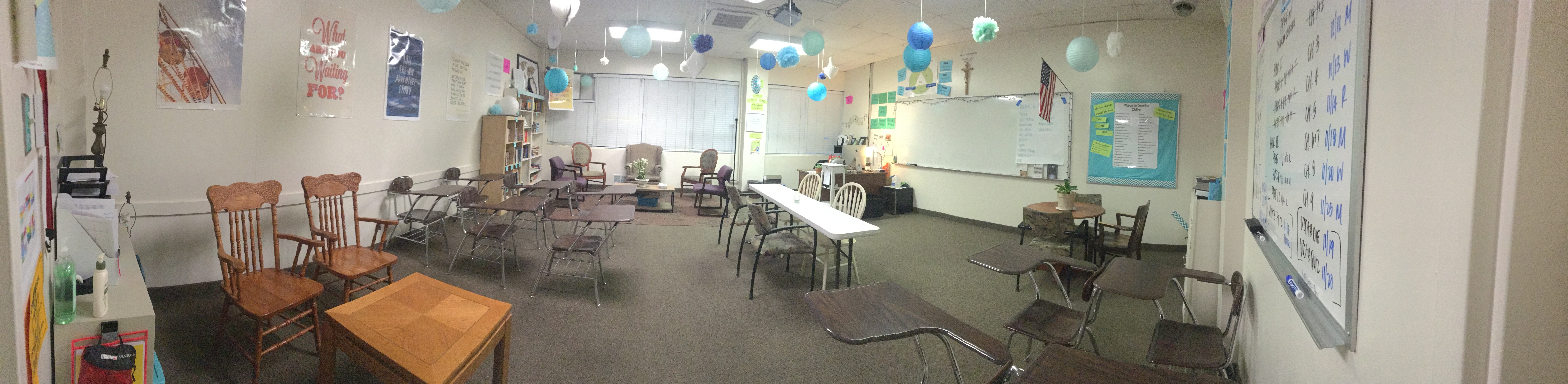
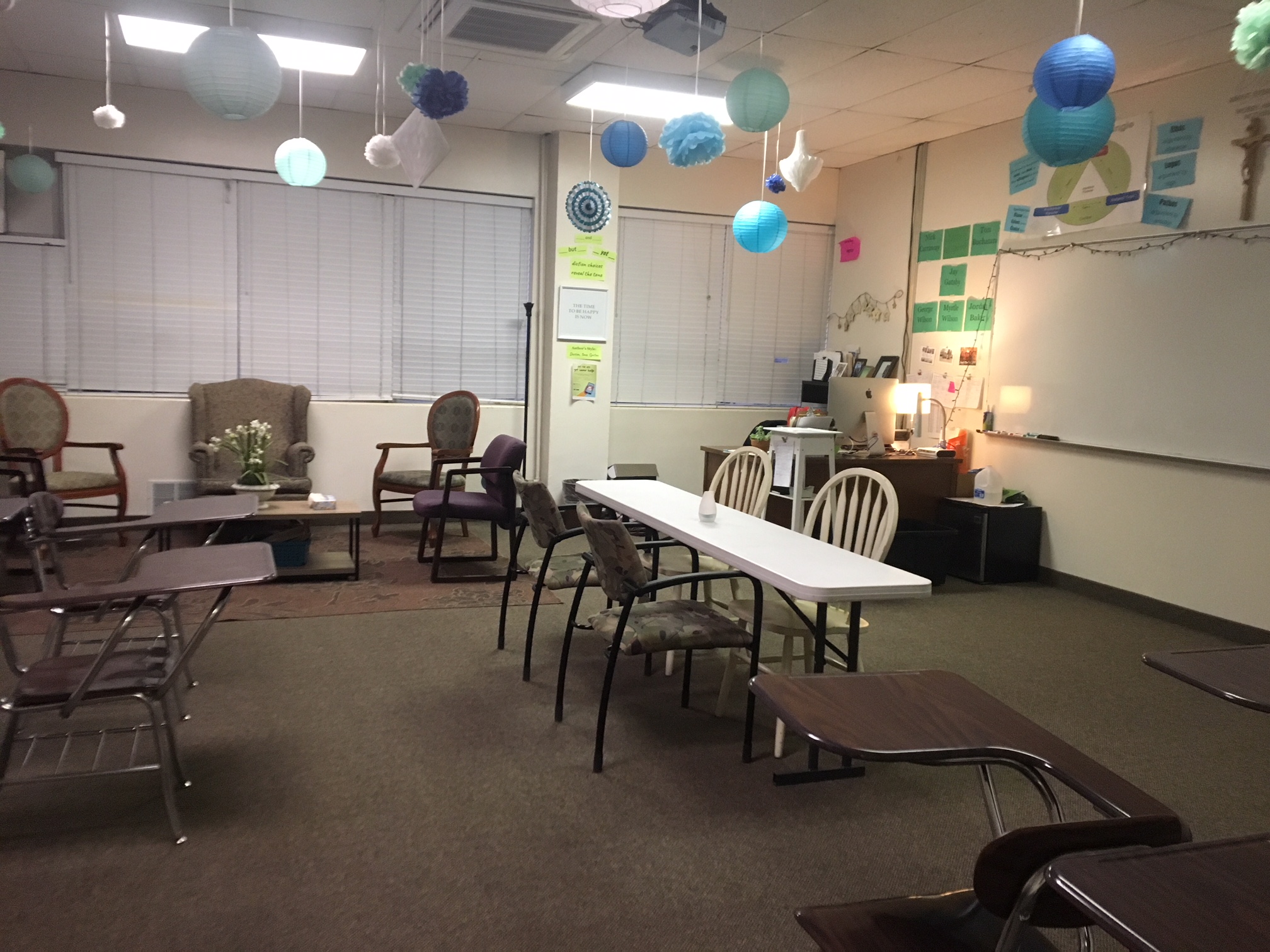
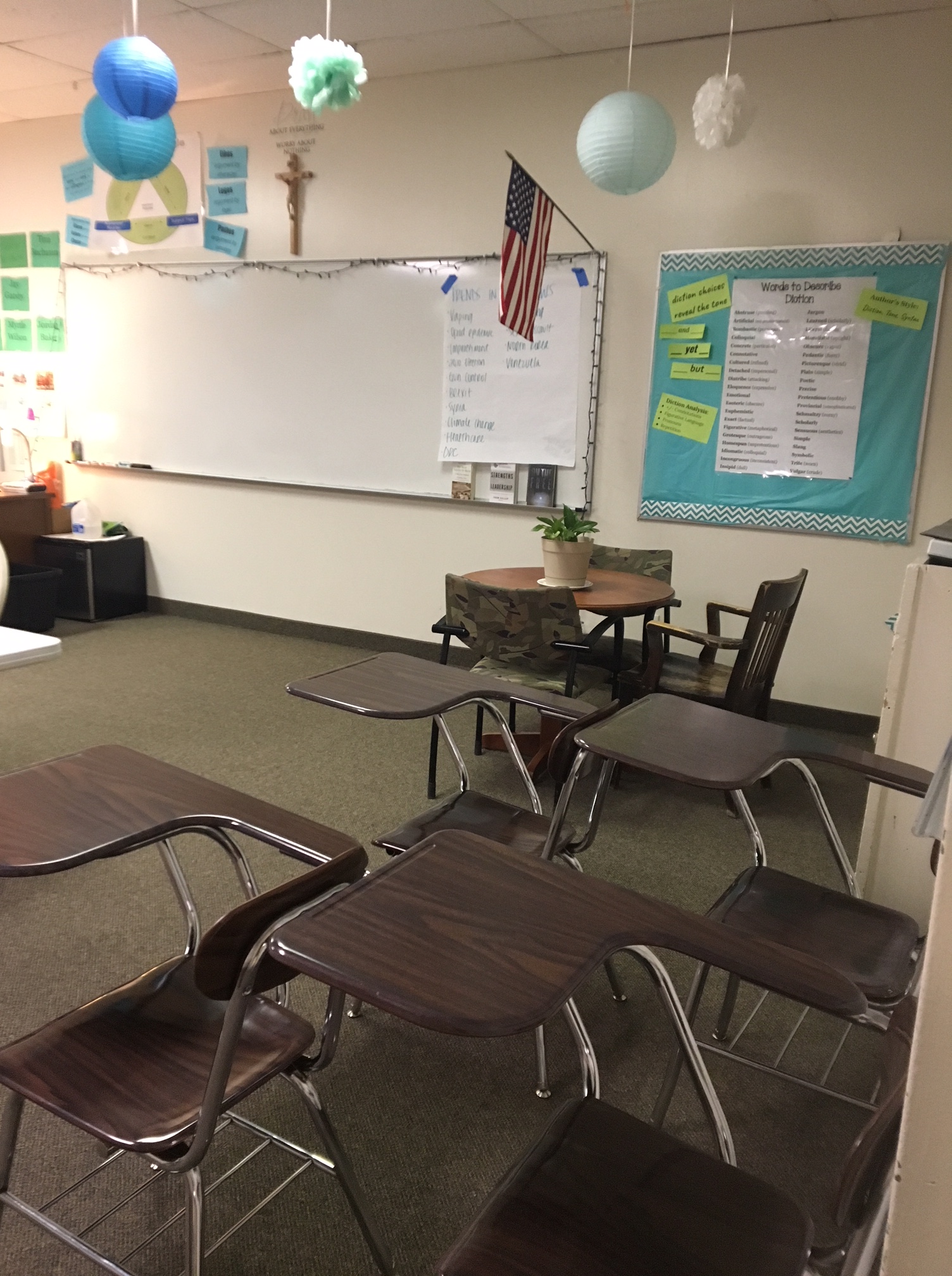
After introducing flexible seating into my junior/senior English classroom last year, I reflected in July about what I liked and didn’t like about the classroom arrangement.  After implementing some changes of my own and many reader suggestions (thank you!), I wanted to reflect over another semester of flexible seating.

Room.JPG

What I changed this fall:

  • Furniture Arrangement:  This year, I made smaller pods of seating. I got rid of the large round tables that ate up a lot of the room and actually moved in more traditional desks (partially due to larger classes).  With the additional space, I was able to fit two smaller tables and a set of chairs for students to work, providing more options for spaces. The room has a nearly-equal balance of seats that require students to use clipboards for writing and desktops or tables.
  • Expectations:  We had a discussion about the purpose and role of flexible seating in the classroom at the end of the second week of school and set guidelines together versus rules.  Students were granted permission to move the furniture to better facilitate group work or sight of the whiteboard, with the stipulation the room comes back to order when the bell rang.  We also discussed the importance of creating a single classroom environment, not one of multiple little pods, and facilitating that through direct eye contact.  I also shared my goal that the classroom feels more like a home than a place of rigid learning, but that homes are to be respected.  
  • Ownership:  While I still reserve the right to ask a student to make a better seating choice, I started the year by asking students to change seating areas each day for the first two weeks.  I believe this established that no one has a “spot,” but we share the space based on need and how we are feeling each day. Additionally, students are required to select a seating new area of the classroom every six weeks or so, which coincides with our school’s midterms and quarters.

Room1.JPG

Room2.JPG

Room3.JPG

IMG_3516.JPG

With larger classes this year, the room is more crowded, but feels more, well, flexible.  Removing the large, cumbersome tables also makes re-arranging the desks and chairs for a Socratic Seminar much easier.  I also have enough desks to facilitate an inner circle of desks and an outer circle of chairs. With smaller tables, groups are naturally formed which is a time saver and I can check in with one area at a time for conferences or work checks. Additionally, with less traditional seating available than with last year’s set up, my students and I have utilized the luxury of the cafeteria tables right outside my door.  While one class period a day may not be able to access these additional workspaces because of the lunch schedule, the cafeteria tables have become an extension of our classroom and great for spreading out groups or when we need more table space.

With very few reminders, students have been respectful and able to flow between small group learning and whole-class learning.  I notice students craning their necks to look at their peers or myself when talking and students.  While some classes are more open to moving daily than others, I find more students are switching around where they sit every few days, are moving based on what we are doing in class, and voluntarily switching seats to accommodate peers.  Students this year take responsibility for their seating choice for the day and have not “claimed” a seat as students did last fall, sitting there through the spring. Sometimes, I confess, the classroom does feel disjointed, like when students are working independently and chatting with those close to them, but I remind myself that at least they’re in a community, not isolated desks of individuals.

While the set-up and general facilitation of non-traditional seating is not always easy and I’d love to make my own place in the classroom just as flexible, students unanimously responded across six classes that they prefer the arrangement and choice to rows of desks, especially for reading time.  So if it works for them, I will make it work for me!

Maggie Lopez wishes everyone a happy, productive 2020 full of excellent books!  She is currently reading “The Lost City of Z” by David Grann after thoroughly enjoying “Killers of the Flower Moon.” You can connect with her @meglopez0.

Novels in Verse in the Senior English Classroom

I have always had a bit of a love/hate relationship with poetry. I know as an English teacher I shouldn’t admit this, but poetry has always been my least favourite genre to teach. While I loved to read poetry as a teenager, I loathed when we had to study it in class as I felt that all the analyzing destroyed it. Unfortunately, some of this mindset has followed me into my teaching career and I have often struggled to really love teaching poetry and I have found that this translated into the way my students have engaged with poetry, as well.

While trying to find a new connection with poetry in my classroom, I have found a few things that have helped. The first was spoken word poetry – the powerful performances of these talented poets sparked some of that old love I used to have for poetry in me and I found that it was easy to translate this excitement into my classes.

The second is what I want to talk about here – my discovery of the novel in verse. The first novel in verse I picked up was Kwame Alexander’s The Crossover when I was trying to find a book to recommend for a sports obsessed reluctant reader. I didn’t realize it was a novel in verse when I first opened it up, but from the moment I started to read it I was hooked. The combination of poetry with a narrative arc spoke to me and I realized that novels in verse could be an accessible pathway to poetry for not just myself, but for my students as well. Since then, I have integrated novels in verse into my classroom in many ways. Sometimes I have held book clubs where all of the novels students can choose to read are novels in verse where other times I have chosen to integrate just one or two titles along with prose novels and graphic novels.

Some of my favourite novels in verse I have used recently in my classes are the following. Some of these books deal with heavy topics (in particular October Mourning), so I would recommend reviewing them before using them with younger students.

Death Coming Up the Hill By Chris Crowe: I stumbled upon this one almost by accident and I am glad I did. It was in the bargain bin at a bookstore I was at and I am glad I discovered it. Death Coming Up the Hill is set during the Vietnam War and follows the story of 17 year old Ashe who is dealing with family issues during the backdrop of the war. The story follows Ashe as he tries to avoid being drafted for a war he does not believe in. This powerful novel in verse is even more impressive as it is written entirely in Haiku with every syllable in the novel representing a fallen solider who actually died during the war.

Enchanted Air: Two Cultures, Two Wings by Margarita Engle: The poetry in this novel is completely compelling. Besides being a novel in verse, it is also a memoir of the author’s experiences growing up between two cultures. Set during the Cold War, we follow Margarita’s childhood as she struggles to reconcile her Cuban heritage with the American world she is growing up in.

October Mourning: A Song for Matthew Shepard by Lesléa Newman: This is a hard read, but a powerful and important one. It may, however, be too much for some students. This novel in verse takes us to October 6, 1998 to tell the true story of when 21 year old Matthew Shepard is lured from a bar and beaten to death simply because he was gay. This novel in verse is tragic and powerful at the same time. 

If you had asked me several years ago if I would ever read a novel in verse, I am not sure that I would have said yes. These three novels in verse, along with several others have changed my opinion and have helped me become a more passionate poetry teacher.

If you want more recommended reads, check out my previous post on integrating authentic voices into our middle years classes.

Pam McMartin teaches Senior English and is the Senior Teacher Librarian at an independent school in Tsawwassen, British Columbia, Canada. She is reluctantly becoming more of a poetry fan the more she exposes herself to powerful, modern works. You can follow her on Twitter @psmcmartin

When Your Teaching Life Throws You a Curve…

Hit a home run.

Or at least make contact, get on base, and rely on your teammates and experience to get you across home plate.

This new year, the new decade, reminds me that teachers often face new challenges and situations. Think about that student who transfers into your school nine days before the semester ends or the joy and then horror that flashes through your mind when you see that new copiers have been installed.

Sometimes though, we face new adventures that even vast swaths of experience cannot prepare us to handle the way we parry and deflect most of what’s throw at us. For me, a move away from athletics pushed me toward new classes that revealed just how comfortable I had become in my almost decade working with seniors. Last year freshman English and freshman Pre-AP English classes taught me about patience and pacing. This year sophomores and AP juniors force me to flex muscles I never knew I had and push me to explore the boundaries of my workshop pedagogy.

For those of us who face the anxiety of teaching a totally new class, a new unit of study, or even a new lesson, consider this advice:

  1. Lean on the pillars of experience around you.
  2. Trust the reading and writing workshop process.
  3. Build a team.
  4. Explore your literacy.

I’ve been blessed to leap into these last two years, and the change they promised, with groups of teachers who had been there before and knew what to expect.  Their knowledge and willingness to support me allowed for less time learning new content and more time planning effective lesson delivery.  While I have many questions, they seem to always have an answer that guides me back on the pathway to success.

Lean into the workshop that supports reading and writing because it invites literacy learners to feel safe within the routines and community that literacy learners need. New learning happens much easier then the teacher and the students feel comfortable and safe with each other.

Growing your support system beyond your teaching team is important. Living on front street with your students about your inexperience can be a scary proposition, but it can also invite them into the type of relationship where they understand that you will all grow together and that they are not the only ones being asked to shoulder a growth mindset. As for the adults in the building, instructional coaches are there to help you and support you, looking for clues to the type of help you need, listening when you struggle, celebrating your successes because they own a piece of your potential. Lastly, but no less importantly, build relationships with your administration. Extend the invitation for them to be in your room and learn about the students that pass through your life on a daily basis.  Admin isn’t there solely to handle disruptions or crisis. Rather, they, like every other educator in the building, have a vested interest in the success of your students and deserve the opportunity to experience your greatness.

Never forget the value of reading and writing beside your students. When you aren’t sure how to fairly and authentically assess the writing tasks you ask your students to perform, write your own response.  When you ask them to revise their writing, invite them into your process to help you explore your ideas.  They will jump at the chance to support your writing the way you support theirs. Share your reading life too.  Your reading life will engage them just as deeply, and as they learn more about what you like to read, they will learn more about you and, perhaps, about their own compassion.

Most importantly, trust the process. Believe in yourself in the face of new experiences. You owe it to the students and to yourself.


Charles Moore recently returned from a 2025 mile road trip vacation where he learned about new people and places and loved every minute of it. He encourages everyone to try to visit the Martin Luther King Jr. Historical Park and The King Center. Bring some tissues just in case a high school band spontaneously shows up to play for Dr. King.

One Word: Goals and Other Possibilities

Happy New Year! 

I always appreciate the expanse of winter break. After the joyful rush of the holidays (and sometimes the excess–so many cookies), I find myself with the time and space and never ending mugs of coffee needed. To think. To properly think and reflect. During this deliberate withdrawal from the world, I recenter and refocus. Usually, I develop new visions for my classroom, my students, and myself (professionally and personally). Last year, discovering #OneWord via my PLN energized my thinking. Jon Gordon describes it here as choosing the one word that will give “meaning, mission, passion, and purpose.” Beyond the fun of ruminating over possible words (always the nerd for words, here), I loved the intentionality of choosing the words that would anchor me for the year. I chose two: outside and feed. 

Outside moored me personally and professionally. I knew I wanted to spend more time literally outdoors, and so, I sought ways to do so: walking, running, hiking, scootering, skating, floating, fishing…even working outside. In fact, this one word led me to my best outside adventures of the year–hiking and running in Norway and enjoying a fjord cruise. This particular journey also fit my other interpretation of outside–seeking ways to go beyond or outside my comfort zone. The trip was the first long trip with my husband away from my children. Anchoring to outside helped me take risks professionally, too, which is why I write this now as an instructional coach. 

Feed became a mainstay in my classroom. I thought of feed as the ways in which I provided, maintained, or sparked the energy of the classroom and my students. So, I worked on delivering feedback that fed forward. I managed pace, working to stay brisk and lively. I altered mini lessons so that they stayed consumable. Feed nurtured my students and me. 

Reflecting now, I wish I had engaged my students in this kind of reflective anchoring. It’s a different way of goal setting, certainly. Here and here are some resources for getting started with students. But the possibilities for use during workshop make it worth further consideration. These extend beyond the variation of the New Year’s Resolution. 

Use OneWord to…

  1.  Set purpose each week for your class or for workshop time. Tethering to a carefully selected word might help students move more intentionally through the week and allows a reflection point at the end of the week. Class this week is brought to you by the word ___________. 
  2. Craft one word summaries of how their writing is going prior to conferring with you or their peers. Perhaps these one words are more about their affective states (build emotional intelligence further by providing them with a list); perhaps they indicate progress; perhaps they demonstrate the most valuable word of the piece. 
  3. Employ in quick writes. Encourage students to apply one word from independent reading into multiple quick writes from the week. That word might take on different meaning for that student. 
  4. Shape perspective. Instead of or in addition to essential questions, these one words become the essential ways for filtering reading and writing in the classroom. Maybe students use a blend of whole class (community perspective and individual one words (identity driven) through which to view reading and writing.
  5. Create a Words to Watch list of your own as a class. Consider using this list as a mentor text of sorts. Maybe students tie in Article of the Week and develop a word list based on their explorations of contemporary issues.
  6. Identify the developmental arc of a character. Students could choose one word to describe a character at each stage of transformation. 
  7. Craft one word summaries of their reading. This isn’t a new idea but maybe a reminder of how students might use words as mainstays–perhaps starting with what’s accessible before  
  8. Ground in reflection. Invite students to choose one word (provide them with a list if necessary) to depict their progress as readers, writers, or thinkers over the course of the week. They could use Flipgrid or SeeSaw or a Jamboard or just their notebooks or post it or notecard to present the word and reflect on it as their choice. 

And what else? I’m certain there are other ways to adapt the one word perspective. And I’m also certain that as we encourage students to ruminate over words–whether for the purpose of goal setting, reflecting, or creating–that we give them ways to anchor their thinking. 

I’m still ruminating over my word for this year. Pause is a strong possibility. So is perspective. And leap, dive, explore, and elevate.  I think I’ll pour another cup of coffee. 

Kristin Jeschke taught high school English for nineteen years, twelve in Waukee, Iowa at Waukee High School. She now serves as Instructional Coach (20 years in education in 2020!) and is as big a word nerd as ever. Follow her on Twitter @kajeschke. 

“It’s Beautiful” – A Simple Reminder

Happy Holidays!

I’ll keep this post short and sweet.

I hope you are finding your holiday break restful and rejuvenating, filled with warmth and time with family. I know I am enjoying spending time with both mine and my husband’s extended families. Both of our families are large and loud and full of children under the age of ten. It’s chaotic and joyful and, honestly, one of my favorite gatherings of the year – on both sides.

While sitting in church on Christmas Sunday, my three year old niece brought me a coloring page and began to use my lap as a table. The last one to grab crayons, she was stuck with a really drab brown. She enthusiastically scribbled and scrabbled and scratched her ugly brown crayon all over that coloring page with – seemingly – no rhyme or reason. Breathing heavily, she gave it her all for five frantic minutes.

Then she stopped, held up her art, and sighed. “It’s beautiful.”

My heart melted. Of course it was. She saw beauty where I only saw a mess.

It reminded me of conferencing with my students. There’s always something worth praising, something beautiful in their writing. I don’t know about you but my first instinct is to start with what we can fix, where I can teach by showing what the student can do better. When I start conferencing after the break, I want to remember my niece and ask my students: What do you LIKE about this piece? What’s beautiful?

I think that reframing will make for a good moment in our conferences.

Sarah Morris teaches AP English Language and Composition, AP Seminar, and Film as Literature in Murfreesboro, TN. She is currently reading and loving Mo Willems’s picture books. She tweets @marahsorris_cms.

Finding A Better Recommendation Letter Approach by Mark Nepper

To Whom It May Concern:

It gives me great pleasure to recommend Ethan for admission to your institution. Ethan enrolled in three of my classes through his high school career. He is a student who has achieved academic success and possesses great potential. He has inspired me and students in class with his work ethic, his writing ability and his thoughtful commentary. You will be pleased to admit him to your upcoming class.

Blah, Blah, Blah. That induces as much boredom reading it as it did writing it. But my college recommendation letters often read like that. What am I doing? I find myself wondering about the entire recommendation letter process.

By the time I let the computer cool down, I will have written 40+ recommendation letters this application season. Interestingly, it occurs that these letters actually represent a form of summative assessment. Though the students tend not to see them as such, these really afford the teacher the opportunity to give summative assessments of their students that are not in any way connected to points, grades and all the other elements of assessment.

I typically don’t share the letter with students. However, if I truly do value it as a summative assessment, then it seems I should share it with them. I should use it to provide teachable insights with the students and let them know this is how I see them not only as a students, but also as people. The comments and observations in the letters represent their strengths.

In the Greater Madison Writing Project we promote the C3WP (College Career Community Writers Program) protocols of argument writing to our project members. One of the elements that always stands out focuses on strengths in the students’ writing. So often in assessment we look at what doesn’t appear, or weaknesses. We get locked in to the deficit framework, sometimes to the neglect of the good. The National Writing Project rubric, though, suggests instead that teachers approach assessment from a point of strengths as opposed to weaknesses. We can learn and grow as much and likely more from emphasis on what we do well than a laser focus on what we have done less well.

When I write a letter of recommendation, I try to present insights into the ability of the student and important qualities of character. With thoughtful contemplation, this recommendation letter could become a clearer snapshot of the student’s abilities and work in my class than numbers on a page.

As I get excited about the possibilities of writing a letter not just for my students, but a letter to my students, I stop cold. I often have wondered about the actual, true importance of the letter in the student’s application.. And does it really matter? Many of my colleagues have come to believe it doesn’t. They put as little actual effort into the letter as possible. They believe admissions officers likely glance at the letter in search of red flags. So then I wonder if writing this kind of letter enhances admission chances. It may not. It will definitely take more time to write. If I choose to write a true reflection of the total student, I would want it to be more than just a writing exercise.

I like so much better the idea of writing a letter to my student, rather than a letter to some anonymous admissions officer, who is skimming through lines of type, eyes bleary, keeping a close count on their daily numbers of applications read and scored.

So Dear Ethan, or Dear Nana, Dear Shamyon, Dear Naia, Dear Eva, Dear Hannah, Dear Edwin, Dear All: This is my assessment of you. Let me tell you first of all, what a privilege it has been to teach you in this class and what a bright future you have ahead of you. Though I may not have taken the time to share these thoughts with you in class, I want you to know I always appreciated you and all that you did. Not only are you a thoughtful student, you are a fine and wonderful person. You should always know and believe that about yourself.

I would have loved to receive a letter like that from a teacher.

All right. I’m committed to the idea.

This is what my recommendation letters will look like:

To Whom It May Concern:

Dear Ethan,

While your friends socialized loudly before school, you leaned against a locker, studying a textbook on robotics. We don’t offer courses in Robotics, but you want to learn as much as possible to become a more effective leader of your robotics team. That is so you. You commit. Wholly. Completely. You stand out as one of those students who possesses this insatiable intellectual curiosity. You strive to constantly learn and grow, and what you want to learn crosses all spectrums of knowledge. You just want to know as much as possible. You have said you only get one opportunity to live your life. You might as well get as much out of it as you can. Everybody should adopt your philosophy on living. Interestingly, I wouldn’t classify you as a bookworm or a drudge, though. You possess a vast friend base. You thrive in social interactions with friends or teammates, whether they are swimming teammates or members of the robotics team. You draw people to you. Your laughter lights up a room. Your future looks so bright. It’s time for you to go out into the world and get after it.

Sincerely,

Mark Nepper

Mark Nepper teaches in Madison, Wisconsin and works with high schoolers as well as practicing teachers. While he has been teaching for over 30 years, he is not quite ready to retire.

How To Break Up With Your Phone

I have told every student I know about How to Break Up With Your Phone by Catherine Price. I’ve also told my friends, family, and actual strangers in the grocery store. Today, I want to tell you about this book.

Price, a health and science journalist, began writing this book only after she felt compelled to break up with her own phone (she writes about this moment with poignancy here).

As I write this, twenty teens are in front of me in a study hall. Of them, ten are studying or working on projects for another class. Three are gossiping. The other seven have their heads bent, phones in hand, screens scrolling. When I ask students what they do on their phones, they tell me–Instagram, YouTube, games. Passive apps that require no interaction and which don’t provide much “content” for absorption.

When pressed further, one student told me she was a little shocked to realize she’d never thought about what it was she actually did on her phone–it was just a reflex.

Too many of us do the same thing. I worry about the impacts of this habit on our society in terms of interpersonal interaction (read Reclaiming Conversation by Sherry Turkle or The Shallows by Nicholas Carr if you’re as fascinated with this topic as I am), but I also worry about it as a teacher of readers and writers.

A passage from Price’s chapter on attention span gets to the heart of digital vs. print reading:

If you’ve noticed that reading a book or printed newspaper doesn’t feel the same as reading the same material on your phone or computer, you’re not crazy. It’s not the same.

When we read a book or the paper, most of the distractions we encounter are external… This leaves our brains with plenty of available bandwidth to think about and absorb what we’re reading. …

But when we read on a phone or computer, links and ads are everywhere. …when mental fatigue causes us to give in to our brains’ natural preference for distraction…we reinforce the same mental circuits that made it hard to sustain our focus to begin with. We get better at not staying focused.

How to Break Up With Your Phone, pp. 56-58

The implications of this are massive. As more and more English departments shift to online textbooks, and as more and more of our students have a phone in their pocket, it becomes much more difficult to sustain attention to anything, let alone the habit of deep reading. A generation of distracted, solitary young people is being born before my eyes.

I fully look forward to a generation of young people who chooses to reject the addictive lure of mindless technology use–which, perhaps, I can help speed along by throwing this book at every teen I see–but until then, I’ll keep sharing what I’ve learned from this book with everyone I know in an effort to get them to break up with their phones.

Shana Karnes is working on breaking up with her own phone by making more frequent trips to her local library in Madison, Wisconsin. Reading print books before bed and in spare moments leaves her feeling more relaxed and intellectually productive at the end of a busy day filled with teens and her two small children. Connect with Shana on Twitter at @litreader.

Workshop-izing Our Writing Instruction

“We didn’t have to spoon feed them!” The teacher beamed as we read the student writing hanging in the hallway.

Two months ago, the experience had been a little different. It was time for informational writing and students researched spiders. With class input, teachers wrote the spider report on chart paper. When it was time for students to write, 95% of them copied the report the teacher had written.

We realized that this kind of writing wasn’t honoring the students and all they know how to do.

Where we started

In my role as a literacy coach, I support teachers in lots of ways. This year one district is in the first year of implementing a writing workshop curriculum (after piloting and lots of teacher input, they decided on the Collaborative Classroom Being a Writer).

Some teachers, though, feel like this new curriculum takes away a chance to do “fun” writing that they enjoyed in the past. So we face the question of how to support students in transferring the rich skills they’re learning in workshop to other tasks. In other words, how could we take the things they’d done in the past and workshop-ize them?

We started by naming what students could do as writers, and then thinking about the implications:

Screen Shot 2019-12-09 at 7.52.01 PM


Workshop-izing

Teachers tried again with another informational writing unit. We began by showing students an image as a provocation:

Screen Shot 2019-12-09 at 8.15.50 PM

We used the See/Think/Wonder protocol to get the conversation going, a strategy I first learned from Tanny McGregor. First, we asked students to list the things they see in the image. After discussion, we then asked them to talk about what they think is happening in this image. This step encourages students to make inferences. After discussing our predictions, we then explained the origin of the image (this one is a photograph of monarchs migrating).

Then we moved to the Wonder step. Here we ask students to capture all the questions they have about this topic. From there, we might go in a few directions:

  • give students a set amount of time to find as many answers to as many questions (the shorter the better — we want students to see how much they can learn in a short time).
  • provide students with a shared text and ask them to annotate the text every time they find answers to their questions.
  • ask students to trade questions with a classmate and find the answers.

Once students built their schema around the topic, we stopped and talked about what they could do next as writers. We showed them several ways that writers write about information:

Students noticed that writers can use pictures and labels, or write a story, or even have a fact-based informational paragraph. And if writers did that, then they can too. Now students were ready to write. And they soared.

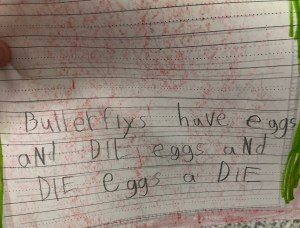
They wrote stories and poems and fact-based writing. One student wrote an opinion. Another wrote a story with characters. The best part was that we saw them transferring skills from other writing units to this one.

IMG_7679

This writer shows evidence of craft through repetition and using capitals to show emotion.


What does this have to do with secondary students?

You may have noticed by now that the writers I’ve been talking about are first graders. Why would I be sharing what first grade teachers are doing on a blog that’s meant for secondary teachers? Because, as I’ve written about before, I think secondary teachers have much to learn from what students are doing in elementary school.

Can our middle and high school students do this too? I’d argue that yes, those writers can make these same kinds of moves. What would happen if instead of giving our older writers graphic organizers and fill-in-the-blank essay templates, we instead give them a chance to write in ways that stretch them?

Let’s workshop-ize the writing that’s happening in all our classrooms. Let’s make space for all the writers to soar.

Angela Faulhaber is a literacy coach in Cincinnati, OH. You can follow her on Twitter @WordNerd