Category Archives: Writers

Grateful November and a give-a-way for you

Sometimes thank you has to be enough.

Last evening I joined in #poetrychat and learned from 28 teachers from various parts of the U.S. and Canada about how to more effectively teach grammar by using poetry. Chats like this inspire me, and I want to be a better teacher. Tomorrow I will share this poem with my students as we begin argumentative writing:  The Joy of Writing by Wislawa Szymborska, my new-found favorite poet.

Thanks to all of you who’ve joined in our monthly chats about poetry. I am a better poet, and poetry teacher, than I was last May when TTT started hosting the monthly poetry chat.

Also, I am a better teacher because of you, the readers of this blog. I teach with more intention because I know I will write about the lessons, activities, books, and other resources I use with my students.

Audience matters to every writer, and I consider it a gift that my audience is also my muse. Thank you for your questions that inspire such deep thinking and so many posts.

May November bring a sense of gratitude and rich blessings in the lives of each of our readers. Thank you for your confidence in us as we share the experiences, lessons, and activities from our workshop classrooms.

So what’s the give-a-way already?

Shana, Jackie, and I met online last week to talk about our goals for this blog and how we can support you more fully. We might be able to help more if you give us some direction. So —

We know it’s not much, but it will buy a few books: We’re giving away one $25 Amazon gift card.

Just complete the short 3-5 minute survey, and you’ll be entered automatically. We’ll choose a winner randomly on November 10 and let the winner know via Twitter or email.


3 Lessons from Running a Spooky 5K

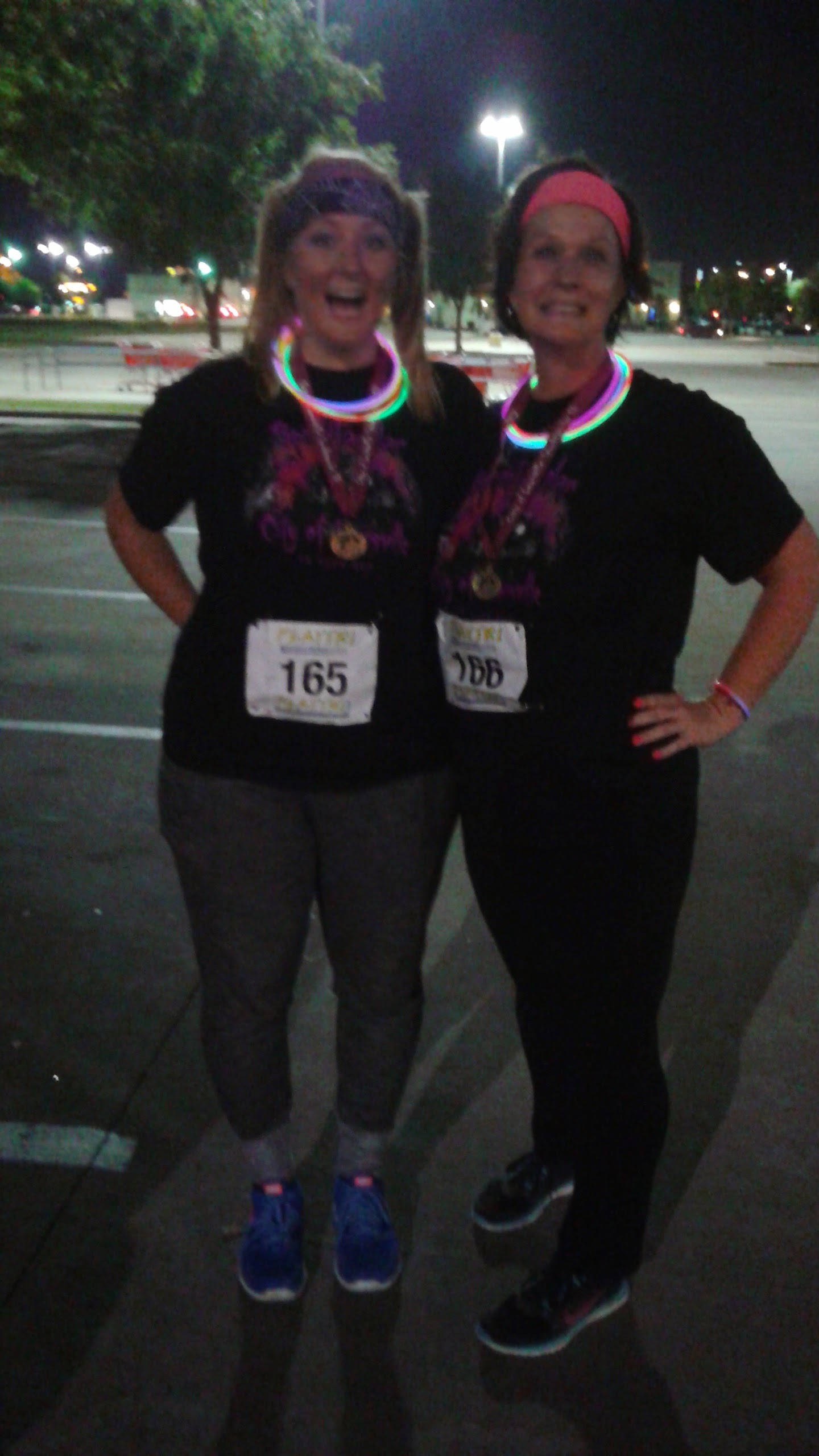
spooktacular runSaturday was the one-year anniversary of the race that changed my perspective about running — the “Spook-tacular 5K.”

I’d trained for about three months, getting up early for interval training before the hot TX sun demanded I go right back inside. Then at dusk going out again to run-a-little-walk-a-lot while my stamina claimed some courage.

Volunteers dressed up as ghouls and witches jumped from behind trees and fences along the pathway. Zombies roamed and groaned their way against the grain of runners. It was all fun and games until I lost sight of my daughter.

That’s when it got spooky. I could not see my daughter Jenna, my running partner who kept me from giving up.

Jenna’s a lot younger than me, so it’s no wonder she didn’t want to hang back and shuffle along. I even told her to run ahead.

But then the doubt started. What if I want to stop? Jenna won’t be here to tell me to power up. How will I keep going if Jenna’s not here to talk me through the sameness of a 3.1 mile jog? You know you hate running, why do you even try?

Two years before I’d tried to become a runner, but I could not make myself enjoy it. Jenna and I’d run one race back then, and I’d stationed myself behind an 70 year old man who ran with a walker. Really he ran with a nurse, but still, and there I was pacing myself behind him. He ran slowly, steady and sure, never stopping to catch a breath or break stride. A vacuum cleaner ate my lungs, but I kept moving. By the end, I thought my rubber legs would kill me.

Obviously, they didn’t.

Now, here I was in much better shape. Jenna and I worked out hard, and I knew I could run this whole race without stopping. I just needed to prove to myself that I could.

So I ran. I steadied my breathing, and I refused to stop. Booing ghosts and all.

I got about a hundred yards from the finish line, and I could hear “Monster Mash” blaring from the pavilion. I knew I’d almost made it when about eight little stick-figure-girls cut a corner and raced past me from behind.

Little cheaters.

I’d run the whole race, slow but steady, and these little adolescents with their long legs and glow sticks ran just long enough to “glisten” as they crossed the finish line right in front of me.

I crossed the finish line complaining. I didn’t even notice my time or relish the fun of finishing. I let them steal that from me.

And I learned some lessons that night:

1) I am stronger than I think I am.

2) I can do hard things, even by myself.

3) I shouldn’t let anyone at anytime steal my celebrations or my joy.

So what does this have to do with teaching? with readers and writers workshop and sharing what I know works? with conferring with my readers and teaching kids to write? with facing a room full of teens each day who need all the skill I’ve got?

Yeah, if you’re reading this post, I know you get it.

We train and practice and learn. We keep talking about books and conferring with our kids. We find joy when they light up about a book — or finally finish one. We focus on the skills we know our students need. We stay positive and hold fast to our pedagogy. We know workshop works. We revision our classrooms to meet the needs of our students — every single day. . . and sometimes every class period.

We keep moving, so our readers and writers will keep moving, too.

©Amy Rasmussen, 2011 – 2015

Mini-Lesson Monday: Learning Concrete Details with Independent Reading

More than any other writing, I love reading my students’ narratives. We start the year with narrative for many reasons, but my favorite is that I get to know my students faster than I can get to know them during one-on-one reading conferences or during group activities and discussions.

Here’s a short list of what I’ve learned from student stories just this week:

  • several of my male students wish they had a father who showed interest in their lives
  • a few of my girls live with their fathers because of their mothers’ poor choices
  • several boys and girls journeyed long and far, walking miles through jungles, so their families could escape oppression, rape, and murder
  • many of my teenagers have experienced heartache because of love interests, friends, and family members
  • a few are still grieving the loss of grandparents, aunts, uncles, and friends who died from suicide
  • at least one young woman still holds anger toward her mom because of the way she handled a brother’s addiction and abuse

Personal and powerful, all of these stories matter. My goal as a writing teacher is to help my writers harness the words so emotion reigns in the heart of the reader. The problem?

Abstract language.

Objectives — Using the language of the Depth of Knowledge Levels: Show understanding of the terms abstract vs. concrete; in your independent reading books, identify concrete details and figurative language; analyze the effectiveness of the author’s language; revise your writing to include fresh concrete details and figurative language as you create a text that evokes powerful emotions.


Lesson
— Before the mini-lesson, students have already drafted a few pieces, narratives or poems. I abstractconcreteusually do the mini-lesson after silent reading time, but for this lesson I begin before because I want to give students a specific purpose for reading.

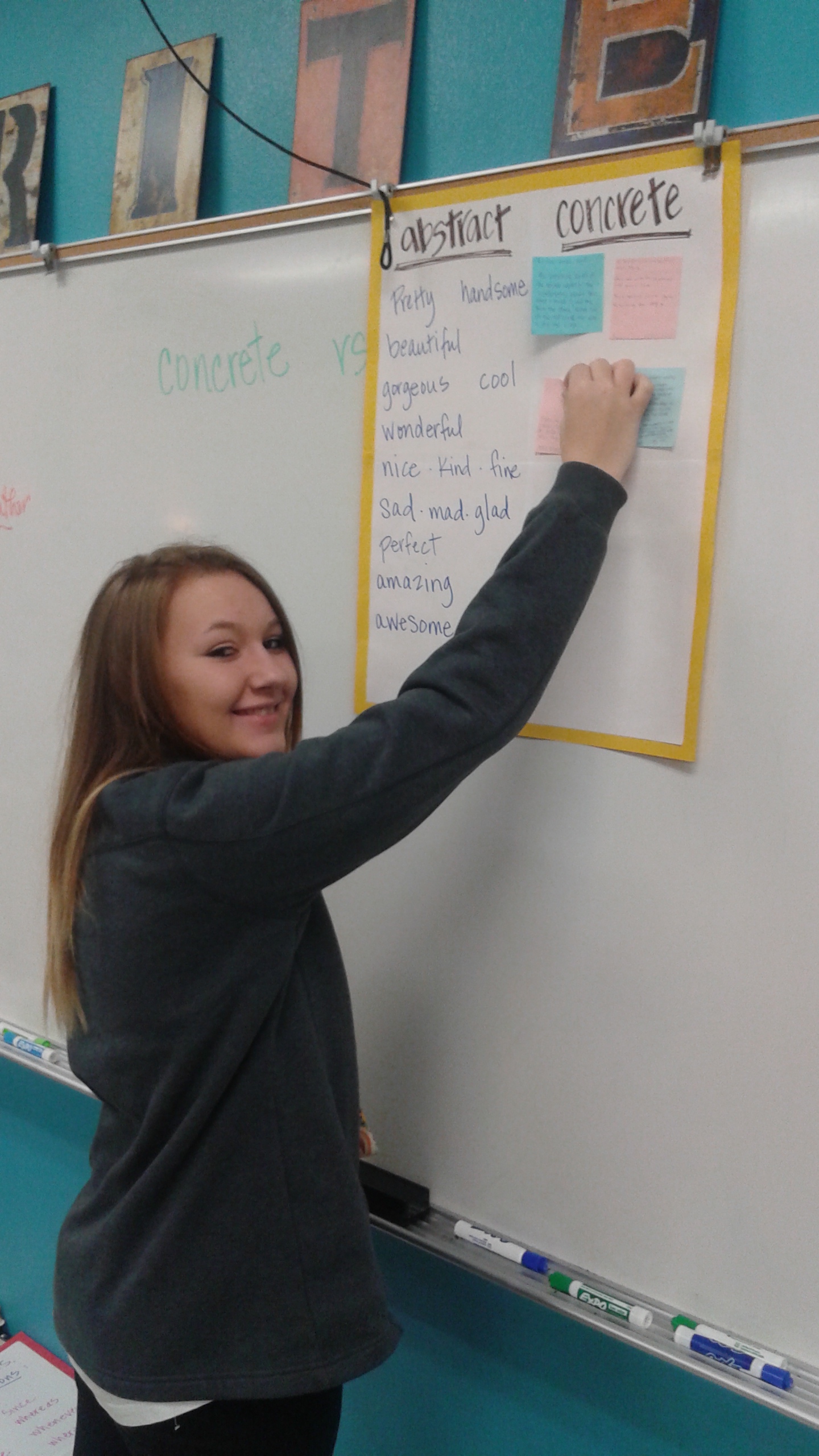
First, I write on the board ABSTRACT and CONCRETE and we review what these terms mean when it comes to writing. I try to use only abstract words as they begin to discuss this with me.

“Awesome, you might get it,”

“Wonderful, I think you know what I mean,”

“Hey, that’s pretty good…”

Eventually, they will pick up on what I’m doing, and we make a list of abstract words. Then I give each table-group a word and challenge them to come up with a concrete description that shows us that abstract word. They get 1-2 minutes, and then we share out as I write the concrete details on the board. We discuss the difference in how an author can create emotion.

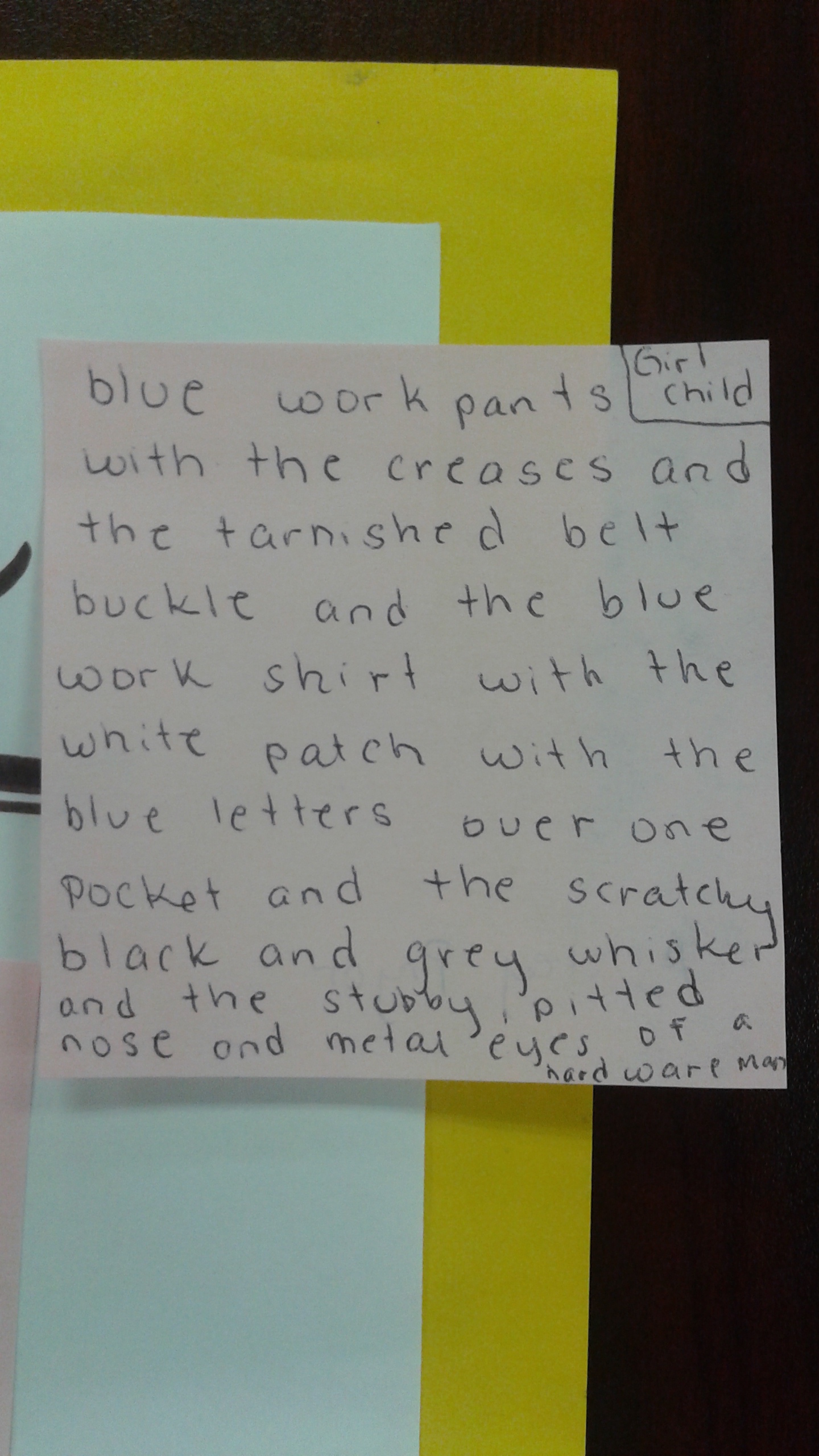
Next, I ask students to pay attention to the concrete details in the book they are reading, and I give them each a sticky note. “As you read today find at least one sentence where the author does something really clever with concrete details and/or figurative language,” I say.

Students read for 15 minutes, pen in hand, paying particular attention to the author’s craft. When time is up, I ask students to share their sentence in small groups and to analyze the effectiveness of the author’s word choice.

AllieTate“Think about what he’s trying to do there. Why did he mention the color of the sweater, or the smell of the breeze?” If they feel like the author’s accomplished creating emotion, they put the sticky on the board (or as in the photo here –poster).

Students need to not only recognize the details and know that they create some kind of imagery, they need to think about how effective the word choice is for what the author is doing at that moment in the story. If I can get them to start thinking about this, I can get them to begin making purposeful choices in their own writing.

Next, I ask students to search their own writing for concrete details that create images and to add a lot more. “Where can you add a phrase or line similar to what you found in the book you are reading? Is there somewhere you can add color or shape or texture?”

And we revise.

Follow-Up — When students immediately apply learning we’ve practiced using their personal reading materials, they begin to see the connections between becoming active readers and purposeful writers. This is the kind of lesson I do again and again with a different literary or grammar skills students to master. Next up:  subordinating conjunctions.

A few lines from students’ published narratives:

“Each body turned to watch as the green army, blurry, entered the gate. The ground only knew sadness and the sky transformed into a dark night, roaming like a lion.” –Tha Sung

“My first impression when I met Lucila:  petite, chunky, short red-velvet hair, wearing a sweater that covered her sins, mysterious face with a sealed silent mouth.” –Karina Rangel

“My brothers slept like angels with devilish grins.” –Geovanni Medina

Fitting Self-Assessments into Competency Based Grading

fotolia-33988899-xs-photogalleryThis year my school shifted to competency based grading.  For those unfamiliar with this, grading is centered on students’ mastery of the Common Core competencies.  While I have found it differs from state to state, our school has integrated competency based grading by requiring all classes to follow a grading percentage of 80 percent summative assessments and 20 percent formative assessments.  In addition, students are allowed to retake summative assessments as many times as they would like assuming they initially approached the assessments having prepared with good effort.

For me, as an English teacher, this process of retakes and revisions isn’t new.  That being said, the idea of 80 percent of my students’ grades being summative assessments is most certainly a shift.  In the past, while their final product has always served as a large portion of their grade (over 50 percent), it hasn’t counted quite as much as it does now.

I value formative assessments; I cherish the time my students spend cracking apart texts, mimicking authors’ craft, and simply reading.  For many of us, high school was a formative experience.  The time we spent exploring who we were paid off long term, yet competency-based grading values the final product more than the process.

To a degree, I take fault with this.  I understand that once students enter the workplace they are assessed based on their final products.  In the same breath, I also believe that high school must provide a platform for students to explore their interests in a safe and supportive environment that values process.  My life has largely looked like the reverse of my gradebook—80 percent of my time is spent reading, writing, brainstorming, drafting, discussing, and working, while maybe 20 percent of it is actually publishing, sharing, or posting my work.  I learned this process in high school.

Because summative assessments count for so much this year, I hate (even more than usual) applying a specific number to my students’ work.  In turn, to compensate for this competency based grading, I ask my students to assess themselves.

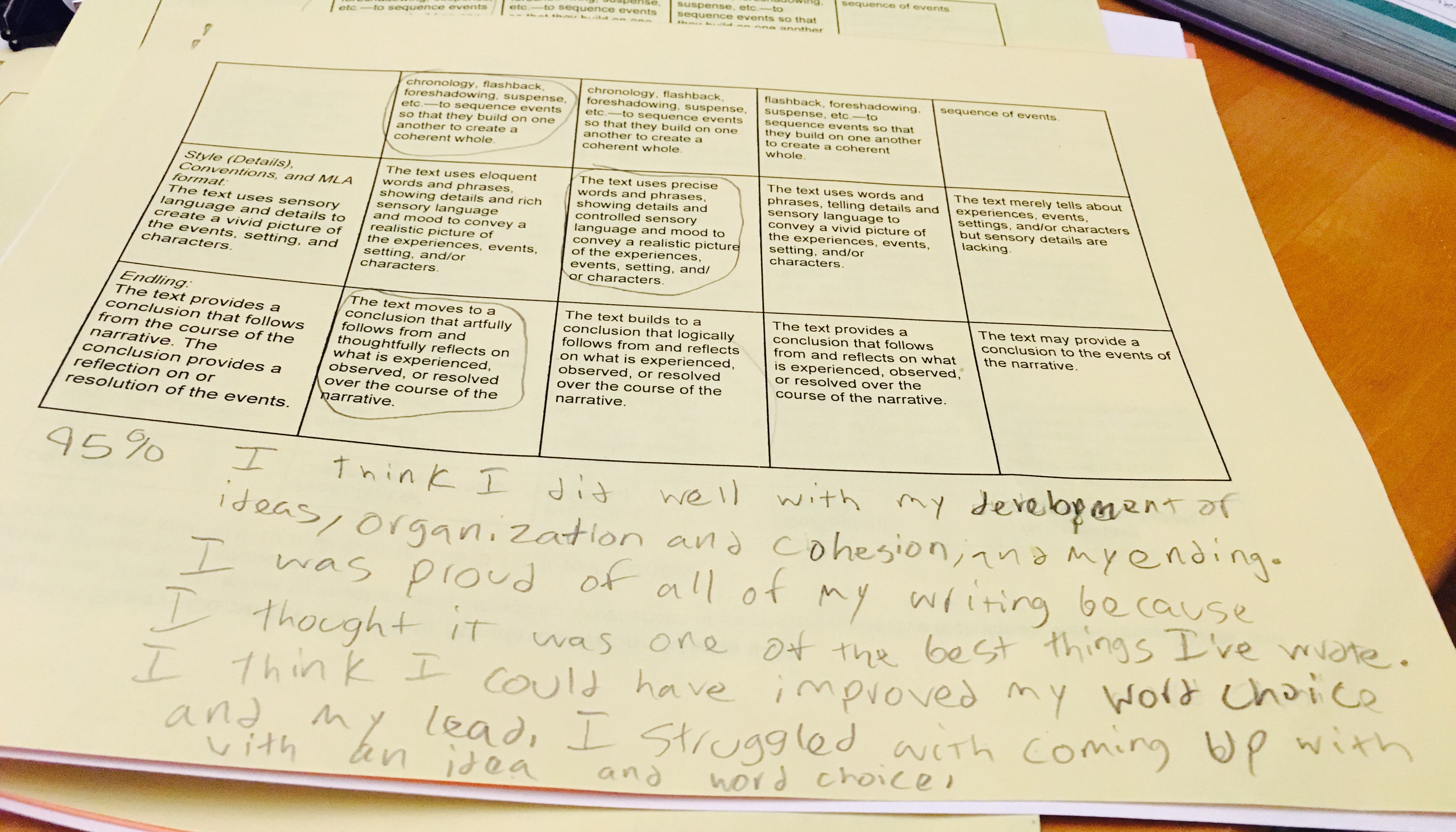
Every time my students hand in a paper or summative assessment like a notebook check, they grade themselves, writing a brief “metacognition analysis” in which they explain their writing, thought process, and reasoning.  In turn, instead of being blind sided by my grades, they have a say in how and even whether or not they met the competencies of the assignment.  Typically, they’re spot on with their grading.

FullSizeRenderNicole wrote, “I think my essay deserves that grade because I worked really hard on it.  I ended up printing it 4 times because every time I printed it I would self edit and have someone else edit it so that it came out just how I wanted it.  Just like always, I put a lot of my personality and voice into this piece.  I wanted people to laugh when they read it.  I added lots of detail about tiny situations and background.”

Ryan, had a similar assessment, “I think I did well with my development of ideas/organization and cohesion, and my ending.  I was proud of all of my writing because I thought it was one of the best things I’ve written.”

Ultimately students are also willing to honestly discuss their shortcomings.  Maddie targeted areas she hoped to improve in future pieces: “I feel I did well but could’ve been better.  I struggled with creating sensory details, but I feel I wrote this piece pretty well.  I would like to try and make this story more vivid, putting the reader in my position.” 

While I’m still addressing these changes and gauging my own understanding of competency based grading, self-assessments are the single most important change I’ve made in my classroom this year.  After I’m done reading rubrics, circling boxes, and checking off competencies, their voice is the resounding voice I hear.

Do you have competency based grading in your school?  Have you shifted to the 80:20 grading system? What changes have you made to better meet the needs of your students?

Mini-Lesson Monday: Imitating Poetry

Reading more poetry with my students has been a goal of mine these past few years, and it’s been a goal I feel has been readily achieved with ideas like creating Heart Books or reading novels in verse.

But writing poetry–well, that’s a different story.

Students who aren’t accustomed to writing poetry need a scaffold before they can leap into free verse composition without a topic, genre, or form prompt.  For this scaffold, I use imitation.

Objectives — Using the language of the Depth of Knowledge Levels:  Identify patterns of language, structure, and punctuation in a given poem; Modify the style of the given poem to suit your purpose; Create a poem in the style of a given poem.
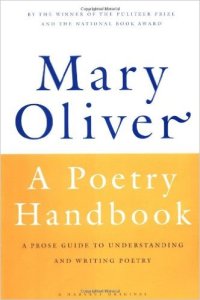
41KeFnbnPfL._SX330_BO1,204,203,200_Lesson — Before the mini-lesson, I will have already booktalked two of Mary Oliver’s books–A Poetry Handbook and Dog Songs, which is always a favorite with my students.  As the mini-lesson begins, I’ll read to them from Oliver’s chapter on imitation.

“You would learn very little in this world if you were not allowed to imitate,” Oliver begins. “Before we can be poets, we must practice; imitation is a very good way of investigating the real thing.”

“I have some poems here today for us to imitate and investigate,” I follow up.  I pass out the following options, lately garnered from my incredible poetry seminar with Mary Ann Samyn:

“Read over these quickly, and choose one you’d like to imitate.  Then open to a fresh page in your notebook.”

“I’m going to write with you, and I’m going to choose ‘A Display of Mackerel,'” I say.  “It seems long, but look how short the lines and stanzas are.”  I put my chosen poem under the document camera.  “Now, this poem is about a display of fish, and I want to imitate it and write about a display of something.  There’s a pretty big display of colorful objects in my room…” I trail off.

“Your library!” Nathan helpfully supplies.

“Yep,” I agree.  “I’m going to imitate this poem and write about my bookshelf.  I’m just going to change a few words per line, but I’m going to keep all the punctuation and the numbers of words the same.  It’s so easy to write poetry this way.”

On the document camera, I begin my imitation next to Doty’s original:

They lie in parallel rows,                   They rest in slumped rows,

on ice, head to tail,                           on shelves, spine to spine,

each a foot of luminosity                   each a sheaf of wisdom

“See how easy that is?  I keep Doty’s structure, punctuation, and even some of his words.  I just change a few to make the poem about my display of books, rather than his display of mackerel.  Now you take a few minutes to give this a start.”

We set about writing together.

After 10-15 minutes, we each have a full imitation poem.  We break into small groups, working with others who imitated our same poem.  We read our poems aloud.  Feedback is given on what we notice–similarities to and diversions from the original, and the effects of both.

Follow-Up — We’ll practice imitation a few more times before we leap into writing poetry independently.  When we do, I’ll ask, as always, that my students create a small anthology of their work on that genre–some samples of their early forays into poetry through imitation, as well as a few examples of their own independent attempts.  I’ll definitely include my “A Display of Books” in my own anthology, as I find it a lovely description of my library that I’d like to preserve.

My Imitation Poem: “A Display of Books”
by Shana Karnes & Mark Doty

They rest in slumped rows,
on shelves, spine to spine,
each a sheaf of wisdom

creased with cracked spines,
which divide the plots’
most gripping sections

like bands of color
in a double rainbow.
Vibrant, luminous

prismatics: think indigo,
the wildly rainbowed
spectrum of a springtime rain,

think sun spearing through clouds.
Wonder, and wonder,
and all of them in every way

unique from one another
–everything about them
a onetime blend of letters. Thus,

they’re all creative expressions
of a million different souls,
each a tenuous effort

of the soul’s footprint,
writer’s essence. As if,
after a lifetime of drafting

at this printing, the author’s
taken irreversible steps,
each as permanent

in its inked completion
as the one next door
Suppose we were shoulder-to-shoulder,

like these, the same but different
from our universe
of neighbors—would you want

to be yourself only,
unduplicatable, doomed
to be in print? They’d prefer,

plainly, to be award winners,
forever honored. Even now
they seem to be straining

forward, heedless of their lifelessness.
They don’t care they’re ink
and simple paper,

just as, presumably,
they didn’t care that they were imagined:
all, all for all,

the rainbowed shelf
and its acres of brilliant words,
in which no verb is singular,

or every one is. How eager they seem,
even on shelves, to be different, selfish,
which is the price of publication.

Sharing Student Work — Making a Pledge to Do More

For some time now I’ve thought I needed to do more. I ask my students to write a lot. I ask them to take ownership of their process, practice their craft, take risks. I hope they will care about their audience, but unless it’s a post on their blogs (and sometimes even then) I don’t think they consider much about their readers.

My colleagues here at Three Teachers Talk and I had the idea a few years ago to publish student work on this site regularly. We planned it all out. We’d hope for student volunteers that might want to produce something like a mini-Nerdy Book Club but with student readers and student writers. Then I did a little research:

I found sites like Young Writers SocietyTeen Ink, Figment, Teen Lit, and of course, NaNoWriMo that publish the work of young writers and allow them to join online writing communities and learn about competitions, awards, scholarship, and more. This list of 40 of the Best Sites for Young Writers has even more resources.

I still want to do more, but what I need to do is introduce my writers to site like these and extend the invitation that they explore, discover, and get involved. I know a few will. Maybe many will.

In the meantime, here’s a sampling of the writing I’ve read this week. Not because I like the topic — it horrifies me on many levels — but because this writer shows heart, I want to share her work.  Read it. You’ll see why I know I need to do more to help my students write for audiences that will appreciate their craft.

Bruised-Knees by Alexia Alexander

It was a breaking point.

By the time my spoon scraped the bottom of the bowl, my face was wet with tears. I was sick, in part from eating, and in part from everything else. I had to cry quietly; I suffered silently in order to avoid questions, sometimes, even hidden behind smiles and laughter. The chocolate and caramel ice cream weighed my stomach down. I felt 200 lbs of milk, sugar, grief, loneliness, depression, cocoa, corn syrup, and artificial flavors. My entire 500 caloric intake itched in my throat. I felt heavy now. I felt worthless now. I felt defeated now. I ran as quickly up the stairs as I could, but voices, almost as loud as the screaming downstairs, followed me.

Why’d you eat that ice cream? You’ve already had enough. You’re just going to GAIN weight if you eat something like that. You can’t you even starve yourself right,” I told myself.

Staying up late reading about it, I prepared myself for chaos. Although I laid under two blankets and behind a locked door, I found little comfort. In fact, I hadn’t even kept the monsters out; they began to creep inside of my head. I spent the nights crying, reading pro-anamia blogs, drowning my ears out in Maria Mena, and looking up the most fabulous ways to destroy myself, self-esteem first.

Now getting a chance to test my research, I rushed to the bathroom, still crying. I looked at myself in the mirror; I cried even more. I was sobbing and choking, sounding like that one kid in elementary that always forgot his inhaler on mile-day. I dropped to my knees, as if I were about to pray, but I couldn’t remember what people were supposed to say to a divinity.I gripped the sides of bleach-white seats, as if my faith would be found there, and hung over the porcelain throne, like a sea-sick passenger. The bathroom became dizzy in my eyes, and the pink walls were a blur mixed in the leopard print bathroom curtain. The white tiles painted my knees black and blue and staring at them made the wave of sickness more intense. In the reflection of the toilet-bowl-water, I even looked green and sickly, but I can’t say my self-perception was quite accurate in those days.

I had screenshotted instructions on my cracked iPod screen on how to do it. I looked up everything. I needed all the how-to’s before I went through with anything. I knew I could use a toothbrush or two fingers. I knew I could make markers in my stomach. I knew how many seconds it would take. I knew that it would sting. I knew the long-term damage the acid could do to my teeth. I knew how deadly it was. I knew how sick I was.

But I continued, another event to add to my list of “First-Times.”

Slowly shoving a finger in between my lips, I danced it around trying to find the spot. I felt the tickling as I touched the dangling piece of skin. I added a finger, this time gagging slightly, but knowing no matter hard I cried, I couldn’t take my hand out. I gagged again,  bringing up the bile taste in my throat. I couldn’t choke. I had to keep going. I gagged another time, body split over the toilet as I heaved.

I had found the food that comes up almost as easily as it goes down. The ice cream coated my throat, for a second time, and it still felt cold. It masked the normal taste of vomit, gladly, and I finally felt lighter;I equated that to feeling better and didn’t think twice about why I was still crying.

Maybe you can be lovely now. See, you’re already feeling better,”  said the demons in my head, who told me things like this frequently. I tried to ignore them, but sometimes my own silent voice felt like a scream between my ears. I cried myself to sleep that night, still trying to convince myself I had done well.

I wish I had known then what I really was trying to rid myself of. I wish somewhere on that ground I really had some holy revelation, but wisdom like self-love and perseverance can only be taught from low moments like those. It took years to find what really weighed me down, more than food or fat. It took years to love myself and my body. It took years to get over the urge to skip a meal, and the shame after eating. It took years to face the demons and shut them up. But each moment that buckled me to my knees gave me strength, and brought me closer to where I am now. Moments I’d rather forget, have to remain real, so  I always remember my growth, and never repeat the past.


©Amy Rasmussen, 2011 – 2015

7 Reasons to Stop Asking about AP Test Scores

The question took me by surprise.

I’d just spent an hour or so sharing how I facilitate readers and writers workshop in my AP English Language classroom. I’d shared a video that showed my students testifying to how much they like having a choice in the books they read and why they feel like they will learn through choice reading this year. I’d shared a mini-lesson on how I teach skills using the books students choose to read, even when they are reading 30 different texts. I’d answered a variety of questions asked by pre-service teachers in Dr. Leavell-Carter’s master’s class at the University of North Texas and started to pack my things.

“What about your AP scores, did they go up?” one young woman asked, “I mean, I just think that would be a double benefit,” she said with a smile.

They say there are no bad questions, but I’ll go to the mat arguing that this is one we really need to stop asking.

I answered as honest as I could: “No. . .well, yes, when I began facilitating writer’s workshop, my scores increased double digits, but I don’t put much stock in AP scores, any standardized test scores, really, there are so many variables, you know; the students and their abilities differ from year to year, and since I’ve only taught in Title I schools where open enrollment is an invitation for all students to take AP classes with no prerequisites or even any preparation for the rigorous coursework, it’s difficult to prepare all students all the time at the same level of learning…”

Then I kicked myself all the way home. Why was I trying to justify my test scores? I’ve written about this before. I have much better proof that workshop works than any kind of testing data:

  1. Many of my students read more during the nine months they spend in my class than they do in

    from Joseph’s reading self-evaluation

    all of the 10 years of school they’ve had prior to coming to me.

  2. Almost all of my students read more books the year they spend with me than they read the year before.
  3. Many students read their first book cover to cover their junior year in my AP English class.
  4. Most students move into complex reading on their own because choice not only gets students reading; it gets them reading critically.
  5. Students tell me every year, “Thank you for allowing me to love reading again.”
  6. My readers learn to see themselves, and to see beyond themselves, by participating in book clubs with peers in non-threatening conversations about literature.
  7. My writers take ownership of their writing and compose beautifully and skillfully crafted texts.

There is no test that measures what my student come to appreciate as readers or what they come to realize as writers.

Sure, I want my students who choose to take the AP exam to do well, but I do not believe it shows what they come to understand about language. (And after scoring essays in Kansas City in June, I believe that even less.) Sure, I’ll keep encouraging my students to take the exam, but I believe most of them will benefit from taking freshman comp in college — even if they read and write well enough to score a 5. At least one English professor agrees with me:

“AP-credits are not always an accurate gauge of student learning. High AP scores in chemistry, for example, may indicate that students understand the basic concepts, but that doesn’t mean they know what to do at a laboratory bench.” (Bobby Fong, college dean and English professor).

I say what’s true for chemistry is also true for English. That doesn’t mean they know what to do when writing an essay for graduate school or a blog post for their employer or reading a report for their business or a decree in a divorce settlement.

Let’s focus on the skills our students need to be successful in the lives that lay before them.

For me, readers and writers workshop helps me do that.


©Amy Rasmussen, 2011 – 2015

The Importance of Narrative: Stories That Stay With Us

I was reading a weekly one-pager yesterday and came upon this little note from a student:

IMG_9850

This student, Aleigha, had taken an elective writing class with me as a sophomore.  Now, as a senior, she wanted to revisit the story she’d begun two years ago, and give it a different ending.  I was surprised that Aleigha had remembered that story, and that its ending had nagged her for two years.  I was even more surprised, as I started to read her one-pager, that I remembered her story, too–a fictional narrative in which two soulmates are torn asunder by circumstance.  She’d ended the story unhappily, leaving the two protagonists separate.  In this year’s one-pagers, though, she’s slowly bringing them back together.

Aleigha’s narrative was powerful to her, and personal, despite its fictional genre.  Her peers’ feedback indicated that her characters’ situations were relateable–that everyone wants people in love to end up together, because it’s something we all strive for as humans.  Narratives give us something to root for.

During a Google Hangout this summer, Jackie talked about her students’ writing of narratives, and how “the transformative power of common stories” brought out their best and most vulnerable writing.  “Every child has a story to tell,” agrees Don Graves.  Because of this truth, narratives are my favorite genre to teach.

We all have a story to tell–a story that stays with us, that we can’t get out of our minds, no matter how long it’s been since the idea was seeded.

As my students write their narratives, I’m shocked by how naturally the words are flowing out of their pens.  When the topic is powerful, I feel like I have little to do in the way of writing instruction–I simply have to get out of the way and let them write.  I have mini-lessons planned on pacing, setting, sensory details, and characterization.  But I’m finding beautiful writing already extant in their drafts:

“Every time I step onto the ice, it takes me to my childhood,” Mitchell’s story begins.

Kaylee stuns me with: “The musky smell of burning wood rose into the air as the sound of water crackling split the silence.”

“Realizing you’re gay, and accepting you’re gay, are two very different things,” another story leads with.

The brilliant Tom Newkirk explains why students are able to effortlessly write this way in Minds Made for Stories:  “The hero of the story is a narrative itself…Narrative is there to help us ‘compose’ ourselves when we meet difficulty or loss. It is there to ground abstract ideas, to help us see the pattern in a set of numerical data, to illuminate the human consequences of political action. It is home base.”

We make sense of the world by weaving its happenings into a story–by the time our students come to their notebooks with an idea, they’ve already rehearsed this story many times.  They are just bursting to tell it.  It is home base.

While narrative may not be considered the most “rigorous” of genres, I believe it is the most important one.  It is the writing that demands to be done–the genre that is the most personally fulfilling, the most emotionally wrenching to write, but the most necessary to exorcise from our minds.  Let your students write their stories–write your own beside them–and watch your community of writers bloom.

Mini-Lesson Monday: This lesson stinks, literally.  Teaching Sensory Details in Narrative Writing.

FullSizeRender-1I, like many of my students, am a kinesthetic learner.  Not only do I learn by doing, but for many tasks, I require a hands-on approach to fully grasp the complexity of a concept.  Yet as a teacher, applying kinesthetic techniques to English concepts can be somewhat challenging.  While we write and read and physically play with words, I try to create simulations and activities that allow my students to experiment with writing in unique ways.  This activity, which is one of my favorites of the year, uses students’ olfactory sense to stimulate sensory detail writing within their personal narratives.

Objectives:  Using the language of the Depth of Knowledge levels, students will identify personal memories associated with unidentified scents.  Recalling prior and newly acquired knowledge, they will translate their observations into descriptive writing by constructing sentences that rely on sensory details.  Finally, students will apply their understanding of descriptive writing to their own personal narratives.

Lesson:  This mini-lesson takes preparation, but students’ responses are worth the extra time.  First, collect the following supplies: Plastic cups (I use blue Solo cups), a permanent marker, tinfoil, a toothpick, rubber bands (optional), and a variety of objects that have a scent.  This year I used lime juice, perfume, scented wax blocks from Walmart, BBQ sauce, apple cider vinegar, garlic, mint extract, crayons, and Play-Doh.  Every year is different though and I typically rely on what I have around my home.

I put the scented sauces, liquids, and objects in each of the cups, cover the cups with tin-foil, and wrap a rubber band around the top to secure the foil.  I label each cup with a number and poke holes in the tin-foil with a toothpick.  Next I place the cups around the room. After taking some notes on the concept of “show don’t tell,” students walk around the room smelling the contents of each cup.  They must not peek (believe me they will try)!

FullSizeRender

My students were convinced I had a tiny Abercrombie and Fitch model in this cup. In reality, it was a block of scented wax from Walmart.

I provide each student with a grid in which they fill in the cup number, adjectives to describe the scent, and personal memories the scent conjures.  They must then write a two-to-three-line story or scenario in which they describe the scent without identifying what the scent is.  By the end of the activity, when we come back together as a group, students excitedly volunteer to read their sentences in order to reveal the contents of the cup.

Follow Up:  Following this activity, we identify sensory details within our independent reading books and take turns discussing these details within our groups.  Finally, during workshop time, students add sensory details to their personal narrative rough drafts, in turn “showing” images rather than “telling” them.  The process of digging into their narratives and writing in the margins reinforces the messy, step-by-step process of revision that many of my students struggle to grasp.  If time allows, students partake in a whip share in which we each share one line from our narratives that includes sensory details.

What are some untraditional writing activities you use? How do you get your students moving around the classroom?

#FridayReads: Whole-Class Novels to Teach, and How to Frame Them

This past summer Shana and Jackie found that we’d both taken on a unique experiment within some of our classes–we had decided to strip them of whole class novels and instead focus on independent reading, book clubs, and smaller whole-class texts.  As workshop teachers confident in the power of choice reading, we each felt that this shift would be both empowering and inspiring within our classrooms.  After our year of experimentation, we both left our classrooms with unique perspectives on the power of whole-class novels as well as how we would incorporate them moving forward.

Today is the third and final installment of our week-long discussion using Google Docs.  Please, join the conversation in the comments!

41Cx8mY2UNL._SY344_BO1,204,203,200_Question 6: How is it different to be forced to teach a certain novel versus to be able to choose the ones you teach?

Jackie: I will readily admit that I am “forced” to teach To Kill A Mockingbird and Macbeth at the freshman level.  That being said, I love teaching both of them and am fortunate that my students respond well to both pieces.  The challenges are certainly different though.  I must create student buy-in or else my students will drag through the next four to six weeks of our unit.  I frame each lesson to fit their needs and I make sure to fit the book into a workshop structure the best I can to create consistency.

I do believe that teachers must have a choice in what they teach, though.  We must be allowed to tailor our lessons to fit the needs of our students.  Independent reading allows us to understand our students as readers and individuals, which in turn, allows us to further assess what books our students might connect with best.  Fortunately for me, the freshman team I work on is progressive and forward-thinking.  They’re always willing to try new things, which oftentimes involves integrating contemporary works.

Shana:  This summer in Tom Newkirk’s class, he innocently posed this question to our class:  “Why is the defining novel about race in our country written by a white woman?”  He was referring to To Kill a Mockingbird, of course, as many of us were discussing its lately-released sequel.  That question, so casually tossed into our midst, made me think about why the canonized novels taught in schools are often so heavily prescripted.  Why does Harper Lee have a voice of authority about being black in America?  Why do my rural students need to read a particular story about race?  I know why it’s important to read stories about people different than us–I would argue that it’s essential to building empathy and a broader worldview to read widely–but why does Harper Lee hold the monopoly on that topic, and not someone like Toni Morrison or Zora Neale Hurston?

As usual, I have raised more questions than I’ve even attempted to answer, but I’m still not sure of the correct solutions.  I think it’s preposterous to have a rote schedule of “books to teach” for all teachers in a school when it’s blatantly obvious that the community of every classroom is different, which means the culture of its students is always unique, which means that no child ever needs the same book at the same time.

Jackie: It’s funny that you bring up Tom Newkirk’s question.  As I was sitting next to you, I had one of those hide-your-face-moments when I thought, “Oh geez, I teach To Kill A Mockingbird!”  As I said earlier, I am required to teach this book, and while I love it, it does not meet the needs of all of my students.  Teaching in New Hampshire, I have a predominantly white population.  This means that their understanding of race relations and their exposure to diverse literature is rather whitewashed.  We desperately need new, diverse voices to help our students understand and empathize with a variety of individuals.  The precious few books we read together should be based on the needs and interests of our students instead of being dictated by a one-size-fits-all approach.

Question 4: What is the most effective way to frame a whole-class novel and create student buy-in?

Jackie: At the beginning of the school year I discuss the different types of reading we encounter as lifelong students.  I explain that, as a reader, I read for pleasure as well as for knowledge.  Oftentimes those two paths can and may cross, but typically my personal reading life looks drastically different from my professional reading life.  I love pouring through popular YA lit, but in the same breath, I can’t get enough of dissecting poetry with my AP Literature class.

This same pattern applies to my students’ reading within our classroom.  As a class we must learn to maintain a fruitful and engaging personal reading life that allows us to not only learn from our literature but to also explore our own interests and passions.  That being said, we mustn’t overlook the power of dissecting and discussing language and craft as a class.  Reading whole class novels reinforces the fact that no two people read a book the same way.

Shana:  If choice is the golden guide to teaching of reading, then I think the culture of a classroom must dictate the novel we read.  While A Raisin in the Sun was immensely popular in my inner-city Cincinnati classroom, it completely flopped here in West Virginia when I tried to teach it.  The inverse is true of Huck Finn; wildly successful in WV, but a total fail in Ohio.  Thus, I seek to hear the themes my students return to again and in again in their writing and conversations–this year, we are engaged in many discussions about political rhetoric, the origin of power, and the struggle that class/social/financial/ethnic differences create.  Thus, I’ll seek out novels that explore those themes to help us engage with them more fully.

In closing, we leave you with a list of the most successful whole class novels we have taught as well as a list of the books we would teach our current students if given the opportunity.

Most successful novels I taught, from Shana:28c4d1f2e8d048f702c3dbf0990aca8c

A Separate Peace by John Knowles

The Absolutely True Diary of a Part-Time Indian by Sherman Alexie

Macbeth by William Shakespeare

Fahrenheit 451 by Ray Bradbury

What I’d love to teach, based on my current students, from Shana:

Peace Like a River by Leif Enger

Boy21 by Matthew Quick

Poisonwood Bible by Barbara Kingsolver

Into the Wild by Jon Krakauer

Most successful novels I taught, from Jackie…(you’ll notice some repeats):51BWES5VL2L

Of Mice and Men by John Steinbeck (read aloud and performed as a play)

On Writing by Stephen King

The Absolutely True Diary of a Part-Time Indian by Sherman Alexie

The Glass Castle by Jeannette Walls

Macbeth by William Shakespeare

Fahrenheit 451 by Ray Bradbury

What I’d love to teach, based on my current students, from Jackie:

Sold by Patricia McCormick

Here, Bullet by Brian Turner

One Flew Over the Cuckoo’s Nest by Ken Kesey

All the Light We Cannot See by Anthony Doerr

Be sure to join the conversation today in the comments! We would love to hear your perspective on whole class novels and how you incorporate them into your classroom.

Click here to read day two of our conversation.

Click here to read day one of our conversation.