Category Archives: Writers

The Trouble with Grading by Abigail Lund

I sit down at my desk. It’s the end of quarter 3 and it’s time for the dreaded report cards — the time where I average the homework grades, find missing assignments, and vigorously come up with something to say. My computer flickers on and my online gradebook comes to life. It happily tells me many students are receiving A’s and B’s and then, as if it is the Ghost of Christmas Past, the dreaded F appears. John Doe: English Language Arts Quarter 3: F. I stare blankly at the screen.

This very moment I had been dreading the whole quarter. What does this F tell me about John Doe? Does it say how much he’s improved in reading over the quarter? Does it say if he knows how to compare two texts or write an introduction to an opinion writing piece? More so, does it tell me about his cooperation with others and his big heart?


A year ago this is how I graded, this vicious, unnerving cycle of grading. Then I found Twitter. Twitter is a beautiful tool, and after a bit of digging I realized that there were other classrooms out there that were gradeless (an amazing Twitter community for all of this is Teachers Going Gradeless; @TG2chat). I wasn’t the only crazy person – so I took the plunge.  The past seven months of a gradeless classroom has changed my perspective and gives my John Does a fighting chance

Gradeless doesn’t mean a lack of assessment. It means giving students an opportunity for success through practice, voice, and self-reflection. A gradeless classroom is multi-faceted and is constantly changing.

In my experience, it offers students more practice, collaboration, observation, conferring, and gives more time to accomplish what I, as a teacher, was asking for previously. Gradeless classrooms take the pressure off of points and focuses on learning and growth (which happens for kids at different times). According to the Organization for Economic Cooperation and Development (OECD), researchers concluded that “after around four hours of homework per week, the additional time invested in homework has a negligible impact on performance.” This very fact was the first step into my gradeless classroom. As teachers, our time is often consumed with grading endless amounts of homework in hopes that our kids will average a decent score at the end of the quarter, but with my gradeless classroom I spend my time on more things of value.

When I finally had this mind shift, I allowed for more student reflection on work, which has a positive affect, and I eliminated graded homework. Previously I spent a lot of time assessing students’ homework. When I decided to move to gradeless I moved more towards rubrics and conferencing, which naturally moved away from homework. Students reflect on the work they have done. Through reflection and rating of their understanding, I am able to confer with them more effectively during our conferencing and small group times – far more than homework ever did.
images.jpgBy ditching homework students have more opportunity for self-reflection and practice without the pressure of having every piece of their work graded. Students take more risks and ask more questions, because there isn’t the fear of failure. For example, student practice work and homework becomes less about getting the right answer and more about the exploration of the process. In the day to day students are meeting in small groups, reflecting on learning using rubrics, and analyzing strong mentor models.

Eventually, as the learning processes unfold, I formally measure students’ understanding through using my State’s standards: student exceeds standard, meets the standards, or does not meet the standard. This assessment occurs after students have had ample time to ask how they need to improve and what they need to learn. There isn’t a specific algorithm for when this assessment occurs, but by meeting with students weekly you will get a strong sense of what your students know and how you can push them towards meeting the standard.

When I started caring LESS about the percentage and MORE about my students learning, I began to let go of control. Gradeless means more attention to detail. As a teacher, I am able to observe student work and evaluate it with a greater purpose in mind. When evaluating, I use standards based grading, which is district initiative. This lends itself greatly to my gradeless classroom because it eventually assesses students on skills and not percentage based scales. Standards-based and gradeless are not synonymous but are blended very easily. If you are thinking about going gradeless, standards based is a route you may want to go, but there are other avenues as well.

This can also be done by creating standards-based rubrics and face-to-face conversations for assessment. It allows for my students to work through projects together to begin with, and after gaining confidence, they often being to soar through the second quarter. Through this gradual release, I am able to create lessons that are multi-faceted and allow students to know what I am expecting, the standards, and how to achieve them.

Some questions come to mind

What will my report cards say if my district isn’t like yours and has percentage based grading?

An encouraging word I was gradeless before my district moved this way. Unfortunately when it comes to report cards you will have to average your students’ work. However, this doesn’t have to be done in the traditional sense of a composite score of homework, assessments, and projects. This can be done with observation notes, through assessing what your students really DO know, and using your knowledge of your students to grade them fairly.

How do you keep track of your students’ progress?

In my classroom I have my students send their work via Google-classroom. This gives me a portfolio of work to draw from when I am assessing with our standards. My students are rated on a 1-4 scale (1: not progressing 2: progressing with guidance 3: grade-level achievement 4: achieving above grade-level). Also students rate themselves on their understanding weekly. I am able to pull from those examples to compile an understanding of where my students’ understanding is.

How did I explain this to my students’ parents?

For the most part my parents were very much on board when I decided to go gradeless, this was probably because we were also going to standards based grading scales, which was a district decision that they communicated to parents. I was very upfront at the beginning of the year, explaining the gradeless philosophy, and had a lot of support from my parents.  With a gradeless classroom I believe that I am talking more to my students than I ever did before, and this translates to home as well. Keeping an open conversation going about student progress keeps parents happy, whether it is concerning grades or not.

Going gradeless is an ever-changing, flexible way of teaching. This isn’t perfection but what in education is? My hope is that my classroom would be a place where students can explore, desire education, and create. My greatest desire is that my students would be known and their ideas & thoughts would be validated. The place I have chosen to start is to know my kids by name and not by a letter.

Abigail Lund teaches 4th grade ELA and math to her fabulous kiddos in Cincinnati. She loves coffee about as much as her husband and cat… and is a self-proclaimed lifetime learner. Catch up with daily happenings and ramblings on Twitter @mrsablund.

Story Generates Story, and More

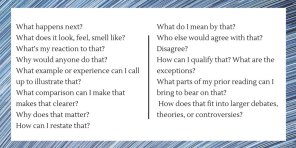
This past weekend, Tom Newkirk tweeted about writiNewkirk Self-Promptsng fluency and the value of “self-prompting,” and he included a list of a dozen+ prompts that foster such fluency. For Tom, these prompts “swirl in his head” as he writes. For our students, we need to build the habit of prompting questions into their process. Whether through daily writing, regular conferring, or sheer faith in the possibility, many students this year have discovered the true generative nature of writing — a sentence begets a sentence, begets a sentence, and so on. Alas, too many have not.

Our students hear from published poets and slam poetry veterans (our school librarians put on a magnificent Poetry Week every year) about lengthy revision processes. They view interviews with their favorite authors who explain the grueling evolution from idea to draft to revision to “finished” piece. They read lots of writers on writing about the toil of the work. Still, more students than I care to admit still believe in some divine inspiration behind the magic of words on a page, which one either receives or does not. And, to try to write without this inspiration (as in, every day in their Writer’s Notebooks) is a futile endeavor.

Tom’s recent tweet seemed divine in its timing. The day before, as an in-school field strip, 10th-grade English classes participated in a workshop with storytellers from Chicago’s 2nd Sstory_line_awk-e1523848925727.jpgtory, an organization that holds storytelling events, workshops, and education in the value of story — in both the telling and the listening — as the source of human connection. The name 2nd Story refers to the very nature of story as generative: one shares a story of their own experience, which inevitably reflects some aspect of the universal, and then invites others to do the same.

Presenters shared their own stories, which included universals such as losing our youthful belief in things magical, facing our greatest fears and living story_line_rightto tell, proving we’re capable of what others believe we are not. Then they got students up out of their seats in parallel lines or inside-outside circles, so humans faced other humans, screen-free. First, students shared one-sentence stories based on prompts like “I felt [insert emotion] when …” or “Tell about a time when you … broke or ruined something … told a lie … received a gift you really wanted (or not) …” Lines and circles shifted and rotated to maximize the quantity of faces in contact.
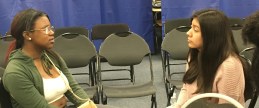
Sure, it was awkward and scary at first for many — if not most — of these 15- and 16-year-olds, who may or may not have met before. Gradually, though, as stories even as brief as one sentence were shared, it became less so.

In one of the two workshop rooms, students talked in pairs, sharing their stories by kelly_empathyjpg.jpgelaborating on one of the prompts from the first part of the exercise. I could hear the energy in the room even before I was fully in the door. Moving through pairs of students, I could hardly hear the stories themselves, but no matter. story_lean-in.jpgWhat mattered was that students were hearing them from their partners, many of whom started out as strangers (different classes were blended into one workshop). And not just hearing, but listening. They began, literally, to lean in, closing distances through shared stories and the natural empathy that results. When we return to our regular classrooms this week, students will begin recording their stories on FlipGrid, listening to and commenting on one another’s without the high stakes and vulnerability (even unfamiliarity) of face-to-face, real-time human interaction. Which reminds me …
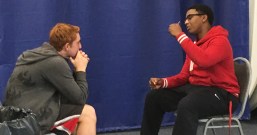
story_engagement.jpgI’d like to pause briefly to offer this qualifier: On-demand, face-to-face, forced interaction with strangers is not every 10th grader’s cuppa tea. (Heck, it’s not every adult’s cuppa, either.) In fact, several students literally waited it out on the sidelines. But even these reticent, reluctant, and even recalcitrant folks couldn’t help but listen — and be drawn into — the stories of others. And maybe even, as a result, classmates who were still strangers became less “other” than they had been 90 minutes earlier. I’m even holding onto the possibility that the stories heard that day will sustain their generative power and elicit even more — not only more stories, but more listening, more “leaning in,” more empathy, even more inspiration: not from any divine spirit, but from engagement with each other and with the work of writing — and speaking — their truth.

Growing Writers: Making Use of Student Mentors

My mentee Sarah, a new-to-the-district teacher in the midst of an intense co-teaching experience (where on an average day seven adults supported thirty students with an expanding continuum of needs), was filling me in on the narrative her students would be drafting. Support for students while drafting is critical. Sarah’s students would need questions answered, ideas suggested, and gentle encouragement: just-in-time support. Which is why I blurted out, “We should see if the AP Lit. kids will help!”.

Why AP Lit. kids? Why not?! By the time they reach AP Literature in our building, these students have completed two advanced English courses and a college level composition course (AP Language). Skilled, these students know what good writing looks like and how to produce it. But more than that, the AP Lit. kids could be–as Shana coined and Amy embellished on–living mentor texts.  

As living mentor texts, the AP Lit. kids’ stories differ from the current story of this particular classroom and the many stories of the students in it; the AP Lit. students are further along the learning journey. No one would be comparing the writing generated by Sarah’s students to these mentors, and there’s comfort–safety–in that. 

I did worry a little, though. While our AP Lit. students successfully provide feedback for writers in the advanced sophomore course, routinely mentoring them, I didn’t know how this would translate to a co-taught classroom. Would our living mentor texts help the sophomores optimize their skills and ultimately their stories as writers? 

Steps of the Experience

Before escorting the seniors to Sarah’s room, I briefed them on the parameters of the narrative writing assignment. After coaching the seniors to listen, paraphrase, question, ask to look at the writing, offer suggestions, and celebrate strengths, we headed to Sarah’s classroom. Following introductions, the seniors began moving about the room, neatly engaging the sophomores in conversation about their writing, inviting them to story-tell. Of course, my worry was needless. 


Reflections on the Outcome

Sarah certainly saw the power of their interactions:

“I saw my students open up so much more. Students who were nervous or uncertain about asking me questions or getting feedback were so much more willing to talk to peers. The students seemed to look up to these upperclassmen. Even if the seniors said the same thing I did as a teacher, the students took the senior’s perspective so seriously and really engaged with the process fully. Even if it was only a few minute conversations, the students really appreciated having someone who could check in with them right away. A lot of the base level questions could be answered more efficiently since there were more “experts” to share. Especially in a large class of 30 like mine was, it is hard for the teacher to get to spend quality time each student. This allowed for more contact time with each student.”

When Sarah later collected her students’ reflections on what type of feedback they found most helpful for their narrative essay, so many noted their living mentor texts.

“The AP people helped a lot. They just were there when I needed help or was stuck.”

“The peer mentors helped me see where I could transition or use better words.”

“Having an upperclassman helped me see how other people might do the essay which helped me think of new ways to write.”

“The AP students were new eyes and that helped me get over my writer’s block.”

“I liked that other students from another class saw my paper. It wasn’t pressure like a teacher grading but I still got feedback.”

Wanting to know what impact being a living mentor text had on the senior volunteers, I asked them to reflect on the experience.

Emily felt both “inspired to stop taking her English skills so lightly” and “inspired to use [her skills] to their full potential.”

Claire noted that “[the students] seemed really appreciative of [her] help, and seemed like they really wanted to talk about their writing. In helping and talking to them, [she] realized that [she does] have the ability to be a writer.”

Kyler reflected that “[t]he goal is getting students to revise and revise until they feel they’ve created something great. The smiles that came across some students’ faces when [he] told them [he] loved a part of a sentence or a comparison were fulfilling…The world of writing is something [he] really enjoy[s], and to share that joy by helping others consider the impact they can have is always a joyful experience.”

Screen Shot 2018-04-14 at 10.21.43 PMWhile Sarah and I loved the story of her classroom those two days, we experienced less success the next attempt. But we’ll try again. We’ll schedule the AP Lit. students more specifically, we’ll partner students according to need, we’ll invite the AP Lit. mentors to support the sophomores throughout the writing process. We’ll even explore digital mentoring through Google Docs. Sarah’s optimistic that increased access to our living mentor texts would increase confidence in her writers, helping them to grow. And, I am too.
Next Steps


IMG_1718

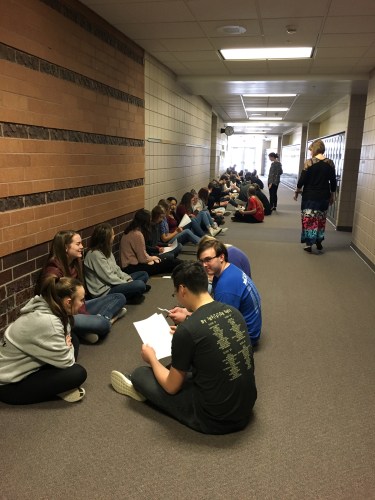
Ap Lit. students work with Honors II sophomores. Also pictured my teaching partner Amanda who teaches AP Lit. and one of my mentors Ann who first began the practice of AP Lang. and AP Lit. students mentoring honors students. 

My fellow AP and advanced teachers plan to expand the current mentoring as well. AP Lit. students and AP Lang. students will continue to guide our advanced sophomores; yet starting next fall we hope our advanced sophomores will mentor our advanced ninth graders (who are in different buildings). What a way to use writing to  foster connection!


I know there are exceptional peer writing tutor programs out there. But in these times of budget cuts and burgeoning class sizes, tapping into resources like Emily, Claire, Kyler, and the others who serve without expectation of reward is powerful. Many of the students–mentors and mentees–recognized the value in the stories of others and in their own. Their perspectives on writing, on others, and on themselves shifted, ever just so slightly.

It’s a small way to change the world. Or at least grow writers.

Kristin Jeschke teaches AP Language and Composition and College Prep seniors at Waukee High School in Waukee, Iowa. She loves when her former students eagerly volunteer their services for the underclassmen yet upstream, and she loves serving as mentor to her two favorite mentees, Abbie and Sarah. Follow her on Twitter @kajeschke. 

Racing to the Finish Line: What Does Your Workshop Practice Need Most Right Now?

My Spring Break brain is still turned on. Fortunately, this means I’ve been very good at sleeping the past few days. Unfortunately, it means my capacity to focus and otherwise try to be brilliant is at an all-time low for April. It would seem my enthusiasm is likewise dormant, as I’m struggling to harness my usual oompah-pah for school, running, parenting, you name it.

What to do? What to?

b1ae4985-4a2c-4306-ac08-4838ccd725ff

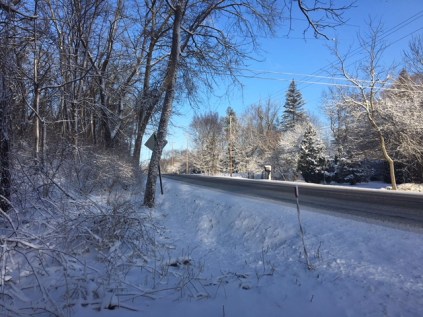
The view from my driveway during Spring Break.


I could stare at a thermometer and attempt to inch the mercury up with nothing by my sheer will and determination to curtail this never-ending winter.

I could establish a formal countdown of the school days as I’ve noticed several students and colleagues have done. (Ok, ok. I’ve done this already. There are exactly 40 days left of school.)

I could count and recount how many summative writing assessments I have left to grade, even if it’s likely true that I’m spending more time counting than I am actively providing feedback to my students.

So. There. Where does that leave me? Counting a lot, apparently, which is something I don’t particularly enjoy.

Still Thursday. Still 40 days to go. Still staring out the window at the 42-degree rain.

So. There. Where does that leave us?

For that, I look to you, dear readership of Three Teachers Talk.

help me

This is an all call for a bump in creativity, a burgeon to our daily workshop flow, a change of pace. Do you need more book recommendations for your classroom? Workshop friendly prep for an AP test? Ideas for mentor texts in a specific area of study? Blog posts that commiserate your struggles, or successes, or both? What can the writers and contributors at Three Teachers Talk focus on to help you most in the coming weeks? How can the writers at Three Teachers Talk help make these last few weeks of the 2017-2018 school year all kinds of amazing in your classroom?

When your inbox pings with a post from 3TT, what insight would tickle your fancy, make your day, or just help ease the stress of wrapping up the year in a workshop classroom? We’ve got writers who teach from Foundational Freshmen to AP Language/Literature, coach current teachers, prepare pre-service teachers, and everything in between.

We all need a little help now and then, so we’d love to hear from you:

Please take a moment to fill out this quick survey and let Three Teachers Talk help move your workshop practice forward to round out this year and/or get you rolling for the next.

And as always, remember the rich archive of posts on a variety of topics that you can search on the right side of the screen at threeteacherstalk.com. You can search by keyword, contributor, and/or topic. The special sauce for your next few weeks of teaching may already be right here!

As a collaborative community of educators, we look forward to hearing from you and pointedly adding to the amazing wealth of workshop knowledge that Three Teachers Talk readers and writers share. Have a great weekend!


Screen Shot 2017-05-01 at 8.44.22 PM

Also, a friendly reminder, if you would like to write a guest post for Three Teachers Talk, please send your ideas to me at lisadennibaum@gmail.com. We are always looking for fresh voices, ideas, and experiences. Thanks!

Moving from Assigner to Teaching Along Side My Students

Hi, my name is Kristin and I’m a recovering assigner.

I can easily blame the system that taught me. Numerous years of forced writing assignments, inauthentic essay prompts, and unfair expectations with little to no chance to confer.

What I am describing is not just my own experience of high school in the mid to late 90’s but even my own classroom (I’m a work in progress). It wasn’t until this group of wonderful educators and the amazing work of Penny Kittle and Kelly Gallagher did I even begin to understand there was more to writing than the pattern of assigning, “teaching”,  and correcting. It started slowly last year through personalized writer’s notebooks, engaging quick writes, and dabbling in mentor texts to help us grow readers and writers.  But I still didn’t feel “there”– I didn’t feel ready for the complete jump into writer’s workshop.

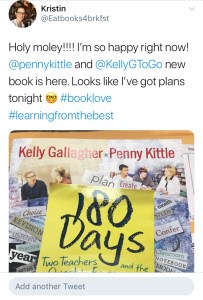
Fast forward to March– State testing is winding down and I have Kelly Gallagher and Penny Kittle’s new book, 180 Days: Two Teachers and the Quest to Engage and Empower Adolescents in my hands.

Image-1 (1)

Their recent book takes a look at the question “How do you fit it all in?” but does it with such thoughtfulness, insight, and in a way that makes their readers stop and think about their own practice. For me, it really made me think about how I needed to move from assigning narrative writing to immersing my students in the art of narrative writing.

After reading 180 Days the first time (I’m planning on rereading with my PLC as a book study), I was struck by how Penny and Kelly take different laps during their writing units, with each lap building off the last until students have shown a deeper level of development of their writing than our traditional 4×4 setup (read a book, take a test, write a paper, and repeat each term) allows us to do.

So, how has my life changed?

What my narrative unit was before:

  • I would diligently create a beautiful assignment, even including criteria for success so the students knew exactly what was needed in their narrative.
  • Students were given some choice in what they wrote (but it was choice in disguise–it still had to connect to the novel we recently read)
  • I gave students time in class to work and would start each day with a mini-lesson but it was based on what I thought needed to be taught, not in a responsive way through conferring or using a baseline assessment.
  • Usually five days later, the narrative was due. Some students used their 43 minutes each day to stare at a blank screen and eventually passed in an attempt at a story. Some loved this type of activity but passed in a narrative that was underdeveloped or without any organization. Some didn’t pass in anything at all–they would rather take the zero than take the risk.
  • While they were writing, I spent my time catching up with my grading and walking the room, begging my reluctant writers to get something on the page.

What my narrative unit is now/moving towards:

  • We started last week with multiple low-stake narrative activities in their writer’s notebooks using engaging mentor texts like “Hands” by Sarah Kay, 36-word stories using Visa commercials (Amy R. wrote about a very similar activity here), and writing alongside excerpts from some great young adult books from our classroom library.
  • This week, students will choose which pieces they want to work with and during our work time to expand them based on the day’s mini-lesson and practice revision skills (especially since my students think their first draft in their only draft–still trying to break this habit). We’ll also continue using mentor texts but use them for imitation work– “borrowing” great lines or ideas from actual writers!
  • After a well-deserved spring break, we will take a final lap with narratives the last week of April. I’m still deciding this piece– I want to see how the beginning of this week goes and see where we need to go next as we move towards the break.  I’m trying to be more responsive as a teacher, which is hard as a Type A planner. At the same time, I think this will benefit both myself and my students because I’m teaching the kids and skills in front of me versus just assigning the same narrative prompt year after year.

Although it’s only been a week in, these are some of the things I know so far:

  • My students have never been this engaged (in terms of their writing lives). How do I know this? Their notebooks are out and ready to go each class. They are passing their notebooks around the room, asking their peers to read what they worked on in class. We end our classes with “beautiful words” and they fight over who gets to share this time.
  • My closeted writers are finally finding their space in my classroom. They are sharing their work with others, giving advice to their peers, and even sharing their personal work with me (I had tears in my eyes when one of my painfully shy students handed me her poetry journal she brought from home–she thought I would like to read them this weekend. Be still, my teacher heart!).
  • Where my students are! Skimming through their notebooks has helped me see where they are starting and where we need to go. In the past, I wasn’t seeing their work until the end, which Kelly Gallagher calls gotcha grading. Now, I know where I want to and need to go to help my students with this type of writing.
  • And the best part- I’m writing. Whatever the students are writing, I’m writing alongside them and using my document camera to show my students my typos, my revisions, and myself. Narrative writing can be so personal. To see my struggle but also share parts of myself and my life has helped us connect in ways only stories can.

Although I still have a long way to go to shed the title of assigner, I feel so much hope that I am finally moving in the direction I’ve watched so many other teachers move towards. I’m reminded of what a wise educator has said about teaching– it’s making your practice 5% better each year. In this little way, I feel that my practice is becoming better because of the resources I have at my fingertips (like this group) and finally making the jump into the deep end of the workshop pool. 

What are some of your favorite things to engage and move your narrative writers? What advice do you have for those who are moving from assigners towards writer’s workshop?


Kristin Seed has been teaching for ten years at both the middle school and high school level in Massachusetts. Her passion is reading and leaving piles of books in every room of her house. You can find her chasing after her five-year-old son and now a 13 week old Golden Retriever, Abby. Follow her adventures on Twitter @Eatbooks4brkfst.

Guest Post by @cJezasaurusRex — An Open Letter from a Book Thief

Dear Ms. Gerdes,

You were the first teacher who taught me how/ when to properly use “Ms.” You taught me the power of a Phenomenal Woman. You taught me to value my mother. Big Time. And you taught me that reading is magic.

Ironically, you were my math teacher.

I wish I could say that you “gave” me books. The fact of the matter is that — I actually stole them. Actually. Literally. (Non?)Legitimately. STOLE A BOOK FROM YOU. Maybe even more than one. Probably, Likely so.

And all I can do right now is to apologize. Also–what is your address? Do you prefer USPS, FedEx, UPS, Armed Guard?

Just, please forgive me.

If you remember me at all, then you know (at 36) I would eventually be safely breaking every conventional rule in regards to punctuation and grammar. I hope you knew me well enough to know there is purpose behind my rebellion.

This all started more than 25 years ago. You were a Pioneer for Choice Reading time. And I know that I talked through most of those minutes, but I swear to you that I WAS SOAKING IT IN. Conduct marks set aside, I watched as you made time to focus on your own book during MATH!? I was, assuredly, a total A-Hole about it. Again, Sooooooo Soorrryyyy About that. But— I need to tell you that you are the ONE who (unknowingly) gave me a gift that I hope I am worthy enough to pass on to hundreds of other fellow humans.

I teach English to High School Students, and I flipping swear that 15-year-olds are and will remain the ultimate worst EVER. I love them. Every day. Not every second of every day… but mostly just every day. I look at them and am reminded of when I got sent to ISS or locked in a book closet by my English Teacher, and so it’s just effing fine by me that I threw my Pre-Law Degree out the window (wish the student loan attached would disappear too).

Since I’m always broke, and I’m the baby sibling, my Big siSTAR gave me her OLD Kindle about 12 years ago. Before I reset the account, I had to read ALL THE BOOKS she left on the account. One was Readicide by Kelly Gallagher.

For roughly 12 years, I’ve (kinda) done what I’ve been told by The System while I operated another system behind that closed door. I’ve tossed the curriculum back to my students like a contagious, hot potato. What. Do. YOU. Love. To. Read. As teachers, we often forget that it was NEVER about us, and it NEVER will be about us. And it has been my mission since my first year of teaching to throw my neck out on the guillotine to fight for that freedom.

Ms. Gerdes, I hope you are proud of the part you played in creating this monster.

But I stole your book. Now that I have built a classroom library of close to one thousand books, I know how pissed I get when my curation starts to disappear. Year after year, the carefully selected and bargained-for dwindles as quickly as cotton candy in a humid, Houston Heater. Some moments, I look at my shelves and wonder why my students can’t just return that damn book!

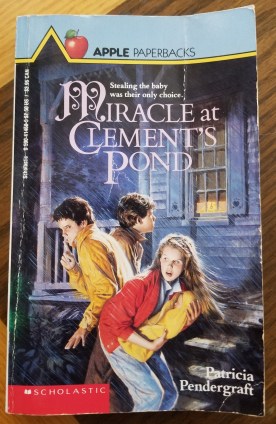
Today, while my Punky Brewster of a daughter was helping me pull all the donations we have for our town’s Little Free Library, she brought me Miracle at Clement’s Pond by Patricia Pendergraft. Your name written in permanent marker across the back.

miracle 1miracle-2.jpg

I’m. Melting. I am so sorry. I won’t even say that, “I can’t believe it.” I won’t even say that, “I’m so ashamed.” I can believe it. And I’m a little glad that I’m not ashamed.

You must have told me about the miracles found in books. Maybe, even this one in particular. Maybe I wasn’t ready, at 11 years old, to read what my teacher suggested–but I was ready to STEAL it so HARD! (I am sorry about that.) Mostly, at 36, I know what it feels like to bury my nose in words that make magic. The spell that is crafted by each stroke of the pen. To finish a novel and then hold it close to your heart with your eyes closed. Brimming with tears of empathy and connection. The feeling that next day of “Great Book Hangover” causing all other brain functions to fail.

This is the most life-altering lesson any teacher can leave behind.

I’m real sorry that I stole your book. (Plus, also I am sorry I was kind of a pain). The most sincere apology I can offer is that I am about to read this book, and I will NEVER forget Miracle at Clement’s Pond by Patricia Pendergraft–even if it sucks so hard. Plus, each time one of my books turns up missing, I promise to think of this apology. I promise to think of how pseudo- crappy kids can turn out to be alright humans. Or that ultra-rad kids can sometimes make terribly impulsive decisions. I promise. I promise. I promise. I stole something from you that is much bigger than a 242 page paperback from Scholastic.

I stole promise.

I hope you will forgive me. I hope you know that you truly changed my life. I hope to do the same for others.

Incredibly Sincerely Best of all Regards,

Crystal Jez

Crystal Jez has been teaching high school English in Texas for twelve years.  As curator of a chaotically color-coded classroom library, she is typically knee-deep in stacks of books.  When she isn’t reading or teaching, you can find her chasing chickens or saltwater kayak fishing.  Crystal is the wife of a super-hot guy and mom of three ultra-rad kids.

Formative Assessment Works!!!

For those of you who haven’t taught Seniors, trust me on this:  Formative assessment during the second semester is challenging.

If you’ve taught seniors, then you might understand where I’m coming from:  Sometimes it’s hard to tell if they aren’t grasping a concept, or they are just too tired of school to have the energy to engage.

I hurts my heart to even consider that my precious learners are worried about bigger issues than Comparative Literary Analysis essays or finding examples of bias in their self-selected texts.  Prom looms five days away and graduation seven weeks after that.  They work, they compete in extra curriculars, they deal with the adults and peers in their lives.  I forget, sometimes, that their plates are filled with important thoughts.  I remind myself I’m not doing their stress levels any favors by point out that we still have important work to do before June 2nd.

Last Monday we reviewed an excerpt from Niel Schusterman’s Thunderhead as a mentor text for practicing literary analysis through all the lenses that should be crystal clear to these literate learners.  I needed to assess their understanding and thinking so that I could make decisions about the instruction leading up to the summative assessment.  That’s the point of formative assessment; to “form” a plan for instruction.

I read the short selection with them, and asked them if they would, please, mark their thinking on this first lap through the text.  They should, as they’ve done many times before, underline or highlight what they noticed about the words the author chose through the lenses of diction, bias, author’s purpose…literally anything they noticed within the realm of literary analysis. It’s the last nine weeks of their public education career. They should be able to look at a text through a variety of lenses.

Some of them made some marks on the page while others wrote notes next to highlighted lines or words.  Others, though, marked nothing.  [Alarms wiggle and stir in my head. Something’s not right.]

I asked them to share within their groups what they noticed.  Muted whispers of ethos, tone, and metaphor struggled out of some groups, but again, most said very little.  Very few connections were being made. For them and for me, the picture was as clear as mud. This, by itself, is important formative assessment. This wasn’t working. [Def Con 55- Full tilt klaxons at maximum volume!]

Yet, I refuse to blame them.  I fully believe that it is solely on me, the teacher, to facilitate engagement with the text.  Somehow I need to do a better job inviting them to take all those useful tools out of their tool belts and dissect this very meaningful text.

New England Patriots at Washington Redskins 08/28/09

I bear a striking resemblance to Tom Brady.  Photo by Keith Allison

In football parlance, I needed to call an audible in the middle of the game. What I had hoped they would do; they won’t or can’t.  It’s time for me to jump in and scaffold this concept to a place where they can see the connections they can make and I can assess their thinking.  I’m not going to put them in a position to fail on the summative assessment if I know they aren’t ready for it.

In a whole class mode, I read over the text, mark what I notice and verbalize my analysis.

Now I ask them to talk about what they notice.  There it is…an increase in discussion, an inflation in dialogue. The alarm volume turns down a notch, but it doesn’t turn off.

I wrap the class period up with an invitation to write about what moves the author is making and as they do I confer with a few students who seem completely flabbergasted.  The bell tolls, signaling an end to their literary torture session.


Thus was the source of my salvation:

book

I only saunter.

Jumping into this book reminded me of a few important tenets of writing instruction that I let myself forget:

  1. Give them choice- I was allowing no choice in the subject of their analysis.  I know better than to restrict their reading and writing experiences and I let my, and their, end of the year exhaustion affect my decision making.
  2. Show them, not tell them, what you want to assess.  I wasn’t showing them examples of literary analysis and again, I know better.  I was expecting, wrongly, that Senior English students would confidently engage in literary analysis and move forward with their thinking in a way that shows me they can write a response in essay form.

After school, I tore up my lessons plans for the next four days and re-wrote them to reflect what I SHOULD do to support my students in this exploration.

On page 5 of their amazing new book Marchetti and O’Dell introduce a mentor text written by Joe Fassler from The Atlantic.  His recurring series “By Heart” is a collection of responses from a diverse group of thinkers and writers and is an amazing resource.  A simple Google search returned a link to this series of essays. I scanned the list of the titles and discovered an article from September titled, “What Writers Can Learn From Goodnight Moon.”   In it, Celeste Ng describes her feelings of the children’s book and how it “informs” her writing.

Perfecto!!!

This checked so many of the boxes of what I was looking for in a mentor text.  And…I get to read a children’s book to “big” kids.  I know enough about my students to know they will love this.

Also, I used Marchetti and O’Dell’s five part descriptions of literary analysis on pages 11 and 12 to create a glue-in anchor chart for their readers’/writers’ notebooks that helped to clarify what exactly we should look for when reading and writing literary analysis.

Confidence restored! Disaster averted… kind of.

We Ng’s reflection and discussed how this was a perfect example of literary analysis.  They asked questions, we laughed about Goodnight Moon.  I saw their confidence grow and I knew we were back on track and ready to move toward our essay.

Thursday, we started the drafts and I hope to see many of them tomorrow.

Being responsive and intentional is a crucial part of the workshop pedagogy.  I can’t stress enough how this one piece can make our break my teaching.  My lesson planning skills have finally reached the point where I plan for and anticipate opportunities to change up what we are doing to match what the students need. This was an opportunity for which I hadn’t planned, but we made the adjustment and made it work.

Sometimes, that’s how it goes.

Let me know in the comments below when you’ve had to make big changes on the fly to support your students’ learning. I know I can’t be the only one.

Charles Moore is neck deep in Children of Blood and Bone.  He’s spending the day taking his daughter to school and then having lunch with her.  It might be the best day of his life.  His summer TBR list is growing uncontrollably; feel free to add to it in the comments.

Carpe Disputationem

Before introducing metaphysical poetry to my AP Literature students, I often take a page out of the fictional Professor Keating’s book. My students and I take a little “field trip” to the front of the school, where photographs of students dating back to the first graduating class of 1901 line the foyer. I ask my students to write down their observations. When we return to class, I ask them to share. They often cite racial homogeny right off the bat. Our student population is incredibly diverse, and they cannot imagine an exclusively white school. A discussion about desegregation of schools inevitably follows, as does a conversation about the surprising number of females in the early graduating classes. We also talk about the devastation the World Wars had on the young men in those faded photographs. How many of them survived? They wonder: how did our graduating class grow from 6 to approximately 1100?

After what never fails to be a rich conversation, and the students’ realization that they have walked past those photos everyday without ever looking at them (a life lesson in itself), we watch the film clip from Dead Poets Society in which Keating, played by Robin Williams, engages his students in a similar activity. He explores the concept of “carpe diem” and mortality. Following this clip, I invite my students to write their response to carpe diem. They might write about what it means to them, whether they embrace this philosophy, or any other thoughts or feelings that the saying evokes.

CarpeDiemAfter a few minutes of writing, I ask for volunteers to share their thoughts. In a recent discussion, some students found the idea of carpe diem “frivolous” and thought that people should always stay focused on future goals. To them, “living for today” was short-sighted and irresponsible. This makes sense for teens who are driven to go to the right college and earn the right degree to live a “good” life. Other students said that since none of us are guaranteed a future and we’re “all going to die,” we should do something today: something of value, something productive. Such responses received a great deal of agreement, though students realized that “value” and “productive” are relative, subjective terms. One student wisely noted that we should remember that while we’re trying to live our best lives, others are as well. They discussed the complexities of when the lives of people with different goals intersect. Ultimately, my students saw how their seemingly disparate ideas actually overlapped a great deal, and they separated carpe diem from the trite YOLO idea that many of them initially equated as the same concept.

After a 20-30 minute discussion of carpe diem, my students not only understood the concept, but they also understood their relationship to the aphorism as well as its universal appeal. Onward to metaphysical poetry analysis!

I shared this teaching anecdote to underscore the importance of setting up and maintaining a safe workshop environment in which students expect to read, write, think, share, and work together to construct meaning. My students fearlessly followed me, willing to discuss observations even when issues such as race were broached. I could have presented them with the definition of “carpe diem” or asked them to draw on prior knowledge as a quick basis for launching into the unit of study, but by giving them the space and opportunity to explore the concept, they built a stronger foundation of understanding that will ultimately translate into better reading, writing, and thinking. We make choices everyday about when to lecture and when to facilitate; when possible, we must “seize” the opportunity to trust our students to delve deep beneath surface-level understandings and reach true depths of meaning.

What Teachers Really Need To Hear

I have been working on a post about how to teach students to write purposeful conclusions. I’ll still write that. But as I’ve spent the last few weeks working with teachers, creating plans for the weeks before testing, I realized there’s something else I need to say. 

Dear Teachers,

I see you.

I see you on the picket lines, demanding more for students, for yourselves, for our world. I see you in your classroom in the late afternoon light, fine-tuning tomorrow’s lesson. I see you on the last day of spring break, bringing your own son to school, working for hours in your classroom to get ready for the week. At your daughter’s soccer practice, grading papers between goals. At the beach, reading books your kids might like. At the library, scouring shelves for the just-right books about mullets for that one kid.

You. Are. Amazing.

I see you now, as testing season blooms, these weeks that have been looming finally here. I see you cheerleading and boosting and nudging. I see you creating review games, engaging kids and building their confidence. Behind that, though, I see the stress, the wonderings, the worry.

Will they try?

Are they ready?

Did I do enough?

The answers: Probably. Yes! Absolutely!

The truth is, we’ve done everything we can. We are at the doors of the big game, and what’s left is to cheer. And to remember that despite what it feels like, the test is a slice of a year full of wonder and growth and success. 

The tests feels huge — they are huge. But these tests are not the sum of you as a teacher. Just as you remind your students that they are more than a score, you are more than a growth measure or a value added or a designation on an evaluation. You are their teacher. 

I’m reminded too that after testing season passes, we still have several weeks of instruction left this school year. What a gift! We still have time to introduce students to new characters, to immerse them in new genres of writing, to push them to stretch.

Dear Teachers, I see you. You are beautiful and strong. Thank you.

This letter is inspired by the piece What Students Really Need to Hear by Chase Mielke (a great mentor text for students!). 

Angela Faulhaber works as a literacy coach in Cincinnati, OH, and teaches pre-service teachers at Miami University. She is in awe every day of the passion she sees in teachers and loves planning with and supporting them so they can do their best work.


Some Multi-Genre Magic

So, remember my lamentations 2 weeks ago about students turning in “drafts” less than 24 hours before the “final version” of their multi-genre writing was due? Well, I still think years of indoctrination of The Gradebook Mentality is doing immeasurable damage to students own perception of their learning and success. But dang, did they come through in the end.

To review, seniors in Advanced Writing produced a multi-genre paper focused on an author or a genre. And the genres they could choose to write in were seemingly endless. To generate these, we played a version of Scattergories in which groups competed to name the as many unique genres as possible.  (Apparently, competition is a real motivator. Who’da thought?) Some of the noteworthy were manifestos, glossaries, Scrabble game boards, breakup letters, suicide notes, and on. What might have been the favorite was Choose Your Own Adventure: Claire took readers through an existential journey through Camus, and Maya let readers find love (or not) in her study of David Levithan.

qualitiescoverOne mentor text we studied brought about some magical results: The Book of Qualities by Ruth Gendler (BIG props to my teaching partner Mariana Romano for this idea). In this book, Gendler takes a whole slew of abstract “qualities” and embodies them in a collection of beautiful prose poetry.
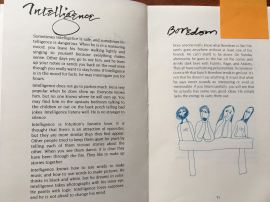
Many students followed Gendler’s lead by taking prominent “qualities” of the work they studied and embodying them in prose poetry.  To express a theme that emerged from his study of Salinger, Jed personified “Innocence:” qualitiesexample

Innocence is that old friend. You know the one. That friend you run into on the street … It’s been so long, right?! Maybe not quite long enough… But at this stage of your life, it just isn’t a good match … and somehow you manage to lose them more than youMorrisonAppendix already had. 

Myria, who studied parallel universes in fiction, personified the fear that permeates the work. fear_myria

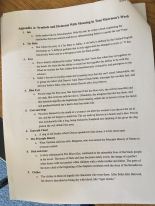
Elizabeth, one of the worst “late draft” offenders, included an appendix in her study of Morrison to aid her own readers in interpreting the complex symbolism in Morrison’s fiction.

Gray composed a recipe poem to explain the operation of the worlds built in Brandon Sandrecipe_grayerson’s fiction.

And Maya even went 3-D — her project on David Levithan’s love stories lives in a breakup bag! breakupbag.jpg

So, hope is restored. Which is SO useful as I follow my seniors into the final quarter of their high school experience — useful for me, anyway.