Sounds like the title of a catchy pop song, right? It might actually be one, but if it is, my guess is that its tone would contrast to my own summer state of mind so far. Last year kicked my teaching a**: two sections of AP Lang, two sections of a brand new sophomore curriculum implementing a workshop model, and one section of a senior elective titled Advanced (read: “creative”) Writing. Like anyone reading this blog, I loved (or grew to love) every student, I loved (almost) every teaching minute, I (usually) loved the planning. I had so much love that there weren’t enough minutes in the day to express it. Literally. We express our teaching love through individualized attention, nurturing encouragement, and meaningful feedback, right? So, literally not enough minutes.
My own personal summer state of mind consisted of my mind grinding to a halt. For almost the whole first two weeks after school let out, Chicago spat a chill rain and my bones ached with mental exhaustion. And my brain hurt. I checked out of my teaching self so deeply that I put out of sight the stack of books I had planned to devour starting on day one. And I unwittingly missed two blog posts, for which I sincerely apologize. Guilt over that professional lapse drove me further into the delinquency of binge-watching season 2 of Marcella. Although I did drag my attitude out of the mire to see Roxane Gay speak about her memoir and her new anthology, about rape culture and politics, about writing and (of course) Queen Bey. I went with my friend and teaching partner Mariana, with whose pen I scrawled pieces of Gay’s wisdom on a cocktail napkin. Ms. Gay was inspiring (although Mariana and I shamefully confessed to each other that it had been tempting to just put on pajamas per usual at 6:30 pm, but tickets had been purchased).
Has anyone been there, in that “summer state of mind”? I suspect you have. Despite the temporary comfort of a British-TV-mystery binge, between the exhaustion and the guilt, it’s not fun. When I got home from the Roxane Gay event, I tucked the cocktail napkin into my copy of 180 Days without even looking at it. Shana wrote of not being able to turn off her teaching self, but I was wallowing in the avoidance of mine and in the guilt of doing so. This couldn’t go on.
 A few days later, I followed through with plans to meet with a few beloved colleagues, two of whom will be new to our sophomore workshop curriculum next year, to do some planning. These are smart, passionate, devoted teachers–not to mention funny, lovely people. But even among these dynamos, my own energy still waned. So now I had something new to feel guilty about: not bringing my best professional self to that coffee shop and to my colleagues. But lo and behold, that very same day, Shana had posted this. And that brief paragraph at the end, so straightforward and honest, but more complex than anyone in another profession could know: “I think it just contributes to that overall feeling of exhaustion I have, so maybe I just need to pick it up when I’m a little more rested.”
Boom. Mic drop.
We’ve all read and written about how much we deserve our summer break, and even its accompanying anxiety. But we’ve also all heard the haters. Is it their rhetoric that brings  about the guilt? Is it seeing our loved ones go off to their year-round jobs while we are still sipping coffee in jammies? Is it because I was raised Catholic? (I have to admit, the moment of reading that paragraph in Shana’s post felt to me like I had just prayed the Rosary).
This post doesn’t offer anything new, but I guess I wrote it just in case anyone is still struggling with a “summer state of mind” that isn’t what that phrase connotes. As for our better teaching selves, “maybe we just need to pick them up when we are a little more rested.”

 Allison Marchetti and Rebekah O’Dell,
  Who says we shouldn’t judge books by their covers — and their titles? I won’t apologize for instantly loving these books for their beautiful, ethereal covers and alluring titles. What a happy coincidence that each is filled with the pathos of personal experience that makes memoir so compelling in addition to an earnest and essential reminder about the human beings that live and struggle behind the headlines and the hashtags.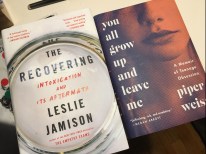

 I’m pretty sure many of my students in Advanced Writing left the course still skeptical of the notion that artists — even accomplished ones — still turn to the work of other artists to inform or inspire their own. So, next year if they don’t believe me, maybe they’ll believe Questlove. In a section of this inspiring and accessible book called “Reduce, Reuse, Recycle,” he celebrates this practice and discusses “covering” the work of other artists not only as a way to work through an artistic slump but as an act of creativity in itself. Thanks, Questlove, for a refreshing take on the concept of mentor texts. He explains, “That’s another thing that creativity is–taking the existing world and making something new from it.” (BTW, I know that’s going on a handout somewhere.) I really loved his discussion of the MTV series Unplugged, which features popular (and typically “plugged-in”) musicians in a stripped-down, acoustic format. I’m determined to figure out a way to use the series to demonstrate the impact of form and tone.
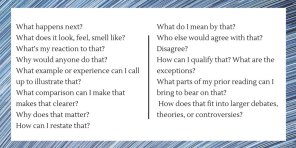 ng fluency and the value of “self-prompting,” and he included a list of a dozen+ prompts that foster such fluency. For Tom, these prompts “swirl in his head” as he writes. For our students, we need to build the habit of prompting questions into their process. Whether through daily writing, regular conferring, or sheer faith in the possibility, many students this year have discovered the true generative nature of writing — a sentence begets a sentence, begets a sentence, and so on. Alas, too many have not.
 to tell, proving we’re capable of what others believe we are not. Then they got students up out of their seats in parallel lines or inside-outside circles, so humans faced other humans, screen-free. First, students shared one-sentence stories based on prompts like “I felt [insert emotion] when …” or “Tell about a time when you … broke or ruined something … told a lie … received a gift you really wanted (or not) …” Lines and circles shifted and rotated to maximize the quantity of faces in contact.
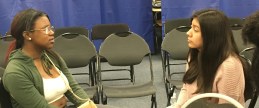 elaborating on one of the prompts from the first part of the exercise. I could hear the energy in the room even before I was fully in the door. Moving through pairs of students, I could hardly hear the stories themselves, but no matter.
  What mattered was that students were hearing them from their partners, many of whom started out as strangers (different classes were blended into one workshop). And not just hearing, but listening. They began, literally, to lean in, closing distances through shared stories and the natural empathy that results. When we return to our regular classrooms this week, students will begin recording their stories on FlipGrid, listening to and commenting on one another’s without the high stakes and vulnerability (even unfamiliarity) of face-to-face, real-time human interaction. Which reminds me …
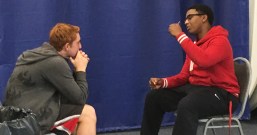 I’d like to pause briefly to offer this qualifier: On-demand, face-to-face, forced interaction with strangers is not every 10th grader’s cuppa tea. (Heck, it’s not every adult’s cuppa, either.) In fact, several students literally waited it out on the sidelines. But even these reticent, reluctant, and even recalcitrant folks couldn’t help but listen — and be drawn into — the stories of others. And maybe even, as a result, classmates who were still strangers became less “other” than they had been 90 minutes earlier. I’m even holding onto the possibility that the stories heard that day will sustain their generative power and elicit even more — not only more stories, but more listening, more “leaning in,” more empathy, even more inspiration: not from any divine spirit, but from engagement with each other and with the work of writing — and speaking — their truth.
 One mentor text we studied brought about some magical results: The Book of Qualities by Ruth Gendler (BIG props to my teaching partner Mariana Romano for this idea). In this book, Gendler takes a whole slew of abstract “qualities” and embodies them in a collection of beautiful prose poetry.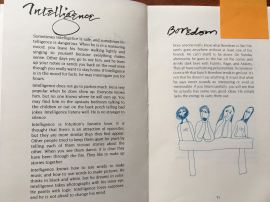
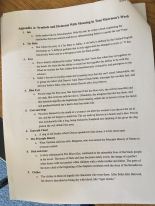 already had.
 erson’s fiction.

 This course is about nothing if it’s not about writing as a process. For three quarters, our work has been based on no other principle more than this one. Students who handed in drafts so late clearly did not engage in the work at this fundamental level. Surely I couldn’t award them the same grade as those who had. Right?! Right. So I started drafting a not-so-nice email to those stragglers pointing out that they all have known the due date for quite some time and surely they must have had no intention to revise in the first place so why did they even bother handing in a draft and was it just to get a number in a gradebook but of course I will not award the same credit so you will receive that fat ZERO because you’re seniors and by gosh I’m going to use that fat zero to show you how the world works because it’s time you start …

 function in perpetual chaos. Every day I whack-a-mole them into their current book, notebook work, mentor text, draft, or just away from their phones.
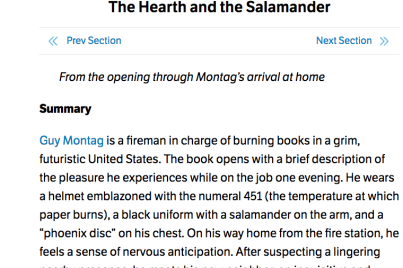 That day, the SparkNotes summary of the first chapter of Fahrenheit 451° (one book circle choice) was their writing prompt. There was some confusion: Were they supposed to write about whether they were going to choose that book? Or to predict what the book might be about? This prompt is like any other daily writing, I told them. Just write what it brings to mind.

 Three Teachers Talk