Category Archives: Guest Post

Stay Gold, Ponyboy. Authentic Literary Analysis: Poetry in Two Voices – Guest Post by Elizabeth Oosterheert

Over the past several months, social media has been a buzzing hive of Tweets, articles, and teaching resources for The Outsiders, as S.E. oosterHinton’s beloved classic celebrated fifty years of resonating with readers of all ages around the globe.

In using The Outsiders as a whole class text this spring with a seventh grade class composed of nearly all boys, I began to explore juxtaposing the beauty and power of poetry during National Poetry Month, and authentic literary analysis. How could I use poetry as an analytical catalyst?

The answer came in an approach that I love because it promotes several of the pillars of writing workshop:

  • Student agency/ownership of the writing process
  • Collaborative writing and thinking
  • Mentor texts as models for writing craft moves
  • Opportunities for teachers to participate in workshop as writers

Poems in Two Voices are an excellent way to invite creative literary analysis, since by definition, they challenge student writers to take on the personas of fictional characters and to look at a literary work through the lens of their chosen character’s perspective.


As an invitation into learning about Poems in Two Voices, I shared a poem that I wrote from Johnny and Pony’s point-of-view during our workshop time, as well as poems written by former students.

Seventh Grade Literature
The Outsiders
“The End of Innocence: A Poem in Two Voices” by Mrs. O.

ooster2

Ponyboy Curtis Johnny Cade
Nature’s first green is gold, her hardest hue to hold. Nature’s first green is gold, her hardest hue to hold.
Gold was my mother. She was beautiful. Nothing gold can ever stay. My life has been black.
Gold is my brother Soda. Movie star handsome. He kind of radiates. I pulled a silver switchblade, thinking it was for the best. Disaster from then on.
Beauty was the sunrise in Windrixville. There was a silent moment when everything held its breath. I did, too. I remember Pony’s voice as he read Gone With the Wind. Dallas is gallant, going into battle like those Southern gentlemen.
I thought things could only get better, but we went from ice cream sundaes at Dairy Queen to the red Hell of the church on fire. We started it with our cigarettes. I was a hero for a moment. Instead of being beaten down, I was giving life. Pony said Jerry thought we were sent from Heaven.
Johnny never thought of himself. We can’t live without him. The gang needs him. I don’t want to die now. Sixteen years ain’t long enough.
Sixteen years on the street, and you can learn a lot. But all the wrong things, not the things you want to learn. Sixteen years on the street, and you can see a lot.  But all the wrong sights, not the sights you want to see.


Then leaf subsides to leaf… Then leaf subsides to leaf…
We had a rumble, but in the midst of the fight I realized, I don’t hate the Socs anymore…None of us should have been there, throwing punches with a gang of future convicts. Useless…fighting’s no good. I tried to tell Pony that. I have to get the words out while I still have a pulse.
Johnny was so quiet, I thought Dallas and I were too late. I thought Johnny was already dead. “We’re all proud of you, buddy.” That’s what Dallas said. I loved Dallas. I wanted to die with his words in my ears.
Johnny was trying to talk to me. I leaned in,  close to his burns, his closed eyes. “Stay gold, Ponyboy. Stay gold.”
The pillow sank a little, and Johnny died. I see something on the horizon. Light.
So Eden sank to grief,

So dawn goes down to day.

Nothing gold can stay.

So Eden sank to grief,

So dawn goes down to day.

Nothing gold can stay.

After sharing my poem, and giving students the opportunity to read several student written poems aloud, we wrote the following list of writing craft moves:

Writers of Poems in Two Voices…

  • Look back at passages in the text where the characters they’ve chosen are actually speaking, or where they can “hear” their thoughts.
  • Base their poems on a specific passage in the book, or make their writing a more general reflection of everything that they’ve read so far.
  • Might give a voice to a character who doesn’t speak often or is silent. This allows creative license as a writer. For example, what would Bob say if he could speak to Johnny or Pony about what happened in the park? What would Johnny say to the children he rescued from the church in Windrixville?
  • “Steal” lines or word choices from the book such as a favorite Again and Again, or golden line
  • Sound like the character being represented
  • Decide which lines will be read in unison, and which ones will be read individually
  • Include important details from the novel to illustrate close reading
  • Practice reading poems ALOUD with coauthors to work on timing and inflection


Two voice poetry allows students to powerfully express how a text has changed their thinking about the world, gives them the opportunity to write with a coauthor, and to present their poetry to others.  It works beautifully with any book. My students loved revisiting favorite scenes in The Outsiders, and we’ve also written narrative poetry, found poetry, and whipstitch poetry together.

The end of the year is the perfect time to utilize poetry as an analytical tool.

How do you use poetry with your students? Please add your ideas and questions to the comments below!


Elizabeth Oosterheert teaches middle school language arts and directs the 8th Grade Theatre Troupe at Pella Christian Grade School in Pella, Iowa.

She loves reading and writing with middle schoolers.


Screen Shot 2017-05-01 at 8.44.22 PM

Care to join the conversation? We’d love to add your voice! Please email guest post ideas to Lisadennibaum@gmail.com.

Practicing What We Teach, One Letter at a Time – A Guest by Amy Menzel

I’m not always ready for Monday, but I was ready for this one. I had spent a lot of time reading Penny Kittle’s Book Love over the weekend and was anxious to get back into the classroom and spread my love of all things literary. Wouldn’t you know it…my seniors weren’t.

Now, it was “senior skip day,” and I knew that, so maybe I was less prepared than I thought. I thought, “Hey, I’ll be able to give more individual attention to students Screen Shot 2017-05-01 at 8.44.22 PMwho need it.” Meanwhile, they thought, “Hey.  I’m here.  What more do you want?”

It’s not so much that they thought this that bothered me, but that they said it. They actually said,  “You should just be happy we’re here.”  To my face. And they meant it.

A small part of me died right then and there. Likely from overheating because my blood was boiling. It took me a while (and eleventy-seven deep breaths) to calm down. Somehow I made it through the day without exploding, but barely.

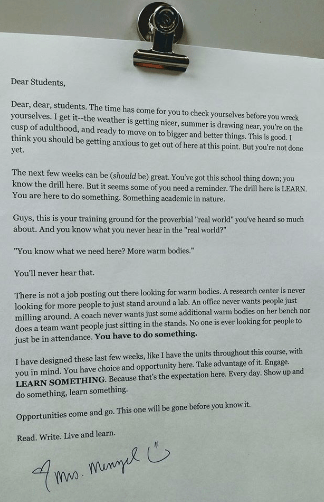
That afternoon, I sat at my desk as the building got quiet. When only the sounds of the custodian’s sweeping and my continued deep breathing remained, I opened a new Google doc. “Dear Students,” I began, and channeled my frustrations and feelings through my fingertips.

menzel

I made 140 copies, left them in a neat stack in the middle of my cluttered desk, closed my door, walked to my car, drove away, and hoped for a better day.

I felt better that I wrote about it (duh, say many researchers). And I felt better having calmly and clearly expressed my expectations. I also had a student voice echoing in my head from last semester: I’ve never had a teacher take the time to write to us before.”

Of course, we write to students all the time; we write our syllabi, our assignments, our writing prompts. But I do think there’s a difference when we address a note, a discussion to our students. It’s more personal. I forget about this.

It’s also a way to practice what we teach.

Back in April, Lisa talked about the importance of English teachers being readers. She closed her impassioned post, “We must be readers…otherwise, we are in the business of false advertising.” The same is true of our work as writing teachers.  We must write.

This is a lesson I learned (or finally appreciated) during my participation in the UWM Writing Project back in 2010. One of the core principles of the National Writing Project, the program of which the UWM Writing Project is an affiliate, is that, “Knowledge about the teaching of writing comes from many sources: theory and research, the analysis of practice, and the experience of writing. Effective professional development programs provide frequent and ongoing opportunities for teachers to write and to examine theory, research, and practice together systematically,” — emphasis mine.

I learned a lot that summer, but the most significant lesson I took away was the importance of practice. Each of us teacher consultants prepared and presented a teacher inquiry workshop and the number one rule for these presentations was to have your participants write early and often. It changed the way I teach. Still, I find that I need to remind myself to write more often.

Now, I know it’s the end of the year. So you may be thinking…

menzel2

But I’m all about embracing the constant reflect-and-revise nature of teaching. So allow me to publically commit to writing to my students more–early and often starting next school year.

Dear fellow teachers,

Are you with me?

Sincerely,
Amy Menzel

Amy Menzel teaches English at Waukesha West High School in Waukesha, Wisconsin. She hopes her unbridled enthusiasm for all things literary haunts her graduating seniors for decades to come. In the best possible way, of course.


icon

Care to join the conversation? We’d love to add your voice! Please email guest post ideas to Lisadennibaum@gmail.com.

Uncovering the Bonds We’ve Built With Books – A Guest Post by Karry Dornak

I live for a good mentor text, and I have started to experience somewhat of a “Baader-Meinhof Phenomenon” because I find them everywhere.Screen Shot 2017-05-01 at 8.44.22 PM

Most recently, while scrolling through Facebook.

An article titled, “Dying, with a Lifetime of Literature” sounded powerful, so I clicked the link.

I immediately knew this piece would appear in my classroom.

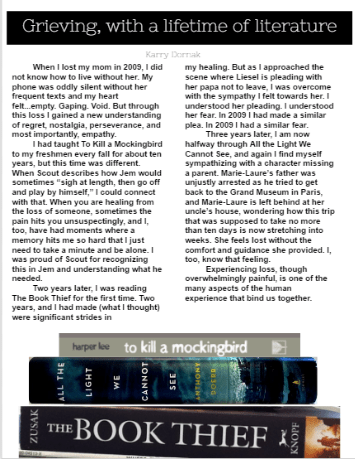
The piece, written by Lynette Williamson, a former English teacher of thirty years, documents her diagnosis with ALS while sprinkling in allusions to literary works that stuck with her and appeared at various times after her diagnosis: quotes from Toni Morrison, Sophocles, Shakespeare, and even a connection to Kafka’s cockroach from The Metamorphosis.

I wondered, about myself and my students, “If we dug deep enough, which literary scars would we find hiding in our own skin?”

To start this excavation process, we created our own “ideal bookshelves” (based on the book My Ideal Bookshelf by Jane Mount and Thessaly La Force and referenced in Book Love by Penny Kittle). I get overly and outwardly excited when we talk books in our classroom, so, to spare my students another one of my emotionally-charged nerding-out moments, I stifled my excitement when I overheard their conversations about books! “Oh, remember this book?” “Oh yeah, that’s a good one – I need to add it to my shelf, too!” “You’ve never heard of this book? It’s so good! It’s about…”

And sure enough, at the end of the period, students were handing me their ideal bookshelves, my first peek into the connections they have forged with books.

The next day, we read “Dying, with a Lifetime of Literature,” together. I asked, “What is she doing as a writer?” And we agreed that she is referencing pieces of literature to tell her story. Then, to press the issue, I said, “We all superficially agree that books teach lessons (hello, thematic statements), but have we looked at that personally?” I told my students to visualize two timelines: one is everything they’ve read in life. The other runs parallel and is their life story. Where can we make connections or intersections between these two parallel timelines? What has happened in your own life that you could connect to a character’s?

To support this idea, I shared with my students the part of Mechanically Inclined where Jeff Anderson explains the “linguistic data pool theory,” where “all of a student’s visual and aural language experiences flow into that student’s personal pool of data” (17). I thought it fascinating to consider that what we read leaves marks on our schema and manifests itself at times and in ways that we may not even be aware.

At this point I’m sure my students are thinking I’m taking this idea way too far. So I snapped out of it, and we got to work.

And, true to my “Baader-Meinhof” tendencies, when I start thinking of an idea, possibilities appear everywhere. My instructional specialist, Stephanie, had recently shared with our grade level team an idea from Cult of Pedagogy (“16 Ways to Use Google for Student Projects”).

Dornak 1

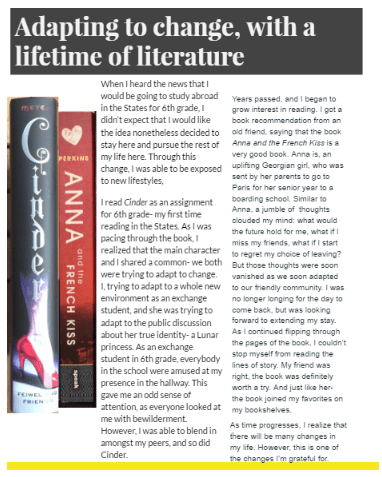
One idea is the e-book, which had just the right amount of simplicity and polish for our needs. I instructed my students on how to set up their e-books (using Google Slides, go to File, Page Setup, then change the dimensions to 8.5×11). Once the Slide is the right orientation and size, students can add images of books plus insert text boxes to type their own versions of Williamson’s writing.

For students who struggled to get started, I encouraged them to start the same way she did.

Hers: “When I was diagnosed with ALS….”

Mine: “When I lost my mom in 2009…”

A student’s: “When I heard the news that I would be going to study abroad in the States for 6th grade…”

I continued drafting my own “literary touchstone,” as I was now calling the assignment, in front of my students while they, too, drafted theirs. Writing together is powerful – students are able to see both my thoughts and my emotions while writing. The best writing is raw, real, and should be shared. After all, if these books had never been shared with us, look at all of the touchstone moments we would have missed out on.

Dornak 2

To foster sharing, I created a Padlet. Students were able to share the link to their Google Slides presentation directly to that Padlet for other students to see. I make all of my Padlets require moderator approval, which means I have to approve the post first. This feature also allows me to not approve posts whose authors wish to keep their work private. I can still see the post, but others cannot.

Dornak 3

Dornak 4

This experience (the words “activity” or “assignment” just don’t do it justice) touched on so many things I hold valuable in the classroom: conversation, nurturing book love, experimenting with writing, sharing, and publishing.

Experiences like these don’t happen in my classroom every day, but I hope that now that I am seeking them out, the Baader-Meinhof effect will continue to work in my favor.

Karry Dornak is living the dream teaching sophomore English at Klein Collins High School in Spring, TX. She is energized by research-based practices, innovative ways to teach and learn, and coffee.


icon

Care to join the conversation? We’d love to add your voice! Please email guest post ideas to Lisadennibaum@gmail.com.

Guest Post: A Different Take on News That Is Fake (It’s Not…It’s Manufactured Via a Profit-Making Monopoly)

A few days ago, my husband posted the following on his Facebook page. His message ties to my post yesterday, and it sparked even more of my thinking about the importance of critical thinking. You may find it does so, too.


“You can see the skies. They look like they’re upset about what mankind has been doing, and they’re threatening the Earth with storms. The clock says it’s daytime, but dark night is strangling the sun.”  No Fear Shakespeare, Macbeth, Act 2, scene 4.

All this fuss and vicious finger pointing about fake news. Sheesh. Let me suggest, my friends, without being too obnoxious, it isn’t fake at all, rather, it is manufactured.

Well, yes, manufactured.

It starts with a “mined” or “harvested” raw resource (supposedly the facts or the “truth” [air quotes]), then it goes through various refinement processes until finally there’s a “bombshell of the day” or “breaking news” or “blockbuster movie or TV series” product at the end of the value chain designed to get and hold our attention across multiple channels and media. But, when the news and/or entertainment finally hits the airwaves (the shelves of our eyes and ears) there are two things to try to keep in mind:

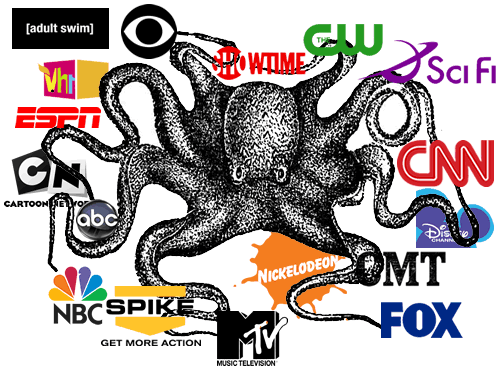
  1. The owners of the bulk of news and entertainment makers and distributors devolve into a VERY small group of companies–a monopoly of sorts–that are controlled by 20 to 30 so Billionaires, that make ALL the decisions on what/who gets reported and not reported, filmed and not filmed, bullied and not bullied, even elected and not elected, etc. (Please see the list of companies below.)

  2. The content of news and movie/TV entertainment is extremely curated and molded. Why? Because the goal no longer is to keep news and entertainment separated. It is unnecessary since there is no external moral code to dictate what is right and wrong, good and bad, virtuous or vice. Today, those considerations are dictated by who is in charge of controlling the minute by minute, hour by hour, daily, weekly, monthly and yearly newsfeed, entertainment and educational narrative in order to make . . . MONEY!

Manufactured news must be carefully designed to inform and entertain in order to fuel the “attention to profit” revenue engine.

Buying this?

If so, may I suggest to never forget the money trail IS the only thing that matters at the end of the month/quarter. It seems, today, that there are NO altruistic incentives in news or entertainment. Either the media outlet makes a profit or they’re gone. And, the political, moral views of those who control the content are intricately tied into the “profitable” audience that pays for a certain point of view or worldview to win or triumph.

And the battle lines are drawn very profitably by these news and entertainment media manufacturing monopolists.

The funny thing is that unless we are willing to see behind the curtains (there are multiple layers of curtains) there is a assembly line or “value chain” that narrows down ideas, slants perspectives, and cherry-picks management teams to promote, or hold to, a certain bias, then we are most unwittingly duped no matter what political or moral side we’re on. We’ll argue until we’re toxically bloated that we’re right, but there’s ALWAYS another story behind the story behind the story that may undo our “I’m right and you’re wrong” arguments.

Consider this:  All those thousands of TV channels we thought represented diversity and fairness, uh, no. . .

What I’m going to share is quite eye-opening (at least I think so). All we hear about is how horrible Rupert Murdoch and Fox News are, but let’s look at the top companies (unranked) that own 90% of the media (including News Corporation aka Rupert). It seems fair to me that any and all could read through this and be able to conclude that there’s more to the “facts” than we’re being told when it comes to who/what controls what we see, hear, and read every day in news and entertainment. And, all of which, today, in my opinion, are manufactured one and the same:

  1. Comcast ($55 billion…ish) owns or has it’s hands in . . .ready?

NBCUniversal; twenty-four television stations and the NBC television network; Telemundo; USA Network; SyFy; CNBC; MSNBC; Bravo; Oxygen; Chiller; CNBC World; E!; the Golf Channel; Sleuth; mun2; Universal HD; VERSUS; Style; G4; Comcast SportsNet (Philadelphia), Comcast SportsNet Mid-Atlantic (Baltimore/Washington, D.C.), Cable Sports Southeast, Comcast SportsNet Chicago, MountainWest Sports Network, Comcast SportsNet California (Sacramento), Comcast SportsNet New England (Boston), Comcast SportsNet Northwest (Portland, Ore.), Comcast Sports Southwest (Houston), Comcast SportsNet Bay Area (San Francisco), New England Cable News (Boston), Comcast Network Philadelphia, Comcast Network Mid-Atlantic (Baltimore/Washington, D.C.); the Weather Channel (25 percent stake); A&E (16 percent stake); the History Channel (16 percent stake); the Biography Channel (16 percent stake); Lifetime (16 percent stake); the Crime and Investigation Channel (16 percent stake); Pittsburgh Cable News Channel (30 percent stake); FEARnet (31 percent stake); PBS KIDS Sprout (40 percent stake); TV One (34 percent stake); Houston Regional Sports Network (23 percent stake); SportsNet New York (8 percent stake).

They also own: Comcast Interactive Media; Plaxo; Universal Studios Hollywood; Wet ‘n Wild theme park; Universal Studios Florida; Universal Islands of Adventure; Philadelphia 76ers; Philadelphia Flyers; Wells Fargo Center; iN DEMAND; Music Choice (12 percent stake); SpectrumCo (64 percent stake)

(Note: Some of these companies/titles have or will change hands, but no new hands have shown up during the past 20 years. It is still the same group of Billionaires and companies incestuously fleshing it out for profit.)

  1. Time Warner ($29 billion…ish)

One of the largest media holding company with the Warner Brothers Television Group; Warner Brothers Television; Warner Horizon Television; CW Network (50 percent stake); TBS; TNT; Cartoon Network; truTV; Turner Classic Movies; Boomerang; CNN; HLN; CNN International; HBO; Cinemax; Space; Infinito; I-Sat; Fashion TV; HTV; Much Music; Pogo; Mondo TV; Tabi; CNN Español the Cartoon Network, Adult Swim, Turner Classic Movies, CNN and Headline News and CW.

TW also owns: Warner Brothers (which owns DC Comics); Warner Brothers Pictures; New Line Cinema; Castle Rock; WB Studio Enterprises, Inc.; Telepictures Productions, Inc.; Warner Brothers Animation, Inc.; Warner Home Video; Warner Premiere; Warner Specialty Films, Inc.; Warner Brothers International Cinemas

  1. News Corporation (Rupert Murdoch) the largest market cap at $40 billion…ish

Owns Fox Broadcasting Company; television and cable networks such as Fox, Fox Business Channel, National Geographic and FX; print publications including the Wall Street Journal, the New York Post and TV Guide; the magazines Barron’s and SmartMoney; book publisher HarperCollins; film production companies 20th Century Fox, Fox Searchlight Pictures and Blue Sky Studios; numerous websites including MarketWatch.com; and non-media holdings including the National Rugby League. FX; SPEED; FUEL TV; Fox College Sports; Fox Movie Channel; Fox Soccer Channel; Fox Soccer Plus; Fox Pan American Sports; Fox Deportes; Big Ten Network; National Geographic U.S.; Nat Geo Adventure; Nat Geo Music; Nat Geo Wild; Fox International Channels; Utilisima; Fox Crime; NEXT; FOX History & Entertainment; the Voyage Channel; STAR World; STAR Movies; NGC Network International; NGC Network Latin America; LAPTV; Movie City; City Mix; City Family; City Stars; City Vibe; the Film Zone; Cinecanal; Elite Sports Limited; BabyTV; STAR India; STAR Taiwan; ESPN STAR Sports; Shine Limited. Hulu.com (32 percent minority share). HarperCollins Publishers; the New York Post; the Daily News; News International (the Times; the Sunday Times; the Sun); News Limited (146 newspapers in Australia); Dow Jones (Wall Street Journal, Barron’s, SmartMoney, Factiva, Dow Jones Newswires, Dow Jones Local Media, Dow Jones VentureSource). Fox Filmed Entertainment; Twentieth Century Fox Home Entertainment; Twentieth Century Fox Television; Twentieth Television; Fox Television Studios

  1. General Electric media holdings keep changing, but it sorta includes television networks NBC, MSNBC, NBC Sports, Telemundo, 27 television stations in the United States and many cable TV networks, including the History Channel, and Sci Fi Channel. It also owns the popular web-based TV website Hulu. (Sorta means they co-own a lot of things with other media behemoths)
  2. Disney ($55 Billion)

Owns the ABC television network; cable networks including ESPN, the Disney Channel, SOAPnet, A&E and Lifetime; 277 radio stations, music- and book-publishing companies; film-production companies Touchstone, Miramax and Walt Disney Pictures; Pixar Animation Studios; the cellular service Disney Mobile; and theme parks around the world. And, don’t forget they own Marvel Studios now!

They also own dozens of cable networks, and with the Disney channel they control millions of kids’ eyeballs — and moms’ pocket books.

  1. Viacom owns 160 cable channels including MTV, VH1, CMT, Logo, Nickelodeon, Comedy Central, TV Land, Spike TV, Tr3s, BET and CENTRIC

They also own numerous studio brands including Paramount Pictures, Insurge Pictures, MTV Films and Nickelodeon Movies.

  1. Bertelsmann ($20 billion…ish)

Owns Random House (with over 200 imprints in 15 countries, including the Ballantine Publishing Group, the Bantam Dell Publishing Group, Broadway, the Crown Publishing Group, the Doubleday Broadway Publishing Group, Pantheon, Random House U.K., Transworld, Sudamericana, C. Bertelsmann, Karl Blessing Verlag, Goldmann, Siedler Verlag, Wolf Jobst Siedler Verlag, Plaza & Janes (50 percent), Grijalbo Mondadori (50 percent), the Knopf Publishing Group, the RH Adult Trade Publishing Group, RH Audio, RH Children’s Books, RH Direct, Inc., the RH Information Group, RH International, RH Large Print, RH Value Publishing, and Waterbrook Press; Gruner + Jahr (285 print titles in 20 countries)

  1. We mustn’t forget Social Media:  Facebook with over 1.5 billion people who primarily get their news and entertainment from the Facebook feed they unwittingly created for themselves, warmly cocoons them within a pleasant “me, me, me” echo chamber.

(Source: Freepress)

Getting the picture (pun intended)?

I’m a Cinephile, lover of movies, and I’m going to share some stats on movie gross earnings vs product costs that provide some perspective on how what we see/hear is manufactured to keep our attention in order to make a profit.

This daily, highly-touted, data-set got underway in the mid ’70’s when the first summer Blockbuster hit the big screen. It went like this:

Da…dum

Daaaaa…dum

Da-dum, da-dum, da-dum (faster and faster)

It was Spielberg’s, Jaws, and it grossed $470 million on a production budget of $7 million; 67 times the initial investment.

Another more recent example:

Beauty and the Beast, the 2017 metaphor of love, sacrifice and atonement, grossed $900 million, but cost $300 million to make; a 300% return.

It used to be that we’d only hear about the “box office” earnings at certain times of the year, but now we hear about how big, or bad, the “weekend box office” will be, or was, year around. (WARNING: They’re just marketing to us, but now it’s designed to cocoon us in a world of news and entertainment that gets us hooked.)

Don’t believe me? Well, here is a stat to chew on:

Only 2 to 3% of us go to movies in theaters, but 90% of us watch them or TV series (we’ve heard about) in our own homes on DVD, network TV, or streamed TV.

Ready for some more hype that hooks us into the “manufactured media” consumption loop?

Manchester By The Sea grossed $72.6 million, but cost $8.5 million. (BTW, what in the heck was that Oscar-winning movie supposed to achieve???)

La La Land, an absolutely delightful look at the quest for fame and love, grossed $442 million worldwide on a production budget of $30 million.

Historical Hype? (no ranking order)

My Big Fat Greek Wedding (and who didn’t like this laugh fest?) is the highest gross earnings to cost movie: $369 million against $6 million.

Star Wars grossed $775 million against a $40 million budget.

Mrs. Doubtfire grossed $441 million against a $38 million budget.

Slumdog Millionaire grossed $378 million against a budget of $15 million.

There’s Something About Mary grossed $370 million against a $31 million budget

The Hangover grossed $467 million against a budget $36 million.

The Passion of Christ grossed $612 million against a budget of $35 million

The reality is that these movies, based on these numbers, are portrayed as making a profit at the Box Office.

They didn’t.

Movies, in MOST cases, only become profitable after they hit DVD and TV.

NOW, go back to that list of news and entertainment companies and note how many of them own the advertising networks, the movie studios, the news stations, and the TV networks and subscriber channels. And remember that without the TV outlets 2/3’s of their profits disappear.

See the cross-channel, total-immersion system?

Manufactured — end to end — news and entertainment designed to monopolize our eyes, ears, minds, hearts–and pocket books.

And the vast majority of it has NOTHING to do with facts or truth. Well, okay, the weather and sports seem to be based in truth most of the time (unless you think there’s a conspiracy in the NFL, NBA, MLB, NHL, MLS, etc. haha)

And on that sports analogy…from the Witches in Macbeth:

“Fair is foul and foul is fair.”

Sources: SLATE, Hollywood’s Profits Demystified; Freepress, Who Owns the Media?; CNBC, Entertainment, Most Profitable Movies of All Time

Curtis Rasmussen is a lover of great movies, great marketing, and people who don’t fit in. He practices reaching across the aisle to befriend people of the opposite persuasion, politics, or affiliations. Curtis is a marketing strategist and writer who lives in Dallas, Texas, with his wife, Amy, his dog Jag, and his youngest child of seven, Zach. 
ruBRICKS Part II – A Follow-Up Guest Post by Julie Swinehart

Blogging, writing, talking, being part of the conversation about what it means to be an educator in 2017, it’s all easier to do than to actually live it and breathe it and teach it. We can talk about theory, we can read our guiding texts, we can attend professional development conferences around the world, participate in twitter chats, and we can all talk the talk.

Walking the talk is the hardest part.

Theory doesn’t always meet practice. But we try. I try.

I recently wrote about the idea of rubrics – that they should serve more as a foundation than a weight or a wall pinning students in. That they should allow for creativity rather than limiting imagination.

One way that I have tried to allow for student voice and creativity is with the most important thing I can help my students learn.

The topic is the habits of a healthy reading life.

If my students learn to read literary nonfiction, classic novels, and short stories, it will be fantastic. But it’s fantastic only if they actually choose to read these texts on their own. Most importantly, they need to have a habit of reading, to discover the reader within themselves.

This winter I realized that I wasn’t sure that my students knew what the endgame was. So we talked about it. We talked about what it looks like to have a healthy reading life, and we brainstormed the attributes of a healthy reading life.

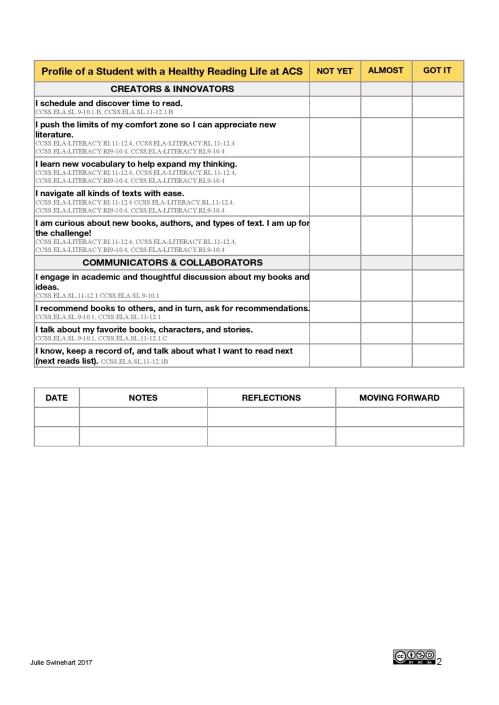
I did my best to organize their ideas into categories and indicators that made sense. I used our school’s student profile to help with the organization. The six categories are Respect and Integrity, Global Awareness, Reflective Thinking, Critical Thinking, Creators and Innovators, and Communicators and Collaborators.

From that, I created a rubric.

I think the process for this rubric can be re-created with other standards and goals, and can be simplified to a simple yes/no checklist, or a one point rubric for student self-reflection.

healthyreadinglifeprofile-page-001

healthyreadinglifeprofile-page-002

I know, I know… There are still problems with the document. But I think the point is that the ideas in it originally were theirs. The ideas belonged to the grade nine students.

While it’s an intimidating double-sided checklist in its entirety, it is easy to split into the six sections, which means we can examine just one section of a student’s reading life at a time. At that point it becomes smaller and quite manageable, and it’s not a brick wall of text.

I can print just one section at a time, and use it as an exit ticket or as a prompt for a reflective quick write. It doesn’t weigh students down when they simply examine only two or three indicators about their habits of reading.

The document still needs to be refined, and maybe all of the Common Core standards I’ve attached to the indicators aren’t exactly right; it’s still a draft, a work in progress. But this rubric, one that could be revised to a simple yes/no checklist, has been the catalyst for some seriously authentic and relevant conferences with my students.

Because I used their criteria and ideas, it’s not a brick wall, and it doesn’t confine my students between narrow rails. Instead, it’s a conversation starter, a tool for goal-setting while conferring, and it’s something that shows my students what to strive for.

It shows them what this readers workshop is all about: healthy reading lives.

I think the takeaway here is that teaching is always a work in progress, as is learning. Setting goals is important for students and for teachers. Creating authentic scoring guides continues to be one of my goals. This year I created one about the topic that I think is the most important of all – the healthy habits of reading. Next year we will tackle the habits of being a writer.

I will keep talking the talk – that means I am learning and reflecting on my practice. I will also keep trying to walk the talk, which I think has to include student input, because student voice is so essential to readers workshop, and is of course essential to building the habits of healthy reading lives of students.

We can’t weigh them down with our “help” – our rubrics and scoring guides should serve as foundations for growth, which is what I think this one does.
Nothing’s perfect, and we teachers have to be okay with that. We will continue to read, learn, discuss, and to walk the talk. Walking it and living it is a work in progress, and our students are better because we keep trying.


Julie has been teaching secondary language arts for eighteen years, spending the first fifteen in rural Central Oregon, and the last three in Amman, Jordan. A recent convert to the workshop model, she likes to blog about and share her learning and experience with others.

Follow her on twitter @SwinehartJulie

Follow her blog https://adventuresinhighschoolworkshop.wordpress.com/


iconCare to join the conversation? We’d love to add your voice! Please email guest post ideas to Lisadennibaum@gmail.com.

When rubrics are unintentional ruBRICKS – Guest Post by Julie Swinehart

My fourteen-year-old son surprises me with some of the things that come out of his mouth. I won’t repeat them all here (you’re welcome), because sometimes I’m astounded in a way that makes me laugh, but doesn’t necessarily make me think.

But the other day, he did make me think.

We were at the kitchen table. I was reading my students’ online readers notebooks while he was working on homework. Responsibly, he checked the rubric that accompanied the assignment he was working on, but by doing so, he seemed to get more frustrated instead of finding clarity.

I looked over at him, eyebrows raised in silent question. His response was, “This rubric is more of a brick than a help!” and he went on to explain that it felt like he was weighed down by the rubric rather than feeling like it provided guidance.

I immediately understood his comparison. Rubrics as bricks, hobbling students,

brick

“This rubric is more of a brick than a help!”

confining them to strict definitions and requirements, weighing them down instead of allowing them to soar.

Rubrics as brick walls on paper, wordy, unclear, sometimes too demanding, confining creativity instead of providing a place from which to let creativity flow.

I then turned my thoughts to my own teaching and to my own students. Have I unintentionally weighed down my students with a brick of a rubric?

Have the rubrics I’ve attached to my class assignments served as brick walls, stifling creativity, rather than as foundations that my students could use as guides for demonstrating what they know and what they can do?

Have the rubrics I’ve provided my students allowed them to show that they can exceed and see things in a way that I, as the teacher, never imagined?

During this school year my thinking and teaching style has evolved dramatically. I’ve moved away from a more traditional method, in which my students read the same texts, responded to the same writing prompts, learned the same skills, and turned in the same assignments, all at the same time. I used rubrics for most of their assessments, and while my students demonstrated their learning, I inadvertently didn’t really allow for a ton of creativity.

This year, my students are reading different texts, sometimes have individualize due dates that they have chosen, and are turning in very different assignments from each other.

This year, I’ve also still used some rubrics, and I think there are some good ones out there. But in response to the advice of one my colleagues, I started the slow move to a more holistic approach to scoring guides.

I still include the standards and learning targets for students on the task sheet, and I describe what an exemplary, middle, and poor quality product will look like, include, or omit. But I find that the more holistic scoring guide approach allows for the student choice and creativity that is essential in the workshop model.

It’s not as prescriptive as a rubric can be, and instead of being a document made of bricks that build walls around and confine creativity, it serves more as foundation of sorts, something students can build from, and also demonstrate their learning through their own creative ideas.

A holistic scoring guide does not provide all of the answers that a rubric holds. There aren’t as many words on the paper, which means that students have to think about what they are going to do, rather than simply tick some boxes of requirements in order to get the grade.

I’m enjoying the holistic scoring guide approach, and my students are still doing well with the change. They demonstrate creativity, they show their learning, and they allow their personalities to shine through in their work.

Workshop is about student choice, and I think some rubrics unintentionally stifle the choice that we are so eager and willing to provide.

I’m going to be careful from now one, doing my best to ensure that the assignments I give allow for student agency, and doing my best to ensure that my students aren’t weighed down or walled in by unnecessary bricks.


Julie has been teaching secondary language arts for eighteen years, spending the first fifteen in rural Central Oregon, and the last three in Amman, Jordan. A recent convert to the workshop model, she likes to blog about and share her learning and experience with others.

Follow her on twitter @SwinehartJulie

Follow her blog https://adventuresinhighschoolworkshop.wordpress.com/


iconCare to join the conversation? We’d love to add your voice! Please email guest post ideas to Lisadennibaum@gmail.com.

Where I’m From, With a Twist – Guest Post by Margaret Egler

During the process of writing this poem, I had to make many decisions. Since this poem is not about myself, it was difficult to include details and experiences. I interviewed Tommy and he told me where he came from and his passions in life. When Tommy began to tell me about his memories, I pictured them in my head and pulled out words/pictures I thought related to that particular story. I struggled at times trying to put my all into this poem; writing about someone is a lot more difficult than it looks. — Darcy

Writing in general is a lot more difficult than it looks.  And for juniors and seniors in high school, the stakes for writing well are high: college admission essays, standardized writing tests, artist statements, scientific reports —  not to mention, massive group texts!Screen Shot 2017-05-01 at 8.44.22 PM.png

As writing teacher, I’m constantly on the lookout for authentic writing experiences that give students new perspectives — on themselves and others. I’m also drawn to the economy and intentionality of poetry as a way to help students both appreciate the beauty of words and make them aware that each word needs to earn its place in a piece of writing.  For my first semester students, I’ve used Kelly Norman Ellis’ “Raised By Women” poem to launch writing college essays, finding that the short bursts of images and details provide insightful golden nuggets that can be then mined for longer personal narratives.

For my second semester students, I wanted to create a similar experience with poetry, but I didn’t have the imperative of a college essay to focus our attention.  I teach at a project-based high school where I share a team of students with a teacher in another discipline. This year, my biology partner and I wanted students to interview stakeholders for our inter-disciplinary project on protected environmental spaces.  

A new idea for poetry was born! Taking Willie Perdomo’s moving and gritty “Where I’m From” poem as a mentor text, I twisted the usual process of using this poem to write about one’s own home. Instead, I randomly partnered students up and asked them to write a first-person “Where I’m From” poem about the other person’s life.

This poem had its ups and downs. Something that worked well was that it was cool seeing a perspective of another person. Sometimes we get too stuck in our own world and just don’t put into perspective how someone’s life is. — Gabriel

Once they found their partner, I gave the pairs a series of questions based on Perdomo’s poem to prompt them into conversation and let them loose around the school to interview each other:

— Describe the landmarks around your home

— What tunes do you listen to?

— What are the “sayings” of your family?

— What languages are spoken in your home?

— What streets do you live on?

— Who are the people in your life?

When students returned from their interviews, they began drafting their poems, but with certain structures that guided the structure of their poems.  For example, they were required to write six stanzas and to use an anaphoric line at the beginning of each stanza (e.g., “Where I’m from…” or “If you knew…”). We also discussed the importance of  concrete and sensory details as tools to make writing interesting.  As they got underway, students soon realized they didn’t have enough information to fill out the stanzas or they lacked specific details. So back they went to their partners to delve more deeply into their lives.

Screen Shot 2017-05-01 at 8.10.36 PMFinally, I would like to thank Isaiah, Victoria, Andrew, and Margaret for helping me make this poem the best version possible. I would also like to give a big shout out to Holly for answering all of my annoying, pestering questions and letting me represent her through this poem. — Hannah

In the process, students underwent an intensive cycle of writing with prodding questions
from their peers and me about the content of their poems, (“Which specific beach do they go to?” What specific dish does their grandma make? What does it smell like?”). What emerged was a deep desire to respect and honor their partner’s emotional life through details and word choices.

I wrote to capture the way Betty would have written it. It was very difficult to write in the shoes of someone else and talk about their life. — Andrew

As a visual touch to their poems, students traced their own self-portraits and scanned them into photoshop to play around with color and line.  When they were done, their writing partner assembled the final poem using InDesign to create a visually compelling and creative piece of art.


Margaret Egler teaches 11th and 12th grade humanities at High Tech High in San Diego, CA. This project had many inspirational sources: Kelly Williams, Paul Lopez, Kalle Palmer, Jeremy Farson, Stephanie Lytle, Kaleb Rashad, and, post hoc, Chris Emdin (“Help students dig into themselves to mine their own brilliance”). Thanks especially to the Margarita Whales and Kalle Flowers for sharing their brilliance.


Screen Shot 2017-05-01 at 8.44.22 PMCare to join the conversation? We’d love to add your voice! Please email guest post ideas to Lisadennibaum@gmail.com.
A Lot of Dancing, Please — Guest Post by Billy Eastman

My beautiful and vivacious and pernicious six-year-old daughter frequents a Kindergarten class. She pretends her way through life these days; it’s a problem. But, a problem I refuse to address. Because, one day, that problem with vault her to success in something.

Violet uses a wheelchair. She doesn’t use it all the time. Most of the time, she traverses time and space with arm crutches — but at school, she uses her wheelchair so she doesn’t become fatigued from chasing other small people around.

The other day, an adult at Violet’s school admitted something to me:  she caused Violet to school hallwaytip over in her wheelchair in the hallway (Don’t worry, no daughters were harmed in the making of this short narrative). Really, Violet wasn’t hurt, but the big person was distraught.

I thanked her. For tipping my daughter’s wheelchair over in the hallway. You see, they were dancing. An educator was dancing with Violet in her wheelchair. They were spinning and twirling and tipping and falling. I prefer that.

So, this is what we should prefer in our classrooms as well:  possibilities, no limitations, risk and reward, fear and excitement, falling down, getting up and saying “I’m OK, and some dancing (at least on the page). A lot of dancing, please.

Random undiscernibly identifiable adult:  please continue to dance with Violet in the hallways.

Teachers:  dancing is better than walking in straight lines with bubbles in your mouth.

And, this clearly applies to reading, writing, and thinking—which is what I was writing about this whole time.

Billy Eastman is a curriculum coordinator for English Language Arts and World Languages and Culture in League City, TX. He enjoys talking with folks and finding ways to make smart ideas happen. Follow Billy on Twitter @thebillyeastman


Readers-Writers Workshop: But, Does It Work? by Jessica Paxson

1444217.pngThere are many things that are frustrating about teaching in general, and teaching SENIORS.  They are almost adults who think they are already adults, and say they want to be treated as such, but show that they want to be treated like a child for just a little while longer.

Me too, guys.  Adulting is HARD.

This makes for quite a few venting sessions during our PLC time.  A few days ago, a fellow teacher was venting about our Shakespeare unit.  She and another colleague noticed that the feedback from walkthroughs seemed to be nudging us more toward skill teaching rather than teaching whole works, especially in Shakespeare.  She then began to vent about college readiness.  They will HAVE TO read whole works in college.  If they’ve never read anything cover to cover, they will never survive in college!

Obviously I began to feel my Reading/Writing Workshop senses going off.  They’re much like Spidey Senses, but possibly even more dangerous.  These topics are often thin ice with teachers, and if you stomp too firmly into the conversation, you’ll break right through and be left to freeze on your own in the frigid pool of, WHAT DO YOU MEAN YOU DON’T WANT TO TEACH SHAKESPEARE?  In an effort to be heard and not misunderstood, I gingerly began to ask questions.

  • But will they need to have read THESE works, specifically?
  • Do you think non-liberal arts majors will encounter an entire work of Shakespeare during their time in college?
  • Do you think what they need to know is the stories of Shakespeare, or how to parse difficult language in general?

Then, finally, quietly, with the shaky hands I often get when I’m about to make something dear to me vulnerable to scrutiny, I asked: Have you ever read Book Love by Penny Kittle?

I’m surprised how many issues have come up this year during PLC to which the best solution would be, emphatically, give them choice on what they read; write more than you can grade; give them choice on what they can write; start where they are and gradually encourage more challenge and nuance.

I thought it would be helpful to write about some of the most Frequently Asked Questions I’ve received about RWW, even with less than a year under my belt of these practices.  Here they are, in no particular order:

  • How do you make sure your students are reading challenging books?
  • How do you test their knowledge?
  • What if they lose your books?
  • What do you mean, use mentor texts?  Are you talking about your Creative Writing class?
  • How do you grade if they all do different stuff?
  • Why are you making this so hard on yourself?

I have to tell you, I don’t know a definitive answer to all these questions.  By no stretch of the imagination have I perfected Reading/Writing Workshop.  (If you have, I’d love to borrow your brain for a day or five.)  

What I do know, is that it works.  

Don’t other things work, too?  Maybe, but it depends on your goal.  If the goal is for students to know facts about the plot of a handful of works, and know how to fill in a graphic organizer, sure.  


Now, if only I could figure out how to answer questions on the spot, we might be in business!

Jessica Paxson is an English IV and Creative Writing teacher in Arlington, TX. She also attempts to grapple with life and all of its complexities and hilarities over at www.jessicajordana.com. Follow her on Twitter or Instagram @jessjordana.

Mini-Lesson: The Simultaneity of Instants by Jessica Paxson

I am an anti-bandwagon jumper.  I tend to think if everyone is flocking toward something, I’m likely too cool for it.  I attribute that to my father, and I’ve discussed it before, but that’s beside the point.  

18143977.jpgThis year, as I made the venture to RWW, I knew I would need to read lots of buzz-worthy books, simply for the purpose of recommending.  Needless to say, I have slowly been broken down from my rigid ways. It’s because of this anti-bandwagon mentality that I am so late to the Anthony Doerr party, particularly in respect to All the Light We Cannot See.  

I decided to tackle this novel over Christmas break because of how many people had recommended it to me.  I was reluctant, but of course, Doerr drew me in with his utterly gorgeous descriptions of difficult cultural situations, the relationships between characters, and the flawless knitting together of a nonlinear storyline.  

So.  I’m a fan.  Likely at least two years after everyone else, but better late than never, right?

I was specifically intrigued by one of the chapters near to the end, entitled, “The Simultaneity of Instants.”  This chapter reminds me a little bit of the montages that occur at the end of a movie or a season finale in which all characters come together for a final appearance.  The only difference with this chapter is that they did not come together in the same place, but simply in the same moment.  I thought this would be a great way to coach my students through describing an important moment with a bird’s eye view.  

Objective: Students will describe an important moment in their life by also providing a glimpse into that same moment for other “characters” in their story.

Mentor Text

Lesson: First, students will begin by writing about a specific moment that they remember vividly.  You could draw from many different forms of pre-writing for writing about memories, but a few of my favorites are Writing Territories and Blueprinting.  After students decide on a moment that was important to them, we will do a quick draft for about 10 minutes.  

Next, students will begin to brainstorm about what other people might have been up to at that very moment.  The key here is for students not to get hung up on what actually happened, but to simply imagine that moment in time from a broader scope.  

Finally, after brainstorming simultaneous instants, it’s time to weave them together.  This is the moment in which Doerr’s writing as a mentor text will be unequivocally valuable.  Students will ask, “Well, how do I know which moment to put where?”  And I’ll say, “What does the mentor text do?”  And on and on until we have pieces of writing of which the students never imagined they would be capable.

I hope to do this along with my students, and I’m particularly imagining a Simultaneity of Instants starting with the Presidential Inauguration, or Obama’s farewell wave, or something to that effect.  I may already be blubbering as I brainstorm.  

Follow Up:

I teach Seniors and Creative Writers.  While my CWers will work on this concept soon, I may save this for my Seniors until their end of year MGPs (anyone want to help me plan?).  I think an imaginary Simultaneity of Instants as they walk across the stage.  This will end up resembling an end-of-an-era-montage, and I can’t wait to see what they come up with!

Jessica Paxson is an English IV and Creative Writing teacher in Arlington, TX. She also attempts to grapple with life and all of its complexities and hilarities over at www.jessicajordana.com. Follow her on Twitter or Instagram @jessjordana.